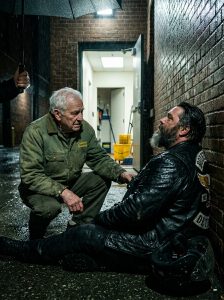
He was 72 years old, alone in a basement room, when he heard something in the alley. Most people would have kept walking. Walter Briggs didn’t. The man was enormous, leather jacket, biker patches, fever burning in his eyes, and he couldn’t stand up on his own. Walter didn’t ask questions. He just held out his hand.
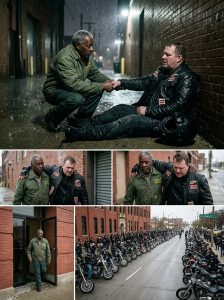
That was a Thursday night in November. Sunday morning, Walter stepped out his front door and stopped cold. Woodward Avenue was gone, replaced by something he had no words for. Chrome and steel and engines and people stretching farther than he could see in either direction. 1,800 of them, all there for one reason, all there because of one Thursday night, one open door, one old man who didn’t walk past.
What happened next, nobody in that building ever forgot. The rain had been falling on Detroit for 3 days straight. Not the gentle kind that taps on windows and lulls children to sleep. This was the November kind, the kind that comes in sideways off Lake Erie, and turns every street corner into a gray, wind-swept misery.
The kind of rain that makes old bones ache, and old men move slowly through the world, which was exactly what Walter Briggs was doing at 11:17 on a Thursday night when he heard the sound outside the service entrance of the Caldwell building. Walter had worked the overnight maintenance shift at the Caldwell for 11 years.
He knew every sound the building made, the groan of the boiler in sub-basement two, the particular squeal of the elevator on the fourth floor that he’d reported 17 times without anyone fixing it. The way the wind caught the corner of the roof and made a low, mournful whistle that he’d come to think of as the building talking to itself.
He knew those sounds the way a man knows the breathing of someone he’s slept beside for decades. This sound was different. It came from the alley that ran between the Caldwell and the parking structure next door. A rough, wet cough followed by something heavier, like dead weight settling against brick. Walter set down his mop, tilted his head, and listened.
The building’s lobby was empty at this hour, the night porter, Tucker Mills, dozing behind the front desk with his chin on his chest. The fluorescent lights buzzing their endless, tuneless song above the cracked linoleum floor. Walter pulled on his work coat, the green canvas one with Caldwell Building stitched in yellow on the chest pocket, and pushed through the service door into the alley.
The man was sitting with his back against the brick wall about 15 ft from the door. His long legs stretched out in front of him in the rain. He was wearing a black leather jacket so soaked it had turned the color of coal, and his helmet was on the ground beside him, the visor cracked down the middle. He was a big man, the kind of big that comes from decades of physical work rather than vanity, with a dark beard streaked with gray and arms like bridge cables.
On his back, even through the grime and rain, Walter could make out the patches of a motorcycle club, a winged skull, the words that said what it said, the bottom rocker naming Detroit as his chapter. Walter Briggs had lived in Detroit his entire 72 years. He’d grown up in Brightmoor when it still had working families in it, had spent 30 years on the line at the Chrysler Assembly Plant in Jefferson North until his knees gave out, had buried his wife Clara in 2009, and his best friend Otis in 2014, and had watched his daughter Donna move
to Phoenix and call less and less frequently as the years went on. He was not a man who frightened easily, and he was not a man who walked past someone sitting in the rain. He crouched down beside the man slowly because his knees weren’t what they used to be either and said, “Hey, you okay?” The man opened his eyes.
They were dark brown, those eyes, and glassy with something that wasn’t right. The particular shine of fever, Walter recognized it immediately, had seen it in Clara’s eyes in her last winter, had seen it in his own reflection once when the flu had laid him flat for a week back in ’08. “Fine,” the man said, and his voice was like gravel in a tin can.
“Just resting.” “You’re sitting in a November rainstorm in an alley,” Walter said. “That’s not resting. That’s something else.” The man tried to stand and couldn’t quite manage it. His arms pushed against the wall, his legs straightened partway, and then he came back down with a grunt that had pain in it. “Your bike break down?” Walter asked.
“Down the block.” A pause, a cough that shook his whole chest. “Was riding. Started feeling bad, made it this far.” Walter looked at him for a long moment. The rain was coming down harder now, drumming on the dumpster at the end of the alley, running in dark rivers along the gutter.
The man’s lips had a bluish tinge that Walter didn’t like at all. “Come on,” Walter said. “I don’t need I didn’t ask what you need,” Walter said with the particular firm patience of a man who has spent a lifetime doing things that needed doing without drama or discussion. “I’ve got a room in the basement. It’s warm and it’s dry.
You can sit in this alley if you want, but I’m not going to stand here and watch you do it.” He held out his hand. The man looked at it. Something moved across his face. Surprise, maybe, or something older and more complicated than surprise. He took the hand. Getting him up was a project. The man had to weigh 230, at least.
And Walter’s back made its feelings about this very clear. But they managed it together. The big man leaning heavily on Walter’s shoulder as they moved toward the service door. Up close, Walter could feel the heat coming off him through the wet leather. Genuine fever heat. The kind that made a body working hard against something it didn’t want inside it.
“Walter Briggs.” Walter said as he pushed the service door open. “Raymond Cole.” The man said after a moment, like he was deciding whether to offer it. “Raymond.” Walter said. “Let’s get you out of the rain.” Walter’s room in the basement of the Caldwell building was, by any objective measure, not much. It was a maintenance storage room that management had grudgingly converted into a living space for the overnight janitor position 11 years ago.
The conversion consisting primarily of removing some shelving, adding a cot with a metal frame, and installing a half bathroom that was really more of a closet with ambitions. There was a hot plate on a wooden shelf, a mini fridge that hummed louder than it had any right to, a 12-in television that Walter watched exactly 1 hour of news on each morning before his shift ended, and a folding chair that he used as a bedside table.
What the room had, and what mattered right now, was heat. The boiler room was on the other side of the wall, and the temperature in Walter’s room never dropped below 70° even in the worst of Michigan winters. He got Raymond Cole through the door and onto the cot, which protested under the man’s weight but held.
Raymond was breathing hard from the short walk, which told Walter more than anything else about the state he was in. Walter pulled off the man’s waterlogged boots, a task that required both hands and some determination, and went to his small closet for the spare blanket he kept folded on the top shelf. “You got a phone?” Walter asked, spreading the blanket over Raymond’s legs.
“Inside pocket.” Walter didn’t take it. “I mean, is there someone you should call? Someone who’d be looking for you?” Raymond was quiet for a moment. “I’ll handle it.” he said. “All right.” Walter went to the hot plate and put water on for the instant soup he kept in the cabinet, chicken noodle, the kind in the foam cup.
Not much, but it was hot and it was salt, and it was something. “You want to tell me what’s wrong with you, or you want to play it close?” A sound that might have been a short laugh. “Started 3 days ago. Thought it was just a cold. Kept riding.” “3 days.” Walter looked at him. “That’s not just a cold.” “No.” Raymond agreed. “Probably not.
” “You need a hospital.” “No hospitals.” Walter had heard that before, from men of a certain type, men who’d grown up learning that showing weakness was an invitation for something worse than weakness. He didn’t argue it. He brought the soup over and set it on the floor beside the cot, close enough for Raymond to reach.
“Drink that when you can. I’ve got aspirin in the bathroom.” He got the aspirin. He got a glass of water. He pulled the folding chair close and sat down, because his back was telling him that if he didn’t sit down soon, it was going to have a serious conversation with him about the choices he was making. Raymond took the aspirin.
He took the soup after a few minutes, drinking it slowly, both big hands wrapped around the cup. Some color came back into his face, not much, but some. “Why are you doing this?” Raymond asked. He wasn’t looking at Walter when he said it. He was looking at the water stain on the ceiling above the cot, a brown archipelago that Walter had looked at himself for 11 years without anyone ever doing anything about it.
“Because you were sitting in the rain,” Walter said. “Lots of people sit in the rain.” “And lots of people walk past them,” Walter said. “I don’t.” Raymond was quiet after that. After a while, Walter could tell from his breathing that he’d fallen asleep, which was probably the best thing for him. Walter turned the television on low, the late news, all bad, same as always, and sat in his chair and kept watch the way he had learned to do in the years since Clara died.
The quiet monitoring of the small hours that had become as natural to him as breathing. At some point before 3:00 in the morning, he fell asleep in the chair. He woke to Raymond Cole sitting on the edge of the cot, his phone in his hands, typing something with the careful deliberateness of a man who was still not entirely well, but was well enough to be thinking again.
Walter looked at the clock on his phone. 6:14 in the morning. The overnight shift ended at 7:00. Tucker Mills would be handing off to the day portero. Carl Hutchins would be coming in to open the management office, and the building would begin its daily transformation from quiet to busy. “How are you feeling?” Walter asked.
Raymond looked up. In the thin light from the bare bulb overhead, he looked better than he had. Not well, but better. The glassy fever shine in his eyes had dimmed somewhat and the color in his face was closer to normal. Better. He said. Still not right. But better. You need to see a doctor today. Raymond nodded slowly which Walter hadn’t expected.
I know. He said. I’m going to. He looked at Walter with an expression that was difficult to read. Direct, serious, something working behind it. You didn’t have to do this. I know that. Most people wouldn’t. I know that too. Walter said. Raymond Cole looked at him for another long moment and then he nodded once.
The way a man nods when he’s made a decision about something. He put his phone in his pocket, bent down to pull on his boots. Walter made instant coffee on the hot plate. The real kind, not the foam cup kind with the small stainless pot he kept for mornings. And poured two cups. They sat in the small room.
The old janitor and the big biker and drank their coffee while the building above them began to wake up. Footsteps and elevator sounds and the distant slam of doors filtering down through the ceiling. Raymond left at 6:50 moving better than he’d arrived but still carefully. At the service door he turned back. Walter Briggs. He said. Raymond Cole.
Walter said. Raymond nodded again. Then he walked out into the alley and Walter listened to his footsteps fade and then there was nothing but the rain which had finally slowed to something more like mist. Walter finished his coffee, gathered his cleaning supplies and went to start his rounds. The morning passed the way Thursday mornings usually did at the Caldwell building.
Walter mopped the lobby floor and wiped down the brass fixtures on the elevator doors and replaced the burned out bulb in the second-floor hallway that had been burned-out for 2 weeks. He was in the middle of cleaning the glass on the building directory when Carl Hutchins came out of the management office. Carl Hutchins was 43 years old, average height, with the soft assured bearing of a man who had never been wrong about anything in his own estimation.
He had managed the Caldwell building for 6 years and considered this a position of some consequence. He wore button-down shirts and khaki slacks and had opinions about the proper appearance of the building that he expressed frequently and with great confidence. “Briggs,” he said, stopping behind Walter. “Someone told me there was a motorcycle parked down the block all night.
You know anything about that?” Walter continued cleaning the glass. “No.” “Sheila Norwood on three said she thought she heard voices in the alley last night, around midnight.” “Building makes a lot of sounds at night,” Walter said. Hutchins looked at him with the look he always used. Not quite suspicious, not quite accusatory, but in the neighborhood of both.
“If someone was on property that shouldn’t have been, that’s a liability issue. You understand that?” “I understand it,” Walter said. Hutchins stood there another moment, then went back into his office. Walter finished the directory glass and moved on to the stairwell. In the afternoon, he saw Sheila Norwood waiting for the elevator, a woman of about 60 with careful hair and the particular alertness of someone who considers herself the unofficial record keeper of everything that happens in the building.
She looked at him with bright evaluating eyes as the elevator arrived. “Walter,” she said. “Quiet night?” “Quiet enough,” Walter said. She held the elevator door with one hand. I thought I heard something in the alley. A man’s voice. Wind does funny things, Walter said pleasantly, and she let the door go and the elevator took her up.
Walter went back to his rounds. He didn’t think much about Raymond Cole as the day went on. He hoped the man had gone to a doctor the way he’d said he would. He hoped the fever had broken. He thought, briefly, about the expression on Raymond’s face when Walter had held out his hand in the alley. That complicated thing that had moved across his features.
Surprise layered over something more guarded, more practiced in expecting nothing from the world. Walter had seen that expression before. He’d felt it himself, if he was honest, in the years after Clara died, when the world had seemed to be a place where people walked past each other in the rain with considerable efficiency. He mopped the basement hallway outside his room.
He restocked the supply closet. He ate a sandwich at 4:00 in the afternoon, sitting on the loading dock with his back against the wall, watching the Detroit sky turn the particular shade of pewter that meant more rain coming. He didn’t think about gratitude or recognition or what Raymond Cole might or might not do.
He had done what he’d done because a man was sick in an alley in the November rain, and that was all the reason there was. By the time he’d finished his shift and returned to his room for the night, he had mostly forgotten about it. What he did not know, in his small, warm room with its water-stained ceiling and its humming mini fridge and its 12-in television showing the late news, was that Raymond Cole had not forgotten about anything at all.
Friday went. Saturday went. Sunday morning arrived with cold clarity, the clouds finally breaking apart and the Detroit sky showing its November blue, pale, almost colorless, with a sun in it that gave light without warmth. Walter was up at 5:00 as he always was, making his coffee on the hot plate, watching the first segment of the news, pulling on his work coat with the Caldwell Building stitched on the chest.
He was in the lobby at 5:30, beginning the morning sweep, when Tucker Mills, who worked the overnight shift on weekends, came through the front door with an expression on his face that Walter had never seen there before. Tucker was 26, a broad-shouldered young man who played video games on his phone behind the front desk and occasionally helped Walter move heavy equipment without being asked, which Walter appreciated.
Tucker was not, generally, a man who looked unsettled. He looked unsettled now. “Walter,” Tucker said, “you need to come look at something.” “What is it?” “I don’t” Tucker stopped, started again. “You just need to come look.” Walter set down his broom and followed Tucker to the front door. Tucker pushed it open and held it, and Walter walked through and stood on the front steps of the Caldwell Building and looked out at Woodward Avenue.
The motorcycles stretched as far as he could see in both directions. They were parked in rows along both sides of the street, filling the parking lot of the Baptist church across the way, lining the side streets that fed into Woodward from the east and west. Hundreds of them, then more hundreds, and still more.
Big touring bikes and customs and everything in between, their chrome catching the thin morning sun. And beside the bikes, in groups and clusters, standing in the cold November air with their breath making small clouds, were the riders. Men and women both, most in leather and denim, patches on their backs and chests, a sea of them stretching down the block and around the corner and out of sight.
Walter stood on the steps and looked at this for a long time. At the front of the crowd, maybe 20 ft from the bottom of the steps, stood Raymond Cole. He was wearing a clean jacket and his beard was combed and he was standing straight, which told Walter the fever had broken. Beside him stood a man who was introduced to Walter shortly as Frank Delano, Raymond’s vice president, though that was not the word they used, a lean, weathered man in his 50s with silver hair and a calm that felt like authority.
Raymond walked up the steps. He stopped two steps below Walter so their eyes were level. “Raymond,” Walter said. “Walter,” Raymond said. Behind Raymond, the crowd had gone quiet. Not completely. There was still the tick and creak of cooling engines, the occasional murmur, but quiet enough that Walter could hear the wind moving down Woodward, cold off the river.
“I made some calls,” Raymond said. “Told some people what happened. They wanted to come.” Walter looked out at the street again. “All of them?” “More coming,” Raymond said without inflection. “Word traveled.” Walter was quiet for a moment. He was a man who had lived a quiet life, who had measured his importance in the cleanliness of floors and the proper functioning of boilers and the careful stewardship of a building that did not belong to him and never would.
He had not sought recognition for anything in 72 years. He was not entirely sure what to do with it now that it had arrived on Woodward Avenue in the form of a thousand motorcycles and what Frank Delano would later tell him was 1,800 riders, give or take, from chapters across Michigan, Ohio, Indiana, and Pennsylvania.
I just gave you a room, Walter said. You gave me more than that, Raymond said. Walter looked at him. Raymond Cole was not a man who said things he didn’t mean. Walter had understood that within 10 minutes of meeting him. There was no performance in his face now, no theater in the statement. It was just what it was.
I don’t know what to do with all this, Walter said honestly. Raymond almost smiled. You don’t have to do anything with it. We just wanted you to know. Carl Hutchins arrived at 8:15, which was early for a Sunday. He’d gotten a call, someone had called him. The phone had woken him up.
He’d come in because this was, he told Walter in the lobby with considerable agitation, an enormous liability issue. 1,800 people could not simply park on Woodward Avenue. There were permits required. There were regulations. He stopped when Raymond Cole stepped into the lobby behind Walter and looked at him with the particular look of a man who has run out of patience for small concerns.
Hutchins stopped talking. We’ll be out of here by noon, Raymond said. Not as a promise. As a fact. Hutchins left and made a phone call, and whatever conversation happened on the other end of that call resulted in him not coming back out of his office until 11:30, at which point most of the bikes were already gone.
Sheila Norwood came down in the elevator at 9:00 and stood in the lobby looking at what she could see through the front door glass with an expression that moved through several phases. Alarm, calculation, and then something that Walter suspected might have been awe, though she would never have described it that way.
Walter, she said turning to him, what on earth Old friend, Walter said. She looked at him with new eyes, the careful, reevaluating eyes of someone revising a file they thought they had closed, and said nothing more. They brought things. Walter hadn’t expected that, but they brought things. Not all of them, but many of them.
Bottles of fuel, which was a joke among themselves that Walter didn’t entirely follow, and food from a place they’d apparently arranged to have open early on a Sunday. Boxes of it, real food, the kind Walter didn’t buy for himself because the portions at the grocery store were sized for families, and he was one man in a basement room.
There was a card that had been signed, he understood later, by everyone present, though it was less a card than a piece of construction paper folded in half with signatures covering both sides in a density that made it hard to read any individual name. Frank Delano gave him an envelope that Raymond had asked him to give, and when Walter opened it later, alone in his room, he sat on the edge of his cot for a long time looking at what was inside.
He thought about calling Donna. He looked at the time in Phoenix, 2 hours earlier, she’d still be asleep, and decided to wait. He would call her later. He would tell her some of it, not all of it. He wasn’t sure yet how to tell the whole of it. He sat on his cot and looked at the water stain on the ceiling, his old familiar companion, the brown archipelago above his head, and thought about Clara, who had believed without reservation or qualification that kindness was its own reason and its own reward, that you didn’t help people
because of what it brought back to you, you helped people because they needed help and you were there. And that was the entire equation. She had been right about that. She had been right about most things. He missed her every day, though the missing had changed shape over the years, become less like a wound and more like a weight he’d learned to carry, and had, in some strange way, come to think of as company.
He put the envelope in the drawer of the small table beside his cot, the folding chair that served as a table, and went back to his rounds, because the building didn’t clean itself. He called Donna at noon. She answered on the third ring, which was better than usual. Phoenix was clear and warm, and she had been out for a walk, she said, and he could hear the openness of the desert in the background of her voice, the particular acoustics of a landscape with no walls.
“Dad,” she said, “everything okay?” “Everything’s fine,” he said. “I just wanted to call.” A pause. He could hear her settling somewhere, sitting down, making the shift from walking conversation to staying conversation. “Is something going on?” He looked through the small window of his room that gave onto the service alley.
The same alley where he’d found Raymond Cole sitting in the rain 6 days ago. The alley was empty now, just brick and wet pavement and the dumpster at the far end, ordinary and unremarkable and his. “I helped somebody last week,” he said. “Man was sick. I let him sleep in my room.” “What kind of man?” “The kind who needed somewhere to sleep,” Walter said.
Donna was quiet for a moment. He could feel her deciding how to respond, the careful calibration she did now, the way she managed a conversation with him, the way you’d manage something fragile. It hadn’t always been that way. He wasn’t sure exactly when it had started, whether it was Clara’s death or his retirement, or simply the natural drift of a daughter who had built a life far away, but there was a distance in it that had nothing to do with the miles between Michigan and Arizona.
“That was kind of you,” she said carefully. “He came back,” Walter said. “This morning brought about 1,800 of his friends.” The silence on the other end was complete and total. “I’m sorry,” Donna said. “Motorcycles,” Walter said. “Lined up the whole length of Woodward. I’ve never seen anything like it.” He paused.
“Clara would have liked it, I think. She would have found it funny.” “Dad.” Donna’s voice had changed. Something in it had shifted, the careful management falling away, replaced by something raw and more real. “Dad, are you serious?” “I’m serious. And you’re okay?” “I’m fine. Better than fine.” He thought about it.
“I just wanted you to know. I don’t know why, exactly. I just thought I wanted He heard her breathing on the other end, and then something that might have been a small laugh, and then a longer silence that felt different from the other silences, warmer, less careful. “Tell me the whole story,” Donna said, “from the beginning.
” So, Walter Briggs sat in his small, warm room in the basement of the Caldwell building in Detroit, Michigan, with the boiler murmuring through the wall, and the water stain on the ceiling above him, and the drawer beside him holding an envelope he’d think about later. And he told his daughter about the night it rained, and the man in the alley, and the hand he’d held out in the dark.
He talked for a long time. She listened in a way she hadn’t listened in years, and he could feel it through the phone, the genuine quality of it, the attention. When he finished, there was a silence, and then she said, “I’m coming to visit, Dad, in December. I’m going to book it today.” He hadn’t known how much he’d needed to hear that until she said it.
“That would be good,” he said, and his voice came out slightly rougher than he’d intended. “I’d like that.” After they hung up, he sat for a moment longer. Then he got up, put on his coat, and went back to work. The weeks after were quiet, mostly, the way his life was quiet, the steady rhythm of rounds and maintenance requests, and the building’s small mechanical crises that he handled one at a time with the calm precision he’d developed over a decade of overnight shifts.
Hutchins didn’t bring up the Sunday morning again, though Walter noticed him looking at him differently in the hallways, with a reassessment in his eyes that Walter found faintly amusing. Sheila Norwood brought him a plate of cookies one afternoon, oatmeal raisin wrapped in cellophane with a bow, which she left at the service desk without much explanation.
Just a brief nod when she passed him in the lobby that seemed to contain several things it couldn’t quite say out loud. Tucker Mills asked him one overnight shift what it had been like, and Walter told him a version of it, the clean lines of it, the rain, the alley, the room, the man, the morning. And Tucker listened with the focused attention of someone filing something carefully away.
“You weren’t scared?” Tucker asked. “I mean, a guy like that, those patches.” “Scared of what?” Walter said genuinely. “He was sick. Sick people aren’t scary.” Tucker thought about this for a while. “I think most people would have been scared,” he said finally. “Most people would have walked past, Walter said.
Doesn’t mean they’re bad people, just means they weren’t thinking about it. Tucker nodded slowly. What do you think about when you see somebody like that? Somebody who needs help? Walter considered the question seriously, the way he’d learned to consider things. Without hurry. Without performance. Just looking at it straight.
I think about what it costs me. He said. And what it costs them. And then I think about Clara, who would have already been halfway across the alley by the time I finished thinking about it. Tucker smiled. Who’s Clara? My wife, Walter said. She died 15 years ago. He picked up his mop. She would have liked today.
She liked when things turned out right. Raymond Cole came back in December alone on a Saturday afternoon when the first real snow of the season was coming down on Detroit. Fat, soft flakes that turned the city briefly quiet and white and almost unrecognizable. Walter was on the loading dock taking a break when he heard the bike. Raymond parked on the street and came around to the service entrance and Walter let him in and they sat in the small room the way they’d sat two months ago.
Though this time both of them had chairs and neither of them was sick or wet or uncertain about anything in particular. Raymond had seen a doctor. The pneumonia, that’s what it had been. Walking pneumonia that he’d pushed through until it became something more serious was fully resolved. He’d taken antibiotics for two weeks and rested, which he described as the hardest part, with a wry dryness that Walter appreciated.
They talked for an hour. Not about the Sunday morning on Woodward, not directly. They talked about Detroit, which Raymond had lived in his whole life, too, though a very different Detroit than Walter’s. They talked about the plant closures and what they’d done to the east side, about the river in winter, about what the city felt like from a motorcycle at 3:00 in the morning when the streets were empty and the lights were all green and it belonged to nobody and everybody at the same time.
Raymond brought something from the back of his jacket, a photograph printed on good paper, laminated. It showed the length of Woodward Avenue from a vantage point that must have been a second or third-floor window. Someone had thought to document it and you could see the motorcycles stretching both directions as far as the image showed, the density of them, the sheer number, and in the foreground the steps of the Caldwell building with two figures on them, one old and one large, the old one looking out at the street with an
expression that Walter didn’t quite recognize on his own face. He looked like a man who had been surprised by the world. He looked, Walter thought, a little like Clara in the last photograph he had of her, a picture from 2007, 2 years before she died, taken in the backyard of the house in Brightmoor on a summer afternoon when she’d looked up from her garden and straight at the camera with that expression she had, that particular light in it, as if the world had just shown her something it kept mostly hidden and she
was deciding whether to tell anyone. He kept the photograph. He put it on the small shelf beside his hot plate where he could see it from the cot and it joined the water stain and the humming fridge and the boiler sound through the wall as one of the fixed points of his small, particular world.
Donna came on December 19th and stayed through Christmas. She slept on an air mattress in the room. There wasn’t space for much else, which she seemed unbothered by in a way she might not have been 10 years ago. They watched the news on the 12-in television and ate at the diner on Woodward that Walter liked and walked through the Detroit streets in the winter dark.
The city doing what it always did in December, pulling in its edges and burning its lights against the cold. On Christmas Eve, Donna asked to see the photograph. Walter showed it to her, the laminated image, the length of Woodward, the two figures on the steps. She held it for a long time, tilting it to catch the light. “That’s you,” she said.
“That’s me,” he agreed. “You look surprised.” “I was surprised.” She handed it back and looked at him with an expression that was new, or maybe not new, maybe just one he hadn’t seen in a long time, the way she used to look at him when she was young, before distance and the ordinary drift of things had placed so many miles and so many unspoken adjustments between them.
“Mom would have loved this story,” she said. “I know,” Walter said. “She would have told it to everyone she ever met.” “I know that, too.” Donna smiled, a real one, the kind that reached her eyes. “She would have been out there with a tray of sandwiches.” Walter laughed. It came out of him fully and genuinely, the way laughter had before Clara died, the unmanaged kind.
“She absolutely would have,” he said. “She would have been out there in 5 minutes flat with enough food for all of them, and she would have known every single one of their names by noon.” They sat with that for a while, with Clara’s presence in the room, which was how it worked, how it had always worked. She showed up in the spaces where she was relevant, and you let her in, and it was fine. It was more than fine.
“I’m going to come more often,” Donna said, not as a resolution or a promise made in the holiday air, just as a statement of fact, the way Raymond Cole stated facts. “I should have been coming more. I’m sorry I didn’t.” “You don’t have to apologize,” Walter said. “I want to,” she said. “So, let me.” He nodded. “All right,” he said.
“I accept it.” Outside, the Detroit winter was doing its thing. The wind off the river, and the snow on the streets, and the particular sound of the city in the cold, which Walter had listened to for 72 years, and still found in its way like coming home. The boiler murmured through the wall. The fridge hummed its tuneless hum.
The photograph stood on the shelf beside the hot plate. The two figures on the steps. The motorcycle stretching as far as the camera could see. Walter Briggs sat in his small, warm room, and felt, without drama or ceremony or any particular event to occasion it, that something had shifted in his life.
Not changed entirely, because the life was what it was, and he was what he was. The janitor of the Caldwell Building. The widower of Clara Briggs. The man in the small room in the basement who kept things clean and working and in order. But shifted the way a weight shifts when someone puts their hand beneath it without being asked.
Lighter by exactly that much. He had given a sick man a room out of the rain. That was all he had done. That was the beginning and the end of it. What had come back was not a transaction, not a payment, not a reward dispensed by a fair universe in recognition of good behavior. It was something else. Something that Clara had known and tried to tell him and that he was still at 72 in the slow process of understanding.
When you open a door for someone in the dark, you let the light out as much as you let them in. You don’t choose that. It just happens. It is the nature of doors and light and the darkness of alleys in November rain. Walter Briggs thought about that for a while. Then he got up and made coffee because his daughter was here and it was Christmas Eve and some things, the good ones, were exactly that simple.