PART 2
I want to tell you who Earl Brennan was before he walked into my lobby.
Earl was born in 1966 in a town called Leadville, Colorado, up the Highway 24 from where he lives now. His father worked the mines until the Climax Mine shut down in 1981. His mother ran the day shift at a small diner on Harrison Avenue. He had one younger sister named Joyce who became a registered nurse and now lives in Pueblo, and one older brother named Wesley who went into the Marines in 1979 and came home in 1982 in a state from which he never fully returned. Wesley passed in 1989 of complications related to that state.
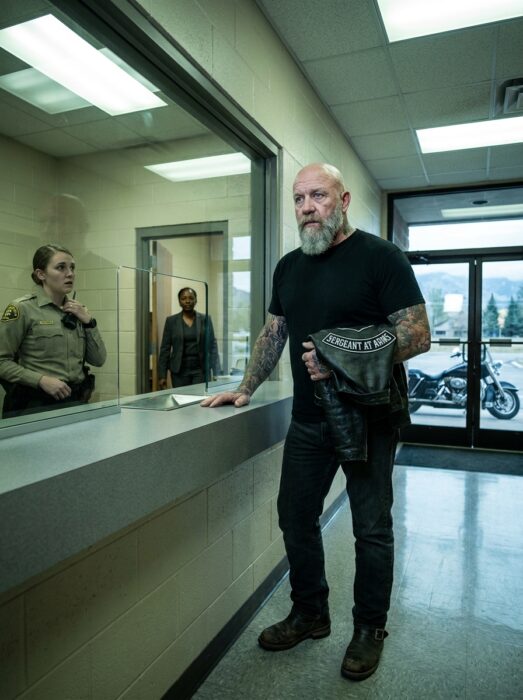
Earl was twenty-three when Wesley died.
He did eighteen months at Buena Vista at twenty-five for an assault charge connected to a man who had hurt Joyce. He came out at twenty-six. He met Marlene at twenty-seven at a diner off the I-70. He married her at twenty-eight.
He prospected for our local independent charter — they ride out of a clubhouse off Highway 6 in Eagle — he prospected in 1992 and earned his patch in May of 1993. He has been a patched brother for thirty-one years. He has been the charter’s Sergeant at Arms for eleven of those years.
In thirty-one years as a patched brother in Eagle County, Earl Brennan has been arrested exactly zero times. He has been pulled over exactly twice — once for a faulty tail light in 2009, and once for a routine sobriety checkpoint in 2014, where he blew zero point zero zero.
He has a son.
His son’s name is Kyle.
Kyle Brennan was born in November of 2001. He is twenty-three years old as I write this. He is, by everybody’s account who knew him as a boy, a quiet kid who liked motorcycles the way his father liked motorcycles, who got his learner’s permit at fifteen and his full driver’s license at sixteen and a half, and who, in the fall of 2017, was a sixteen-year-old junior at Battle Mountain High School in Edwards.
On the night of December 11th, 2017, Kyle Brennan was sixteen years old.
He had had his full driver’s license for four months.
He was not allowed to drive after eleven p.m. under the Colorado graduated driver’s license law for drivers under eighteen without a parent in the vehicle, except for school events or work.
He was not, on the night of December 11th, 2017, driving with a parent in the vehicle.
He was driving his father’s 2014 GMC Sierra pickup truck, which his father had told him explicitly that morning he could not borrow without permission.
He had taken it without permission at ten-fifteen p.m. on a school night.
He had been driving home from a girl’s house in Avon — a girl his father did not know he was seeing — on Highway 6 at eleven thirty-eight p.m., in light snow, with one broken headlight on the driver’s side that he had not told his father about because he had broken it backing into a fence post at the high school parking lot the previous Tuesday.
He had taken the curve too fast.
He had crossed the centerline.
He had hit Linda Aguirre’s Camry at fifty-eight miles an hour.
He had not stopped.
He had driven the Sierra home in shock with the airbags deployed and the front end folded in and the steering pulling hard left. He had pulled into his father’s driveway in Edwards at twelve-oh-six a.m.
His father had been waiting up.
PART 3
What Earl Brennan did in the next four hours of December 11th and 12th, 2017, is the part of this story Earl told me from the other side of the interview-room table at five oh-seven p.m. on a Wednesday afternoon in October of 2024, with his folded leather cut on the table between us, with the recorder running, with his Miranda rights waived.
He said:
“Detective. I want to tell you exactly what happened. I want it on the record. I don’t want you to interrupt me. I am gonna tell it once.”
I said: “Mr. Brennan. Go ahead.”
He told me.
He said his son Kyle had come into the kitchen of their house in Edwards at twelve-oh-eight a.m. on the morning of December 12th, 2017. He said his son had been crying. He said his son had told him what had happened on Highway 6 outside Avon. He said his son had then asked him what they were going to do.
Earl said he sat his son down at the kitchen table.
He said he poured his son a glass of water.
He said he made his son tell the story three times — every detail, every minute, every road sign — until Earl was certain his son was telling him the truth.
He said when his son was done, Earl had gotten up from the kitchen table, gone out to the driveway, looked at the Sierra, walked back into the kitchen, and said to his sixteen-year-old son:
“Kyle. You are going to drive my Harley to the clubhouse right now. You are going to wake up Mason and Bishop and Reverend and tell them I asked you to come. You are going to tell them I told you to bring my bike. You are going to sleep on the couch at the clubhouse tonight. Tomorrow morning at six I am gonna come pick you up. We are gonna talk about this for the rest of our lives. But not tonight.”
Kyle had said: “Dad. Aren’t we calling the police?”
Earl had said: “Kyle. I’m gonna handle this. Go.”
Kyle had gone.
After Kyle had left the driveway on Earl’s Harley — a sixteen-year-old, in light snow, on a 2008 Road King with a hundred and ninety thousand miles on it, with no motorcycle endorsement — after Kyle had left, Earl had spent the next three hours, by his own confession in the interview room, doing the following:
He had backed his Sierra into his closed garage. He had shut the garage door. He had taken every piece of broken headlight glass from the front of the truck and put it in a plastic grocery bag. He had pulled the dented fender off with a pry bar. He had replaced the dented fender with a fender he had ordered for a different repair job two months earlier that was sitting in his shop and that he had not yet installed. He had repainted the new fender with the touch-up paint he kept for the Sierra. He had replaced the broken headlight assembly with the spare he kept in his shop.
By six in the morning, the Sierra in Earl’s garage had no evidence on it that connected it to the crash on Route 6 outside Avon.
By seven in the morning, Earl had driven the Sierra to a self-storage lot in Glenwood Springs and parked it in a unit he had rented two years earlier under a different name, where the truck would sit for fourteen months until Earl sold it at a private auction in Wyoming under a forged title.
By eight in the morning, Earl had ridden the spare bike he kept at the clubhouse — a 1999 Heritage Softail — back to his house in Edwards with Kyle on the back.
By nine in the morning, Earl had walked into the kitchen, made breakfast for his sixteen-year-old son, and looked across the kitchen table at the boy he had raised and said:
“Kyle. You drove home at twelve-oh-six this morning in my truck. You hit a car. You did not stop. If we report what you did, you go to juvenile and then you go to adult and you do seven to twelve years and the rest of your life is over. I am fifty-one years old. I have done time. I know how to do time. I am gonna take this off you. But you are going to live with what happened for the rest of your life. You are not gonna ride a motorcycle until you are twenty-five. You are not gonna take a drink of alcohol until you are twenty-one. You are gonna go to college and you are gonna become whatever you can become and you are gonna make this woman’s family proud that you lived.”
He paused.
He said, in the interview room, with the recorder running:
“Detective. I covered for my son. I took the wrong oath. I am here today to take it back.”
PART 4
I want to tell you what was different about Earl Brennan when he walked into my lobby on October 9th, 2024.
He was, by my read across the table from him in interview room two, a man who had been waiting seven years to do the thing he was doing.
His hands were not shaking. His voice was not shaking. He was not crying. Bikers in his charter do not cry easily in front of strangers. He looked across the table at me with the same flat steady look he had given me at three prior interviews in 2018 — except the look this time was not lying.
The look this time was finished.
I asked him why now.
I asked him why, after seven years of letting the case go cold, after seven years of the woman he had let his son hit walking with a permanent limp and three rounds of reconstructive surgery on her left hip, after seven years of letting Linda Aguirre’s family go to bed at night not knowing who had hit her — why now.
Earl Brennan looked at his folded cut on the table.
He picked it up.
He turned the inside front panel toward me.
There was a small embroidered patch on the inside of his cut, over his heart, that I had not seen at any of the three prior interviews because the cut had been on the back of his chair at the kitchen table in his house in Edwards and I had not asked to see it.
The patch was a small square of pale gray cotton.
It said, in white embroidered thread:
L.A. 12-11-17.
Earl said: “Detective. I made that the week after the accident. I’ve worn it for seven years. Marlene sewed it.”
He said: “My wife told me, the night I covered for my son, that we were not going to be able to live with what we did unless we did the right thing eventually. She told me to wait until Kyle was twenty-three. She told me to wait until he had a college degree. She told me to wait until I was certain he was a man who could survive knowing what we had done for him.”
He said: “Kyle graduated from Colorado State in May. He starts a Master’s program at the University of Wyoming in two months. Marlene and I decided last night I was coming in. Kyle does not know I am here. I am asking you, Detective, to give me at least until tonight to call him myself.”
He laid the cut flat on the table.
He looked at me.
He said: “Detective. The accident was my son’s. I am not lying about that part right now. I am telling you, on the record, that I covered it up. I did the cover-up. I obstructed your investigation. I lied to you three times. I sold the truck under a forged title. The charges for what I did are mine to face. I am not asking you to leave Kyle out of it. I am asking you, please, to let me call him before you do.”
I let him call Kyle.
I gave him my desk phone. I gave him my office. I closed the door behind him.
I stood in the hallway outside the door for eleven minutes while Earl Brennan called his twenty-three-year-old son and told him what he was doing.
When Earl opened the door at five forty-six p.m., his face was wet.
He handed me the phone.
He said: “Detective. Kyle is on his way down. He is driving from Fort Collins. He will be here by eleven tonight. He will turn himself in to you when he arrives. He asked me to wait so we could do it together.”
I said: “Mr. Brennan. I can hold you in custody until then.”
He said: “Detective. I’d be obliged.”
PART 5
I want to back up to the patch.
The small gray cotton square sewn into the inside of Earl Brennan’s leather cut, over his heart, with the letters L.A. and the date 12-11-17 in white embroidered thread — that patch was the thing that broke this case open for me, internally, when Earl turned the cut over on the interview-room table.
It was not because of the patch itself.
It was because of what it told me about Marlene Brennan.
Marlene is fifty-five years old. She works as a unit clerk at Vail Health Hospital, which is the hospital where Linda Aguirre had been admitted for eleven days in December of 2017. Marlene had been on shift the night of December 11th, 2017. Marlene had checked Linda Aguirre into the ICU at one forty-seven a.m. on December 12th. Marlene had been one of the first faces Linda Aguirre’s husband Carlos had seen when he had arrived at the hospital at two-thirty in the morning to find out whether his wife was going to live.
Marlene had checked the paperwork.
Marlene had not, at that point in the morning, known that her husband’s Sierra had been the vehicle that had put Linda Aguirre into that ICU.
She found out at six a.m. when Earl came home with Kyle on the back of the Heritage Softail.
She found out from Earl himself at six fifteen, sitting at the kitchen table, after Earl told her everything.
She told Earl, by Earl’s own confession in the interview room and by Marlene’s own confirmation in her separate interview three days later, that she was not going to be able to face Linda Aguirre at the hospital nurses’ station every day for the next eleven days unless they did three things.
One. Earl had to wear a patch on the inside of his cut with the date and Linda Aguirre’s initials, where nobody outside the marriage would ever see it, for as long as the cover-up stood.
Two. Earl had to put the equivalent of his son’s full college tuition — once it was figured out, eventually — into an anonymous fund that they would, one day, somehow, find a way to give to Linda Aguirre’s family. They had been depositing money into a separate savings account since January of 2018. They had, by October of 2024, accumulated one hundred and seventeen thousand dollars in that account.
Three. The cover-up ended when Kyle was twenty-three and had a college degree in his hand and was a man Marlene could look at across her kitchen table and know was strong enough to survive what came next.
Kyle had graduated in May.
Earl had walked into my lobby in October.
The patch had been on the inside of his cut for two thousand five hundred and nineteen days.
PART 6
Kyle Brennan arrived at the Eagle County Sheriff’s substation at eleven oh-eight p.m. on a Wednesday night in October of 2024.
He walked through the front doors alone.
He walked up to Officer Stevens at the front desk.
He said: “Ma’am. My name is Kyle Brennan. My father called you earlier today. I’m here to turn myself in for the hit-and-run on Highway 6 outside Avon on December 11th, 2017. The driver of the Sierra that night was me. I was sixteen. I was not legally permitted to be driving. I had a broken headlight. I crossed the centerline. I struck Mrs. Aguirre’s vehicle. I did not stop. I have lived with this every day for seven years.”
He set a single piece of folded notebook paper on the front counter.
It was a written statement he had typed on the four-hour drive from Fort Collins, printed at a Kinko’s in Silverthorne, signed in pen with his own name.
He was twenty-three years old.
I came up from the holding area where his father was sitting.
I brought father and son into the same interview room. I sat down across from them. I read Kyle his Miranda rights. He waived counsel. I started the recording at eleven thirty-one p.m.
What happened in the next three hours and forty-five minutes is not mine to give you in detail.
I will tell you the result.
The Eagle County District Attorney charged Earl Brennan with obstruction of justice, evidence tampering, and accessory after the fact to vehicular assault. The DA charged Kyle Brennan with vehicular assault, leaving the scene of an accident, and operating a motor vehicle in violation of the Colorado graduated driver’s license law.
Both men pleaded guilty.
Earl was sentenced to four years in Colorado state correctional facility in March of 2025. He is currently serving that sentence at the Crowley County Correctional Facility outside Olney Springs. He is fifty-nine years old. He is six months in. He is expected to be released, with good behavior, in early 2028.
Kyle was sentenced to two years, suspended, with eight years of supervised probation, four hundred hours of community service, and a permanent revocation of his Colorado driver’s license. He is, by court order, required to write a letter to Linda Aguirre once a year for the next ten years.
Linda Aguirre received an anonymous gift in November of 2024 of one hundred and seventeen thousand dollars from a savings account at a credit union in Glenwood Springs. The credit union, by court instruction, did not disclose the source.
Linda Aguirre cashed the check.
She used it to pay off the medical debt from her seven months of rehabilitation.
She does not know, to this day, that the check came from the family of the boy who hit her.
She does not need to know.
PART 7
Marlene Brennan kept Earl’s cut.
She has it hanging on a wooden peg by the back door of their house in Edwards. The peg has been empty for the seven years Earl was free to wear the cut. The peg is full now, for the next two and a half years until Earl gets out.
She washes the leather once a month with saddle soap.
She does not touch the inside patch.
The small gray square of cotton with the white thread reading L.A. 12-11-17 still sits, sewn against the inside front panel, over the heart of an empty leather cut on a peg by a back door in a small house in Edwards, Colorado.
Marlene drives forty miles east on the I-70 every other Saturday to visit her husband at Crowley County.
She tells him about the garden.
She tells him about Kyle.
She tells him about the cut hanging on the peg.
She does not tell him about Linda Aguirre, because Earl asked her not to.
He told her, the last morning they were in their kitchen together before he turned himself in: “Marlene. From the day I walk into that lobby, Linda Aguirre is somebody we don’t talk about anymore. We did what we did. We are paying for it. She doesn’t owe us a thought. She gets to have her life back, however that looks now.”
Marlene has kept that bargain for fourteen months.
The patch stays sewn in.
The cut stays on the peg.
He took the wrong oath. He took it back.
Follow the page for more stories about the bikers America thinks it knows — and the patches they sew into the inside of their cuts that nobody outside the marriage will ever see.