Part 1: The Emergency Key My Father Never Returned
Three weeks after my husband died, my father used an emergency key to enter my house and told me I had until sunset to leave. I was eight months pregnant, still sleeping with Lucas’s T-shirt beneath my pillow, and too stunned to understand why Charles believed he could remove me from the home I owned.
His twenty-four-year-old wife, Courtney, followed him into the kitchen carrying a folder and two empty suitcases. She looked around as though she were already deciding which of my belongings should remain.
“Lucas left debts,” Charles said. “The house must be sold before the bank takes it.”
I pushed the folder back across the table. “My name is on the deed, and no bank has contacted me.”
Lucas had purchased the house before our marriage, then added me to the deed two years later. We had lived there together for six years, and every room still contained some ordinary reminder that he was not coming back.
Charles dismissed the deed as something Lucas had probably changed without understanding the consequences. He said he would handle the estate because pregnancy and grief had made me incapable of making financial decisions.
“You don’t represent me,” I replied. “Take Courtney and leave.”
His expression hardened. Charles had always treated disagreement as disrespect, especially when it came from me.
I stood carefully with one hand beneath my stomach. When I moved toward the hallway to retrieve my phone, he grabbed my arm.
“Sit down and sign the authorization.”
I pulled away. His other hand caught in my hair, and he forced me toward the front door while Courtney accused me of turning a business problem into family drama.
“Dad, stop. You’re hurting me.”
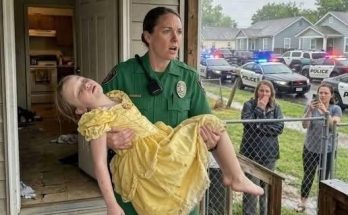
He opened the door and pushed me onto the porch. I landed on one knee and managed to protect my stomach, but a sudden rush of fluid soaked through my clothes.
For one second, none of us spoke. Courtney’s amused expression disappeared as I looked down and realized what had happened.
“My water broke.”
Charles tossed my handbag beside me. “Then call an ambulance, but you are not coming back inside until you calm down.”
I called 911 immediately. The dispatcher kept me seated against the porch railing, asked about contractions and bleeding, and sent both an ambulance and police.
Only after help was on the way did I call Samantha Vance, the attorney who had handled Lucas’s estate planning. She answered on the second ring.
“My father is inside my house,” I said. “He tried to make me sign something, forced me outside, and now he’s searching Lucas’s desk.”
Samantha’s voice became sharply controlled. She told me not to reenter the house, confront Charles, or touch any documents he offered.
“Victoria, Charles contacted my office yesterday. He claimed you had appointed him to act for you.”
“I never did.”
“I know. Your estate documents require confirmation directly from you.”
Through the open doorway, I watched Charles remove papers from Lucas’s desk. Courtney stood beside him, reading over his shoulder while the emergency folder remained on the kitchen table.
Samantha explained that Lucas had placed his investment accounts and company shares in a trust for me and our child. The house was separately protected by the recorded deed, and Charles had no authority to sell it.
A siren sounded at the end of the street. Inside, Charles’s phone began ringing.
He answered with the same confidence he had shown when he entered my home. Then his shoulders stiffened.
“What do you mean the transfer has been suspended?” he demanded.
Courtney moved closer, but Charles turned away from her. He listened for several seconds before looking through the doorway at me.
Samantha heard him through my phone. “That will be the bank’s fraud department. I asked them to preserve everything connected to his request.”
“What request?”
She paused before answering. “This morning, Charles attempted to use a power of attorney to gain control of Lucas’s business shares and the estate account.”
The ambulance stopped in front of the house as two police officers approached the porch. Charles remained frozen beside Lucas’s desk, clutching his phone.
Samantha’s final sentence followed me as the paramedics lifted me onto a stretcher.
“The document carries your signature, Victoria—and according to its date, you signed it the day after your husband died.”
Part 2: The Call That Stopped the Transfer
The paramedics focused on my pregnancy while the officers separated Charles and Courtney inside the house. My contractions had begun by the time the ambulance left the driveway.
One officer rode behind us after photographing the folder, Lucas’s disturbed desk, and the papers Charles had removed. He also collected the emergency key that had allowed my father to enter without permission.
At the hospital, doctors confirmed that my water had broken early. They monitored the baby while preparing me for the possibility that labor could progress quickly.
Samantha remained on the phone until a nurse asked me to put it away. Before ending the call, she said the bank had suspended every transaction connected to the disputed power of attorney.
Nothing had been transferred. The restriction simply prevented Charles from moving estate funds or exercising Lucas’s voting shares until the document could be verified.
My father called repeatedly while I was being examined. I did not answer, but his first voicemail described the confrontation as a misunderstanding.
“I was trying to protect the company,” he said. “Courtney became upset, you became emotional, and everything got out of control.”
He did not mention grabbing me, forcing me outside, or searching Lucas’s office. He also failed to explain why a document bearing my signature had been submitted without my knowledge.
Courtney left a separate message claiming she had believed Charles owned the house. She apologized for “laughing nervously” but insisted she had not understood that I was in labor.
I saved both messages for the police. Explaining their motives was not my responsibility while doctors were trying to protect my child.
Labor continued despite medication and monitoring. Shortly before midnight, my daughter was born five weeks early.
She weighed less than five pounds and needed help maintaining her temperature, but she was breathing without a ventilator. The neonatal team placed her in an incubator and told me her early signs were encouraging.
I named her Lucy, the name Lucas and I had chosen together. Seeing it written on the hospital card nearly broke me.
Grief and relief arrived at the same time. Lucas would never hold his daughter, yet the last decisions he made were now protecting the home where I hoped to raise her.
The following morning, Samantha came to the hospital with certified copies of the deed, trust documents, and business records. She waited until I returned from visiting Lucy before discussing them.
The house belonged to me through the recorded deed. Lucas’s investment accounts were held in trust for my benefit and Lucy’s, while his company shares passed to the trust under a voting arrangement requiring my authorization.
Charles had no automatic control over any of them. His role as Lucas’s former business partner did not give him authority over Lucas’s estate.
“What was he trying to do?” I asked.
Samantha explained that Baldwin-Gallagher Logistics was considering a sale to a larger transportation company. Charles supported the offer, but Lucas’s shares carried enough voting power to delay or block it.
The disputed power of attorney would have allowed Charles to vote those shares in my name. It also authorized limited access to the estate account, supposedly to pay business expenses.
“He told the bank you were medically unable to manage your affairs,” Samantha said. “He claimed you signed the document voluntarily after Lucas died.”
The timing made me feel ill. On the date beside my alleged signature, I had spent the entire day arranging Lucas’s funeral with Samantha and my sister-in-law.
Samantha already had emails, appointment records, and security footage from her office confirming my location. Charles’s story would have to survive evidence he apparently never considered.
A detective arrived later that afternoon to take my formal statement. He said Charles had been ordered to remain away from my home while the investigation continued.
The papers found in my kitchen included a proposed listing agreement for the house. They also contained a copy of the disputed power of attorney and instructions for transferring voting authority before the company’s next board meeting.
I examined the signature. It resembled mine from a distance, but the final letters curved in a way I had never written them.
Then I noticed the notary section. The document claimed I had appeared personally, shown identification, and signed in front of a licensed notary.
I had never met the woman whose seal appeared beneath my name.
Samantha turned the page and showed me the notary’s business address.
It was the same apartment Courtney had lived in before she married my father.

Part 3: The Signature That Wasn’t Mine
Courtney’s former apartment was now occupied by a woman named Melissa Grant, who had recently become a mobile notary. Public records showed that Melissa and Courtney had operated a small event-planning business together before Courtney married my father.
Samantha sent the document to the detective rather than contacting either woman. She also requested the notary journal, identification record, and payment information connected to the appointment.
The journal claimed Melissa met me at my house at ten on the morning after Lucas died. My doorbell camera showed no visitors during that hour.
At the time, I had been inside Samantha’s office reviewing funeral arrangements. Security footage showed me entering at nine fifteen and leaving shortly after noon.
The identification number written in Melissa’s journal belonged to my driver’s license, but I had not presented it. A photocopy of that license had been stored in Lucas’s business files for insurance purposes.
Charles had access to those files as the company’s co-founder. Courtney had apparently provided the connection to someone willing to notarize a signature without me present.
The detective cautioned me that the investigation would determine who created the signature and what each person knew. The evidence was serious, but responsibility would not be decided in a hospital room.
Samantha then explained why Charles had acted so quickly. Baldwin-Gallagher Logistics had received an acquisition offer several months before Lucas’s death.
Lucas opposed the sale because the buyer intended to close two regional facilities and eliminate hundreds of jobs. His shares gave him enough voting power to block approval.
After his death, those shares passed into the trust for Lucy and me. Charles could not vote them unless I authorized him or the trustee accepted that I was legally unable to act.
The false power of attorney attempted to solve both problems. It declared that grief and pregnancy had temporarily impaired my judgment, then appointed Charles to manage my property and business interests.
“He told the bank you were staying with him and had asked him to handle everything,” Samantha said. “That may explain why he tried to force you out before anyone verified your address.”
The house was not collateral for Lucas’s business debts, despite what Charles claimed. The proposed listing agreement would have directed the sale proceeds into an account Charles described as an estate-management fund.
No such fund existed in Lucas’s estate plan. The account number belonged to a business entity controlled by Charles.
I felt no satisfaction as the pieces connected. My father had not arrived because he misunderstood a complicated will; he had arrived expecting me to obey before I knew which questions to ask.
The police obtained footage from my doorbell camera. It showed Charles entering with the emergency key, Courtney carrying the empty suitcases, and both of them leaving the porch only after officers arrived.
The camera also recorded part of the confrontation. My voice could be heard telling Charles to stop, followed by Courtney saying I should sign the papers instead of acting helpless.
Courtney contacted the detective through an attorney later that day. She claimed Charles had told her I already agreed to move and that the suitcases were intended to help pack my clothing.
Her statement did not explain the notary connection. It also contradicted her voicemail, in which she said she believed Charles owned the house.
Meanwhile, the company postponed its board vote until ownership of Lucas’s shares could be confirmed. Charles sent other directors an email blaming the delay on my “temporary medical instability.”
Samantha preserved the email. My condition did not transfer my voting rights to him, and giving birth did not make me legally incompetent.
She obtained the proposed acquisition agreement that evening. Most shareholders would receive the same price per share, but Charles had negotiated a separate five-year consulting contract for himself.
The contract guaranteed him millions even if the buyer closed the facilities Lucas had fought to protect. It became effective only if the sale passed before the end of the month.
Then Samantha found a private email Lucas had sent Charles two weeks before the accident.
Lucas had written that if Charles ever tried to force the sale through his family, he would remove him from every position of trust he still held.
Charles replied with one sentence.
“If you won’t give me your vote, I’ll get it from Victoria when you’re gone.”
Part 4: What My Father Thought Grief Had Taken From Me
Charles came to the hospital two days after Lucy was born. Security stopped him in the lobby because the police report already identified him as the person who had forced me from my home.
He left flowers and a letter asking me to withdraw my statement. The letter described his actions as a desperate attempt to preserve the company Lucas and he had built together.
There was no apology for the forged document or the porch. Charles claimed he had only restrained me because grief had made me irrational.
I gave the letter to the detective. Samantha then helped me request a temporary protective order covering both the hospital and my home.
Courtney contacted me through her attorney. She admitted introducing Charles to Melissa but claimed she believed the power of attorney was legitimate.
According to Courtney, Charles already possessed a copy of my driver’s license and a page with my signature. He told Melissa that I was confined to bed, unable to appear personally, and had authorized them to complete the document without me.
Melissa gave investigators a different account. She said Courtney had assured her that I knew about the arrangement and that Charles needed the paperwork completed before Lucas’s funeral.
Their conflicting stories did not prove who copied my signature. They did establish that neither woman had watched me sign the document they notarized.
The bank permanently rejected Charles’s authority and preserved its records for investigators. The estate account remained in the trust, while the house stayed under my ownership.
The company’s board met without Charles controlling Lucas’s shares. Samantha attended as the trust’s attorney, and I participated remotely from a private room near the neonatal unit.
Charles argued that delaying the acquisition could destroy the business. He described me as an inexperienced widow allowing emotions to interfere with hundreds of employees’ futures.
I asked the board to review the special consulting agreement he had negotiated for himself. I also requested an independent evaluation of the acquisition’s effect on the two facilities scheduled to close.
The board postponed the sale. It also removed Charles from negotiations until the questions concerning the false power of attorney and his undisclosed compensation were resolved.
He did not lose the entire company in one afternoon. He lost the ability to make a decision affecting hundreds of families without scrutiny.
After the meeting, Charles left me a voicemail. He said Lucas had poisoned me against him and warned that I would regret destroying my daughter’s inheritance.
Lucy was sleeping inside her incubator while I listened. My father had tried to access her inheritance before she was even born, yet he still presented himself as her protector.
Courtney eventually admitted that the empty suitcases had been intended for Lucas’s documents and my personal belongings. Charles planned to move me into a short-term apartment after I signed the authorization.
She insisted she never expected him to become physical. Her surprise did not erase the fact that she entered my home prepared to help remove me from it.
The detective later confirmed that Melissa’s notary commission had been suspended pending review. The broader fraud investigation would take months, and Samantha warned me not to expect immediate answers.
I was discharged before Lucy. Returning home without her was painful, but the hospital assured me she needed only a little more time to feed and maintain her temperature.
The locks had been changed, the alarm code reset, and Charles’s emergency access formally revoked. Lucas’s desk remained disturbed, although the police had returned everything they collected.
Inside the bottom drawer, Samantha found an envelope bearing my name. It had been sealed months earlier and stored with Lucas’s copy of the acquisition proposal.
I opened it beside Lucy’s empty bassinet. The first page was not a legal document but a letter from my husband.
Lucas wrote that Charles had privately asked him to transfer voting control shortly before the accident. He refused because he believed my father cared more about the sale than the workers or our family.
Then I reached the final paragraph.
If anything happens to me, trust Samantha and trust yourself. Charles will mistake your grief for permission, but I have left you one record he does not know exists.
Attached to the letter was a printed list of payments from the company.
The largest had been sent to an account in Courtney’s name.

Part 5: The House He Could No Longer Enter
The payments to Courtney had been described as consulting fees for marketing work her company never performed. Lucas had questioned them before his death and preserved invoices, emails, and bank records for an independent audit.
Samantha gave the documents to the company’s attorneys and investigators. I did not confront Charles or Courtney because the records could speak more clearly than another family argument.
Courtney began cooperating after realizing Charles had exposed her to financial and legal consequences. She claimed he controlled the invoices and had told her the payments were legitimate compensation for helping with corporate events.
Investigators would decide how much she knew. Her cooperation did not erase the morning she entered my home with empty suitcases and watched my father try to remove me.
The company’s independent review found that Charles had approved payments to Courtney without disclosing their relationship to the board. He was removed from his executive position, although he retained whatever ownership rights had not been affected by the investigation.
The acquisition proposal was withdrawn after the buyer refused to proceed under increased scrutiny. The company appointed temporary leadership and kept both regional facilities open while exploring other options.
Charles did not lose everything overnight. Over the following months, he faced separate consequences for the incident at my home, the false power of attorney, and the undisclosed payments.
He eventually accepted responsibility for forcing me from the house and violating the protective order by continuing to contact me. The financial investigation lasted longer and was handled without requiring me to turn it into a public performance.
Melissa surrendered her notary commission while her role was reviewed. Courtney moved out of Charles’s house before Lucy came home from the hospital.
She sent one final apology saying she had trusted the wrong person and panicked when the plan collapsed. I did not respond.
An apology could acknowledge harm, but it could not require me to reopen a relationship. Forgiveness and access were not the same thing.
Lucy spent twelve days in the neonatal unit before she was strong enough to leave. Samantha drove me to the hospital, and a nurse helped secure my daughter into the car seat Lucas and I had chosen together.
Bringing her home without him was both joyful and unbearable. I carried her through the front door and showed her the rooms her father had prepared for our future.
The house remained mine, but it no longer felt like something I possessed only because documents had defeated my father. It was the place where Lucas and I had built an ordinary life before either of us knew how valuable ordinary days would become.
I placed his letter in a locked file with the deed and trust documents. His T-shirt remained beneath my pillow for several more months because grief did not end when the legal danger did.
The trust continued providing for Lucy and me under the terms Lucas established. I hired an independent financial adviser and learned enough about the company shares to make decisions without surrendering control to anyone who claimed expertise.
I also changed every lock, security code, and emergency-contact authorization. Charles’s relationship to me no longer gave him automatic entry into my house or my life.
Some relatives urged me to let him meet Lucy. They said becoming a grandfather might change him and that a baby should not inherit an adult conflict.
Lucy had inherited no conflict. She had inherited a mother responsible for keeping her safe.
I refused contact while the protective order remained active and made no promises about the future. Any relationship would require accountability Charles had not yet shown.
By spring, I could sit on the porch without remembering only the moment I had been forced onto it. I placed a small rocking chair near the railing and held Lucy there during quiet mornings.
One day, her hand closed around my finger while sunlight moved across the front steps. Inside, Lucas’s desk had been restored, the false documents were gone, and the door remained locked against anyone who confused family with ownership.
Charles had entered my home believing grief had made me helpless. He thought Lucas’s death created an opening through which he could take the house, the shares, and the authority to decide my future.
What he never understood was that Lucas had not protected me by building an empire or arranging instant revenge. He had protected me by recording ownership clearly, choosing trustworthy advisers, and leaving decisions where they belonged—with me.
The porch did not erase what happened there. It became the place where I held our daughter and began building a life no one else was entitled to control.