“WHOLE STORY:
She made her choice. I saw it in the way her shoulders dropped. She wasn’t choosing victory. She was choosing a cliff dive.
She walked back into the living room.
I heard my father’s voice. Sharp. Demanding. “”Where have you been?””
“”Getting breakfast,”” she said. Her voice was quiet, but steady. “”I don’t owe you an explanation for every moment of my life.””
The silence that followed was the loudest thing I had ever heard.
Then I heard a chair scrape against the floor. Footsteps. Heavy, angry footsteps. The front door opened.
“”You will regret this, Sonya. You will beg me to come back.””
The door slammed shut.
I stood frozen in the bedroom. My heart was a wild animal in my chest. I didn’t know if I should run or stay. Then her shadow filled the doorway again.
“”He’s gone,”” she whispered.
I walked out. The apartment felt different. Empty. The air was lighter.
She was standing in the middle of the living room. A paper bag with croissants hanging from her hand. She looked so small. So fragile. So brave.
“”I just lost everything,”” she said. “”My home. My security. My future.””
“”I know.””
“”I don’t even know if you love me,”” she said, her voice cracking. “”Or if I am just a weapon you used against him.””
I crossed the room. I took the paper bag from her hand and dropped it on the floor. I held her face in my hands.
“”I hated him first. That hate was a fire. It burned everything. But you… you are not a fire, Sonya. You are the peace after the storm. I am not choosing you to hurt him. I am choosing you because you are the only thing that makes sense in my broken life.””
She broke down. She collapsed into my chest. I held her for a long time.
“”We need to leave,”” I said. “”We can’t stay here.””
We packed one bag. It took ten minutes. We left the key on the kitchen counter. We didn’t look back.
We checked into a motel on the edge of town. It had faded floral wallpaper and a buzzing neon sign outside. It smelled like bleach and old cigarettes. It was the most beautiful place I had ever been.
Because she was there.
We spent two days in that room. We didn’t talk about the future. We didn’t talk about my family. We just existed. We held each other. We made love. We ate cheap takeout and watched bad television. She slept on my chest. I watched the rise and fall of her breathing.
I felt peace for the first time in my life.
Then the world caught up.
My phone buzzed. Then it exploded.
Messages from my mother. My uncle. My friends. Fabian.
“”Simon, I know what you did.””
“”You have lost your mind.””
“”How could you betray us like this?””
“”The whole town is talking.””
I ignored all of them. Until I heard my mother’s voice on a voicemail. She was crying.
“”Simon. You were supposed to save me from him. Instead, you ruined me. You took the woman who destroyed our family and made her your queen. I cannot look at you. I cannot speak to you. You are dead to me.””
The words hit me like a physical blow. I dropped the phone.
Sonya was sitting on the edge of the bed. She saw my face.
“”She hates me,”” I said.
“”She hates me too,”” Sonya said. She showed me her phone. A message from my father.
“”You are a liability. You chose a boy over a kingdom. You will have nothing.””
She looked at me. “”We have nothing now.””
“”We have each other,”” I said. “”We can build from that.””
We tried.
I got a job at a bookstore. It was humiliating. Customers I grew up with stared at me. They whispered. I ignored them.
Sonya became a waitress at a diner outside town. She walked three miles every morning before sunrise. She came home with sore feet and tired eyes.
We were paupers. But we were free.
Until she got sick.
It started small. She was tired all the time. Then she couldn’t keep food down. I came home from the bookstore one evening. The apartment was dark. I found her on the bathroom floor, crying.
“”I can’t stop throwing up,”” she said.
A cold dread settled in my stomach. “”Sonya… how long has this been going on?””
“”Two weeks.””
“”Have you missed your period?””
She looked up at me. Her eyes were wide. Terrified. Hopeful.
“”Yes.””
I sat down on the floor with her. I took her hand.
“”It’s from that night,”” she whispered. “”The night in the apartment.””
Our night. The night I held her. The night I loved her. The night we made a new life.
“”We are going to have a baby,”” I said.
“”I can’t have a baby,”” she cried. “”I am the woman who destroyed your family. I am carrying the grandchild of the man who used me. This baby has no future.””
“”Stop,”” I said. I lifted her chin. “”This baby is not a punishment. This baby is a second chance. Our second chance.””
“”How can you be so sure?””
“”Because I love you. And I will love this child. We will give this baby everything we never had. Unconditional love. A home built on truth, not lies.””
She placed my hand on her stomach. It was still flat. But I could feel it. Life. Our life.
“”Okay,”” she said. “”Okay.””
We didn’t tell anyone. We kept the secret close to our hearts. It was ours.
But secrets never stay hidden.
My uncle found out. He visited me at the bookstore.
“”The whole town knows,”” he said. “”Your father is furious.””
“”He is always furious about something.””
“”He wants to see you.””
“”I don’t want to see him.””
“”He is sick, Simon. His heart. The stress. The doctors say he needs to rest. He is asking for you.””
“”I have nothing to say to him.””
“”You have a child to say it for. Don’t let your pride rob your child of a grandfather.””
I went home. Not to the mansion. To the motel. I told Sonya everything.
“”Go,”” she said. “”See him.””
“”I can’t leave you.””
“”Simon, the longer you carry this anger, the heavier it gets. Put it down. Go see your father. Make peace. For our baby.””
She was always the wise one.
I went to the hospital.
My father looked small. The king had shrunk. He was lying in a thin hospital gown, surrounded by wires and tubes. His face was pale. His eyes were tired.
“”You came,”” he whispered.
“”Sonya made me.””
He smiled weakly. “”She always made me do the right thing. I was too proud to listen. You are not.””
“”Why did you want to see me?””
“”I want to fix the book.””
“”Love: True Utopia?””
“”It is a lie. I wrote a book about love, but I never understood it. I talked about fear and courage. I was writing about myself. But you… you and Sonya. You are the real story.””
“”What do you want from me?””
“”I want you to help me rewrite the ending. I want the world to know the truth. I want my legacy to be something real. Something honest.””
“”Why should I help you?””
He looked at me. For the first time, he looked like a father. Not a king.
“”Because I am proud of you. You found the love I was too scared to find. You are having a child. My grandchild. I want to be a part of that. I want to be worthy of that.””
I sat down. I cried.
We worked on the book together. Every day. In his hospital room. He told me about his own broken childhood. The pressure of being the perfect son. The emptiness of being admired but not loved.
I told him about Sonya. About the night I fell in love with her. About our baby.
“”I was going to give her a child,”” he said. “”But I was going to own her. You are giving her a life. There is a difference.””
“”I was so angry at you.””
“”Rightfully so. I hurt everyone. Your mother. You. Sonya. I was a hurricane of selfishness.””
“”But you are still my father.””
“”And you are still my son. The man I failed. And now the man I look up to.””
The day he was discharged, he came to our small apartment.
He stood outside the door. He didn’t look like a king. He looked like a grandfather.
Sonya opened the door.
For a long moment, no one spoke.
Then my father dropped to his knees.
“”Sonya,”” he said. “”I am sorry. For everything. For using you. For trying to trap you. For treating you like a possession. You are a woman of immense grace, and I was a blind, selfish fool.””
Sonya started to cry. “”I was so scared of you.””
“”You never have to be scared again. I am going to fix this. I am going to give you everything you deserve. A home. Security. A family.””
He bought us a small house. It was modest. It was ours.
He started taking my mother on dates. Not out of obligation. Out of genuine effort. She was slow to forgive. She was angry. But she started visiting us.
She held Sonya’s hand. She touched her belly.
“”This is a strange family,”” my mother said. “”But it is a family.””
The launch of “”Love: True Utopia”” was the biggest event in town.
Every influential person was there. My mother sat in the front row. My father stood on stage.
I was in the back, holding Sonya’s hand. She was nine months pregnant. She was glowing.
My father read the original text.
“”Just because humans can never cultivate this incomprehensible thing called love for a long time. Too much fear. Too little courage.””
He stopped. He looked at the audience.
“”I wrote those words. But I didn’t live them. I was too afraid. I didn’t have the courage. It took a woman who had every reason to hate me, and a son who had every reason to abandon me, to show me what love actually looks like.””
He asked us to come up.
The crowd parted. Sonya waddled down the aisle. I helped her up the stairs.
My father looked at us.
“”This is my son, Simon. And this is Sonya. The woman I almost destroyed. The woman he saved. They wrote the real story of this book. The story of finding love in the wreckage. Of choosing each other when the world screamed at them to stop.””
He turned to Sonya. He placed his hand on her belly.
“”And they are bringing a new life into this world. A life that will know nothing of the hate that came before. Only the love that awaits.””
The crowd was silent. Then someone started clapping.
Then everyone stood up.
My mother rose from her seat. She walked to the stage.
She took the microphone.
“”I fought this,”” she said. “”I screamed at God. I hated everyone. But I was blind.””
She took Sonya’s hand.
“”You gave me back a son I had lost. You are carrying my grandchild. You are the bravest woman I have ever met.””
She turned to my father.
“”And you… you are still a fool. But you are my fool. And I am ready to try again.””
The four of us stood on that stage. A broken family. Trying to be whole.
That night, Sonya went into labor.
I drove her to the hospital at a hundred miles an hour. She was screaming. I was screaming.
My parents met us at the emergency room.
“”We are here,”” my mother said. “”We are not going anywhere.””
It was the longest night of my life.
I held Sonya’s hand. I watched her fight. I watched her give everything.
“”It’s a boy,”” the doctor said.
I cut the cord.
The nurse placed him on Sonya’s chest. He was perfect. Ten fingers. Ten toes. A full head of dark hair.
“”He has your eyes,”” I said.
“”He has our courage,”” she whispered.
My parents came into the room.
My father looked at the baby. He didn’t say a word. He just cried.
My mother held him first. She touched his tiny face.
“”He is the beginning of something new,”” she said.
We named him Noah. A new beginning.
I held my son in my arms. I looked at Sonya, exhausted and beautiful. I looked at my parents, humbled and present.
We were not a perfect family.
We were not a utopia.
We were something better.
We were real.
—
TITLE:
In Ohio, a man met his father’s SECRET LOVER. He was ORDERED to ruin her reputation. One NIGHT changed everything. His life was GONE. No family. No future. JUST A SECRET. WHAT WOULD YOU DO?
FACEBOOK CAPTION:
I was born and raised in a picture-perfect town in Ohio. My father was the respected author everyone looked up to. My mother was his devoted wife, praying in silence while he broke her heart. I was the resentful son who saw the cracks in the facade.
Then SHE walked in. Sonya. The woman he called his “”secretary.”” The woman he introduced at family parties like she was nothing. The woman destroying my mother from the inside out.
He FORCED me to work with her on his new book. “”Love: True Utopia.”” Can you believe that? A book about love written by a man who had none.
I wanted to EXPOSE her. I wanted to catch her in a lie, to prove to everyone she was just a gold-digger. I watched her like a hawk.
But Sonya wasn’t what I expected. She was quiet. Gentle. And deeply, deeply broken.
One night, I pushed her too far. I talked about his cruelty, how he discards people. She completely collapsed. She sobbed in my arms, her whole body shaking. I held her. I comforted her. And in that moment, the lines blurred.
I stopped being the son seeking revenge.
I became a man falling in love.
The work sessions turned into late nights. The late nights turned into confessions. She told me about her lonely life. I told her about my hatred for him. We built a bridge between our pain.
My girlfriend Fabian confronted me. “”Who is she?”” she screamed. “”You are a stranger to me!”” I couldn’t answer her. My mother stopped talking to me. I didn’t care. I only cared about her.
The night I went to her apartment, I knew there was no turning back.
She opened the door. She was wearing a simple dress. Her hair was down. She looked terrified and hopeful at the same time.
I didn’t say a word. I just walked in and held her.
The night we spent together was a confession of everything we had denied. Her skin. Her tears. Her whispered “”I love you.”” I felt like the luckiest and the most cursed man alive.
I woke up as the sun streamed through her window. She was sleeping on my chest. I felt peace for the first time in years.
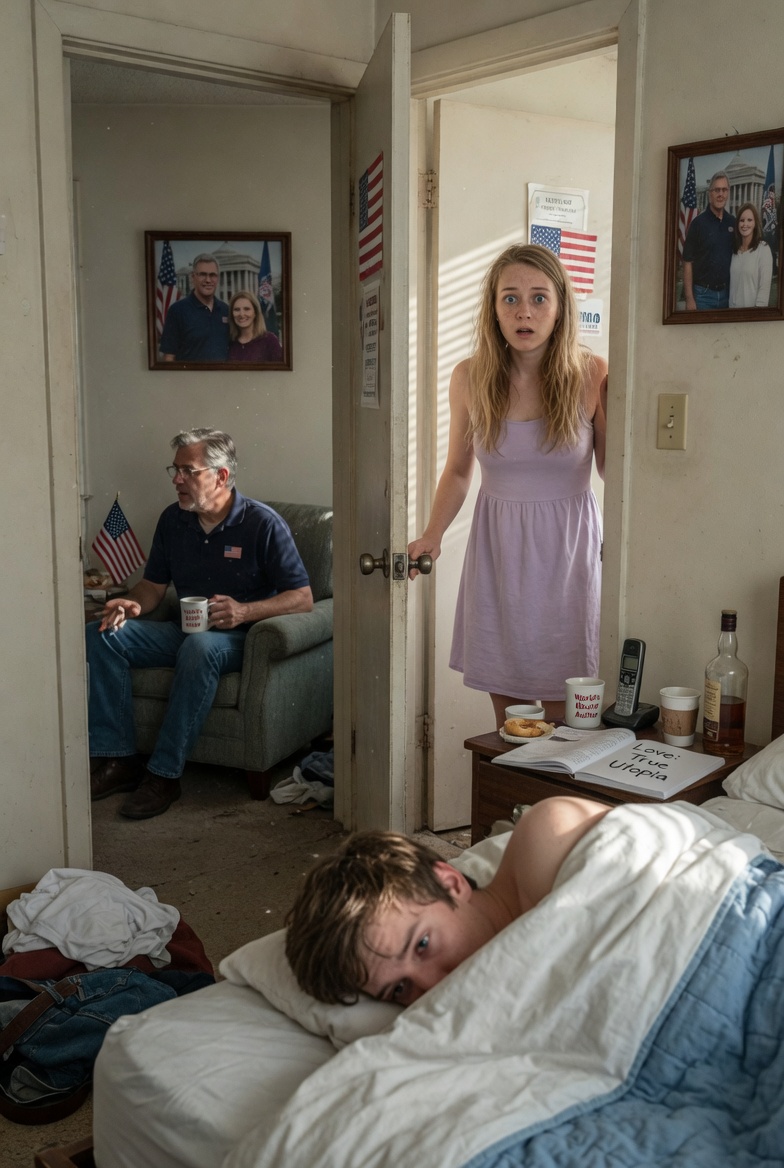
Then I heard the key in the lock.
My blood turned to ice.
“”Sonya!”” His voice. The king. My father.
I grabbed my clothes. No time. He was already inside.
I dove under the covers. I pulled them over my head like a terrified child.
I heard him sit down in the living room. I heard him pour a cup of coffee.
“”Sonya wants a child,”” I heard him say on the phone. “”That’s the only way to fix this mess.””
A child. He wanted to give her a child. My stomach turned.
He didn’t know I had already been there. I had already given her everything.
The front door opened again.
Sonya was back.
“”Where have you been?”” he demanded, his voice sharp.
“”Getting breakfast,”” she answered softly. I could hear the fear in her voice.
The bedroom door creaked.
Her shadow filled the doorway. She saw me.
Her eyes went wide. “”He’s here,”” I whispered.
She looked back at the living room. She looked back at me.
Her father. Or her lover.
She had to choose.
WHOLE STORY:
The peace of that moment didn’t last long. The real world has a way of intruding on your fairy tale.
The nurse came back. Her face was calm, but her eyes were careful.
“”Mr. and Mrs. Whitmore? The pediatrician wants to keep Noah in the NICU overnight for observation. His bilirubin is still climbing. Standard protocol, but we want to be thorough.””
Sonya’s hand tightened around mine. The joy in the room evaporated.
“”I want to stay with him,”” Sonya said.
“”You can visit any time. But you need rest. You just gave birth.””
“”I don’t care about rest. I care about my son.””
I looked at my parents. My mother was frozen. My father was already pulling out his phone.
“”I’ll call Dr. Harris,”” he said.
“”No,”” I said. The word came out harder than I intended. “”Put the phone away, Dad.””
“”But—””
“”No more calling people. No more fixing. He’s my son. We will handle this the way normal people handle it. We will wait. We will trust the doctors. And we will be here.””
My father stared at me. For a second, I saw the old flash of anger. Then it faded. He put the phone in his pocket.
“”Okay,”” he said quietly. “”I’ll get coffee.””
He walked out. My mother followed him, casting one long look back at Noah.
Alone, Sonya turned to me. “”You stood up to him.””
“”I had to. I’m a father now. I have to be the man I needed when I was a child.””
She reached for my face. “”I love you.””
“”I love you too. Let’s go see our son.””
The NICU was cold. It smelled of antiseptic and sterile gauze. Noah was lying in an open crib, a tiny mask over his eyes, a blue light shining down on him.
He looked so small. So fragile. My entire heart was lying in that bed.
Sonya reached in and touched his hand. He wrapped his tiny fingers around hers.
“”We are going to be okay,”” she whispered to him. “”Mommy and Daddy are right here.””
I stood behind her, my hand on her shoulder. We stayed like that for hours.
The next three days were a blur of exhaustion.
We barely slept. We took turns holding him during feedings. We learned his cries. His hunger cry. His tired cry. His “”I just want to be held”” cry.
The night we brought him home, we laid him in the bassinet beside our bed. We both just stared at him.
“”He’s real,”” Sonya whispered.
“”He is real.””
“”We made him.””
“”We did.””
She started to cry. Not sad tears. Happy tears. Terrified tears. The tears of a woman who had been told she was worthless, and now she held the proof that she was the opposite.
“”I don’t know how to be a mother,”” she said. “”I had no example.””
“”Neither did I,”” I said. “”But we have each other. And we have a stubborn love that refuses to quit.””
“”Promise me you won’t leave. Promise me that when it gets hard—and it will get hard—you won’t run.””
I took her face in my hands.
“”Sonya. I ran from my family. I ran from my reputation. I ran from my old life. But I will never run from you. You are not a destination. You are my home.””
She kissed me. It was deep. It was desperate. It was a vow.
The first month was brutal.
Sonya had postpartum depression. It came like a fog. She would sit in the rocking chair, crying for hours, holding Noah, apologizing to him for bringing him into a broken world.
I called my mother.
“”I need help,”” I said. “”Sonya is struggling. I don’t know what to do.””
There was a long silence on the line.
“”Your father’s mistress is struggling, and you are calling me to help her?””
“”Mom, she is the mother of your grandson. She is my wife. I am asking you as your son.””
Another long pause.
“”I’ll be there in an hour.””
She came. She didn’t say much. She took Noah from Sonya’s arms. She rocked him. She made soup. She cleaned the kitchen.
Sonya watched her, confused.
“”You don’t have to do this,”” Sonya whispered. “”You hate me.””
“”I hate what you represent,”” my mother said. “”But I love my son. And I love this baby. And I see you drowning. I have been drowning for thirty years. I know what it looks like.””
Sonya broke down. My mother sat beside her. She didn’t hold her. But she sat.
“”One day at a time,”” my mother said. “”That’s how you survive.””
Weeks turned into months.
Sonya got better. She started therapy. She painted again. She had been an artist before she got tangled in my father’s web. We hung her paintings on the walls of our small apartment.
My father came to visit every Sunday. He brought books for Noah. Board books. Picture books. Classics.
“”He will be a reader,”” my father said.
“”He will be whatever he wants to be,”” I replied.
My father looked at me. “”You are a good father, Simon. I wish I had been half the man you are.””
“”You are here now. That’s what matters.””
He nodded. He held Noah. He read him “”Goodnight Moon”” in a voice that cracked with emotion.
One afternoon, Fabian showed up at my bookstore.
She looked different. Softer. Older.
“”I heard you got married,”” she said.
“”I did.””
“”To her.””
“”Yes.””
“”And you have a son.”””
“””Yes.””
She stared at me for a long moment.
“”I was so angry at you,”” she said. “”I thought you threw everything away for a fling. For revenge.””
“”It wasn’t a fling.””
“”I know that now. I ran into your mother at the grocery store. She told me everything.””
“”She told you?””
“”She said you were happy. She said you saved your family.””
“”I didn’t save anyone. I just stopped lying to everyone. Including myself.””
Fabian smiled. It was a sad smile. A goodbye smile.
“”I’m getting married next month. To a good man. A simple man. I wanted you to know. I wanted you to be the first to know.””
“”Congratulations, Fabian. I hope he treats you well.””
“”He does. He doesn’t have any secrets.””
“”Good.””
She turned to leave. Then she stopped.
“”Simon?””
“”Yeah?””
“”Was it worth it? The pain? The chaos? The loss?””
I thought about Sonya. I thought about Noah sleeping on her chest. I thought about my father reading books in his shaky voice. I thought about my mother learning to forgive.
“”It was worth it,”” I said. “”It was worth every single second.””
She nodded. She walked out of the store.
I never saw her again.
On Noah’s first birthday, we gathered in our backyard.
It was October. The leaves were orange and red. The air was crisp. My mother brought a cake. My father set up a photo booth.
Noah took his first steps that day.
He let go of Sonya’s hands. He wobbled. He fell. He got up. He took three steps into my arms.
“”Da-da,”” he said.
I crumbled.
I held him. I cried. Sonya wrapped her arms around us both.
“”We did it,”” she whispered.
“”We did it,”” I said.
My parents watched from the porch. My father was crying. My mother was crying. They were holding hands.
That night, after Noah went to sleep, I sat in my study. I opened my laptop.
I had been writing a book. Not my father’s book. My own. It was called *After the Utopia*.
It was about a man who thought love was a perfect garden. A place without weeds. A place where nothing died.
But real love, I wrote, is not a garden. It is a forest. It is wild. It is messy. It has storms and droughts. It has fallen trees and hidden streams. It has animals that bite and flowers that bloom in the dark.
It is not safe. It is not perfect.
But it is alive.
I finished the manuscript that night.
Sonya came in. She was wearing my old sweater. Her hair was messy.
“”Are you writing?”” she asked.
“”I finished it.””
“”Can I read it?””
“”It’s for you.””
She sat on my lap. She read the first page. She read the last page.
Then she closed the laptop.
“”It’s beautiful,”” she said.
“”It’s the truth.””
“”The truth is beautiful.””
“”Not always. But this time, it is.””
She kissed me. “”I love you, Simon Whitmore.””
“”And I love you, Sonya Whitmore. The woman I was supposed to find. The woman I almost lost. The woman I will never, ever let go.””
We sat there in the dark, the computer humming, the baby sleeping, the world quiet.
We were not a perfect story.
We were a real one.
And that was enough.
The book came out the following spring.
It didn’t sell a million copies. It didn’t win awards. But people read it. They wrote letters. They said it helped them forgive their parents. It helped them love their spouses. It helped them feel less alone.
My father wrote me a letter.
“”I read your book,”” he wrote. “”I always thought I was teaching you. But I was wrong. You taught me. You taught me that the greatest act of courage is not to hide your mistakes. It is to live with them, openly, honestly, and still find a way to love. I am proud to be your father. I wish I had been better. But I am grateful you are my son.””
I still have that letter. It is framed in my study.
Noah is four now.
He has Sonya’s eyes and my stubbornness. He loves trains and painting and reading books with his grandfather.
My father is aging. His hands shake. His voice is quieter. But he reads to Noah every Sunday without fail.
My mother comes over on Wednesdays. She and Sonya plant tomatoes in the backyard. They are not best friends. They will never be best friends. But they have found a rhythm. A fragile, beautiful rhythm.
And Sonya?
She is luminous.
She paints in the mornings. She takes Noah to school. She laughs more. She cries less. The shadows that haunted her face when I first met her are gone.
She is free.
We are free.
One night, when Noah was asleep, we sat on the porch.
“”Do you ever regret it?”” she asked.
“”What?””
“”Choosing me. Leaving everything behind.””
I took her hand.
“”I regret nothing. I would lose everything a thousand times just to find you once.””
“”You don’t have to find me again. I’m not going anywhere.””
“”Good. Because neither am I.””
The stars were out. The air was cool. The world was quiet.
And for the first time in my life, I felt whole.
Completely whole.
No secrets. No lies. No masks.
Just Simon. Just Sonya. Just Noah.
The story didn’t end with a wedding. It didn’t end with a birth.
It ended with a choice.
A choice to stay.
A choice to forgive.
A choice to love.
Every single day.
And that, I have learned, is the only utopia that ever matters.
Six years passed. The rhythm of our lives became a quiet song. Noah started kindergarten, then first grade. He made friends. He drew pictures of our family—stick figures with big smiles, a yellow sun, a green house with a red door.
Every morning, Sonya packed his lunch. She tucked handwritten notes inside the napkin. “”You are brave.”” “”Mommy loves you.”” “”Draw a dragon today.””
I worked at the small bookstore we had bought with the advance from *After the Utopia*. It was called The Forest’s Edge. We had a reading corner with cushions, a coffee machine that hissed and groaned, and shelves I built myself. Sonya painted a mural on the back wall: a wild woodland with light streaming through the branches.
People came. Not many, but enough. They bought books. They sat and read. They sipped lattes and talked about their lives.
I thought the storm had passed.
Then the email arrived.
It was a Tuesday afternoon. The store was quiet. I was sorting returns at the counter. My phone buzzed with a notification.
**From: Rebecca Hartley**
**Subject: Your story. The truth.**
I didn’t open it right away. I stared at the name. Rebecca Hartley. I knew her byline. She was a journalist for a national magazine. She wrote long-form pieces about family secrets, scandals, redemption arcs. She had won awards.
My hand trembled as I tapped the screen.
*Dear Simon,*
*I am writing a feature about legacy, betrayal, and the cost of love. Your father’s book “”Love: True Utopia”” and the events surrounding your family have become a topic of renewed interest in certain literary circles. I have spoken to several people who know your story, and I would like to hear your side.*
*I understand you have a wife and child. I understand you have built a new life. I want to tell that part of the story—the aftermath, the healing. I believe the public deserves to know the full truth, not just the rumors.*
*I would love to sit down with you, and if she is willing, with Sonya as well. My schedule is flexible. I hope you will consider.*
*Sincerely,*
*Rebecca Hartley*
I read it three times.
The old anger stirred. The old fear. The feeling of being watched, judged, dissected.
I closed the phone and slipped it into my pocket.
That night, after Noah was asleep, I showed Sonya the email.
She was sitting at the kitchen table, sketching in her notebook. She had taken up drawing again—portraits of Noah, landscapes from memory. Her hands were stained with charcoal.
I placed the phone on the table in front of her.
She read it slowly.
Then she looked up. Her eyes were cautious. “”Are you going to respond?””
“”I don’t know. I wanted to talk to you first.””
She closed her notebook. “”I thought we were done with all that. I thought we had put it behind us.””
“”We have. But she’s not asking about the scandal. She’s asking about the healing. About our life now.””
“”Is there a difference? If she writes about us, people will dig up the past. They will call your father my *benefactor*, or worse. They will find photos of that apartment. They will find the old rumors about your mother’s breakdown. Noah will go to school and kids will whisper.””
Her voice shook, but she did not cry. She had stopped crying about the past years ago.
“”I know,”” I said. “”I had the same thought.””
“”Then why are you even considering it?””
I sat down across from her. I took her hand. The charcoal smudged against my skin.
“”Because I’m tired of hiding. We spent so many years hiding. From him. From the town. From ourselves. I think maybe the only way to truly bury the past is to let it be seen and still stand.””
She pulled her hand away. Not angry—thinking.
“”And Noah? How do we protect him from this?””
“”We tell him the truth. The version he can understand. We prepare him. And we trust that the love we have built is stronger than any article.””
She was quiet for a long time. The clock on the wall ticked. A car passed outside, its headlights sweeping across the window.
“”Call her,”” she said finally.
“”What?””
“”Call her. But I want to be there. I want to tell my own story, not have it told for me.””
I took a breath. “”Are you sure?””
“”No,”” she said, a small, sad smile on her lips. “”But when have I ever been sure about anything? And look where it got me.””
I kissed her forehead. “”Okay. I’ll call her tomorrow.””
The interview was set for a Saturday morning, at our home.
Rebecca Hartley arrived at nine o’clock sharp. She was in her late forties, with silver hair pulled back in a neat bun, glasses on a chain, and a leather notebook that looked well-worn. She wore a simple gray dress and flat shoes.
She stood at our door and looked at the house. The garden my mother had helped plant. The swing set in the backyard. The bicycles leaning against the fence.
“”Thank you for letting me come,”” she said.
“”Thank you for wanting to hear the truth,”” I said.
She smiled. “”That’s all I ever want.””
Sonya came to the door. She was wearing a soft blue sweater. Her hair was down. She looked calm, but I knew her well enough to see the tension in her shoulders.
Rebecca extended her hand. “”Sonya. Thank you.””
Sonya shook it. “”I don’t know if I’m ready. But I’m here.””
“”That’s all that matters.””
We sat in the living room. Rebecca set a small recorder on the coffee table. She asked for permission. We gave it.
She started with simple questions. How did we meet? Not the first time, but the real meeting—the night I held her in the study.
Sonya spoke first. “”I was so broken. I had been used for so long that I forgot I was human. He—Simon’s father—he made me feel like a possession. But Simon saw me. He saw the person I was hiding inside.””
I watched her as she spoke. Her voice was steady. She was no longer the fragile woman I had held in that motel room. She was strong.
Rebecca turned to me. “”Simon, what did you see in her?””
“”A mirror,”” I said. “”I saw someone who was also trapped by my father’s shadow. Someone who was hurting as much as I was. I didn’t plan to love her. It just happened. And once it happened, I couldn’t unsee it.””
We talked for two hours. About the book, about the night in the apartment, about the pregnancy, about the reconciliation.
Rebecca listened more than she wrote. She nodded. She asked follow-up questions that were gentle but probing.
At one point, Noah came downstairs. He was wearing his dinosaur pajamas. He rubbed his eyes.
“”Mommy, who is that?””
Sonya pulled him onto her lap. “”This is Rebecca. She’s a writer. She’s writing a story about our family.””
“”A story about us?”” His eyes went wide. “”Are we famous?””
I laughed. “”No, buddy. We’re just people who have a story worth telling.””
“”Does it have dragons?””
“”It has dragons of a different kind,”” Sonya said. “”But they were defeated.””
Rebecca smiled. “”Can I take a picture of your family? Just the three of you?””
Sonya looked at me. I nodded.
We posed on the front porch. Noah sat on my shoulders. Sonya leaned into me. The morning sun was behind us.
Rebecca snapped the photo.
“”I think that’s enough,”” she said. “”Thank you. Both of you. I will send you the draft before it goes to print.””
“”Will you write the truth?”” Sonya asked.
“”I will write what you told me. The truth as you lived it. That’s all I can promise.””
She left.
The next weeks were agony of waiting. Every time the phone rang, my stomach dropped.
Then the email came. Subject: **Draft for review.**
Sonya and I sat on the bed. Noah was at school. We opened it together.
The article was titled “”The Other Side of the Storm.””
It started with the night my father left the apartment. Then it wove backward and forward. It talked about the affair, but it also talked about the transformation. It included quotes from my father, who had spoken to Rebecca separately. He had said, “”I was a tyrant. They taught me what love actually means.””
My mother had also spoken to her. She said, “”I was angry for so long. But anger is a cage. Sonya and Simon broke my cage. I am free now, too.””
The article ended with a line from *After the Utopia*: *””The only utopia that matters is the one you build with your own hands, out of broken pieces, and call home.””*
We sat in silence after reading it.
“”She did it,”” Sonya whispered. “”She told our story.””
“”Without the poison.””
She leaned her head on my shoulder. “”I feel lighter.””
“”Me too.””
When the article was published, the reactions were mostly kind. Some called it a redemption story. Some said we were brave. A few old voices muttered about scandal. But mostly, people moved on.
Noah came home from school one day with a drawing. It was a picture of four people—a man, a woman, a boy, and a baby. The baby was floating above a stroller.
“”Who is the baby?”” I asked.
“”Me, when I was little,”” he said. “”And you are holding me. And Mommy is holding your hand. And Grandpa is reading a book.””
“”Where is Grandma?””
“”She’s picking flowers.””
He had drawn our world exactly as it was.
That evening, I sat on the porch alone. Sonya was inside, reading Noah a bedtime story. The sky was fading from orange to purple.
I thought about the night in the motel room. I thought about the fear. The hunger. The way her hand felt in mine.
I thought about the baby we made. The boy who drew dragons and believed in happy endings.
I thought about my father, still alive, still reading books with trembling hands.
I thought about my mother, laughing at the kitchen table with Sonya.
We had not escaped the past. We had woven it into our present. It was part of the fabric.
I heard footsteps. Sonya came out and sat beside me.
“”He’s asleep.””
“”Good.””
She leaned into me. “”What are you thinking about?””
“”How we got here. How impossible it all seemed.””
“”And now?””
I kissed her hair. “”Now it feels like the only possible outcome.””
She smiled. “”Do you think we’ll ever stop having to defend our love?””
“”No,”” I said. “”But I don’t think we need to. Love that needs defending is love that is alive. And our love is very, very alive.””
We sat in the dark, the porch light buzzing softly above us.
The world was quiet.
The family was whole.
And for the first time in my life, I believed that utopia was not a place you find.
It was a place you make.
And we had made ours.
Right here.
In Ohio.
In the wreckage.
In the light.”