His name is Sal. Real name’s Salvatore, but everyone’s called him Sal for fifty years. He’s fifty-five, rides out of Phoenix, Arizona, runs a small auto shop, and he is exactly the kind of man the world judges in half a second. Big. Bearded. Tattooed. Hard.
I’m going to tell you the whole thing — from the shop owner near the corner, from the mother herself, and from Sal, who never wanted any of this told and only allowed it because, he said, “if it gets one person to stop for somebody living in a car, then fine, tell it. Just don’t make me out to be a hero. I just couldn’t watch it happen twice.”
The little girl’s name is Rosa — fitting, the mother says, given the roses. She was ten. She and her mother were living in a car. And the reason a 250-pound biker cried over a single rose, and then changed two lives forever, goes back thirty years, to a different car, and a different desperate child.
But first, the corner.
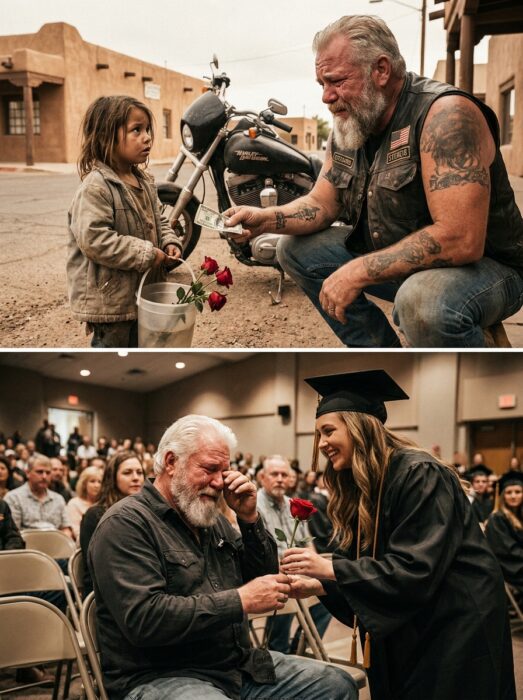
Rosa was ten years old and she was the breadwinner.
Her mother, Maria, had done everything right and gotten crushed anyway, the way it happens to people one missed paycheck from disaster. A job lost. Then the apartment. Then the slow terrible slide that ends with a mother and her daughter living in an old sedan in a Walmart parking lot, because at least Walmart wouldn’t tow you overnight, and at least there were bathrooms inside, and at least it felt a little safer than the open street.
And to eat, they sold roses. Maria would scrape together a few dollars when she could and buy cheap roses in bulk, and Rosa — bright, brave, ten-year-old Rosa — would stand on a street corner and sell them one at a time. A dollar here, two dollars there. Enough for a meal sometimes. A child doing a grown-up’s job, holding her little family together one rose at a time, while her mother tried desperately to find a way back up.
That’s who Sal pulled up to that afternoon. A little girl on a corner with a bucket of roses and the kind of tired, watchful eyes no ten-year-old should have.
He bought a rose. And he gave her a hundred-dollar bill. And when she tried to refuse it — too honest, too proud, insisting one rose wasn’t worth a hundred dollars — Sal broke down, because that little girl’s honesty over a flower, when she so obviously needed the money, was almost too much to bear.
“You deserve so much more than this,” he told her, crying.
And then, instead of just driving off feeling good about himself, Sal did the thing that mattered. He crouched down and he talked to her. Really talked. Asked about her life. And Rosa, who was a good kid and didn’t know to be guarded with a crying man who’d just been so kind, told him the truth. That she lived with her mom. In a car. That her mom was sick. Really sick. That she didn’t know what to do.
Sal asked if he could come see. And Rosa led him to the car.
What Sal found in that car was an emergency.
Maria was in the back seat, burning up with a fever that had been climbing for days. Too weak to move. Too sick to think clearly. The kind of dangerously ill that, untreated, in a hot car, in the Arizona heat, kills people. She’d been lying there getting worse while her ten-year-old sold roses on a corner because there was no money and nowhere to turn.
Sal didn’t hesitate. He took one look at Maria and called 911. Got an ambulance to that parking lot. Got Maria to a hospital, where it turned out she was seriously, life-threateningly ill — the doctors later said another day or two in that car and she likely wouldn’t have made it.
He’d found them just in time. A biker who stopped to buy a rose had, by following a hunch and a little girl to a car, saved a woman’s life.
And then Sal did the thing that turned a rescue into a transformation.
He paid the hospital bill. All of it — and for two people with no insurance, that’s not a small thing. And while Maria was recovering, Sal didn’t disappear the way most people would have, their good deed done. Instead, he went and put down a deposit on an apartment. A real apartment, for Maria and Rosa, so that when Maria got out of that hospital, she wouldn’t be going back to a car in a parking lot. She’d be going home. To a home. The first one they’d had in longer than Maria could stand to admit.
A biker who bought one rose ended a family’s homelessness in the span of a few days.
I want to be honest about what this story is.
It’s not a story about a tough man with a soft heart, though that’s true. It’s a story about a man who saw his own past lying in the back of that car, and refused to let history repeat itself.
Because when Maria recovered, and she sat with Sal, overwhelmed and confused and grateful, and she asked him the question — why? Why would a stranger do all of this for us? — Sal told her the truth. And the truth was the key to everything.
He said: “Thirty years ago, my mother and I were living in a car too. Just like you and Rosa. We had nothing. My mom got sick, in that car, the same way you did. And nobody stopped. Nobody. People walked past us and drove past us for weeks, and not one single person stopped to help. And then my mom got too sick, and there was no money, and no one came.” Sal had to stop for a moment, Maria said, before he could finish. “I lived. My mother didn’t. She died in that car because nobody stopped. I was a kid, and I watched my mom die because the whole world decided we weren’t worth stopping for.”
He looked at Maria. “So when I saw your little girl on that corner, and then I saw you in that car — I wasn’t going to drive past. I couldn’t watch the same thing happen all over again. I couldn’t let another little kid lose their mom in a car because nobody stopped. I had to stop. I’ve been waiting thirty years to be the person who stops.”
That’s the heart of it. Sal had lived the exact nightmare that Rosa and Maria were living. He’d been the child in the car. He’d watched his own mother die because the world looked away. And he’d carried that — for thirty years, he’d carried the grief and the rage of it, the memory of being a kid whose mother was dying while a thousand people drove past and didn’t stop.
And when he stumbled onto Rosa and Maria, he wasn’t just helping strangers. He was reaching back through thirty years to save his own mother, the only way he ever could — by saving someone else’s. By being, for Rosa, the person who never came for him. By stopping. By refusing to let the cruel thing that happened to him happen to another child.
He couldn’t save his own mom. So he saved Maria. And in doing it, some thirty-year-old wound in him finally, finally got a chance to heal.
That’s not charity. That’s a man redeeming the worst thing that ever happened to him by making sure it didn’t happen to someone else. That’s grief turned into salvation.
But here’s what makes Sal’s story more than a single dramatic rescue. He didn’t stop after the apartment. He stayed.
For twelve years, Sal stayed in Rosa and Maria’s life. Not as a savior hovering over them, but as family. As the steady, dependable presence they’d never had. He helped Maria get back on her feet — not by doing it for her, but by being there while she did it herself, the way you help someone you respect. Maria got healthy, got work, rebuilt a life, and Sal was a constant through all of it. Uncle Sal. The big scary biker who’d become the closest thing to family this little family had.
And he watched Rosa grow up. The little girl who’d sold roses on a corner to feed her mom grew into a teenager, then a young woman. And she was bright — brilliant, even, the kind of kid who, given half a chance, could do anything. The problem was, kids who grow up homeless don’t get that chance. College is a fantasy when you’ve slept in a car.
So Sal gave her the chance. When Rosa was eighteen and ready for college, Sal paid for it. All of it. Four years of tuition for the little girl he’d met selling roses on a corner. He told Maria it was the best money he’d ever spent. He told Rosa her only job was to study hard and become whatever she dreamed of being — that the bill was his to carry, and that her grades were the only thanks he’d ever want.
Rosa studied hard. And at twenty-two, she graduated.
I want to be honest about what this story is one more time, because the ending matters.
It’s not just a story about a man’s money. Money’s the easy part, for someone who has it. What Sal gave Rosa and Maria wasn’t really the cash for the apartment or the tuition. It was the thing he never got: someone who stopped. Someone who saw two people the world had written off and decided they were worth everything. Someone who stayed, year after year, through the whole long climb out, never asking for anything back.
He gave Rosa a childhood with a roof and a future with a degree. He gave Maria her life, literally, and then her dignity, by helping without diminishing her. He gave them both the thing that had been denied him in that car thirty years ago — the simple, world-changing miracle of one person who stops.
And Rosa never forgot where she came from. Never forgot the corner, the roses, the car, or the biker who bought the first flower and then bought a whole future.
Which is why, at her graduation, she did the thing that’s now made millions of people cry.
Rosa graduated from college at twenty-two. Cap and gown, diploma, the whole thing — a young woman who’d been a homeless ten-year-old selling roses to eat, now a college graduate with her whole life ahead of her.
And Sal was there. Of course he was. In the audience, this big bearded biker, prouder than any father has ever been, watching the little rose seller walk across that stage.
After the ceremony, Rosa came and found him. And she was holding something. A single rose.
She handed it to Sal. And she said — and Maria was there, and she’s the one who told me, crying the whole way through —
“Sal. Today I’m selling you my last rose. I graduated. I made it. And I made it because twelve years ago, you bought my first rose — and then you bought every rose after that. You bought all of them. The roses, the apartment, the doctor for my mom, my whole life. You’re the man who stopped. So here. My last rose. For the man who bought the first one.”
And she gave him the rose.
Sal — this fifty-five-year-old man who’d become sixty-seven over those twelve years, this hard man who’d watched his own mother die in a car and carried it for three decades — completely broke down.
Because the circle had closed. Thirty years before, he’d been a child whose mother died because nobody stopped. And now, a girl who’d been exactly where he’d been — a homeless kid one missed stop away from disaster — was standing in front of him in a graduation gown, alive, thriving, educated, with a future, handing him a rose and calling him the man who stopped.
He’d saved her. And in saving her, he’d done the impossible thing he’d wanted his whole life: he’d made sure that this time, the child in the car got to keep her mother, got to grow up, got to graduate, got to have the life that the boy in the car thirty years ago never got to have. He couldn’t change his own story. But he’d written a different ending for Rosa’s. And her different ending was, somehow, a healing of his own.
The boy whose mother died because no one stopped had become the man who stopped — and a little girl got to live because of it. The circle hadn’t repeated. Sal had broken it. With one rose, and a hundred-dollar bill, and twelve years of staying.
Maria told this story. After the graduation, overwhelmed with gratitude, she shared it — the corner, the car, the rescue, the apartment, the twelve years, the last rose. And it went around the world. Tens of millions of people.
The comments became a place where the whole struggling world gathered. People who’d been homeless, who knew exactly what it was to have everyone drive past. People who’d been the kid holding the family together. People moved beyond words by Sal’s reason — that he’d lost his own mother in a car because nobody stopped, and spent thirty years waiting to be the one who stops. And so many people simply vowing: I’ll stop. Next time I see someone in that car, that corner, that situation — I’ll stop.
The top comment said: “He couldn’t save his own mom. So he spent his life saving someone else’s. That’s not charity. That’s a man healing a 30-year-old wound by refusing to let it happen again. We should all be the one who stops.”
Another, the one that became the title everywhere: “A homeless kid sold him one rose. Twelve years later she handed him her last rose at her college graduation. ‘Thank you for buying the first one — and all the ones after.’ I’m done crying, I swear.”
Rosa’s doing great. She’s a college graduate with a career now, building the life Sal made possible. She and Maria are family with Sal for good — he’s the grandfather to the family Rosa will someday have, the man who’ll be at every milestone, the one who stopped and then never left. Maria says Sal saved their lives, and that the only way they could ever repay him was to make sure his investment was worth it — and they have, a thousand times over.
And that last rose? Sal kept it. He had it preserved — dried, pressed, sealed in a special glass case that he keeps on a shelf where he sees it every day. The first rose he bought from Rosa is long gone, twelve years dead. But the last rose — the graduation rose, the one she sold him when she’d made it all the way — that one he keeps forever. A single preserved flower in a glass box, the symbol of a circle that finally, after thirty years, got to close.
He keeps something else too, in the inside pocket of his vest, the pocket over his heart. It’s an old photo — faded, decades old — of a woman and a little boy. His mother. The one who died in the car. He carries her everywhere. And Maria says that at Rosa’s graduation, after Rosa handed him the rose, Sal took out that old photo of his mother, and he held it up, and he showed it the rose, and he whispered something to it that nobody could hear.
Maria thinks she knows what he said, though. She thinks he told his mother: I stopped, Mama. This time, somebody stopped. She made it. We made it. I finally fixed it.
The Harley still rumbles around Phoenix. People still see the big bearded man and decide exactly what he is.
They have no idea. They have no idea that the scariest-looking man around is a boy who watched his mother die in a car because nobody stopped — and who spent the next thirty years becoming the man who stops, until one day he stopped for a little girl selling roses on a corner, and broke the circle for good.
You deserve so much more than this, he told her, crying over a single rose.
She did. He made sure she got it.
He stopped. He stayed. He bought every rose.
And a little girl who should have disappeared into a parking lot grew up to hand him her last rose at her college graduation instead.
That’s the whole thing. He couldn’t save his mother. So he saved someone else’s. And the boy from the car finally got to write a happy ending.
Be the one who stops.
A biker who watched his own mother die in a car because nobody stopped to help spent thirty years waiting to become the person who stops — and when he found a homeless girl selling roses to feed her sick mother, he saved them both, and stayed for twelve years, until she handed him her last rose at her college graduation. Be the one who stops. You never know whose whole life is waiting on it.
Follow the page for more stories from the road and the people who ride it. He couldn’t save his mother. So he saved someone else’s. 
If you or someone you know is facing homelessness, you don’t have to face it alone — in the US you can call 211 anytime to be connected with local housing, food, and emergency resources, free and confidential.
“We Didn’t Order For Your Son,” My Sister Said, Ha…
Part 2 of 2