
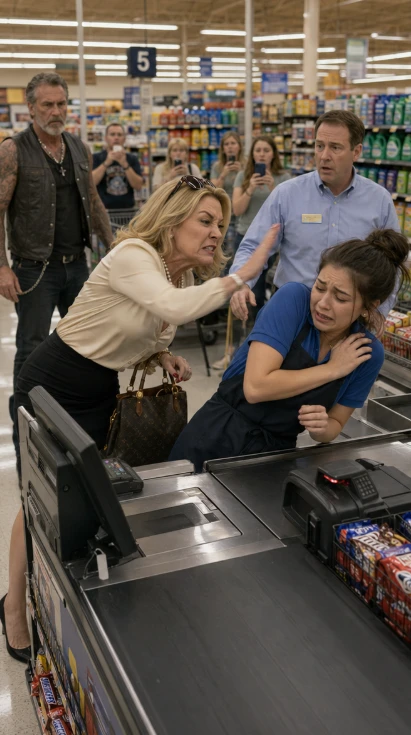
Water exploded across the checkout lane — splashing over designer sunglasses, dripping down a pearl necklace, soaking a silk blouse that probably cost more than the cashier’s monthly rent.
For a split second, the entire grocery store froze.
The woman — mid-40s, manicured nails, high heels clicking against tile — stood stunned in front of register six. Her credit card lay on the counter. The screen blinked red.
DECLINED.
“This is ridiculous,” she had been yelling moments earlier. “Run it again!”
The cashier, barely nineteen, name tag reading “Emily,” kept her voice low. “Ma’am, I’ve tried three times.”
The line behind them grew restless.
“Call your manager.”
“I already did.”
The woman’s voice sharpened. “You think I can’t pay? Is that it?”
Emily swallowed.
The store manager hurried over, flustered, apologetic.
The card failed again.
The woman leaned across the counter.
“Don’t you dare look at me like that.”
Emily hadn’t realized she was even looking.
Then—
A sharp crack.
The sound cut through the fluorescent hum of the store.
The woman’s hand struck the cashier’s cheek.
Gasps.
Someone whispered, “Oh my God.”
Emily staggered back, eyes wide, hand pressed to her face.
No one moved.
Not the manager.
Not the shoppers clutching carts.
Phones lifted, but feet stayed planted.
And then the water hit.
A large yellow mop bucket had tipped forward, sending a cold cascade straight into the woman’s face.
She shrieked.
“What the hell is wrong with you?!”
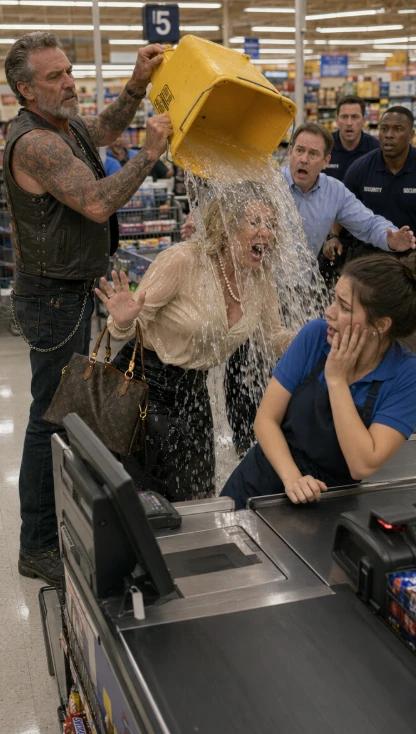
Standing beside the spill — steady, silent, holding the mop handle — was a man in a sleeveless leather vest.
Gray at his temples. Tattooed forearms. Broad shoulders. Weathered expression.
He didn’t apologize.
He didn’t shout.
He just looked at her.
And the entire store shifted its focus from the slap… to him.
No one knew yet who he was.
Or why he had stepped in.
The outrage came fast.
“You assaulted her!”
“Are you insane?”
The soaked woman sputtered, mascara streaking down her cheeks. “He attacked me!”
The manager rushed forward. “Sir, you cannot—”
The biker leaned the mop against the wall and set the bucket upright with deliberate calm.
“You hit her,” he said evenly.
The woman wiped water from her eyes, fury returning stronger than embarrassment.
“She disrespected me!”
“She ran your card,” the biker replied.
The store felt smaller now. Tighter.
Shoppers stepped back, creating a circle.
From a distance, it looked ugly.
A biker throwing water at a woman in public.
Aggressive.
Uncontrolled.
“Call security,” someone muttered.
“I’m calling the police.”
Emily stood behind the counter, still shaking, hand pressed against her cheek where a red mark bloomed.
The biker glanced at her once.
Just once.
“Did she touch you?” he asked quietly.
Emily hesitated.
The woman snapped, “Don’t answer him!”
The manager stammered, “Sir, you need to leave.”
The biker didn’t move.
Didn’t raise his voice.
But he didn’t step back either.
The soaked woman stepped toward him, finger pointing at his chest.
“You have no right—”
He held up one hand.
Not threatening.
Just firm.
“You don’t get to hit people.”
The crowd murmured.
Some nodded.
Others shook their heads.
“He still threw water.”
“That’s assault too.”
Security finally appeared from the back — two employees in navy polos.
“Sir, we need you to come with us.”
The biker nodded once.
“I’m not running.”
He didn’t resist as they positioned themselves beside him.
The woman grabbed her purse, dripping, still furious.
“You’re going to jail,” she spat.
The biker’s expression didn’t change.
He looked toward the checkout counter again.
At Emily.
Then he reached into his vest.
Gasps.
Security stiffened.
Phones zoomed closer.
But he only pulled out his phone.
Typed something.
Pressed send.
No explanation.
No defense.
Just one short message.
And then he waited.
The tension hung thick between wet tile and fluorescent lights.
And somewhere in the store’s ceiling, a small security camera had captured everything.
But no one had replayed it yet.
The police arrived within minutes.
Two officers stepped through the automatic doors, scanning the scene — puddled floor, shaken cashier, soaked customer.
The woman spoke first.
“He assaulted me with that filthy water!”
The officers turned to the biker.
He stood calmly near the cleaning aisle, hands visible.
“She struck her,” he said simply, nodding toward Emily.
The woman scoffed.
“She’s lying!”
Emily looked down.
The manager shifted uncomfortably.
The first officer asked, “Did she hit you?”
Emily’s voice was barely audible. “Yes.”
The woman snapped, “I barely touched her.”
Phones recorded everything now.
The second officer gestured toward the mop bucket.
“You threw that?”
“Yes.”
The admission hung in the air.
“Why?”
The biker glanced toward the ceiling.
“Check the cameras.”
The officers exchanged a look.
The woman laughed sharply. “He thinks that justifies assault?”
The biker didn’t respond.
He stepped back slightly, giving space.
Not defensive.
Not aggressive.
Just… steady.
From across the store, an older man whispered, “He shouldn’t have done that.”
A young mother replied softly, “She shouldn’t have slapped her.”
The officers asked for footage.
The manager hurried to the back office.
The woman paced, dripping water onto the tile.
“You think you’re some hero?” she hissed at the biker.
He shook his head once.
“No.”
The officers moved to cuff him while waiting.
He didn’t resist.
The metal clicked around his wrists.
Emily’s eyes widened.
“I’m sorry,” she whispered to him.
He looked at her calmly.
“Don’t be.”
Minutes later, the manager returned with a tablet.
The footage began to play.
Regular speed.
The card declined.
The shouting.
The lean across the counter.
The slap.
Clear.
Undeniable.
But the officers didn’t stop there.
“Rewind,” one said.
They slowed it down.
Frame by frame.
The woman’s hand raised high.
Emily flinching before impact.
The manager frozen.
The biker stepping forward — not immediately.
He hesitated.
Watching.
Assessing.
Then reaching for the mop bucket.
Not aiming at her face directly.
A quick upward splash.
Cold water.
Shock.
De-escalation.
The slap echoed louder in replay than the splash.
The store went quiet.
The officers paused the video.
The woman stopped pacing.
And the certainty in her voice evaporated.
But the biker remained cuffed.
Still waiting.
Because the truth was there now.
And it was only a matter of seconds before someone said it out loud.
The store didn’t explode into applause.
It went quiet.
The kind of quiet that feels heavier than shouting.
The tablet screen froze on the exact frame: the woman’s hand mid-air, fingers stretched, Emily’s cheek about to take the blow. In slow motion, the impact looked worse than it had in real time. A sharp arc of entitlement meeting bare skin.
No one defended her now.
No one rushed to comfort her.
The officers replayed the footage again.
Regular speed.
Slap.
Beat.
Splash.
Not rage.
Not chaos.
Interruption.
The first officer uncuffed the biker without ceremony.
The metal clicked open, almost apologetically.
“You escalated,” the officer said, but his tone had softened.
The biker flexed his wrists once. “She escalated first.”
It wasn’t defiance.
It was fact.
The soaked woman stood near the end of the checkout lane, blouse clinging awkwardly to her shoulders. The anger that had filled her voice earlier had drained into something smaller. Colder.
“You’re all ridiculous,” she muttered.
But even that sounded thin.
The store manager cleared his throat.
“Ma’am, we’ll need to ask you to leave.”
Gasps — softer this time.
The woman stared at him.
“Excuse me?”
The manager didn’t raise his voice. “You struck an employee.”
She looked around for backup.
There was none.
The crowd that had once turned on the biker now watched her.
Not shouting.
Just watching.
Power had shifted without anyone announcing it.
At the far end of the aisle, the automatic doors opened again.
A low engine hum drifted in from the parking lot.
Heads turned instinctively.
Three motorcycles idled just outside the entrance. Not roaring. Not revving. Just present.
Two riders removed their helmets and stepped inside, boots deliberate on tile.
Older men. Sleeveless leather vests. Clean posture. Quiet eyes.
They didn’t storm in.
They didn’t shout.
They simply walked to the cleaning aisle and stood a few feet behind the biker.
“Everything good?” one of them asked calmly.
“Yeah,” the biker replied.
Nothing more.
The officers glanced at the additional riders, then at the tablet still paused on the frame of the slap.
The message was clear.
Not intimidation.
Support.
The soaked woman shifted uncomfortably under the fluorescent lights. The spectacle she had created no longer belonged to her.
Emily stood behind the counter, still pale, but steadier now.
The first officer turned to her gently. “Do you want to press charges?”
The question landed differently than the shouting had earlier.
Emily hesitated.
The biker didn’t look at her.
Didn’t signal.
Didn’t nod.
He just stood there.
Waiting.
The woman opened her mouth to protest — but stopped.
For the first time since she had walked into the store, she looked uncertain.
The mop water pooled around her heels.
The engines outside idled steadily.
And the fluorescent hum of the store returned, slowly replacing tension with something else.
Not victory.
Not celebration.
Just equilibrium.
Emily lowered her eyes.
“Yes,” she said softly.
The woman inhaled sharply.
“You can’t be serious.”
The officer didn’t react to her tone.
He stepped toward her with the same procedural calm he had shown the biker earlier.
“Ma’am, please place your hands behind your back.”
The store watched in silence as the cuffs clicked shut around manicured wrists.
No one cheered.
No one filmed now.
Phones lowered.
The spectacle had ended.
The soaked blouse no longer looked expensive.
It looked heavy.
As the officers guided her toward the exit, the biker stepped aside, giving them space.
He didn’t smirk.
Didn’t nod.
Didn’t claim anything.
The woman passed him with wet mascara streaked down her cheeks.
For a split second, their eyes met.
He didn’t say a word.
Outside, the patrol car door shut with a dull thud.
The motorcycles idled a moment longer, then cut off.
The store returned to movement — carts rolling, scanners beeping, conversations restarting in hushed tones.
The manager approached Emily.
“You okay?”
She nodded.
The red mark on her cheek had already begun to fade into something less visible.
The biker walked back toward the mop bucket.
He picked it up, wrung the mop slowly, and began pushing water toward the drain.
One steady stroke at a time.
As if cleaning up was always part of the job.
One of the other riders clapped him lightly on the shoulder.
“You done?”
“Yeah.”
Emily stepped around the counter.
“Thank you,” she said, voice steadier now.
The biker paused.
“You don’t let people hit you,” he replied.
It wasn’t advice.
It wasn’t a lecture.
Just a boundary.
He placed the mop back against the wall and walked toward the exit.
The automatic doors opened.
Sunlight flooded the entrance.
Outside, the afternoon traffic moved like nothing had happened.
Before putting on his helmet, he glanced back through the glass.
Emily had returned to her register.
Head up.
Posture straighter.
The line moved forward again.
He didn’t wave.
He didn’t wait for acknowledgment.
He mounted the bike and started the engine.
The low rumble rolled across the parking lot and faded into traffic.
Inside the store, someone finally whispered, “I thought he was the bad guy.”
Another replied quietly, “Me too.”
The mop water dried.
The red mark faded.
But the memory lingered.
Not of the splash.
Not of the spectacle.
Of the moment a raised hand was interrupted.
And of a man in leather who chose to step forward — not perfectly, not politely — but precisely when someone else wouldn’t.
The fluorescent lights buzzed overhead.
The registers beeped.
And the store carried on.
But something small had shifted.
A reminder that sometimes silence protects the wrong person, and sometimes it takes an unexpected disruption to make the room look again.
He didn’t leave a speech behind.
Just a wet floor.
And a line no one crossed again that day.
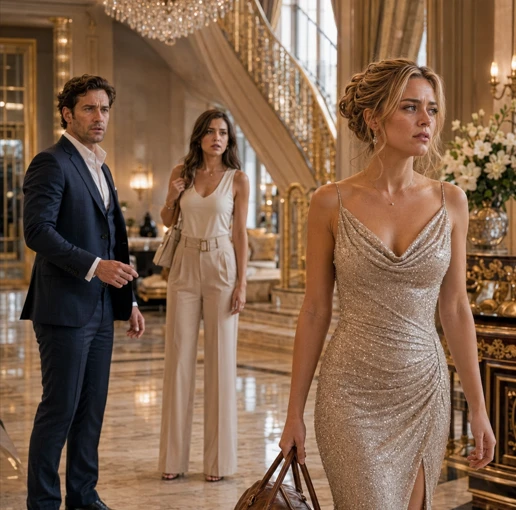
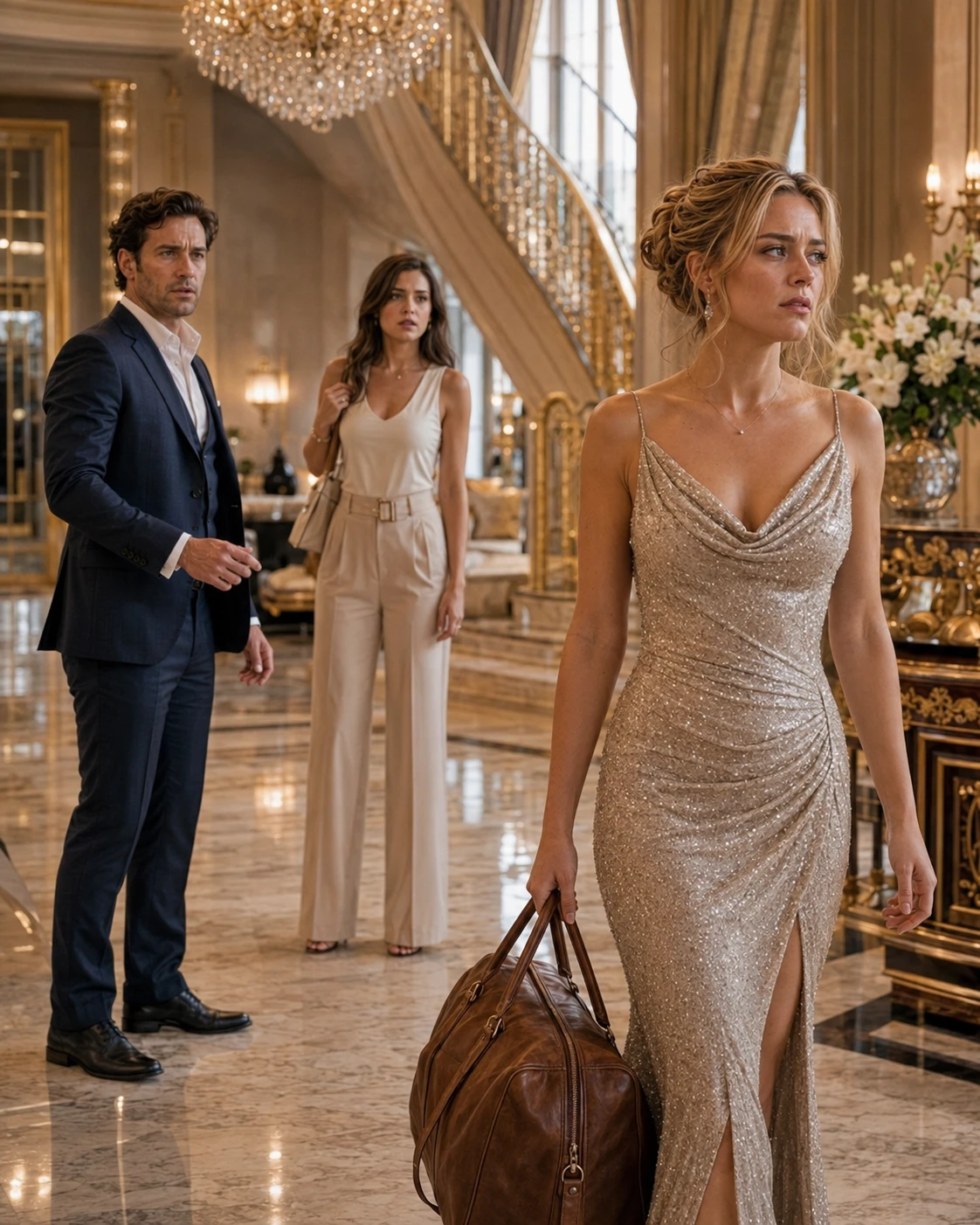
The struggling wife saw his mistress dressed in his shirt, left with only one bag, and the billionaire realized far too late that she could purchase everything he owned.
Part 2
Vanessa laughed softly. “Is this supposed to scare him?”
Emily looked at her.
Then she smiled.
Not bitterly.
Not angrily.
Just once.
A small, almost sympathetic smile.
And somehow that smile unsettled Ethan more than screaming ever could.
“No,” Emily said quietly. “Nothing about this is supposed to scare him.”
Then she opened the front door.
The storm swallowed her.
And she was gone.
For several seconds nobody moved.
Rain lashed the windows.
The grandfather clock in the hallway ticked.
Vanessa crossed her arms.
“Well,” she said. “That was dramatic.”
Ethan stared at the closed door.
For reasons he couldn’t explain, a strange discomfort settled in his chest.
Not guilt.
Certainly not regret.
Something else.
Something unfamiliar.
He dismissed it immediately.
By midnight he was drinking whiskey in his office while Vanessa slept upstairs.
By morning he had convinced himself Emily would return.
Women always returned.
Especially women who had once lived in studio apartments and suddenly found themselves married to billionaires.
Especially women who had never earned real money.
Especially women like Emily.
Or so Ethan believed.
Three days later, she still hadn’t called.
A week later, she still hadn’t called.
Two weeks later, his attorney informed him divorce papers had been filed.
Not requested.
Filed.
Aggressively.
With astonishing precision.
Every financial document.
Every property agreement.
Every trust structure.
Every corporate protection clause.
The paperwork was flawless.
Ethan sat behind his mahogany desk and frowned.
“Who prepared this?”
His attorney adjusted his glasses.
“That’s the strange part.”
“What?”
“The legal team handling her case is one of the most expensive firms in New York.”
Ethan laughed.
“Impossible.”
“I’m serious.”
“She can’t afford them.”
The attorney hesitated.
Then said something Ethan would remember for the rest of his life.
“They aren’t billing her.”
Silence.
“What?”
“They’ve represented her family for decades.”
Ethan blinked.
“Her family?”
“Yes.”
For the first time, uncertainty flickered across Ethan’s face.
A tiny crack.
Nothing more.
Yet.
Three thousand miles away, Emily sat inside a private conference room overlooking Boston Harbor.
Floor-to-ceiling windows reflected gray ocean water.
Eight executives sat around the table.
Every one of them stood when she entered.
“Good morning, Dr. Blackwell.”
Emily nodded politely.
“Good morning.”
Nobody called her Mrs. Blackwell here.
Nobody ever had.
On the screen behind her appeared the logo of a company worth nearly two hundred billion dollars.
Aerospace.
Quantum computing.
Defense systems.
Artificial intelligence.
The company had quietly become one of the most powerful technology organizations on earth.
And Emily owned forty-eight percent of it.
Not through marriage.
Not through inheritance alone.
Through patents.
Through decades of work.
Through brilliance.
At thirty-eight years old, Emily Blackwell was considered one of the most influential scientific minds of her generation.
Most people simply didn’t know her face.
She preferred it that way.
A board member cleared his throat.
“Are you certain about acquiring Blackwell Global Capital?”
The room became quiet.
Emily looked at the financial reports.
Then at the company name.
Ethan’s company.
The empire he believed made him untouchable.
“Very certain.”
Another executive hesitated.
“The acquisition will be hostile.”
Emily smiled.
“Only if they resist.”
Back in Los Angeles, Ethan’s month got worse.
Then worse again.
Then catastrophic.
A major investor withdrew.
A merger stalled.
Three international contracts suddenly disappeared.
Banks began requesting additional guarantees.
At first Ethan blamed market conditions.
Then competitors.
Then politics.
Then bad luck.
But eventually patterns emerged.
Every obstacle somehow connected to the same invisible force.
Funding vanished.
Partners changed direction.
Negotiations collapsed.
Entire opportunities evaporated overnight.
One evening his chief financial officer entered his office looking pale.
“Ethan.”
“What now?”
“We have a problem.”
“Join the line.”
“No.”
The CFO swallowed.
“This is serious.”
A folder landed on Ethan’s desk.
He opened it.
Read the first page.
Then the second.
Then the third.
The color drained from his face.
“No.”
The CFO nodded.
“I’m afraid so.”
Ethan read the name again.
Then again.
And again.
Dr. Emily Grace Blackwell.
Controlling shareholder.
Aether Dynamics Holdings.
Estimated net worth: $34.8 billion.
Ethan stared at the numbers.
His mind rejected them.
Thirty-four billion.
Not million.
Billion.
The room felt suddenly smaller.
“She hid this.”
The CFO looked uncomfortable.
“Actually…”
“What?”
“She didn’t.”
“What are you talking about?”
“These records are public.”
Ethan’s eyes lifted.
“The patents. The research publications. The foundation grants. The ownership disclosures.”
The CFO paused.
“Most people in aerospace know exactly who she is.”
A terrible realization began forming.
“Then why didn’t I know?”
Nobody answered.
Because everyone understood the truth.
He never asked.
That night Ethan couldn’t sleep.
He walked through the mansion.
Every room felt different.
Every memory looked different.
The kitchen.
The library.
The terrace.
The garden.
Everywhere he looked he saw things he had never bothered to notice.
The engineering journals stacked beside her bed.
The scientific conferences she attended.
The Nobel Prize winners who called her by her first name.
The military officials who treated her with unusual respect.
The billionaire philanthropists who seemed oddly eager to speak with her.
He had seen every clue.
Ignored every clue.
Because he preferred a simpler story.
The beautiful waitress.
The grateful wife.
The rescued woman.
And now that story was collapsing.
Two weeks later the collapse became public.
Financial media exploded.
Television analysts discussed it nonstop.
Headlines appeared worldwide.
BLACKWELL GLOBAL TARGETED BY MYSTERIOUS BUYER
HOSTILE ACQUISITION UNDERWAY
MARKETS REACT TO MASSIVE TECHNOLOGY TAKEOVER
Ethan spent sixteen straight hours in emergency meetings.
Then seventeen.
Then eighteen.
Every solution failed.
Every defense collapsed.
The buyer already controlled too many positions.
Too many lenders.
Too many strategic partners.
Too many votes.
Finally the identity of the buyer became public.
The boardroom fell silent.
A single name appeared on the screen.
EMILY G. BLACKWELL.
Nobody spoke.
Ethan felt the blood leave his face.
His own wife.
No.
His ex-wife.
The woman he claimed came from nothing.
The woman he said wasn’t enough.
The woman he thought needed him.
She was buying his company.
Piece by piece.
Asset by asset.
Share by share.
And there was absolutely nothing he could do to stop her.
Three days later Ethan requested a meeting.
To his surprise, she agreed.
The meeting took place in New York.
Top floor.
Private conference suite.
When Ethan entered, Emily stood near the windows.
She wore a navy suit.
No diamonds.
No dramatic jewelry.
No attempt to impress anyone.
She looked exactly like herself.
And somehow that confidence terrified him.
“Emily.”
She turned.
“Ethan.”
The silence stretched.
Finally he spoke.
“You planned this.”
“No.”
“You expect me to believe that?”
She folded her hands.
“I didn’t leave intending to buy your company.”
“Then why are you doing it?”
Emily looked out at Manhattan.
Lights glittered below.
“When I left your house, I wanted peace.”
She paused.
“You refused to give it to me.”
Ethan’s jaw tightened.
“I made mistakes.”
“You humiliated me.”
“You could have talked to me.”
Emily laughed softly.
The sound carried no joy.
“Talked?”
“You never listened.”
He took a step forward.
“I’m listening now.”
Her eyes met his.
And for the first time he saw the complete truth.
She was finished.
Completely.
Permanently.
The marriage wasn’t damaged.
It was dead.
“You know what’s funny?” she asked.
“What?”
“You always thought money made you powerful.”
She slid a folder across the table.
Ethan opened it.
His hands began shaking.
The acquisition documents.
Final approval.
Signed.
Completed.
Irreversible.
Emily now controlled everything.
His company.
His board.
His future.
His empire.
Gone.
“Why?” he whispered.
Emily looked at him for a long moment.
Then she said the one thing he never expected.
“Because my grandfather loved you.”
Ethan blinked.
“What?”
“He believed you loved me.”
Confusion crossed his face.
Emily opened her purse.
Removed an old envelope.
The same envelope she had carried from the mansion.
She handed him the letter.
Ethan unfolded the yellow paper.
His eyes moved across the words.
Then stopped.
Then widened.
Then filled with horror.
At the bottom was a legal addendum.
A clause.
One hidden condition attached to the family trust.
A condition Ethan had unknowingly triggered.
If Emily’s spouse is proven to have committed marital betrayal resulting in divorce, control of the Blackwell Strategic Trust shall immediately transfer solely to Emily, including all associated acquisition authorities and reserved holdings.
Ethan stared at the page.
His hands trembled.
“No…”
Emily nodded.
“My grandfather built that clause after my grandmother was betrayed.”
The room spun.
The realization hit him like a freight train.
His affair hadn’t merely destroyed his marriage.
It had activated the very mechanism that allowed Emily to take everything.
Everything.
The trust.
The voting rights.
The acquisition authority.
The billions.
The takeover.
All of it.
His own betrayal had armed the weapon that destroyed him.
A weapon sitting quietly beside him for five years.
Hidden in plain sight.
Waiting.
He sank into a chair.
Speechless.
Broken.
Defeated.
Emily picked up her coat.
Then paused beside him.
For a moment she saw the man she once loved.
The man she had chosen.
The man she had believed in.
And she felt absolutely nothing.
No hatred.
No revenge.
No satisfaction.
Nothing.
Which was somehow worse.
She walked toward the door.
“Emily.”
She stopped.
“What?”
His voice cracked.
For the first time in his life, Ethan Blackwell sounded afraid.
“Did you ever love me?”
Emily stood silently.
Then smiled sadly.
“Enough to leave thirty-four billion dollars untouched for five years.”
The answer shattered him.
Because suddenly he understood.
She had never wanted his money.
Never needed his mansion.
Never cared about his status.
She had chosen him while already possessing more wealth than he could imagine.
And he had thrown that away for a woman wearing his shirt on a couch.
The door opened.
Emily stepped through it.
Then closed it behind her.
Ethan remained alone.
Listening to the silence.
Listening to the sound of an empire ending.
And somewhere high above Manhattan, reflected in the glass of a skyscraper she now owned, Emily Blackwell finally became something she had not been in years.
Free.