PART 3
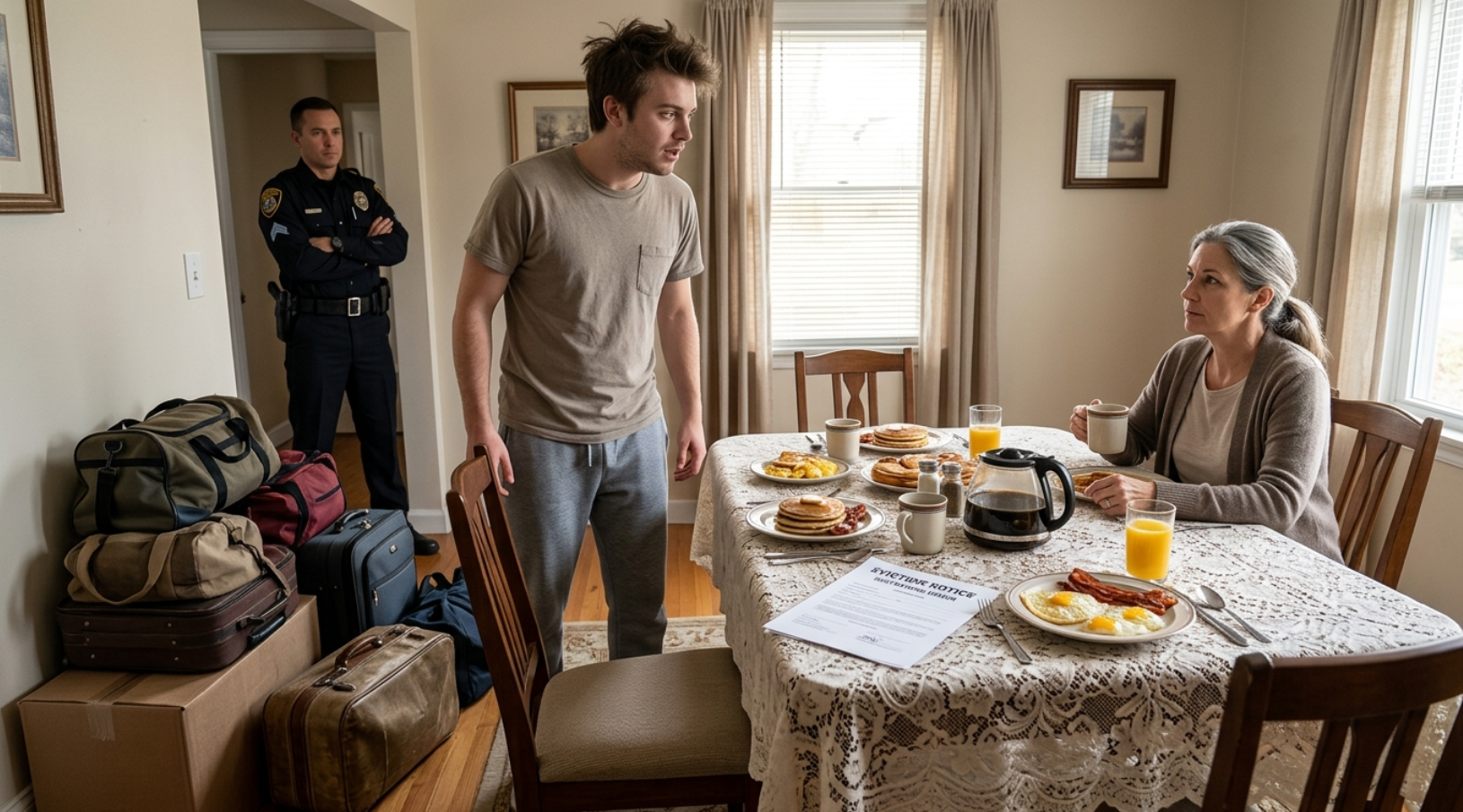
Then he smelled breakfast.
His expression changed.
“Wow,” he said, looking at the table. “You made all this?”
I placed the coffee pot down.
“Good morning, Jason.”
He walked closer, examining the pancakes, sausage, scrambled eggs, and crispy hash browns.
Then he noticed the embroidered tablecloth.
He smiled.
“So you finally learned.”
I said nothing.
He pulled out a chair and sat down.
“See? This is what I mean. We don’t have to fight over everything. You get emotional, I get frustrated, and things get out of hand. But we’re family.”
He reached for a pancake.
I watched him spread butter across it.
He spoke as casually as if the previous night had been an ordinary disagreement.
“Honestly, Mom, you made it worse by refusing to help me. I was already stressed. You know I’ve got a lot going on.”
I placed a small envelope beside his plate.
He barely glanced at it.
“What’s that?”
“Something you need to read.”
He kept eating.
“Can it wait? I’m starving.”
“No.”
There was something in my voice that made him stop moving his fork.
I had never spoken to him that way before.
Not once in twenty-three years.
He looked up.
For the first time that morning, he noticed my face.
His smile faded slightly.
“What happened to your cheek?”
I held his gaze.
“You tell me.”
He looked away first.
“Oh, come on. Are we really doing this?”
“Yes.”
He dropped his fork.
“Mom, I said I was sorry.”
“No, Jason. You didn’t.”
His face tightened.
“I didn’t mean for it to happen.”
“You told me I made you do it.”
“I was angry.”
“So was I.”
He stared at me as if he couldn’t understand what I meant.
I continued quietly.
“But I didn’t hit you.”
The room fell silent.
Outside, a delivery truck passed our house. Somewhere down the street, a dog barked.
Jason pushed his plate away.
“So what? You’re going to punish me now?”
I glanced at the envelope.
“Read it.”
He snatched it up, tore open the flap, and pulled out several sheets of paper.
The first page contained a short letter.
The second was a list of the money I had given him over the previous two years.
The third contained something he had never expected to see.
His expression changed as he read.
“What is this?”
“Read it all.”
He looked down again.
The list was longer than he expected.
$150 for a phone bill.
$280 for car insurance.
$400 for a missed rent payment on an apartment he had once tried to rent.
$600 for a car repair.
$200 for groceries.
$350 for another emergency.
And dozens of smaller amounts.
I had kept records because I worked in a school library, where organization had become second nature to me. For years, I had recorded each payment in a notebook, telling myself it would help Jason repay me when he found steady work.
The total at the bottom was $4,760.
Jason laughed bitterly.
“You actually added everything up?”
“Yes.”
“You’re my mother!”
“I know.”
“So you’re keeping a record of every time you’ve helped me?”
“I kept a record because I thought one day you’d want to make things right.”
He tossed the pages onto the table.
“This is unbelievable.”
I took a slow breath.
“No, Jason. What’s unbelievable is that I spent two years trying to rescue you from every consequence of your decisions, and somehow you came to believe that I owed you more.”
He stood.
“You’re making me sound like some kind of criminal.”
“I haven’t called you anything.”
“You don’t have to. It’s obvious what you’re trying to do.”
I nodded toward the remaining pages.
“There’s more.”
He hesitated before picking them up.
The final sheet was a formal notice explaining that his living arrangements would change. Beginning that day, he was no longer permitted to treat my home as a place where he could threaten me without consequences.
It stated that he would need to leave the house while I made arrangements for my safety and consulted the appropriate professionals about the lawful next steps.
I had not written it alone.
The previous night, after I made that phone call, I had spoken to someone who helped me understand that loving my son did not mean I had to remain in danger.
I had been careful not to promise myself that everything would be solved by a single piece of paper.
But I had finally begun taking action.
Jason read the notice twice.
Then he looked at me.
“You’re kicking me out?”
“I am making sure I can live safely in my own home.”
“Because of one slap?”
The question came out so quickly that I almost failed to recognize what it revealed.
One slap.
He had reduced the moment that changed my entire understanding of our relationship to an inconvenience.
I looked at him.
“Would you call it one slap if I did it to you?”
He said nothing.
“Would you tell your friends that I had the right to hit you because I was upset? Would you tell them that you deserved it because you refused to give me money?”
His jaw moved, but no words came.
“Then why,” I asked, “should the answer be different because I’m your mother?”
For a moment, I saw the little boy he had once been.
The boy who cried when his goldfish died.
The boy who used to crawl into my bed during thunderstorms.
The boy who once made me a card that said I was the best mother in the world.
I loved that child.
But the man standing before me had hurt me and blamed me for it.
I could not keep pretending those were the same thing.
Jason crumpled the notice in his fist.
“You’re going to regret this.”
The old me would have panicked.
I would have apologized, offered him money, or promised that we could discuss everything later.
Instead, I looked at the food he had barely touched.
“Breakfast is getting cold.”
He stared at me in disbelief.
Then he shoved his chair backward.
“You’re unbelievable.”
He stormed upstairs.
A moment later, something heavy struck the floor.
Then his bedroom door slammed.
I stood alone in the dining room, listening to the silence that followed.
My hands were trembling.
I hadn’t felt brave.
I had felt terrified.
But beneath the fear was something I hadn’t experienced in years.
Relief.
For the first time, I had said no without immediately taking it back.
And I knew that was only the beginning.
At 8:40 a.m., my phone rang.
It was David.
I had not spoken to my ex-husband in nearly three weeks, except for a brief exchange about Jason’s car insurance.
“Sarah,” he said, sounding unusually serious. “We need to talk about our son.”
I closed my eyes.
“Did he call you?”
“Yes. He says you’re throwing him out and refusing to give him money.”
“That’s true.”
David exhaled.
“He says you went crazy last night.”
I looked toward the staircase.
“Did he tell you what happened before I decided he couldn’t keep living here the way he has been?”
There was a pause.
“No.”
“Then let me tell you.”
I described the argument. The money. My refusal. The threat.
Then I told David about the slap.
I didn’t cry.
I didn’t exaggerate.
I simply told him what had happened.
When I finished, the line remained silent for several seconds.
Finally, David spoke.
“He hit you?”
“Yes.”
“Sarah, are you all right?”
The question nearly broke me.
Not because it was complicated.
Because it was the first time someone had asked me that morning without first explaining what Jason supposedly needed.
“I’m safe right now,” I answered. “But I’m not all right.”
David’s voice became quieter.
“I should have called more often.”
I leaned against the kitchen counter.
“This isn’t about you and me.”
“I know. But I should have paid more attention.”
For years, I had blamed David for leaving. I had watched Jason turn that hurt into anger, and I had tried to compensate for it by becoming endlessly patient.
David had done something similar from a distance.
Whenever Jason called him, David occasionally sent money, hoping it would ease the resentment between them.
Neither of us had realized how much our separate attempts to help had taught Jason to turn every disagreement into a negotiation.
“Did you give him money recently?” I asked.
David hesitated.
“Last week. Two hundred dollars.”
“Did he tell you what it was for?”
“He said he needed to pay an overdue bill.”
I closed my eyes.
“He told me he had less than twenty dollars.”
“I know.”
I opened my eyes.
“What do you mean, you know?”
David was quiet again.
Then he said, “Sarah, there’s something else. I think we need to look at what’s actually been happening with Jason.”
That afternoon, David drove to my house.
I had not seen him in person for several months. He looked older than I remembered, with more gray around his temples and the same tired expression he used to wear after difficult meetings at work.
He stood on my porch for a moment before entering.
When he saw the mark on my cheek, his face hardened.
“Sarah…”
I shook my head.
“Don’t. I don’t need you to tell me how terrible you feel. I need us to understand what is happening.”
He nodded.
We sat at the kitchen table.
Jason remained upstairs, moving around his bedroom and occasionally making calls.
David opened his briefcase and removed a folder.
“I started looking into things after Jason asked me for money last week.”
Inside were bank transfers, screenshots of messages, and a few printed account statements Jason had apparently sent him when asking for financial assistance.
David placed the papers between us.
“He hasn’t been telling either of us the full story.”
I studied the first page.
Jason had asked David for $200 to cover an overdue insurance payment. But the message beneath it showed that he had also asked me for money that same day.
The amounts were different.
The explanations were different.
And both of us had sent him money.
Another message showed that he had asked David for $350 to repair his car. Three days later, he had told me the car needed a different repair and asked for another $180.
My stomach tightened.
“How long has this been happening?”
David rubbed his forehead.
“I don’t know exactly. I started comparing messages after I realized he’d asked us both for money in the same week.”
I turned another page.
There were more examples.
A phone bill he had claimed was overdue, even though the account record suggested the payment had already been made.
A request for grocery money that came just hours after he had told David he couldn’t afford food.
A claim that he had lost a temporary job, followed by a message asking his father to help him purchase a new phone.
I sat back.
For two years, I had worried that Jason was struggling to survive.
Now I was beginning to understand that I hadn’t even known what his struggles were.
“Why didn’t you tell me?” I asked.
David looked ashamed.
“I thought he was embarrassed. I didn’t want to make things worse between you.”
“I thought the same thing.”
We looked at each other.
It was a painful realization.
Our divorce had ended our marriage, but it had not ended our responsibility to make sensible decisions as parents.
Instead, we had each tried to protect Jason from disappointment.
And in doing so, we had stopped asking him to be honest.
David gathered the papers into a neat pile.
“Sarah, I need to tell you something else. A few weeks ago, Jason asked me whether I would be willing to guarantee a loan for him.”
I frowned.
“What kind of loan?”
“He said it was for a small business opportunity. He told me he had a friend who wanted to start a car-detailing service.”
“Did you agree?”
“No. I told him I needed a business plan and proof that he could repay it.”
I let out a slow breath.
“What happened?”
“He got angry. Said I never believed in him.”
That sounded painfully familiar.
David continued.
“Then, yesterday morning, he sent me a message saying he had found another way to get the money.”
My fingers tightened around my coffee cup.
“What way?”
“I don’t know. I called him twice, but he didn’t answer.”
For a moment, I wondered whether the $300 he had demanded from me had anything to do with that loan.
But I didn’t want to invent answers before I knew the truth.
“We need to stop giving him money,” I said.
David nodded.
“Agreed.”
“And we need to stop letting him make us feel guilty for saying no.”
“Agreed.”
I looked at him.
“But David, this doesn’t mean we stop caring about him.”
“No,” he said. “It means we stop confusing caring with paying.”
Those words stayed with me.
For years, I had believed that if I could just give Jason enough help, he would eventually find his way.
But help without honesty had become a cycle.
And I had to accept that I could not change my son by sacrificing my safety, my savings, or my peace.
We agreed that neither of us would provide further cash without understanding what was happening. If Jason needed legitimate support, we could discuss it openly and look for practical ways to help that did not involve handing him money on demand.
We also agreed that the violence could not be ignored.
David offered to stay while I arranged a safe place to go if Jason became threatening again.
I thanked him.
Then I asked him to do something more important.
“Please don’t make promises to Jason on my behalf. And don’t tell him he can come to your house without discussing it with me first.”
David nodded.
“I won’t.”
For the first time in years, we were speaking as two adults who could cooperate without trying to undo the past.
It was a small beginning.
But it was a beginning.
Jason came downstairs just after four o’clock.
He stopped when he saw his father sitting at the kitchen table.
“What are you doing here?”
David stood.
“We need to talk.”
Jason looked at me.
“You called him?”
“Yes.”
His expression turned hostile.
“Of course you did. You couldn’t handle this privately, so now you’re bringing everyone into it.”
David’s voice remained calm.
“Jason, your mother was hurt last night. That’s not something we can pretend didn’t happen.”
Jason scoffed.
“She knows how to push my buttons.”
“No,” David replied. “She knows how to say no.”
Jason looked at him with disbelief.
“So you’re taking her side?”
“I’m telling you that hitting your mother is unacceptable.”
Jason shook his head.
“Nobody understands what I’m going through.”
David nodded slowly.
“Then explain it. But you don’t get to hurt someone because you’re angry.”
Jason turned away.
“Forget it.”
He started toward the stairs.
“Jason,” I said.
He stopped without turning around.
“The money is finished. Your father and I have compared what you’ve been telling us. We know you’ve been asking us for money using different explanations.”
His shoulders stiffened.
“That’s none of your business.”
“Money we give you is our business. And what happened in this house last night is my business.”
He turned.
“You went through my private life?”
“No. We compared the messages and payment requests you sent us.”
“You’ve been spying on me!”
David shook his head.
“We’re your parents, Jason. Not your personal bank accounts.”
Jason laughed, but there was no humor in it.
“Fine. You know what? I’ll leave. I’ll go somewhere else, and then you can both sit here congratulating yourselves.”
He disappeared upstairs.
A few minutes later, we heard drawers opening and closing.
David looked at me.
“Do you want me to stay?”
“Yes,” I said. “Please.”
We waited.
Eventually, Jason came back down carrying a duffel bag.
He stopped at the front door and looked at me.
“You’re really doing this?”
I felt the old urge to soften my words.
I wanted to say that he could stay if he promised to behave. I wanted to believe that one apology would make everything safe again.
But I had learned something that morning.
A promise made in anger was not the same as change.
“I’m willing to help you find a safe place to stay and discuss practical next steps,” I said. “But you cannot remain here as if nothing happened.”
He stared at me.
“You’d rather have me sleeping on the street?”
“No. I want you to take responsibility for your life. Those are not the same thing.”
He shook his head.
“You’ve changed.”
I looked at the table, at the white cloth, at the breakfast plates that had long since gone cold.
“Yes, Jason. I have.”
He left without saying goodbye.
The door shut behind him.
I didn’t run after him.
I didn’t call him back.
And although I cried after David left that evening, I did not take back what I had said.
For the first time, I allowed myself to grieve the son I remembered without pretending the man he had become was someone I could safely rescue.
I did not know where Jason would go next.
I did not know whether he would apologize.
But I knew that the next chapter of our lives could not begin with another envelope of money.
It had to begin with the truth.
PART 4
For three days, Jason didn’t call.
I told myself that the silence was probably a good thing. He needed time to calm down, and I needed time to understand how my own home had become a place where I was afraid to say no.
But on the fourth morning, I woke to find seven missed calls from an unknown number and a message from Jason.
Mom, please answer. I need to talk to you. It’s important.
I read the message twice.
My first instinct was to call him immediately.
It was the instinct that had governed nearly every decision I had made since he was born. When he was sick, I stayed awake all night. When he failed an exam, I helped him study. When he lost a job, I reassured him that another opportunity would come.
Whenever he stumbled, I reached out my hand.
And for years, I had confused being a good mother with making sure he never had to face the full weight of his choices.
I picked up my phone.
Then I put it down.
I was willing to speak with him, but I would not return to the old pattern simply because he sounded desperate.
I replied:
I’m willing to talk when we can do so calmly and honestly. I won’t give you money, and I won’t accept threats or insults.
His answer came almost immediately.
Forget it.
I stared at those two words.
Then I placed my phone on the counter and went to work.
That afternoon, while I was organizing returned books at the elementary school library, the office secretary came to find me.
“Sarah, there’s a man on the phone asking for you. He says he’s Jason’s father.”
I felt a familiar knot tighten in my stomach.
“David?”
She nodded.
I picked up the receiver.
“What’s happened?”
David sounded worried.
“Jason came to see me this morning.”
“Is he all right?”
“Physically, yes. But something is wrong, Sarah. He finally told me why he needed that $300.”
I stepped into the empty staff room and closed the door.
“What did he say?”
David hesitated.
“He’s been borrowing money from people. Not just us. Friends, former coworkers, and someone he met online. He says he’s in over his head.”
I closed my eyes.
“How much?”
“He couldn’t give me an exact figure. He thinks it’s several thousand dollars, possibly more.”
For a moment, I couldn’t speak.
I had known Jason was irresponsible with money. I had known he was hiding things from us.
But I had imagined that his problems were limited to unpaid bills, poor decisions, and the ordinary difficulties of a young adult trying to find his way.
I had never imagined that he had been borrowing money from people while telling his own parents completely different stories.
“Did he explain what he spent it on?” I asked.
“Some of it went toward bills. Some went toward his car. Some went toward things he says he needed to feel better.”
“And the rest?”
“He says he doesn’t know exactly where it went.”
I pressed my fingers against my forehead.
“David, I cannot pay his debts.”
“I know.”
“I mean it. I won’t borrow against my retirement. I won’t risk this house. I won’t hand him thousands of dollars because he’s frightened.”
“I know, Sarah.”
His voice softened.
“But he asked me to tell you something. He says he’s sorry about what happened.”
I felt my heart contract.
For one dangerous second, hope rose inside me.
Then David continued.
“He wants to come home.”
I looked out the staff room window at the children playing in the courtyard.
“Is he asking to come home because he’s sorry he hurt me,” I asked, “or because he needs somewhere to stay?”
David didn’t answer immediately.
“I don’t know.”
“Neither do I.”
We ended the call a few minutes later.
That evening, I sat at my kitchen table and looked at the empty chair where Jason had eaten breakfast.
I remembered his little-boy laughter.
I remembered the first time he rode a bicycle without training wheels, turning around every few feet to make sure I was watching.
I remembered the night his father moved out. Jason had sat on the floor beside my bed and asked whether people could stop loving each other without warning.
I had held him and promised that whatever happened between his father and me, he would always be loved.
I had kept that promise.
But somewhere along the way, I had begun believing that love required me to absorb every consequence of his behavior.
That night, I finally understood something painful.
I could keep loving my son without giving him access to everything he wanted from me.
And that was exactly what I intended to do.
Two days later, Jason arrived at my house with his father.
I had agreed to meet them because David promised the conversation would remain calm. I also asked a trusted friend to be nearby, and I made it clear that the meeting would end immediately if Jason threatened me.
When I opened the door, Jason looked exhausted.
His hair was unwashed, and the confident expression he had worn at breakfast was gone.
He carried no bag.
“Can we talk?” he asked.
I stepped aside, leaving the doorway open.
“Yes. Come in.”
We sat in the living room.
David took the chair near the window. Jason sat on the edge of the sofa, his hands clasped tightly between his knees.
For several seconds, nobody spoke.
Then Jason looked at me.
“Mom, I’m sorry.”
I let the words settle between us.
“Tell me what you’re sorry for.”
He blinked.
“What?”
“I’m listening. Tell me what you’re sorry for.”
He looked down.
“For hitting you.”
“All right.”
“And for saying those things.”
I nodded.
He waited, apparently expecting me to move closer, embrace him, and tell him everything was forgiven.
When I didn’t, his expression shifted.
“Isn’t that what you wanted to hear?”
“I wanted you to understand what you did.”
“I said I was sorry!”
“And I’m glad you said it. But an apology doesn’t automatically make me feel safe.”
His eyes filled with frustration.
“So what am I supposed to do? Spend the rest of my life paying for one mistake?”
I took a breath.
“No. You’re supposed to take responsibility for it and show me, through your actions, that it won’t happen again.”
He leaned back and rubbed his face.
“I don’t know how to fix everything.”
NEXT> My 23-Year-Old Son Hit Me for Refusing to Give Him Money—
My 23-Year-Old Son Hit Me for Refusing to Give Him Money—The Next Morning, I Set the Table, and He Finally Understood What I Had Prepared for Him
Part 1 of 2