
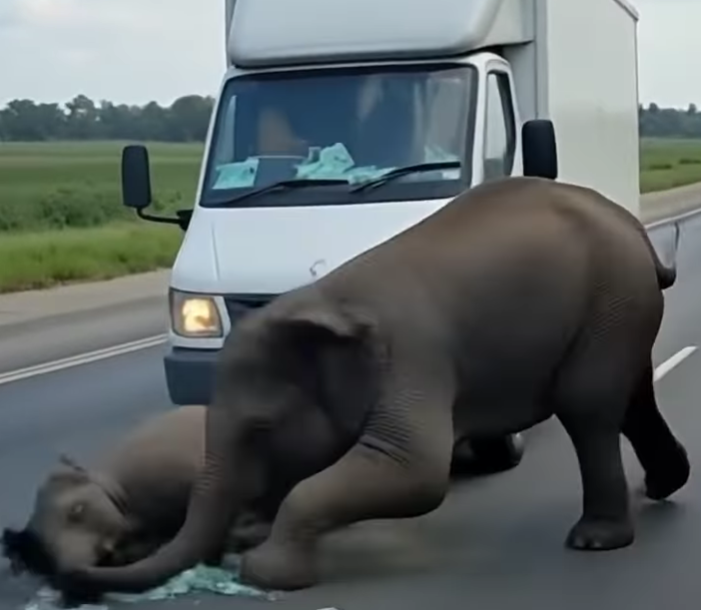
In the vast and untamed wilderness of Africa, where the sun casts its golden rays over sprawling savannas, a dramatic and heart-wrenching event unfolded that captured global attention. A seemingly ordinary day turned into an extraordinary tale of maternal love and instinct, leaving witnesses both stunned and inspired.
The incident began when a driver, navigating through a dusty road winding between acres of wild terrain, accidentally struck a baby elephant. The young elephant, barely old enough to have wandered far from its mother’s side, was suddenly thrown into a terrifying situation.
As the dust settled, the air was filled with a tense silence, soon to be broken by the low, resonant rumble of the mother elephant. With a mix of fear and determination, she approached her injured calf, her massive form moving with a grace and urgency that belied her size.
Witnesses held their breath as the mother elephant did something unbelievable. Instead of reacting with aggression, as one might expect, she demonstrated a remarkable level of intelligence and care. Using her trunk, she gently nudged her calf, encouraging it to stand, all while making low, soothing sounds.
The road was quiet that night… until one sound changed everything.
A heavy crash echoed through the East–West Highway in Malaysia.
A truck had struck something in the darkness.
But what no one expected was what came next.
From the forest edge, a massive shadow emerged—slow, shaking, alive with panic.
A mother elephant.
She rushed straight to the scene, her trunk searching wildly, her feet refusing to leave the spot where her calf lay motionless on the cold asphalt. The world around her kept moving… but she didn’t.
Minutes passed.
Then an hour.
Then more.
Drivers who stopped to watch later said the same thing: she wasn’t just standing there—she was grieving in a way words can’t fully hold. She nudged the truck, pushed against it, as if trying to undo what had already been done. And when nothing changed… she simply stood guard over her baby.
For nearly five hours, she didn’t leave.
Rain began to fall, but she stayed.
Head lowered. Body unmoving. Refusing to accept the silence.
And somewhere in that stillness, the highway stopped feeling like a road… and started feeling like a memorial.
Then, in the distance, headlights returned—this time not from passing traffic, but from wildlife authorities arriving carefully, aware that even one wrong move could turn heartbreak into danger.
They worked slowly, gently, until finally they managed to calm and relocate her away from the scene.
But long after the trucks were gone and the road was cleared, what remained wasn’t just an accident report.
It was the image of a mother who refused to abandon her child… even when the world had already moved on.
And the forest, waiting in the dark nearby, seemed to keep her silence with her.
Hours later, the highway looked normal again.
Cars kept moving. People kept driving. Life returned to its usual speed.
But in the nearby forest, something had changed forever.
The mother elephant had been released far from the road, deep enough to be safe—but not deep enough to forget.
At first, she stood still.
No sounds. No movement. Just breathing.
Then she turned.
Slowly… as if she already knew the direction without needing to see it.
And she began walking back.
Step by step, she retraced the invisible path her heart remembered more than her eyes.
Back toward the place she was taken from.
Back toward the last place she saw her calf alive.
Wildlife officers tried to redirect her gently, but grief doesn’t listen to commands. It doesn’t obey distance. It doesn’t understand “safe.”
It only remembers loss.
And somewhere far behind the trees, the highway still carried the faint echo of what happened—like a wound the road itself couldn’t forget.
Because for the mother elephant…
The story didn’t end when the road was cleared.
It was just the moment she decided she would keep searching anyway.
By dawn, the sky over the East–West Highway turned pale gray, as if even the light was hesitant to arrive.
Workers had cleaned the road. The truck was gone. Traffic signs were reset.
On paper, everything was “back to normal.”
But in the forest line nearby, nothing about it felt normal at all.
The mother elephant had stopped walking.
Not because she had given up…
But because she had found something.
A faint scent in the air. A memory in the ground. A place her heart recognized even before her eyes confirmed it.
She stood still for a long time, trembling slightly, her trunk lowering toward the earth where the tragedy had begun.
And then she made a sound no one nearby would ever forget.
Low. Deep. Broken.
Not a roar of anger… but something heavier.
Grief with nowhere left to go.
Wildlife officers watched from a distance, silent, knowing they could not truly step into that moment without breaking it.
She circled the area slowly, carefully, as if afraid the world might take even this last connection away from her.
And when she finally stopped moving, it wasn’t dramatic.
It was quiet.
Too quiet.
Like the forest itself had decided to pause with her.
Because some losses don’t end with time.
They only change the way a mother walks through the world after.
Days passed after the incident, but the forest around the East–West Highway didn’t feel the same anymore.
The traffic kept moving. The road stayed busy.
Yet every now and then, drivers would slow down… as if remembering something they never actually witnessed, but somehow still felt.
And deep in the forest reserve, the mother elephant was still there.
Not far.
Not gone.
Just… changed.
She no longer wandered like before. She moved less, stopped more. Often standing in the same places for long stretches of time, as if listening for a sound only she could hear.
Wildlife officers monitored her from a distance. They noted she was eating again, drinking again—but something in her behavior had shifted permanently.
Grief doesn’t leave the body quickly in animals like her.
It settles.
Becomes part of how they move, how they pause, how they look at empty spaces.
One afternoon, a ranger quietly reported something unusual.
She had returned—briefly—to the edge of the road.
Not crossing.
Not charging.
Just standing.
Looking.
As if checking one last time.
And then, slowly, she turned away.
This time, she didn’t rush back into the forest in panic.
She walked.
Deliberately.
Steadily.
Like someone carrying something invisible that could never be put down… but had finally become bearable enough to carry forward.
And as the sun dipped behind the trees, the highway kept going like always.
But for those who knew the story…
It would never just be a road again.
Weeks later, the story began to fade from headlines.
New news replaced it. New tragedies took attention away. The world, as it always does, moved on.
But in that stretch of forest, something stayed behind.
The rangers noticed it first in small ways.
The mother elephant no longer came near the road edge. She kept deeper within the reserve. She moved with a slower rhythm now—more careful, more measured.
Not lost… but no longer the same.
And then, one morning, something unexpected happened.
A group of elephants was seen crossing safely farther down the highway, guided by rangers who had begun setting up improved warning systems after the incident.
Among them was her.
She paused at the tree line.
For a moment, she didn’t step forward.
The road was the same road.
But she was not the same mother who once ran toward it in panic.
This time, she stood still… and watched.
The forest behind her was quiet. The road ahead was brighter than it used to be.
And after a long silence, she made her choice.
Not to forget.
Not to return.
But to continue—carefully, cautiously—alongside the life that still remained.
Because even after unbearable loss…
Nature doesn’t stop moving forward.
It just learns how to carry the memory while it does.
In the months that followed, something quietly changed along the East–West Highway.
It wasn’t sudden. It wasn’t dramatic.
It came in small improvements—warning signs placed higher and clearer, rangers increasing patrols, drivers being reminded to slow down in known wildlife crossing zones.
The place where the tragedy happened became part of a larger effort to prevent it from happening again.
But for those who remembered that night, it was never just about infrastructure.
It was about the moment a mother refused to leave her child… and how that image stayed longer than any headline ever could.
The elephant herself remained within the reserve.
She was seen less often near the roadside, but occasionally, at dawn or just before sunset, rangers would catch a distant silhouette moving between the trees.
No longer rushing.
No longer searching.
Just existing.
Alive, but changed.
And sometimes, when the wind moved in a certain way, they said she would stop for a moment… turn her head toward the highway… and stand perfectly still.
Not as if she was trying to go back.
But as if she was remembering.
Because some bonds don’t break when life ends.
They only reshape the way the living continue.
One early morning, a ranger stationed near the crossing noticed something unusual again.
The forest was quiet—too quiet in a way that made even routine patrol feel different.
Then, slowly, movement appeared at the edge of the trees.
The mother elephant.
But this time, she wasn’t alone.
A young calf—smaller, cautious—stayed close behind her, stepping exactly where she stepped, never more than a trunk’s reach away.
The ranger watched without moving.
She didn’t rush. She didn’t hesitate.
She simply led.
Across the same stretch of land that once held her deepest loss… now she guided new life forward.
When they reached the roadside, she paused again.
For a second, it looked like she might turn back.
But she didn’t.
She waited until the calf was steady, until the path was clear, until the world felt safe enough to continue.
Then she walked on.
And the forest followed.
Not with silence this time…
But with something softer.
A rhythm that said life had not forgotten what it lost…
But it had chosen to continue anyway.
The highway remained the same in shape, the same in traffic, the same in noise—but not in feeling.
Locals who traveled that route often said they slowed down there without thinking. Not because of signs, but because something about the place felt different now.
Like the air carried a memory that couldn’t be ignored.
The mother elephant and her calf were seen a few more times after that crossing.
Always at a distance.
Always moving with the herd.
The calf stayed close to her side, learning the rhythm of the forest step by step, never straying far, as if the world had already taught it what danger feels like.
And she—once seen standing frozen in unbearable grief—now moved with quiet awareness.
Not healed in the way people usually imagine.
But steady.
Present.
Alive in a way that held both what was lost and what remained.
One evening, as the sun dipped low behind the trees, rangers saw her pause once more at the forest edge.
She looked toward the highway for a long time.
Cars passed. Engines faded. Time moved forward.
Then, gently, she turned away.
And this time, she didn’t look back again.
Because some stories don’t end with forgetting.
They end with carrying forward… while still remembering everything that made them who they are.
Years later, the East–West Highway had changed in ways most drivers never fully understood.
Speed limits were stricter near the crossing zones. Warning lights flashed when animals were nearby. Patrol teams worked in shifts, especially during dusk and dawn.
Accidents became rarer.
And the forest—though still wild—felt a little more respected by the road that cut through it.
The mother elephant was no longer often seen near the highway.
She had grown older now, her movements slower, more deliberate. The young calf that once followed her had grown strong enough to walk beside the herd without hesitation.
Sometimes they traveled far, deep into the reserve where human noise couldn’t reach.
But once, on a quiet morning, a ranger reported something that stayed with him for a long time.
She had returned alone to the edge of the forest.
Just for a moment.
She stood there, still and calm, looking at the road that once took everything from her… and also led to everything that came after.
No anger.
No panic.
Just recognition.
Then, as if answering a question only she understood, she turned and walked back into the trees.
Not escaping the past.
Not chasing it.
But finally living with it.
And somewhere between the forest and the highway, the world kept moving—gentler now, because it had learned, in a small way, to make space for what it once failed to see.
One final season passed over the land.
The rains came heavy that year, turning the forest floor soft and alive again. New tracks appeared where old ones had faded. The river near the reserve swelled, then slowly returned to its banks.
Life kept rebuilding itself in quiet, unstoppable ways.
By now, the story of the mother elephant had become something people only whispered about—told by rangers to new trainees, mentioned by locals as a reminder, carried more as memory than news.
But memory has its own way of staying alive.
On a calm evening, a patrol team made a routine stop near the crossing zone.
Everything looked ordinary.
Until one of them noticed movement far beyond the tree line.
A herd.
Slow. Steady.
And at the center of it, unmistakable even from a distance, was her.
Older now.
Calmer.
But still unmistakably the same presence that once stood frozen in grief on that very road.
She moved forward with the herd, guiding them across safely, just as she had learned to do over time.
And beside her, now fully grown, walked the calf that once followed her trembling steps—no longer fragile, but strong, aware, and fully part of the world it had inherited.
As they crossed, the vehicles waited.
No horns. No rush. No interruption.
Just stillness.
When the last of them reached the other side, the herd continued into the forest without breaking pace.
The mother elephant paused only once.
A brief glance back—not at loss this time, but at everything that had come after it.
Then she disappeared into the green.
And the road, once the site of a tragedy, carried on as it always had…
Except now, it also carried something else.
A quiet understanding that even in the hardest places, life can slowly learn how to protect itself.
After that, nothing dramatic ever happened there again.
No headlines returned to that exact stretch of highway. No new tragedy echoed the same way.
But the place never fully became “just another road” either.
Drivers who passed through often did something small without realizing it—they slowed down a little earlier, stayed a little more alert, glanced toward the forest edge longer than necessary.
Not because they were afraid…
But because they had been reminded.
In the reserve, the herd continued its cycles—moving with the seasons, following ancient paths that had existed long before the highway was ever built.
The mother elephant was seen less often now.
Age had softened her pace, but not her presence. When she did appear, it was usually at the edge of movement—watching, guiding, ensuring the younger ones stayed together.
And the grown calf, once fragile and trembling on that long-ago night, now moved confidently among the herd, carrying forward a life that had nearly never continued at all.
One quiet morning, a ranger stood at the crossing and noticed something familiar.
The mother elephant was there again.
Still.
Not crossing.
Not leading.
Just watching.
The road stretched in front of her, empty for a moment—no cars, no noise, just open space.
For a brief second, it felt like time held its breath.
Then she turned her head toward the forest behind her.
And without urgency, without hesitation, she stepped away.
Not because she had forgotten.
But because she no longer needed to stay in the place where it happened.
And as the forest closed around her once more, the highway continued on—carrying traffic, carrying distance, carrying life forward.
But somewhere beneath it all, it also carried a quieter truth:
Some stories don’t end when they are over.
They end when they are understood.
As years kept passing, even the people who once remembered the incident began to change.
New drivers learned the road only as a safe crossing zone with warning signs and slow-down reminders. New rangers were trained with procedures already improved by lessons from the past.
The tragedy itself slowly became history.
But in the forest, history doesn’t fade—it transforms.
The herd continued to move as one living pattern through the reserve, guided by instincts older than roads, older than memory.
The mother elephant, now visibly aged, no longer led every crossing. Sometimes she stayed within the trees while others guided the young forward. Her role had shifted from leader in motion… to presence in waiting.
And that grown calf—the one who had once stood near her in the darkest moment—now often walked at the front.
Strong. Alert. Steady.
Carrying forward a life that had once almost ended before it truly began.
One late afternoon, a ranger stationed near the highway crossing saw them again.
The herd approached slowly, carefully, as they always did now.
The vehicles stopped in respect without needing instruction.
And at the center of it all, for just a few seconds, the mother elephant and her grown calf walked side by side at the edge of the road.
Not in grief.
Not in fear.
But in quiet continuity.
Then, as they crossed into the forest, she did something she hadn’t done in a long time.
She paused.
Looked once toward the open road.
And then, without ceremony, she followed the herd deeper into the green.
And that was it.
No ending that demanded attention.
No final moment that tried to be remembered.
Just life continuing—carefully, slowly, and fully—on both sides of the road.
After that day, even the forest seemed to settle into a calmer rhythm.
The crossing zone remained active, but smoother now—less chaotic, more understood. It was as if both humans and wildlife had, in their own separate ways, learned to share the same fragile space.
The mother elephant became a quieter figure in the herd’s movement.
Not absent.
Not distant.
Just no longer the one who had to carry everything alone.
She would still appear during crossings sometimes, especially when the herd moved with young calves. But more often, she stayed slightly behind—watching, guiding with presence rather than force.
And the grown calf—now fully integrated into the herd’s leadership circle—often looked back to make sure she was still there.
A small gesture.
Repeated without thought.
A reminder of where it all began.
One evening, as the sky turned orange over the forest edge, a ranger on duty noticed something unusual again—not dramatic, just quietly meaningful.
The herd paused before crossing.
Not because of danger.
Not because of fear.
But almost as if they were waiting.
And when they finally moved forward, the mother elephant was the last to step onto the road.
She crossed slowly, steadily, unhurried by anything around her.
Halfway across, she paused for just a moment.
Looked down the empty stretch of highway.
Then continued on.
No hesitation. No urgency.
Just movement.
And when the last of them disappeared into the forest, the road remained still for a few seconds longer than usual—empty, quiet, and unchanged on the surface.
But for those who had followed the story from the beginning…
It was no longer just a road.
It was a place where something once broke, something was remembered, and something else—quietly, stubbornly—learned how to go on.
Years later, the story stopped being told as something extraordinary.
It became something simpler.
A lesson.
A reference.
A reminder used in training sessions for wildlife rangers, traffic officers, and conservation teams working near protected corridors.
Not for drama.
But for awareness.
In the forest, the herd remained strong and stable. Generations began to shift—new calves born, older members slowly fading into memory as nature always allows.
The grown calf from long ago was now fully adult, sometimes even taking the lead during crossings when conditions were uncertain. It moved with confidence shaped not only by instinct, but by experience passed silently through the herd.
And the mother elephant…
She was still there.
Older now, her pace slower, her presence quieter.
She no longer defined the herd’s direction—but the herd still moved with awareness of her behind them, as if her existence alone stabilized their movement.
One final morning, during a soft mist over the highway, the herd approached the crossing as usual.
Traffic paused.
The world waited.
And she stepped forward.
Not first.
Not last.
Just at the right moment.
She crossed the road slowly, as she had done countless times before, each step steady, deliberate, unhurried.
Halfway across, she stopped—not in fear, not in memory—but in simple presence.
The mist drifted around her. The forest waited on the other side.
Then she moved again.
And when she finally reached the trees, she didn’t pause this time.
She walked straight into the green.
The herd followed.
And the road, once marked by a single devastating moment, remained behind them—still there, still carrying traffic, still existing as always.
But now it also carried something else:
Not the weight of what was lost…
But the quiet proof that life, even after breaking, does not stop learning how to continue.