PART 3
I knew every inch of that land.
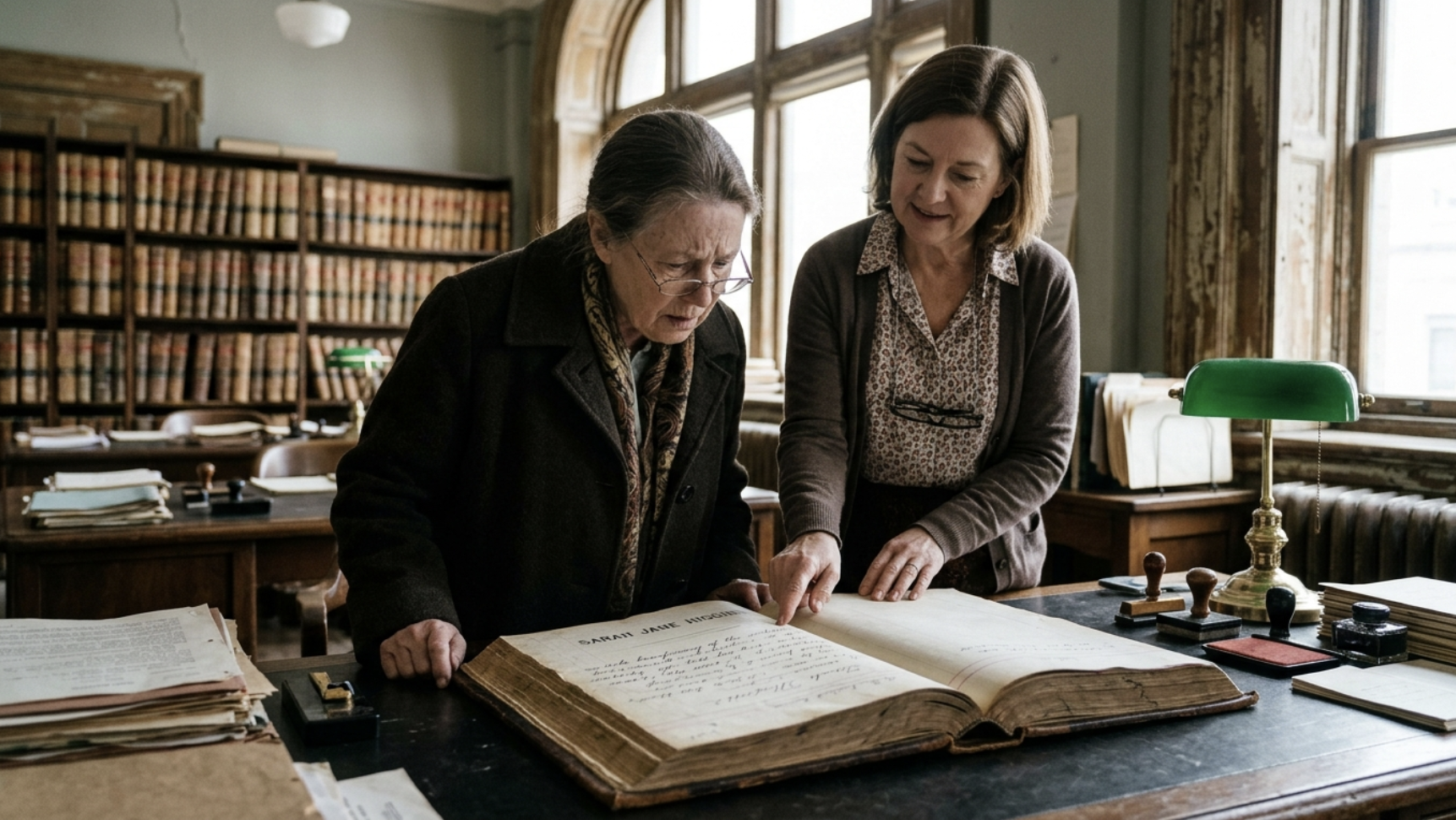
I’d walked those fields as a little girl behind my mother. I’d picked pecans there in the autumn. I’d watched Mrs. Henrietta Lockridge sit on her porch with a blanket over her knees, even when the weather was warm, simply because she liked watching the birds.
And now my name was written beside it.
“Rosella,” I whispered, “what am I looking at?”
She pulled a chair out for me.
“Sit down, honey.”
“I don’t understand.”
“I know.”
“Is this some kind of mistake?”
“No, Elnora. It isn’t.”
She sat across from me and folded her hands on the table.
“Henrietta came to the courthouse eleven months ago. She brought her attorney, her identification, and every document necessary to make sure this was done properly. She signed the deed in front of the people required to witness it. The transfer was recorded, and the original paperwork is in the file.”
I looked back at the book.
“But why would she put my name here?”
Rosella took a breath.
“Because she wanted you to have the property.”
The courthouse suddenly felt very quiet.
Somewhere down the hallway, a door slammed. A telephone rang at the counter. A man laughed at something someone had said.
The world continued as if nothing extraordinary had happened.
But my world had stopped.
“That can’t be right,” I said. “Mrs. Lockridge had three sons.”
“Yes, she did.”
“They’re her family.”
“And so were you, in the way that mattered most to her.”
I shook my head.
“No. No, ma’am. I was her housekeeper.”
Rosella’s expression softened.
“Is that what you thought you were?”
I didn’t answer.
She opened a folder and slid several pages across the table.
At the top was the name of a law firm in Nashville. Beneath it were dates, signatures, and the description of the property.
“This is the recorded deed,” she explained. “The property was transferred to you during Henrietta’s lifetime. This isn’t merely a wish she wrote down in a will. The county records show that the transfer was completed.”
I couldn’t make myself touch the pages.
“What about her boys?”
“They were not named as grantees on this deed.”
“But they’ll say she wasn’t thinking straight.”
“Henrietta’s attorney arranged for the necessary documentation when the deed was prepared. There are records concerning her capacity and the circumstances of the transfer. If her sons challenge it, the attorneys will have to deal with that.”
I looked at Rosella.
“Did she tell them?”
“I don’t know everything she discussed with her family. But I know she told me she wanted you to be informed, and she wanted me to make sure you received a copy of the recorded document.”
My fingers trembled as I picked up the first page.
The legal language was difficult to follow. I recognized a few words, but most of it looked like something written for people who had gone to school for years to understand what ordinary people couldn’t.
Then I saw the date.
Eleven months earlier.
I remembered that time.
Mrs. Lockridge had been unusually interested in my life. She’d asked about Alfreda, about my car, about whether I still had a mortgage, and whether my Social Security covered my expenses.
I’d assumed she was simply being thoughtful.
One Friday, she’d even asked whether I had ever considered buying a little house of my own.
I had laughed.
“At my age, Miss Henrietta? What would I do with a house?”
She’d stirred her coffee slowly.
“Live in it, honey. That’s what houses are for.”
I’d forgotten that conversation.
Now I wondered how many other things she’d said that I’d failed to understand.
“There’s something else,” Rosella said.
She reached into the folder and pulled out a sealed envelope.
My name was written across the front in the familiar handwriting I had seen on grocery lists, birthday cards, and the little notes she used to leave beside my coffee cup.
Elnora Ruthanne Whitsett.
The letters were slightly uneven, but every curve was hers.
I pressed the envelope against my chest.
“She wrote this for me?”
“She did. Her attorney instructed me to give it to you after I verified your identity and showed you the recorded deed.”
I couldn’t open it.
Not there.
Not in that courthouse, with strangers passing through the hallway and my hands shaking so badly I could barely hold the envelope.
“Can I take it home?”
“Of course.”
Rosella reached across the table and covered my hand with hers.
“Elnora, before you leave, there’s one more thing you need to understand. The deed transfers the property, but it doesn’t mean the matter is guaranteed to be free of disputes. There may be taxes, maintenance expenses, and questions about the estate. You should have an independent attorney review everything before you make any decisions.”
I nodded.
I was seventy-two years old. I’d raised a daughter, buried my mother, worked through illnesses, and lived long enough to understand that good news could sometimes arrive carrying a burden of its own.
But as I tucked the papers into my purse, one thought kept returning.
Why had Henrietta done this?
And why hadn’t she told me?
I thanked Rosella and walked outside.
The October sunlight was bright against the courthouse steps. I sat in my Buick for several minutes without turning the key.
Then I opened the envelope.
Inside was a single handwritten letter.
The first line nearly broke me.
My dearest Elnora,
If you’re reading this, then I have gone where you cannot follow me just yet. I wish I could be sitting across from you with a cup of coffee, watching you fuss over the crumbs on my table while I tell you something you probably won’t believe.
I laughed once, but it came out sounding like a sob.
I could almost hear her voice.
I kept reading.
For twenty-six years, you have come into my home and cared for it as if it mattered. But you did something far more important than clean my floors. You noticed when I was lonely. You noticed when I was frightened. You listened when my sons were too busy to hear me.
I have three sons, Elnora. I love them. I always will. But I have spent too many years confusing the love I feel for them with the things I believe I owe them.
They think the farmhouse is their inheritance. They have talked about selling it for years. Carlton wants to divide the proceeds. Thurston wants to develop the fields. Bertram has already made promises to people about land that does not yet belong to him.
They believe the house is a collection of boards, the grove is a collection of trees, and the fields are a number written on a bank statement.
You know better.
I stopped reading.
Through the windshield, I could see a woman helping an elderly man down the courthouse steps. She held his arm carefully, never once looking at her watch.
I thought of my mother.
She had worked on the Lockridge property for most of her adult life. She had never owned the house where she raised me. Every spring, she planted flowers along the tenant house porch, even though she knew the land wasn’t hers.
When I was a girl, I’d once asked her why she bothered.
She had smiled and said, “Because making something beautiful is never a waste, baby.”
Mrs. Lockridge’s letter continued.
I remember the winter your mother was sick. You were sixteen, and you missed three weeks of school because you were afraid to leave her alone. I remember bringing soup to your little house and finding you asleep beside her bed.
Your mother asked me to make you finish school. She said you were too smart to spend your life working for other people.
I promised her I’d help you.
I didn’t keep that promise the way I should have. I told myself I was helping by giving you work. I paid you fairly, or so I thought, and I let myself believe that was enough.
But I watched you grow older. I watched you put your daughter’s needs before your own. I watched you drive that old Buick with the bad heater through winters that would have kept me inside my house. And I watched my sons come home for holidays, eat my food, and leave without asking whether I needed anything.
I cannot change the years behind us. But I can decide what I do with the years and possessions I have left.
The farmhouse is yours now, Elnora. Not because I believe you need to spend the rest of your life caring for an old woman’s memories, but because you deserve a place where nobody can stand behind a screen door and tell you that you are no longer needed.
I pressed the letter against my mouth.
The tears came then.
Not because of the land.
Not because of the farmhouse.
Because she had seen me.
For twenty-six years, I had walked through that back door carrying cleaning supplies, groceries, and sometimes medicine she’d forgotten to order.
I had never expected to be remembered for anything beyond a clean kitchen.
Yet there I was, sitting in a parking lot, reading words that made me feel as if somebody had reached back through every difficult year of my life and placed a hand on my shoulder.
I continued.
There is something I need you to do before you decide what the property should become.
Go to the attic. In the cedar chest beside the old sewing machine, you will find a blue envelope with your mother’s name on it.
Please read what is inside before you speak with my sons.
And Elnora, one more thing.
Do not let anybody frighten you into giving away what you have been given. If you decide to sell the property someday, let it be because you want to. If you decide to live there, live there. If you decide to turn the tenant house into a home for someone who needs a fresh start, I believe your mother would smile at that.
For once in your life, my dear girl, make a decision that begins with what you want.
With all the love I should have said aloud more often,
Henrietta.
I sat in that parking lot until the sunlight moved across the dashboard.
Then I started the Buick and drove home.
For the first time in a week, I didn’t look at the three-hundred-dollar check sitting in my kitchen drawer.
I had something else to think about.
The cedar chest.
The blue envelope.
And the woman I had loved for twenty-six years without ever quite understanding how much she had been watching.
I returned to the farmhouse the following morning.
I didn’t tell Alfreda where I was going.
I knew she would worry, and I couldn’t bear to hear anyone suggest that I was being foolish before I had even taken the first step.
The long lane looked different as I drove down it.
The pecan trees were turning gold at their edges. Dry leaves gathered beside the fence. The old barn leaned slightly to one side, just as it had when I was a child.
The tenant house stood at the end of the lane.
Its white paint had peeled in places, and one of the porch steps sagged. But the porch swing was still there, hanging from the same thick chains.
I parked and walked toward the main house.
The back door was locked.
A new padlock hung from the handle.
I stood there for a moment, looking at it.
Then I remembered that the deed did not make me immune to foolishness. I had a recorded ownership document, but I wasn’t about to break a lock or force my way into a house occupied by someone who might dispute my rights.
I took photographs of the door, noted the date, and called the attorney whose name appeared on Henrietta’s letterhead.
His name was Samuel Price.
A receptionist took my information and promised to have him return my call.
I waited in the Buick for nearly twenty minutes.
When he finally called, his voice was calm and professional.
“Mrs. Whitsett, I’ve been expecting to hear from you.”
“You have?”
“Mrs. Lockridge told me you might need some help understanding the documents. Do you have a copy of the recorded deed?”
“I do.”
“Good. Don’t sign anything from her sons, and don’t agree to any sale or transfer until you’ve had independent advice. I can explain the paperwork Henrietta prepared, but I want you to understand that you are entitled to consult your own lawyer as well.”
“I understand.”
“Regarding the house, I recommend that we arrange a proper inspection and document the current condition. If the family is occupying or controlling the property, we’ll address that through the appropriate legal process. Please don’t get into a confrontation with them.”
I promised I wouldn’t.
Then I asked him about the cedar chest.
There was a pause.
“The blue envelope,” he said.
“You know about it?”
“I know Henrietta asked that you receive a personal letter. She didn’t tell me everything it contained. That was between her and you.”
“Can I get into the attic?”
“We’ll work out the proper arrangements for access. Give me a little time to contact the estate representative.”
I hung up and looked toward the farmhouse.
For the first time, I understood that owning a place and entering it were not always the same thing.
I could be patient.
I had spent twenty-six years waiting for coffee to finish brewing, biscuits to rise, and floors to dry. I could wait a little longer for the law to catch up with what Henrietta had done.
I drove home.
That afternoon, Carlton called.
I almost didn’t answer.
“Hello?”
“Elnora. Carlton Lockridge.”
His voice sounded different from the man who had handed me the check.
He was polite now.
Almost friendly.
“I wanted to discuss something with you.”
“All right.”
“My brothers and I are working through Mother’s affairs. There are some things that need to be settled regarding the farmhouse.”
I sat down at my kitchen table.
“What things?”
“Administrative matters. Documents. We need to make sure everything is handled correctly.”
“I agree.”
He cleared his throat.
“Mother had a habit of making arrangements without telling anyone. Toward the end, she could be quite stubborn.”
I remembered Henrietta correcting the county tax assessment from memory while recovering from pneumonia.
“She was stubborn,” I said. “She was also sharp.”
Silence.
“Yes,” Carlton said finally. “Well, that’s part of what we need to discuss.”
“What exactly do you want from me, Mr. Lockridge?”
The formal name seemed to catch him off guard.
“I’d rather speak in person.”
“Then have your attorney speak to mine.”
Another silence.
“Your attorney?”
“Mr. Price is helping me understand the documents.”
Carlton’s voice hardened.
“Why would you need an attorney, Elnora? You’re a longtime employee. Surely we can settle this as a family.”
I looked at the photograph of Henrietta that sat on my kitchen shelf.
She was standing beside the pecan trees, wearing a straw hat and holding a basket of flowers.
“A family doesn’t hand someone a check and shut the door in her face the morning after a funeral,” I said.
I had never spoken to Carlton like that before.
My heart pounded so hard I could hear it.
He said nothing.
Then he hung up.
I sat there for several minutes, shocked by my own words.
I wasn’t accustomed to defending myself.
My mother had taught me to be polite. Mrs. Lockridge had taught me to be patient. Life had taught me that sometimes the quietest person in the room was the one expected to swallow the most hurt.
But I had begun to understand something Henrietta wanted me to learn.
Being kind didn’t mean surrendering.
And being seventy-two didn’t mean I had run out of time to stand up for myself.
Three days later, Samuel Price called.
The estate representative had agreed to arrange supervised access to the farmhouse so that I could retrieve my personal belongings and the items Henrietta had specifically left for me.
I drove out on a Friday morning.
Carlton was waiting in the front parlor.
Thurston stood by the fireplace with his arms crossed. Bertram sat at Henrietta’s desk, looking through a stack of papers.
None of them offered me coffee.
That hurt more than I expected.
For twenty-six years, Friday mornings had belonged to Henrietta and me. Even when she was tired, even when she was upset with one of her sons, she always made time for our little ritual.
I could almost hear her saying, The dirt will wait.
Carlton approached me.
“Let’s keep this simple.”
“I would like that.”
“Mother’s property is complicated. There are debts, taxes, and responsibilities. You may not realize what you’ve agreed to by accepting this arrangement.”
“I haven’t agreed to anything beyond receiving the deed and asking an attorney to explain it.”
He glanced at Samuel Price, who had accompanied me.
Samuel spoke before Carlton could answer.
“Mrs. Whitsett has not signed any agreement relinquishing her rights. Today, we’re here to arrange access and retrieve the items identified in Mrs. Lockridge’s instructions.”
Thurston gave a short laugh.
“Her instructions? Mother left instructions for the gardener, too. Does that mean he owns the fields?”
Samuel remained calm.
“Any questions about the validity or scope of the deed can be addressed through the proper legal channels.”
Bertram pushed back his chair.
“This is ridiculous. We’re her sons.”
I looked at him.
“Yes, you are.”
“Then you understand why this is difficult for us.”
I did understand.
What I didn’t understand was why they believed their grief gave them the right to dismiss mine.
“I loved your mother,” I said quietly. “I miss her every morning. I know you loved her too. But I won’t pretend those twenty-six years meant nothing just because I’m not related to you by blood.”
Nobody answered.
Samuel asked the estate representative to accompany us upstairs.
The attic smelled of cedar, dust, and old paper.
The sewing machine sat beneath a sheet. Beside it was a cedar chest with brass hinges and a faded floral design on the lid.
I recognized it immediately.
My mother had once helped Henrietta polish it.
I knelt and lifted the lid.
Inside were folded quilts, an old photograph album, and a bundle of letters tied with blue ribbon.
At the bottom lay a blue envelope.
My mother’s name was written across it.
Martha Whitsett.
For a moment, I couldn’t breathe.
I had not seen my mother’s handwriting in more than thirty years.
I reached for the envelope, but my hands were trembling too badly to open it.
Samuel quietly stepped away to give me privacy.
I sat on the attic floor, surrounded by the dust and memories of a house that had shaped my entire life.
Then I opened it.
Inside was a letter dated thirty-six years earlier.
The first words were unmistakably my mother’s.
Henrietta,
I know you’ve offered to help Elnora, and I know you mean well. But I need you to understand something before I leave this world.
My daughter believes she must earn every kindness she receives. She thinks that if she works hard enough, if she never complains, and if she never asks for too much, people will finally understand how much she is worth.
Please don’t let her spend her whole life believing that.
I covered my mouth.
My mother had been sick for months when she wrote those words. She died before I turned thirty-seven, leaving me with a daughter of my own and more responsibilities than I knew how to carry.
I had never known she had written to Henrietta.
The letter continued.
Elnora has a good heart. Sometimes I worry that people will mistake that goodness for weakness. She will give until she has nothing left and then apologize for needing a little help herself.
If you can do anything for her, teach her that she is allowed to receive love without paying for it in labor.
I have no land to leave her. No money. No house that belongs to us. But I hope she will one day have a place where she can sit on the porch and rest without wondering who will come along and tell her she doesn’t belong.
Thank you for looking after my girl.
With gratitude,
Martha.
I read it twice.
Then a third time.
All those years, I had believed my mother left me with nothing but her memories and the determination to survive.
But she had left a message behind.
A message Henrietta had kept for decades.
I pressed the letter to my heart and cried in that attic as quietly as I had cried in the Buick outside the courthouse.
When I finally stood, I placed the letter carefully inside my purse.
There were other things in the chest: photographs, a small Bible, a handful of recipes written in my mother’s handwriting, and a photograph of the two of us standing beside the tenant house.
I took only the items Henrietta’s instructions identified as mine or intended for me, with Samuel documenting what I removed.
Before I left, I looked out the attic window.
The pecan trees stretched across the fields.
For the first time, I could imagine the land not as a place where I had spent my life serving others, but as a place where I might finally decide what my own life would look like.
Then I heard Thurston’s voice from the hallway.
“She has no idea what she’s getting herself into.”
I turned.
He stood in the doorway, his face flushed.
“You think a deed makes you one of us?” he demanded.
“No,” I said. “I never wanted to be one of you.”
His expression changed.
“I wanted to be treated like a person.”
He stared at me as if those words were something he’d never considered.
Then he walked away.
I followed Samuel downstairs.
At the front door, Carlton was waiting.
“We need to talk about a settlement,” he said.
I paused.
“What kind of settlement?”
“We could make you an offer. A generous one. You’d receive enough money to live comfortably, and we’d take responsibility for the property.”
I looked at him for a long moment.
A week earlier, I would have accepted almost anything to avoid a confrontation.
Three hundred dollars had been enough to make me feel small.
But now I had my mother’s letter in my purse and Henrietta’s words in my heart.
“I’ll consider any written offer after my attorney reviews it,” I said. “But I won’t agree to anything today.”
Carlton’s jaw tightened.
“You may regret making this difficult.”
I thought of the padlock on the back door.
I thought of the check he’d pushed through the screen.
Then I thought of Henrietta sitting across from me on Friday mornings, insisting that the dirt could wait.
“No, Mr. Lockridge,” I replied. “I think I’ve spent enough of my life making things easy for everyone else.”
And I walked out.
For the first time in twenty-six years, I left the farmhouse without wondering whether the kitchen floor was clean.
I had more important work to do.
I had to learn how to build a life that belonged to me.
And I had a feeling the Lockridge brothers were only beginning to show me why Henrietta had insisted that I read my mother’s letter first.
Because there was one more thing I had not yet discovered.
The letter had been written thirty-six years ago.
But tucked inside the blue envelope, beneath my mother’s final page, was a second sheet of paper.
It carried a date from just eleven months earlier.
And at the bottom, in Henrietta’s unmistakable handwriting, were six words that made my blood run cold:
They have already promised the land.
I didn’t know to whom.
I didn’t know what they had promised.
But I knew, with the kind of certainty that comes from living long enough to recognize trouble before it reaches the front porch, that the next time Carlton Lockridge called me, it would not be to offer me money.
It would be to ask me for something.
And this time, I intended to find out exactly what it was.
PART 4
The next morning, Samuel Price called me before I had finished my coffee.
“Elnora, I need you to come to my office. There’s something you should know about that second sheet of paper.”
I sat down slowly.
“What is it?”
“Henrietta left instructions concerning a proposed sale of part of the property. Her sons had been negotiating with a developer, but the transaction was never completed. The developer’s attorney has contacted the estate.”
I stared at my kitchen wall.
“So they were trying to sell her land before she died?”
“They were discussing a possible deal. Whether they had authority to make any binding commitments is another question. Your recorded deed changes the situation considerably.”
I thought about Henrietta’s letter.
They have already promised the land.
“Mr. Price, what did she want me to do?”
“I believe she wanted you to understand what was happening before anyone pressured you into signing something. Come in, and we’ll review the documents together.”
I drove to his office that afternoon.
On his desk lay a thick folder containing copies of emails, a proposed purchase agreement, and a map of the Lockridge property.
The developer wanted the fields behind the farmhouse for a commercial project. The plan included warehouses, a parking area, and a new access road.
The pecan grove was marked for removal.
So was the tenant house.
My childhood home.
I touched the map with one finger.
“They want to tear everything down?”
“That’s what the preliminary plan shows,” Samuel replied.
I remembered my mother planting flowers beside the porch. I remembered the swing creaking in the evening breeze. I remembered Henrietta bringing me biscuits when I was a girl and telling me not to worry about the future.
The future had arrived.
And it wanted to bulldoze the past.
“What happens now?” I asked.
“Because the deed was recorded before Henrietta’s death, the developer cannot simply assume her sons have the authority to sell the property. We need to establish exactly what agreements were made, whether any rights were granted, and what obligations, if any, remain. We’ll also arrange for an independent attorney to review your position.”
I nodded.
Then Samuel showed me another document.
It was a letter from Henrietta to the developer, dated several months before her death.
She had refused their proposal.
Her handwriting was firm.
This land is not available for purchase. I have made my decision, and I will not discuss the matter further.
Beneath the letter was a handwritten note Samuel had found in the file.
If they try again after I’m gone, make sure Elnora knows she has a choice.
I sat very still.
All those years, I’d thought Henrietta’s greatest concern was whether her curtains were clean or her garden had been watered.
I hadn’t understood that she had been fighting to preserve something.
Not merely a house.
A piece of land that held generations of memories.
And she had trusted me to decide what happened next.
Two days later, the Lockridge brothers came to my house.
All three of them.
I watched from my kitchen window as Carlton stepped out of his expensive car, followed by Thurston and Bertram. They looked uncomfortable standing beside my old Buick and the flowerpots on my front porch.
I opened the door but didn’t invite them inside.
Carlton cleared his throat.
“Elnora, we need to settle this situation.”
“What situation?”
“Mother’s property.”
I folded my arms.
“My attorney is handling the legal matters.”
“We aren’t here to argue,” Bertram said. “We’re here to make you an offer.”
Thurston handed me an envelope.
Inside was a proposed agreement offering me a substantial sum in exchange for transferring the farmhouse and all associated land to the brothers.
The amount was far more money than I’d ever held in my bank account.
For a moment, I imagined what it could do.
A new roof. A reliable car. A comfortable retirement. Money for Alfreda. Enough to stop worrying every time the electricity bill arrived.
Then I imagined the pecan trees disappearing.
The tenant house becoming rubble.
And the long lane where my mother had walked beside me when I was little.
“Why do you want me to sell?” I asked.
Carlton sighed.
“Because the property is valuable, and managing it will be expensive. You’re seventy-two years old. Do you really want to spend the rest of your life worrying about a farm?”
“I’ve spent most of my life worrying about everybody else.”
“That isn’t fair,” he said.
I looked directly at him.
“Neither was the three-hundred-dollar check.”
His face reddened.
“I was dealing with Mother’s death. I wasn’t thinking clearly.”
“You could have said you were sorry.”
He looked away.
For the first time, I saw something other than arrogance in his face.
But an apology, even a sincere one, wouldn’t settle the question before us.
I handed the envelope back.
“I’m not signing anything today. My attorney will review your offer.”
Thurston shook his head.
“You don’t understand what you’re turning down.”
“Perhaps not. That’s why I have an attorney.”
Bertram stepped closer.
“Mother would never have wanted her sons fighting over a farm.”
“No,” I said quietly. “She would have wanted her sons to treat people with kindness, even when they didn’t stand to inherit anything from them.”
Nobody answered.
They left without another word.
That evening, Alfreda came over.
I’d finally told her everything.
READ CONTINUE ENDING PART
They Fired the 72-Year-Old Housekeeper After the Funeral—Then the Courthouse Revealed Whose Name Was on the Deed
Part 1 of 2