“I need eyes on everyone in that backyard,” I said, and my own voice sounded too calm to belong to me.
Lily shifted beside me, her breath catching in tiny broken pulls that made my chest tighten with every sound.
The voice on the line said, “Medical first, Arthur. Whatever else happens, she needs a hospital that cannot be reached by him.”
I looked at Richard walking toward the truck, slower now, his smile pulling apart at the corners like wet paper.
He had finally noticed the change in the air, the way people stopped pretending this was only an embarrassing family scene.
His mother stood behind him, one hand pressed against her throat, watching my dashboard light blink like it had teeth.
“Arthur,” Richard said again, softer this time. “Let’s not make something ugly out of a misunderstanding.”
That word sat between us like spoiled food.
Misunderstanding.

Lily’s fingers tightened once, then slipped from my sleeve as if even holding on took too much strength.
I wanted to step out. I wanted to put my hands on Richard and teach him the difference between fear and consequence.
But Lily made a small sound, barely more than air, and it pulled me back into the only choice that mattered.
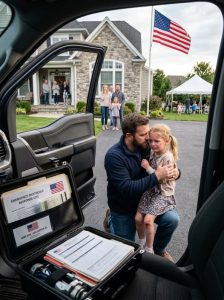
I shut the passenger door gently, then locked it, keeping the satellite phone pressed between my shoulder and ear.
“Nearest safe facility is St. Anne’s regional,” the voice said. “Forty-one minutes east. State jurisdiction, not local.”
Richard stopped three steps from my truck when he heard that word through the cracked-open window.
State.
It landed differently than p0lice, differently than lawsuit, differently than any threat he had bought his way around before.
Behind him, the Chief looked up from the barbecue, still holding his paper plate, but no longer laughing with anyone.
For the first time that afternoon, the man with the badge seemed unsure where to put his hands.
I started the engine.
Richard’s mother moved fast for a woman who always acted like walking was beneath her.
She came around the front of the truck and planted herself there, palms raised, face tight with outrage.
“You are not taking my son’s wife anywhere,” she said, loud enough for the lawn to hear.
I watched her through the windshield and remembered Lily at seven, standing on my boots to reach the kitchen counter.
She had been making Easter eggs with vinegar and food coloring, her hands stained blue and pink for two days.
Back then, she had asked me if families always stayed families, even when people made mistakes.
I had told her yes, because fathers lie when the truth is too heavy for a child.
Now that lie sat in my mouth like ash.
“Move,” I said.
Richard’s mother did not.
The satellite voice asked, “Is there an obstruction?”
“Yes,” I said. “Non-lethal. Witnessed. Recorded.”
Something about the words made Richard look toward the dash camera again, then toward the guests gathered behind the glass.
Those guests had not helped Lily, but they understood cameras. They understood liability. They understood the smell of ruin.
A woman near the porch took one cautious step backward, as if distance could clean her from what she had watched.
The Chief finally started moving across the lawn, wiping sauce from his fingers onto a paper napkin.
“Arthur,” he called, forcing warmth into his tone. “Why don’t we all take a breath and talk this through?”
His badge flashed at his belt, small and bright, while Lily lay folded in my passenger seat like a discarded promise.
I lowered my window two inches.
The Chief’s eyes flicked past me to Lily, then away too quickly.
That single glance told me more than any confession could have.
He knew.
Maybe not every detail, maybe not every night, but enough to know why no one had called him from inside that house.
“Chief,” I said. “You are currently standing at a private party hosted by the suspect, after witnessing an injured woman being removed.”
His face hardened, not with guilt, but with irritation at being described accurately.
“Careful,” he said.
That was when Lily opened her swollen eye as much as she could and whispered, “He saw me last Christmas.”
The words were so soft I nearly missed them beneath the engine’s idle.
But Richard heard enough.
His face changed.
Not fear. Not yet. Something sharper. The anger of a man realizing someone he owned had spoken without permission.
Last Christmas came back in pieces I had refused to arrange before.
Lily wearing a scarf indoors. Richard joking she was always cold. The Chief laughing too loudly beside the fireplace.
I had asked if she was alright, and she had smiled with that same half-second delay.
A father learns certain sounds.
He also learns how many times he forgave himself too easily.
The voice on the phone said, “Arthur, leave now. Do not engage further. We have the recording.”
Richard’s mother slapped both hands onto my hood.
The sound cracked across the driveway, and every conversation behind her disappeared.
For one second, nobody moved.
Then Lily whispered, “Dad, please.”
Not please hurt him.
Not please punish them.
Just please.
The word was smaller than justice and heavier than rage.
I put the truck in reverse.
Richard’s mother stumbled back, startled that the world did not stop simply because she demanded it.
I backed down the drive slowly, not because I was afraid of them, but because the dash camera was still recording everything.
Richard walked alongside the truck for several yards, his mouth moving with threats I could not hear through the glass.
His hand struck the window once, hard enough to make Lily flinch into herself.
That flinch made my vision narrow.
The road behind me bent past hedges trimmed into perfect shapes, past white lilies tied to the mailbox, past rented Easter beauty.
At the gate, I stopped long enough for it to open, and Richard’s reflection appeared in my side mirror.
He was standing in the driveway now, surrounded by guests who suddenly looked like strangers at their own party.
The Chief had one hand near his phone, but he was not calling for help.
He was calling for control.
We drove out.
For three miles, neither of us spoke.
The road rolled beneath the tires with a low steady hum, and Lily’s breathing filled every space inside the cab.
I kept one hand on the wheel and one hand near her wrist, counting the pulse beneath her skin.
The satellite phone stayed open on the seat between us, the calm voice checking in every few minutes.
At the first red light outside town, Lily turned her face toward the window and started crying without sound.
That silence broke something in me more completely than screaming would have.
“I should have come sooner,” I said.
Her answer came after a long pause, and it was not the answer I wanted.
“I stopped calling sooner.”
The light turned green.
I did not move until the car behind us honked, a sharp ordinary sound from an ordinary world.
Lily stared at her own hands.
“He always said you’d make it worse,” she whispered. “He said you’d come in angry, and everyone would believe him.”
The worst part was that Richard had studied me well enough to make the lie useful.
I had been angry my whole life when it mattered least, then quiet when my daughter needed questions instead of pride.
“I believed I was protecting you by not interfering,” I said.
Lily closed her eyes. “I believed marriage meant trying harder.”
There it was.
Two people sitting in a truck, both holding broken pieces of the same gentle lie.
The voice on the phone said, “Arthur, a state unit is rerouting toward St. Anne’s. Do not stop for local vehicles.”
Almost as if summoned by the warning, blue lights appeared far behind us in the mirror.
Not close. Not fast. Just present.
Lily saw them too.
Her whole body stiffened, and one hand reached for the door as though she needed somewhere to escape.
“No,” she breathed. “No, no, no.”
“It’s okay,” I said, though nothing about that moment was okay.
The blue lights stayed back, matching our speed.
A local cruiser.
Of course it was.
The choice came then, not like thunder, not like some movie moment, but like a hand closing around my throat.
Pull over and trust the shape of the law, even when the law had eaten lunch in Richard’s backyard.
Keep driving and turn myself into exactly the kind of man Richard would describe later.
A reckless father.
A violent old soldier.
A lonely man stealing another man’s wife because he could not accept losing his daughter.
The lies were already waiting for me.
They would have clean suits, calm statements, and smiling photographs from Easter Sunday.
Lily touched my arm.
“Dad,” she said. “I don’t want you to disappear because of me.”
Those words almost made me pull over.
Not because the cruiser deserved obedience, but because my daughter had already lost too much to men making choices around her.
I looked at her then, really looked, past the swollen cheek and the split lip, to the child who once asked if families stayed families.
“This one is yours,” I said. “Do we stop, or do we keep going to the hospital?”
Her breath trembled.
The cruiser lights pulsed red and blue across the rear window, washing her face in colors that made her look both young and exhausted.
For a few seconds, time stretched thin enough to hear everything.
The tick of the turn signal I had not realized was on.
The soft rattle of the satellite phone against the console.
Lily swallowing pain before she answered.
“Hospital,” she whispered.
That was the choice.
Not revenge.
Not pride.
Not the old life I had buried in a black case beneath my dashboard.
Just a father driving his daughter toward help, while the world behind them tried to drag her back.
I pressed the accelerator gently.
The cruiser followed.
The satellite voice said, “State unit is six minutes from intercept. Maintain speed. Cameras are live.”
I did not ask which cameras.
Some questions belong to lives a man has left behind, and I had already opened that door too wide.
Lily leaned her head back and watched the road ahead through half-closed eyes.
“I thought if I told the truth,” she said, “everyone would lose something.”
I kept my eyes forward.
“You were right,” I said. “Truth always takes something.”
Her mouth trembled.
“What does it take from us?”
I wanted to tell her nothing.
I wanted to promise that by nightfall Richard would be gone, the house would be quiet, and she would sleep without fear.
But easy promises had already done enough damage.
“It takes the version of our lives where we pretend we didn’t know,” I said.
She turned her face away, and one tear slid into her hairline.
The cruiser behind us suddenly accelerated.
For a breath, the whole road seemed to narrow.
Then two state vehicles appeared ahead, turning onto the highway with clean, silent authority.
The local cruiser slowed immediately.
It did not stop. It just fell back, like a dog remembering the edge of its chain.
Lily saw it happen.
Her hand found mine, and this time she did not flinch.
At St. Anne’s, nurses met us before I had fully parked.
Someone must have called ahead, because no receptionist asked for insurance, and no one told Lily to wait.
They brought a wheelchair, but Lily looked at it for a long second before shaking her head.
“I can walk,” she whispered.
I wanted to carry her again.
Instead, I stepped back.
She stood slowly, one hand gripping the open truck door, knees trembling beneath her Easter dress.
Every inch of movement cost her something, but she took those steps herself.
Inside, the hospital smelled of sanitizer, coffee, and rain-soaked coats, though the sky outside was still clear.
A nurse asked Lily whether she felt safe answering questions without me in the room.
Lily looked at me.
There was fear there, but something else too.
A small, painful request to be allowed ownership of her own voice.
“I’ll be right outside,” I said.
The door closed between us with a quiet click.
That click was the loudest sound of the day.
I stood in the hallway, my hands empty for the first time since her call.
On the wall across from me, a framed print showed a field of yellow flowers under a soft blue sky.
It was the kind of harmless picture hospitals hang so people have somewhere to put their eyes while falling apart.
The satellite phone vibrated in my pocket.
“Arthur,” the voice said. “The recording from Lily’s phone uploaded before the device went dark.”
I closed my eyes.
That meant the room was preserved.
Richard’s voice. His mother’s shove. The guests’ silence. The Chief’s presence. Lily’s whisper. My own restraint.
All of it.
“There is more,” the voice said.
I opened my eyes.
Across the hall, through the narrow window in the exam room door, I saw Lily speaking to the nurse.
Her shoulders were shaking, but she was speaking.
“What more?” I asked.
“The local department logged a welfare call from your daughter last December,” the voice said. “It was closed by the Chief personally.”
The framed yellow flowers blurred.
Last Christmas.
The scarf.
The laugh half a second late.
The Chief beside the fireplace, lifting his glass like nothing in that house could ever touch him.
I wanted the truth because it was right.
But in that hallway, I understood what truth would do.
It would not only break Richard.
It would break every memory Lily had tried to keep clean.
It would prove that help had been close before, close enough to hear her, and had chosen comfort instead.
The nurse opened the exam room door.
“Mr. Hale,” she said gently. “Your daughter is asking for you.”
I stepped toward the room, then stopped when I saw what Lily held in her hand.
The nurse had given her a form.
A formal statement.
Lily’s thumb rested near the signature line, trembling over the place where silence could finally end.
She looked at me, and for the first time that day, she did not ask me what to do.
She asked something harder.
“If I sign this,” she whispered, “there’s no going back, is there?”
The hallway seemed to lengthen behind me.
Somewhere outside, a siren passed and faded.
I thought of Richard’s polished house, his mother’s diamond ring, the Chief’s paper plate, and every guest who had lowered their eyes.
Then I thought of Lily at seven, hands stained blue and pink, asking whether families always stayed families.
I sat beside her, careful not to touch her until she leaned into me first.
“No,” I said. “There’s no going back.”
Her eyes filled, but she did not look away.
I placed my hand flat on the table, beside hers, not over it.
“But there is forward.”
Lily looked down at the form.
For a long moment, the pen did not move.
Then she picked it up.