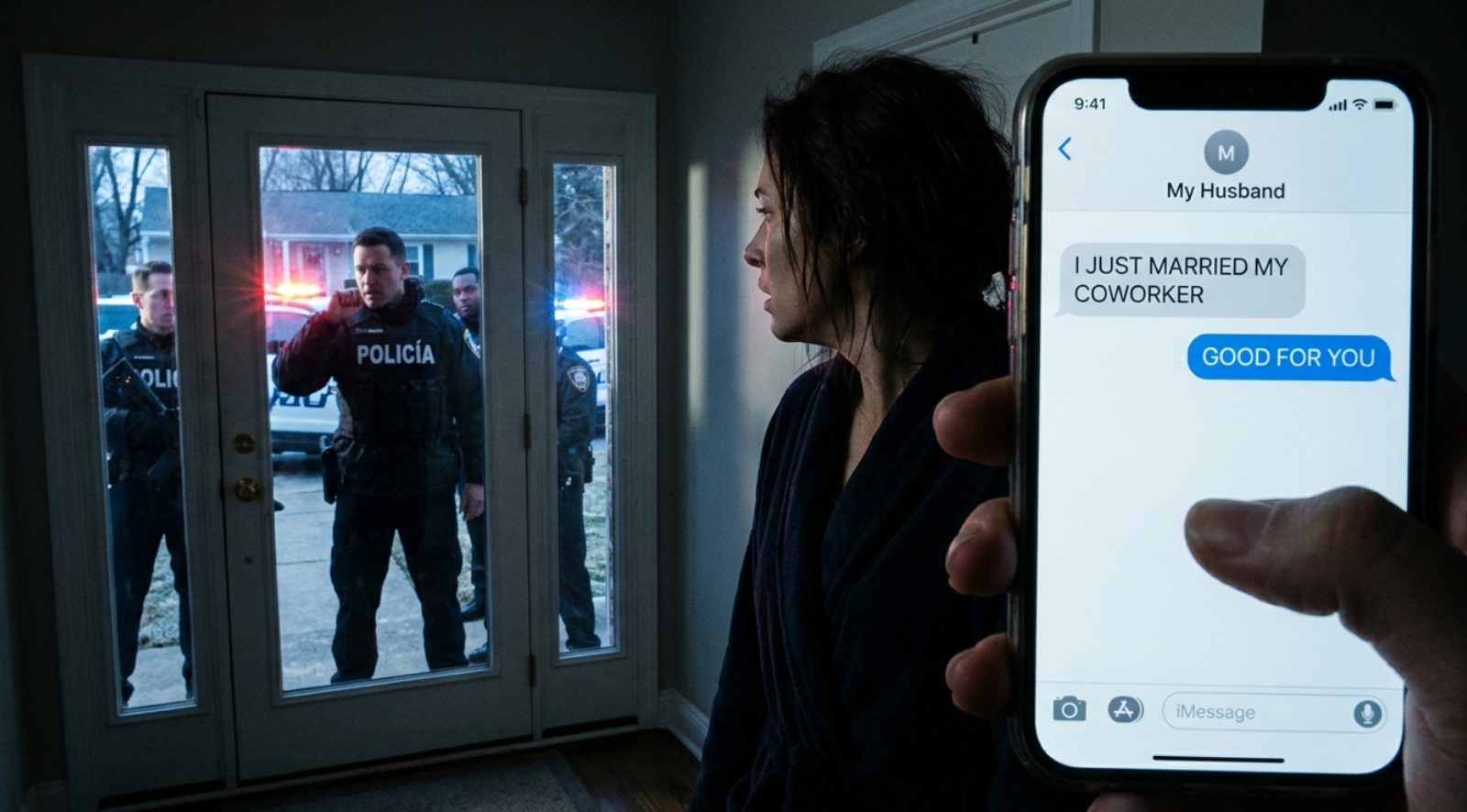
PART 3
He looked at his mother, then at Rebecca, then at me.
For six years, I had watched this man talk his way out of late payments, broken promises, and debts he swore he would repay. He could turn an argument into an apology and an apology into a reason why everyone else owed him sympathy.
But standing in my driveway, surrounded by boxes containing everything he owned, Steven seemed to have run out of words.
Rebecca turned to me.
“Chloe, please. Did you really know nothing about us?”
I studied her face.
She was younger than me by several years. Her makeup was running beneath her eyes, and the white dress she had worn so proudly earlier that day was now wrinkled and stained from the long trip back to Austin.
“I knew nothing about you until 2:47 this morning,” I answered. “That was when your husband decided to inform me that he’d married you.”
“He told me you two were separated.”
“We weren’t.”
“He said you slept in different rooms. That you hadn’t been intimate in years. That you were basically roommates.”
I almost laughed.
Steven and I had slept in separate rooms for the last three months, but not because I had stopped loving him. He had claimed he needed better sleep for work. I had accepted his explanation because I was tired of arguing about every small thing.
Now I understood why he had wanted privacy.
“He also told me he owned this house,” Rebecca continued, looking around the driveway. “He said he had invested money in it.”
I glanced at Steven.
“Is that true?”
He said nothing.
“Steven?”
“It’s complicated.”
“No. It’s actually very simple. I purchased this house three years before we met. You have never paid the mortgage, the property taxes, or the insurance. If you invested anything, perhaps you can show us the receipts.”
Lily stepped forward.
“You don’t have to humiliate him!”
I looked at her.
“Your brother sent me a message calling me pathetic because my life was boring. He announced that he’d married another woman while he was still married to me. Then he sent the police to my house because I changed the locks. Which part of this situation do you believe I created?”
Lily opened her mouth, but nothing came out.
For a moment, nobody spoke.
Then Steven pointed at the boxes.
“Fine. Give me my things. I’ll get a lawyer, and you’ll regret every second of this.”
“Your belongings are here. You can take them.”
“And my money?”
“What money?”
“The money in our joint savings account!”
I looked directly at him.
“The joint savings account has been closed.”
His face went pale.
“You can’t do that!”
“It’s a joint account. I haven’t touched any funds that aren’t mine. I transferred my documented personal contributions into an account in my name after speaking with my bank, and I have kept the records. Any remaining disputed funds will be handled through the proper legal process.”
That was not the answer he had expected.
For years, Steven had assumed that because I worked in finance, I would always clean up his financial messes.
He had mistaken my competence for obedience.
He had mistaken my patience for weakness.
And now he was discovering the difference.
Rebecca stared at him.
“You said we had enough money to buy a house.”
“We do.”
“You said the savings were yours!”
“Rebecca, stop making this worse.”
She shook her head slowly.
Then she asked the question that made Margaret go completely silent.
“Steven, did you use my money to pay off your credit cards?”
His expression answered before he did.
“That’s not what happened.”
“Then what happened?”
“It’s complicated.”
“You keep saying that!” Rebecca screamed. “Everything with you is complicated when someone asks where the money went!”
I stepped back toward the garage.
“You have your belongings, Steven. If you need anything else, contact my attorney. I won’t be discussing this in my driveway.”
He stared at me with an expression I had never seen before.
Fear.
Not fear of losing me.
Fear of losing control.
As I closed the garage door, I heard Rebecca demanding to see his phone and Margaret insisting that everyone needed to calm down.
I went inside, locked the door, and finally allowed myself to sit down.
My hands were shaking.
I had spent the entire day pretending I was made of stone, but the truth was that I was a woman whose marriage had just collapsed in less than twelve hours.
I had loved Steven.
I had defended him when my friends questioned his behavior. I had made excuses for his unemployment spells, his spending, his selfishness, and his endless promises to become the man he claimed he wanted to be.
Somewhere along the way, I had started believing that if I worked harder, loved more patiently, and complained less, we would eventually become the couple I had imagined on our wedding day.
Instead, I had become the person who paid for the life he wanted while he searched for someone else to blame for his unhappiness.
I pressed my palms against my eyes.
And for the first time since reading his message, I cried.
I cried for the six years I couldn’t recover.
I cried for the woman I had been before I learned to measure love by how much disappointment I could tolerate.
And I cried because, despite everything, a small and humiliating part of me still wanted him to knock on the door and tell me he had made a terrible mistake.
But no one knocked.
My phone rang instead.
It was my best friend, Natalie.
“Chloe, are you home?”
“Yes.”
“Good. I’m coming over.”
“You don’t have to.”
“I know. I’m coming anyway.”
Twenty minutes later, Natalie arrived with takeout, a bottle of sparkling water, and the kind of expression that suggested she was prepared to commit several nonviolent acts of revenge.
She listened while I told her everything.
When I finished, she sat quietly for a moment.
Then she said, “I’m going to ask you something, and I need you to answer honestly.”
“What?”
“Did Steven ever have access to your financial records beyond the accounts you shared?”
I frowned.
“He knew my income. He knew about the house. He had access to our joint account and was an authorized user on some of my cards.”
“I’m not asking about the accounts he used. I’m asking whether he could access your personal financial information.”
I thought about it.
During the second year of our marriage, Steven had helped me organize documents for a mortgage refinancing application. He had known my Social Security number, and he had once used my laptop to print tax forms.
“I don’t know,” I admitted. “Why?”
“Because men who suddenly announce they’ve married someone else don’t always leave quietly. Especially when they’ve spent years benefiting from your money.”
Her words unsettled me.
After dinner, I opened my laptop and reviewed my personal accounts.
The balances looked normal.
My credit cards were canceled or secured.
My retirement account appeared untouched.
Then I checked my email.
There was a notification from my credit monitoring service.
A new credit inquiry had been made that morning.
I stared at the screen.
The inquiry was associated with a financial institution I had never used.
And it had been submitted using my personal information.
I immediately contacted the institution’s fraud department. The representative verified my identity and told me the inquiry was connected to a loan application.
An application submitted under my name.
I felt the room tilt.
“I never applied for a loan,” I said.
The representative placed me on hold.
When she returned, her voice was more serious.
“Ms. Rivers, the application has not been approved. However, the information submitted includes your personal details and an unfamiliar email address. We recommend that you report this as suspected identity theft and place appropriate fraud alerts on your credit file.”
I thanked her and ended the call.
Natalie had gone completely still.
“Chloe,” she whispered, “what if the marriage announcement wasn’t the only thing he planned to do today?”
I didn’t answer.
I was staring at the date and time of the application.
It had been submitted at 1:16 a.m.
Less than ninety minutes before Steven texted me from Miami.
And the email address associated with the application contained his initials.
For several minutes, I could barely breathe.
I had thought the worst thing Steven had done was betray our marriage.
Now I was beginning to wonder whether he had been preparing to betray me financially long before he boarded his flight.
I saved the notification, downloaded the available records, and wrote down the customer service representative’s name.
Then I called a lawyer.
Not a divorce lawyer recommended by a friend.
A family law attorney who also understood financial misconduct.
By the time I finished explaining the situation, it was nearly nine in the evening.
“Don’t confront him about the application yet,” the attorney advised. “Preserve every record. Secure your accounts. Report the suspected fraud through the appropriate channels. And don’t make assumptions about what happened until we have the documents.”
I promised I would.
When I hung up, Natalie squeezed my hand.
“You’re going to be okay.”
I wanted to believe her.
But at 10:32 p.m., another message arrived from an unknown number.
I almost deleted it.
Then I read the first line.
CHLOE, IT’S REBECCA. I THINK STEVEN HAS BEEN LYING TO BOTH OF US.
I stared at the message for several seconds before replying.
“What do you mean?”
Her response came almost immediately.
“He told me you were divorcing him and that you had agreed to help him get a business loan. He said you knew about the wedding and didn’t care. He showed me a document with your signature.”
My stomach tightened.
“What document?”
“A loan guarantee. It says you’re responsible if he doesn’t repay the money.”
I sat upright.
“Rebecca, I never signed any loan guarantee.”
There was a long pause.
Then she sent a photograph.
I opened it.
The document carried my full legal name, my address, and what appeared to be my signature.
For a few seconds, the room became completely silent.
The signature looked convincing.
But I knew I hadn’t signed it.
I had spent more than a decade reviewing contracts, financial statements, and legal documents. I knew how my own signature looked. I also knew that a convincing signature did not prove that a document was authentic.
I enlarged the photograph.
At the bottom was a company name I recognized.
It belonged to a small consulting business Steven had started two years earlier.
A business I had believed he abandoned.
I read the document again.
The loan amount was $185,000.
My name appeared beneath the words personal guarantor.
And the date beside the signature was six weeks earlier.
I felt something cold settle in my chest.
Six weeks earlier, Steven had taken me to dinner and told me he wanted to start over.
He had apologized for being distant. He had promised to take more responsibility around the house. He had even brought me flowers.
That same week, he had asked me to print several financial documents because his laptop wasn’t working properly.
I had printed them.
I hadn’t signed anything.
I looked at Rebecca’s photograph again.
“Where did you get this?” I asked.
“From his briefcase. He left it in the hotel room when he went downstairs. I was looking for my passport.”
“Does he know you have it?”
“No.”
“Don’t confront him about it yet. Keep the original document safe, if you can do so without putting yourself at risk. Don’t alter it. My attorney will need to review it.”
Rebecca sent a single word.
“Okay.”
Then, after another minute, she wrote:
“Chloe, I’m sorry.”
I stared at those two words.
An apology from the woman my husband had married behind my back.
I wasn’t ready to forgive her. I wasn’t even sure I believed her.
But I knew one thing.
Whatever Steven had done, I wasn’t going to let either of us destroy evidence or make reckless decisions out of anger.
I replied, “Tell the truth, keep yourself safe, and let the lawyers handle the rest.”
Then I put my phone down.
For the first time that day, my tears had stopped completely.
I opened a new folder on my laptop.
I named it STEVEN — FINANCIAL RECORDS.
Inside, I saved the text message, the credit inquiry, the photograph of the loan guarantee, and every document I could locate concerning his business.
I didn’t know yet whether Steven had forged my signature.
I didn’t know whether the loan had been approved.
And I didn’t know what other secrets he had buried beneath six years of marriage.
But I knew I would find out.
At 11:48 p.m., my doorbell rang.
I checked the security camera.
Steven stood on my porch alone.
He had no suitcase, no boxes, and no charming smile.
He looked directly into the camera.
“Chloe,” he said, his voice trembling, “please open the door. We need to talk.”
I didn’t move.
Then he leaned closer to the camera and whispered six words that made my blood run cold.
“You don’t understand what you’ve done.”
And for the first time since this nightmare began, I wondered whether Steven had returned because he regretted losing his wife—or because he had finally realized that the woman he had betrayed was the only person who could expose everything he had done.
PART 4
“You don’t understand what you’ve done.”
I watched Steven through the security camera, standing on my porch as if he still had the right to command my attention.
I didn’t open the door.
Instead, I spoke through the intercom.
“I understand perfectly, Steven. You married another woman while you were still married to me. Now you can explain everything to my attorney.”
His expression changed.
“Chloe, listen to me. That loan application isn’t what you think it is.”
“Then you won’t mind explaining it to the police.”
He stopped talking.
That silence told me more than any confession could have.
“Please,” he said finally. “We have six years together. Don’t destroy my life over a misunderstanding.”
I almost laughed.
“You sent me a message calling me pathetic. You told me you’d married Rebecca. You didn’t even have the courage to tell me in person. And now you’re asking me to protect your life?”
“I was angry.”
“You were married.”
“I made a mistake!”
“No, Steven. A mistake is forgetting an anniversary. You made a series of decisions, and now you don’t like the consequences.”
He struck the door with his palm.
“Open this door!”
I stepped away from the entrance and called the police non-emergency line. I explained that my estranged husband was outside, shouting and refusing to leave. I told the dispatcher about the earlier incident and asked that the situation be documented.
When Steven realized I wasn’t coming outside, he began pacing.
“You think you’re so smart,” he muttered toward the camera. “You think you can take everything from me.”
I watched until the officers arrived.
This time, Steven didn’t try to explain his marriage.
He simply walked away.
Before getting into his car, he looked directly at the camera again.
I knew that look.
For six years, I had seen it whenever something didn’t go his way.
Steven wasn’t sorry.
He was frightened.
And the next morning, I learned why.
The Investigation Begins
At 9:00 a.m., I sat in the office of my attorney, Daniel Mercer, with a folder containing every document I had collected.
Daniel was in his fifties, with silver hair, a calm voice, and the kind of expression that made people feel they could tell him the truth without being judged.
He examined the loan guarantee, the credit inquiry, and the messages.
“First, we’re going to protect you,” he said. “We’ll dispute the application, notify the relevant institutions that you deny authorizing it, and preserve the evidence. We’ll also begin the divorce process.”
“What happens if he forged my signature?”
“That depends on the evidence and the applicable law. But if the document is fraudulent, the people who submitted or relied on it need to know. We won’t make accusations beyond what we can support.”
He arranged for me to speak with the appropriate fraud investigators and helped me prepare a formal record of the events.
Then he asked a question that made me think about my marriage differently.
“Did you ever invest money in Steven’s consulting company?”
“No. He asked me for advice occasionally, but I never invested.”
“Did you ever authorize him to use your identity for business financing?”
“Never.”
Daniel nodded.
“Good. We need to establish exactly what information he had access to and whether he used it without permission.”
For the next two hours, we reviewed the documents.
The company had been registered two years earlier. Steven had told me it was a small consulting operation that never gained traction.
Yet the loan application suggested the business had been seeking substantial financing.
There was also a second document: a financial statement listing assets that appeared to belong to me.
My house.
My savings.
And an investment account I had built over twelve years of employment.
Steven had presented those assets as evidence that the proposed loan was secure.
I felt sick.
He hadn’t simply lied about our marriage.
He might have been trying to turn the life I had built into collateral for a business I knew almost nothing about.
Daniel closed the folder.
“Don’t contact him directly about any of this. Let the investigators handle the financial questions. And don’t sign anything he sends you.”
I nodded.
Then I asked the question that had haunted me all morning.
“Can he take my house?”
Daniel looked at me firmly.
“Your house was purchased before the marriage and is titled in your name. That is important evidence of your separate ownership, though we still need to review the relevant Texas law and any potential claims. A loan document bearing your name doesn’t automatically make it valid. We will challenge anything that was not properly authorized.”
For the first time in two days, I felt I could take a full breath.
I wasn’t powerless.
I was simply dealing with something I had never expected from the person I trusted most.
Rebecca Reveals Everything
Three days later, Rebecca contacted me again.
This time, she asked if we could meet somewhere public.
I agreed to meet her at a coffee shop near my attorney’s office. Daniel knew about the meeting, and I told Rebecca beforehand that I wouldn’t accept original documents or make any agreements without legal advice.
When she arrived, she looked exhausted.
She sat across from me and placed a thick envelope on the table.
“I know you don’t owe me anything,” she began. “But I need to tell you the truth.”
I waited.
“Steven told me you were separated. He said you had been living separate lives for almost a year and that the divorce was delayed because of financial paperwork. He said you knew about me.”
“Did you ever speak to me before the wedding?”
“No.”
“Did you ever ask to see the divorce papers?”
She looked down.
“He showed me a document that he said was proof you had filed. I didn’t understand what I was looking at. I wanted to believe him.”
I couldn’t help asking, “And the wedding?”
“He told me it was legal. He said there was no reason to wait.”
Her voice broke.
“I found out the truth when I searched for the marriage paperwork. I couldn’t understand why he was avoiding my questions. Then I discovered that he was still legally married to you.”
I sat silently.
Rebecca wiped her eyes.
“I know what I did was wrong. I should have questioned him. I should have insisted on seeing the actual divorce decree. But I didn’t know he was planning to use your information for a loan.”
“What else did you find?”
She pushed the envelope toward me.
“Copies of business emails, financial statements, and some letters from lenders. I didn’t take them to hurt him. I took them because I was afraid he’d destroy them.”
I didn’t open the envelope immediately.
“Rebecca, if these documents are evidence of fraud, you need to provide them to the appropriate investigators. My attorney can explain how to do that properly. I can’t promise what will happen to you, and I won’t make deals on anyone’s behalf.”
“I understand.”
She took a shaky breath.
“There’s something else.”
I looked at her.
“Steven didn’t just tell me he owned your house. He said he planned to refinance it after the divorce. He claimed that once the loan was approved, he would use the money to buy us a property in Florida.”
I felt the old anger rising, but I forced myself to remain calm.
“He was planning to borrow against a house that wasn’t his.”
“That’s what he told me.”
“Did you give him any money?”
Rebecca nodded.
“About $28,000. He said it was for the wedding, moving expenses, and the deposit on our new place. Some of it went toward his business.”
I leaned back.
For years, Steven had relied on the same strategy: tell each person a different version of the truth, borrow money from one to satisfy another, and make promises that would keep everyone from asking questions.
He hadn’t changed after leaving me.
He had simply found another person willing to believe him.
Rebecca looked at me with red eyes.
“I don’t expect you to forgive me.”
“Good,” I said quietly. “Because I’m not ready to.”
She nodded.
“But if you’re telling the truth now, cooperate with the investigators. Keep your records. Don’t let him convince you to lie for him.”
“I won’t.”
We left the coffee shop separately.
That afternoon, Daniel arranged for the documents to be reviewed and provided through the appropriate channels.
The investigation began moving forward.
The Day Steven Lost His Story
Two weeks later, Steven’s lawyer contacted Daniel.
Steven wanted to negotiate a divorce settlement.
He claimed our marriage had been emotionally over for years. He wanted a portion of my savings, compensation for improvements he allegedly made to the house, and a confidential agreement that would prevent me from discussing the financial dispute.
Daniel read the proposal twice.
Then he looked at me.
“He wants you to sign away your right to pursue certain claims before the facts have been established.”
“Will you reject it?”
“We’ll respond through the legal process. You don’t need to agree to anything simply because he demands it.”
I felt strangely calm.
For so long, Steven had made me believe that conflict was something I should avoid at all costs. If he was angry, I apologized. If he overspent, I found a solution. If he disappointed me, I lowered my expectations.
Now I understood that peace purchased through silence was not peace at all.
It was simply the postponement of another crisis.
The next month brought more difficult news for Steven.
The lender had placed the loan application under review after receiving my formal dispute. The investigators were examining the disputed signature and the documents submitted with the application.
Steven’s business accounts also came under scrutiny as part of the financial inquiry.
I didn’t celebrate.
I knew the investigation could take time, and I understood that allegations had to be proven. I had no interest in inventing a story about what he had done.
I wanted the truth established properly.
Then, one Thursday afternoon, Daniel called me.
“The lender has confirmed that the loan was not funded,” he said. “The application is being investigated, and they’ve been provided with your statement denying authorization. We also have additional documentation that supports your position that you never agreed to guarantee the debt.”
I closed my eyes.
“So I’m not responsible for the $185,000?”
“Based on what we know, you have strong grounds to dispute any claim that you guaranteed it. We still need to follow the process, but the lender has not treated the disputed document as an established obligation of yours.”
I thanked him.
Then I sat alone in my office for several minutes.
I had spent years worrying about what would happen if Steven failed.
I had never imagined I would one day have to protect myself from his success.
That evening, I received an email from an unfamiliar address.
It was Steven.
He wrote that I had ruined his reputation, destroyed his relationship, and turned his family against him.
He claimed Rebecca had betrayed him by handing over documents.
He said I had always wanted to control him and that my actions proved I had never loved him.
I read the message once.
Then I forwarded it to Daniel for the record.
I didn’t respond.
For the first time in my life, I understood that I didn’t have to defend myself against every lie someone told about me.
Sometimes the truth could stand without my assistance.
READ CONTINUE THE END PART
My Husband Married His Coworker in Miami—Then Discovered the Wife He Betrayed Wasn’t the Woman He Thought She Was
Part 1 of 2