PART 3
His voice cracked.
“She called me back. She put a warm tray in front of me, with mashed potatoes, chicken, green beans, and a dinner roll. Then she leaned over and whispered, ‘Daniel, sweetheart, I made too much again. If you don’t help me eat this, I’m going to have to throw it away.’”
A few people in the hallway laughed softly through their tears.
Daniel shook his head.
“She said that every time. Every single time I was hungry.”
He reached into his jacket and pulled out a small, faded photograph.
“I kept this for thirty years.”
It showed a teenage boy sitting at a cafeteria table beside a smiling woman wearing a white apron.
My mother.
“I became a doctor because somebody made me believe I was worth taking care of before I had anything to offer the world. Miss Bernie never asked whether I would become successful. She never asked whether I’d repay her. She simply fed me.”
He turned toward Dr. Whitfield.
“And today, I heard that you gave her a ten-dollar gift card after forty-two years of service.”
The principal’s face tightened.
“Mr. Brooks, I appreciate the sentiment, but this is an internal school event. We have procedures for retirement celebrations, and—”
“I’m not finished, sir.”
Daniel’s voice wasn’t loud, but it stopped the principal in his tracks.
“Last year, our hospital hired twenty-three nurses, seven technicians, and four administrative employees who graduated from this school. I know their stories because many of them told me the same thing.”
He turned toward the hallway.
“Would you please come forward?”
A woman in blue hospital scrubs stepped out of the crowd.
Then another.
Then a man with a neatly pressed uniform.
One by one, they moved into the break room.
A nurse named Angela spoke first.
“My mother was in prison when I was thirteen. I lived with my grandmother, who was sick and couldn’t always get out of bed. Miss Bernie used to save me a container of soup to take home. She told everyone it was leftover food, but I knew she was making extra.”
Another woman stepped forward, holding the hand of a little boy.
“I was in foster care. I changed homes three times in one school year. I never knew where I’d be sleeping next month, but I knew that every day at noon, somebody would look me in the eye and ask how I was doing.”
She looked at Mom.
“You remembered my birthday when my own family forgot it.”
Mom began crying.
Not the quiet tears she had wiped away when the principal handed her that envelope.
These were different.
These were the tears of someone who had spent forty-two years giving pieces of herself away and had never expected anyone to notice.
Then a firefighter stepped forward.
“Miss Bernie paid for my lunch for almost an entire semester. When I finally got a job after graduation, I came back to the school and tried to give her fifty dollars. She refused to take it.”
He smiled sadly.
“She told me to use the money to take my mother out to dinner instead.”
Another man spoke from behind him.
“She helped me study for my GED after I dropped out. She wasn’t even supposed to be tutoring anybody. She just stayed late in the cafeteria with me because she said smart people sometimes need a second chance.”
A woman holding a baby wiped her cheeks.
“She taught me how to make the chicken soup she used to serve us. When my daughter was born prematurely, I sat beside her hospital bed and fed her that soup every day because it reminded me that somebody had once taken care of me.”
The stories kept coming.
A man who owned a construction company remembered Miss Bernie buying him winter gloves when he showed up at school with his fingers turning blue.
A woman who now ran a successful accounting firm remembered being the only student who couldn’t afford the class trip. Miss Bernie had quietly handed her an envelope with the money and told her it came from a school fundraiser.
Years later, she discovered that there had never been a fundraiser.
A retired police officer said Miss Bernie had helped him apply for a scholarship after his father died.
A mother explained that Miss Bernie had noticed her son coming to school with bruises and had quietly alerted the counselor, helping the family find support before things got worse.
A teacher admitted that Miss Bernie had once paid for groceries for a student whose family had lost their home in a fire.
And then a man wearing an Army uniform stepped forward.
He stood straight, his hands clasped behind his back.
“My name is Sergeant Michael Hayes. I graduated in 2003.”
He looked at Mom with the kind of respect usually reserved for someone who had saved a life.
“When my brother died, I stopped eating. I stopped talking to people. I started skipping class because I couldn’t stand hearing everyone complain about problems that seemed so small compared to mine.”
His jaw tightened.
“Miss Bernie never forced me to talk. She just put a plate in front of me and sat nearby. Sometimes she didn’t say anything for twenty minutes. She just made sure I ate.”
He took a breath.
“The last thing she told me before I enlisted was, ‘Michael, you don’t have to be strong every minute of every day. Just don’t give up on yourself.’”
He looked down briefly.
“I carried those words overseas. There were nights when I thought I couldn’t take another step. I remembered them.”
Then he faced Mom again.
“I’m here today because I wanted you to know that the kindness you gave a grieving boy followed him all the way around the world.”
By then, the teachers in the break room had stopped pretending not to cry.
Even the ones who had only known Mom for a few years stood quietly, realizing how much of her life they had never truly understood.
Dr. Whitfield shifted uncomfortably near the doorway.
“Look,” he said, forcing a smile, “this is clearly a wonderful tribute. And nobody is questioning Miss Bernice’s kindness. But we have to consider the practical realities of running a school. Budgets, staffing, efficiency—”
A voice from the back interrupted him.
“Then let’s talk about the budget.”
The crowd parted.
An older man in a dark navy suit walked forward, carrying a leather folder.
I recognized him immediately.
Thomas Caldwell.
He was the president of the local community bank, a former student at the high school, and one of the most successful businessmen in our town.
He had graduated in 1989.
He stopped beside Daniel and opened his folder.
“I’ve been listening to these stories for the past three months,” he said. “Because I started asking questions about Miss Bernie after I heard the school was replacing the kitchen with vending machines.”
Dr. Whitfield straightened his jacket.
“Mr. Caldwell, with respect, the cafeteria contract was approved through the appropriate administrative channels.”
“I’m sure it was,” Caldwell replied. “But I don’t think anyone considered what the school would be losing.”
He turned toward Mom.
“Miss Bernie, do you remember a boy who used to sit alone at the table near the windows? The one who always brought a stack of library books to lunch?”
Mom wiped her cheeks.
“Thomas?”
He smiled.
“You remembered.”
“Of course I remembered you, sweetheart.”
Thomas looked down at his folder.
“My father lost his business when I was fourteen. We went from living in a big house to sharing a two-bedroom rental with my aunt. I was angry at everybody. I nearly quit school.”
He paused.
“One afternoon, I told Miss Bernie I wasn’t coming back after Christmas. She asked me why. I told her school wasn’t going to change anything for a kid like me.”
He looked up.
“She handed me an apple and said, ‘Thomas, you don’t get to decide how your whole life ends just because you’re having a difficult chapter.’”
He laughed softly.
“I thought she was just a cafeteria worker giving me life advice.”
Then his expression grew serious.
“Thirty-seven years later, I own a bank. I’ve helped hundreds of families buy homes, start businesses, and recover from financial disasters. I employ people who once believed their lives were over.”
He closed the folder.
“And I have spent the last three months speaking with former students, local business owners, and community organizations. We have a proposal.”
Dr. Whitfield frowned.
“What kind of proposal?”
Thomas turned toward the crowd.
“Raise your hands if Miss Bernie ever helped you with a meal, a school expense, a personal crisis, or something you were too embarrassed to ask anyone else for.”
Nearly every hand in the hallway went up.
Hundreds of hands.
Some belonged to people in expensive suits. Others belonged to workers with rough hands and worn shoes. Some belonged to parents holding small children.
They had become doctors, teachers, electricians, nurses, soldiers, mechanics, business owners, and parents.
But for a moment, they were all teenagers again.
Teenagers who had once stood in a lunch line, hoping nobody would notice they had nothing to pay with.
Thomas looked back at the principal.
“We’re establishing the Miss Bernie Student Meal and Opportunity Fund. It will cover emergency meals, school supplies, transportation assistance, and other basic needs for students who are struggling financially.”
The room erupted in applause.
“But that’s not all,” he continued.
“Our bank will provide the initial funding. Several local businesses have agreed to contribute. Daniel’s hospital will support students interested in healthcare careers. Other alumni have offered scholarships and paid internships.”
He glanced at Mom.
“And we want Miss Bernie to help us build the program, if she’s willing. Not as a cafeteria employee. Not as somebody expected to work for free. We want to offer her a paid community adviser position, with flexible hours, so she can help us make sure no student in this town feels invisible.”
Mom stared at him.
“I don’t know what to say.”
Thomas smiled.
“You don’t have to say anything today. You’ve already said enough with forty-two years of actions.”
For the first time since the principal entered the break room, nobody was looking at Dr. Whitfield.
They were looking at Mom.
And I realized something that made my chest ache.
For forty-two years, she had stood behind a serving counter while thousands of people walked past her.
She had watched them grow up, graduate, leave town, and build lives of their own.
She had never asked what they would become.
She had simply hoped they would be okay.
Now they had come back to tell her.
And the story wasn’t finished yet.
Because Daniel Brooks still had one more thing to say.
He reached into his briefcase and removed a thick envelope.
“Miss Bernie, before we announce anything else, there’s something I think you should see.”
He handed it to her.
Mom opened it with trembling fingers.
Inside was a stack of letters.
Dozens of them.
Some were handwritten on yellowed paper. Others were printed emails. A few had photographs attached.
On the first page, in large letters, someone had written:
“To the woman who made sure we never went hungry.”
Mom began reading.
Then she pressed the letters against her chest and whispered the words that made the entire hallway fall silent.
“Oh, my goodness. You kept them?”
Daniel nodded.
“We all did, Miss Bernie. Every single one of us.”
And as the crowd moved closer, ready to tell her what those letters meant, Dr. Whitfield finally looked down at the ten-dollar gift card still lying on the table.
For the first time that afternoon, he seemed to understand that the smallest gesture in the room wasn’t the one Miss Bernie had given away.
It was the one he had offered her.
PART 4
Mom opened the first letter with shaking hands.
It was written by a woman named Rebecca, who had graduated in 1998.
“Dear Miss Bernie, you probably don’t remember me. I was the quiet girl who sat alone every day. My mother was sick, and some nights we ate crackers for dinner. You never made me feel ashamed when I couldn’t pay for lunch. You told me that someday, when I was able, I should do the same for someone else. I’m a school counselor now. Every time I help a child who feels forgotten, I think of you.”
Mom pressed the letter to her heart.
Then she opened another.
And another.
Some letters came from people who had become successful. Others came from people still struggling to make ends meet. One was written in a child’s handwriting, with a drawing of a lunch tray and a crooked red heart.
Every letter carried the same message.
You saw me when nobody else did.
I stood beside my mother, crying harder than I had in years.
For most of my life, I had believed Mom was simply a hardworking cafeteria employee who came home tired, washed her apron, and went back to work the next morning.
I hadn’t understood the size of what she was doing.
She had been feeding children, yes.
But she had also been giving them dignity.
And sometimes, dignity was the only thing they had left.
Then Daniel raised his hand.
“There’s one more announcement.”
The crowd quieted.
“Our hospital foundation has committed $100,000 to the Miss Bernie Student Opportunity Fund. That money will support emergency meals, school supplies, and scholarships for students who need help.”
The hallway erupted in applause.
Thomas Caldwell stepped forward.
“Our bank and several local businesses are contributing another $150,000 over the next three years.”
More applause followed.
A woman from the back called out, “I’ll donate ten thousand!”
Another voice answered, “My company will match that!”
Within minutes, people were offering money, supplies, transportation, and professional services.
But Mom raised her hand.
The crowd gradually became quiet.
She looked at Daniel, then Thomas, then the hundreds of faces filling the hallway.
“Please,” she said softly. “I appreciate all of this more than you know. But I don’t want anybody giving money just because they feel sorry for me.”
Thomas nodded respectfully.
“That’s not why we’re doing it.”
“Then promise me something,” Mom continued. “Promise me the money will go to the children. Not to fancy offices. Not to people sitting around having meetings. Make sure the children get fed.”
Daniel stepped forward.
“I promise.”
“And if a child comes to school hungry, don’t make them prove they’re poor before you give them a meal.”
Several people nodded.
Mom’s voice trembled.
“Sometimes the child who needs help the most is the one who is best at hiding it.”
For several seconds, nobody spoke.
Then Thomas closed his folder.
“That’s exactly why we want you involved.”
Mom looked down at the envelope containing the letters.
“I’ll help,” she said. “But I have one condition.”
“Anything,” Thomas replied.
“Let me meet the children. I don’t want to be somebody whose name is printed on a wall. I want to know whether they have enough to eat.”
Daniel smiled through his tears.
“Then we’ll make sure you do.”
The applause that followed was so loud that teachers in classrooms down the hall opened their doors to see what was happening.
And Dr. Whitfield?
He stood beside the break-room table, silent.
The ten-dollar gift card was still there.
Nobody had touched it.
The next Monday, the story spread across town.
Someone had recorded part of the gathering on a phone. By Sunday evening, the video had been shared thousands of times.
The headline on the local news read:
“After 42 Years Feeding Students, Cafeteria Worker Receives a Standing Ovation From Hundreds of Former Students.”
Reporters called the school. Alumni sent messages. Former students who had moved to other states began contacting the organizers to ask how they could contribute.
But Mom refused to give interviews at first.
“I’m not famous,” she told me. “I just made lunch.”
I smiled.
“Mom, you made a lot more than lunch.”
She shook her head.
“People are hungry in different ways, sweetheart. Some need food. Some need somebody to remember their name. Some need to hear that they still have a future.”
She paused while folding the kitchen towel in her hands.
“I was lucky enough to give them a little of what they needed.”
That was how she saw her entire life.
Not as a sacrifice.
Not as a heroic achievement.
Just as something a person ought to do when another person needs help.
Three weeks later, the school board held an emergency meeting after receiving hundreds of messages from parents and alumni.
The vending-machine contract was reviewed. Several board members admitted that they had focused too heavily on reducing costs without properly considering the effects on students who depended on school meals.
The school announced that it would reconsider its food-service plans and work with the community foundation to protect access to affordable, nutritious meals.
Dr. Whitfield was asked to explain his handling of the retirement celebration and the changes to the cafeteria.
He issued a public apology.
He admitted that his remarks about nobody being irreplaceable had been dismissive and disrespectful.
He also acknowledged that he had underestimated Miss Bernie’s impact on the school community.
Some people wanted him fired immediately.
Others said an apology wasn’t enough.
Mom, however, surprised everyone when a reporter asked whether she thought he should lose his job.
“No,” she answered. “I think he should learn something.”
The reporter blinked.
“After what happened?”
Mom nodded.
“People make mistakes. What matters is whether they become better after they realize they’ve hurt someone.”
She paused.
“But he should also understand that saving money means nothing if the children who need us are the ones who suffer.”
Those words became the most quoted part of her interview.
Not because they were cruel.
Because they were fair.
And because they came from a woman who had every reason to be bitter but had chosen not to be.
Two months later, the school held another ceremony.
This time, it wasn’t in the teachers’ break room.
It was in the gymnasium.
Every seat was filled. Alumni traveled from neighboring states. Parents brought their children. Former teachers returned, including several who had retired years earlier.
At the center of the stage stood a simple wooden plaque.
It read:
THE MISS BERNIE STUDENT CARE FUND
No student should ever have to choose between hunger and dignity.
Beneath it was a photograph of Mom standing behind the old cafeteria counter, wearing her familiar white apron.
She had protested when they showed her the plaque.
“You didn’t need to put my picture up there.”
Daniel laughed.
“We know. That’s why we did it.”
The fund had already begun helping students.
A ninth-grade boy whose father had lost his job received meal assistance without being singled out in front of his classmates.
A young girl who needed transportation to school was given a bus pass.
Another student received supplies for a technical program she had been afraid to apply for because her family couldn’t afford the equipment.
And the organizers kept one rule that Mom insisted upon.
No child would have to stand in a special line to receive help.
Every student deserved to eat without being embarrassed.
At the ceremony, Thomas announced that donations had reached $425,000, including the initial commitments and additional contributions from former students and local businesses.
The audience stood and applauded.
Mom sat in the front row, wearing a modest blue dress she had bought for the occasion.
She looked uncomfortable with all the attention.
Then Daniel took the microphone.
“Before we celebrate the money raised, I want everyone to understand something. Money can buy food. It can buy books. It can open doors. But Miss Bernie taught us something money alone cannot teach.”
He looked toward her.
“She taught us that the person standing in front of us is never just a problem to solve or a number in a budget. That person has a story. And sometimes, the smallest act of kindness becomes the reason they keep going.”
He paused.
“I became a surgeon because people gave me opportunities. But I survived the years before those opportunities because one woman made sure I didn’t go hungry.”
He turned toward the audience.
“If you remember nothing else today, remember this: we may never know what someone is fighting when they walk into a room. But we can decide whether they leave feeling smaller or feeling seen.”
The entire gym rose to its feet.
Mom covered her face and cried.
This time, she didn’t try to hide it.
A year later, I drove Mom back to the high school.
She had officially retired, but she visited twice a week as a volunteer adviser to the fund. She met students, reviewed requests for assistance, and worked with the staff to make sure no child slipped through the cracks.
The school had also restored a proper cafeteria meal program instead of replacing the kitchen entirely with vending machines.
When we entered the building, I heard familiar laughter coming from the lunchroom.
Mom stopped.
A young boy was standing near the serving counter, staring at the food.
He looked about fourteen.
His backpack was worn, and his sleeves were too short. He kept glancing toward the other students, then looking down at the tray in his hands.
Mom recognized that look immediately.
She walked over.
“Hello, sweetheart. What’s your name?”
“Ethan,” he murmured.
“Well, Ethan, I’m Bernie. Have you tried the chicken today?”
He shook his head.
“Then you must tell me what you think. I’m very serious about chicken reviews.”
He smiled a little.
Mom leaned closer.
“And if you like the mashed potatoes, you can have a little extra. The cook made plenty today.”
The boy looked at her carefully.
“Do I have to pay?”
Mom’s face softened.
“No, sweetheart. You just have to eat.”
He stared at her for a moment, as though he wasn’t sure he had heard correctly.
Then he sat down and began eating.
Mom didn’t hover over him. She didn’t ask why he couldn’t pay. She simply sat nearby and talked about the weather, his classes, and whether he played any sports.
After a while, his shoulders relaxed.
When we left the cafeteria, I saw him laughing with another boy at the table.
I looked at Mom.
“You’re still doing it.”
She glanced at me.
“Doing what?”
“Making sure nobody feels alone.”
She smiled.
“Some things are too important to retire from.”
That evening, I asked Mom a question I had carried for years.
“Why didn’t you ever tell me how much money you spent feeding those kids?”
She sat quietly at the kitchen table.
“Because I didn’t want you to think we were struggling more than we were.”
“But you used your own money.”
“Sometimes.”
“How much?”
She shook her head.
“I never kept track.”
I thought about the receipts I had found after Dad passed away. The small purchases. The grocery bills. The occasional notes about buying food for students.
“You must have spent thousands of dollars.”
“Maybe.”
“Mom, why?”
She looked at me as if the answer were obvious.
“Because I knew what it felt like to worry about whether there would be enough food tomorrow.”
I had heard stories about her childhood, but never in much detail.
Her family had struggled when she was young. Her mother sometimes skipped meals so the children could eat. Neighbors helped when they could.
Mom had never forgotten the feeling of being hungry and pretending everything was fine.
“When I started working at that school,” she continued, “I recognized the signs. The children who drank water to make their stomachs feel full. The ones who said they weren’t hungry because they knew they couldn’t pay. The ones who took their time in line because they were hoping somebody might change their mind and let them have something.”
She looked out the window.
“I couldn’t fix every problem they had. But I could make sure they had lunch.”
I reached across the table and took her hand.
“I’m sorry I didn’t understand.”
She squeezed my fingers.
“You were busy building your own life. That’s all right.”
Then she smiled.
“And now you understand.”
I did.
More than I ever had before.
On the second anniversary of her retirement, the school invited Mom to speak to the graduating class.
She stood on the stage in the gymnasium where hundreds of former students had once gathered to honor her.
This time, the audience was filled with teenagers preparing to begin their own lives.
Mom didn’t bring notes.
She didn’t talk about the fund’s success or the money raised. She didn’t mention the principal’s apology or the newspaper articles.
She simply looked out at the students.
“Some of you will become doctors,” she began. “Some of you will become teachers, builders, business owners, artists, parents, or people who are still trying to figure out what you want to do.”
A few students laughed.
“And some of you may have difficult days. You may feel like nobody notices you. You may look around and believe that everybody else has more money, more opportunities, or more reasons to be hopeful than you do.”
She paused.
“If that happens, please remember that your life is not decided by your hardest day.”
The gym grew quiet.
“You don’t have to become rich or famous to matter. You don’t have to wait until you’re successful to be kind. And you don’t have to change the whole world to make a difference in it.”
She looked toward the graduates in the front row.
“Sometimes, making a difference means sharing your lunch. Sometimes, it means helping a classmate with homework. Sometimes, it means sitting beside someone who is having a terrible day and letting them know they don’t have to face it alone.”
Her voice trembled slightly.
“For forty-two years, I served lunch in this school. I thought I was just feeding children.”
She smiled.
“Then one day, hundreds of those children came back and reminded me that we had been taking care of one another all along.”
The audience rose to its feet.
The applause continued long after Mom left the microphone.
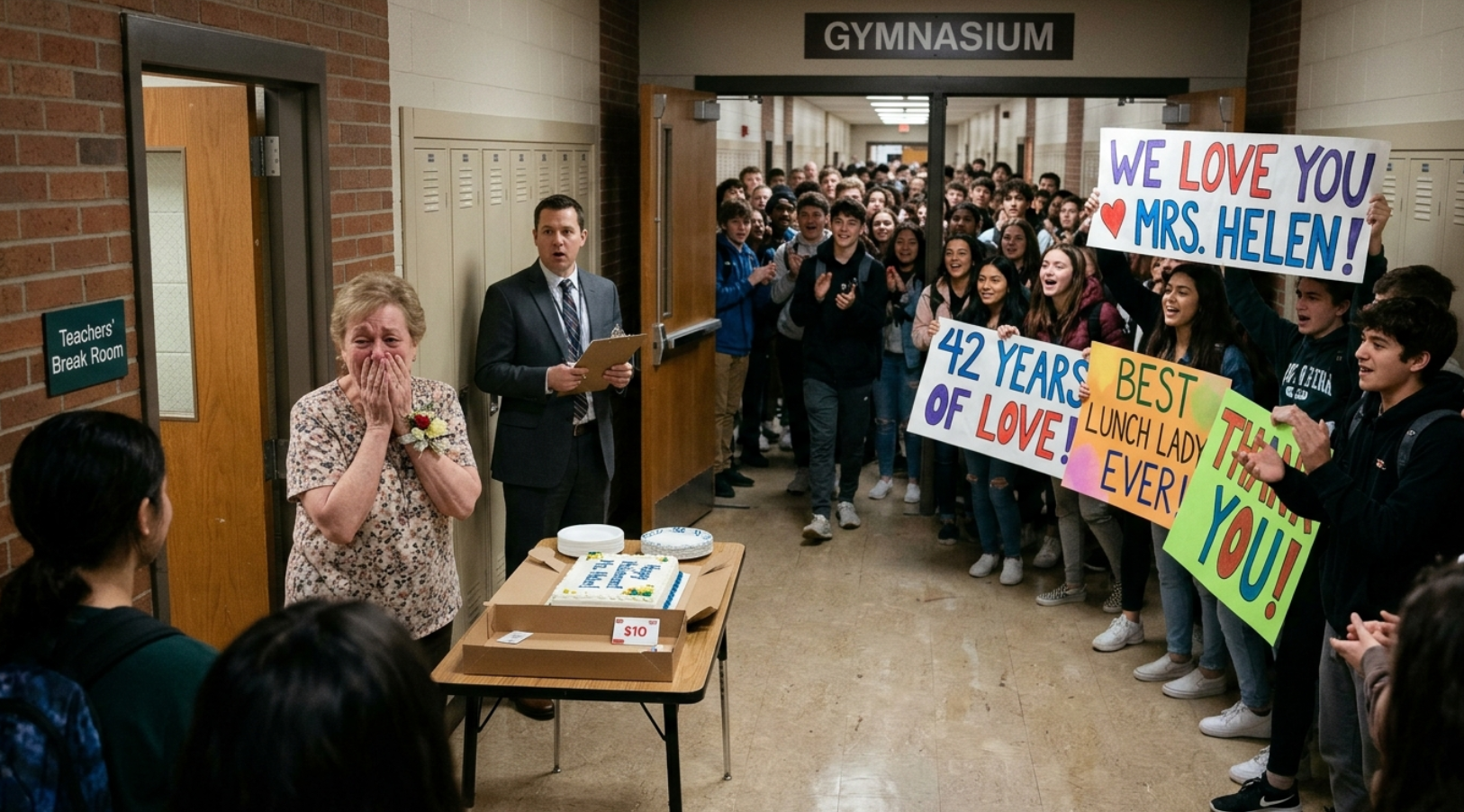
As I watched her walk off the stage, I remembered that cheap grocery-store cake, the misspelled blue letters, and the ten-dollar gift card.
I remembered the principal’s words about nobody being irreplaceable.
He had been wrong.
Not because Mom was the only person who could serve lunch.
But because nobody else could have lived her forty-two years exactly as she had.
Nobody else could have remembered those names, noticed those empty trays, or offered those quiet acts of kindness in quite the same way.
Her job could be replaced.
Her impact could not.
And the greatest reward wasn’t the money, the applause, or the plaque bearing her name.
It was the fact that somewhere in that town, a hungry teenager could walk into school tomorrow, sit down with a warm meal, and believe that someone cared whether he was okay.
Mom had spent forty-two years making sure children never had to earn the right to be treated with kindness.
And now, thanks to the people whose lives she had touched, that kindness would continue long after she had hung up her apron.
As for the ten-dollar gift card, Mom eventually used it.
She bought herself a cup of coffee and a blueberry muffin.
Then she took the remaining balance and bought breakfast for a young man standing outside the coffee shop who had been counting coins in his palm.
When I asked her why she had done that, she laughed.
“Well, sweetheart, I had more than enough.”
And that was Miss Bernie.
She had always believed there was enough to share.
Sometimes, all it took was one person willing to prove it.