Over the next several weeks, my life changed in ways I could never have imagined.
Richard introduced me to an independent attorney who specialized in trusts and estate planning. Together, we reviewed the documents, confirmed my identity, and established the precise extent of my rights under the trust.
Nothing happened overnight.
There were records to verify, accounts to review, and legal procedures to complete.
But eventually, the trust administrator confirmed the arrangement Harold and Thomas had created so many years earlier.
The assets were real.
The money had been preserved and invested for decades.
And I was entitled to receive the benefits set out in the trust.
For the first time in my life, I had financial security beyond anything I had dreamed of.
I could afford my own home.
I could pay for medical care without worrying about draining my savings.
I could travel if I wanted to.
Most importantly, I could make decisions without fearing that I would become homeless if someone became angry with me.
I bought a small, comfortable house in a quiet neighborhood.
It had a sunny kitchen, a garden large enough for roses, and a little porch where I could sit with a cup of tea in the mornings.
I chose the curtains myself.
I filled the rooms with photographs of Harold.
I placed his old toolbox beside the bookshelf in the study, not because it was valuable, but because it reminded me of the man who had built a beautiful life with his hands.
When I moved out of Kevin’s house, I didn’t leave in anger.
I cooked dinner for the family on my final evening there.
I hugged my grandchildren.
I told them that I loved them and that they could visit me whenever they wished.
Then I gave Kevin a letter.
Inside, I wrote:
My dear son,
I have loved you since the first moment I held you.
That love has never depended on your success, your income, or your ability to make me happy.
But I need you to understand that loving someone does not mean surrendering every boundary.
I am your mother. I am not your financial plan, and I am not a burden you must tolerate in exchange for money.
I want you to build a good life. I want you to become a man who treats people with kindness, even when they have nothing to offer you.
If you can learn that lesson, then perhaps something good will come from what happened.
I will always love you.
Mom.
When I handed him the letter, he held it against his chest.
“I don’t want you to go,” he whispered.
I touched his cheek.
“Then don’t let me become someone you only value when you need something.”
He began to cry.
And I hugged him.
Because he was still my son.
But I finally understood that I could love him without allowing him to decide what my life should be.
Tara did not take the news well.
When Kevin told her I was moving, she accused me of abandoning the family.
She said the children would miss me.
She said Kevin would struggle without my help.
She even suggested that I was being manipulated by Daniel and the Whitmore family.
But I didn’t argue.
I simply moved into my own home.
A few days later, Daniel visited me with a small wooden box.
Inside was a photograph of Harold and Thomas, along with a letter from Thomas Whitmore that had been written shortly before his death.
It read:
To the wife of the man who saved my life,
If this letter has reached you, then my promise to Harold has finally found its way home.
He never asked me for anything. When I offered him wealth, he asked me to help people who had been forgotten by the world.
He told me that a person’s character was measured not by what he could take, but by what he was willing to protect.
I have never forgotten that lesson.
Whatever you decide to do with the resources entrusted to you, I hope you will use them in a way that brings you peace.
You owe me nothing.
You owe Harold nothing.
And you owe the world no explanation for choosing a life in which you are safe, respected, and free.
With gratitude,
Thomas Whitmore.
I read the letter twice.
Then I looked at Daniel.
“Your father and my husband would have gotten along very well.”
Daniel smiled.
“They did. In many ways, your husband was the only person who ever treated my father as a man instead of a fortune.”
I thought about that.
Then I made a decision.
I would use a portion of the trust’s permitted distributions to establish a small charitable fund in Harold’s name, subject to the trust’s terms and professional advice.
The fund would help older people who were being pressured by relatives to surrender their savings, sign away property, or give up their independence.
It would pay for legal consultations, emergency housing, and practical support for people who had nowhere else to turn.
I didn’t want to create a grand institution with my name on the door.
I wanted to help people who felt as powerless as I had felt sitting in that pawn shop.
Daniel helped me connect with experienced professionals who could administer the fund responsibly.
Within a year, the Harold Bishop Senior Support Fund was assisting its first group of elderly residents.
And every time I received a letter from someone who had found safety, I thought of Harold.
The man who had once refused a fortune because he believed that helping someone mattered more than becoming wealthy.
He had never known that his quiet act of kindness would eventually help hundreds of people.
But perhaps that was the point.
The best things we do in life often grow far beyond what we can see.
Six months after I moved out, Kevin came to visit.
He looked tired, but different.
He had found a second job doing accounting work on weekends. He and Tara had sold one of their expensive vehicles and canceled several subscriptions they rarely used.
They had also begun working with a financial counselor.
For the first time in years, Kevin was taking responsibility for his choices instead of hoping someone else would solve his problems.
We sat in my garden beneath the rosebush Harold would have loved.
Kevin looked at my wedding ring.
“Mom, can I ask you something?”
“Of course.”
“Do you ever think about selling it now?”
I smiled.
“No.”
He nodded slowly.
“I didn’t understand why it mattered so much. I thought you were attached to it because Dad was gone.”
“That’s part of it.”
“What else?”
I turned the ring around my finger.
“It reminds me of the man your father was when he had almost nothing. He didn’t buy it because he was rich. He bought it because he wanted to make a promise to me, and he worked hard to keep it.”
Kevin looked down.
“And I tried to take that away from you.”
“Yes.”
He wiped his eyes.
“I am so sorry, Mom.”
I reached for his hand.
“I forgive you.”
He looked up hopefully.
“Does that mean everything can go back to how it was?”
I shook my head gently.
“No, sweetheart. It means we can build something better.”
For a long time, we sat together without speaking.
Then he told me something I hadn’t expected.
He had started talking to Tara about the way they treated me.
At first, she had become defensive. She blamed stress, money, and the pressures of raising children.
But Kevin had refused to let the conversation end there.
He had told her that he had been wrong, too, and that their marriage could not continue as though his mother’s dignity was negotiable.
Tara had eventually agreed to attend counseling with him.
She wasn’t transformed overnight.
There were still difficult conversations, old habits, and moments when she struggled to accept that I was no longer available to solve every problem.
But Kevin was learning to speak up.
And Tara was slowly learning that boundaries were not punishments.
They were the conditions that allowed relationships to survive.
A few months later, she came to my house alone.
She stood on the porch holding a small bouquet of white roses.
I invited her inside.
We sat at the kitchen table where I had placed Harold’s photograph.
Tara looked uncomfortable.
“I came to apologize,” she said.
I waited.
“I was selfish. I wanted that vacation so badly that I convinced myself your ring was something you could spare. I didn’t think about what it meant to you.”
“No,” I replied. “You didn’t.”
She looked down at her hands.
“I also thought that because you lived with us and helped with the children, you should be willing to do whatever the family needed.”
“And now?”
She swallowed.
“Now I understand that helping us was something you chose to do. It wasn’t something we were entitled to demand.”
I studied her face.
I wanted to believe her, but I had learned not to confuse an apology with a guarantee.
“Thank you for saying that,” I told her. “I hope we can build a better relationship. But I need you to understand that my home, my money, and my belongings are mine to manage.”
She nodded.
“I understand.”
We didn’t suddenly become best friends.
Trust takes longer to rebuild than it takes to break.
But Tara began calling before visiting. She stopped asking me to cover unexpected expenses. When the children came over, she thanked me for spending time with them instead of treating my help as an obligation.
Slowly, our relationship became more honest.
And that was enough.
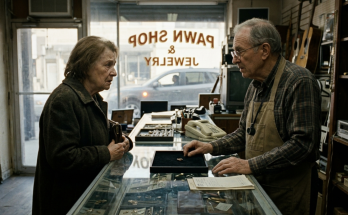
One year after the day Tara drove me to the pawn shop, I returned to the jeweler who had recognized my ring.
His name was Arthur.
He was sitting behind the same counter when I entered, though the guitars and old leather jackets had been rearranged.
He smiled when he saw me.
“Mrs. Bishop! It’s wonderful to see you.”
I held up my hand.
“Still wearing it.”
Arthur chuckled.
“I would have been disappointed if you weren’t.”
I placed a small framed photograph on the counter.
It showed Harold standing beside Thomas Whitmore at the factory, both men smiling as though the future held nothing but possibility.
“I thought you might like a copy.”
Arthur adjusted his glasses.
“Thank you. I’ll treasure it.”
I looked around the shop.
The place no longer seemed filled with other people’s desperation and heartbreak.
It seemed filled with stories.
Every object behind the glass had once belonged to someone who had loved it, needed it, or carried it through a difficult chapter of life.
I thought about the people who might walk through that door tomorrow, hoping to turn something precious into enough money to get through another week.
That was why the support fund mattered.
Not because I could save everyone.
But because I could help some people find another choice.
Before leaving, I turned to Arthur.
“Do you remember the first thing you said when you read the engraving?”
He smiled.
“I believe I said I needed to make a phone call.”
“You did.”
“And I suppose that phone call changed your life.”
I looked down at Harold’s ring.
“No,” I said softly. “The ring reminded me that my life was still mine to change.”
Arthur nodded.
Then I stepped out into the afternoon sunlight.
I had no luxury vacation planned.
No first-class ticket waiting for me.
No enormous suite overlooking a tropical beach.
Instead, I had a little house filled with flowers, a garden where I could hear the birds in the morning, grandchildren who visited on weekends, and a son who was finally learning that love required more than taking.
And on my finger was a thin gold band with a small diamond.
Inside it were six words that had survived more than six decades.
When the time comes, remember Daniel.
For years, I thought those words were a mystery about someone my husband had known.
Now I understood their deeper meaning.
Harold had left me a promise, but he had also left me something far more valuable than money.
He had left me the courage to remember who I was.
I was not merely an old widow who needed a place to stay.
I was not a source of rent, free childcare, or emergency money.
I was not someone whose memories could be exchanged for another person’s comfort.
I was Diane Bishop.
I had loved a good man for sixty-four years.
I had raised a son.
I had survived loss.
And I had every right to live the rest of my life with dignity.
Sometimes, the greatest inheritance is not the money someone leaves behind.
It is the reminder that you were worthy of love long before anyone knew what you possessed.
And sometimes, the smallest ring carries a promise large enough to change an entire family.
The End. ❤️
My Daughter-in-Law Forced Me to Sell My Wedding Ring for Her Luxury Vacation—But the Jeweler Recognized Six Secret Words That
Part 2 of 2