PART 3
A folder landed on the table beside my bed.
“I have been instructed to deliver these documents directly to Elena Robles, in the presence of an independent hospital representative. Not to her husband. Not to her mother-in-law. And certainly not to anyone attempting to obtain control over her medical decisions.”
Carmen made a sharp, offended noise.
“Are you accusing us of something?”
“I haven’t accused anyone of anything, Mrs. Robles.”
There was a pause.
“I am simply following instructions left by a man who apparently anticipated this exact situation.”
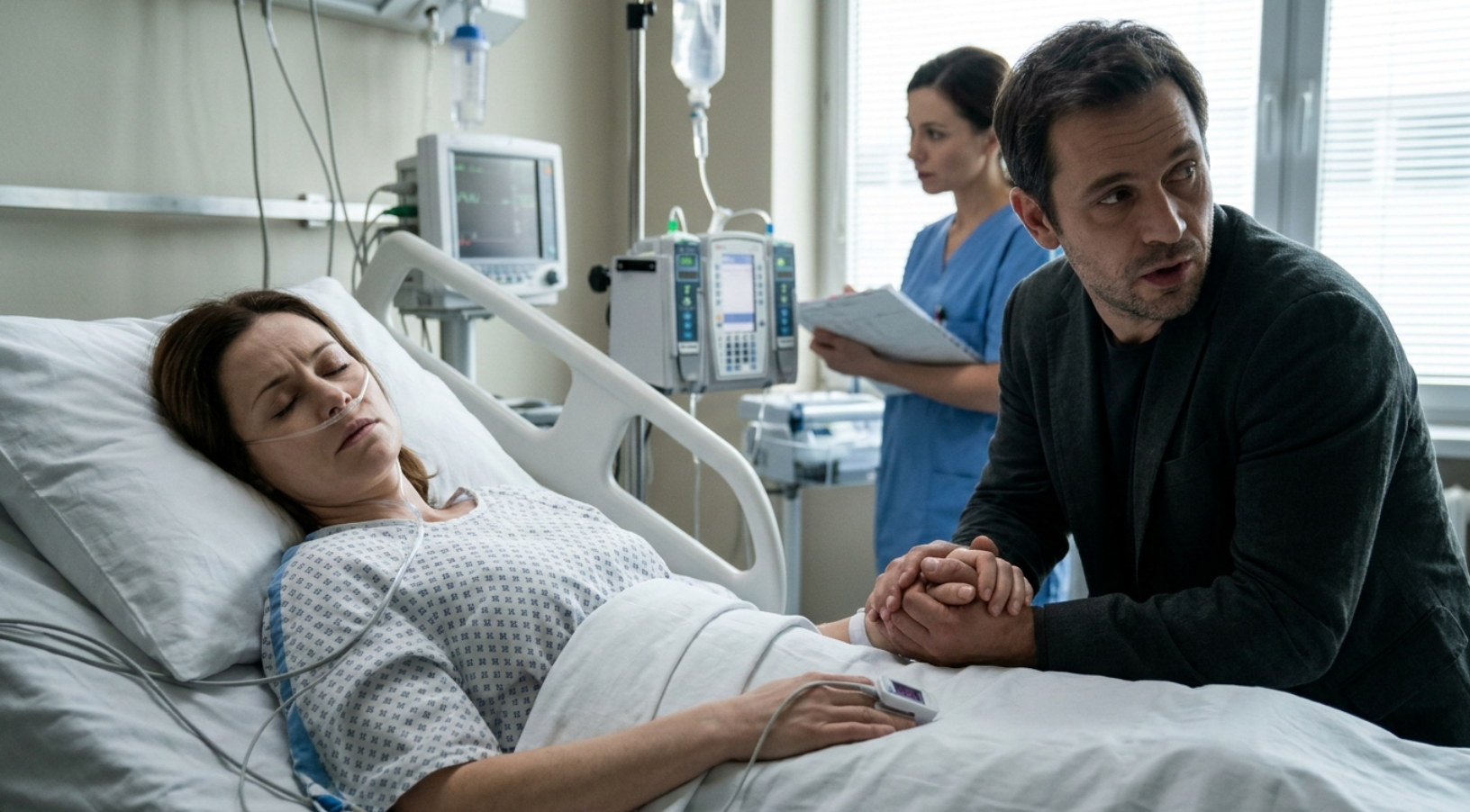
I felt Marcos release my hand.
It was a small movement, but I noticed it immediately.
For seven days, he had apparently been sitting beside me, holding my hand, allowing visitors to see him as the devoted husband who refused to leave his unconscious wife.
Now that someone had mentioned my father’s name, his fingers had become cold and distant.
“What instructions?” Marcos demanded.
Dr. Ibarra opened the folder.
“First, Mr. Arthur Robles requested an independent review of any medical decision made on his daughter’s behalf if she became incapacitated under suspicious circumstances. Second, he instructed his attorney to freeze any attempted transfer of her inheritance until her condition could be independently verified. Third—”
“That’s ridiculous!” Carmen interrupted. “Arthur was an old man. He was paranoid about everything.”
“Perhaps,” Dr. Ibarra answered. “But he was also very specific.”
I heard paper slide across the table.
“His final instruction was that if anyone attempted to sedate Elena unnecessarily, obtain guardianship through forged documents, or transfer ownership of her Brooklyn property while she was unable to consent, the hospital’s legal department was to contact the authorities immediately.”
My heart began to race.
The monitor betrayed me.
Beep. Beep. Beep.
Marcos turned toward it.
“What’s wrong with her?”
“Elevated heart rate,” a nurse said from somewhere near the doorway. “That can happen even in a sedated patient.”
I prayed she wouldn’t look too closely at my face.
Then Dr. Ibarra said something that made my husband’s breathing stop.
“Mr. Robles also left a recording.”
“A recording?” Carmen whispered.
“Yes. It is addressed to Elena, and it contains information that may be relevant to the circumstances of her hospitalization.”
Marcos stepped toward the table.
“I want to hear it.”
“No.”
The word came from the doctor so firmly that even Carmen fell silent.
“The recording belongs to Elena. Unless she is unable to receive it and the appropriate legal conditions are met, neither of you has permission to access it.”
“You can’t keep things from her husband!” Marcos snapped.
“I can certainly prevent unauthorized access to confidential legal materials.”
I heard a chair scrape across the floor.
Marcos was angry now.
Not frightened in the way an innocent husband might be frightened by the possibility of losing his wife.
Angry in the way a man becomes when he realizes someone else has taken control of a situation he thought he owned.
“Come on, Mom,” he muttered. “We’re wasting our time.”
Carmen didn’t move immediately.
She leaned close to my bed, and I could almost feel her eyes examining my face.
“Elena,” she whispered, suddenly sweet again. “If you can hear me, you need to fight, sweetheart. Your husband needs you. We all need you.”
The hypocrisy nearly made me choke.
Only minutes earlier, she had called me an old woman who wouldn’t die easily.
Now she was begging me to survive.
Not because she loved me.
Because she had just learned that my father had left behind something she couldn’t control.
The door opened.
Footsteps retreated down the hallway.
But before Marcos left, I heard him speak quietly to someone.
“Find Salgado. Now.”
Then the door closed.
For the first time in seven days, I was alone with a person who might actually be on my side.
Dr. Ibarra waited until the footsteps disappeared.
Then he spoke in a voice so quiet that I almost missed it.
“Mrs. Robles, if you can hear me, you need to know something.”
I concentrated on keeping my breathing steady.
“Your father didn’t just leave you money.”
A pause.
“He left you a way out.”
And for the first time since waking inside my own nightmare, I allowed myself to believe that I might survive it.
The next few minutes passed painfully slowly.
I heard Dr. Ibarra speaking to the nurse. He asked her to document the medication administered during the night and to preserve the electronic records of every person who had accessed my chart.
The nurse sounded uncomfortable.
“Dr. Salgado approved the latest orders,” she said. “I assumed everything was legitimate.”
“Then you should have no difficulty documenting what happened.”
“I didn’t know there was a problem.”
“I’m not asking you to decide whether there was a problem. I’m asking you to preserve the evidence so the appropriate people can determine that.”
A moment later, I heard him make a telephone call.
“Yes, this is Daniel Ibarra at the hospital. I need the patient safety officer and the attending physician who is independent of Dr. Salgado. There may be a medication issue involving Elena Robles.”
He lowered his voice.
“And please contact hospital security. No one is to alter her orders or access her records without authorization.”
My eyes remained closed.
But inside, I was listening to every word.
I had spent three years believing that marriage meant trust.
I had trusted Marcos with my home, my routines, my fears, and the private memories that made me who I was.
I had even trusted him when he told me that my father’s death had left me emotionally unstable.
“You’re grieving, Elena,” he used to say. “Let me handle things.”
At first, I thought he was being kind.
He began taking my phone when I went to sleep, saying I needed rest. He offered to organize my financial documents because paperwork made me anxious. He told me not to visit the Brooklyn house alone because it brought back painful memories.
Then came the small suggestions.
Perhaps I should sell the house.
Perhaps I should move somewhere smaller.
Perhaps I should let him manage my inheritance so I wouldn’t have to worry about money.
Every suggestion had sounded reasonable when considered separately.
Together, they had formed a cage.
And now I understood why my father had warned me to keep the keys to that cage hidden.
Several minutes later, the nurse approached my bed.
“Mrs. Robles?” she said gently. “I’m going to check your vital signs.”
Her fingers touched my wrist.
I wanted to tell her that I could hear her.
I wanted to ask her to stop the medication.
Instead, I waited.
She checked the monitor, examined the IV line, and reviewed the medication pump.
Then she muttered something under her breath.
“Oh, no.”
My stomach tightened.
She stepped away and called for another nurse.
“Can you come here? I need you to verify this order.”
Another voice answered.
“What about it?”
“The dose doesn’t match the current plan.”
Silence.
“Who entered it?”
“Dr. Salgado.”
“Did he examine her?”
“Not since yesterday afternoon.”
I heard the second nurse approach.
They spoke quietly, but not quietly enough.
“The patient has been unresponsive for seven days,” the second nurse said. “We need to establish whether the medication is contributing to that.”
“We need the attending physician.”
“And we need to document everything before changing anything.”
The first nurse exhaled sharply.
“I should have questioned it earlier.”
That sentence hurt more than I expected.
Because somewhere in that hospital, people had been making decisions about my body while I lay helpless.
Some had followed instructions without asking questions.
Others might have suspected something was wrong.
And I had no way of knowing who had chosen silence and who had simply been afraid.
A few minutes later, the medication pump beeped.
Someone adjusted the equipment.
I felt a brief sting where the IV entered my arm, followed by a faint ache.
Then the heaviness began to change.
It didn’t disappear immediately. My arms still felt weak, and my eyelids seemed impossibly heavy.
But for the first time, I could feel my fingers.
I moved the smallest one.
Just once.
The nurse stopped speaking.
“Did you see that?”
“See what?”
“Her finger.”
A hand gently touched mine.
“Mrs. Robles? Can you hear me?”
I wanted to answer.
I tried to open my eyes, but only managed to make them flutter beneath my eyelids.
The nurse leaned closer.
“Don’t rush,” she whispered. “You’re safe right now. We’re here with you.”
Safe.
I almost laughed at the word.
But a tear slipped from the corner of my eye and disappeared into my hair.
The nurse saw it.
“Oh, my God.”
She called for the physician.
Within moments, the room filled with footsteps, clipped instructions, and the sound of equipment being checked.
Someone called my name.
Someone asked me to squeeze their hand.
I tried.
My fingers moved weakly against theirs.
“She’s responding,” a physician announced. “Let’s assess her neurological status.”
I heard another person ask whether Marcos had been notified.
Dr. Ibarra answered before anyone else could.
“Not yet. We need to establish the patient’s condition and ensure that she can communicate privately before informing anyone who may be involved in the concerns we’re investigating.”
For once, someone had considered what I needed before considering what my husband wanted.
I forced my eyes open.
The light hurt.
Everything was blurred, and my mouth felt like sandpaper. I couldn’t immediately recognize the people surrounding me.
But one face gradually came into focus.
A middle-aged doctor with tired eyes stood beside my bed.
“I’m Dr. Chen,” she said. “You’re in the hospital, Elena. You’ve been unconscious for several days. Can you hear me?”
I blinked.
“Good. Don’t try to speak yet. Just squeeze my hand if you understand.”
I squeezed.
She nodded.
“Do you know your name?”
I moved my lips.
Nothing came out.
“That’s all right. Take your time.”
I tried again.
“Elena,” I whispered.
The room became very still.
Dr. Chen smiled, but her eyes were serious.
“Welcome back, Elena.”
I swallowed painfully.
Then, with every bit of strength I could gather, I asked the only question that mattered.
“Marcos?”
Dr. Chen exchanged a brief glance with Dr. Ibarra.
“He was here earlier,” she said carefully.
I stared at her.
“Don’t… let him…”
My voice broke.
Dr. Chen leaned closer.
“Don’t let him what, Elena?”
I gripped her hand.
“Touch… my medicine.”
No one spoke for a moment.
Then Dr. Chen nodded.
“I understand.”
She turned toward the nurse.
“Document that statement exactly as she gave it. And make sure her medication orders remain under independent review.”
I closed my eyes again, exhausted.
But this time, I wasn’t pretending to be asleep.
I was simply trying to find the strength to survive what came next.
Because I knew my husband.
The moment he discovered that I was awake, the loving mask he had worn beside my bed would begin to crack.
And I wasn’t sure what he would do when he realized that I had heard everything.
By late afternoon, I could speak in short sentences.
My throat hurt, my muscles felt weak, and every movement required an effort that seemed absurd for something as simple as lifting my hand.
Dr. Chen explained that I would need further evaluation and close monitoring. She wouldn’t speculate about why I had remained unconscious or how much of my condition was connected to the medication until the medical team had reviewed the evidence.
I appreciated her honesty.
For the first time in a long while, I didn’t want someone to reassure me with convenient promises.
I wanted the truth.
Dr. Ibarra returned shortly after four o’clock.
He carried a slim black folder and a small envelope sealed with red wax.
When he placed the envelope on my bedside table, my breath caught.
I recognized my father’s handwriting immediately.
For Elena. Open only when the truth can no longer be hidden.
My father’s letters had always leaned slightly to the right. He wrote carefully, as though every sentence deserved the same attention he gave the roses in his garden.
I stared at the envelope until the words blurred.
“How long have you had that?” I whispered.
“Since your father passed away,” Dr. Ibarra replied. “His attorney transferred it to me with instructions regarding its delivery.”
“Why didn’t anyone tell me?”
“Because the conditions he specified had not been met until now.”
I looked at him.
“What conditions?”
He pulled a chair closer to my bed.
“Your father asked us to wait until there was credible evidence that someone was attempting to take control of your medical or financial affairs while you were incapacitated. He believed that simply giving you the documents earlier might cause the people he feared to change their behavior before the evidence could be preserved.”
I looked at the envelope again.
“My father knew about Marcos?”
“He had concerns about your husband,” Dr. Ibarra said. “I cannot tell you how much he knew without showing you the documents.”
I swallowed.
“Open it.”
Dr. Ibarra carefully broke the seal.
Inside was a handwritten letter, several pages of legal documents, and a small photograph.
He placed the photograph in my hand.
It showed my father standing outside the Brooklyn house, one arm resting on the shoulder of a younger man.
I recognized the man immediately.
Marcos.
My husband.
But the photograph had been taken almost eight years before I met him.
I stared at it, confused.
“Why is he with my father?”
Dr. Ibarra studied my face.
“Your father met Marcos long before your marriage.”
“That’s impossible.”
“I’m afraid it isn’t.”
I looked at the photograph again.
Marcos appeared younger, but there was no mistaking his face. His familiar smile was there, along with the small scar above his left eyebrow.
My father was smiling too.
They looked like old friends.
A terrible feeling began spreading through my chest.
“What does the letter say?”
Dr. Ibarra handed it to me.
My fingers trembled as I unfolded the paper.
My dearest Elena,
If you are reading this, then something has happened that I prayed you would never have to experience.
I wanted to tell you everything while I was alive. More than once, I nearly did. But each time I looked at you, I saw how happy you were, and I was afraid that telling you the truth without sufficient evidence would destroy your happiness without protecting you from the danger.
I know you believe that love is built on trust. I taught you that, and I still believe it is true. But trust must never require you to ignore what your own eyes can see.
There are people who study kindness because they want to understand it.
And there are people who study kindness because they want to exploit it.
When you met Marcos, I recognized something about him that frightened me. I had seen it before, years ago, in another man who believed that a woman’s affection was simply another asset to be acquired.
I tried to investigate quietly. What I discovered was incomplete, and I refused to accuse a man of something I could not prove.
That was my mistake.
If Marcos has betrayed you, do not waste your life asking whether you should have noticed sooner. You were not foolish for loving someone. He was responsible for what he chose to do with that love.
There is something you must understand about the Brooklyn house.
It was never merely a house.
I stopped reading.
My eyes lifted toward Dr. Ibarra.
“What does that mean?”
He gently turned to the next page.
“Your father left a detailed explanation.”
I continued.
The locked room you have known about since childhood contains documents connected to a legal arrangement I established many years ago. I told you that one day you would understand everything because I hoped that by the time you opened that door, you would be old enough to recognize the difference between what a person owns and what a person is willing to sacrifice to obtain it.
The property is protected by a trust. The house cannot be sold or transferred through a simple signature, and no one can use your incapacity to bypass the trust’s safeguards.
But the trust contains something even more important than the house.
It contains records.
Some of those records concern a company I once invested in. Others concern people who believed they could use my name, my money, and my trust to conceal what they were doing.
I kept copies because I learned a long time ago that a man who destroys one document cannot destroy every copy.
If anyone attempts to take your inheritance or force you to surrender the house, contact my attorney before signing anything.
And Elena, if you discover that Marcos was involved in any of this before he met you, do not confront him alone.
Let the evidence speak first.
I love you more than you will ever know.
Dad.
I read the letter twice.
Then a third time.
When I finally lowered it, I realized I was crying.
Not because I was frightened.
Because my father had known that there might come a day when I would be alone, surrounded by people who wanted something from me, and unable to tell whom I could trust.
Even after his death, he had tried to protect me.
I pressed the letter against my chest.
“Dr. Ibarra,” I whispered, “what exactly did my father discover about Marcos?”
He hesitated.
Then he opened the black folder.
“Your father hired a private investigator several years before he died. The investigator uncovered financial transactions involving a company that had once done business with your father’s firm.”
“Was Marcos working for that company?”
“Not officially, according to the records we have.”
“Then how was he involved?”
Dr. Ibarra removed another document.
“This is a copy of a report your father’s attorney received shortly before your wedding.”
I looked at the page.
At the top was a name.
Marcos Vidal.
Beneath it was a list of dates, business addresses, and financial transactions.
One entry had been marked in red.
The date was eight months before Marcos first asked me out.
Next to it was a note written in my father’s handwriting.
Why is he asking about Elena’s inheritance?
I felt the room tilt.
I remembered that evening.
Marcos and I had been sitting at a small Italian restaurant in Manhattan. We had been dating for only a few weeks.
He had asked about my father, my childhood, and whether I expected to inherit the Brooklyn property.
At the time, I had thought he was simply interested in my life.
Now I wondered whether he had been measuring the distance between himself and my money.
“Did my father know about the five hundred thousand dollars?” I asked.
Dr. Ibarra nodded.
“He knew about the inheritance. But the amount you mentioned is only one part of the estate.”
I stared at him.
“What do you mean?”
“Your father left assets in several separate arrangements. Some were distributed directly to you. Others were placed in trusts with specific conditions.”
“How much?”
“I don’t want to give you an incomplete figure while the estate records are being reviewed. But I can tell you this: the money in your private account was never the full extent of your father’s estate.”
For a moment, I couldn’t speak.
I had spent my entire life believing my father was comfortable but not extraordinarily wealthy. He lived modestly, drove the same car for years, and repaired things rather than replacing them.
He had taught me to save money, pay my bills on time, and never confuse a person’s possessions with their character.
I had never thought to ask whether his modest lifestyle concealed something more.
Now I understood that he had deliberately kept certain matters private.
And Marcos had apparently been searching for those secrets long before I ever became his wife.
I turned back to the photograph.
“Who is the other man in this report?”
Dr. Ibarra pointed to a name on the page.
“Carmen Vidal.”
My mother-in-law.
The room seemed to shrink around me.
“She knew my father too?”
“According to the investigator’s report, she had business dealings with one of the companies involved. Your father believed she might have been the person who introduced Marcos to certain financial opportunities.”
I closed my eyes.
Suddenly, three years of memories began rearranging themselves in my mind.
Carmen insisting on coming to my house every weekend.
Marcos asking me to show him my father’s old documents.
The way Carmen had examined the Brooklyn house from room to room when she first visited.
Her insistence that the locked room was a waste of space.
The time she had asked whether my father had ever owned property outside New York.
I had answered every question without suspicion.
Why wouldn’t I?
She was my husband’s mother.
I had believed that welcoming her into my home was part of building a family.
Instead, I might have been giving information to people who had been waiting for an opportunity to take what belonged to me.
I wiped my eyes.
“There’s something else,” I said.
Dr. Ibarra waited.
“Marcos said something while he thought I was unconscious. He said Dr. Salgado had told him I wouldn’t wake up.”
Dr. Ibarra’s expression hardened.
“Did he say anything else?”
“He said they wanted to obtain medical guardianship. Carmen had documents with a copy of my identification and a signature they had practiced.”
He didn’t interrupt.
“And he told her to increase my dose.”
Dr. Ibarra closed the folder.
“Thank you for telling me. Your statement will need to be documented and handled carefully. We will not draw conclusions before the evidence is reviewed, but those are serious allegations.”
I nodded.
For the first time, I understood why my father had written that I should let the evidence speak first.
I had spent my life believing that the truth would be obvious once someone heard it.
But the truth needed witnesses.
It needed records.
It needed people who could not be bought, frightened, or persuaded to look the other way.
And it needed me to stay alive long enough to tell it.
That evening, Marcos returned.
I knew it was him before he spoke.
His footsteps were familiar, as was the faint scent of his cologne. For three years, that smell had meant home to me.
Now it made my stomach tighten.
He entered carrying a bouquet of white roses.
“Elena, my love.”
His voice was soft, almost breaking.
“I heard you’re awake.”
I kept my eyes closed.
Dr. Chen had warned me not to exhaust myself, and Dr. Ibarra had advised me not to discuss the investigation until the appropriate safeguards were in place.
I didn’t know whether Marcos had already been questioned.
I didn’t know what he had been told.
But I knew one thing.
He could not be allowed to see how much I remembered.
He approached my bed.
“Sweetheart?”
I heard the roses being placed on the table.
Then the mattress shifted as he sat beside me.
“I was so worried.”
His hand touched mine.
I fought the urge to pull away.
“I haven’t slept properly in seven days,” he continued. “I’ve been praying every night.”
A bitter thought rose inside me.
Praying for what, Marcos?
For my recovery?
Or for the money?
He sighed.
“Your mother-in-law has been here every day. She’s been so worried too.”
I almost laughed.
Then he lowered his voice.
“There’s something I need you to understand, Elena. If you can hear me, don’t let anyone confuse you when you wake up. Your father left complicated financial arrangements, and some people may try to interfere.”
My heart beat faster.
He knew about the documents.
Perhaps he had spoken to Carmen.
Perhaps he had already discovered that the hospital was reviewing his actions.
“Your father didn’t trust many people,” Marcos continued. “He always made things more difficult than they needed to be.”
His fingers tightened around mine.
“But I can protect you. I can make all of this easier. You just have to trust me.”
I remained still.
For several seconds, he said nothing.
Then his voice changed.
The sweetness disappeared, leaving something colder beneath it.
“You know, Elena, I never understood why you kept that house.”
I felt his thumb move against my hand.
“It’s old. It’s expensive. It has problems that need fixing. You could sell it, invest the money, and live comfortably for the rest of your life.”
He paused.
“Your father isn’t coming back.”
The words struck me like a slap.
I wanted to open my eyes and tell him that my father was more present in that room than Marcos could ever be.
But I stayed silent.
Marcos leaned closer.
“And if you do wake up, we need to talk about the paperwork. Carmen has already spoken to the attorney. It’s all very straightforward.”
He waited.
I didn’t move.
“Elena?”
Nothing.
His breathing grew heavier.
“Don’t make this difficult.”
There it was.
Not a declaration of love.
Not a prayer for my recovery.
An instruction.
He straightened and walked toward the door.
Before leaving, he stopped.
“You know what the worst part is?” he whispered.
I listened.
“I really did love you once.”
The door opened.
Then closed.
I lay perfectly still, staring into the darkness behind my eyelids.
Perhaps some part of him had loved me once.
Perhaps the beginning of our marriage had contained real affection mixed with selfishness, ambition, and secrets.
I would never know for certain.
But even if his love had once been real, it did not excuse what he had chosen to do.
Love did not give him ownership of my body.
Marriage did not give him ownership of my inheritance.
And the years I had spent trusting him did not obligate me to trust him now.
When the nurse returned, I opened my eyes.
“Please,” I whispered.
She leaned close.
“I need you to call Dr. Chen.”
“Of course.”
“And Dr. Ibarra.”
She nodded.
I swallowed, gathering the strength to speak.
“I want to make a statement.”
The nurse’s expression became serious.
“All right, Elena.”
I looked toward the closed door.
“And I want someone to protect my father’s house.”
PART 4
Three days after I woke from my coma, I learned that my husband had made one final mistake.
He believed I was still the frightened woman who would apologize for questioning him.
He believed that if he spoke softly enough, held my hand long enough, and called me sweetheart often enough, I would eventually sign whatever he placed in front of me.
He had forgotten one important thing.
I was Arthur Robles’s daughter.
And my father had taught me that the truth could remain hidden for years, but it could never become something else.
The morning after I made my statement, Dr. Ibarra returned with two investigators. They listened carefully as I described what I had heard while pretending to remain unconscious.
I told them about the medication.
I told them about the forged signature.
I told them about the proposed guardianship and the money Carmen had mentioned.
They recorded everything.
Later that afternoon, the hospital confirmed that my medication history and treatment orders would be independently reviewed. Dr. Salgado was removed from my care while the hospital investigated the circumstances surrounding his orders. I was also informed that any suspected criminal conduct would be referred to the appropriate authorities.
I didn’t feel victorious.
Not yet.
I was still weak, and every time I closed my eyes, I remembered Marcos standing beside my bed, asking someone to increase my dose.
But I was no longer helpless.
And that made all the difference.
Two days later, I was discharged to a secure rehabilitation facility, where independent doctors continued monitoring my recovery.
Marcos called seventeen times.
Carmen called eleven.
I answered neither.
Instead, I called my father’s attorney, Margaret Ellis.
She had known my father for almost twenty years. When she heard my voice, she remained silent for a moment.
Then she said, “Elena, your father told me this day might come.”
I closed my eyes.
“He knew Marcos would do this?”
“I cannot tell you that he knew exactly what would happen. But he had concerns about your husband’s intentions, and he prepared for the possibility that someone might try to exploit your vulnerability.”
“Why didn’t he tell me?”
“Because he was afraid you would confront Marcos without evidence. Your father knew how fiercely you defended the people you loved.”
I looked out the window at the Manhattan skyline.
“I defended the wrong person.”
“No,” Margaret said gently. “You loved someone who didn’t deserve your trust. That is not the same thing.”
For the first time in days, I allowed myself to cry without feeling ashamed.
Then I wiped my face.
“Margaret, I need to go to Brooklyn.”
“Not alone,” she replied immediately.
“I want to see the house.”
“I understand. But we need to arrange protection and make sure the property is secure. Your father left specific instructions concerning the locked room.”
I sat up straighter.
“What instructions?”
Margaret hesitated.
“Elena, there is something I haven’t told you yet.”
My fingers tightened around the phone.
“What?”
“The locked room contains more than your father’s personal papers. It contains the original records of a company he helped establish nearly thirty years ago. Those records explain why your father became so protective of the property.”
“Was he hiding money?”
“No. He was protecting something much more complicated.”
She paused.
“And I believe Marcos knows it.”
The following Monday, I returned to Brooklyn.
The neighborhood looked exactly as I remembered it.
Children rode bicycles along the sidewalks. A woman watered flowers outside her brownstone. The smell of fresh bread drifted from the bakery on the corner.
For a moment, I felt as though I had returned to a world where nothing terrible had happened.
Then I saw my house.
The yellow front door needed repainting. The bougainvilleas had grown wild along the fence. My father’s old wind chime still hung beside the porch, turning gently in the autumn breeze.
I had not visited since his funeral.
I had been too busy trying to rebuild my life after losing him.
Then Marcos had filled that empty space.
Now, standing before the house, I realized that I had spent three years trying to create a new home while gradually surrendering the one my father had given me.
Margaret stood beside me with two security officers and a locksmith.
“Are you ready?” she asked.
I nodded.
The front door opened with a familiar creak.
Inside, everything smelled of dust, wood polish, and memories.
The yellow kitchen tiles were still there.
The old dining table stood beneath the window where my father used to read the newspaper.
His gardening gloves remained beside the back door.
I touched the table.
For years, I had believed that grief was the hardest thing a person could survive.
I was beginning to understand that betrayal could be worse, because grief took away someone you loved, while betrayal made you question whether the love you remembered had ever been what you thought it was.
Margaret led me upstairs.
At the end of the hallway stood the locked room.
The door was dark brown, with a brass handle that had grown dull over the years.
I remembered being a little girl and asking my father what was inside.
“Nothing you need to worry about yet,” he would say.
“Why do you lock it?”
“Because some things are valuable, sweetheart.”
“Like money?”
He would smile.
“Sometimes the most valuable things aren’t money.”
I had thought he meant photographs or old letters.
Now I stood before that same door, wondering how much of my life had been shaped by the secret behind it.
Margaret handed the locksmith a key.
He tried it.
The lock turned.
The door opened.
I expected to see a storage room.
Instead, I found a small office.
There was a wooden desk, a filing cabinet, a safe, and shelves filled with carefully labeled boxes.
On the wall hung a framed photograph of my father standing beside four other men.
One of them was Marcos.
I froze.
“Margaret.”
She followed my gaze.
“Yes,” she said quietly. “That is one of the reasons your father wanted you to see this room with me present.”
I stepped closer to the photograph.
“When was this taken?”
“About eight years ago.”
Before Marcos and I met.
Before our wedding.
Before he ever held my hand and told me he loved me.
“What was he doing here?”
Margaret opened a folder on the desk.
“Your father was an early investor in a technology and property management company called Northbridge Holdings. Marcos worked for one of its financial subsidiaries for a period of time.”
“Marcos told me he had worked in consulting.”
“That may be technically true. He did not tell you the entire story.”
Margaret laid several documents on the desk.
Northbridge had originally been established to finance affordable housing and renovate neglected residential properties. My father had invested a substantial portion of his savings because he believed that profitable businesses could still serve ordinary families.
He had also helped establish a charitable foundation that supported housing assistance for elderly people and families struggling to pay rent.
But several years later, discrepancies began appearing in the company’s accounts.
Money was transferred between subsidiaries.
Properties were sold at suspiciously low prices.
Loans were approved for companies with no clear business purpose.
My father questioned the transactions.
Some executives resigned.
Others insisted everything was legitimate.
Then my father discovered that one of the subsidiaries had been used to move money through a network of shell companies.
The investigation had never been fully resolved.
“What does this have to do with me?” I asked.
Margaret turned to another page.
“Your father eventually discovered that some of the people connected to those transactions were attempting to acquire his shares in Northbridge. He refused to sell them.”
“Was Marcos involved?”
“We have documents showing that Marcos communicated with people connected to the disputed transactions. We also have evidence that he asked questions about your father’s estate before you met.”
My hands began to shake.
“So he approached me because of the money.”
“We cannot establish every motive from the documents alone,” Margaret replied. “But the timing is troubling.”
I stared at the photograph again.
Marcos stood beside my father, smiling.
My father had his hand on the young man’s shoulder.
I wondered whether he had once believed Marcos was trustworthy.
I wondered whether my father had blamed himself for introducing him into the wider circle of people connected to his business.
Then Margaret opened a second folder.
“There’s something else.”
Inside was a copy of an agreement signed by my father and several original investors.
The document established that a controlling block of shares had been placed in a trust.
My father’s shares were included.
The trust was designed to prevent a single person from acquiring control through pressure, deception, or the forced transfer of an individual investor’s assets.
I read the document twice.
“Who controls the trust now?”
Margaret looked directly at me.
“You do, Elena. You are its designated beneficiary and voting representative, subject to the trust’s terms.”
I stared at her.
“Me?”
“Yes.”
“How much is it worth?”
“The value depends on the current assets, liabilities, and the outcome of the company’s financial review. But the trust’s holdings are substantial.”
I sat down.
For years, I had believed my father had left me a modest inheritance and a house full of memories.
Now I was discovering that he had also left me a responsibility.
And it was a responsibility that someone had apparently been trying to obtain long before I understood what it meant.
“Why would Marcos need me to sign a guardianship document?” I asked.
Margaret placed another paper on the desk.
“Because if someone could convince a court that you were incapable of managing your affairs, they might attempt to gain authority over certain financial decisions. That would not automatically give them ownership of the trust, but it could create an opportunity to challenge or interfere with its administration.”
I looked at the paper.
It was a draft petition for temporary guardianship.
My name appeared at the top.
Beneath it were statements suggesting that I had been unable to make rational financial decisions since my father’s death.
The document claimed I had become confused, emotionally unstable, and incapable of understanding complex legal matters.
None of it was true.
I looked at Margaret.
“Who prepared this?”
“The draft bears the name of an attorney who has since denied submitting it to any court. We are investigating how it was prepared and whether it was intended to be filed using forged supporting documents.”
I felt sick.
They hadn’t merely wanted my money.
They had planned to make the world believe I was incapable of protecting myself.
And if they had succeeded, every protest I made might have been dismissed as the rambling of a woman who could no longer be trusted.
My father had understood the danger.
That was why he had insisted on independent verification.
That was why the trust had safeguards.
And that was why the locked room existed.
I turned toward the safe.
“What is inside?”
Margaret looked at the locksmith, then at me.
“Your father left instructions that the safe could be opened in your presence after the conditions in his letter were met.”
The locksmith entered the combination Margaret had received from the estate’s executor.
The safe opened.
Inside were several envelopes, a small digital recorder, a stack of financial records, and a sealed package addressed to me.
I picked up the package.
My name was written across it in my father’s handwriting.
I opened it carefully.
Inside was a letter.
Elena,
READ THE END PART
I Woke From a Seven-Day Coma and Heard My Husband Order the Doctor to Increase My Dose—But My Late Father Had Left One Final Secret That Changed Everything
Part 1 of 2