PART 4
Grandpa opened the envelope again, and this time, he read the letter aloud.
“Dear Earl,
For eleven years, I’ve kept a promise to a woman who believed that a person’s character was worth more than all the money in this building.
Your wife asked me to wait until the right moment to share her final request with you. After what happened last Tuesday, I believe that moment has arrived.
Please come inside. There are people here who need to hear her story.
—Tom Callahan.”
Grandpa sighed.
“Your grandmother always did enjoy making a simple morning complicated.”
But I saw him straighten his shirt before stepping out of the truck.
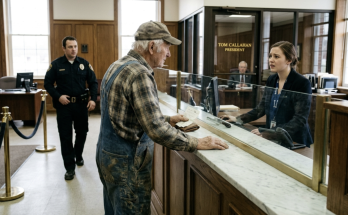
When we entered the bank, nearly thirty people were gathered in the lobby. Farmers, shopkeepers, retired teachers, and older residents stood beside the waiting chairs. Some carried old photographs. Others held envelopes and documents.
Tom stood near the counter.
When he spotted Grandpa, he walked over and shook his hand.
“Thank you for coming, Earl.”
Grandpa looked around.
“Tom, what’s all this?”
Tom turned toward the crowd.
“Eleven years ago, Martha Doyle asked me to preserve a piece of this town’s history. She believed that the people who built our community deserved to be remembered—not because they were wealthy, but because they helped others when there was no guarantee they would ever receive anything in return.”
He gestured toward a table near the windows.
On it sat the old wooden box, Grandma’s photograph, and a framed document.
Tom continued.
“Many of you remember the financial crisis this bank faced decades ago. Some of you helped keep it open. Others received loans when no other institution would take a chance on you. What many people don’t know is that Martha recorded those stories for years.”
He lifted the black notebook.
“She documented the farmers who helped their neighbors, the shop owners who extended credit to struggling families, and the people who quietly paid for school supplies when parents couldn’t afford them.”
An elderly man near the back raised his hand.
“Martha paid my daughter’s school fees one year,” he said. “She told me it was a scholarship. I found out only after she passed that she’d used her own money.”
A woman beside him nodded through tears.
“She brought meals to my mother every Thursday. Never told anyone. Never asked for anything.”
Grandpa lowered his head.
That was Grandma.
She had spent her life doing things that seemed small to her and enormous to everyone else.
Tom placed the framed document on an easel.
“After Martha passed away, I began speaking with our board about creating a permanent community program in her honor. We wanted to support local farmers, help young people pursue education, and provide emergency assistance to families facing difficult times.”
He paused.
“Today, I’m pleased to announce the establishment of the Martha Doyle Community Fund.”
A quiet murmur spread through the room.
Tom explained that the bank’s board had approved the initial funding, with additional contributions from several local businesses. The program would offer small emergency grants to struggling families, educational scholarships, and limited-interest loans for farmers who needed to repair essential equipment.
Grandpa stared at him.
“How much money are we talking about?”
Tom smiled.
“The initial fund is two hundred and fifty thousand dollars.”
Grandpa nearly dropped the envelope.
“Two hundred and fifty thousand? Tom, have you lost your mind?”
A few people laughed.
Tom shook his head.
“No, Earl. We’ve simply decided to invest in the people who make this town what it is.”
He then handed Grandpa a second letter.
“This one is from Martha. She left it with specific instructions that it be given to you when the fund was officially established.”
Grandpa’s fingers trembled as he opened it.
The handwriting was unmistakably hers.
He read silently at first, his lips moving slightly over the familiar words.
Then he began to read aloud.
“My dearest Earl,
If you are reading this, it means Tom finally listened to me about something important.
You always worried that you hadn’t done enough. You worried about the farm, the bills, our children, and whether there would be enough money left when we were old.
But I want you to know something.
I never measured our life by the money in our account.
I measured it by the neighbors who came to our table when they had nowhere else to go. I measured it by the children who grew up believing they could become something more. I measured it by the mornings I woke up beside you and knew that, whatever happened, we would face it together.
You gave people help without asking whether they deserved it.
Please don’t stop doing that simply because I’m no longer there to remind you.
And if one day someone looks at your muddy boots and thinks you have nothing to offer, smile at them, Earl.
You and I have always known better.
All my love,
Martha.”
Grandpa couldn’t finish the last line.
He folded the letter and pressed it against his chest.
For a long moment, the entire bank remained silent.
Then the elderly man near the back began to clap.
Others joined him.
Soon the room was filled with applause.
Grandpa looked uncomfortable.
“Now, hold on,” he said, raising a hand. “I didn’t do all those things. Martha did most of the remembering, and plenty of people helped us along the way.”
Tom smiled.
“That’s exactly why we’re here.”
He turned toward Emily, the young teller.
She stood near the counter, listening with tears in her eyes.
“Emily,” Tom called gently, “would you come over here for a moment?”
She walked toward them.
Tom addressed the gathering.
“Emily has something she’d like to say.”
She looked at Grandpa.
“Mr. Doyle, when you came in last week, I saw your muddy clothes and made a judgment about you before I even looked at your account. I assumed that because you didn’t look like the customers I expected, you didn’t belong here.”
She took a shaky breath.
“I was wrong. And I’m ashamed of how I treated you.”
Grandpa nodded but didn’t interrupt.
Emily continued.
“I thought being professional meant keeping everything neat, following procedures, and making sure the bank looked respectable. I forgot that the most important part of my job is treating people with respect.”
She looked around at the crowd.
“I can’t undo what I did, but I can learn from it. I want to help with the community fund, if you’ll let me.”
Tom considered her request.
Then he nodded.
“I think that would be a good place to begin.”
Grandpa looked at Emily.
“Everyone makes mistakes, young lady. The important thing is what you do after you realize you’ve made one.”
“Thank you,” she whispered.
“But remember something else.”
She looked up.
“Next time a farmer comes in with mud on his boots, don’t assume he’s poor. And next time a man comes in wearing a fine suit, don’t assume he’s honest.”
A few people laughed.
Even Emily managed a small smile.
Grandpa tipped his cap.
“Now, if that’s all, I’ve got a tractor to repair.”
This time, the laughter was warm.
And when Grandpa walked out of the bank, people followed him to the door, shaking his hand and thanking him for things he barely remembered doing.
But the most important moment came after the crowd had dispersed.
Three weeks later, the first recipient of the Martha Doyle Community Fund arrived at the farm.
His name was Caleb, a twenty-three-year-old farmer who had inherited a small piece of land from his father. His tractor engine had failed just before planting season, and the repair costs were more than he could afford.
He had gone to several lenders.
They had all turned him down.
Tom had heard about his situation through the new program and arranged for Caleb to receive an emergency loan with manageable repayment terms.
Caleb stood awkwardly on our porch, holding his cap in both hands.
“Mr. Doyle, I don’t know how to thank you.”
Grandpa was sitting at the kitchen table, repairing a broken pocketknife.
“Thank me for what?”
“For helping me keep the farm.”
Grandpa set down the knife.
“Did I give you the money?”
“No, sir. The fund did.”
“Then thank the people who created it. And when you’re doing well enough to help someone else, you do the same.”
Caleb nodded.
“I promise.”
Grandpa studied him for a moment.
“Good. Now, have you eaten?”
Caleb looked surprised.
“No, sir.”
“Well, Martha would haunt me if I let a hungry young farmer leave this house without a meal.”
He stood and headed toward the kitchen.
I watched Caleb smile as he followed.
For a moment, I could almost imagine Grandma standing beside the stove, shaking her head at Grandpa’s stubbornness while preparing enough food for an army.
That evening, I found Grandpa sitting alone on the porch with Grandma’s letter in his hands.
The sun was setting over the north field. The harvested rows stretched toward the horizon, glowing gold beneath the fading light.
I sat beside him.
“Do you miss her?” I asked.
He looked at me as though I’d asked whether the sky was blue.
“Every day.”
“Does it get easier?”
He thought about that.
“No,” he said. “You just learn how to carry it.”
He folded the letter and slipped it into his shirt pocket.
“Your grandmother used to say that the best things a person leaves behind aren’t the things they own. They’re the things they teach other people to do.”
He nodded toward the road, where Caleb’s old pickup was disappearing into the distance.
“I think she was right.”
Over the next year, the Martha Doyle Community Fund grew beyond anyone’s expectations.
Local businesses contributed money. Farmers donated equipment to families who had lost theirs. Retired teachers volunteered to help students apply for scholarships.
Emily became one of the program’s most dedicated volunteers. She visited farms, listened to families, and learned to look beyond appearances.
She never forgot the morning Grandpa walked into her bank wearing muddy overalls.
Neither did Tom.
And neither did I.
One year after that first withdrawal, Grandpa and I returned to the bank to attend the fund’s first annual gathering.
This time, Grandpa wore the same muddy boots.
He had come straight from repairing a fence.
When we entered the lobby, Emily spotted him and hurried over with a smile.
“Good morning, Mr. Doyle. Your usual two thousand dollars?”
Grandpa chuckled.
“Not today. Just here to see what trouble Tom has gotten himself into.”
Tom appeared from his office.
“Earl, I heard that!”
“Then your hearing’s better than your bookkeeping.”
The lobby erupted in laughter.
On the wall behind the reception desk hung a large photograph of Grandma and Grandpa, taken years earlier in front of the old bank.
Beneath it were the words:
“A community is measured not by the wealth it holds, but by the people it refuses to leave behind.”
Grandpa stood in front of the photograph for a long time.
Then he reached into his pocket and took out Grandma’s letter.
He didn’t open it.
He didn’t need to.
He knew every word.
As we walked back toward the truck, I glanced at his boots.
They were still covered in mud.
And I finally understood something that no classroom had ever taught me.
A person’s worth isn’t determined by the clothes they wear, the money they carry, or the respect their title commands.
It’s determined by what they do when someone else needs help—and whether they can show kindness when nobody is watching.
Grandpa had never needed the bank to recognize his importance.
He had spent his life proving it in a thousand quiet ways.
And Grandma, even after eleven years, had found a way to remind the whole town.
That evening, as we drove home, Grandpa rolled down his window and breathed in the cool autumn air.
“Your grandmother would have liked today,” he said.
I smiled.
“Yeah, Grandpa. I think she would have.”
He tapped the steering wheel, humming an old song she used to sing while cooking supper.
Then, as we turned onto the gravel road leading to our farm, he said something I would remember for the rest of my life.
“Never be embarrassed by honest work, son. Mud washes off. A poor character is much harder to clean.”
I looked at his weathered hands resting on the steering wheel.
Hands that had planted seeds, repaired machines, helped neighbors, and held my grandmother’s hand through the hardest days of her life.
Those hands had never looked more beautiful to me.
And I knew that when I eventually left the farm to build my own life, I would carry his lesson wherever I went.
Because the greatest inheritance my grandfather could ever give me wasn’t land, money, or a name.
It was the understanding that you never have to look important to make a difference—and you never have to be rich to leave a legacy.
And as long as there were people willing to remember that, Grandma’s kindness would never truly disappear.
The End.
The Bank Teller Humiliated My 84-Year-Old Grandpa—Until the Bank President Recognized His Name
Part 2 of 2