“WHOLE STORY:
I stared at Diana Harrington’s smile.
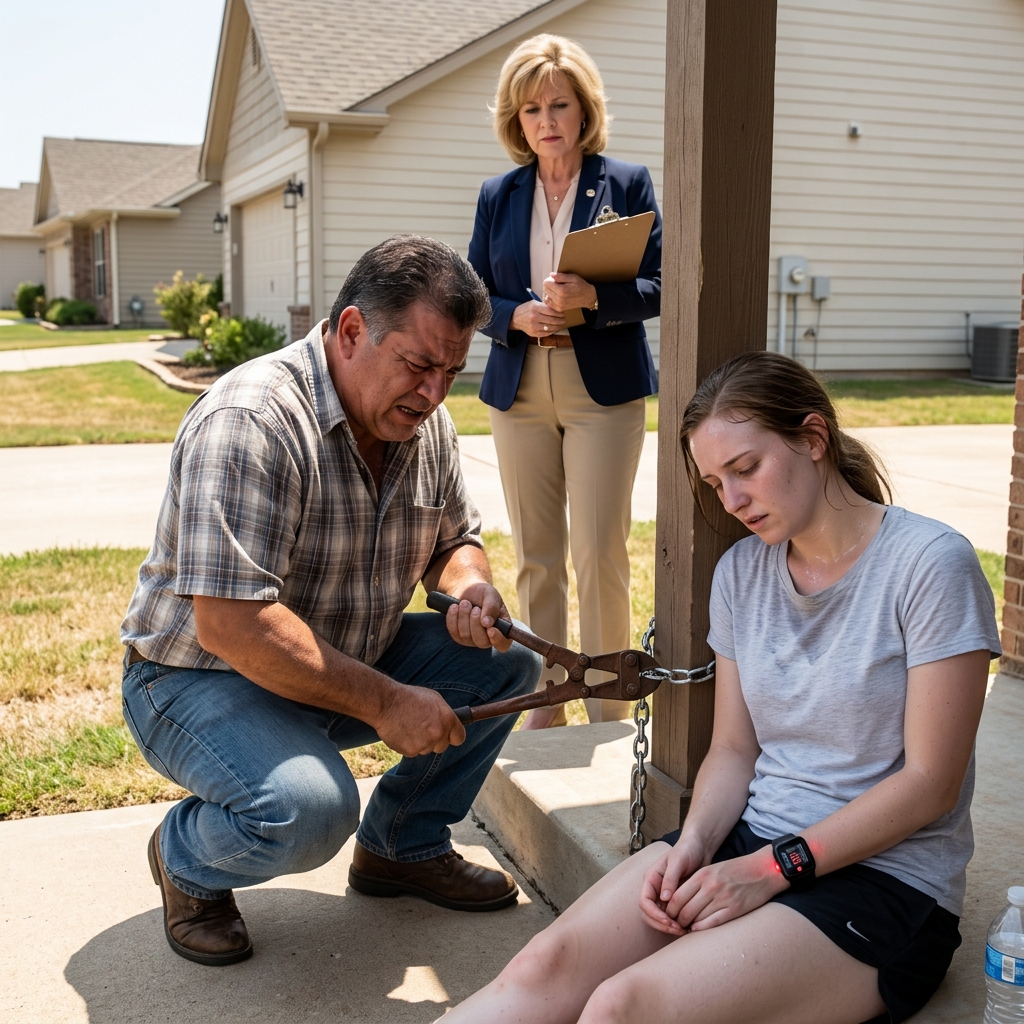
The world went silent except for Emma’s labored breathing, the distant wail of sirens, and the roaring in my own ears. My hands were still shaking from the bolt cutters. The chain lay in pieces on the porch. My daughter’s heart monitor kept beeping—each one a tiny hammer against my chest.
“She was unsupervised,” Diana repeated, louder now, as if the neighbors gathering on their lawns needed to hear her justification. “I was protecting the community.”
I didn’t answer.
I couldn’t.
Because the moment I opened my mouth, I knew what would come out—and it wouldn’t be the voice of a sheriff. It would be the voice of a father who had just watched his child nearly die.
Emma’s eyes fluttered open for half a second. “Daddy… hot…”
I pressed my palm against her cheek. Her skin burned. “I know, baby. The ambulance is coming. You stay with me, okay? You stay right here.”
Behind me, Deputy Miles’s patrol car screeched to a halt. He jumped out, radio already at his lips. “Dispatch, confirm ETA on medic unit one-two. We have a pediatric cardiac emergency.”
“Two minutes out,” the radio crackled back.
Two minutes.
That felt like an eternity.
Diana shifted her weight, still holding that clipboard like a shield. “I followed protocol,” she said, her voice climbing an octave. “The HOA emergency procedures clearly state—”
“Ma’am,” Miles interrupted, stepping between us, “I’m going to need you to step back to the sidewalk and remain there.”
She didn’t move. “Do you know who I am?”
“I know exactly who you are,” I said.
My voice came out flat. Dead. The kind of voice I used when I was about to arrest someone who thought they were untouchable.
Diana’s smile flickered.
The ambulance turned onto our street, lights washing over the houses. Two paramedics ran toward us, one carrying a bag, the other a stretcher. They dropped to their knees beside Emma, and I forced myself to let go of her hand.
“Sheriff, we need you to move back,” the lead paramedic said—a young woman with steady hands and a calm voice.
I didn’t move.
She looked up at me, and something in her eyes softened. “Sir, I promise you, we’re going to take care of her. But I need room to work.”
I backed away three steps.
Four.
Five.
My boots hit the grass, and I turned around.
Diana was watching the paramedics work with the same expression she probably wore when she mailed out violation notices—cold, satisfied, righteous.
“You have no idea what you just did,” I said.
She tilted her head. “I did what was necessary. Your daughter was unattended. The chain was for her own safety. She could have wandered into the street.”
“She has a heart condition,” I said. “She’s eight years old. She weighs forty-two pounds. And you chained her to a post in ninety-five-degree heat.”
“I didn’t chain her,” Diana said. “I secured her.”
The sirens died as the ambulance doors slammed shut.
I watched them load Emma inside. Her tiny hand hung off the edge of the stretcher, fingers limp. The paramedic was already placing an oxygen mask over her face.
“I’m going to the hospital,” I said to Miles. “You secure the scene. Get every doorbell camera, every phone video, every witness statement. And do not let her leave that sidewalk until Captain Reeves gets here.”
Miles nodded. “Copy that, Sheriff.”
I climbed into my personal vehicle—the department car was already being processed for evidence—and followed the ambulance through the neighborhood streets. Every stop sign felt like an hour. Every light turned red.
At the hospital, they didn’t let me into the trauma bay.
I sat in a plastic chair in the hallway, still wearing my uniform, still covered in Emma’s blood from the cut on her wrist. A nurse brought me a cup of water I didn’t drink.
Two hours later, Dr. Mehta came out.
I knew her face before she spoke.
“Sheriff Ramirez, Emma is stable for now, but her heart has sustained significant stress. We’re monitoring her closely.”
“What does that mean?” I asked.
She sat down across from me. “It means the heat, the dehydration, the panic—her heart couldn’t compensate. She’s in acute heart failure. We’re doing everything we can to stabilize her, but she’s going to need a transplant.”
The words didn’t make sense at first.
Transplant.
That word belonged to other families. Families on TV. Families in fundraisers. Not my little girl who had just been chained to our porch.
“She was fine this morning,” I said. “She was laughing. She was eating cereal.”
“I know,” Dr. Mehta said softly. “But the incident pushed her over the edge she was already standing on.”
I put my head in my hands.
That night, Captain Reeves found me in the ICU waiting room. He looked tired, his tie loosened, his eyes carrying the weight of a case that had already become personal for everyone involved.
“I need you to hear this from me,” he said, handing me a folder.
Inside was a printout of texts, emails, and a transcript.
I read the first line: “Ramirez thinks his badge puts him above neighborhood standards. That sick kid on the porch is the perfect lesson.”
I read the second line: “Once the neighborhood sees I can control him, nobody will question me again.”
I read the timestamp on the 911 call Diana made before Mrs. Levin called.
Twenty-six minutes before I got home.
Twenty-six minutes my daughter sat chained in the heat while Diana watched.
Reeves sat down beside me. “We found more. Notes about fining the veterans. Threats against the widow. And a recording from a board meeting where she talked about using your daughter to set an example.”
I closed the folder.
“She’s claiming HOA emergency authority,” Reeves said. “We’re looking into who signed that document.”
I looked through the glass wall into Emma’s room. She was asleep, her chest rising and falling under a thin white sheet. The scar on her wrist was covered in gauze.
“Find them,” I said.
The investigation took three weeks.
In those weeks, I slept in the hospital. I watched Emma open her eyes, then close them again. I held her hand while she asked me if the bad lady was gone, and I told her yes, even though I knew Diana was still out there, free, waiting.
On the fourth week, the DA’s office charged Diana Harrington with attempted murder, aggravated child abuse, false imprisonment, and civil rights violations.
Her attorney held a press conference the same day.
“My client acted in good faith to protect a vulnerable child from potential harm. The HOA had a standing policy for unattended minors. Mrs. Harrington followed that policy to the letter.”
The video didn’t support that.
Mrs. Levin’s doorbell camera showed Diana walking up our porch steps with a chain already in her hand. It showed Emma shrinking back, saying, “My dad said I could sit here.” It showed Diana kneeling down, wrapping the chain around Emma’s wrist, and pulling it tight.
Emma started crying immediately.
Diana didn’t stop.
She looped the chain twice, locked the padlock, and stood up. She looked at Emma for ten seconds. Then she walked away.
The video didn’t show her calling 911 until seventeen minutes later.
At trial, I sat in the front row.
Diana wore a cream suit and a string of pearls. She looked composed, serene, as if she were attending a board meeting instead of a criminal proceeding.
The prosecutor called witness after witness.
The paramedic who said Emma’s body temperature was 104 degrees.
The neighbor who heard Emma calling for water.
The veteran who testified about the ramp.
The widow who described the ambulance fine.
And then they called me.
I stood in the witness box, sworn in, and looked at Diana for the first time since that day.
She didn’t look away.
“Sheriff Ramirez,” the prosecutor said, “can you describe what you saw when you arrived home that afternoon?”
I told them.
I told them about the chain. About the monitor. About the blue lips and the sound she made when I lifted her.
I told them about the twenty-six minutes.
When I finished, the courtroom was silent.
The defense attorney cross-examined me for an hour, trying to paint me as an overprotective father who used his badge to persecute a well-meaning neighbor.
“You were angry, weren’t you?” he asked.
“Yes.”
“Angry enough to want revenge?”
“I wanted my daughter to live.”
He kept pushing. But the video didn’t lie. The emails didn’t lie. The recording didn’t lie.
On the third day of testimony, the prosecutor played the board meeting recording.
Diana’s voice filled the courtroom.
“Ramirez hides behind that badge and that fragile little girl. Once the neighborhood sees I can control him, nobody will question me again.”
The juror in the second row started crying.
Diana’s face turned pale.
The verdict came back in four hours.
Guilty on all counts.
The judge sentenced her to life in prison without the possibility of parole.
When the gavel fell, Diana finally looked at me.
I didn’t smile.
I just stood up, walked out of the courtroom, and drove straight to the hospital.
Emma was awake that day.
She was sitting up, eating a popsicle, her hair pulled back in a tiny ponytail.
“Daddy,” she said, her voice still weak but steady. “Did you catch the bad lady?”
I sat on the edge of her bed. “Yes, baby. They put her away for a long time.”
She took another bite of her popsicle and looked toward the window. “Can I go home soon?”
“Soon,” I said.
It wasn’t a lie.
She came home three weeks later.
The HOA was dissolved by court order. The board members who signed that fake document were removed. The neighborhood became a resident council, and the first thing they did was approve Emma’s ramp.
But the transplant list never stopped feeling like a ticking clock.
Some nights, I held her while she coughed, while her monitor beeped warnings, while she asked me if she would get to see her next birthday.
“You will,” I told her every time.
I didn’t know if it was true.
But I believed it.
Six months after the trial, I got a call while I was on duty.
“Sheriff Ramirez, we have a match.”
I dropped the phone and ran.
Emma’s transplant was successful.
She spent two months in recovery, then three, then six. She learned to walk again. She learned to laugh again.
One afternoon, we sat on our front porch—the same porch where she had been chained.
She leaned against me, her hand in mine, her eyes closed.
“Daddy,” she whispered.
“Yeah, baby?”
“I’m not scared anymore.”
I kissed the top of her head.
“Neither am I.”
And for the first time in a long time, that was true.
The words hung in the air between us, light and fragile as the butterfly that landed on the railing beside Emma’s hand.
She watched it open and close its wings, her eyes soft.
“Daddy, do you think the butterfly knows it was almost winter?”
I followed her gaze. The afternoon sun slanted through the trees, casting long shadows across the lawn where the ambulance had parked six months ago. The grass had grown back where the tires had torn it.
“I think butterflies just live,” I said. “They don’t worry about what’s coming.”
Emma turned the butterfly’s name over in her mouth like a question. “Maybe that’s why they’re so pretty.”
She was quiet for a long moment. Then she pulled her hand away from mine and placed it flat on her chest, over the scar that ran beneath her shirt. Her fingers pressed gently, feeling the rhythm of the new heart.
“Does it feel different?” I asked.
“It feels like someone else’s heartbeat,” she said. “Like there’s a stranger inside me who’s always running.”
I didn’t know what to say to that.
She solved it for me. “But that’s okay. The stranger saved my life.”
I blinked hard and looked away. The neighbor’s kid was riding a bike down the street, training wheels wobbling. Mrs. Levin was watering her petunias. The world had moved on.
But inside our house, clocks still ticked in a different time.
That night, I couldn’t sleep.
I sat at the kitchen table with a cold cup of coffee and the folder Captain Reeves had left on my desk months ago. I’d kept a copy. Not for evidence. For memory.
I opened it.
The transcripts. The emails. The photo of Diana kneeling beside Emma, holding the chain.
I turned to the last page.
There was a typed statement from Paul Whitcomb, the HOA treasurer who had recorded the board meeting. At the bottom, in his handwriting, he had added a line:
“I’m sorry I didn’t stop her sooner.”
I closed the folder.
The clock on the wall said 2:17 a.m.
Emma’s bedroom light was on.
I found her sitting cross-legged on her bed, the stuffed bunny she’d had since she was two cradled in her arms. She was staring at the wall, where she had taped up drawings of our family: me, her, Grandma, and a figure in a sheriff’s hat that looked more like a blob than a person.
“Can’t sleep?” I asked.
She shook her head. “I keep thinking about the hospital.”
I sat beside her. “What about it?”
“The beeps,” she said. “The way the machines talked to me. They said numbers I didn’t understand. But I knew when the numbers were bad because the nurses’ faces got tight.”
She looked at me. “Your face got tight too, Daddy.”
I reached for her hand. “That’s because I was scared.”
“Were you scared I would die?”
The question hit me like a punch to the chest.
“Yes,” I said. “Every day.”
She nodded slowly, as if she had already known. Then she leaned her head against my shoulder.
“I wasn’t scared,” she said. “Because I knew you would come.”
I held her until she fell asleep, her breathing evening out, her hand still clutching the bunny.
I stayed there the rest of the night.
The next morning, a Saturday, I woke to the smell of pancakes.
Emma was standing on a stool at the stove, flipping a pancake with a spatula that was too big for her hand. She had flour on her nose.
“I’m making breakfast,” she announced.
“I can see that.”
“Sit down. You don’t have to do everything.”
I sat.
She served me a plate with three pancakes, slightly burnt on one side, drizzled with syrup that had pooled into a lake on the plate.
I ate every bite.
“Good?” she asked.
“The best I’ve ever had.”
She beamed.
Then the doorbell rang.
I wiped my hands and opened the door.
A man stood on my porch. Middle-aged, balding, dressed in a polo shirt and pressed khakis. He held a manila envelope in both hands, like an offering.
“Sheriff Ramirez?”
“Yes.”
“My name is Howard Chen. I was on the HOA board.”
My body went rigid.
He saw it and stepped back half a foot. “I’m not here to cause trouble. I’m here to apologize.”
I didn’t open the screen door. “You were one of the people who signed that emergency authority document.”
“Yes.” His voice cracked. “I didn’t know what it would be used for. Diana told us it was a standard safety protocol. She said it was just a formality. I trusted her.”
“And now?”
He pressed the envelope toward me. “I’ve been keeping records. Every meeting, every decision, every time she pressured us to approve something questionable. I’m giving you everything.”
I took the envelope.
“I have a daughter too,” he said quietly. “She’s six. She has asthma. I keep thinking—what if it had been her?”
He waited.
I said nothing.
“I know I can’t undo what happened,” he continued. “But I want to make sure it never happens to anyone else again.”
I opened the envelope.
Inside were notebooks, USB drives, printed emails, and a handwritten timeline stretching back three years.
I looked up.
Howard Chen was crying.
“Please,” he said. “Help me make this right.”
I stepped aside and held the door open.
“Come in.”
He sat at my kitchen table, across from Emma’s half-eaten pancakes. I poured him a cup of coffee, and he started talking.
He told me about the first time Diana had proposed fining the veteran—a retired Marine named Frank Kowalski who had built a wheelchair ramp without HOA approval. Diana had called it “an eyesore that lowers property values.” The board had voted 4-3 against the fine. Diana had overruled them the next day, citing a clause in the bylaws that didn’t exist.
Howard had questioned her.
She had responded by launching an audit of his finances, looking for reasons to remove him from the board.
He found nothing, but the message was clear.
“That’s how she controlled everyone,” Howard said. “Fear. Shame. The threat of public humiliation.”
He pulled out a photograph from his folder. It showed a woman in her seventies, standing in front of a house with a FOR SALE sign. “Margaret O’Leary. Widow. Her husband died of cancer. She had hospice come three times a week. Diana fined her for the ambulance parking in the driveway. $200 per occurrence. Margaret couldn’t pay. She lost the house.”
I stared at the photo.
“Where is Margaret now?”
“Living with her daughter in Nevada. She left the state.”
Howard slid another paper across the table. “There’s more. Eleven families. All targeted for medical equipment, disability accommodations, or end-of-life care.”
He looked at me. “Your family was number twelve.”
The kitchen felt small.
Emma walked in from the living room, her bunny under her arm. She looked at Howard, then at me.
“Daddy, who is that?”
“A friend,” I said. “Someone who wants to help.”
She studied Howard for a long moment, then walked over and placed her bunny in his lap.
“You can hold him if you’re sad,” she said. “He’s very soft.”
Howard looked down at the worn bunny, its fur matted from years of hugs. He opened his mouth, closed it, and pressed the bunny to his chest.
“Thank you,” he whispered.
Emma nodded and walked back to her room.
The next few months changed the neighborhood in ways I hadn’t expected.
With Howard’s records, the DA’s office opened a broader investigation into Diana’s tenure. They found evidence of financial fraud, coercion, and a pattern of abuse that went back seven years.
Eleven families were contacted.
Seven filed lawsuits against the HOA.
The remaining four chose to remain anonymous, too traumatized to relive it.
But the most surprising thing happened on a Tuesday afternoon in October.
I came home from work to find a crowd gathered on our lawn.
For a second, my heart stopped. I thought something had happened to Emma.
Then I saw the banner.
“WELCOME HOME, EMMA.”
Mrs. Levin was there, holding a tray of cookies. Howard stood beside her, holding a sign that read “NEIGHBORHOOD HERO.” Frank Kowalski, the Marine veteran, sat in his wheelchair, a flag folded in his lap.
And in the center of the crowd, Emma stood on a small stage made of wooden pallets, wearing a paper crown.
“What is this?” I asked.
Emma ran to me. “They threw me a party, Daddy! They said I’m the bravest kid in the whole subdivision!”
I looked at Mrs. Levin.
She shrugged. “We couldn’t let the day pass without doing something.”
“What day?”
She smiled. “Exactly six months since you cut that chain.”
The crowd cheered.
I stood there, holding my daughter, surrounded by neighbors who had once been strangers, and felt something I hadn’t felt in years.
Hope.
That night, after the party ended and the decorations came down, I sat on the porch alone.
Emma was asleep, her new heart beating steadily in her chest.
I looked at the spot where the chain had been wrapped around the post. The wood was still scarred, a faint groove worn into the paint.
I touched it.
Then I heard footsteps.
Howard Chen walked up the driveway, a folder in his hand.
“Sheriff,” he said. “I have something else.”
I stood.
He handed me the folder. Inside was a letter, typed on official letterhead.
“What is this?”
“An invitation,” he said. “The new resident council wants to rename the subdivision.”
I read the letter.
It was a proposal to change the name of Harrington Estates to Emma’s Grove.
I looked up.
Howard smiled. “The vote was unanimous.”
The paper trembled in my hands.
I thought of the chain. I thought of the monitor. I thought of the twenty-six minutes.
I thought of Diana Harrington, sitting in a cell, her pearls confiscated, her smile long gone.
And I thought of Emma.
“She’ll love it,” I said.
Howard nodded.
We stood together in the dark, two men who had failed to protect the people we loved—and who had been given a second chance.
“Thank you,” I said.
“I should be thanking you,” Howard replied. “You showed me what courage looks like.”
I looked at the porch, the scarred post, the stars beginning to appear.
“It wasn’t courage,” I said. “It was just love.”
A light flicked on in Emma’s window.
She was standing there, waving.
I waved back.
And for the first time, I believed that the worst was behind us.
The next morning, sunlight crept through the curtains and found me still sitting on the porch.
I hadn’t moved since Howard left.
The letter was still in my hands, the paper warm from my grip. Emma’s Grove. I turned the words over in my mind, testing their weight. They felt lighter than Harrington Estates. Cleaner. Like the air after a storm.
The screen door creaked behind me.
Emma stood there, her hair tangled from sleep, her bunny dragging by one ear. She blinked at the morning light and shuffled over to sit on my lap.
“”Daddy, why are you still in your uniform from yesterday?””
I looked down. She was right. I had fallen asleep in the chair, still wearing my duty belt, my badge catching the early light.
“”Guess I forgot to take it off.””
She pressed her cheek against my chest. “”You work too hard.””
I kissed the top of her head. “”Maybe. But I had a good reason to stay awake last night.””
She pulled back, her eyes curious. “”What reason?””
I handed her the letter.
She frowned at the official header, her lips moving as she sounded out the words. She was still learning, still catching up on reading after months of hospital stays.
“”Emma’s… Grove?”” She looked up. “”Is that a tree place?””
“”It’s going to be the new name of our neighborhood.””
Her eyes went wide. “”Our whole neighborhood? Named after me?””
“”The whole thing.””
She stared at the letter again, then back at me. “”But why?””
I took her hand, the one with the faint scar around her wrist. “”Because you reminded everyone what matters. Because you’re brave. Because this neighborhood wants to remember that taking care of each other is more important than rules.””
She was quiet for a long moment. Then she said, “”Can we plant a tree?””
I laughed. “”What kind of tree?””
“”An apple tree. So everyone can have apples.””
I pulled her close. “”We’ll plant the first one today.””
—
Two weeks later, on a Saturday morning that felt more like spring than late autumn, the whole neighborhood gathered at the intersection of Maple and Elm.
A wooden sign stood covered by a white sheet. Frank Kowalski had built the frame himself, his wheelchair parked beside it, his hands still dusted with sawdust. Mrs. Levin had organized the refreshments. Howard had printed the programs.
And Emma stood at the front, wearing a dress she had picked out herself—pink, with butterflies embroidered on the collar.
The resident council president, a quiet woman named Patricia who had taken over after Diana’s arrest, stepped up to the microphone.
“”Neighbors, friends, and family. Today we mark a new beginning. For too long, this community was governed by fear. By control. By one person’s belief that she had the right to decide who belonged here and who didn’t.””
She paused, her voice catching.
“”But that’s not who we are. That’s not who we choose to be. And so, with a unanimous vote, it is my honor to dedicate this neighborhood to the little girl who taught us what courage really looks like.””
She pulled the sheet.
The sign read: “”EMMA’S GROVE — EST. 2024″”
The crowd erupted.
Emma clutched my hand, her eyes shining. “”Daddy, it’s really my name.””
“”Forever, baby.””
Frank Kowalski wheeled forward, holding a small sapling in a pot. “”This here’s a Granny Smith apple tree. Best kind for pies.”” He winked at Emma. “”I figured you’d want to get started on that apple supply.””
Emma let go of my hand and knelt beside him. Together, they dug a small hole in the patch of earth beside the new sign. She placed the sapling in, packed the dirt, and patted it gently.
“”There,”” she said. “”Now it’s really a grove.””
People clapped. Someone took photos. Mrs. Levin handed out cookies shaped like apples.
And for one beautiful hour, the neighborhood felt whole.
—
But healing isn’t a straight line.
Two months later, on a cold January night, I got a call from the prison.
“”Sheriff Ramirez, this is Warden Colton at the state correctional facility. I’m calling regarding inmate Diana Harrington.””
I set down the coffee I had been holding. “”What about her?””
“”She’s filed an appeal based on new evidence. Her attorney claims the emergency authority document was notarized by a licensed professional, and that the board members who signed it were acting within their rights under the original HOA bylaws.””
My jaw tightened. “”Those bylaws were dissolved by court order.””
“”Yes, sir. But the appeal argues that the document was signed before the dissolution, and therefore the charges of false imprisonment and civil rights violations should be reduced or dismissed.””
I closed my eyes.
“”She’s also claiming that your daughter’s medical condition was pre-existing, and that the prosecution failed to prove the heat exposure directly caused the deterioration. Her attorney is pushing for a retrial.””
The kitchen felt cold.
“”When is the hearing?””
“”Three weeks from today. The judge has agreed to review the case.””
I thanked the warden and hung up.
For a long time, I stood in the dark kitchen, staring at the phone.
Emma was asleep upstairs. Her new heart was beating strong. She had just started second grade, catching up on math and reading, making friends, drawing pictures of apple trees and butterflies.
And now Diana Harrington might get a second chance.
I walked upstairs and stood in Emma’s doorway.
She was curled on her side, her bunny tucked under her arm, her breathing steady.
I wanted to wake her. I wanted to tell her not to worry. I wanted to promise her that nothing would change.
But I had already learned that promises don’t always hold.
So I just stood there, watching her sleep, and let the anger burn through me until it turned into something colder.
Determination.
—
The next morning, I called Howard.
“”We need to talk.””
He met me at the diner on Main Street, the one with the cracked vinyl booths and coffee that tasted like regret. He looked older than I remembered, the lines around his eyes deeper.
“”You heard,”” he said.
“”Heard. Didn’t believe.””
Howard stirred his coffee. “”Her attorney is grasping at straws. The notary was a friend of Diana’s from a real estate firm. She’s already been questioned about the validity of her stamp.””
“”Questioned, but not charged.””
“”Not yet. But the DA is working on it.””
I leaned forward. “”What do we need to win this?””
Howard set down his spoon. “”We need the original recording. The full one, not the edited version. Diana’s attorney is arguing that the board meeting recording was tampered with to remove context.””
My stomach dropped. “”Was it?””
Howard hesitated.
“”Howard.””
“”I don’t know,”” he said. “”I gave the DA everything I had. But there was one recording I never handed over. Diana made a private call after that meeting. I caught it on my phone by accident.””
I stared at him.
“”Where is it?””
He pulled out his phone, scrolled through files, and slid it across the table.
“”I’ve been holding onto it because I was scared,”” he said. “”If she finds out I recorded a private conversation, I could be sued. But if it helps keep her in prison…””
I pressed play.
The recording was grainy, distant, but Diana’s voice came through clear.
“”Did you get the notary sorted?””
A pause. Then a man’s voice. “”Yes. She’ll sign whatever I put in front of her.””
“”Good. And the board members?””
“”They’re scared. They’ll keep their mouths shut.””
“”Make sure they do. If anyone talks, I’ll make their lives hell. I’ve done it before.””
The recording ended.
I looked up.
Howard’s face was pale. “”That’s her. On tape. Witness tampering. Obstruction of justice.””
I handed the phone back. “”Send that to the DA. Now.””
He nodded and started typing.
I drank my coffee, cold and bitter, and felt something shift inside me.
Diana thought she could still win.
But she had made one mistake.
She had forgotten that the truth has a way of surfacing—even when you think you’ve buried it deep.
I waited for the coffee to go cold in my hands.
Howard’s fingers moved across his phone screen, his expression tight. The diner hummed around us—the clatter of plates, the low murmur of morning conversations, the occasional hiss of the espresso machine. None of it reached me.
“”Sent,”” Howard said, setting the phone face-down on the sticky table.
I didn’t look away from the window. Outside, a woman was pushing a stroller past the diner, her toddler laughing at something invisible. Normal life. The kind of life I used to have.
“”Now we wait,”” I said.
Howard wiped his palms on his jeans. “”I’ve never done anything like this before. I’ve never—I’ve never been on this side of a fight.””
I finally looked at him. “”Neither had I. Not until I found my daughter chained to a post.””
He nodded slowly, his jaw working. “”What happens next?””
“”The DA reviews the recording. If it’s admissible, they file new charges. Witness tampering. Obstruction. Maybe conspiracy.”” I paused. “”And then we see if the judge grants the appeal hearing.””
“”And if she wins?””
I thought about Emma’s face this morning, the way she had pressed her hand to her chest, feeling the stranger’s heartbeat.
“”She won’t.””
Howard held my gaze for a long moment. Then he picked up his coffee and drained it in one swallow.
“”I should get home,”” he said. “”My daughter has a doctor’s appointment this afternoon. Just a checkup. But I want to be there.””
I reached across the table and gripped his shoulder. “”Go.””
He stood, leaving a crumpled five-dollar bill on the table. At the door, he turned back. “”Sheriff?””
“”Yeah?””” “””I’m not scared anymore.””
He walked out, the bell above the door jingling behind him.
I stayed in the booth for another hour, staring at nothing, running through every possible outcome in my mind. The DA would act fast—she had to. The hearing was in three weeks. Every day counted.
My phone buzzed.
A text from Captain Reeves: *””Got the file. DA is reviewing. Hold tight.””*
Hold tight.
I almost laughed.
—
The next two weeks were a slow-motion blur.
Emma went to school. I went to work. The neighborhood settled into its new rhythm—residents waved at each other now, stopped to talk, shared plates of cookies on front porches. The apple sapling Frank had planted was already growing small buds.
But underneath the surface, the ground was shifting.
I didn’t tell Emma about the appeal. She didn’t need to carry that weight. She was busy learning multiplication tables, practicing her handwriting, drawing pictures of our house with a giant apple tree in the front yard.
One evening, she looked up from her homework and asked, “”Daddy, is the bad lady still in jail?””
I set down my newspaper. “”Yes, baby. She is.””
“”Good.”” She went back to her worksheet.
That was the only time she mentioned it.
But I saw the way she checked the front door lock before bed. The way she flinched when a car backfired in the street. The way her hand found mine in the dark, her fingers cold and small.
She remembered.
Children always remember.
—
On the Monday before the hearing, Deputy Miles pulled me aside at the station.
“”Sheriff, there’s something you need to see.””
He led me to his desk and turned the monitor toward me. On the screen was a news article from a local online paper.
**””HOA Appeal Hearing Set for Wednesday—New Evidence Could Overturn Conviction.””**
The comments section was already filling up. Some people believed Diana was innocent. Some called her a monster. A few blamed me for using my badge to “”railroad a good woman.””
Miles watched my face. “”Publicity like this can sway a judge.””
“”I know.””
“”The DA wants to meet with you this afternoon. She’s got a strategy.””
I nodded and walked away.
—
The meeting took place in the DA’s office, a cramped room on the third floor of the county courthouse. Papers covered every surface. A whiteboard was filled with timelines and names.
DA Sarah Chen—no relation to Howard—was a sharp woman in her early fifties who had prosecuted two governors and a dozen corrupt officials. She didn’t smile much.
“”Sit down, Sheriff.””
I sat.
She leaned back in her chair. “”The recording Howard Chen sent us is gold. Diana’s voice, clear as day, discussing witness tampering and obstruction. But her attorney will argue it was obtained illegally—that Howard had no right to record a private conversation.””
“”Can they suppress it?””
“”Maybe. But we’ve got something stronger.”” She slid a folder across the desk. “”The notary—Lydia Ross—flipped this morning. She admitted Diana pressured her to backdate the emergency authority document. We have her signed confession.””
I opened the folder. Inside was a four-page statement, signed and dated.
“”She’s willing to testify?””
“”She’s terrified of Diana, but she’s more scared of prison time. We offered her immunity in exchange for full cooperation.””
I closed the folder. “”When do we present this?””
“”Wednesday morning. The hearing starts at nine.”” Sarah leaned forward, her eyes hard. “”But here’s the thing, Robert. Diana’s attorney requested that Emma be called as a witness.””
The words hit me like a physical blow.
“”No.””
“”It’s already on the docket. The judge approved it.””
“”She’s eight years old. She has a heart transplant. She has nightmares—””
“”I know.”” Sarah’s voice softened. “”I fought it. But the defense argues that Emma’s testimony is critical to establishing whether she was ‘unattended’ or ‘secured for her own safety.’ They want to paint you as an overprotective father who overreacted.””
I stood up. “”She’s not testifying.””
“”Robert—””
“”I’ll take the stand again. I’ll say whatever you need. But Emma stays out of that courtroom.””
Sarah studied me for a long moment. Then she nodded slowly. “”I’ll file a motion to exclude her testimony based on medical trauma. But I can’t guarantee the judge will grant it.””
I walked out of her office without another word.
—
That night, I sat on the edge of Emma’s bed, watching her sleep.
The monitor beside her bed was silent. Her new heart beat steadily. Her face was peaceful, relaxed, unburdened by the weight of what was coming.
I reached out and brushed a strand of hair from her forehead.
“”Daddy?”” Her eyes fluttered open.
“”Sorry, baby. Didn’t mean to wake you.””
She blinked, her gaze finding me in the dim light. “”Are you sad?””
“”No. Just thinking.””
She shifted over, patting the space beside her. “”You can stay.””
I lay down beside her, careful not to crowd her small body. She curled into my side, her head on my chest.
“”Do you remember the butterfly?”” she asked.
“”On the porch? Yes.””
“”I liked that butterfly. It didn’t care about anything. It just flew.””
I wrapped my arm around her. “”Maybe that’s the secret.””
“”What secret?””
“”To not caring about the things that don’t matter.””
She was quiet for a moment. Then she said, “”Daddy, I know about the hearing.””
My heart stopped.
“”I heard you talking to Captain Reeves on the phone yesterday. You said the bad lady might get out.””
I closed my eyes.
“”I’m not scared,”” she continued, her voice small but steady. “”Because I know you’ll protect me. You always do.””
I couldn’t speak.
She lifted her head and looked at me. “”But Daddy?””
“”Yeah?””
“”If she gets out, can we move somewhere with more butterflies?””
I pulled her close, burying my face in her hair, and let the tears fall in silence.
—
Wednesday morning came too fast.
The courthouse steps were crowded with reporters. Camera flashes popped like fireflies. Someone shouted my name. I kept walking, Emma’s hand in mine, my badge on my belt.
Sarah had lost the motion.
Emma would testify.
We sat in a small room beside the courtroom, waiting. Emma wore a blue dress with white flowers. She had insisted on wearing her heart monitor under it, even though Dr. Mehta said she didn’t need it anymore.
“”It makes me feel safe,”” she had said.
I didn’t argue.
Sarah appeared in the doorway. “”They’re ready for us.””
I stood, pulling Emma gently to her feet. She looked up at me, her eyes clear.
“”Daddy, I want you to stay in the room. Can you do that?””
“”I’ll be right there, baby. Front row.””
She nodded, squared her shoulders, and walked through the door.
I followed, my heart pounding harder than it had the day I found her chained.
Diana sat at the defense table, dressed in a gray suit, her hair pulled back. She looked thinner, older. But her eyes were the same. Cold. Calculating.
She looked at Emma as we entered.
And she smiled.
Not a big smile. Just a small, knowing curl of her lips.
I wanted to cross the room. I wanted to do something I would regret.
Instead, I sat down in the front row, folded my hands, and prayed.
The judge entered. The bailiff called the court to order.
Diana’s attorney stood first. “”Your Honor, before we proceed, I’d like to recall that the state’s key witness—Ms. Emma Ramirez—is a child of fragile health. The defense has no desire to cause undue distress. However, the facts of this case hinge on the child’s own actions on the day in question. Specifically, whether she was truly in danger or simply—””
“”Objection,”” Sarah said. “”Speculation.””
“”Sustained.””
But the damage was already done.
I watched Emma sit in the witness chair, her feet barely reaching the floor. The bailiff adjusted the microphone so she could speak.
She looked at me.
I nodded.
And then she began to talk.Emma’s small voice sliced through the courtroom silence like a blade.
“”I was sitting on the porch because Daddy said I could. He always lets me sit there when the sun is warm. He says the vitamin D is good for my heart.””
The judge leaned forward, his expression unreadable. The jurors—empaneled for the initial trial but recalled for this evidentiary hearing—sat motionless, their eyes fixed on the eight-year-old in the witness box.
Diana’s attorney, a man named Strickland with a silver watch and a practiced smile, approached slowly. “”Emma, do you understand what it means to tell the truth?””
“”Yes. It means you don’t make stuff up.””
“”And do you promise to tell the truth today?””
“”Yes.””
Strickland clasped his hands behind his back. “”On the day you were on the porch, did you feel like you were in danger?””
Emma’s gaze drifted to me for a split second. I held my breath.
She looked back at Strickland. “”At first, no. I was just drawing with chalk. But then the lady came.””
“”The lady?””
“”Mrs. Harrington. She had a chain.””
Strickland’s smile tightened. “”And what did she say to you?””
“”She said I was a problem. She said my oxygen tank was ugly and that Daddy thought he was special because he had a badge.”” Emma’s voice wavered but didn’t break. “”She said she was going to teach us a lesson.””
A ripple moved through the gallery. Someone whispered. The judge tapped his gavel once.
“”Go on,”” Strickland said, his tone deceptively gentle.
“”She wrapped the chain around my wrist. It was tight. I told her it hurt. She said it was supposed to hurt so I wouldn’t forget.””
My hands gripped the wooden bench in front of me until my knuckles turned white.
“”Did she tell you why she was doing it?”” Strickland asked.
Emma nodded. “”She said because Daddy made her look bad in front of the neighborhood. She said now everyone would see that she was in charge, not him.””
Strickland’s mask cracked for just a moment. He recovered quickly. “”And did you believe her?””
“”I believed she was mean,”” Emma said simply. “”I believed she didn’t care if I got hurt.””
The courtroom held its breath.
Strickland tried a different angle. “”But you were outside alone, weren’t you? Your father wasn’t watching you.””
“”Daddy was at work. He’s a sheriff. He catches bad guys.””
“”So you were unsupervised.””
Emma’s chin lifted. “”I was eight. I’m allowed to sit on my own porch.””
A murmur of approval from the gallery. The judge didn’t gavel this time.
Strickland pressed on. “”Did you ever tell Mrs. Harrington that you had a heart condition?””
“”Yes. I showed her my monitor. She said it was ugly and I should hide it.””
“”And did you feel like you needed medical attention at any point before your father arrived?””
Emma’s eyes welled up. “”I felt hot. Really hot. And my chest felt funny. Like my heart was running too fast. I asked her for water. She said no.””
Strickland held up a piece of paper. “”Your Honor, I’d like to introduce the defendant’s written statement, in which she claims the child did not request water.””
“”Emma, did you ask for water?””
“”Yes. Twice.””
“”And what did Mrs. Harrington say?””
“”She said, ‘You should have thought about that before you became a neighborhood problem.’””
The words dropped like stones into still water.
I saw one of the jurors—a woman in her fifties—press a hand to her mouth.
Strickland retreated, regrouping. He tried to chip away at her story, asking the same questions in different orders, searching for inconsistencies. But Emma’s account never wavered. She remembered the heat. The chain. The burning in her chest. The way Diana had stood there, watching, waiting.
When Strickland finally sat down, Sarah Chen rose for redirect.
“”Emma, you said Mrs. Harrington told you she was teaching you a lesson. What do you think that lesson was supposed to be?””
Emma was quiet for a long moment. Then she said, “”That some people think they can hurt you and get away with it.””
Sarah nodded. “”And did she get away with it?””
“”No,”” Emma said, her voice steady. “”Because Daddy came home.””
The courtroom erupted in whispers.
The judge adjourned for lunch.
I found Emma in the hallway, sitting on a wooden bench, swinging her legs. A court officer had brought her a juice box. She sipped it slowly, staring at the floor.
I sat down beside her.
“”You did good, baby.””
She looked up. “”Was I brave?””
“”Braver than anyone I’ve ever known.””
She leaned her head against my arm. “”I don’t want to go back in there.””
“”You don’t have to. You’re done.””
She nodded, relief softening her face. “”Can we go home now?””
“”Soon. I just need to hear the judge’s decision.””
She thought about that. “”Will it take long?””
“”I hope not.””
We sat in silence for a while. Then she said, “”Daddy, I think the butterfly was right.””
“”About what?””
“”About not worrying. Because even when you worry, bad things still happen. So you might as well just fly.””
I hugged her close, feeling the steady beat of her new heart against my chest.
The stranger inside her.
Still running.
Still fighting.
Still alive.
—
The hearing resumed at 2:00 p.m.
The prosecution called Lydia Ross, the notary, who broke down on the stand and admitted to forging Diana’s emergency authority document. She described late-night phone calls, veiled threats, promises of payment.
Then Howard Chen testified about the culture of fear Diana had cultivated.
Then Frank Kowalski rolled his wheelchair to the front of the room and told the court how Diana had fined him for building a ramp so he could leave his own house.
“”I served this country,”” Frank said, his voice thick. “”I bled for it. And some woman with a clipboard told me my ramp was an eyesore. She said I was lowering property values. I told her my wife was dying and I needed to get her to the hospital. She said I should have thought about that before I bought a house with steps.””
The jury—the same jurors who had convicted Diana the first time—listened.
And when the defense rested, the judge took thirty minutes to deliberate.
Then he returned.
“”The defendant’s motion for a new trial is denied. The conviction stands. Additionally, based on new evidence of witness tampering and obstruction of justice, I am referring this case to the state attorney general for further investigation into additional charges.””
Diana’s face went white.
She stood up, hands flat on the table. “”This is a farce. You’re all afraid of him because he wears a badge—””
“”Bailiff,”” the judge said calmly, “”remove the defendant.””
Diana was led away, still speaking, her voice rising and falling, echoing off the walls until the door closed behind her.
I sat in my seat, Emma’s hand in mine, and let out a breath I had been holding for three weeks.
—
Outside, the reporters swarmed.
But I didn’t stop.
I carried Emma down the courthouse steps, past the cameras, past the shouting voices, past everything that had tried to break us.
At the bottom, she looked up at me.
“”Daddy?””
“”Yeah?””
“”Can we get ice cream?””
I laughed—the first real laugh in a long time.
“”Any flavor you want.””
She thought about it. “”Strawberry. With sprinkles.””
I buckled her into the car seat, closed the door, and walked around to the driver’s side.
Before I got in, I looked back at the courthouse.
Somewhere inside, Diana Harrington was learning that she wasn’t untouchable.
But that wasn’t my fight anymore.
My fight was at home.
My fight was a pink dress and a heart monitor and a little girl who had taught an entire neighborhood what courage meant.
I got in the car and drove.
The sun was setting, golden and warm, casting long shadows across the road.
Emma watched it through the window.
“”Daddy, do you think the butterfly found a flower?””
“”I think the butterfly found exactly what it needed.””
She smiled, small and sleepy, and leaned her head against the seat.
I drove home, past the new sign that said “”EMMA’S GROVE,”” past the apple sapling that was already growing taller, past houses where people sat on their porches and waved.
And for the first time in a year, I felt like we had finally arrived.
The chain was gone.
The monster was locked away.
And my daughter was alive.
That was enough.
That was everything.”