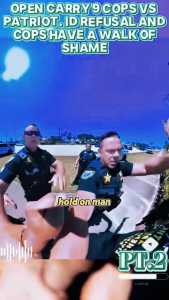
It started like any other roadside encounter—quiet street, flashing lights, and a man who refused to back down.
But what happened next would turn a routine “ID request” into a standoff that no one on scene was prepared for.
The officer stepped closer, voice firm but controlled. “Sir, I need to see your identification.”
The man didn’t move. Didn’t reach for his wallet. Instead, he calmly pointed at the camera rolling beside him and said something that instantly changed the tone of everything:
“I’m not breaking any law. So I don’t have to comply with that request.”
For a moment, the air went still.
Then another patrol unit arrived… then another. Within minutes, the quiet street filled with marked cars and uniforms—each officer trying to figure out what they were walking into.
But the man didn’t flinch.
And that’s when the situation stopped being a simple traffic interaction… and started becoming something much bigger.
More officers stepped into the frame, spreading out without saying much at first—watching, assessing, waiting for the moment the situation would tip one way or the other.
The lead officer repeated the request, this time more direct. “You’re being asked to identify yourself. Last chance before this escalates further.”
The man remained steady. No raised voice. No sudden movements. Just the same firm refusal.
“I’ve done nothing illegal. I’m not providing ID without lawful reason.”
That’s when the dynamic shifted. The officers stopped treating it like a routine stop and began treating it like a legal standoff—careful wording, cautious steps, radios quietly clicking in the background.
Bystanders started gathering at a distance. Phones came out. The “normal day” feeling disappeared completely.
Minutes stretched.
And then, just as tension peaked—something unexpected happened: instead of moving in, the officers began conferring among themselves, visibly reconsidering their next step.
The energy changed again.
Because now, it wasn’t just about one man refusing ID…
It was about whether the situation could even legally continue the way it started.
One of the officers stepped slightly away from the group, speaking into his radio in a lower tone. The rest stayed fixed in place, but the urgency started to fade from their posture—replaced by something less aggressive, more uncertain.
The man noticed it too.
He didn’t move closer. Didn’t taunt. He just stood there, arms relaxed, eyes steady on the scene unfolding in front of him.
A senior officer finally approached again, but this time the question had changed.
“This is not a detention at this point… we just need to clarify what we’re dealing with here.”
That shift was subtle—but important. The demand had turned into a legal assessment.
Moments later, a supervisor arrived. He listened first, asked a few quiet questions, and reviewed what had already been said. The energy of the entire scene lowered another level.
Then came the decision that changed everything:
There would be no arrest. No escalation. No forced compliance.
Just a termination of the encounter.
One by one, the officers began stepping back toward their vehicles. The same street that had filled with tension slowly emptied again, engines starting, lights fading into the distance.
And the man?
He stayed in place until the last patrol car pulled away—still calm, still recording, still unmoved.
But the most unexpected part wasn’t the “stand down.”
It was how quickly a situation that looked like it was about to explode… ended in silence.
As the last police vehicle disappeared down the road, the silence that followed felt heavier than the sirens that came before it.
The man finally lowered his camera slightly, scanning the empty street as if confirming what just happened was real. Around him, bystanders who had gathered moments earlier were now whispering among themselves—some impressed, others confused, a few still unsure what they had actually witnessed.
There was no celebration from the man. No shouting. No dramatic victory speech. Just a slow breath, like someone resetting after a long standoff.
A few minutes later, he finally spoke directly into the camera again.
“This is why you need to know your rights.”
That single line is what would later get clipped, reposted, and reshared—cut away from the full context of how tense, uncertain, and carefully managed the situation actually was.
Online, the story would take on a life of its own:
- “9 cops vs one patriot”
- “walk of shame”
- “police back down”
But on the ground, it was something more complicated—an encounter that ended not in victory or defeat, but in a legal gray area where both sides chose not to escalate.
And that’s where the real story often gets lost—between what happened… and how it gets told.
By the time the clip started circulating online, the scene had already been reshaped into something sharper, louder, and far more certain than what it actually was.
The video edits cut out the pauses. The radio chatter. The careful back-and-forth between officers. What remained was a compressed narrative: a lone man standing firm, multiple officers around him, and an ending that looked like retreat.
Comments flooded in almost immediately.
Some people called it a clear “win” for constitutional rights. Others insisted the officers had “no case from the start.” And a few pointed out something quieter but more accurate—that most of the real story was happening in the parts no one bothered to upload.
Because what didn’t go viral was just as important:
- the uncertainty on both sides
- the legal caution that kept things from escalating
- the fact that no arrest was ever clearly justified in the first place
- and the decision to de-escalate before it became something worse
Back in the real world, there was no aftermath drama. No court case. No official statement turning it into a headline.
Just a traffic-style encounter that ended the way many do—quietly, without resolution that fits neatly into a viral title.
And yet, online, it had already become a symbol.
Not of what happened…
But of what people wanted it to mean.
The end.