
By the time I married Nathan Calloway, I had already sold my car, emptied my savings, refinanced my house, and borrowed money from anyone who would still take my calls.
People would later say I married for money.
I never corrected them.
Because the truth was far worse.
I married to save my daughter’s life.
My name is Claire. I’m forty-three years old.
And until that year, I believed I understood fear.
I didn’t.
Real fear doesn’t scream.
It doesn’t arrive with chaos or drama.
It sits quietly in a hospital room at three in the morning, listening to machines that refuse to change their rhythm.
It lives beside a daughter who doesn’t wake up.
It counts days instead of hopes.
Ava, my nineteen-year-old daughter, had been in a catastrophic highway accident during a winter storm.
She survived.
Barely.
A chain reaction of crashes on an ice-covered bridge had left dozens injured, but in the end, no single person could be blamed.
It didn’t matter.
Not to me.
Not when I stood beside her hospital bed and watched her lie still for six months.
The only chance she had left was a neurological rehabilitation program in Chicago.

It was also the only thing I couldn’t afford.
Not even close.
I fought anyway.
Insurance appeals. Grants. Loans. Anything.
Every door opened briefly—then closed again just as fast.
Until one morning, Dr. Brennan entered Ava’s room with a folder in his hand.
I already knew what it meant.
“The center called,” he said quietly.
My stomach tightened.
“They’ve granted a final extension.”
“How long?” I asked.
“Five days.”
Five days.
After that, her place would be gone.
Transferred to someone else.
Reassigned like a file.
I nodded politely until he left.
Then I sat beside my daughter and cried for the first time in weeks.
Not because I had stopped fighting.
Because I was running out of ways to continue.
That afternoon, I went to the Calloway estate.
I had worked there for nearly a year.
Nathan Calloway was only twenty years old—young, brilliant, and already carrying an inheritance that came with more weight than privilege.
Most people expected arrogance.
Instead, he was observant, sharp, and frustratingly honest.
When I walked into the kitchen, he was staring at a bowl of oatmeal like it had personally offended him.
“You realize normal people don’t glare at breakfast,” I said.
“It started it,” he replied.
“The oatmeal?”
“It knows what it did.”
Against everything I was carrying, I laughed.
His eyes narrowed slightly.
“That’s a hospital call,” he said immediately.
The smile faded.
“How did you know?”
“You only laugh like that when you’re exhausted.”
I sank into a chair.
“The rehab center gave us five days.”
His expression changed instantly.
“How much?”
I told him.
He didn’t react at first.
Then quietly: “What happens if you don’t get it?”
“They transfer her.”
“And her chances?”
I couldn’t answer.
And he didn’t need me to.
Two days later, he asked me to stay after work.
I found him in his study.
Papers covered every surface—legal documents, financial reports, trust agreements.
It looked like a war room.
“What is all this?” I asked.
He hesitated.
Then slid a folder toward me.
“I’ve been trying to help.”
“You did what?”
“Three weeks ago, I submitted an emergency funding request for Ava’s treatment.”
My breath caught.
“And it was denied.”
“Why would you do that without telling me?”
He didn’t answer immediately.
When he did, his voice had changed.
Heavier.
“I found something.”

“What kind of something?”
His eyes met mine briefly… then shifted away.
“Not yet.”
I stood up immediately.
“No.”
“Claire—”
“No.”
“If you’re bringing this up, then you tell me everything.”
“I’m still investigating.”
“Then finish investigating.”
I left before he could respond.
The next days were brutal.
Another rejection. Another denial. Another closed door.
I sold my car.
It still wasn’t enough.
Three days before the deadline, Nathan came to me again.
This time, he looked exhausted.
“I know why the funding was denied,” he said.
“Then tell me.”
“My family estate is controlled by trustees during ongoing litigation.”
“So?”
“They can block discretionary funding.”
“And?”
He took a breath.
“There is one exception.”
I already felt where this was going.
“A spouse can file a legal petition when there’s a conflict of interest.”
Silence.
Then I understood.
“No.”
“Claire—”
“No.”
“I’m not offering charity.”
“You’re offering marriage.”
“It’s a legal arrangement.”
I let out a short, broken laugh.
“This is insane.”
“Probably.”
“People will think I’m using you.”
“They already think I’m impossible to deal with,” he said. “We’ll survive it.”
That almost made me smile.
Almost.
“I’m not marrying you.”
“I understand.”
And for forty-eight hours, he said nothing more.
Then the deadline arrived.
By noon, the rehabilitation center confirmed Ava’s slot would be released at midnight.
That evening, I sat beside her bed.
Rain tapped softly against the window.
I held her hand and watched the clock.
Ten hours.
Nine.
Eight.
At 8:47 p.m., my phone rang.
Nathan.
I almost didn’t answer.
Almost.
“Claire.”
His voice was different now.
Final.
“The board rejected the appeal.”
My chest tightened.
“I’m sorry.”
“So am I.”

Silence stretched between us.
Then
“My lawyers are ready to file tomorrow.”
My breath caught.
“Nathan…”
“It only works if someone directly affected joins the petition.”
I understood immediately.
Not money.
Not power.
Standing.
A legal voice that could force the system to listen.
I looked at Ava.
Then the clock.
Then back at her.
“I hate this,” I whispered.
“So do I.”
The silence lasted longer this time.
Then I said it.
“Okay.”
The courthouse wedding lasted twelve minutes.
No celebration.
No music.
No promises of forever.
Just signatures.
Documents.
Two people holding onto desperation more than each other.
I thought that was the hardest part.
I was wrong.
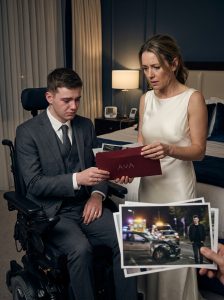
Three weeks later, after the petition succeeded and Ava was finally admitted into rehabilitation, Nathan handed me a crimson envelope.
My daughter’s name was written on the front.
“Open it,” he said quietly.
My hands shook as I did.
Inside were documents.
And the moment I saw them, my blood went cold.
Because in that instant, I finally understood something I hadn’t seen before.
Nathan hadn’t only been helping.
He had been carrying a truth
One that explained every hesitation.
Every silence.
Every look he couldn’t quite meet.
And everything I thought I understood about the marriage we built in desperation was about to change.