
My parents told everyone in town that my 12-year-old is a thief. She lost all her friends and got kicked off her school teams. “She should learn respect,” my mom said. So, I made one call to my grandpa’s former lawyer and their lives started to unravel…
I knew something was wrong before my daughter even reached the porch.
Porch light on. Curtains drawn. My mother smiling like a church bulletin photo. My father standing behind her with that blank, patient face he used whenever he wanted everyone else to feel unreasonable.
Then my 12-year-old stepped into view.
She didn’t run to me. She didn’t throw her arms around my waist. She didn’t start talking about dance practice or some ridiculous thing a girl at school said.
She just stood there, eyes down, clutching her dance bag like it weighed more than she did.
“Sarah,” my mother sang. “She’s just tired. Big week.”
My daughter hugged me stiffly, like she was afraid someone might grade her on it.
I looked over her shoulder at my parents.
“What happened?”
My mom’s smile didn’t move. “Nothing happened. Family takes care of family.”
That was the first lie.
I waited until we were in the car. The dashboard glowed blue. My daughter stared out the window with her hood pulled forward and both hands locked around the strap of her bag.
“How was dance?” I asked carefully. “Your performance is this week, right?”
She didn’t answer.
Then she said, very softly, “I’m not on the team anymore.”
My hand tightened on the steering wheel.
“What do you mean?”
“They kicked me out.”
The words were flat, practiced.
“Why would they kick you out?”
Silence.
I tried again. “Sweetheart. Talk to me.”
She swallowed. “I don’t want to talk about it.”
My daughter talks about everything. When she goes quiet, something has hurt too deeply to touch.
So I tried a safer door.
“Do you still need a birthday present for Sophie on Saturday?”
Her jaw tightened.
“I’m not going.”
I blinked. “You’ve talked about that party for weeks.”
“I’m not invited anymore.”
Twelve years old, sitting beside me, already learning what exile felt like.
At home, I made dinner. I put plates on the table.
She took three bites and stared at the table.
Finally, I set my fork down.
“Okay,” I said. “What happened?”
Her face crumpled.
“Grandma said I was stealing.”
The room went cold.
“What?”
“She told people I’m a thief.”
I stared at her, waiting for the sentence to turn into something else. It didn’t.
“Why would Grandma say that?”
“Because of Belle.”
Belle was my sister Vanessa’s daughter. The family’s golden child.
My daughter wiped her face with the back of her hand, angry that she was crying.
“Belle couldn’t find her dance shoes. She needed them for the stage, and she panicked. Then she said I took them.”
“Did you?”
Her head snapped up.
“No. Mom, I swear. I didn’t touch them. I didn’t even go near her stuff.”
“I believe you,” I said immediately.
“Grandma and Grandpa came into my room later. They said I stole them because I wanted to sabotage Belle. They said I was jealous because I got a better placement.”
The word sabotage sounded obscene coming from her mouth.
“What did you say?”
“I said I didn’t do it. I thought I was just going to be grounded.”
She laughed once, broken and tiny.
“Then they went to my school.”
My mouth dried out.
“They what?”
“They told the coach. They told the moms. They told people I stole Belle’s shoes.”
“And the shoes?”
“They said they found them later at their house. In the hallway by the front door. But I didn’t see them find anything. They just showed them to me and said that proved I must have put them there.”
She looked at me like the answer to her whole life was hiding in my face.
“Mom, I never took them.”
“I know.”
Her voice dropped.
“Everyone acts like I’m not safe now. Sophie said if I did it to Belle, I’d do it to anyone.”
I picked up my phone.
My mother answered cheerfully. “Hi, Sarah.”
I didn’t say hello.
“What did you do?”
A pause. Then a sigh. “What are you talking about?”
“You told people my daughter stole.”
“She stole Belle’s shoes.”
“How do you know?”
“She couldn’t find them,” my mother said, as if she had just presented evidence in court. “Then we found them at home.”
“That proves nothing.”
“Belle wouldn’t lie.”
“So you assumed,” I said. “And you ruined my daughter’s name over an assumption.”
My father came on the line. “We handled it.”
“No,” I said. “You spread it.”
My mother’s voice sharpened. “Even if she didn’t steal, she still needed to learn respect.”
I went still.
Across the table, my daughter had stopped moving.
“You called her school,” I said.
“They needed to know.”
“You didn’t know.”
“This isn’t a courtroom, Sarah.”
“No,” I said. “It’s her life.”
My mother didn’t soften. “Consequences are how children learn.”
I ended the call.
The kitchen was silent except for my daughter’s uneven breathing.
The next morning, I called the coach. Then the school. Then Sophie’s mother. Every answer came wrapped in polite concern and quiet judgment.
Your parents seemed very sure.
We have to consider the safety of other children.
We understand this is upsetting.
By noon, my daughter was on the couch with her hood up, flinching every time my phone buzzed.
That was when I stopped explaining and started moving.
I called my grandfather’s former lawyer.
He had trusted her. Said she could make powerful people read fine print they hoped nobody noticed.
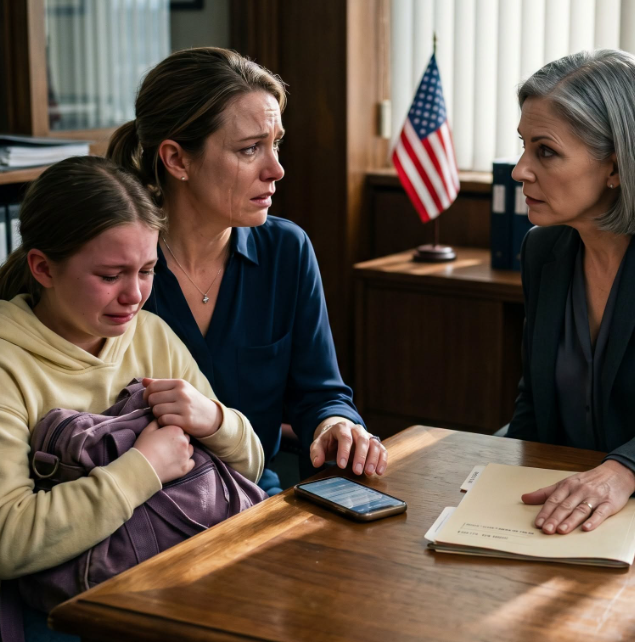
Two days later, my daughter and I sat across from her in a quiet office that smelled like coffee and old paper.
The lawyer listened without interrupting.
When I finished, she said, “Accusing a child of theft without proof and spreading it through school channels is serious.”
My daughter looked up for the first time.
“So we can do something?” I asked.
“Yes,” the lawyer said. “We can demand records. We can send letters. And we can warn your parents that false statements have consequences.”
“Do your parents handle anything official for your daughter?”
“No,” I said.
Her eyes narrowed.
“Then who is handling the trust?”
I froze.
“What trust?”
She leaned back.
“The trust your grandfather set up for her.”
My daughter’s hand found mine under the table.
And for the first time all week, I saw fear cross someone else’s face.