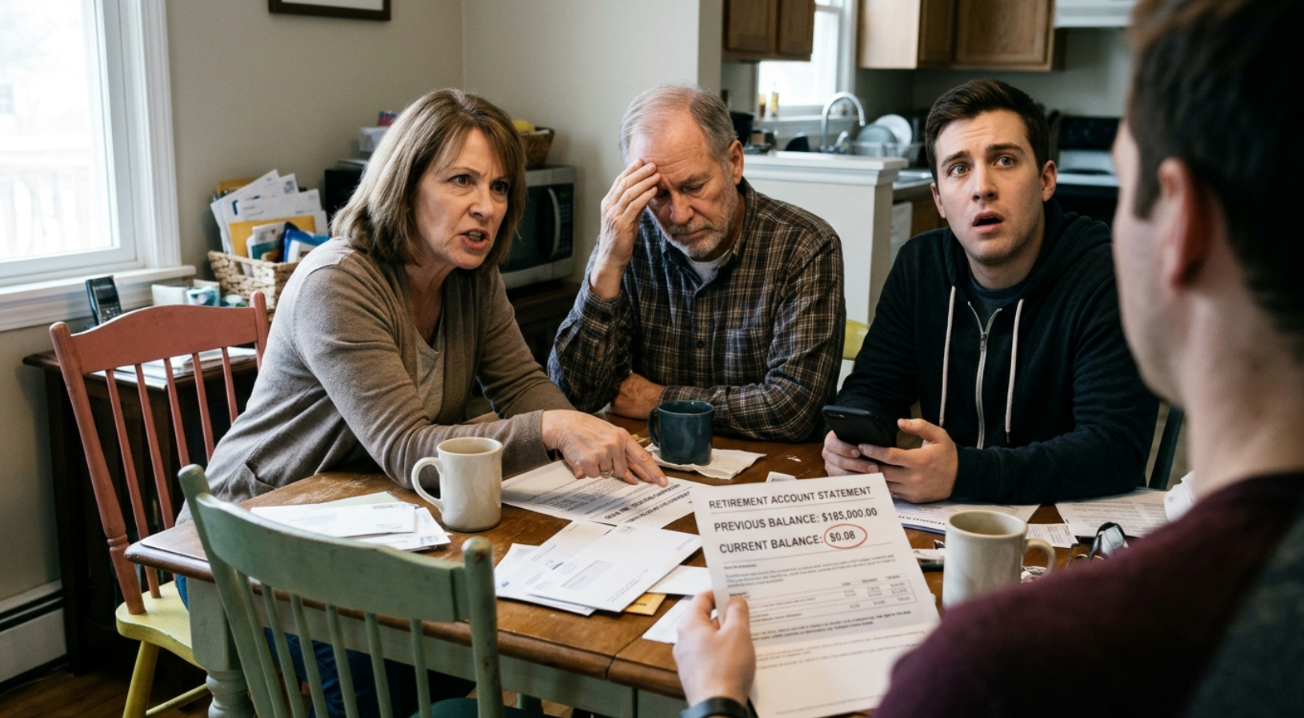
I looked at her.
“You brought up my retirement account at dinner. You announced that Steven had withdrawal privileges. You explained that my money was being wasted because I decorate cupcakes. But now that I’m asking questions about his finances, suddenly this isn’t the time?”
“That’s enough,” Dad said quietly.
It was the first time he’d spoken all evening.
But I wasn’t finished.
I reached into my handbag and removed a thin folder. I had prepared it that morning, although I hadn’t originally planned to show it to everyone.
I placed it beside the empty serving platter.
“Claire, I don’t know how much you already know about your husband’s financial situation. But I think you deserve to see what I found.”
Steven stood so quickly that his chair scraped against the hardwood floor.
“Don’t you dare.”
Claire turned toward him.
“Steven, sit down.”
“Claire, she’s trying to destroy this family.”
“No,” I said. “I’m trying to explain why my mother thought you needed $185,000 so desperately that she was willing to interfere with an account that never belonged to her.”
My mother looked at me with an expression I recognized from childhood.
It was the expression she used whenever I refused to apologize for something I hadn’t done.
“Your brother is under pressure,” she said. “He has a mortgage. He has children. His wife is pregnant. You have no idea what it costs to raise a family these days.”
“I know exactly what it costs to live on a limited income. I’ve been doing it for ten years while saving money every month.”
“You don’t have children.”
“No. I don’t.”
“You don’t have a husband.”
“No, Mom.”
“You don’t even own a house.”
I nodded.
“And apparently, that means I don’t deserve to keep the money I worked for.”
Nobody answered.
I turned to Claire.
“Please look at the folder.”
She hesitated before pulling it closer.
The first page contained a list of credit accounts.
The second contained several transaction records.
The third contained a loan application.
I watched her eyes move down the page.
At first, she looked confused.
Then she looked concerned.
Finally, her face changed completely.
“Steven?”
He rubbed his forehead.
“It’s not what you think.”
“How many?”
“Claire, listen.”
“How many credit cards have you opened using my information?”
My mother reached for the folder.
“Maybe we should discuss this privately.”
Claire pulled it away.
“No. I want to know.”
Steven looked at me.
“You’ve been digging through my private business?”
“I haven’t accessed your accounts. I received a credit alert after someone attempted to use my information as a guarantor on a loan connected to one of your applications. The lender contacted me to verify my identity.”
That was the truth.
Two months earlier, I had received a notification from a financial institution I had never dealt with.
Someone had listed me as a secondary guarantor for a $42,000 personal loan.
The application contained my full name, date of birth, and an old address.
It also contained an electronic signature that looked remarkably similar to mine.
I immediately contacted the lender and filed an identity-theft report.
During the investigation, I learned that the application had been submitted through a financial service that had previously processed a loan for Steven.
I didn’t have access to his private financial records.
But I had enough information to understand that my name had been used without my permission.
And that wasn’t the only problem.
Steven had accumulated several thousand dollars in overdue credit-card debt.
He had also taken out a personal loan that Claire apparently knew nothing about.
The application for the $42,000 loan was still under investigation.
I had no evidence that Claire had participated in any of it.
But I did know that someone had tried to make me responsible for a debt I had never agreed to pay.
And now my mother was trying to give Steven access to my retirement savings.
The pieces were beginning to fit together.
Claire turned another page.
“What is this $18,600 loan?”
Steven swallowed.
“It’s a business loan.”
“What business?”
“I was going to invest in something.”
“You told me we had enough money for the baby.”
“We do.”
“Then why did you borrow eighteen thousand dollars?”
He didn’t answer.
Claire looked down at the next page.
“And these credit cards?”
Steven finally sat down.
“Some of them were temporary.”
“Temporary?”
“I needed to cover expenses.”
“What expenses?”
He looked at my mother.
That small movement told me more than any confession could have.
Mom immediately stepped in.
“Steven was trying to make an investment that would benefit everyone. He didn’t want to worry Claire while she was pregnant.”
Claire stared at her.
“Did you know about this?”
Mom’s lips tightened.
“I knew he was having some financial difficulties.”
“How much did you know?”
“Claire, you’re getting upset. You need to think about the baby.”
It was the same sentence my mother used whenever she wanted someone to stop asking questions.
Claire slowly closed the folder.
Then she asked something I hadn’t expected.
“Did you know he was planning to take Margaret’s money?”
My mother looked down.
That was answer enough.
Claire stood.
“I need some air.”
Steven reached for her hand.
“Claire, please. We can talk about this at home.”
She pulled away.
“Not until you tell me the truth.”
She walked toward the kitchen.
For a moment, the dining room became completely silent.
Then Steven turned on me.
“You’re enjoying this, aren’t you?”
I looked at him.
“No.”
“You’ve always been jealous of me.”
I almost laughed.
Not because it was funny.
Because after everything that had happened, he still believed this was about jealousy.
“You’re right about one thing,” I said. “I was jealous once.”
He looked surprised.
“When we were teenagers, I was jealous because Mom and Dad always seemed to believe you could do anything. You got encouragement. You got second chances. You got help whenever you needed it.”
I paused.
“But I grew up. I stopped being jealous. I built a life that didn’t depend on their approval.”
Steven shook his head.
“You think you’re better than everybody.”
“No. I think I’m allowed to own what I earned.”
My father finally looked up.
“Margaret, why didn’t you tell us about the loan application?”
I turned toward him.
“Because the last time I told Mom that Steven had borrowed money from me, she told me to forget about it. When I said I was uncomfortable with him using my name, she called me selfish.”
Dad’s expression changed.
“I didn’t know about that.”
I believed him.
My father had never been particularly involved in family financial decisions. He worked, paid the bills, and allowed my mother to handle everything else.
But staying uninvolved didn’t mean he was innocent.
He had watched her dismiss me for years.
He had watched Steven receive help that I was told I didn’t need.
And he had remained silent.
“Dad,” I said, “you don’t have to defend me. I just wish you had asked whether I was okay before agreeing to give my brother my money.”
He lowered his eyes.
“I should have.”
For the first time that evening, I felt something loosen inside my chest.
It wasn’t forgiveness.
It was simply the realization that I no longer needed him to agree with me.
The following morning, my phone began ringing at 7:15.
Mom.
I let it ring.
Then she called again.
And again.
At 7:42, I finally answered.
“What?”
“Margaret, we need to talk.”
“About what?”
“Your brother.”
I looked through the bakery window at the empty parking spaces outside.
“I thought we already talked about him.”
“Steven had a terrible night. Claire is furious. She took the children to her sister’s house.”
I closed my eyes.
“That sounds like something Steven needs to discuss with his wife.”
“Don’t be cruel.”
“I’m not being cruel, Mom.”
“You humiliated him in front of his wife.”
“He humiliated himself.”
“He made mistakes.”
“Using my identity isn’t a mistake.”
“He was desperate.”
“So was I when I was nineteen and trying to save enough money to build a future. Nobody offered to take responsibility for my problems.”
She sighed dramatically.
“Your grandmother would be heartbroken to see what you’ve become.”
That sentence hurt more than I wanted to admit.
My grandmother Dorothy had been the person who made me feel valuable before I had accomplished anything.
She taught me how to bake.
She taught me how to save money.
She taught me that independence wasn’t about refusing help. It was about never allowing someone else to control your life.
I remembered sitting beside her kitchen counter when I was twelve, watching her measure flour.
“Never let anyone make you feel small because your dreams are different from theirs,” she once told me.
My mother knew how much those memories meant to me.
And she was using them as a weapon.
“Don’t bring Grandma into this,” I said.
“I’m only saying she wanted this family to stay together.”
“She wanted me to have a future. That’s why she left me that money.”
“Steven has a family to support.”
“And I have a life to live.”
There was a long silence.
Then Mom lowered her voice.
“Your father and I were hoping you would transfer at least $80,000 to Steven. Just enough to clear his debts and help with the baby.”
I stared at the phone.
She was asking again.
Less than twenty-four hours after discovering that the account was empty.
“Mom, you still don’t understand.”
“What?”
“I am not giving Steven any money.”
“He’s your brother!”
“And I’m your daughter.”
She went quiet.
I continued.
“For years, you have treated my savings like something the family could claim whenever Steven needed help. You treated my work like a hobby because it didn’t look like the life you imagined for me. You treated my future like it was less important because I wasn’t married.”
“That’s not fair.”
“Neither was what you did.”
I ended the call.
Then I blocked her number.
I didn’t feel victorious.
I felt exhausted.
But for the first time, I didn’t spend the rest of the morning wondering whether I had done something wrong.
Three days later, I received an unexpected email.
It was from Claire.
The subject line read:
I owe you an apology.
I opened it during my lunch break.
Her message was short.
She explained that Steven had finally admitted he was carrying more debt than she knew.
He had been making minimum payments on several credit cards while using new credit to cover old balances.
The $18,600 loan had been used partly to cover household expenses and partly to fund an investment that had failed.
The $42,000 application had been submitted using my information as a proposed guarantor without my consent.
Claire had also discovered that Steven had told my parents he was about to lose the house.
That wasn’t entirely true.
They were behind on payments, but the bank hadn’t started foreclosure proceedings.
My mother had exaggerated the situation in her hardship letter to make the brokerage believe there was an emergency.
Claire ended her email with a sentence I read three times.
I knew your family treated you differently, but I never understood how much you had been carrying. I’m sorry I stayed quiet.
I sat there for a long time.
Claire hadn’t stolen anything from me.
She had been kept in the dark, just as I had been kept in the dark about the financial decisions being made behind my back.
I wrote back.
You don’t owe me an apology for what someone else did. I hope you and the children are safe. Please make sure your own financial information is protected.
Then I returned to work.
I had customers waiting for their birthday cakes.
And for once, that felt more important than whatever was happening in my mother’s dining room.
The brokerage investigation took several weeks.
During that time, I worked with a financial adviser and a lawyer to review every authorization attached to the original account.
We discovered that my mother had retained limited trading authority long after I became the legal owner.
That authority did not give her ownership of the money or automatic permission to add another person with withdrawal privileges.
The attempted change was rejected.
The old authorization was permanently revoked.
The institution also documented the attempted unauthorized access and preserved the application, correspondence, and supporting letter.
I moved my retirement funds to a properly titled account under my sole control.
The balance was still there.
The $185,000 hadn’t disappeared.
It was safe.
And Steven had received exactly what I had promised him.
Nothing.
Except that the situation was about to become much bigger than a family argument.
One afternoon, my lawyer called.
“Margaret, there’s something else you need to know.”
I sat down in the small office behind the bakery.
“What happened?”
“The compliance department reviewed the hardship letter your mother submitted.”
“Okay.”
“They found an additional document attached to the application.”
“What document?”
“A proposed family authorization agreement.”
My stomach tightened.
“What does that mean?”
“It appears your mother attempted to obtain written permission for Steven to control the account by presenting a document that represented you had already agreed.”
I stared at the wall.
“I never signed anything.”
“I know. That’s why the institution rejected it.”
“Whose signature was on it?”
He paused.
“Your name.”
For a moment, I couldn’t speak.
Then I asked the question that had been sitting in my chest since the first phone call.
“Did they investigate who submitted it?”
“Yes. The application was transmitted through the credentials associated with your mother’s existing authorization. The brokerage has retained the records and referred the suspected forgery for further review.”
I thanked him and ended the call.
Then I sat completely still.
My mother hadn’t simply assumed that Steven deserved my money.
She had tried to make it appear that I had agreed to give it to him.
I remembered all the times she had told me that family members should trust one another.
All the times she had asked me to sign paperwork without explaining what it meant.
All the times she had told me not to make financial matters complicated.
Suddenly, those memories looked different.
I didn’t know whether she had planned this for months or whether it had started as one desperate decision.
But I knew something important.
I couldn’t allow guilt to make me ignore what had happened.
That evening, I called my lawyer again.
“Please continue with the formal complaint,” I said. “I don’t want this handled privately just because we’re related.”
He assured me that everything would proceed through the appropriate channels.
And I meant what I said.
For the first time in my life, I wasn’t going to protect someone from the consequences of treating me unfairly.
Two weeks later, Claire came to the bakery.
It was a rainy Thursday afternoon.
I was decorating a three-tier wedding cake when I heard the bell above the front door.
I looked up.
Claire stood there holding a small umbrella.
She looked tired.
Not just physically tired, but emotionally exhausted.
“Hi, Margaret.”
I put down my piping bag.
“Hi.”
She glanced around the bakery.
“This place is beautiful.”
“Thank you.”
She smiled faintly.
“Steven used to say you were wasting your time here.”
I wiped my hands on a towel.
“He says a lot of things.”
She nodded.
Then she placed a small envelope on the counter.
“I wanted to give you something.”
“What is it?”
“The $6,000.”
I stared at her.
“Claire, you don’t owe me that.”
“I know. But Steven does.”
She explained that she had found the original repayment agreement in an old folder.
Steven had never repaid the loan he took from me two years earlier.
Claire had decided that money needed to be returned.
She had sold some jewelry and used part of her own savings to put the payment together.
I pushed the envelope back toward her.
“Please don’t do that. You have children and another baby coming.”
She shook her head.
“This isn’t about helping you. It’s about making sure the money he borrowed is finally returned.”
I looked at her for a long moment.
Then I accepted the envelope.
“Thank you.”
She sat on one of the stools near the window.
For several minutes, neither of us spoke.
Finally, she asked, “Can I ask you something?”
“Of course.”
“Did you ever hate us?”
I looked at her.
“Us?”
“Steven. Me. The children. My whole family.”
I thought about it carefully.
“No. I was hurt. Sometimes I was angry. But I never hated your children. They didn’t do anything wrong.”
Claire’s eyes filled with tears.
“I was afraid you would.”
I shook my head.
“Your children are not responsible for their father’s choices.”
She covered her face.
“I don’t know what happens now.”
I sat across from her.
“That’s something you have to decide. But please don’t let anyone convince you that protecting yourself makes you a bad wife or mother.”
She nodded.
Then she said something I hadn’t expected.
“Steven told me he wants to apologize.”
I looked toward the cake.
“An apology would be nice.”
“He wants you to forgive him.”
I slowly shook my head.
“Forgiveness isn’t something he gets to demand. And it doesn’t mean he gets access to my life again.”
Claire understood.
Before she left, she looked at the bakery one more time.
“You know,” she said, “I think your grandmother would have loved this place.”
I smiled.
“I think so too.”
After she left, I returned to my wedding cake.
I added the final row of white flowers and stepped back to examine the result.
For a moment, I imagined Grandma Dorothy standing beside me, flour on her apron, smiling as she watched me work.
I wished she had been there.
But I also knew what she would have said.
Keep building your life.
Don’t let anyone take it from you.
And that’s exactly what I intended to do.
Three weeks after Claire visited the bakery, I received a letter from my mother.
It wasn’t an apology.
It was four pages explaining why I had misunderstood everything.
She wrote that she had only wanted to help Steven. She said she had been under tremendous pressure because of the baby, the mortgage, and the possibility of losing the house. She reminded me that parents sometimes had to make difficult decisions for their children.
Then came the sentence that made me put the letter down.
I hope one day, when you have children of your own, you understand why we had to put Steven first.
I read it again.
Then I folded the letter and placed it in a drawer.
Not because I agreed with her.
But because I finally understood something.
My mother wasn’t asking me to understand her decision.
She was asking me to accept that my place in the family would always be second.
And I was finished accepting that.
The financial investigation continued.
The brokerage confirmed that the attempted authorization change had been rejected and that my mother’s trading privileges had been permanently removed.
The institution also preserved the suspicious agreement bearing my forged signature.
My lawyer advised me to cooperate fully with the review and maintain copies of every communication.
I did.
I also froze my credit, changed my financial passwords, and placed additional security restrictions on my accounts.
For the first time, I realized how much of my financial life had been exposed simply because I had trusted my parents.
I wasn’t going to make that mistake again.
Meanwhile, Steven’s situation became increasingly difficult.
Without access to my retirement money, he had to face the debts he had accumulated.
The investment he had made failed completely.
He sold his expensive truck and replaced it with an older used vehicle.
Claire moved back into the house after several weeks, but their marriage was far from normal.
She insisted on seeing every financial statement.
They began meeting with a debt counselor.
My mother called me twice more.
The first time, she asked me to reconsider.
The second time, she accused me of destroying Steven’s marriage.
I didn’t answer either call.
I had finally learned that not every accusation deserved a response.
Six months passed.
The bakery became busier than ever.
I hired two employees, expanded the breakfast menu, and started accepting larger wedding orders.
One Saturday morning, a local wedding planner visited and asked whether I would be interested in supplying desserts for several upcoming events.
The contract was worth more than I had ever earned in a single month.
I accepted.
For the first time, I began seriously considering opening a second location.
I found myself thinking about Grandma Dorothy more often.
She had always believed that a small business could become something extraordinary if the person behind it was willing to work hard.
One evening, while cleaning the office, I found an old photograph of us.
I was fourteen, standing beside her in her kitchen.
My hair was tied into two uneven ponytails, and there was flour on my cheek.
Grandma was holding a tray of cupcakes.
On the back, she had written:
To Margaret. Never stop creating something beautiful.
I placed the photograph in a small frame and put it beside my desk.
Then I returned to work.
Because that was what she had taught me to do.
The next major surprise came on my thirtieth birthday.
I wasn’t planning anything special.
I had a full schedule of orders, and I intended to spend the evening eating dinner with a few friends.
At around five o’clock, the bakery door opened.
I looked up from the counter.
My father stood there holding a small gift bag.
For a moment, neither of us spoke.
Then he smiled awkwardly.
“Happy birthday, sweetheart.”
I put down the receipt book.
“Thank you, Dad.”
He looked around.
“Your place looks wonderful.”
“Business is good.”
“I can see that.”
He placed the gift bag on the counter.
Inside was a small silver bracelet.
It wasn’t expensive, but I recognized the handwriting on the card.
It was Grandma Dorothy’s.
My father explained that he had found it in an old box while cleaning the garage.
“She wanted you to have it when you turned thirty,” he said. “I completely forgot about it.”
I touched the bracelet.
“Thank you for bringing it.”
He nodded.
Then he looked toward the office.
“Can we talk?”
I wasn’t sure I wanted to.
But I agreed.
We sat at the small table where I usually handled invoices.
Dad took a long breath.
“I owe you an apology.”
I said nothing.
“I should have protected you. When your mother started talking about Steven needing your money, I knew it wasn’t right. But I didn’t want another argument.”
He looked down at his hands.
“I kept telling myself that your mother would eventually calm down. That Steven would figure things out. That you were strong enough to handle it.”
I looked at him.
“Do you know how many times I heard that growing up?”
He frowned.
“What?”
“That I was strong enough. That I didn’t need help. That Steven needed more because he had responsibilities.”
My voice remained quiet.
“I didn’t become independent because I never needed anyone, Dad. I became independent because I learned nobody was coming to help me.”
His eyes filled with tears.
“I know.”
He reached across the table.
I didn’t pull away, but I didn’t take his hand either.
“I can’t change what happened,” he said. “But I want to do better.”
I looked at him for a long moment.
“Then start by treating me like your daughter, not like the person who is supposed to solve everyone else’s problems.”
He nodded.
“I will.”
That evening, we had dinner together.
It wasn’t perfect.
There were things we still couldn’t discuss without feeling uncomfortable.
But it was the first conversation with my father in years that didn’t involve Steven, money, or an argument about what I owed the family.
I considered that a beginning.
Not a complete reconciliation.
A beginning.
Two months later, Steven contacted me.
His message was simple.
Can we talk? Just you and me.
I stared at it for several minutes.
Eventually, I agreed to meet him at a coffee shop.
When I arrived, he was already sitting at a table near the window.
He looked different.
The expensive clothes were gone. He wore a plain shirt and jeans. There were dark circles under his eyes.
He stood when he saw me.
“Thanks for coming.”
I sat down.
“What do you want to talk about?”
He looked at his coffee.
“I owe you an apology.”
I waited.
He rubbed his hands together.
“I know you probably think I’m only apologizing because I didn’t get the money.”
“I don’t know what you think.”
He nodded.
“Fair enough.”
For a while, he struggled to find the words.
Then he finally said, “I knew the account was yours. I knew Grandma left it to you. But Mom kept telling me that you didn’t need it. She said you were young, that you had no children, and that it made more sense for me to use it.”
I looked at him.
“And you believed her?”
He gave a small, bitter laugh.
“I wanted to believe her.”
“Why?”
“Because I was drowning, Margaret.”
He explained that his debts had become overwhelming.
He had been trying to maintain a lifestyle he could no longer afford. The larger house, the truck, the vacations, and the constant pressure to appear successful had gradually become a financial burden.
He had borrowed money to cover other loans.
Then he had borrowed more to cover those.
Eventually, he had convinced himself that my retirement account was the solution.
“Mom said Grandma would have wanted the money to help the whole family,” he said.
I shook my head.
“Grandma specifically told me it was mine.”
“I know that now.”
“You knew it then.”
He looked away.
That was the first time he didn’t try to argue.
After a long silence, he said, “I’m paying you back for the $6,000.”
“Claire already returned it.”
“I know. But I want you to know I understand that I owed it.”
I nodded.
“Good.”
He looked at me.
“Can we ever go back to how things were?”
I considered the question.
“No.”
His face fell.
“But maybe we can build something different,” I continued. “Something where you don’t expect me to rescue you and I don’t have to defend myself every time I say no.”
He nodded slowly.
“I understand.”
I hoped he did.
But I also understood that an apology was only the beginning.
Trust would take much longer.
Before leaving, Steven said something that surprised me.
“Mom keeps saying you changed.”
I smiled faintly.
“Maybe I did.”
“She says you’re cold now.”
I looked directly at him.
“I’m not cold, Steven. I’m just no longer available to be treated like an emergency savings account.”
For the first time, he smiled.
A small, uncomfortable smile.
But it was genuine.
We said goodbye.
And I went back to the bakery.
The biggest change happened almost a year after that Sunday dinner.
I was preparing a large wedding order when my mother walked into the bakery.
She looked around before approaching the counter.
“Margaret.”
I put down my notebook.
“Hello, Mom.”
She looked at the cakes in the display case.
“You’ve done well.”
“Thank you.”
She stood there awkwardly.
Then she said, “Your father tells me you’re thinking about opening another location.”
“I’m considering it.”
“That’s wonderful.”
I waited.
She looked toward the office.
“Can we talk privately?”
I led her inside.
She sat down and placed her handbag on the floor.
For a moment, she looked like the woman who had raised me.
Then she began speaking.
“Steven and Claire are doing better.”
“I’m glad.”
“They’re working through their debts. Claire has been very firm about their finances.”
“That’s good.”
Mom nodded.
Then she looked at me.
“Steven told me you met.”
“Yes.”
“He said you were willing to speak to him.”
“I was.”
She folded her hands.
“I think it’s time we put everything behind us.”
I leaned back.
“What does that mean?”
“It means we’re family. We shouldn’t keep fighting over something that happened a year ago.”
I looked at her.
“Something?”
She sighed.
“Margaret, I know mistakes were made.”
“Which mistakes?”
She seemed surprised by the question.
“What?”
“Tell me exactly which mistakes you think were made.”
She looked uncomfortable.
“I shouldn’t have handled the account without talking to you.”
“You didn’t just handle the account. You tried to give Steven withdrawal privileges.”
“I thought it was the best decision.”
“You submitted a document with my signature on it.”
Her expression changed.
“I never intended to hurt you.”
“Intentions don’t erase what happened.”
She looked down.
For a moment, I thought she might finally apologize.
Then she said, “You have to understand that I was worried about Steven.”
I nodded.
“I understand that.”
“He was struggling.”
“I understand that too.”
“And I thought you could help.”
I looked at her.
“Mom, you didn’t ask me to help. You decided that my future belonged to someone else.”
She pressed her lips together.
“I didn’t think you would ever need that much money.”
I almost laughed.
“You didn’t know what my future would look like. You just decided it wasn’t important enough.”
She became quiet.
Then she said something I will never forget.
“I suppose I always thought you would be fine. You were independent. You never complained. Steven needed more attention.”
There it was.
The explanation I had spent years trying to understand.
Because I was responsible, I received less.
Because I didn’t demand help, people assumed I didn’t need it.
Because I worked quietly, my achievements became invisible.
I looked at my mother.
“I was fine because I worked hard to become fine. That doesn’t mean you were allowed to take advantage of me.”
She wiped her eyes.
“I am sorry, Margaret.”
I waited.
This time, she continued.
“I should never have tried to change your account. I should never have told you that your work wasn’t important. And I should never have made you feel that being unmarried or not having children meant your life was worth less.”
The room became very quiet.
I wanted to feel relieved.
I wanted the apology to erase years of disappointment.
But it didn’t.
It simply gave me something I hadn’t received before.
Acknowledgment.
“Thank you for saying that,” I replied.
She looked at me hopefully.
“Does that mean everything can go back to normal?”
I shook my head.
“No, Mom. It means we can start over if we’re both willing to respect each other.”
She nodded slowly.
Then she stood.
Before leaving, she glanced at the framed photograph of Grandma Dorothy on my desk.
“She would be proud of you.”
I smiled.
“I hope so.”
And for once, I didn’t need to add anything.
Another six months passed.
My second bakery location finally opened.
It was smaller than the original, but it had large windows, a beautiful display counter, and a little corner where customers could sit with coffee and fresh pastries.
I named it Dorothy’s Kitchen.
On opening day, my father arrived early.
He brought flowers.
Claire came with the children.
Steven arrived later, carrying a large box of kitchen supplies as a gift.
He didn’t make a speech.
He simply hugged me and said, “Congratulations.”
I thanked him.
Mom came too.
She stood near the entrance, watching customers fill the shop.
When she approached me, she smiled.
“It’s beautiful.”
I looked around.
The tables were full.
The ovens were working.
My employees were laughing behind the counter.
And on the wall behind the register hung Grandma Dorothy’s photograph.
“Thank you,” I said.
She touched my arm.
“Your grandmother would have loved this.”
I nodded.
“I know.”
That afternoon, after everyone had left, I sat alone in the bakery.
I opened the retirement account on my phone.
The balance was higher than it had been the year before.
I had continued contributing.
Every month.
Even while expanding the business.
Even while paying employees.
Even while building a life that looked nothing like the one my mother had imagined for me.
I looked at the number and smiled.
Then I remembered the eight cents.
The original account had shown a balance of $0.08 after I transferred the funds.
That eight cents had become a family joke.
Steven had once believed he deserved $185,000 of my future.
My mother had believed I was wasting it.
And they had both been certain that I would eventually give in.
But I hadn’t.
I hadn’t lost my inheritance.
I hadn’t lost my future.
And I hadn’t lost myself.
I took out my phone and opened the photograph of Grandma Dorothy.
For a long time, I simply looked at her smiling face.
Then I whispered:
“I kept my promise, Grandma.”
A year after the dinner that changed everything, I received one final message from Steven.
It read:
I know this may sound strange, but I wanted to tell you something. Claire and I have started saving for the kids. We’re putting a little money aside every month. I keep thinking about how you managed to save for so many years when you didn’t earn much. I wish I had learned that earlier. I’m sorry it took me so long to understand.
I read it twice.
Then I replied:
I’m glad you’re starting. Teach your children that money is something people work for, not something they’re entitled to because someone else has it.
He responded with a simple:
I will.
I put my phone away.
There was no dramatic family reunion.
No sudden transformation.
No magical moment when every hurt disappeared.
But there was something better.
I had finally built a life where my peace didn’t depend on whether my family approved of my decisions.
I was no longer the daughter who had to justify every dollar she saved.
I was no longer the sister who was expected to sacrifice because someone else had chosen a different path.
And I was certainly no longer the woman who believed that saying no made her selfish.
I was Margaret Miller.
I was twenty-nine when my mother told me that decorating cupcakes wasn’t a real future.
I was thirty when I opened my second bakery.
And I was still saving for retirement.
Because the money had never been about proving something to my family.
It had been about giving myself choices.
The choice to build a business.
The choice to buy a home someday.
The choice to travel.
The choice to have children or not.
The choice to live without depending on anyone who believed my future belonged to them.
And perhaps the greatest lesson was that I didn’t have to hate my family to protect myself from them.
I could love them from a distance.
I could accept an apology without forgetting what happened.
I could forgive someone without handing them another opportunity to hurt me.
Most importantly, I could stop confusing being a good daughter with being an obedient one.
My grandmother had left me $50,000 when she died.
I had turned it into $185,000 through years of patience, sacrifice, and discipline.
But the greatest inheritance she had given me wasn’t the money.
It was the confidence to understand that my life had value even when nobody else recognized it.
And if my family ever wondered what happened to the $185,000 they thought Steven deserved, the answer was simple.
It was still mine.
Every dollar.
Every cent.
Every part of the future I had worked so hard to build.
And Steven?
He could keep the eight cents.
My Mother Announced That My Brother Needed My Retirement Savings More Than I Did, and Expected Me to Accept Her Decision
I used to believe my parents would never deliberately take something that belonged to me.
I was wrong.
The worst part wasn’t discovering that my mother wanted my retirement savings.
It was realizing she had already decided what would happen to them.
And she had made that decision without asking me.
I was sitting at my parents’ dining table when I finally understood how little control they thought I deserved over my own future.
My brother Steven sat across from me.
His wife, Claire, was beside him.
My mother had just finished explaining why Steven needed access to my retirement account.
One hundred and eighty-five thousand dollars.
Money I had spent years protecting.
Money I had saved while working in a bakery, watching expenses, and telling myself that every small contribution mattered.
My mother spoke about it as though it were an extra serving of food that I had no reason to keep.
Steven had a mortgage.
He had children.
Claire was expecting another baby.
And apparently, those facts made my money more useful in his hands than in mine.
I remember looking at my mother’s face.
She seemed almost irritated that I hadn’t immediately agreed.
That was what frightened me.
Not her anger.
Her certainty.
She believed she had every right to make this decision.
I had grown up listening to explanations about why Steven needed more.
More attention.
More patience.
More opportunities to recover from mistakes.
I was the daughter who managed.
The daughter who worked.
The daughter who didn’t ask anyone to rescue her.
For years, I had mistaken that arrangement for trust.
Sitting at that table, I finally saw what it had become.
An expectation.
My parents expected me to manage my own problems and help Steven manage his.
And when there wasn’t enough to go around, I was supposed to be the one who gave something up.
My name is Margaret Miller.
At twenty-nine, I owned a small bakery.
It wasn’t an enormous operation.
There were cakes to finish, orders to organize, supplies to purchase, and customers who expected me to remember every detail of their celebrations.
Some mornings, I arrived before the sun was fully up.
Some evenings, I left with aching feet and frosting on my sleeves.
My mother liked to describe my work as making cupcakes.
She said it with a little smile.
As though calling it that somehow made the long hours disappear.
I had learned not to correct her every time.
That was another mistake.
My business was not something I did to pass the time until I found a husband.
It was how I earned my living.
It was where I had invested my effort.
And it was something I had built without expecting my family to finance it.
I was proud of that.
Quietly proud.
I didn’t have a large house.
I wasn’t married.
I didn’t have children.
My parents seemed to believe those three facts meant I had very few responsibilities.
But my bills arrived every month.
The bakery needed equipment.
Employees had to be paid when business expanded.
And I wanted to grow old without wondering whether someone else would have to support me.
That was why I saved.
The money had started with my grandmother Dorothy.
She left me fifty thousand dollars when she died.
I never forgot what that gift meant.
Grandma Dorothy had been the first person to teach me that a small amount of money could become something important if you treated it with care.
She didn’t talk about wealth as a way to impress people.
She talked about having choices.
She had taught me to bake when I was a child.
I still remembered standing beside her kitchen counter, watching flour fall into a mixing bowl.
She was patient with me.
Even when I measured something incorrectly.
Even when I made a mess.
Even when my first attempts looked nothing like the pictures I had imagined.
She never made me feel foolish for trying.
When I was twelve, she told me that my future didn’t need to resemble anyone else’s to be worthwhile.
I carried that thought for years.
After she died, I treated the money she left me with the same care she had taught me to give ordinary things.
I didn’t rush out to buy anything expensive.
I didn’t use it to pretend I was wealthier than I was.
I saved.
I contributed more when I could.
And I kept doing it.
Month after month.
Year after year.
Eventually, that original inheritance and my continued saving had grown into a retirement balance of approximately one hundred and eighty-five thousand dollars.
It was more money than I had ever imagined possessing when I was younger.
But I didn’t think of it as money available to spend tomorrow.
It belonged to the version of me who would someday be too old to spend twelve hours standing behind a bakery counter.
That woman deserved some security.
I thought my family understood that.
I knew Steven didn’t live the way I did.
He liked things that looked successful.
A larger house.
A nice truck.
Family trips.
Clothes that made it clear he was doing well.
For a long time, I assumed he could afford those things.
He and Claire had children to raise, and I understood that their expenses were different from mine.
I never believed raising children was inexpensive.
I simply didn’t understand why his responsibilities should erase mine.
Two years earlier, Steven had borrowed six thousand dollars from me.
He promised to repay it.
I believed him.
When the payments didn’t come, I raised the subject with my mother.
She told me he had enough to worry about.
I was encouraged to leave the matter alone.
And I did.
I wish I could say I stood up for myself immediately.
I didn’t.
I told myself that family relationships mattered more than an argument about money.
I told myself Steven would repay me when things improved.
Mostly, I didn’t want to be accused of making life harder for him.
That was how I had learned to keep the peace.
I gave up small arguments.
Then larger ones.
I had no idea how dangerous that habit would become.
Two months before the dinner at my parents’ house, I received a financial notification that made me stop what I was doing.
A lender wanted to verify information connected to a personal loan application.
Forty-two thousand dollars.
I had never applied for such a loan.
At first, I assumed there had been some administrative error.
Then I saw the details.
My full name.
My date of birth.
An address I had used years earlier.
And an electronic signature that resembled mine.
I remember staring at the screen.
I checked the information more than once.
Nothing about it felt accidental.
Someone had supplied personal details that were accurate enough to connect the application to me.
I contacted the lender immediately.
I explained that I had never authorized anyone to use me as a guarantor.
I also filed an identity-theft report.
It was an uncomfortable process.
I had to answer questions about information that should never have been used in the first place.
During the investigation, I learned that the application had come through a financial service previously connected to a loan involving Steven.
That was the first time I seriously considered that someone in my family might be responsible.
I didn’t have proof that Steven had personally entered my information.
I didn’t have access to his private financial records.
And I wasn’t going to pretend otherwise.
But my name was on an application I hadn’t approved.
That much was certain.
The lender continued reviewing the matter.
Meanwhile, I began paying much closer attention to the financial arrangements connected to my retirement savings.
My mother had once been allowed limited authority over the original account.
It was an old arrangement.
One that had remained in place long after the money legally became mine.
I had never understood how much confusion those arrangements could create.
I had trusted her.
That was why I hadn’t questioned them sooner.
But after the loan application, trust no longer seemed like a sufficient reason to leave things alone.
Then came the problem with the retirement account itself.
I learned that my mother was trying to arrange withdrawal privileges for Steven.
She had also submitted information describing his circumstances as a financial emergency.
I couldn’t believe she had taken that step.
I had never agreed to give Steven control of my money.
I had never promised to pay his debts.
And I had certainly never told anyone that my retirement savings were available for the family to distribute.
When I confronted the situation, my mother treated my objections as evidence that I didn’t care about my brother.
It was a familiar accusation.
Only this time, the amount involved was far beyond anything I could overlook.
I began taking steps to protect the account.
I wasn’t trying to punish anyone.
I wanted my savings placed somewhere that only I could authorize withdrawals.
I wanted to be certain that the money Grandma Dorothy had left me would remain mine.
And I wanted any questionable account changes reviewed properly.
By the time my parents gathered us for dinner, I knew more than they realized.
I had already moved my retirement money out of the account they expected Steven to use.
Nearly every cent.
The old account displayed a remaining balance of eight cents.
Eight cents.
I remember looking at that number and feeling something I hadn’t felt in weeks.
Relief.
The money hadn’t vanished.
I hadn’t spent it.
I had protected it.
My parents, however, didn’t know what I had done.
They sat at the table discussing Steven’s needs as though my savings were still waiting for them.
My mother talked about responsibilities.
Steven remained strangely comfortable with the idea.
Claire appeared increasingly confused.
And my father stayed quiet.
I watched them for a while.
Part of me wanted to interrupt immediately.
Another part wanted to understand just how far they had gone without my permission.
I soon got my answer.
My mother made it clear that she believed Steven should have access to my retirement savings because his family needed financial support.
She spoke as though the matter had already been settled.
I looked at Steven.
He didn’t object.
I looked at my father.
He said nothing.
Then I looked at Claire.
I couldn’t tell how much she knew.
But I was beginning to suspect she had been told less than everyone else.
I asked my mother why she thought she could make decisions about an account that belonged to me.
Her answer returned to Steven.
His house.
His children.
The baby Claire was expecting.
I waited for her to mention my life.
She didn’t.
Not once.
That was when I understood the real problem.
This wasn’t simply a request for help.
My mother had decided that Steven’s future had greater value than mine.
And she expected me to accept that judgment because she was my mother.
I looked down at the empty serving platter between us.
I could hear Steven shifting in his chair.
My father still hadn’t spoken.
I had spent most of my life trying to avoid moments like this.
But for once, keeping the peace would mean agreeing that my life mattered less.
I couldn’t do that anymore.
I placed my hands on the table.
And I asked my mother to explain why she believed my brother deserved money that I had earned and saved.
Click here to continue reading: PART 2: My Parents Thought My Brother Had Access to My Savings, Until I Told Them What Was Actually Left in the Account
My Parents Tried to Give My Brother My $185,000 Retirement Account Because “He Has a Family” — But They Didn’t Know I’d Already Moved Every Dollar Except 8 Cents!
Part 1 of 15