When profoundly toxic individuals suddenly lose their iron grip on their designated, lifelong scapegoat, they don’t engage in quiet self-reflection. They don’t seek therapy. They scramble desperately, clawing at the dirt, to rebuild the psychological cage that gave them their sense of superiority.
I initiated a total, uncompromising communication blackout, treating my personal life exactly like I treated my highly secure, compartmentalized networks at the agency. Zero unauthorized access. Total isolation.
They, on the other hand, spiraled into madness. It started with a frantic, breathless voicemail from Eleanor, heavily coated in that fake, sugary warmth she used to manipulate local politicians and country club presidents. “Victoria, darling… things got a little tense and misunderstood at the party. Your father is quite shaken. We should all just sit down for a lovely dinner at that new French place. We are family, after all, and we need to see our new granddaughter!”
I deleted the audio file without a second thought, my expression completely blank.
Next came the manipulative, weaponized nostalgia. A heavy, expensive envelope arrived at my heavily gated estate containing pristine photos of a middle-school science fair, attached to a bright pink sticky note from my mother claiming I was “always the secret genius of the family.” I didn’t even open the secondary envelopes. I fed the entire package directly into the heavy-duty, industrial paper shredder in Sebastian’s soundproof home office.
Julian, true to his cowardly, arrogant nature, opted for passive-aggressive, public hostility. He posted a photo on his professional networking profile, standing in front of a leased private jet, captioning it: “Some people hide behind fancy government titles and classified secrets. Real men actually build wealth and serve the economy.”
I didn’t get angry. I didn’t feel the familiar sting of injustice. I felt a profound, clinical, almost sterile pity. I opened his profile, noted his declining engagement metrics, and permanently blocked him across all platforms. The firewall was impenetrable.
My real life, however, was flourishing beautifully in the light. Sebastian and I lived in a sprawling, fiercely guarded, technologically advanced estate on the quiet outskirts of the city, surrounded by ancient oak trees. We spent our evenings in quiet, intimate companionship, Sebastian managing his global logistics empire from a sleek, encrypted tablet by the fireplace, while I nursed Madeline, surrounded by overwhelming warmth and absolute security. Sebastian knew the crushing weight of my command; he respected the deep shadows I operated in because he commanded an empire of his own. We were a union of quiet, unshakeable power, a stark, beautiful contrast to my family’s hollow, desperate, screaming need for public validation.
A month after the disastrous birthday banquet, a thick, expensive linen envelope arrived in the secure mail drop. It was a handwritten letter from Beatrice. No pathetic excuses. No gaslighting. No attempts to blame her husband or our parents.
“I’m deeply sorry,” the heavy, elegant ink read. “I blindly chased the money and the social image, and I let them treat you like absolute garbage for decades because, God help me, it made me look better by comparison. I was a coward. I am a coward. I know you just had a beautiful baby girl, and I’m so profoundly ashamed that I wasn’t there for you, that I didn’t even know she existed until you walked into that room. I don’t expect your forgiveness. I haven’t earned it. But I am sorry, Victoria. Truly.”
I sat by the large bay window of the nursery, watching the moonlight filter through the trees as Sebastian gently rocked Madeline to sleep in the mahogany crib. I traced the sharp, trembling loops of Beatrice’s handwriting. It was the very first authentic, undefended piece of communication any of them had produced in over twenty years.
I unblocked her private number and called. She answered on the very first ring, her breath hitching audibly in the receiver.
“I’m listening,” I said, my voice flat, devoid of warmth but lacking cruelty.
“Victoria, I… I just want to—”
“We aren’t doing the tears, Beatrice,” I interrupted, my tone uncompromising and clinical. “I am establishing the perimeter right now. You will never, ever stay silent if they insult me or my family again. You will not act as a messenger pigeon for Eleanor or Arthur. You will never weaponize my daughter’s existence to try and force a dramatic family reunion. You break even one of those rules, the line goes dead forever, and you will never see me again. Are we perfectly clear?”
“Clear,” she whispered, her voice tight, choked with emotion, but steady. “I understand.”
I didn’t offer love. I didn’t offer immediate, sweeping forgiveness. I simply set the non-negotiable terms of her conditional surrender.
Two months later, my career trajectory shifted officially. I was promoted to the absolute apex of the agency: JSOC Global Cyber Command Chief Directorate. I took the lead desk as a newly minted executive commander, answering only to the President and the Secretary of Defense. My promotion, while heavily redacted in its specifics, went public on top-tier military and government networks. Formal congratulations poured in from international defense directors, senators, and allied generals.
From my parents and Julian, there was nothing. Just a humiliated, defeated, echoing silence.
I thought that was the absolute end of the war. I thought the ghosts had finally been put to rest. But fate, and the desperate ego of dying empires, always demands a final, definitive confrontation.
I was officially summoned to Washington D.C., to the heart of the Capitol, to serve as the keynote briefer for a massive, joint congressional hearing on international cyber-terrorism threats. I stood alone in the secure holding room, running a calm thumb over the crisp fabric of my tailored suit, adjusting the small, understated lapel pin that signified my rank.
I walked out into the massive, echoing, wood-paneled briefing hall and stepped up to the elevated podium. Sitting in the plush front rows were the literal architects of the American military and economic machine—four-star generals, admirals, and powerful senators holding pens, waiting in hushed silence for me to speak.
I did a standard, practiced visual sweep of the massive room, taking in the exits and the personnel. My eyes hit the upper civilian observation gallery, meant for tourists and low-level aides, and for a fraction of a second, the blood in my veins turned to absolute ice.
Sitting in the cramped second row, clutching cheap, plastic temporary visitor badges, looking incredibly out of place and profoundly terrified, were Arthur and Eleanor.
Chapter 6: The Final Surrender
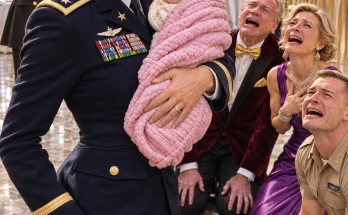
The moment I walked into my father’s 60th birthday dinner carrying my 3-month-old daughter, Mom rolled her eyes. “Great, another useless mouth to feed!” Humiliated, I quietly sat with my baby in a secluded corner. Twenty minutes later, my sister’s husband, a highly decorated Navy SEAL, arrived. Mom rushed to greet him, proudly announcing, “Our family’s greatest hero is here!” But he walked straight past her, stopped in front of me, and snapped into a perfect military salute. “Ma’am!” he declared. The entire room fell silent…
Part 5 of 6