The Offer That Changed Everything
I met Tom at Robert’s office.
He arrived with two members of his planning team.
He looked tired.
“I hope you’re doing well, Mrs. Kessler.”
“I’m doing all right.”
He smiled.
“That’s good.”
He placed several architectural drawings on the table.
“We’ve spent the last two weeks redesigning the project.”
I looked at the drawings.
The original plan had been a massive commercial complex.
Now, the eastern section showed a large green space.
There was a walking path along the creek.
A protected woodland area.
A small community garden.
And a section around the old farmhouse that had been left untouched.
Tom pointed to the map.
“We want to preserve the natural drainage corridor and establish a permanent conservation area. Your farmhouse and the old barn would remain.”
I studied the drawing.
“What happens to the western fields?”
“Those would be part of the commercial development, subject to all environmental and legal approvals. But only if you voluntarily agree to a properly structured arrangement.”
“And the water?”
“Our engineers would work with independent environmental specialists. We would not seek to transfer or interfere with your protected water rights.”
Robert interrupted.
“We would need enforceable restrictions, independent monitoring, and a conservation easement that survives any future transfer of the development.”
Tom nodded.
“Agreed.”
I looked at the plans again.
“Why are you willing to change everything?”
Tom leaned back.
“Because after reviewing the geological reports, we realized that the original plan was not only risky. It was shortsighted.”
He paused.
“Your husband understood something our engineers initially overlooked. The water system is part of the region’s future. If we damage it, the entire development could become a liability.”
I smiled slightly.
“Walt would have liked hearing that.”
Tom smiled.
“I wish I had met him.”
I looked at the drawings.
There was a small building near the creek.
“What is that?”
“A community environmental education center. We would fund its construction and ongoing maintenance. Local schools could bring students to learn about groundwater, agriculture, and conservation.”
I studied it.
“And who owns the land?”
“That is something we would negotiate with you and your attorney.”
I turned toward Robert.
He nodded.
“There’s no reason we couldn’t structure a long-term agreement that protects your ownership and gives the company limited rights to develop designated areas.”
I considered it.
For the first time, I could imagine a future in which the farm didn’t have to disappear for the county to grow.
I looked at Tom.
“I have a condition.”
“Of course.”
“The farmhouse stays. The barn stays. The oak trees stay. The creek remains protected. And nobody gets to tell me what to do with my home.”
Tom nodded.
“Those conditions are reasonable.”
“And I want the agreement to state clearly that no one can use my age or family relationship to pressure me into signing anything.”
Robert smiled.
“We can make that very clear.”
Tom extended his hand.
“I think we can build something good here, Mrs. Kessler.”
I didn’t shake his hand immediately.
Instead, I looked at the drawings one more time.
Then I said something Walt would have said.
“Let’s make sure we’re building something that will still be good fifty years from now.”
Tom nodded.
“That’s exactly what we intend to do.”
The Final Consequences
The legal investigation continued for several months.
Daniel eventually admitted that he had used misleading documentation to support Greenfield Holdings’ acquisition plans.
The matter was referred to the appropriate authorities for further action.
The company lost its financing.
Its investors pursued legal remedies.
Daniel’s personal financial situation deteriorated.
Amanda was also required to cooperate with the investigation and answer questions about her role in the company’s activities.
She eventually accepted responsibility for her actions.
She lost her job.
She also lost the financial stake she had hoped would make her wealthy.
But I didn’t celebrate any of it.
There is nothing satisfying about watching your own child lose everything.
I would have preferred to see her succeed honestly.
I would have preferred to see her become a vice president through hard work.
I would have preferred to have Sunday dinners without lawyers, documents, and painful conversations.
But life doesn’t always give us the ending we would have chosen.
Sometimes it gives us the ending we need.
Six months later, the development company and I reached an agreement.
I did not sell the eighty acres.
Instead, I entered into a carefully negotiated development partnership involving only designated portions of the property.
The agreement protected the farmhouse, the barn, the creek, the old oak trees, and the groundwater rights.
The conservation organization received permanent protections over the most sensitive areas.
Independent environmental monitoring became a condition of the development.
The company also funded the restoration of the old creek bank.
And the community environmental center was approved.
Tom personally attended the groundbreaking ceremony.
He stood beside me while local reporters took photographs.
“Mrs. Kessler,” he said, “I think your husband would be proud.”
I looked at the land.
“I think he’d be relieved.”
Tom laughed.
“Relieved?”
“Yes. He’d probably be wondering why it took so many people so long to understand what he was trying to protect.”
Tom smiled.
Then he handed me a small wooden plaque.
It had been made from reclaimed timber from the old barn.
On it were the words:
THE WALTER AND DOROTHY KESSLER CONSERVATION GROUNDS
I ran my fingers over the letters.
And for the first time in months, I cried.
Not because I was sad.
Because Walt was still part of the place we had built together.
A Mother’s Second Chance
Almost a year passed before Amanda came to visit again.
This time, she didn’t arrive in an expensive car.
She drove an ordinary secondhand sedan.
She carried a grocery bag and a small box.
When I opened the door, she smiled nervously.
“Hi, Mom.”
“Hello, Amanda.”
“I brought your favorite apple bread.”
I stepped aside.
“Come in.”
She placed the groceries on the kitchen counter.
Then she handed me the box.
Inside was an old photograph.
It showed Amanda at ten years old, sitting on Walt’s tractor.
Her hair was messy.
Her knees were covered in dirt.
And she was smiling so widely that her eyes were almost closed.
“I found it while cleaning out the house,” she said.
I looked at the picture.
“I remember that day.”
“Dad let me drive the tractor.”
“He let you sit in the driver’s seat while he controlled the pedals.”
Amanda laughed.
“I told everyone I drove it.”
We stood quietly.
Then she looked at me.
“Mom, I’ve been seeing a counselor. I’ve also started working again. It’s not a big job, but I’m learning to be happy with something honest.”
I nodded.
“That’s a good beginning.”
She looked down.
“I don’t expect you to forget what I did.”
“I won’t.”
“I know.”
“But I also don’t want us to spend the rest of our lives being strangers.”
Her eyes filled with tears.
“Neither do I.”
I pulled out a chair.
“Sit down. I’ll make tea.”
She sat at the kitchen table.
For a moment, it felt almost like the old days.
But something had changed.
There was no pretending.
No expensive promises.
No talk about how much the farm was worth.
Just a mother and her daughter sitting together.
After a while, Amanda asked quietly:
“Do you think you can ever trust me again?”
I placed two cups of tea on the table.
“Trust isn’t something I can give you because you ask for it.”
She nodded.
“You have to earn it.”
“I understand.”
I looked at her.
“But you can start today.”
She began crying.
I reached across the table and held her hand.
We didn’t hug immediately.
We didn’t pretend everything was fixed.
We simply sat there.
And sometimes, that is where forgiveness begins.
Not with a dramatic apology.
Not with promises.
But with two people finally telling the truth.
The Farm Walt Left Me
Two years later, the development was completed.
It was not the enormous concrete landscape originally proposed.
It included shops, restaurants, medical offices, and a small hotel.
But the creek remained.
The oak trees remained.
The farmhouse remained.
And the old barn was restored.
The environmental center opened in the spring.
Local schoolchildren visited to learn about groundwater, farming, and the importance of protecting natural resources.
I volunteered there twice a week.
I showed children how Walt had built the irrigation channels.
I explained how the creek fed the land.
I taught them that soil wasn’t simply something beneath their shoes.
It was something that supported their lives.
Sometimes, I would stand near the old oak tree and remember Walt.
I remembered the day we bought the farm in 1974.
We had very little money.
The farmhouse needed repairs.
The barn roof leaked.
And the fields were full of weeds.
Walt had stood beside me and looked across the eighty acres.
“One day,” he had said, “this place will be worth something.”
I had laughed.
“It’s already worth something.”
He looked at me.
“What’s that?”
“Home.”
He had smiled.
And now, after all these years, I understood that he had been right.
The farm had become worth millions.
But its greatest value had never been measured in money.
It was the life we built.
The memories we made.
The land we protected.
And the people who would benefit from it long after we were gone.
One afternoon, Amanda came to visit.
She had been helping at the environmental center on weekends.
She walked beside me along the creek.
“Mom?”
“Yes?”
“Do you think Dad would be happy with what happened?”
I looked at the water.
“I think he’d be happy that the creek is still running.”
She smiled.
Then she took my hand.
We continued walking.
A few minutes later, she stopped beside the old oak tree.
“Mom, I’ve been thinking about something.”
“What is it?”
“When you eventually decide what happens to the farm, I don’t want you to feel obligated to leave it to me.”
I turned toward her.
“Why would you say that?”
“Because I know what I did. I don’t want you to make decisions because you feel you owe me something.”
I studied her face.
Then I smiled.
“That’s the first sensible thing you’ve said about the farm in a very long time.”
She laughed through her tears.
I squeezed her hand.
“Your father and I didn’t buy this land to make our children wealthy. We bought it to build a life. If you want something meaningful from it, help protect what it represents.”
She nodded.
“I will.”
And I believed her.
Not because she was my daughter.
But because, slowly, she was learning to become someone I could trust again.
The Letter I Left in the Kitchen
On the third anniversary of the development’s opening, I sat at the kitchen table and wrote a letter.
I didn’t know how much longer I would be able to live independently.
At seventy-nine, I still drove the tractor, but I had begun asking for help with the heavier work.
I wanted Amanda to understand something before the day came when I could no longer explain it myself.
I wrote:
“To Amanda,
Your father and I spent most of our lives building this farm.
We bought it when we were young and had almost nothing.
We planted trees, repaired fences, raised animals, and watched our children grow.
We never became rich from it.
But we were wealthy in ways we didn’t always recognize.
Your father used to say that land is not truly owned by the person whose name appears on a deed.
It is borrowed from the future.
We take care of it while we are here, and then we leave it for someone else.
I hope you remember that.
I also hope you remember what happened when you allowed money and ambition to become more important than the people who loved you.
You lost more than a business opportunity.
You almost lost your mother.
I am not writing this to punish you.
I am writing it because I love you.
If one day you inherit anything from this place, let it be the responsibility to protect it.
Never measure your life by the size of someone else’s bank account.
And never mistake someone’s kindness for weakness.
Your father loved you.
I love you.
And I hope you spend the rest of your life becoming someone both of us would be proud of.
Love,
Mom.”
I folded the letter and placed it in Walt’s old wooden cabinet.
Then I walked outside.
The sun was setting over the western fields.
The air smelled like fresh grass and damp earth.
I could hear children laughing near the environmental center.
A delivery truck passed along the new road.
And somewhere in the distance, the creek continued flowing.
I stood on the porch for a long time.
I thought about the morning Amanda had told me to wait in the car.
I remembered sitting there for forty minutes, feeling like an embarrassment.
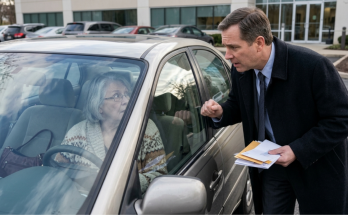
I remembered Tom Harlan tapping on the window.
“Mrs. Kessler? Did you get my letters? I’ve sent eleven.”
At the time, I thought that moment was about a wealthy company wanting my land.
I was wrong.
It was about something much bigger.
It was about remembering that my age did not make me invisible.
My quiet life did not make me unimportant.
And being someone’s mother did not mean I had to surrender my right to be respected.
I had spent my life believing that patience was the greatest strength a person could have.
But Walt had taught me something else.
Sometimes, you must be patient.
Sometimes, you must forgive.
And sometimes, you must stand your ground, even when the person standing against you is someone you gave birth to.
I looked across the eighty acres.
My eighty acres.
The farm was still there.
And so was I.
Because a person may grow old, but that does not mean their voice becomes less important. And a home may become valuable to the world, but its true worth will always belong to the people who loved it first.
The end.
My Daughter Made Me Wait in the Car Because Her Boss “Didn’t Like Old People”—Then Her Boss Recognized Me and Revealed Why He Had Sent 11 Letters About My $5 Million Farm
Part 2 of 2