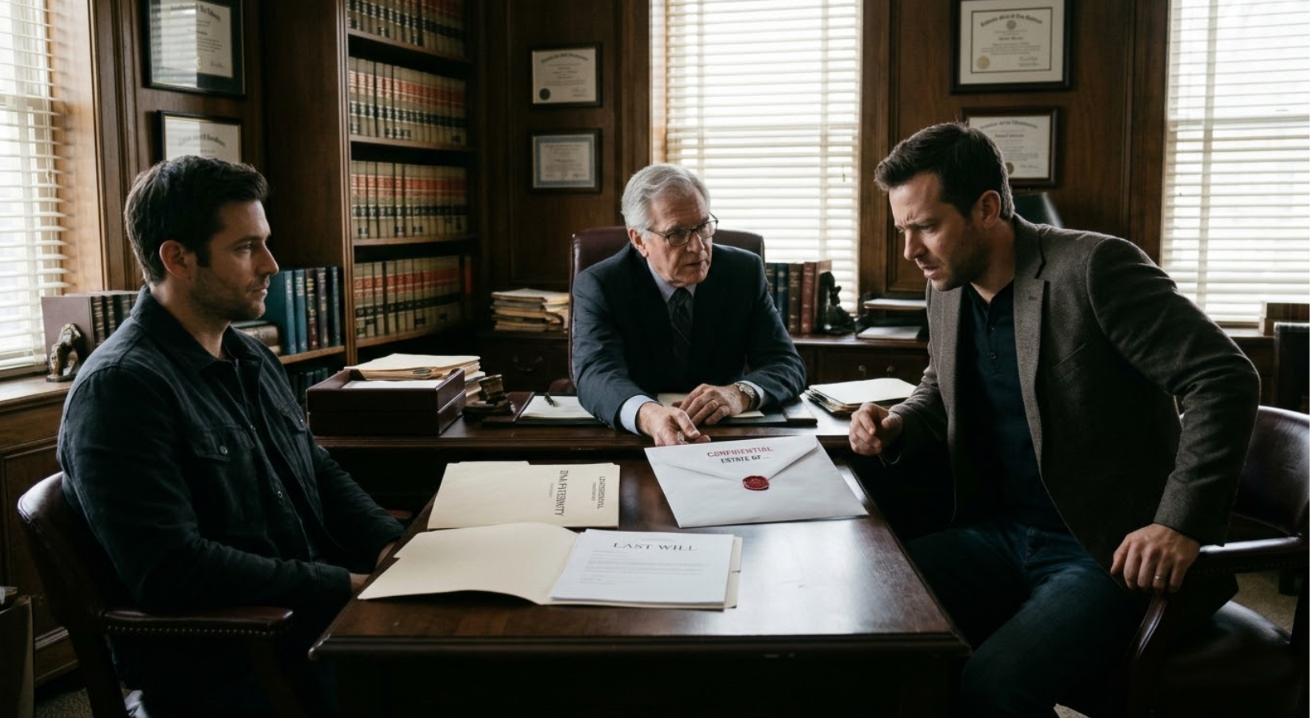
Julian’s lawyer leaned forward.
“Then I suggest we establish the legal relevance before proceeding.”
“That is precisely what I intend to do,” Dalton replied.
He unfolded the second page.
“Julian, if you are sitting in this room, I suspect you have already made your opinion about Arthur’s place in this family very clear. I know you have questioned his bloodline. I know you have spoken about him as though he were a stranger taking something that belongs to you.”
Julian shifted in his chair.
“That’s not—”
“Please allow me to finish,” Dalton said.
For the first time that morning, Julian actually shut his mouth.
My father continued.
“You have made one mistake. You have assumed that blood is the only thing that makes a son. You have also assumed that because Arthur is not biologically mine, he has no right to what I built.”
My mother began crying.
Not quietly this time.
Her shoulders trembled, and she reached for a tissue from the small box sitting beside the conference room telephone.
I stared at the letter.
My father had known.
He had known all along.
And he hadn’t told me.
I felt something strange inside me. Not anger exactly. It was the feeling of discovering that the one person you trusted most had been holding a door closed while you spent your entire life standing outside it.
Dalton turned the page.
“Arthur was three years old when I met him. I knew before I married Eleanor that he was David Hartman’s son. I also knew that David had left, that Eleanor had been abandoned, and that a child should never be punished for the mistakes of adults.”
Julian’s mouth opened.
Then closed.
My father’s words were becoming impossible for him to argue with.
“I raised Arthur. I gave him my name. I paid for his education. I watched him become a man. I never once considered him less of a son because he did not share my DNA.”
I couldn’t breathe properly.
I looked down at the table because I didn’t want anyone to see my eyes filling.
I remembered my father’s hand on my shoulder.
His voice saying, “Proud of you, son.”
I remembered the way he’d stood in the doorway of my college apartment when he visited, looking at the broken furniture and the secondhand refrigerator, and quietly handed me a check without telling my mother.
I remembered the night I had called him after my first promotion.
And suddenly, those memories felt different.
They weren’t moments of a man tolerating a child who wasn’t his.
They were moments of a father loving his son.
Dalton continued.
“I am aware that Eleanor kept the truth from Arthur. That decision was hers, and I will not pretend I agreed with it. But I also know what Arthur has endured in this family. I know Julian has been given advantages Arthur never received. I know the difference between rewarding a son and enabling one.”
Julian pushed his chair back.
“This is a setup. Dad was manipulated. Arthur has been digging into this for months, and now suddenly there’s some conveniently timed letter?”
Sarah calmly opened her briefcase.
“We have the original DNA report, the photograph, the messages you sent threatening to challenge Arthur’s inheritance, and financial records relating to the $50,000 transfer. If you want to question the authenticity of this letter, I’m sure Mr. Dalton would welcome a formal examination.”
Julian turned toward his lawyer.
His lawyer didn’t answer immediately.
That was the first moment I realized Julian was beginning to understand something.
He had come into the room believing he was the only person who had prepared for this meeting.
He had no idea my father had prepared for it years before he died.
Dalton lifted another sheet.
“My son Julian has been told repeatedly that he will inherit responsibility for the family’s business interests. Responsibility is not the same as ownership, and wealth is not a reward for being born first. If he has used my illness to move money, pressure family members, or take advantage of my inability to manage my affairs, I expect those actions to be investigated independently.”
The room went completely silent.
Sarah slowly turned her head toward me.
I didn’t move.
I didn’t smile.
I didn’t even look at Julian.
I was too busy listening to my father’s voice in my head.
Because suddenly I understood something.
The letter wasn’t just about me.
It was about Julian.
And my father had known exactly what his oldest son was capable of.
The First Envelope
Mr. Dalton closed the letter and placed it inside the folder.
Then he reached into his briefcase and pulled out a second envelope.
It was smaller.
Cream-colored.
My name was written across the front in my father’s handwriting.
ARTHUR. OPEN ONLY IN THE PRESENCE OF MY ESTATE ATTORNEY.
My stomach tightened.
Dalton slid it toward me.
“Your father left this specifically for you.”
I stared at my name.
I hadn’t seen his handwriting since the funeral.
For a moment, I couldn’t bring myself to touch it.
Sarah gently placed her hand near mine.
“Take your time.”
I opened the envelope.
Inside was a handwritten letter and a single brass key.
The key was old, slightly tarnished, with a small black tag attached to it.
On the tag was a number.
214.
I unfolded the letter.
My dear Arthur,
If you are reading this, then I am no longer around to explain things the way I should have explained them years ago.
First, I want you to know something that I should have said more often. You were never a mistake. You were never an obligation. You were never a boy I took into my house because I felt sorry for your mother.
You were my son.
I know the DNA test may have hurt you. I know you may feel betrayed by Eleanor. You have every right to ask questions. But don’t let the truth about your biological father erase the truth about the man who raised you.
I loved you, Arthur. I still do. Nothing about that changes because of a laboratory report.
My eyes blurred.
I stopped reading.
The room disappeared for a moment.
I was back in the hospital three months before my father died, sitting beside his bed while he struggled to lift a glass of water.
He had looked at me then and said, “You always show up.”
I thought he meant I was dependable.
Now I understood he meant something more.
I wiped my eyes and continued.
There is something I need you to find. The key belongs to a private storage facility in Denver. Unit 214. The rental agreement is under my name, but the contents are not listed in the estate inventory.
Inside, you will find documents that should have been given to you years ago. You will also find the truth about David Hartman, the man in the photograph.
Do not let Julian go with you.
Do not let Eleanor tell you what is inside before you see it yourself.
And Arthur, if anyone tries to convince you that this is about money, remember that the money is only the smallest part of what was stolen from you.
You deserve to know the truth.
Love,
Dad.
I folded the letter carefully.
My hands were shaking.
Julian suddenly stood.
“What’s that?”
“Nothing you need to worry about,” I said.
His eyes narrowed.
“What’s the key for?”
Sarah answered before I could.
“Mr. Ellington’s private correspondence is not part of this discussion.”
Julian looked at her like he wanted to throw something.
Then he turned toward Dalton.
“Fine. Let’s get to the will. That’s why we’re here.”
Dalton nodded.
“Indeed.”
He pulled out another document.
And that’s when the meeting took a turn I hadn’t expected.
My Father’s Last Will
Richard Dalton began reading the official will.
The first few pages contained the usual legal language.
Outstanding debts.
Taxes.
Funeral expenses.
A charitable donation to the Denver Children’s Hospital, which my father had supported for more than twenty years.
A small scholarship fund for students pursuing accounting and finance degrees at the university I had attended.
I was surprised to hear my name mentioned in connection with the scholarship.
My father had never told me about it.
Dalton explained that the fund was to be administered independently and that my role would be advisory, not financial.
Then came the family property.
The house in Denver.
Two commercial buildings.
A portfolio of investments.
A ranch outside Colorado Springs.
Julian’s expression slowly returned to its familiar confidence.
He leaned back.
He even gave me a small smile.
That smile said he believed the worst was over.
Then Dalton reached the section concerning the family business.
“Mr. Ellington’s instructions regarding Ellington Commercial Holdings are as follows.”
Julian straightened.
My father had built Ellington Commercial Holdings over nearly forty years. It started with a single warehouse and grew into a company managing industrial properties, commercial leases, and several real estate developments across Colorado.
Julian had worked there for the last six years.
His title was Vice President of Operations.
He had spent most of those years telling people he was the future of the company.
Dalton read the first sentence.
“My son Julian shall not assume ownership or control of Ellington Commercial Holdings upon my death.”
Julian stopped smiling.
“What?”
Dalton continued.
“The company shall remain under the oversight of the existing board of directors, with a temporary independent administrator appointed for a period of twelve months. During that period, all financial transactions conducted by Julian Ellington shall be reviewed.”
Julian’s lawyer immediately interrupted.
“Mr. Dalton, I need to review that provision.”
“Of course.”
Julian’s face had turned red.
“That’s not what Dad told me.”
Dalton looked directly at him.
“Your father told you that you would be given the opportunity to lead the company if you demonstrated the ability to do so. He did not promise you ownership.”
“That’s bullshit.”
“Mr. Ellington.”
“No. This is bullshit! I worked for that company. I brought in clients. I built relationships. I—”
“You were compensated for your work,” Dalton said. “Your father was very clear that compensation for employment was not equivalent to inheritance.”
Julian looked at my mother.
“Eleanor, say something.”
She didn’t.
For the first time, she looked as if she was afraid of him rather than simply disappointed by him.
Dalton read the next paragraph.
“Arthur Ellington shall receive a portion of my estate, not because of his biological relationship to me, but because he has demonstrated the values I believe should define the family name.”
Julian turned toward me.
“Of course.”
I didn’t respond.
“Arthur shall receive ownership of the Denver residence, subject to the existing mortgage and estate obligations, as well as a financial inheritance of $2,400,000, placed into a trust administered by Sarah Ang and Richard Dalton’s firm for the first five years.”
I stared at Dalton.
Two million four hundred thousand dollars.
I wasn’t expecting anything like that.
I hadn’t come to Denver for money.
I had come because I wanted to know why my mother had burned my father’s papers, why Julian had suddenly decided I wasn’t his brother, and why the man who had raised me had never told me the truth about my biological father.
Julian let out a sharp laugh.
“Two point four million? That’s it?”
Sarah slowly turned toward him.
“That’s a substantial inheritance.”
Julian ignored her.
“Where’s the rest?”
Dalton closed the document.
“Mr. Ellington’s remaining assets will be distributed according to the provisions outlined in the will, including charitable contributions, company reserves, property trusts, and several private arrangements.”
“Private arrangements?”
“Yes.”
Julian slammed his hand against the table.
“I want the full inventory.”
“You will receive the appropriate documentation through counsel.”
“Right now!”
Dalton’s voice became firmer.
“Mr. Ellington, if you continue to interrupt, we will conclude this meeting and proceed through formal probate disclosures.”
Julian sat down.
But he was no longer the man who had walked into the room smiling.
He was a man who had just discovered that the throne he believed was waiting for him had never been promised.
And there was still another envelope on the table.
The envelope my father had instructed Dalton to open only after the official will had been read.
Dalton looked at Sarah.
Then he looked at my mother.
Finally, he turned toward Julian.
“Before we conclude, Mr. Ellington left one additional document. It concerns a financial transaction that occurred approximately six months before his death.”
Julian’s lawyer whispered something to him.
Julian’s eyes flickered.
Dalton opened the envelope.
And began reading.
“I am aware that $50,000 was transferred from one of my accounts into a private company controlled by Julian. I did not authorize that transfer. I did not approve it as a gift, a loan, or a business expense.”
Julian’s chair scraped against the floor.
“That was a business transaction!”
Dalton continued.
“I have instructed my attorney to preserve the records and refer the matter for independent review. If the money was taken without authorization, it must be returned to my estate. No family member shall be permitted to interfere with the investigation.”
Sarah leaned forward.
“Mr. Dalton, may I have a copy of that document?”
“Certainly.”
Julian pointed at me.
“He’s behind this! He’s been feeding Dad lies! He wants me out of the company so he can take everything!”
I finally looked at him.
“You gave me a DNA test because you thought you could humiliate me into walking away. You threatened me with probate court. You told me the money belonged to real Ellingtons.”
I leaned forward slightly.
“But Dad just told us what he thought about that.”
Julian’s jaw tightened.
“You don’t know anything about running a business.”
“Maybe not,” I said. “But I know the difference between money that belongs to me and money I steal from someone else.”
His face went dark.
My mother whispered, “Please, stop.”
But this time, nobody stopped me.
And nobody stopped Julian either.
He stood so quickly that his chair fell backward.
“You’re going to regret this, Arthur.”
Sarah rose beside me.
“Threatening my client during an estate proceeding is a terrible idea.”
Julian looked at her.
Then at Dalton.
Then at my mother.
He grabbed his briefcase and walked toward the door.
His lawyer followed, apologizing quietly to Dalton as he passed.
But Julian stopped with his hand on the door.
He turned back.
“You think you’ve won?”
I didn’t answer.
He smiled, but it was no longer the smile he had worn at my birthday dinner.
It was something uglier.
“You haven’t even met David Hartman yet.”
Then he walked out.
The door slammed so hard the glass panel beside it rattled.
I sat there, staring at the empty chair.
Because Julian had just said the one thing my father had warned me about.
David Hartman.
My biological father.
And I suddenly realized I had no idea what I was about to discover.
Julian’s last words stayed in my head long after the conference room emptied.
“You haven’t even met David Hartman yet.”
I stood outside the law office with Sarah, watching Denver traffic move through the intersection. The sky was gray, and a cold wind blew between the buildings.
Sarah adjusted her coat.
“Arthur, we need to talk about what Julian said.”
“I know.”
“Your brother may know where David is. Or he may know something about the documents in your father’s storage unit. Either way, I don’t want you going there alone.”
I looked at the brass key in my pocket.
Unit 214.
My father’s letter had been very clear.
Don’t let Julian go with you.
Don’t let Eleanor tell you what is inside before you see it yourself.
“I need to go to the storage facility,” I said.
Sarah nodded.
“Then we’re going together.”
The Storage Unit
The facility was on the outskirts of Denver, behind an industrial road lined with auto repair shops and warehouses. It was the kind of place you would drive past without noticing.
My father had rented Unit 214 for at least six years.
The manager checked the paperwork, confirmed the account, and escorted us through a row of metal doors.
When we reached 214, I stood there for a moment.
I had spent thirty-five years believing there was nothing about my life I didn’t already know.
Now I was about to open a door my father had deliberately kept closed.
I inserted the key.
The lock turned.
Inside were several boxes, two filing cabinets, an old desk, and a large wooden trunk.
Nothing looked particularly extraordinary.
Sarah took photos of the entire unit before we touched anything.
Then we started with the boxes.
The first contained old business documents.
The second contained photographs.
The third contained letters.
I found my birth certificate in a folder marked ARTHUR — PERSONAL.
It was the original.
My mother’s name was Eleanor.
The father’s name was blank.
I sat down on the edge of the desk.
Sarah noticed.
“Are you okay?”
“I don’t know.”
I looked at the document.
For the first time, I saw the official record of my birth without the Ellington name attached to the man who raised me.
It was strange.
I had never thought of myself as someone who needed a name to belong.
But seeing that blank space felt like looking at a hole in a wall I had spent my entire life trying to repair.
Sarah handed me another folder.
“Look at this.”
Inside were copies of bank statements, private correspondence, and a series of legal documents.
One letter was dated twenty-six years earlier.
It was from David Hartman to William Ellington.
William,
I know I have no right to ask you to do this. I know what I did to Eleanor, and I know I left Arthur without the father he deserved.
But I need to tell you that I never stopped thinking about him.
I was young. I was scared. I was offered a job out of state, and I convinced myself that leaving was better than staying and making things worse.
I have regretted it every day.
If you ever decide that Arthur deserves to know who I am, I will be willing to meet him. I won’t ask him to forgive me. I won’t ask him to call me his father.
I only want him to know that he was never the mistake.
David.
I read the letter twice.
Then I put it down.
“Why didn’t my father tell me?”
Sarah examined the folder.
“Maybe he wanted to protect you. Maybe he was waiting for the right time. Maybe he didn’t know how to tell you without making you feel like he was losing you.”
I looked at the letters.
There were several.
David had written to my father over the years.
Some were short.
Some were long.
Some were never answered.
But the dates told me something important.
David had not disappeared completely.
He had been trying to contact my father.
And my father had kept the letters.
I opened the wooden trunk.
Inside was a sealed envelope, a small stack of photographs, and a handwritten note from my father.
Arthur,
David has been living in Oregon for the past several years. His address and phone number are in the envelope. I have not given him permission to contact you directly because I wanted you to have the choice.
If you want to meet him, you can.
If you don’t, you don’t owe him anything.
This decision belongs to you.
I closed my eyes.
That was the first time in my life I felt my father had given me something more important than money.
He had given me the right to choose.
The Phone Call
I waited until Sarah had finished documenting everything.
Then I took the envelope with David’s contact information and walked outside.
I stood beside my car for almost ten minutes before I dialed the number.
It rang four times.
Then a man’s voice answered.
“Hello?”
I almost hung up.
“Is this David Hartman?”
“Yes. Who’s calling?”
“My name is Arthur Ellington.”
There was a silence.
A long one.
Then I heard him take a breath.
“Arthur?”
“Yes.”
“Oh my God.”
His voice broke.
“I’ve been waiting for this call for a very long time.”
I didn’t know what to say.
I had imagined this moment countless times since I saw the photograph.
In some versions, I screamed at him.
In others, I demanded answers.
In others, I simply hung up.
But standing there, holding the phone, I felt nothing like the angry son I had imagined.
I felt like a man who had spent his entire life waiting for someone to explain why he had never been enough.
“Why did you leave?” I asked.
David didn’t answer immediately.
“I was twenty-seven. Your mother and I were together, and I was terrified. I had just lost my job. I was drowning in debt. I thought I could find work somewhere else, get my life together, and come back.”
“You didn’t come back.”
“No.”
“Why?”
“Because I was ashamed.”
I laughed bitterly.
“That’s a pretty convenient excuse.”
“I know.”
“You missed my childhood.”
“I know.”
“You missed my graduation.”
“I know.”
“You missed every birthday.”
“I know, Arthur.”
His voice was shaking.
“I don’t have an excuse. I don’t have a story that makes it right. I made a terrible decision, and then I spent years making it worse by being too afraid to face you.”
I looked at the storage facility.
At the locked door.
At the boxes my father had kept.
“Did you know William raised me?”
“Yes.”
“Did you know he loved me?”
David’s voice became softer.
“Your mother told me. William wrote to me once. He said he was raising you, and he was proud of the man you were becoming.”
I swallowed.
“Then why didn’t you leave me alone?”
“Because I wanted to know you. But I knew wanting something didn’t mean I deserved it.”
I didn’t answer.
David continued.
“I heard about your father’s death. I wanted to call you. I wanted to come to the funeral. But Eleanor told me you didn’t know about me, and she asked me not to disrupt your life.”
I closed my eyes.
My mother.
Of course.
“She told you not to contact me?”
“Yes.”
“Why?”
“I don’t know, Arthur. You would have to ask her.”
I stood there for another moment.
Then I said, “I don’t know if I want to meet you.”
“I understand.”
“I don’t know if I can forgive you.”
“You don’t have to.”
“And I don’t know what I’m supposed to call you.”
David began to cry.
“You can call me David. You can call me nothing. You can hang up and never speak to me again. I just want you to know that I’m sorry.”
I looked at the photograph in my hand.
My mother holding me.
David standing beside her.
A young man who had been too frightened to stay.
“I’ll think about it,” I said.
“Thank you.”
I ended the call.
And for the first time, the truth about my biological father didn’t feel like a weapon.
It felt like a wound I could finally see.
The $50,000 Investigation
Sarah and I returned to Austin two days later.
She had already arranged for an independent forensic accountant to review the transfer Julian had made from my father’s account.
The report arrived eleven days later.
It was worse than we expected.
The $50,000 hadn’t been a single transaction.
It had been divided into five transfers of $10,000 over three weeks.
All five were made while my father was hospitalized.
The money went into an LLC called J.E. Property Advisory.
Julian was the sole managing member.
The company had no employees.
No office.
No business website.
No invoices from clients.
The forensic accountant found that the money had been used to pay off Julian’s personal credit card, a lease payment on his Porsche, and a private vacation in Cabo.
Sarah stared at the report.
“That’s not a business expense.”
“No.”
“That’s not a loan.”
“No.”
“It’s a pattern of unauthorized transfers.”
She closed the file.
“We’re going to refer this to the appropriate authorities and let them investigate. The estate will also pursue repayment.”
I looked out my office window.
Julian had spent my entire life telling me I didn’t belong.
He had treated me like a stranger whenever he thought I was standing in his way.
And now he had taken money from the one man who had loved us both.
I didn’t feel happy.
I didn’t feel victorious.
I felt disappointed.
Because somewhere inside me, I still remembered the two of us as children.
We had once built a treehouse together behind the Denver house.
Julian was seven.
I was five.
He had held the hammer while I handed him nails.
He had told me the treehouse was our secret kingdom.
For a few hours, he had been my brother.
I wondered when that boy had disappeared.
Or whether he had ever really existed.
The Second Meeting
Three weeks later, Sarah received a call from Julian’s attorney.
Julian wanted to meet.
Not at the estate office.
Not at the family house.
He wanted to meet at a restaurant downtown.
Sarah advised me not to go.
“You don’t owe him a conversation.”
“I know.”
“Then why are you considering it?”
I thought about it for a long time.
“Because I want to hear him say what he did without hiding behind a lawyer.”
Sarah studied me.
“Fine. I’ll be there. We won’t discuss settlement terms, and we won’t sign anything.”
The restaurant was quiet.
Julian arrived fifteen minutes late.
He looked tired.
His expensive suit was wrinkled, and for once, he wasn’t carrying himself like a man who owned every room he entered.
He sat down.
“Arthur.”
“Julian.”
He stared at the menu.
“I didn’t know Dad had that letter.”
“I know.”
“I didn’t know he was going to put the company under independent oversight.”
“That’s not what we’re here to discuss.”
He sighed.
“Fine.”
A waiter brought water.
Julian didn’t touch it.
“I screwed up the money,” he said.
I waited.
“I thought Dad wasn’t going to notice. I was going to put it back. It wasn’t supposed to become a big thing.”
“You spent it on your personal bills.”
He looked down.
“Yes.”
“You took money from a dying man.”
“I know.”
“Why?”
Julian rubbed his face.
“Because I was scared.”
I almost laughed.
“Scared of what?”
“Of losing everything.”
I leaned back.
“You were never going to lose everything. You were the son Dad trusted to run the business. You had a salary. You had a house. You had a wife. You had everything.”
He shook his head.
“You don’t understand.”
“Then explain it.”
For the first time, Julian spoke without interrupting himself.
He told me that our father had been increasingly disappointed in him.
That he had made mistakes at work.
That he had taken on debts he couldn’t afford.
That he had spent years pretending he was more successful than he was.
He told me about a failed property deal that cost him nearly $180,000.
He told me he had been afraid Dad would find out.
He told me that when Dad got sick, he saw an opportunity to move the money and cover some of his debt before the company reviewed the books.
Then he looked at me.
“And when you got that DNA test, I thought you would just leave.”
I stared at him.
“You thought you could insult me enough that I’d give up my inheritance?”
He didn’t answer.
“You thought I’d spend my entire life being ashamed of something I didn’t even do?”
He finally nodded.
“Yes.”
The honesty was so ugly that I almost respected it.
Almost.
I looked at him.
“Do you know what the worst part was?”
He shook his head.
“You didn’t just insult me. You watched Mom sit there and say nothing. And you knew exactly what that would do to me.”
His eyes lowered.
“I know.”
“No, Julian. I don’t think you do.”
I stood up.
“Because I spent thirty-five years thinking maybe if I worked harder, maybe if I stayed quieter, maybe if I never asked for anything, I’d finally be treated like your brother.”
He looked up.
“And you know what Dad taught me?”
I paused.
“That being a son isn’t something you prove with blood. It’s something you prove with love.”
Julian began to cry.
I didn’t sit back down.
“I hope you fix your life. I really do. But I’m not going to keep paying for your mistakes.”
I walked out.
Sarah followed.
Neither of us spoke until we reached the car.
Then she said, “You did well.”
I shook my head.
“I don’t feel like I did anything.”
“Sometimes the most important thing you do is stop allowing someone to hurt you.”
That night, I slept better than I had in months.
Not because I had won.
Because I had finally stopped waiting for Julian to approve of my existence.
Six weeks after the meeting with Julian, my mother called me.
I almost didn’t answer.
Her name appeared on my screen, and I sat staring at it for several seconds. I had spent most of my adult life answering Eleanor Ellington’s calls no matter where I was, no matter what I was doing. If she needed something, I found a way. If she was upset, I listened. If Julian had made another mess, somehow I was expected to help clean it up.
But this time, I let the phone ring.
Then it rang again.
And again.
Finally, I answered.
“Arthur?”
Her voice was different.
Not the polished voice she used at charity dinners. Not the gentle voice she used when she wanted me to do something for her. It was tired.
“Yes, Mom.”
“I need to talk to you.”
“About what?”
She paused.
“About everything.”
I looked at the window of my apartment. Austin was bright that afternoon. People were walking along the sidewalk carrying coffee, talking about their weekends, living ordinary lives.
“Mom, I don’t think there’s anything left to say.”
“Please. Just let me explain.”
I should have hung up.
Instead, I said, “You have one chance to tell me the truth. No excuses. No blaming Julian. No telling me you were protecting me. Just the truth.”
She began crying.
“I know.”
“Then start.”
For several seconds, I heard nothing but her breathing.
Then she said, “David was the man I loved before I met your father.”
I already knew that.
“I was young. David and I were going to get married. We had plans. We talked about having a house, children, everything. But David was struggling financially, and he was afraid of becoming a father. When I told him I was pregnant, he panicked.”
“He left.”
“Yes.”
“And you never heard from him again?”
“Not at first.”
I closed my eyes.
“Then what happened?”
“William came into my life. He knew I was pregnant. He knew David had left. He didn’t ask me to explain everything. He just helped me.”
I remembered the letters.
“He knew who my father was.”
“Yes.”
“From the beginning?”
“From the beginning.”
I felt my jaw tighten.
“Then why did you lie to me?”
“Because I was afraid.”
“Afraid of what?”
“That you would want David. That you would look at William differently. That you would think William wasn’t your real father. That our family would fall apart.”
I laughed, but there was no humor in it.
“Mom, our family fell apart long before I found that photograph.”
She sobbed.
“I know.”
“No, you don’t.”
I stood up and walked to the kitchen.
“You watched Julian humiliate me for thirty-five years. You watched him make jokes about me, about my career, about my life. You watched him tell me I didn’t belong. And every time I asked you to stop him, you told me to be the bigger person.”
“Arthur, I—”
“You knew the truth about my father. You knew William loved me. You knew I was his son in every way that mattered. And you let Julian use that truth to hurt me.”
“I never wanted that.”
“But you allowed it.”
She had no answer.
Then she said something that made me stop walking.
“Your father left me a letter too.”
I went quiet.
“What letter?”
“I haven’t opened it.”
“Why?”
“Because I know what it says.”
My voice became colder.
“Then open it.”
“I can’t.”
“Why not?”
“Because I’m afraid of what he wrote.”
I leaned against the counter.
For years, Eleanor had been afraid of losing control of the family story.
She had kept secrets because she believed secrets could protect her.
But now the secrets had become the walls she was trapped behind.
“Mom,” I said quietly, “Dad knew the truth. He knew Julian was hurting me. He knew what happened to the money. He knew everything. And he still left you a letter.”
“Yes.”
“Maybe you should finally read it.”
She began crying harder.
“I don’t know if I deserve to.”
“That’s not my decision.”
I ended the call.
Not because I hated her.
But because I was tired of being the person who had to comfort everyone else after they hurt me.
The Letter Eleanor Couldn’t Open
Two days later, Sarah called.
“Arthur, your mother contacted Mr. Dalton. She wants to arrange a meeting.”
“About what?”
“She says she wants to open your father’s letter in front of you.”
I was quiet.
Sarah continued.
“She also wants to discuss the estate. She’s willing to cooperate with the investigation into Julian’s transfers.”
“Why now?”
“She says she finally understands that keeping quiet was not protecting the family.”
I wasn’t sure I believed her.
But I agreed to meet.
We gathered at Mr. Dalton’s office on a Friday afternoon. My mother arrived carrying a small envelope inside her handbag.
She looked older than I remembered.
Not physically.
Something in her had changed.
She sat down and placed the envelope on the table.
“This is the letter your father left me.”
Dalton confirmed that it was one of the personal letters William had instructed him to deliver after his death.
My mother opened it with trembling fingers.
The first line was written in my father’s handwriting.
Eleanor,
If you are reading this, I hope you have finally stopped trying to control the truth.
My mother began crying before she finished the sentence.
Dalton quietly handed her a tissue.
She continued.
I know you have spent years afraid that Arthur would discover David’s identity. I know you believed that if the truth remained hidden, our family would remain whole.
But a family cannot be held together by silence.
You were wrong to let Julian treat Arthur as though he were less than a son. You were wrong to teach Arthur that peace meant accepting humiliation. And you were wrong to believe that protecting Julian from consequences was the same as loving him.
My mother covered her mouth.
I stared at the paper.
My father had never spoken to her like that in front of me.
He had always been calm.
Always measured.
But in that letter, he was unmistakably disappointed.
Arthur never asked for special treatment. He never demanded anything from us. He worked for what he had. He came home when I needed him. He called me when he succeeded and when he failed. He gave me more of his life than I ever had the courage to ask for.
And yet you and Julian repeatedly made him feel like an outsider.
I cannot change what happened while I was alive. I can only hope you will stop making the same mistake now that I am gone.
My mother was shaking.
Then came the final paragraph.
You cannot ask Arthur to forgive you simply because you are his mother. You must earn the right to be part of his life again. And if he decides he needs distance, respect that. He has spent too many years being told that his feelings were inconvenient.
She couldn’t continue.
She folded the letter and pressed it against her chest.
“I’m sorry,” she whispered.
I sat quietly.
Then she looked at me.
“I am so sorry, Arthur.”
For the first time, she wasn’t asking me to forgive Julian.
She wasn’t asking me to forget.
She wasn’t telling me that family was family.
She was admitting that she had been wrong.
I looked at her.
“I believe you are sorry.”
She nodded, crying.
“But I’m not ready to forgive everything.”
“I understand.”
“And I don’t want you calling me when Julian needs money or when his problems become too big for him to handle.”
“I won’t.”
“I don’t want to be the person you expect to sacrifice his peace so everyone else can be comfortable.”
She wiped her face.
“You shouldn’t have been.”
That was the first honest thing she had said to me in years.
And I appreciated it.
But appreciation wasn’t forgiveness.
Not yet.
Julian’s Consequences
The investigation into the $50,000 transfer continued.
Julian’s attorney negotiated with the estate, and after reviewing the evidence, Julian agreed to repay the full amount.
The money was returned in several installments.
The estate also recovered additional funds after the forensic accountant uncovered unauthorized expenses that had been charged to a company account.
Julian was removed from his position at Ellington Commercial Holdings.
The board issued a formal statement to the employees explaining that management changes had been made following an internal financial review.
His employment ended.
The company survived.
The properties remained.
The employees who had worked for my father for decades kept their jobs.
And the business was eventually placed under professional management.
Julian’s Porsche disappeared from the driveway of the Denver house.
His expensive watches were sold.
His vacation memberships were canceled.
For the first time in his life, he had to sit down and figure out how to live within the money he actually earned.
I heard from him once through Sarah.
He wanted to know whether I would consider supporting him for another position within the company.
Sarah told him my answer was no.
Not because I wanted him to suffer.
But because I wasn’t going to use my father’s company as a place to rescue my brother from the consequences of his own choices.
Julian had been given opportunities his entire life.
Now he needed to learn how to build something himself.
And that wasn’t my responsibility.
The Man at the Coffee Shop
Three months later, I finally agreed to meet David Hartman.
We chose a small coffee shop in Portland, Oregon.
I flew there on a Saturday morning.
When I walked through the door, I recognized him immediately from the photographs.
He was older.
His hair was gray.
His shoulders were slightly bent.
He stood when he saw me.
“Arthur.”
I nodded.
“David.”
We sat down.
He ordered coffee for both of us, but I barely touched mine.
For a while, we talked about ordinary things.
His job.
Where he lived.
The weather.
The years he had spent in Oregon.
Then he began telling me about the time he left Denver.
“I was afraid,” he said. “I had no money. I couldn’t even take care of myself. When your mother told me she was pregnant, I felt like I was drowning.”
I looked at him.
“Did you think about me?”
“Every day.”
“Then why didn’t you come back?”
He looked down at his hands.
“Because every year I stayed away, it became harder to return. I convinced myself that William was doing a better job than I ever could. And I convinced myself that you would be happier without a man who had abandoned you.”
“You decided that for me.”
“Yes.”
“You didn’t give me a choice.”
“No.”
I looked out the window.
People were walking past the shop.
A woman was pushing a stroller.
A man was holding a little boy’s hand.
Life was happening everywhere, and I was sitting across from the man who had missed thirty-five years of mine.
“I don’t know what I feel about you,” I said.
David nodded.
“I understand.”
“I don’t hate you.”
His eyes filled.
“But I don’t feel like you’re my father.”
He swallowed.
“I don’t expect you to.”
I took a breath.
“I had a father. His name was William.”
David looked at me.
“And I loved him.”
“I know.”
“He showed up. He supported me. He was proud of me. He was there when I needed him.”
David nodded, tears running down his face.
“I know he was a good man.”
“He was the best.”
We sat in silence.
Then I told him something I hadn’t planned to say.
“I don’t want to spend the rest of my life angry at you.”
He looked up.
“But I also don’t want to pretend that what happened was okay.”
“It wasn’t.”
“I might be willing to get to know you. Slowly. But I can’t promise anything beyond that.”
David nodded.
“That’s more than I deserve.”
I shook my head.
“Don’t make this about what you deserve. I’m doing this because I want to. Not because I owe you.”
For the first time, he smiled.
Not the kind of smile that came from happiness.
The kind that came from relief.
We stayed for another hour.
When I left, he didn’t try to hug me.
He didn’t ask me to call him Dad.
He simply walked me to the door.
“Thank you for coming,” he said.
I nodded.
“Take care of yourself, David.”
And I meant it.
But as I walked away, I knew something important.
I had finally stopped looking for a father in the man who left.
And I had started honoring the one who stayed.
Six months after my father’s death, I returned to Denver.
The house was quieter than I remembered.
My mother’s wine glasses were gone from the dining table. The fireplace had been cleaned. The old photographs still hung along the staircase, but I noticed something different about them.
For the first time, I didn’t look at those photographs and wonder why I had never been good enough.
I looked at them and remembered my father.
The way he stood in the backyard with a cup of coffee every morning.
The way he read the newspaper without ever finishing it.
The way he pretended not to notice when I took the last piece of pie.
The way he always called me son.
I walked into his study.
The desk was still there.
His old leather chair.
The bookshelf filled with business books he had never finished.
I opened the drawer where he kept his pens.
At the back was a small envelope I hadn’t seen before.
It was addressed to me.
ARTHUR — WHEN YOU ARE READY.
I sat in his chair and opened it.
Inside was one final letter.
Arthur,
I know you will eventually discover everything I left behind. I hope you have found answers. I hope those answers have not made you believe that your life was somehow less meaningful than you thought it was.
There is something I want you to remember.
I did not become your father because I married your mother.
I became your father because I chose you.
And I chose you every day.
I chose to sit beside your bed when you were sick.
I chose to teach you how to ride a bicycle.
I chose to attend your school meetings, even when I was exhausted.
I chose to listen when you called me from college.
I chose to be proud when you succeeded.
And I chose to love you even when I didn’t always know how to say it.
Blood can tell you where you came from. It cannot tell you who stood beside you when you needed someone.
Never allow anyone to make you question your worth because of something you did not choose.
You are not a mistake.
You are not a secret.
You are not an outsider.
You are my son.
And you always will be.
Love,
Dad.
I put the letter down.
Then I cried.
Not the kind of crying I had done at the funeral, when I was trying to hold everything together.
Not the kind of crying I had done after Julian’s birthday insult, when I was still trying to understand how a family could hurt someone so deeply and call it normal.
This time, I cried because I finally understood that my father’s love had never been something I needed to earn.
It had been there all along.
The House That Became Mine
The estate settlement took nearly eight months.
There were court filings, accounting reviews, property evaluations, and enough paperwork to make me question why anyone would voluntarily become wealthy.
But eventually, everything was finalized.
The Denver house became mine.
I didn’t sell it.
I couldn’t.
It was the place where my father had raised me. The place where he had taught me to drive in the empty driveway. The place where he had sat beside me on the porch when I failed my first college exam and told me that one bad day didn’t define a man.
I kept his study exactly as it was.
I changed the dining room.
I removed the mahogany table where Julian had slid that DNA test toward me.
I donated it.
I didn’t want to keep an object that had become a symbol of the worst part of my childhood.
Instead, I bought a smaller wooden table.
Nothing expensive.
Nothing impressive.
Just a table where people could sit without feeling like they were being judged.
I hired a local contractor to repair the backyard.
The old tree where Julian and I had built our treehouse was still standing.
The treehouse itself had long since fallen apart.
I had it removed.
But I kept a small piece of the wood.
Not because I wanted to remember Julian’s cruelty.
Because I wanted to remember that my childhood wasn’t entirely made of bad memories.
There had been moments of happiness.
There had been moments when I was just a little boy who believed his brother was his best friend.
I didn’t want the hurt to erase those moments.
The Scholarship
My father had established a scholarship for accounting and finance students years before he died.
I learned that the first recipient was a young woman named Maria, whose father worked two jobs and whose mother had been unable to return to work after an illness.
She was studying accounting.
When I met her at the scholarship ceremony, she was nervous.
She kept adjusting her sleeves and apologizing for being late because her bus had been delayed.
I told her not to apologize.
Then she handed me a letter.
“Mr. Ellington, I wanted to thank you. I don’t know if you understand how much this means to my family.”
I opened it.
She had written about working at a grocery store while taking classes.
About how she had almost dropped out because she couldn’t afford tuition.
About how the scholarship had allowed her to keep going.
At the bottom, she wrote:
I hope someday I can help someone the way you helped me.
I stood there holding the letter.
And I thought of my father.
He had never told me about the scholarship.
He had never told me how many students he had helped.
He had never bragged about it.
He had simply done it.
That was the kind of man he had been.
And I decided the scholarship would continue.
Every year.
Not because the Ellington name needed to be remembered.
But because someone struggling deserved a chance to build a life without being told they were worth less than someone born into money.
The Message From Julian
Almost a year after the DNA test, I received a text from Julian.
It was short.
I know you probably don’t want to hear from me. I wanted to say I’m sorry for what I did at your birthday. I was cruel. I knew exactly what I was saying, and I said it because I wanted to hurt you. I have no excuse. I’m working, and I’m trying to get my life together. I don’t expect you to forgive me. I just wanted you to know.
I read it twice.
Then I put my phone down.
I didn’t respond that day.
Or the next.
A week later, I sent him a message.
I appreciate you admitting what you did. I hope you genuinely change. I can’t go back to the relationship we had before, and I won’t pretend what happened didn’t matter. But I don’t wish you harm. I hope you build a life you can be proud of.
He replied:
Thank you.
That was all.
And for now, that was enough.
I didn’t invite him to Denver.
I didn’t offer him money.
I didn’t give him a job.
I didn’t become responsible for his recovery.
I let him have the opportunity to change without making myself the price of that change.
My Mother
My relationship with Eleanor changed too.
We began speaking occasionally.
Sometimes she called to ask how I was.
Sometimes I called her to tell her something ordinary.
She stopped asking me to fix Julian’s problems.
She stopped telling me that family disagreements should be forgotten.
She started asking questions instead of assuming she knew what I needed.
One Sunday, she asked if she could visit Denver.
I told her yes.
She came for lunch.
We sat at the new wooden table in the dining room.
For a while, neither of us knew what to say.
Then she looked around the room.
“You changed everything.”
“Not everything.”
She glanced toward my father’s study.
“I suppose not.”
We ate.
We talked about the weather.
She told me about a neighbor who had gotten a new dog.
I told her about work.
It was the most ordinary conversation we had ever had.
And somehow, it was the best one.
Before she left, she stood near the front door.
“Arthur, I know I can’t undo what I did.”
“No.”
“But I want to try to be better.”
I looked at her.
“Then be better.”
She nodded.
And for the first time, she didn’t ask me to say I forgave her.
She simply left.
That was the beginning of something.
Not the family I had imagined as a child.
But perhaps the beginning of something honest.
My Thirty-Sixth Birthday
The following year, I celebrated my thirty-sixth birthday in Denver.
No expensive dinner.
No dramatic speeches.
No family gathering where someone tried to prove they were more important than everyone else.
I invited a few friends from Austin.
Sarah came.
My mother came.
Maria, the scholarship recipient, sent a handwritten card.
And I placed my father’s photograph on the table.
The photograph was taken on my graduation day.
I was wearing a cheap suit.
My father was standing beside me, his hand on my shoulder.
He wasn’t smiling much.
But I remembered the words he had said after the photograph was taken.
“Proud of you, son.”
I had saved those words for years.
And now, finally, I understood why.
At dinner, Sarah raised her glass.
“To Arthur.”
Everyone raised theirs.
I smiled.
“To Dad.”
We drank.
And for the first time, my birthday felt like mine.
The Truth About Being a Son
I still have the DNA results.
I still have the photograph of my mother and David.
I still have David’s letters.
Sometimes I look at them.
Sometimes I don’t.
David and I speak occasionally now.
We are slowly getting to know each other.
He sends me photographs of Oregon.
I send him photographs of Denver.
We talk about books, work, and the weather.
There are no promises.
No forced titles.
No pretending that thirty-five years can be repaired in a few phone calls.
But there is honesty.
And that is more than we had before.
Julian and I are not close.
Maybe someday that will change.
Maybe it won’t.
I have stopped trying to predict what other people will become.
I have stopped believing that being a good son means accepting every insult.
I have stopped confusing silence with peace.
And I have stopped asking people who never valued me to explain why I wasn’t enough.
Because I finally know the answer.
I was enough.
I always was.
On the anniversary of my father’s death, I went to the cemetery alone.
I brought flowers.
I stood beside his grave for a long time.
The grass was wet.
The wind was cold.
I placed the flowers near his headstone and took the letter from my coat pocket.
I didn’t read it again.
I already knew every word.
Instead, I said something I had never been able to say while he was alive.
“Thank you for choosing me.”
I looked at his name engraved in the stone.
William Ellington.
My father.
The man who had raised me.
The man who had loved me.
The man who had never needed a DNA test to know who his son was.
And standing there, I finally felt at peace.
Julian had given me a DNA test because he believed blood was the only thing that mattered.
But he had been wrong.
The test told me where I came from.
My father’s letters told me who I was.
And the years of his love told me something no document, no inheritance, no courtroom, and no cruel brother could ever take away.
I was William Ellington’s son.
Not because of blood.
Because he chose me.
Because he stayed.
Because he loved me.
And because, long after he was gone, his love was still the one thing that brought me home.
I Thought My Thirty-Fifth Birthday Would Be Another Awkward Family Dinner Until My Brother Handed Me Something I Could Never Forget
I used to believe that my father was the one person in our family who never questioned whether I belonged.
I was thirty-five years old before I learned how much truth was hidden inside that belief.
And the person who forced me to learn it was my own brother.
Julian.
He had spent most of our lives making sure I understood where I stood.
He was the older son.
The important one.
The one who would eventually take over everything our father had built.
I was Arthur Ellington.
The younger brother who had learned to keep his expectations small.
I had a job in Austin.
I paid my own bills.
I had made a life that didn’t require Julian’s permission.
At least, that was what I told myself.
The truth was that I still cared about what he thought.
I hated admitting that.
Whenever he made another joke about my career or reminded me that he worked inside the family business, I pretended it didn’t bother me.
I would smile.
Change the subject.
Find another reason to leave the room.
Then I would spend the rest of the evening wondering why I had allowed him to speak to me that way.
My mother, Eleanor, usually told me to ignore him.
She had a particular way of saying it.
As though avoiding an argument was more important than the reason the argument had started.
I followed that advice for years.
Too many years.
My father, William Ellington, was different.
He never treated my career as something small.
When I received my first promotion, he listened to every detail I wanted to tell him.
He asked questions.
He remembered the answers.
I could hear that he was pleased, even when he kept his words simple.
That mattered more to me than I ever told him.
William had spent almost forty years building Ellington Commercial Holdings.
The company had started with one warehouse.
Over time, it became a serious business with industrial properties, commercial leases, and real estate developments across Colorado.
My father understood that business from the ground up.
He knew the buildings.
He knew the numbers.
He knew which decisions had nearly ruined him and which ones had allowed him to keep going.
Julian believed the company belonged to him already.
He had worked there for six years.
His title was Vice President of Operations.
He liked repeating that title.
Sometimes he managed to bring it into conversations that had nothing to do with business.
I never understood why he needed everyone to know how important he was.
Looking back, I think he was trying to convince himself.
My father had always told us that working for the company brought responsibility.
Julian heard something else.
He heard ownership.
And because he was the oldest, he believed the future had already been settled.
I never argued with him about it.
I had built my own career.
I wasn’t waiting for an office at Ellington Commercial Holdings.
I wasn’t asking for a company car or a share of the profits.
I just wanted to be treated like his brother.
That seemed like a reasonable thing to want.
For years, I kept finding reasons to believe it might happen.
Maybe he would grow out of the competition.
Maybe he would become more comfortable with his own success.
Maybe one day we could sit together without him needing to remind me that he had something I didn’t.
I was still waiting when my thirty-fifth birthday arrived.
I remember thinking that another year had passed without much changing between us.
I was older.
I had more experience.
I had learned to solve problems at work without calling anyone for advice.
But the moment I was back around my family, some part of me became that younger brother again.
The one who measured every sentence before speaking.
The one who knew when to stay quiet.
The one who had been told so many times to avoid making trouble that he had started believing his own feelings were the trouble.
Julian gave me a DNA test for my birthday.
Not because he wanted to help me learn about my family history.
Not because we had ever discussed taking one together.
He wanted to prove that I wasn’t William Ellington’s biological son.
That was the point.
My birthday became another opportunity for him to tell me I didn’t belong.
I wish I could say I immediately stood up for myself.
I wish I could say I looked him in the eye and refused to participate.
I didn’t.
I had spent too many years trying not to make family gatherings worse.
So I let his gesture become another thing I was expected to endure.
The test eventually gave him what he wanted.
It showed that William was not my biological father.
For Julian, that was enough.
He treated the result as though it had erased thirty-five years of my life.
The name I carried.
The family photographs.
The childhood memories.
The birthdays William had remembered.
The times he had called to ask whether I was doing all right.
Julian seemed to believe a laboratory could cancel every one of those things.
And I was frightened by how easily his confidence made me question myself.
I kept returning to memories that had never troubled me before.
My father standing in the doorway of my college apartment.
The furniture was cheap.
The refrigerator had already been used by somebody else.
I remember feeling embarrassed by how little I owned.
William looked around without criticizing anything.
Then he gave me a check.
He did it quietly.
He didn’t want my mother involved in a discussion about whether I needed help.
I remembered being grateful.
After the DNA result, I remembered something else.
He had never made me feel as though accepting that check created a debt between us.
It had simply been something a father did for his son.
Or so I had believed.
That was the thought Julian had managed to poison.
What if William had only been kind because he felt sorry for me?
What if I had misunderstood every gesture?
What if there was a reason my brother had always spoken about me as though I were different?
Those questions embarrassed me.
I knew how much my father had loved me.
I had felt it.
I had lived with it.
And yet one piece of paper had made me revisit the ordinary moments of my childhood as though they needed to be investigated.
My father had died not long before the truth came into the open.
During his final illness, I had spent time beside his hospital bed.
Three months before his death, I remembered helping him when even lifting a glass had become difficult.
He looked at me and said something about how I could always be counted on to come when he needed me.
I thought he was thanking me for being dependable.
I didn’t know he was carrying a secret that concerned both of us.
When I thought about that hospital room after my birthday, I felt sick.
He had known me my entire life.
I had trusted him more than anyone.
Yet there had been something important he had never explained.
My mother knew the truth too.
That was another wound.
For years, I had gone to her when Julian said something cruel.
Sometimes she defended him.
Sometimes she asked me to let it go.
Sometimes she acted as though neither of us had really done anything wrong.
Now I understood that her silence had been more complicated than I knew.
She wasn’t simply refusing to confront Julian.
She was protecting information that could have explained why he was so determined to separate me from the family.
I began questioning things I had previously accepted without thinking.
Old conversations.
The way my mother changed subjects.
The way Julian seemed so certain that the DNA test would give him power over me.
I wanted to believe he had discovered the truth accidentally.
But his behavior after the result made that difficult.
He wasn’t concerned about how I felt.
He wasn’t interested in what it meant for our mother.
He didn’t ask whether I needed time.
He began talking about inheritance.
About the estate.
About who had a legitimate claim to what William had left behind.
That was when I understood that my birthday gift had never really been about learning the truth.
It had been about money.
Julian believed that if he could establish I wasn’t related to William by blood, I would no longer have a place in the family’s financial future.
He spoke about the Ellington name as though it were property he could control.
He threatened to challenge my inheritance through the courts.
And I realized he expected me to surrender before anyone had even explained what my father’s will said.
I wasn’t prepared for that.
I had never spent much time thinking about what I would inherit.
My father had been wealthy.
I knew that.
But I had always thought of his business as something he built, not something I was entitled to claim.
I had a job.
A home.
A future I was already working toward.
I would have preferred to have William alive and healthy for another year rather than receive anything from his estate.
Julian didn’t seem capable of understanding that.
To him, everything had become a competition.
And the DNA result was a weapon he believed would finally end it.
I needed to know more.
Not just about the estate.
About myself.
There was an old photograph connected to my mother’s past.
A man named David Hartman appeared in it.
His name would eventually become one of the most important facts of my life.
At that point, however, the photograph raised more questions than it answered.
My mother had also destroyed papers belonging to William.
I couldn’t stop thinking about that.
Why would she burn his documents?
What had she been afraid I would find?
And why had Julian been so eager to make the DNA result public?
I started to understand that the truth had been kept in different places by different people.
My mother knew something.
Julian knew something.
My father had known something too.
And I was the one person whose life they were discussing without ever giving me the complete story.
I hated that feeling.
It made me angry in a way I wasn’t used to.
I had always been able to solve practical problems by working through them.
I could check numbers.
Review documents.
Ask questions until I understood what had happened.
This wasn’t like that.
Every answer seemed to depend on somebody who had already decided I didn’t deserve to hear it.
I needed help from someone who wasn’t trying to protect the family’s reputation.
That was why Sarah Ang became so important.
Sarah was my attorney.
She understood that Julian’s claims about blood and inheritance were not the same as established legal rights.
She also understood that I was dealing with more than a financial dispute.
There were documents to examine.
Threats to preserve.
Questions about William’s estate.
And a brother who seemed increasingly determined to turn family history into a legal fight.
Sarah was practical.
That helped.
When I wanted to focus on why Julian hated me, she brought me back to what he had actually done.
When I wanted to assume the worst about my mother, she reminded me that we needed facts.
And when I felt overwhelmed by the thought of reading my father’s will, she made sure I didn’t have to face it without representation.
Richard Dalton was the attorney handling my father’s estate.
He had known William’s wishes.
He also had documents my brother apparently knew nothing about.
I didn’t understand how important that would become until the day we gathered in his office.
Julian arrived with his own lawyer.
He looked comfortable.
Prepared.
Almost pleased.
I recognized that expression.
He wore it whenever he believed the outcome of an argument had already been decided.
My mother was there too.
She looked tense.
I couldn’t tell whether she was worried about me, Julian, or what Dalton might reveal.
I sat beside Sarah.
I remember the conference table.
The neatly arranged documents.
The small tissue box near the telephone.
Ordinary objects in an ordinary professional room.
Nothing about the setting suggested that my understanding of my family was about to change forever.
Julian kept returning to the DNA test.
He wanted everyone to treat the result as the most important fact in the room.
Sarah wanted the legal relevance established before anyone drew conclusions.
Dalton listened.
Then he opened a letter William had left behind.
It had been prepared before his death.
My father had written about me.
He had written about Julian.
And he had written about the very argument my brother was trying to use against me.
Dalton looked at the page.
Julian leaned forward.
My mother lowered her eyes.
I remember wondering how my father could possibly have known what would happen after he was gone.
Then Dalton began reading.
And I learned that the secret my family had kept from me was not a secret to William at all.
Click here to continue reading: PART 2: My Father’s Attorney Opened a Letter That Proved Dad Had Known My Birth Secret Long Before My Brother Tried to Use It
My Brother Gave Me a DNA Test for My 35th Birthday to Prove I Wasn’t Dad’s Son—But Dad’s Sealed Letter Destroyed His Plans
Part 1 of 16