My husband let his mistress sign my son’s school permission slip.
Not a hotel receipt. Not a dinner reservation. Not some meaningless little note on a florist card tucked under a box of jewelry that wasn’t meant for me.
My son’s school permission slip.
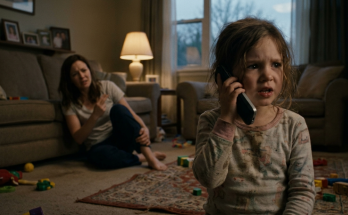
The call came at 9:17 on a Tuesday morning while I was standing barefoot in the marble kitchen of our Greenwich house, watching rain move down the windows in silver threads.
“Mrs. Pierce?” the teacher asked carefully. “This is Emily Calder from Whitestone Preparatory. I’m so sorry to bother you, but I wanted to confirm something about Noah’s courthouse field trip.”
My fingers tightened around my coffee cup.
“Noah’s what?”
There was a pause.
“The eighth-grade civics trip to the federal courthouse in New Haven. We received the permission form yesterday. It has your signature, but…” Her voice softened. “It didn’t look quite right.”
The world did that strange thing it does when betrayal walks into a room wearing perfume. It didn’t explode. It became quiet.
Too quiet.
“Can you scan it to me?” I asked.
“Of course.”
Three minutes later, the email arrived.
I opened it.
There it was.
My name.
Vivienne Pierce.
Only it leaned too hard to the right. The V was too wide. The final e had a ridiculous little curl, like a woman trying to make elegance happen by forcing it.
Under “Emergency Contact,” someone had written: Harper Lane.
Relationship to student: Family coordinator.
Family coordinator.
I stared at those two words until they blurred.
Then I called my husband.
Grayson answered on the fourth ring, his voice wrapped in boardroom impatience. “Vivienne, I’m walking into a meeting.”
“Why is Harper Lane listed on Noah’s school form?”
Silence.
Then a sigh.
Not guilt. Not panic.
Annoyance.
“She was helping.”
I almost laughed.
“She signed my name, Grayson.”
“She dropped the form off. You’ve been busy.”
“I never saw the form.”
“Don’t make this dramatic.”
That was the first mistake he made.
Calling a mother dramatic when another woman crosses a line around her child is like striking a match in a room full of gasoline and calling it candlelight.
I looked again at the scanned form.
The forged signature.
The unauthorized contact.
The custody agreement Grayson had forgotten existed because men like him never remember documents until they’re choking on them.
The case formed cleaner than anything I could have said.
So I said nothing.
I hung up.
Then I put on my pearls, opened the safe behind the wine wall, and pulled out the one envelope my husband never knew I had kept.
It was time to stop being a wife.
It was time to become evidence.
—
## Chapter 1: The Signature in Blue Ink
People always think revenge begins with screaming.
It doesn’t.
Not the kind that lasts. Not the kind that ruins men who believe money makes them untouchable.
Real revenge begins with a quiet inbox, a saved PDF, and a woman who has finally learned not to warn people before she walks away.
I printed the permission slip on thick ivory paper because I wanted to see the lie in daylight.
It looked even worse in my hand.
Harper had used blue ink, probably because she thought that made it feel authentic. She had written my name with the confidence of a woman who had been allowed to sit at my dinner table too many times. A woman who had mistaken access for authority.
Harper Lane was twenty-nine, blond in the polished, expensive way that came with extensions and Pilates and a dermatologist who never asked questions. She had started as a “brand consultant” for Grayson’s real estate firm, Pierce Atlantic, helping him make glass towers and luxury condos look warm on Instagram. Within six months, she was attending investor dinners. Within eight, she was photographed beside him at a charity polo match in Bridgehampton, wearing cream linen and my husband’s hand on the small of her back.
Grayson told me I was paranoid.
Then he told me she was useful.
Then he stopped explaining altogether.
That was the order of most betrayals. Denial. Justification. Disrespect.
By the time he let her sign my name, he had already stopped seeing me as a person. I had become a chair at the end of a table. A last name on invitations. The quiet mother of his son. The woman in pearls who knew where the caterer kept the emergency champagne and which donors had gluten allergies.
For twelve years, I had been Mrs. Grayson Pierce.
Before that, I had been Vivienne Hart.
My mother used to tell me never to let marriage swallow my maiden name.
“A name is not decoration,” she said. “It’s a key. Keep copies.”
My mother, Celeste Hart, built boutique hotels before women in luxury real estate were called visionaries. Back then, men called her difficult, cold, calculating. She smiled when they said it. Then she bought the buildings they were standing in.
She died when I was twenty-six, two years before I married Grayson. Cancer took her fast, but not before she organized her life with the precision of a woman who did not trust grief to manage paperwork.
She left me money.
She left me property.
And most importantly, she left me instructions.
Do not explain your strength to a man who benefits from your silence.
I didn’t understand it then.
I understood it now.
I placed the forged permission slip beside another document: a custody and conduct agreement Grayson and I had signed eighteen months earlier after his first public incident with Harper.
It was supposed to be temporary.
It was supposed to be private.
It was born from one brutal night at Le Cygne, a French restaurant in Manhattan where waiters moved like shadows and every table knew how to pretend not to listen.
I had arrived late from Noah’s winter concert, still carrying a folded program in my clutch. Grayson was already there, in a corner booth, with Harper beside him instead of across from him. Her knee touched his. His hand rested on the back of her seat.
When he saw me, he stood too quickly.
Harper smiled.
Not apologetically.
Possessively.
“Vivienne,” she said, as if we were old friends. “You look exhausted.”
I remember the waiter lowering his eyes.
I remember a woman at the next table pretending to fix her earring so she could hear better.
I remember Grayson saying, “Don’t start.”
Those two words, spoken in public, can turn a wife into a spectacle.
I did not start.
I placed Noah’s concert program on the table and said, “Your son asked why you didn’t come.”
Then I left.
The next morning, photos appeared online. Nothing explicit. Nothing Grayson couldn’t deny. But enough. Always enough.
My attorney at the time, Miriam Vale, drafted an agreement. Grayson signed it because a formal separation would have spooked investors during Pierce Atlantic’s largest funding round.
The agreement said we would remain in the same household temporarily for Noah’s stability.
It said neither parent could introduce a romantic partner as part of Noah’s care structure without written mutual consent.
It said only legal guardians could sign school, medical, travel, or custodial documents.
It said any unauthorized delegation of parental authority would be grounds for emergency custody review.
Grayson probably thought it was moral theater.
Men like Grayson sign agreements when they think the woman is too hurt to use them.
I scanned the forged slip again and saved it in three places.
Then I called Whitestone Preparatory.
“Ms. Calder,” I said when Noah’s teacher picked up, “did Harper Lane come to the school in person?”
Another pause.
“She came to the front office yesterday afternoon.”
“Was my husband with her?”
“No. But she said she was authorized.”
“Did she present identification?”
“Yes.”
“And the office allowed her to update emergency contact information?”
“I believe so. I’m sorry, Mrs. Pierce. I thought you knew.”
“I’m not upset with you,” I said, and I meant it. “I need copies of everything she submitted. The visitor log, the form, any emails, any notes from the office. Please preserve the camera footage from yesterday between two and four.”
The teacher went very quiet.
“Mrs. Pierce…”
“My attorney will send a formal preservation letter within the hour.”
I could hear her swallow.
“Of course.”
After I hung up, I stood at the kitchen island and looked around the room Grayson loved to show people.
The marble had been imported from Italy. The brass fixtures were unlacquered and perfect. There were white orchids on the counter, changed every Monday by a florist who had once asked me whether I wanted them arranged “softly or severely.”
I had said softly.
I was done with softly.
At noon, I drove into Manhattan.
Rain slicked the Merritt Parkway, turning brake lights into red ribbons. I did not cry. I did not rehearse what I would say to Grayson. I did not imagine Harper’s face when she realized the pretty little signature she had practiced had become a blade.
I parked beneath a limestone building on Madison Avenue and took the elevator to the thirty-first floor.
The plaque outside the office read:
VALE, STERLING & ROWE
Family Law. Trusts. Complex Assets.
Miriam Vale had retired six months earlier, but her son had taken over her private clients.
Alexander Vale was waiting when I stepped out of the elevator.
He was taller than I remembered, with dark hair threaded faintly with silver at the temples and the kind of face that looked carved rather than handsome. He wore a charcoal suit, no tie, and an expression that suggested he had never once confused volume with power.
“Vivienne,” he said.
“Alexander.”
His eyes moved over my face. Not pitying. Assessing.
That was why I had come.
I did not need comfort. I needed someone who could count.
He led me into his office. It faced Central Park, where the trees were bare and black against the rain. On the desk sat a legal pad, a fountain pen, and a single glass paperweight shaped like a wolf.
“Tell me,” he said.
I handed him the permission slip and the custody agreement.
He read both without interrupting.
The silence felt expensive.
When he finished, he placed the papers down with surgical care.
“This is clean,” he said.
“I thought so.”
“Cleaner than an affair. Cleaner than emotional cruelty. Cleaner than humiliation.”
“Yes.”
He looked up. “He let her impersonate you in a school record involving your minor child.”
“She also added herself as an emergency contact.”
His jaw tightened slightly.
“That was ambitious.”
“That was stupid.”
For the first time, Alexander almost smiled.
“Do you want custody leverage, divorce leverage, or structural destruction?”
It should have shocked me, hearing my options laid out like menu courses.
It didn’t.
“All three,” I said.
The rain struck the windows harder.
Alexander leaned back in his chair.
“Then we don’t begin with divorce. We begin with preservation. School records, visitor logs, video, email headers, phone records if we can get them. We notify the school. We notify Grayson’s counsel if he has one. We file for emergency temporary orders if necessary.”
“He’ll say it was a misunderstanding.”
“Of course.”
“He’ll say I’m jealous.”
“Let him.”
“He’ll say Harper was just helping.”
Alexander’s expression did not change.
“Then we’ll ask the court why his mistress was helping raise a child she had no legal relationship with.”
There it was.
The sentence that turned my humiliation into architecture.
I looked toward the park. Somewhere below, car horns cried like distant animals.
“There’s more,” I said.
Alexander waited.
I opened my bag and removed the envelope from my safe.
My mother’s envelope.
Inside were documents Grayson had never seen. Not because I hid them in a dishonest way, but because he had never cared enough to ask what existed outside the version of me he controlled.
There were trust papers.
LLC filings.
A lease assignment.
Board voting agreements.
Alexander read the first page.
Then the second.
By the third, he looked up slowly.
“Does Grayson know?”
“No.”
“That you control Juniper Holdings?”
“No.”
“That Juniper owns the building Pierce Atlantic uses as its headquarters?”
“No.”
“That his flagship Manhattan office has been paying rent to your trust for seven years?”
“No.”
Alexander was silent for the first time for longer than three seconds.
Then he said, “Your mother was extraordinary.”
“Yes.”
“And your husband is an idiot.”
That made me laugh.
It was small. Quiet. Almost rusty.
But it was the first laugh I’d allowed myself in months.
“Grayson thinks my mother’s assets were sold during probate,” I said. “I let him think that. I used the income to fund Noah’s education trust, my own investments, and the Hart Foundation.”
“Does he have any claim?”
“No. Premarital. Separate trust. Clean records.”
“Did any marital money go into Juniper?”
“Not one dollar.”
Alexander turned another page. “Pierce Atlantic’s lease renewal comes due in six weeks.”
“Yes.”
“And there’s a morality and legal compliance clause.”
“Yes.”
His eyes lifted to mine.
“Vivienne.”
I knew what he was seeing now.
Not just a wife with a forged school form.
A woman whose husband’s empire stood on floors she owned.
“They humiliated me in restaurants,” I said. “At galas. On social media. In front of women who touched my arm and called me graceful because graceful was the word they used when they meant abandoned.”
Alexander’s face softened, but his voice stayed steady.
“What do you want?”
I thought of Noah.
Not Grayson. Not Harper. Noah.
Thirteen years old. Smart, gentle, too observant. He still left drawings on my desk, though now they were architectural sketches instead of dinosaurs. He had my mother’s eyes and his father’s talent for walking into a room like he belonged there.
I wanted him protected from being used as a prop in adult ugliness.
I wanted him to know that silence was not weakness.
I wanted him never to confuse wealth with worth.
“I want custody,” I said. “I want my son’s life stable. I want my name back. I want Pierce Atlantic out of my building if Grayson thinks my signature is public property. And I want Harper Lane to understand that there are lines you cross at your own funeral.”
Alexander nodded.
“We’ll do it lawfully.”
“Always.”
“Quietly.”
“Until it’s time not to.”
That almost-smile again.
“Your mother really did train you.”
No, I thought.
Grayson did.
Pain is a finishing school no one applies to.
But if you survive it, you graduate fluent in power.
—
## Chapter 2: The Woman at My Table
Grayson came home at 10:42 that night smelling like rain, whiskey, and another woman’s expensive vanilla perfume.
I was in the dining room, not because I was waiting for him, but because I wanted him to find me where he had erased me most often.
The Pierce dining room seated twenty-four. The table was black walnut, polished so deeply that candlelight looked trapped inside it. Above it hung a chandelier made of hand-blown glass drops, each one shaped like frozen tears.
Grayson used to love telling guests it had been commissioned in Prague.
He never mentioned I paid for it.
He paused in the doorway when he saw me.
I wore a black silk dress, my hair pulled back, my mother’s pearl earrings at my ears. In front of me sat one glass of water, untouched.
“Noah asleep?” he asked.
“At Oliver’s house for the night. Remember? Study group.”
He loosened his tie. “Right.”
He did not remember.
A father can love his child and still outsource the details of him to the woman he underestimates.
Grayson crossed to the sideboard and poured bourbon into a crystal glass.
“We need to talk about what happened today,” he said, in the voice he used during negotiations.
I looked at him.
He was still beautiful. That was one of the cruelties of it. Betrayal does not always ruin the face. Sometimes it sharpens it.
Grayson Pierce had dark blond hair, winter-gray eyes, and the kind of smile that made older women forgive him before he apologized. In photographs, he looked like American success had been carved into human form: tailored suit, strong jaw, wedding ring gleaming just enough.
He had once looked at me like I was the room.
Now he looked at me like I was furniture blocking a view.
“Yes,” I said. “We do.”
He took a drink.
“Harper shouldn’t have signed your name.”
The sentence was correct, but the tone was wrong.
Not remorse.
Management.
“No,” I said. “She shouldn’t have.”
“She was trying to help. The form was due, Noah wanted to go, you weren’t answering texts—”
“You didn’t text me.”
His mouth tightened.
“I asked Rebecca to.”
Rebecca was his executive assistant.
My husband had tried to reach the mother of his child through his assistant.
I smiled faintly.
That made him nervous.
“Vivienne.”
“Did you authorize Harper to sign?”
He looked away for half a second.
There are answers in small movements if you’ve been lied to long enough.
“She was in the car with me,” he said. “I told her to drop it off.”
“Did you tell her to sign my name?”
“It wasn’t like that.”
“It was exactly like that.”
He set down his glass too hard. “You’re making this into a criminal trial.”
“Did you know she added herself as Noah’s emergency contact?”
That landed.
Not because he cared about the boundary.
Because he hadn’t known Harper had been bold enough to leave tracks.
“She did what?”
I tilted my head.
“You didn’t know?”
He recovered quickly. “I’m sure she thought it made sense. I travel. You have foundation events. Someone reliable—”
“Someone sleeping with my husband.”
His eyes flashed.
“Lower your voice.”
I laughed then.
Not loudly. Not wildly.
Just enough.
“There’s no one here to protect your reputation.”
He walked toward me, stopping at the end of the table.
“You want to do this? Fine. Yes, Harper and I are involved.”
It was strange, hearing the confession after the evidence had already killed the need for it.
I felt nothing for one heartbeat.
Then a dull ache, deep and old.
“Thank you for your honesty,” I said.
He blinked.
He had expected tears. Accusations. Maybe a thrown glass.
He had not expected manners.
“I didn’t plan it,” he said.
“Nobody ever does, according to them.”
“It got complicated.”
“No, Grayson. International tax structures are complicated. Neurosurgery is complicated. Sleeping with a woman who wants my chair is simple.”
His jaw worked.
“You’ve been unhappy too.”
There it was.
The shared blame portion of the performance.
I folded my hands in my lap.
“I was lonely. That is different from disloyal.”
His face hardened. “I’m not going to be punished forever because you decided to become cold.”
I stood.
The chandelier light slid over the pearls at my ears.
“I didn’t become cold. I became observant.”
He looked at me for a long moment, and I saw it happen: the first flicker of uncertainty.
Good.
“Don’t threaten me, Vivienne.”
“I haven’t.”
“You called a lawyer.”
“I called a mother’s instinct and it answered with a bar license.”
He scoffed. “This is about money.”
“No. The money is about money. This is about Noah.”
His expression shifted again.
There are men who can betray a wife and still become offended when she mentions the child.
“Noah is fine.”
“Noah’s school thought your mistress had authority over him.”
“She made a mistake.”
“She committed forgery.”
“You’re not seriously going to use that word.”
I stepped away from the chair.
“I’m going to use accurate words from now on. They save time.”
Grayson stared at me, and for the first time in months, he looked less like a man in control and more like a man who had misplaced the script.
Then his phone lit up on the table.
HARPER.
I saw the name.
He saw me see it.
Neither of us moved.
The phone buzzed again.
HARPER.
I picked it up before he could.
“Don’t,” he warned.
I answered.
“Hello, Harper.”
Silence.
Then a breath.
“Vivienne?”
“You signed my name.”
Another pause.
When she spoke, her voice was soft and sweet, the kind of sweetness women use when they think witnesses are listening.
“I’m sorry if that upset you. Grayson said it was okay.”
“If?”
“I was just helping Noah.”
My fingers tightened around the phone.
“You don’t get to say my son’s name to polish your crime.”
Grayson reached for the phone. I stepped back.
Harper’s voice changed slightly. Less sugar. More steel.
“You know, Vivienne, at some point everyone has to accept reality. Grayson trusts me.”
There it was.
Not love.
Not apology.
Territory.
I looked at my husband while I answered her.
“Then you should have signed his name.”
I ended the call and placed the phone on the table.
Grayson’s face was pale with anger.
“You had no right.”
I smiled.
“Funny. That’s my line.”
He took two steps toward me. Not enough to frighten me. Just enough to remind me he was used to rooms bending around his mood.
“Careful,” he said.
I looked at the chandelier. The frozen tears. The long table. The chair at the far end where I had hosted investors’ wives, museum trustees, senators, men with mistresses, women with secrets, people who thought money made cruelty tasteful.
Then I looked back at him.
“No,” I said. “You be careful.”
I left him standing there.
Upstairs, I entered my dressing room and locked the door.
It was larger than my first apartment, all mirrored panels and custom lighting. On one wall hung gowns arranged by color: black, ivory, silver, burgundy. On another, handbags sat behind glass like museum artifacts. Grayson loved this room because he thought it proved what he had given me.
He never understood that every woman with a cage eventually learns the price of the bars.
I changed into cashmere pajamas, washed my face, and sat at my vanity.
Then I opened my laptop.
Alexander had already sent the first preservation letter to the school. Another went to Grayson’s office. A third went to Harper directly.
By midnight, we had confirmation from Whitestone that the visitor logs were preserved, the camera footage locked, and the original document secured.
At 12:14, Harper posted an Instagram story.
A black screen.
White text.
Some women are addicted to control because they know they’re no longer loved.
She didn’t name me.
She didn’t need to.
By 12:30, three society accounts had reposted it.
By morning, the rumor had dressed itself in diamonds and walked across Manhattan.
Poor Vivienne Pierce. Still pretending. Still clinging. Still bitter.
At 8:00 a.m., I walked Noah into Whitestone myself.
He was quiet beside me, his backpack over one shoulder, his hair still damp from his shower.
“Mom,” he said as we approached the entrance.
“Yes?”
“Is Dad mad at you?”
My heart broke in the cleanest way.
Not shattered. Cut.
I stopped walking and turned to him.
“Noah, adults sometimes make mistakes and then get angry when there are consequences. That isn’t your fault.”
He looked down.
“Was Harper supposed to sign that thing?”
“No.”
His mouth pressed into a line.
“I thought it was weird.”
“What did you think was weird?”
“She texted me from Dad’s phone and said she’d take care of school stuff now.”
The air left my body.
“She texted you?”
He nodded.
“When?”
“Monday. I didn’t answer.”
“Do you still have it?”
He pulled out his phone and showed me.
There it was.
From Grayson’s number.
Harper here. Your dad asked me to help keep things organized. You can send school forms to me too. Think of me as bonus support 🙂
Bonus support.
I took a screenshot with hands so steady they frightened me.
Noah watched me.
“Mom?”
I crouched slightly, even though he was getting too tall for it.
“Thank you for showing me. You did nothing wrong.”
“Are you and Dad getting divorced?”
Children do not ask questions they don’t already feel the answers to.
I touched his cheek.
“I don’t know exactly what happens next. But I promise you this: you are loved, you are safe, and nobody gets to make you choose between adults.”
His eyes filled, but he blinked hard.
He was trying to be brave for me.
I hated Grayson for that more than the affair.
The mistress could have the man.
But she had reached for my child’s daily life like it was a spare key.
That was when something inside me closed forever.
Not slammed.
Closed.
Softly.
Finally.
After drop-off, I sat in my car and forwarded the screenshot to Alexander.
His reply came one minute later.
Do not respond to anyone. This is now significantly stronger.
Then, another message.
Also: check whether Harper had access to any medical or travel forms.
I stared at the screen.
A cold thought moved through me.
Grayson had asked me three weeks earlier to sign an authorization for Noah’s passport renewal. I had been in Boston for a foundation board meeting. He said he would handle it.
I never saw the paperwork again.
I opened my email and searched: passport, authorization, minor consent.
Nothing.
Then I searched Harper.
Hundreds of results.
Event invites. Photos. Foundation gossip. A forwarded design deck.
And one message from Grayson’s assistant Rebecca.
Subject: Signature pages — urgent
Sent two weeks earlier.
Vivienne, Grayson asked me to resend these for your records. Thanks.
Attachment: PIERCE_FAMILY_TRAVEL_AUTH.pdf
I opened it.
My stomach went still.
There was my name again.
Signed.
Not by me.
This time, notarized.
The notary stamp was from a UPS store in Darien.
The document authorized Grayson Pierce to travel internationally with Noah Pierce for “family business and educational purposes” during the summer.
I had never signed it.
I had never stood before that notary.
And at the bottom of the scanned PDF, just above the notary block, someone had initialed V.P.
The initials were wrong.
The V had Harper’s ridiculous curl.
I sent it to Alexander.
He called immediately.
“Vivienne,” he said. “Are you alone?”
“Yes.”
“Do not go home yet.”
“Why?”
“Because this is no longer a school boundary issue. This may be a pattern.”
I looked through the windshield at mothers in leggings carrying coffee, fathers kissing children goodbye, the ordinary morning continuing like the ground beneath me had not opened.
Alexander continued, voice controlled.
“I’m filing today.”
“For custody?”
“For custody. For exclusive authority over school and travel decisions. For surrender of Noah’s passport. And for an order prohibiting Harper Lane from contact.”
My reflection stared back from the dark screen.
Calm hair. Pale face. Pearl earrings.
A woman becoming dangerous by becoming precise.
“Do it,” I said.
Then I drove to my mother’s old hotel.
The Hartwell stood on the Upper East Side, discreet and cream-colored, with brass doors that shone even in bad weather. It was not the tallest or flashiest hotel in New York. It didn’t need to be. It was where ambassadors stayed when they wanted privacy, where actresses hid after divorces, where billionaires met people they did not want photographed with.
My mother built it when everyone told her boutique luxury was a fragile market.
Twenty years later, it was booked six months out.
I entered through the side door.
The staff still called me Miss Hart when no guests were around.
In the private elevator, I finally let myself breathe.
On the top floor was a suite my mother had never rented. Her office remained there, preserved not as a shrine but as a command center: lacquered desk, wall of books, cream sofa, terrace overlooking the city.
Alexander was already waiting inside.
Not alone.
Beside him sat a woman in her sixties wearing a navy suit and red lipstick. Her silver hair was cut bluntly at her jaw.
“Vivienne,” Alexander said. “This is Judge Elaine Porter. Retired. She consults on complex custody matters.”
Judge Porter stood and shook my hand.
“I’ve reviewed the documents,” she said. “Your husband is either reckless, arrogant, or both.”
“Both,” I said.
She nodded, accepting the diagnosis.
We spent the next three hours building a war out of paper.
The forged school slip.
The visitor log.
The teacher’s call.
Noah’s screenshot.
The travel authorization.
The custody agreement.
The prior public incident.
Harper’s social media post.
Grayson’s admission that Harper had signed because “she was helping.”
By the time we finished, the rain had stopped, and the city outside looked washed and merciless.
Judge Porter closed the folder.
“Mrs. Pierce, I need to ask you something directly. Is your husband a flight risk with the child?”
The words entered the room like a gun placed on a table.
“I don’t know,” I said honestly.
“Does he have international business?”
“Yes.”
“Private aircraft access?”
“Yes.”
“Property abroad?”
“Through affiliates.”
“Would he take Noah to pressure you financially?”
I thought of Grayson’s face in the dining room.
Careful.
I thought of Harper texting my son.
Bonus support.
“I didn’t believe that yesterday,” I said. “Today, I don’t know.”
Judge Porter looked at Alexander.
“That’s enough for emergency relief.”
A strange coldness slid through me.
Not fear.
Permission.
For years, I had minimized my own instincts because Grayson made suspicion sound ugly. Now a retired judge was looking at the same facts and calling them enough.
Enough.
That word can save a woman’s life.
At 4:30 p.m., Alexander filed.
At 5:02, Grayson called me fourteen times.
I did not answer.
At 5:19, Harper texted from an unknown number.
You’re embarrassing yourself.
I forwarded it to Alexander.
At 5:22, he replied.
Good. She’s awake.
I stared at those three words.
Then I laughed again.
This time, it sounded like my mother.
—
## Chapter 3: The Gala Where Nobody Clapped
The emergency hearing was scheduled for Friday morning.
Grayson learned that at the same time his attorneys did.
By Wednesday night, he had moved from anger to charm.
He sent flowers.
White roses.
My least favorite.
The card read:
Let’s not destroy our family over a misunderstanding.
No apology.
No mention of Noah.
No signature, because men like Grayson always assume their absence is recognizable.
I left the flowers in the foyer until they browned at the edges.
Then I had them delivered to Pierce Atlantic with a note:
For your misunderstanding.
By Thursday, the story had started leaking in pieces.
Not the legal documents. Those stayed sealed.
But society has its own bloodstream, and gossip travels through it faster than truth.
There was talk that Grayson and I were separating.
Talk that Harper had “overstepped.”
Talk that I had “lost it.”
Talk that I had hired a terrifying attorney.
Talk that the school was involved.
Talk that custody was involved.
The word custody changed the flavor of everything.
An affair is entertainment.
A child makes people choose their facial expressions carefully.
Friday morning, the judge granted temporary orders.
Noah’s passport had to be surrendered.
Harper Lane was barred from school pickup, school contact, medical contact, travel coordination, and direct communication with Noah.
Grayson was ordered not to delegate parental authority to any third party without written consent.
Decision-making over education and travel was temporarily assigned to me.
The judge did not yell. She did not perform outrage.
She simply read the documents, asked questions, and looked at Grayson over her glasses as if he were something unpleasant left on a white carpet.
“Mr. Pierce,” she said, “do you understand that a romantic partner is not a legal parent?”
Grayson’s attorney, a silver-haired man named Charles Vick, shifted in his seat.
Grayson’s face reddened.
“Yes, Your Honor.”
“And do you understand that signing another person’s name to a school permission slip is not a casual favor?”
“Yes, Your Honor.”
“And do you understand that this court is particularly concerned by the travel authorization?”
Grayson leaned toward the microphone.
“I did not intend—”
“That was not my question.”
The courtroom went silent.
I sat beside Alexander, hands folded, spine straight.
Harper was not there. Of course not. Women like Harper enjoy public proximity to power, not public accountability for it.
When the hearing ended, Grayson caught me in the hallway.
“Vivienne.”
Alexander stepped slightly closer, not blocking him, just reminding him that I was no longer alone.
Grayson looked exhausted. For the first time in years, his suit seemed to wear him.
“Can we speak privately?”
“No.”
His eyes flicked to Alexander.
“This is between my wife and me.”
I answered before Alexander could.
“You made it between your mistress, my son’s school, a notary, and a judge.”
Pain flashed across Grayson’s face. Not remorse, exactly. Something nearer to fear wearing a remorseful mask.
“I never meant to hurt Noah.”
“But you were comfortable hurting me.”
He swallowed.
“That isn’t fair.”
“No. It’s precise.”
He lowered his voice.
“Harper pushed too hard. I see that now.”
I almost pitied him then.
Almost.
Not because he had lost me. He did not yet understand that.
Because he thought sacrificing Harper would save him.
“You don’t get credit for noticing the knife after there’s blood on the floor,” I said.
Then I walked away.
That night was the Hart Foundation Winter Gala.
Everyone expected me to cancel.
That was why I didn’t.
The gala took place in the ballroom of The Hartwell, beneath a ceiling painted with silver constellations. My mother had commissioned it from an artist in Brooklyn after being told “stars were too whimsical for serious luxury.”
She replied, “Only men with no imagination say that.”
By seven o’clock, the ballroom shimmered with black tuxedos, velvet gowns, diamonds, candlelight, and the low, predatory murmur of wealthy people trying not to look hungry for scandal.
I arrived in midnight blue.
Not black.
Black would have been too obvious.
The gown was silk velvet, long-sleeved, cut close to the body, with a low back and a collar of tiny sapphires sewn by hand. My hair was swept up. My makeup was quiet. My wedding ring was not on my finger.
The room noticed.
Rooms like that always notice the smallest absence.
Alexander met me near the entrance. He wore a black tuxedo and looked so composed it almost annoyed me.
“You’re sure?” he asked.
“No.”
“That’s not an answer.”
“It’s the honest one.”
His eyes warmed.
“Then I’ll stay close.”
“People will talk.”
“People were born talking. Let them age into irrelevance.”
That was the first time I truly smiled at him.
It changed something in his face.
For one dangerous second, the ballroom blurred, and it was just the two of us standing under my mother’s artificial stars, both old enough to know better and wounded enough to understand silence.
Then a photographer called my name.
“Mrs. Pierce!”
I turned.
Flash.
Smile.
Chin lifted.
Alive.
The first hour passed like a staged battle.
Women touched my arm and told me I looked beautiful with eyes that asked for blood.
Men who had once ignored me suddenly wanted to discuss my foundation’s education initiatives.
Trustees praised my “strength,” which is the word people use when your suffering has become socially useful.
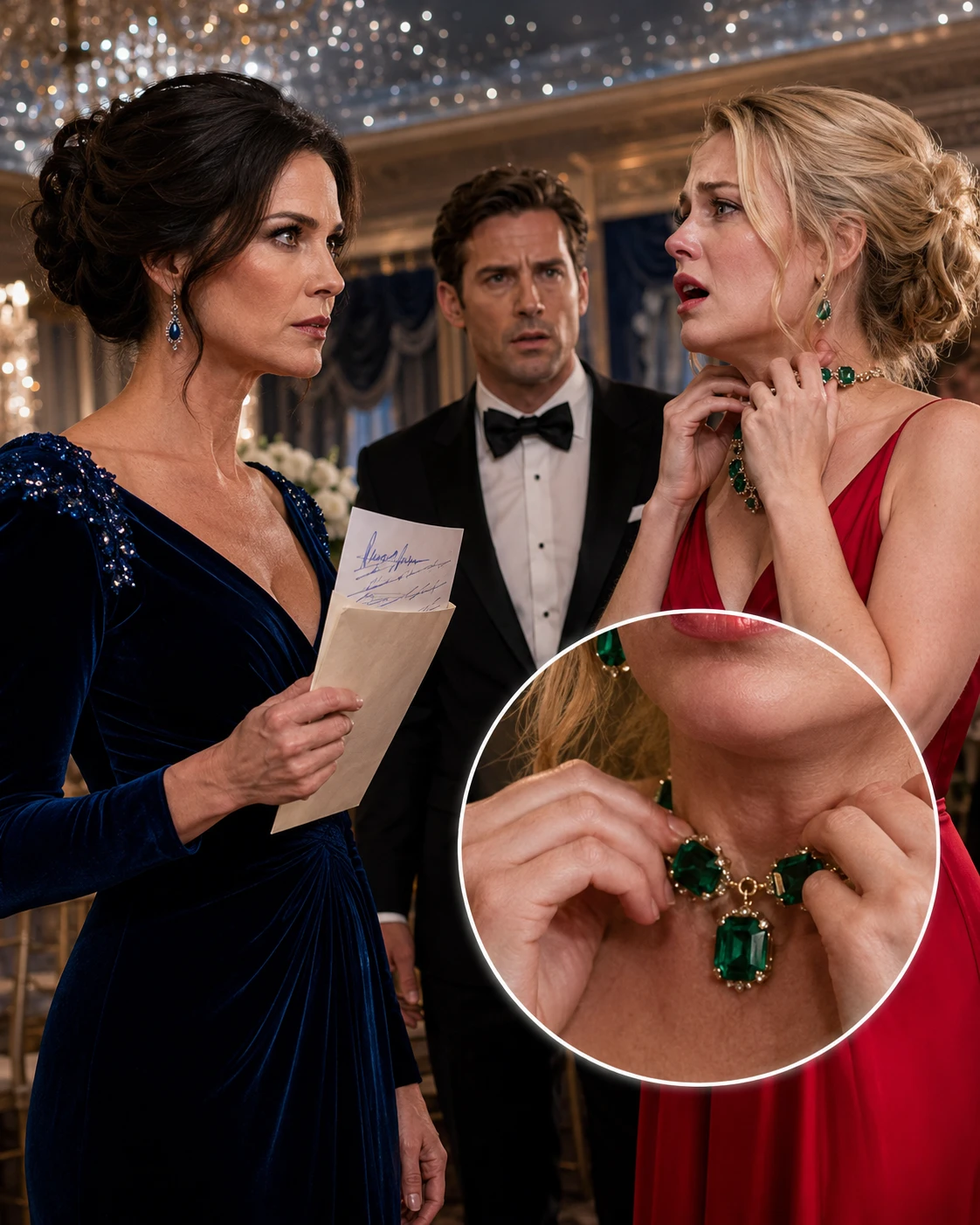
Then, at 8:23, Grayson arrived with Harper Lane.
The room inhaled.
He had made a choice.
A stupid one.
A spectacularly stupid one.
Harper wore red.
Of course she did.
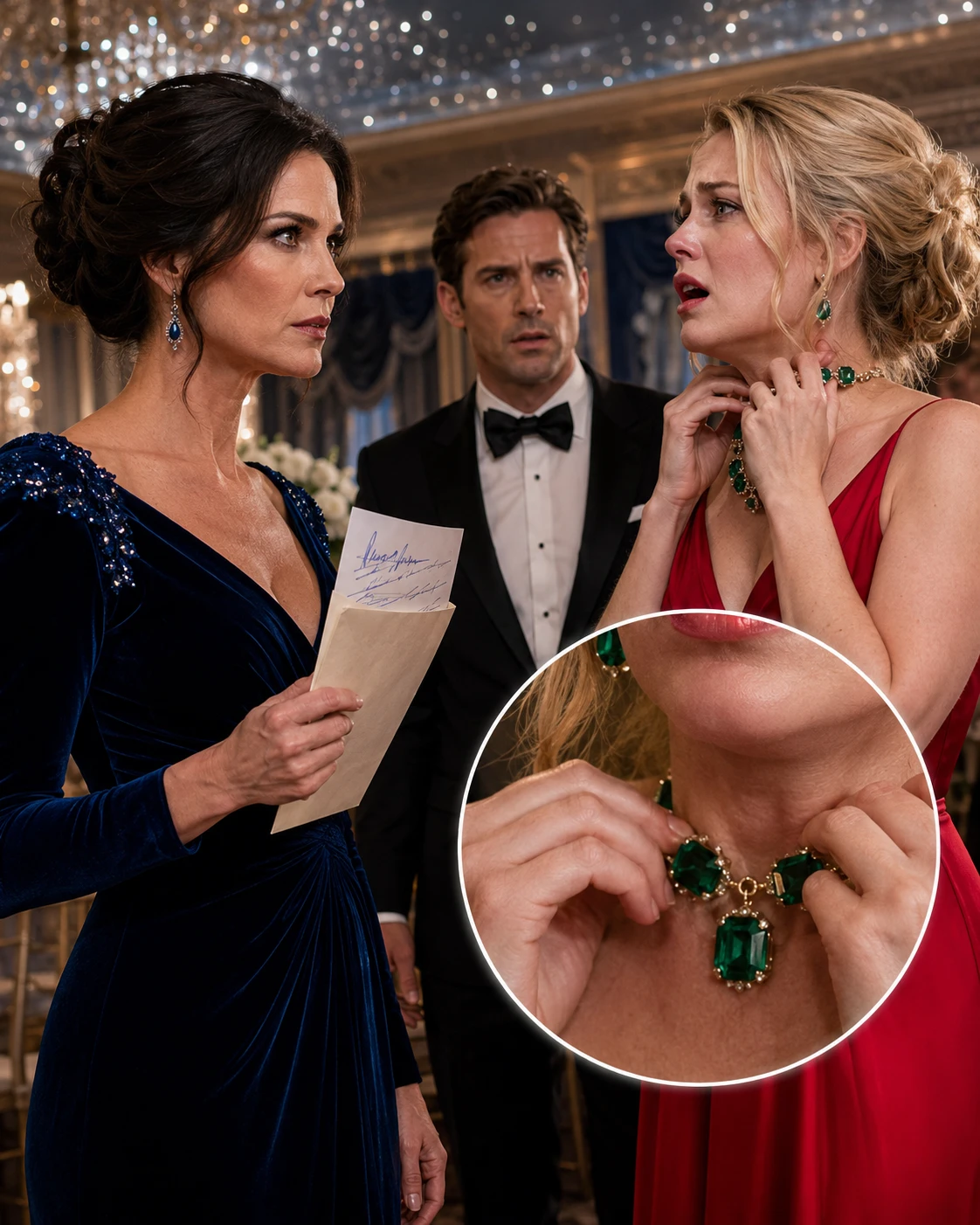
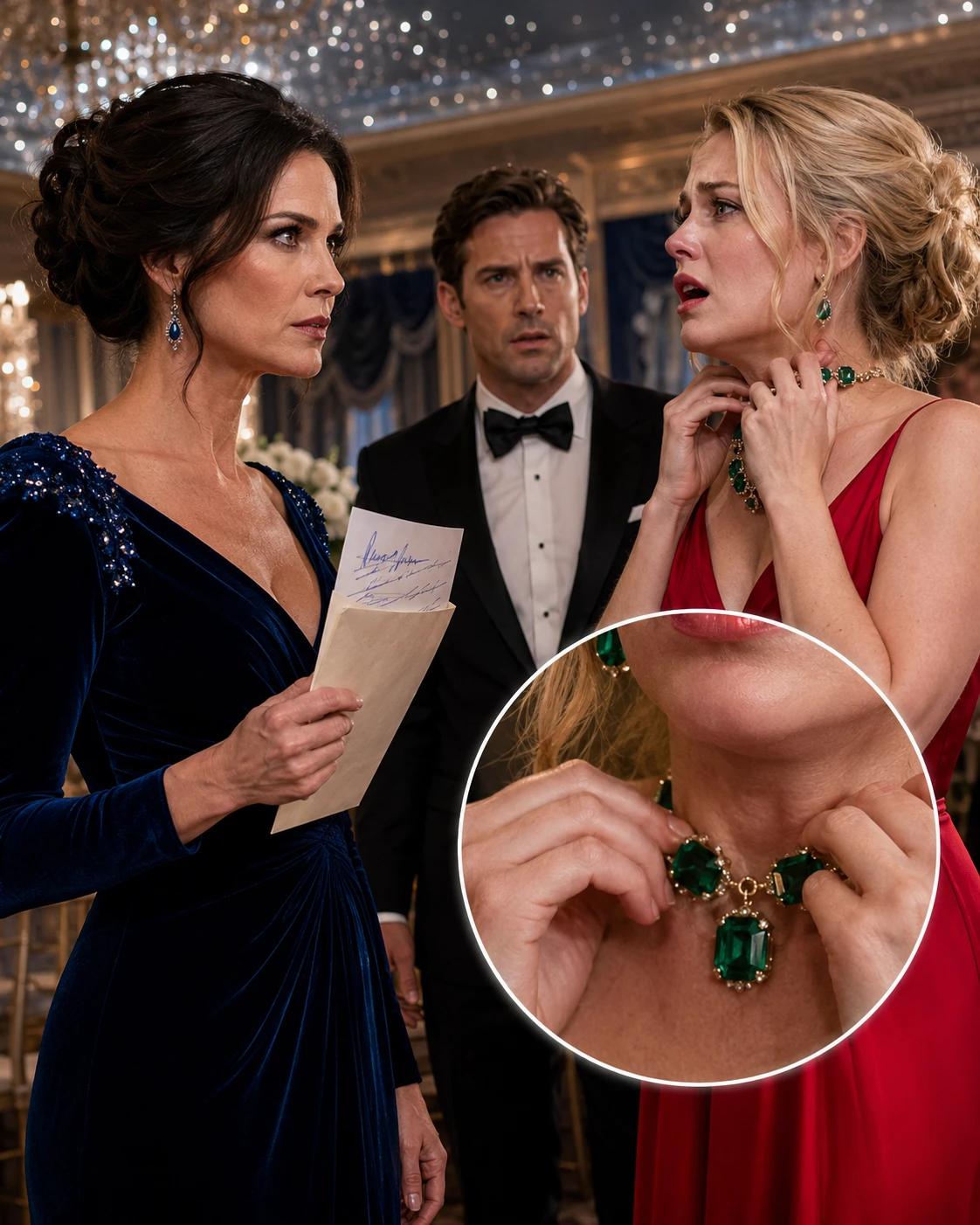
Not deep wine. Not elegant garnet. Bright, theatrical, camera-hungry red. Her hair fell in glossy waves over one shoulder. At her throat glittered an emerald necklace I recognized immediately.
My necklace.
No.
Not mine.
My mother’s.
For a moment, sound disappeared.
The ballroom kept moving, but I could not hear it. I saw only the necklace: Colombian emeralds, old mine diamonds, platinum setting. My mother had worn it the night The Hartwell opened. She had let me touch it once when I was ten, guiding my fingers over the stones.
“Jewels are not magic,” she had told me. “But they remember who survived.”
I had not seen that necklace in three years.
It was supposed to be in the vault.
Harper smiled across the room.
She lifted her champagne flute.
A toast.
To me.
Alexander’s voice came low beside me.
“Vivienne.”
I did not move.
“Is that yours?”
“My mother’s.”
His expression changed, very slightly.
If Grayson had watched him, he might have understood danger.
But Grayson was too busy playing emperor.
He crossed the ballroom with Harper at his side, accepting greetings, daring people to react. Some looked away. Some smiled too brightly. A few watched me, waiting for the crack.
I gave them none.
Grayson stopped in front of me.
“Vivienne,” he said.
“Grayson.”
Harper’s smile widened.
“Your gown is stunning.”
“So is my necklace.”
Her fingers went to the emeralds.
“Oh.” She glanced at Grayson with rehearsed innocence. “He said it was from a family vault.”
“It is.”
I let the pause sharpen.
“My family.”
The people nearest us went still.
Grayson’s face tightened.
“Vivienne, not here.”
I looked around the ballroom.
“The necklace is here.”
Harper’s cheeks flushed under her makeup.
“I had no idea.”
That might have been true.
It didn’t matter.
Ignorance is not innocence when you enjoy the benefits too much to ask questions.
Grayson stepped closer.
“It was a loan. Don’t be petty.”
A loan.
My mother’s necklace on his mistress’s throat.
At my foundation gala.
In my hotel.
After a court hearing about forged signatures involving my child.
And he called me petty.
Something inside me became so calm that the room seemed to brighten.
I turned to a passing waiter.
“Daniel, would you please ask security to join us?”
The waiter froze.
He had worked for my mother.
He did not ask why.
“Yes, Miss Hart.”
Grayson’s eyes narrowed.
“What are you doing?”
“Recovering property.”
Harper laughed nervously. “You can’t be serious.”
I looked at her.
“Harper, you signed my name on a school document. Don’t test how serious I can become in public.”
The nearby silence expanded.
Phones stayed down because the people in that room were too rich to record openly, but every eye recorded enough.
Security arrived in less than a minute. Two men in black suits, discreet earpieces, no visible emotion.
“Miss Hart?” one asked.
I nodded toward the necklace.
“That emerald necklace is Hart family property. It was removed without authorization from a private vault. Please escort Ms. Lane to the office so we can resolve the matter before I decide whether to involve the police tonight.”
Harper’s face drained.
Grayson stepped in front of her.
“This is insane.”
Alexander moved beside me.
“Mr. Pierce,” he said evenly, “I’d advise you not to interfere.”
Grayson looked at him with open hatred.
“You’re enjoying this.”
Alexander did not blink.
“Not as much as the court transcript.”
That sentence landed like crystal breaking.
A murmur passed through the group.
Harper’s hand trembled at her throat.
“I’m not going anywhere,” she said.
I stepped closer.
The emeralds caught the candlelight between us.
“Then take it off here.”
Her mouth opened.
Closed.
Grayson looked around. He finally understood the trap he had built himself. If he defended her, he looked guilty. If he let her remove it, he admitted she had worn what was not hers.
He whispered, “Harper.”
She turned on him.
“You told me it was fine.”
“I said—”
“You said she wouldn’t make a scene.”
Ah.
There it was.
Not a misunderstanding.
A calculation.
I looked at Grayson.
“You brought her here wearing my mother’s necklace because you thought I was too well-bred to object.”
He said nothing.
I smiled softly.
“You always confused manners with permission.”
Harper unclasped the necklace.
Her fingers fumbled. One of the security guards held out a velvet tray from the service station. The emeralds fell onto it with a sound so small and final it made several women flinch.
I picked up the necklace.
It was warm from her skin.
That was the worst part.
I wrapped it in a linen napkin and handed it to Alexander.
“Please document chain of possession.”
He nodded.
Harper’s eyes filled with angry tears.
“You’re cruel.”
I looked at her for a long time.
“No,” I said. “I’m finished being convenient.”
She left the ballroom with security. Not dragged. Not touched. Just escorted through a side door while every powerful woman in the room watched and quietly recalculated what they thought they knew about me.
Grayson stayed.
That surprised me.
Pride is a terrible survival instinct.
“You’ve made your point,” he said under his breath.
I leaned closer.
“No. I’ve introduced it.”
Then I walked to the stage.
The gala chair saw me coming and panicked beautifully.
“Vivienne, are you sure you want to speak now?”
“Yes.”
The orchestra softened.
A spotlight found me.
Three hundred guests turned toward the stage.
I stood beneath the silver constellations my mother had insisted on and looked at the room that had spent years mistaking my composure for surrender.
“Good evening,” I said.
My voice did not shake.
“Thank you for joining us tonight to support the Hart Foundation’s work in education access, student safety, and legal advocacy for families.”
I let the words student safety settle.
Grayson stood near the bar, white-faced.
Alexander watched from the edge of the stage, holding the linen-wrapped necklace like evidence at a coronation.
“My mother believed institutions reveal their true values in the paperwork no one thinks important,” I continued. “Permission slips. Consent forms. Emergency contacts. Custody orders. Signatures.”
Now the room was utterly still.
“She taught me that a signature is more than ink. It is identity. It is authority. It is a boundary.”
I saw two women exchange glances.
Good.
“Tonight, the foundation will be expanding our legal aid program for parents navigating school safety violations, custody coercion, and identity misuse in family systems.”
That announcement had not existed twelve hours earlier.
Alexander and I drafted it in his car after the hearing.
The board approved it in seven minutes because half of them had daughters and the other half had secrets.
“We will fund emergency consultations, document preservation support, and school policy training across Connecticut and New York.”
Applause began softly.
Then grew.
Not wild.
Respectful.
Serious.
Real.
I looked once at Grayson.
He looked as if he had walked into a room expecting to humiliate his wife and discovered she had changed the locks on the entire city.
I finished with my mother’s favorite line.
“Elegance is not silence. Elegance is knowing exactly when to speak.”
The applause rose.
This time, nobody looked away.
After the speech, Alexander found me near the terrace doors.
“You turned a personal injury into a public initiative,” he said.
“I learned from the best.”
“Your mother?”
“Yes.”
“And the worst?”
I looked across the room at Grayson.
“Yes.”
Alexander handed me the necklace, now sealed in a clear evidence bag with a signed note from security.
It should have looked absurd, my mother’s emeralds in plastic.
Instead, it looked honest.
“I’m sorry,” he said.
That nearly undid me.
Not the apology itself.
The fact that it came from someone who had not caused the wound.
I looked down quickly.
“I’m fine.”
“No, you’re functioning.”
I hated how accurately he said it.
Outside, snow had begun to fall over Madison Avenue, fine and pale as ash.
Alexander opened the terrace door, and we stepped into the cold.
The city glittered below us.
For a while, neither of us spoke.
Then he said, “There’s something else.”
I turned.
“We pulled the notary record.”
“And?”
“The notary says you appeared in person.”
“I didn’t.”
“I know.”
He reached into his jacket and handed me a printed image.
Security footage from the UPS store.
A woman at the counter.
Blond hair.
Oversized sunglasses.
Signing a document.
Harper.
Next to her stood Grayson.
Watching.
My breath left in a thin white cloud.
I had known.
But knowing and seeing are different knives.
“He watched her forge my name,” I said.
“Yes.”
Snow landed on my eyelashes.
For one second, grief rose so fast I thought I might bend under it.
Alexander stepped closer, but he did not touch me.
That mattered.
Men had been touching things that belonged to me without permission for too long.
“I loved him,” I said, ashamed of how small my voice sounded.
“I know.”
“I built a family with him.”
“Yes.”
“He brought her into the shape of my life and let her pretend she could fill it.”
Alexander’s voice was quiet.
“She couldn’t.”
I looked at him then.
The ballroom light behind him drew a gold edge around his face. He was not smiling. Not trying to rescue me. Not asking for anything.
Just standing there in the cold with the truth.
And for the first time in years, I felt something besides rage and strategy.
I felt seen.
That frightened me more than revenge.
Inside the ballroom, music swelled.
Outside, Manhattan froze itself into diamonds.
I wiped one tear before it fell.
“File everything,” I said.
Alexander nodded.
“Everything.”
—
## Chapter 4: The Empire Built on My Floor
Divorce papers were served to Grayson at 8:05 Monday morning in the lobby of Pierce Atlantic.
I know because the process server was a former Marine with excellent posture, and the lobby cameras belonged to my building.
I watched the footage from The Hartwell office with a cup of black coffee and no remorse.
Grayson entered through the revolving doors in a navy overcoat, phone to his ear, Rebecca trailing behind him with a tablet. The lobby was all limestone, black steel, living moss walls, and a twenty-foot digital display showing Pierce Atlantic’s latest development: a glass residential tower in Miami called Solara.
A tower marketed around sunlight by a man who kept his family in the dark.
The process server stepped forward.
“Grayson Pierce?”
Grayson barely looked at him. “Yes?”
“You’ve been served.”
The envelope touched his hand.
For half a second, Grayson did not understand.
Then he did.
His face changed.
It is a rare privilege to watch arrogance meet paperwork.
I took a sip of coffee.
Alexander sat across from me, reading emails on his phone. He had removed his jacket and rolled up his sleeves, revealing forearms that looked entirely too competent.
I tried not to notice.
I failed.
“Enjoying yourself?” he asked without looking up.
“Legally.”
“Good distinction.”
On screen, Grayson looked around the lobby, furious that strangers had seen anything happen to him.
He barked something at Rebecca and stormed toward the elevators.
Alexander’s phone buzzed.
“His lawyer wants a call.”
“No.”
“I wasn’t asking.”
I smiled into my coffee.
The divorce filing included adultery where relevant, but adultery was not the blade. The blade was custody, forgery, unauthorized school contact, the travel authorization, and financial discovery.
Especially financial discovery.
For years, Grayson had told the world he built Pierce Atlantic from nothing.
That was almost true if you considered my trust seed capital “nothing.”
Early in our marriage, I had invested indirectly in his first development fund through a Hart family vehicle. I did it because I believed in him. Because he was brilliant then. Hungry. Charming. Full of ideas about converting neglected industrial properties into beautiful spaces.
My lawyers structured the investment as separate property.
Grayson knew about that initial investment. What he didn’t know was that when he later overleveraged the company, my mother’s old holding company quietly purchased the debt at a discount through Juniper Holdings.
Not to trap him.
To save him.
He never asked who had rescued his first major project from foreclosure.
He assumed luck favored men like him.
Luck had my mother’s signature.
Over time, Juniper acquired more: the headquarters building, a minority stake through preferred units, and certain consent rights activated by legal misconduct that threatened the company.
Grayson built his empire.
I owned the ground under it.
Literally in Manhattan.
Contractually in Delaware.
Spiritually in every way that mattered.
Two days after he was served, Pierce Atlantic’s board requested an emergency meeting.
Not because of the affair.
Boards tolerate affairs.
Not because of the custody dispute.
Boards ignore families unless families affect stock prices.
They requested the meeting because Alexander sent a confidential notice to the company’s general counsel that Grayson Pierce may have participated in the forgery of a notarized travel document involving a minor child, and that such conduct could trigger compliance concerns under the company’s financing agreements.
Banks do not care who you sleep with.
They care whether your signature can be trusted.
By Thursday, Grayson was unraveling.
He called from unknown numbers.
He sent emails with subject lines like URGENT FAMILY MATTER and YOU’RE GOING TOO FAR.
He appeared at The Hartwell once and was turned away by security.
He sent Noah a message saying, I’m sorry your mother is making this hard.
Noah showed me immediately.
I forwarded it to Alexander.
The court did not enjoy it.
By Friday, Grayson’s temporary parenting time was ordered supervised until further hearing.
That was the first consequence he truly felt.
Not losing me.
Not losing face.
Losing unsupervised access to the son whose routines he had treated as admin work.
He sent one text after the order came down.
You’re destroying me.
I looked at those words for a long time.
Then I typed:
No, Grayson. I’m documenting you.
I did not send it.
Never interrupt a man while he is donating evidence.
Harper went quiet for five days.
No posts. No stories. No glossy quotes about control.
Then she made the mistake of appearing on a podcast.
The episode was called Modern Love, Old Money, and the Truth About Being the Other Woman.
She did not use my name.
She did not use Grayson’s.
But she used enough.
She spoke about “loving a man trapped in a dead marriage.”
She spoke about “a wife weaponizing motherhood.”
She spoke about “being punished for caring about a child.”
She cried at minute thirty-two.
The clip went viral by dinner.
Not because people loved Harper.
Because people love a woman confessing badly.
In the clip, she said, “Sometimes you step in because the actual mother is too obsessed with appearances to handle the daily things.”
The comments were not kind.
One woman wrote: Girl, you signed a permission slip, not the Declaration of Independence.
Another wrote: “Actual mother” was where you lost custody of the audience.
Another wrote: The mistress crossed school lines. The wife brought the court lines.
I stared at that one.
Then I screenshotted it and sent it to Alexander.
He replied:
Accurate.
The internet, for all its cruelty, occasionally develops a moral compass when a child is involved.
By the next morning, Harper had deleted the podcast clip.
Too late.
Nothing online dies once enough women recognize the villain.
The phrase court lines spread first on Facebook, then Reels, then TikTok edits made by women who had never met me but knew exactly what it felt like to be called dramatic by someone benefiting from your silence.
I did not comment.
I did not need to.
My silence had finally become more expensive than their noise.
But luxury revenge is not loud.
It is scheduled.
On the following Monday, I dressed for the Pierce Atlantic board meeting in winter white.
A cashmere coat.
Ivory silk blouse.
Wide-leg trousers.
My mother’s emerald necklace at my throat.
No wedding ring.
Alexander accompanied me, along with Juniper Holdings’ corporate counsel, a brilliant woman named Dana Cho who had once made a venture capitalist apologize in three languages during the same negotiation.
The meeting was held in Pierce Atlantic’s own boardroom, forty-two floors above Manhattan.
My building.
Their table.
My floor.
Grayson was already there when we arrived.
So were seven board members, the general counsel, Charles Vick, and two representatives from the lead lender.
Grayson stood when I entered.
Not out of respect.
Shock.
“Vivienne,” he said. “What the hell is this?”
I glanced at the board.
“Good morning.”
Dana placed folders at each seat.
Alexander pulled out my chair.
I sat.
The room adjusted itself around me.
Grayson remained standing.
“This is a company meeting,” he said.
“Yes,” I replied. “That’s why I’m here.”
Board member Evelyn Strauss, an older woman with silver hair and a voice like chilled gin, opened her folder.
“Perhaps we should begin.”
Grayson looked at her. “Evelyn, you can’t be serious.”
“I’m extremely serious,” she said.
Dana stood.
“Juniper Holdings is present today pursuant to its rights under the preferred unit agreement and related financing documents. As you’ll see in section two of your packets, certain compliance provisions have been triggered by credible allegations involving document falsification, unauthorized use of signature authority, and court orders affecting Mr. Pierce’s legal standing.”
Grayson laughed once.
It sounded wrong.
“This is absurd. My divorce has nothing to do with Pierce Atlantic.”
Dana turned a page.
“Your alleged participation in notarized forgery may have direct bearing on representations made to lenders and counterparties regarding ethical conduct, legal compliance, and signatory reliability.”
One of the lender representatives avoided Grayson’s eyes.
That was when he began to understand.
He looked at me.
“What is Juniper Holdings to you?”
I said nothing.
Dana answered.
“Juniper Holdings is controlled by the Hart Family Trust.”
The boardroom went silent.
Grayson stared.
“The Hart Family Trust,” Dana continued, “is controlled by Vivienne Hart Pierce.”
There it was.
Hart.
Not Pierce.
The name entered the room like a queen returning from exile.
Grayson sat down slowly.
“You,” he said.
I looked at him.
“All these years?”
“All these years.”
“You hid this from me.”
“No, Grayson. You never looked at anything you didn’t think you owned.”
His face twisted.
“This company exists because of me.”
“This company survived because of my mother.”
Evelyn Strauss cleared her throat.
“Let’s stay on agenda.”
I almost smiled.
Women like Evelyn understood vengeance best when filed under agenda items.
The meeting lasted three hours.
It was not dramatic in the way movies understand drama. There were no shattered glasses, no shouted confessions, no security dragging a billionaire into an elevator.
It was worse.
For Grayson.
It was calm.
Dana walked the board through Juniper’s rights.
Alexander summarized the court orders without violating sealed custody details.
The general counsel confirmed reputational risk.
The lender representatives expressed concern about pending investigations.
Evelyn proposed a resolution placing Grayson on administrative leave pending review.
Grayson objected.
Charles Vick objected more elegantly.
The resolution passed.
Five to two.
Grayson Pierce, founder and CEO of Pierce Atlantic, was removed from operational control of his own company at 1:37 p.m.
He did not look at the board.
He looked at me.
“You planned this.”
“No,” I said. “You caused this. I prepared for it.”
His eyes were bloodshot.
“Was any of it real?”
The question should have belonged to me.
It was almost funny, hearing him steal even that.
“Yes,” I said. “That was the tragedy.”
For a second, something human crossed his face.
A memory, maybe.
The two of us in our first apartment, eating takeout on the floor because we couldn’t afford furniture we liked. Grayson carrying newborn Noah down the hospital hallway like he had been handed the moon. Me standing beside him at his first ribbon-cutting, proud enough to forget I had helped buy the scissors.
Yes, it had been real.
That is what makes betrayal so vulgar.
It ruins the past retroactively.
After the meeting, Grayson followed me into the hallway.
Alexander moved with me, but I lifted one hand slightly.
He stopped.
Grayson and I stood beside a wall of glass, Manhattan behind us like a witness.
“You win,” he said bitterly.
I looked at him.
“You still think this is a game.”
“What do you want from me?”
“The truth.”
“I loved you.”
“Not enough to protect me from your appetite.”
He flinched.
“I made mistakes.”
“You built a second life and let it touch our son.”
He looked away.
“She wanted to matter.”
I laughed softly.
“And you let her practice on my name.”
His eyes closed.
For one second, he looked exhausted enough to be honest.
“She thought if she handled Noah’s forms, it would make things easier when…”
“When what?”
He didn’t answer.
“When you replaced me?” I asked.
His silence was enough.
There are humiliations so complete they become clean.
I nodded.
“You were auditioning her for my life.”
“It wasn’t like that.”
“It was exactly like that. But she failed the signature portion.”
His mouth trembled between rage and shame.
“You’re enjoying destroying me.”
“No. I’m enjoying no longer protecting you from yourself.”
The elevator doors opened.
I stepped inside.
Alexander joined me.
Just before the doors closed, Grayson said, “He’s not innocent either.”
The doors paused.
Alexander’s jaw tightened.
I looked at Grayson.
“What does that mean?”
Grayson’s smile was small and ugly.
“Ask your perfect lawyer why my wife was always so easy for him to answer.”
The elevator doors closed before I could respond.
For the first time in days, uncertainty entered me.
Not about Grayson.
About Alexander.
He stood beside me, silent.
The elevator descended.
“Vivienne,” he said finally.
I kept my eyes on the numbers.
“Is there something I need to know?”
“Yes.”
The word was too honest.
My stomach tightened.
We reached the lobby, but neither of us moved when the doors opened. People flowed around us like water.
Alexander pressed the button to close the doors again.
Then he hit the button for the parking level.
The elevator began to descend beneath the city.
“I should have told you earlier,” he said.
“That is never a good opening.”
“No.”
He looked at me then.
“My mother represented yours for years. You know that.”
“Yes.”
“After your mother died, there was a sealed memorandum in her estate file. Miriam kept it because Celeste instructed her to.”
“My mother left me many sealed things.”
“This one involved Grayson.”
The elevator felt suddenly too small.
“What about him?”
Alexander exhaled.
“Before you married him, your mother investigated Pierce Atlantic’s early financing. She found irregularities. Nothing criminal she could prove then, but enough to worry her. She believed Grayson was willing to use other people’s money recklessly if it served his ambition.”
My throat tightened.
“Why didn’t she tell me?”
“She tried.”
I remembered then.
A month before my wedding, my mother and I argued in her office. She told me Grayson was charming, but charm was not character. I accused her of hating any man who wanted to stand beside me. She went very quiet.
Then she hugged me and said, “I hope I’m wrong.”
I had forgotten.
No.
I had buried it.
Alexander continued.
“She created additional protections in the trust. Juniper’s rights. Separate property walls. Consent triggers. The headquarters acquisition. She didn’t want to control your marriage. She wanted to give you exits you might not know you needed.”
The elevator reached the garage.
The doors opened to concrete, black cars, fluorescent light.
I stepped out because standing still hurt.
Alexander followed at a distance.
“Why did Grayson say you weren’t innocent?”
“Because I knew more than I said on the first day.”
I turned.
His face was pale under the garage lights.
“How much more?”
“When you brought the documents, I recognized Juniper immediately. I knew what it could do.”
“You didn’t tell me.”
“I did. Not all at once.”
“Why?”
“Because you came to me with a forged school slip and a custody emergency. You were bleeding. I wasn’t going to put your mother’s entire contingency plan on top of that before we protected Noah.”
“That sounds noble.”
“It was partly noble.”
“And the other part?”
He held my gaze.
“I have cared about you for a very long time.”
The words did not enter dramatically.
They entered quietly and rearranged everything.
I laughed once, not because it was funny, but because it was too much.
“Alexander.”
“I know.”
“You were my lawyer.”
“I am your lawyer. That’s why I have said nothing and will continue to say nothing unless you choose otherwise. My personal feelings have no place in your case.”
“Then why tell me now?”
“Because Grayson tried to make it look like I was manipulating you. I won’t let your trust in your own choices be poisoned by his implication.”
I looked away.
A black town car idled nearby. Somewhere above us, Manhattan continued buying, selling, cheating, forgiving the wrong people.
“How long?” I asked.
He did not pretend not to understand.
“Since your mother’s funeral.”
My chest tightened.
That day returned in fragments: rain on black umbrellas, lilies, my father already gone years before, Grayson holding my hand while checking his phone between condolences, Miriam Vale standing near the back, and beside her, Alexander, younger, solemn, watching me with an expression I had not known how to read.
“You never said anything.”
“You were engaged.”
“Then married.”
“Yes.”
“And now?”
“Now you are in pain, in litigation, and under more pressure than most people survive gracefully. So now I still say nothing beyond the truth you asked for.”
It would have been easier if he had been opportunistic.
Cruelty is simple to reject.
Integrity is much more dangerous.
I crossed my arms against the cold of the garage.
“I can’t carry this too.”
“I’m not asking you to.”
“Good.”
“Good.”
We stood there, two adults surrounded by concrete and consequences.
Finally, I said, “Do I need different counsel?”
His face changed, but only for a second.
“If you feel my judgment is compromised, yes. I’ll transition everything immediately.”
“Is your judgment compromised?”
“No.”
“Are you sure?”
“Yes.”
“Because you care about me?”
“Because I respect you.”
That answer did more damage than any confession.
I nodded slowly.
“Then remain my attorney.”
“Vivienne—”
“But no more omissions.”
“None.”
“And no more looking at me like that in ballrooms.”
For the first time all day, his mouth curved slightly.
“How was I looking at you?”
“Like you understood the ending before I did.”
His smile faded.
“No. I was hoping you’d survive the middle.”
I looked at him for a long moment.
Then I walked to the car.
Behind me, the city kept humming.
Ahead of me, the war widened.
—
## Chapter 5: The Last Document
The final twist did not arrive like thunder.
It arrived in a banker’s box.
Brown cardboard. White label. Black marker.
HARTWELL ARCHIVE — CELESTE PRIVATE — OPEN UPON TRIGGER EVENT.
The trigger event, according to my mother’s estate instructions, was “any legal proceeding involving Vivienne Hart Pierce, Grayson Pierce, custody of a minor child, or fraud affecting Hart-controlled assets.”
My mother had been dead for eleven years and still had better timing than most living executives.
The box was delivered to Alexander’s office by bonded courier on a Wednesday afternoon.
We opened it together.
Inside were files arranged with Celeste Hart’s ruthless elegance.
Tabs.
Dates.
Indexes.
A flash drive in a velvet pouch because my mother believed even evidence deserved presentation.
The first folder contained background reports on Grayson’s earliest investors.
The second contained copies of emails between Grayson and a former partner.
The third contained a letter addressed to me.
I did not touch it at first.
Alexander noticed.
“You don’t have to read it now.”
“Yes,” I said. “I do.”
The envelope was cream-colored, my name written in my mother’s hand.
Vivienne.
Not Viv.
Not darling.
Vivienne.
I opened it.
My beloved girl,
If you are reading this, then I failed to prevent a wound, but I may still help you survive it.
You were always drawn to brilliance. I understand why. Your father had it. I had it. You have it, though you learned to hide yours when others found it inconvenient.
Grayson Pierce is brilliant. He is also hungry in a way that frightened me. Hunger can build, but it can also devour.
I have no right to choose your life. I do have the right to leave you doors.
If he loves you well, you may never need this. Burn it and laugh at your suspicious mother.
If he harms you, especially through your child, do not waste time asking why. Ask what proof exists. Then use it.
Remember this: a woman is not cruel because she stops feeding the mouth that bit her.
I love you beyond language.
Mom
I read it once.
Then again.
Then I folded it carefully.
I did not cry.
Some tears are too old to fall immediately.
Alexander said nothing, which was the kindest thing.
The flash drive contained what my mother had hinted at but never proved before her death: Grayson’s original business partner, Daniel Cross, had been pushed out of Pierce Atlantic through manipulated valuations and concealed financing commitments.
Not illegal enough then.
But ugly.
Very ugly.
More importantly, the files showed that Grayson had used Hart-associated credibility to secure investor confidence while privately minimizing my family’s role. He had not stolen from my trust. My mother had prevented that.
But he had lied about the source of his stability for years.
The final folder was different.
It was labeled: H. LANE.
My skin chilled.
Alexander saw it at the same time.
He opened it.
Inside was a private investigator’s report from eighteen months earlier, commissioned not by my mother, of course, but by Miriam Vale after the Le Cygne incident, under authority I had signed and forgotten in the storm of humiliation.
Harper Lane was not her original name.
She had been born Harper Delaney in Columbus, Ohio.
No crime in changing a name.
No shame in becoming someone new.
But Harper had worked before as an executive lifestyle consultant to wealthy men during divorce transitions.
Three men.
Three marriages.
In each case, she became involved before separation was filed.
In each case, she inserted herself into domestic routines: calendars, school pickups, home vendors, travel planning.
In two cases, settlements became uglier after she encouraged the men to pursue aggressive custody leverage.
In one case, a wife accused Harper of signing her initials on a nanny tax document.
No charges.
No proof.
Just smoke.
My forged school slip was the fire.
Alexander read silently.
“She has a pattern,” he said.
“Yes.”
“This changes settlement posture.”
“No,” I said. “It changes the ending.”
Because by then Grayson was trying to settle.
He wanted confidentiality.
He wanted shared legal custody.
He wanted no admission of wrongdoing.
He wanted Harper kept out of formal findings.
He wanted to retain his equity.
He wanted me to agree not to interfere with Pierce Atlantic.
He wanted the world to believe our marriage had ended sadly, tastefully, mutually.
Men love mutual endings after unilateral betrayals.
I refused.
Not everything.
I was not reckless.
Alexander and Dana negotiated like surgeons. I asked for what protected Noah and secured clean separation. I did not ask for revenge in the divorce decree because revenge is rarely enforceable.
Instead, I asked for structure.
Sole legal custody for school, medical, and travel decisions.
Grayson could have parenting time, gradually unsupervised, only after compliance and therapy.
Harper barred from contact with Noah until court-approved review, which I knew she would never survive gracefully.
No confidentiality around school safety or forgery issues.
Full preservation of records.
A financial settlement honoring the prenup and separate property.
Grayson’s equity subject to company governance review.
The Hart Foundation expansion funded by a donation from Pierce Atlantic’s board, not Grayson personally, because I wanted the institution to correct the harm it had enabled.
And the necklace returned permanently to a Hart family trust.
Grayson fought for two weeks.
Then the district attorney’s office requested documents related to the notarized travel authorization.
He became reasonable overnight.
The final settlement conference took place in Stamford on a gray morning that smelled like snow.
I wore charcoal wool.
No pearls.
No emeralds.
Just a watch my mother had given me when I turned twenty-one and said, “Never let a man waste your time for free.”
Grayson sat across the conference table with Charles Vick.
He looked thinner. Less golden. His beard had grown in at the jaw, making him look less like a CEO and more like a man who had slept badly in expensive sheets.
Harper was not there.
Rumor said they were “taking space.”
Rumor also said she had been seen crying in a private dining room at Casa Luca while Grayson ignored her calls.
Rumor, for once, showed imagination.
The settlement terms were read.
Page after page.
Custody.
Property.
Conduct.
Compliance.
Foundation funding.
Non-disparagement limited only to false statements.
Truth remained free.
When it came time to sign, Grayson stared at the pen.
I watched him.
There was no satisfaction in it exactly.
Not joy.
Joy is too soft a word for watching a man sign away the power he abused.
It was completion.
He picked up the pen.
Signed.
Grayson Pierce.
His real signature was elegant. Fast. Confident.
A signature that had opened bank accounts, closed deals, bought houses, approved towers, ordered champagne, sent flowers to the wrong woman.
Now it surrendered.
When he finished, Charles slid the pages to Alexander.
Alexander reviewed them, then passed them to me.
I signed my name.
Vivienne Hart Pierce.
For the last time.
My divorce petition included restoration of my legal name.
Hart.
The ink dried quickly.
Grayson watched.
“You’re really taking it back,” he said.
“My name?”
“Yes.”
“It was never gone.”
His face tightened.
“Does Noah hate me?”
There it was.
The first question that sounded like a father instead of a defendant.
I answered carefully.
“No. But he doesn’t trust you.”
Pain moved across his face.
Good, I thought.
Then immediately hated myself for thinking it.
Grief makes cruel little sparks even in decent hearts.
“How do I fix that?” he asked.
“You start by not asking me to solve the damage you caused.”
He nodded slowly.
“Does he know everything?”
“He knows enough. He knows adults made wrong choices. He knows he is not responsible. He knows he is loved.”
Grayson looked down.
“I did love you.”
I believed him.
That was the worst part.
“I know,” I said.
His eyes lifted.
“But you loved being wanted more.”
He had no answer.
The conference ended.
Outside the room, Alexander walked beside me down the courthouse hallway.
“You’re free,” he said quietly.
The word should have made me feel light.
Instead, I felt the weight of what freedom had cost.
“No,” I said. “I’m legally reorganized.”
He laughed softly.
It warmed the hallway.
Then my phone buzzed.
A message from an unknown number.
A photo.
Harper.
Wearing sunglasses, seated in what looked like an airport lounge.
Text below:
You think you won because he signed? Ask him about Solara.
I stopped walking.
Alexander saw my face.
“What?”
I showed him.
His expression changed.
Solara was Pierce Atlantic’s Miami tower.
The sunlight project.
The one on every lobby screen.
The one Grayson hoped would restore confidence.
The one tied to hundreds of millions in financing.
Alexander called Dana.
By evening, we knew.
Harper had not messaged me out of conscience.
She messaged me because Grayson had discarded her, and women who build themselves from proximity to power often mistake revenge for self-respect.
But even bad motives can deliver useful truth.
Solara’s land acquisition involved a side letter.
Not forged by Harper.
Not involving me.
Worse for Grayson.
The side letter showed undisclosed beneficial interests through an entity linked to a city official’s brother-in-law. Possible bribery. Possible lender fraud. Definitely board-level catastrophe.
Harper had found references while managing Grayson’s travel documents and “helping” with his files.
She had not understood all of it.
Dana did.
Within forty-eight hours, Pierce Atlantic’s board voted to remove Grayson permanently as CEO.
Within seventy-two, lenders froze additional draws pending investigation.
Within a week, Grayson’s face disappeared from the company website.
The press release used beautiful corporate language.
Transition.
Governance.
Independent review.
Strategic continuity.
Luxury has many ways to say collapse without wrinkling its suit.
Grayson called me once after the announcement.
I almost didn’t answer.
Then I did, because the war was over and curiosity is a small human weakness.
“Did you give them Solara?” he asked.
“No.”
“Harper did.”
Silence.
Then a bitter laugh.
“Of course she did.”
“You taught her signatures mattered. She learned documents did too.”
He breathed into the phone.
“Vivienne…”
“No.”
“I was going to say I’m sorry.”
“I know.”
“Does it matter?”
I looked across The Hartwell terrace, where snow rested on the iron railing and the city shone beyond it, indifferent and alive.
“Yes,” I said. “But not enough to change anything.”
He was quiet for a long time.
Finally, he said, “You sound like your mother.”
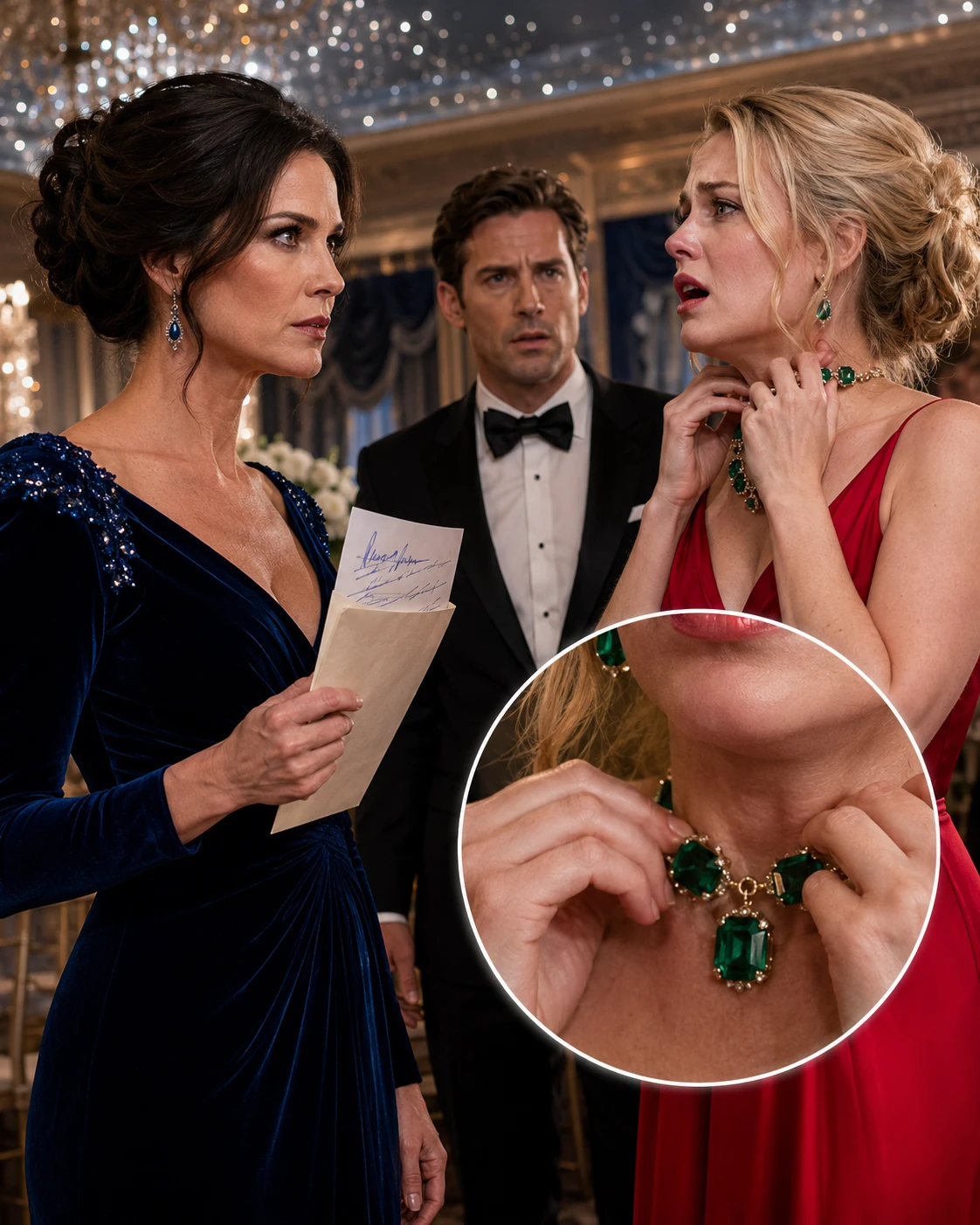
This time, I smiled.
“Thank you.”
I ended the call.
That should have been the final twist.
It wasn’t.
The final twist came three months later, on a spring afternoon when the pear trees along Park Avenue were blooming white and Noah had started laughing again without checking whether I was watching.
I was in my mother’s office at The Hartwell, reviewing foundation applications, when Alexander arrived with a flat archival box.
By then, he was no longer my divorce attorney.
The case was done.
My name was restored.
Custody orders were stable.
Grayson was attending therapy and showing up for supervised-to-unsupervised transitions with the humbled consistency of a man who had finally met consequences in a room where money couldn’t valet them.
Alexander had transferred my remaining corporate matters to Dana and stepped back exactly as ethics required.
For six weeks, he did not call unless necessary.
Then one evening, he sent a message:
When your life is not on fire, I’d like to take you to dinner.
I stared at it for ten minutes.
Then replied:
My life is still smoking.
He answered:
I know a restaurant with excellent ventilation.
I laughed so hard Noah shouted from the next room, “Mom, are you okay?”
I was not okay.
But I was becoming.
Our first dinner was not romantic in the cinematic sense. I cried over the bread. He pretended not to notice until I said, “You can notice.”
So he did.
Our second dinner was better.
By the fifth, I realized he never reached for my hand before I offered it.
That is how trust returned.
Not as a thunderbolt.
As manners.
As patience.
As a man walking on the street side without making a performance of protection.
As someone remembering I hated white roses and loved gardenias.
As someone asking about Noah without trying to become important to him.
As someone who looked at my scars like history, not damage.
That spring afternoon, he placed the archival box on my desk.
“What is it?” I asked.
“Something Miriam found while closing an old storage file.”
His mother had passed away quietly in February, leaving Alexander with grief he wore privately and work he completed because some people honor love through responsibility.
The box contained photographs from my mother’s hotel opening.
Black and white contact sheets.
My mother in a sharp white suit.
Me at sixteen, awkward and unsmiling in a satin dress.
Waiters carrying champagne.
Politicians pretending they had supported her early.
And one photo that stopped me.
My mother stood near the ballroom entrance, laughing.
Beside her was a younger Miriam Vale.
Behind them, slightly out of focus, stood Alexander at maybe twenty-three, home from law school, holding a tray of champagne flutes because apparently someone had mistaken him for staff.
And there I was in the corner of the frame, looking at the painted silver ceiling.
Not at him.
Not at anyone.
My mother had written on the back:
Vivienne under the stars. One day she will stop asking permission to shine.
My throat closed.
Alexander stood beside me, silent.
I touched the words.
“She knew me better than I knew myself.”
“She loved you better than anyone knew how to describe.”
I looked up.
His eyes were gentle.
Not hungry.
Not claiming victory after the ruins.
Just there.
“Alexander.”
“Yes?”
“I’m not ready to be someone’s great love story.”
He smiled faintly.
“Good. I’m not auditioning for a role. I’m asking whether I may sit beside you while you write the next chapters.”
The answer rose slowly.
Not from loneliness.
Not from fear.
Not from needing to be rescued.
From the quiet place where my real self had been waiting, patient and unimpressed by drama.
“Yes,” I said.
He did not kiss me then.
That came later, under the silver constellations in the Hartwell ballroom after a foundation event for school safety advocates. A soft kiss. A careful one. The kind that did not erase the past or promise impossible futures.
Just warmth.
Just beginning.
Just mine.
—
## Conclusion: The Warmth After the Fire
A year after Harper Lane signed my name, I stood in the Whitestone Preparatory auditorium while Noah received an award for his history project.
His project was about landmark custody cases and children’s rights.
When he first told me the topic, I asked if he was sure.
He shrugged in that teenage way that means everything matters too much to admit.
“People should know how stuff works,” he said.
Yes, I thought.
They should.
He stood onstage in a navy blazer, taller than I was now, his hair falling into his eyes. He spoke clearly. He thanked his teacher, Ms. Calder, for “paying attention to details other people might have ignored.”
Ms. Calder cried.
So did I.
Grayson sat three rows behind me.
Alone.
He came because Noah invited him.
He clapped because Noah deserved it.
Afterward, in the lobby, Grayson approached us carefully. He no longer entered rooms like he owned them. That was perhaps the most visible change.
“Noah,” he said. “You were great.”
Noah looked at him, cautious but not closed.
“Thanks, Dad.”
A small word.
A small bridge.
Sometimes that is all healing gives you at first.
Grayson looked at me.
“Vivienne.”
“Grayson.”
He nodded toward the auditorium. “You’ve done an incredible job.”
I could have said, I know.
I could have said, No thanks to you.
I could have said many true things that would have reopened wounds in front of our son.
Instead, I said, “He’s an incredible kid.”
Grayson’s eyes softened.
“Yes. He is.”
Then Noah asked if we could all get coffee because his friends were going to the café down the street, and for one surreal second we looked like a normal divorced family navigating a normal afternoon.
So we went.
Not together, exactly.
But not at war.
That mattered.
The café was noisy, warm, full of students and parents and the smell of cinnamon. Noah sat with his friends. Grayson ordered black coffee. I ordered tea.
Alexander arrived twenty minutes later with gardenias because he had come from a meeting and remembered I hated arriving anywhere empty-handed.
Grayson saw him.
The old version of my ex-husband would have stiffened, performed dominance, made some elegant insult.
The new version only looked at Alexander, then at me, and nodded.
“Vale.”
“Grayson.”
Peace is sometimes just two men not making a woman manage the temperature of a room.
Later, Noah walked home ahead of me, laughing with his friends, backpack bouncing against one shoulder.
I stood outside the café with Alexander, spring sunlight spilling across the sidewalk.
Across the street, a little girl dropped her mother’s hand to chase a white petal skittering along the curb. Her mother called her back gently. The girl returned, holding the petal like treasure.
I thought of names.
Signatures.
Boundaries.
Mothers.
Daughters.
Sons.
The documents nobody respects until they become the only thing standing between a child and chaos.
I thought of my mother’s letter.
Do not waste time asking why. Ask what proof exists. Then use it.
For a long time, I had believed love meant endurance.
Then I believed power meant leaving.
Now I understood something quieter.
Love means protection.
Power means choice.
And peace means waking up in a house where nobody is rewriting your life while you sleep.
The Greenwich mansion sold in June.
I did not keep the dining table.
I did not keep the chandelier shaped like frozen tears.
I kept my books, my mother’s necklace, Noah’s sketches, and one black walnut chair from the kitchen where he used to eat cereal at midnight during growth spurts.
Noah and I moved into a brownstone in Brooklyn Heights with tall windows, creaking floors, and a small garden where nothing matched and everything grew.
The first night there, we ate pizza on the floor.
Noah looked around and said, “It feels like ours.”
That was better than luxury.
That was home.
The Hart Foundation’s school safety program expanded across three states by the end of the year. We helped mothers and fathers who were not rich, not connected, not able to hire Alexander Vale or pull trust documents from hidden archives. We helped them preserve emails, challenge unauthorized pickups, understand custody orders, and teach schools that a child’s safety is not a paperwork inconvenience.
Ms. Calder joined our advisory board.
So did Judge Porter.
Evelyn Strauss donated enough money to fund a hotline for five years and told me, “I’ve been waiting forty years for women to stop whispering about signatures.”
Harper Lane disappeared from New York for a while.
Then she reappeared online under a new name, selling a course about feminine resilience.
I did not watch it.
Some women turn consequences into content because reflection does not photograph well.
Grayson eventually pleaded to a reduced charge related to the travel authorization. He paid fines, completed probation conditions, resigned from all executive roles, and began consulting quietly for smaller firms that did not put his face on billboards.
He became, to his credit, a better father in the slow and imperfect way people become better when the applause is gone.
Noah forgave him in pieces.
I did not interfere.
Forgiveness, like custody, cannot be delegated.
As for me, I learned to sleep through the night.
That sounds small unless you have ever lived beside someone who made peace feel unsafe.
I learned to drink coffee in the garden without checking my phone.
I learned that a house can be quiet without being lonely.
I learned that desire after betrayal is not foolish when it comes with respect.
Alexander and I took our time.
We still are.
There are no viral clips of that part.
No dramatic music.
No red dress.
No courtroom hallway.
Just him standing in my kitchen one rainy Sunday, teaching Noah how to make carbonara while my son pretended not to like him and then ate three bowls.
Just gardenias on ordinary Thursdays.
Just a hand at my back that waits for permission.
Just laughter returning to rooms that once held strategy.
Once, months after everything settled, Alexander asked me whether I regretted not exposing Grayson sooner.
We were on the terrace of The Hartwell, beneath the city lights, the emerald necklace resting against my throat.
I thought about the years I spent being graceful.
The dinners.
The rumors.
The public humiliations polished into private pain.
Then I thought about the teacher’s phone call, the scanned slip, the wrong little curl in the V.
“No,” I said. “I needed the right document.”
He smiled.
“And did you find it?”
I looked out at the city my mother had taught me to survive.
“Yes.”
Because sometimes the smallest paper holds the largest truth.
Sometimes the woman everyone pities is not weak.
Sometimes she is waiting for one clean signature to open every locked door.
My husband let his mistress sign my son’s school permission slip.
He thought it was a favor.
She thought it was a step into my life.
They both forgot that some lines are not emotional.
They are legal.
They are maternal.
They are carved so deep that crossing them does not start a fight.
It starts a record.
And when the record is clean, a woman does not need to scream.
She only needs to sign.
She signed my name. I signed his consequences.