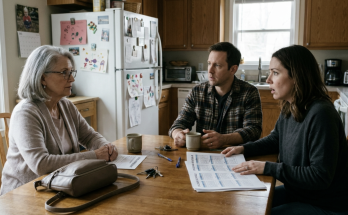
The wall clock above the mediator’s file cabinet clicked to exactly 9:00 a.m. when I signed my name.
The office smelled like burnt coffee, printer ink, and lemon cleaner, the kind people use when they want a sad room to feel professional.
I remember the sound of the pen more than anything.

It scratched once across the signature line, then twice, then it was done.
Ten years of marriage became one blue-ink name at the bottom of a county mediation packet.
I thought my hand would shake.
It did not.
My name is Sarah, and that morning I stopped being Bradley’s wife in any legal sense.
But long before that, I had stopped being treated like one.
I was Connor’s mother first.
I was Madison’s mother first.
Connor was ten and old enough to pretend he understood adult cruelty better than he did.
Madison was still small enough to ask if every airplane went somewhere happy.
That was the part Bradley never understood.
He thought he had only been careless with me.
He had been careless with all three of us.
The mediator was a soft-spoken woman with silver glasses and a stack of folders arranged so neatly they looked untouched by human trouble.
She slid the final page toward Bradley.
He did not even read it.
His phone rang before the ink on my signature had dried.
He looked at the screen, smiled, and answered in front of everyone.
“Yes, babe,” he said.
The word landed on the desk between us like something dirty.
He did not step into the hallway.
He did not lower his voice.
He sat back in that leather chair like I had already been erased.
“I’m just wrapping up here,” he said. “I’ll be right there. Mom and everyone are already at the clinic. Don’t stress. Today is important.”
The mediator’s eyes moved down to her paperwork.
Bradley’s sister Brittany sat in the corner with her purse clasped in both hands.
She wore the satisfied expression of a woman who believed she had helped clean up a family inconvenience.
I knew who was on the phone.
Tiffany.
The woman his family had already started treating like the real future.
The first time I heard her name, Bradley told me she was a client contact.
The second time, he said she was going through a hard season.
The third time, he told me I was paranoid.
People do that when they are trying to make you ashamed of noticing the truth.
They don’t deny the smoke.
They tell you your lungs are dramatic.
For years, Bradley had controlled the money by making every question sound like an accusation.
Why did Connor need camp?
Why did Madison need new shoes this month?
Why had groceries gotten so expensive?
Why did I always make everything harder?
Then I would open the refrigerator and stretch one dinner into two.
I would clip coupons in the pickup line.
I would tell Connor maybe next season for soccer.
I would tell Madison the old shoes still had a little life in them.
All while Bradley’s accounts moved money in places I had not yet learned how to see.
When he ended the call, he grabbed the pen and signed the papers with one fast motion.
“There’s nothing to divide anyway,” he said.
His voice was almost cheerful.
“The downtown penthouse is my premarital property. The SUV is mine. If she wants the kids, let her take them. Less hassle for me.”
The mediator looked up at that.
Brittany gave a small laugh.
“At least now everyone can move on,” she said. “Tiffany is giving this family a fresh start.”
A fresh start.
That was what they called it.
Not the late-night phone calls.
Not the money missing from accounts.
Not the way Bradley’s mother, Margaret, had stopped inviting me into conversations but somehow always knew Tiffany’s doctor appointments.
Not the birthday dinner where Margaret barely looked at Madison’s handmade card but asked Tiffany three times if she needed to sit down.
Not the years I spent trying to make myself smaller so the children would not feel the walls cracking around them.
A fresh start.
I opened my purse.
The leather felt cold under my fingers.
I took out the penthouse keys and placed them beside the paperwork.
Bradley smirked.
“Good,” he said. “You’re finally catching on to your place.”
I nodded once.
“I learned when to stop arguing.”
He liked that sentence because he thought it meant defeat.
It did not.
Then I reached back into my purse and pulled out two navy-blue passports.
Connor’s.
Madison’s.
Bradley’s smile faded for the first time that morning.
“What are those?” he asked.
“The visas were finalized last week,” I said. “The children and I are leaving today.”
Brittany straightened so quickly her purse slid off her lap.
“Leaving where?”
“London.”
The office went quiet.
Even the mediator stopped moving papers.
The wall clock kept ticking above the cabinet.
Bradley laughed once, but it sounded dry.
“Who’s paying for that?”
Before I could answer, a black Mercedes GLS pulled up outside the glass doors.
The driver stepped out, buttoned his jacket, and opened the rear door like the moment had been scheduled to the minute.
“Miss Sarah,” he said politely, “the car is ready.”
Bradley looked from the driver to me.
For one second, he saw a version of me he did not recognize.
Not pleading.
Not explaining.
Not waiting for permission.
I picked up Madison’s backpack.
I took Connor’s hand.
Then I looked at Bradley one last time inside that office that smelled like coffee and cleaner and endings.
“From this exact second forward,” I said, “the kids and I will never interfere with your new life.”
I walked out before he could turn my leaving into another argument.
In the car, Connor sat close enough that his shoulder pressed into my ribs.
Madison held her stuffed rabbit by one ear.
The driver pulled away from the curb and handed me a thick manila folder.
“Mr. Harrison asked me to pass this to you.”
Harrison was my attorney.
Bradley did not know about Harrison.
Bradley did not know about a lot of things.
I opened the folder on my lap.
Inside were bank records, wire transfer receipts, high-definition photographs from a luxury real estate brokerage, and a purchase agreement for a multi-million-dollar condo Bradley had somehow afforded while telling his family we needed to cut back.
The first transfer was timestamped 3:42 p.m. on a Tuesday.
The second transfer had a wire confirmation attached.
The third had been routed through an account Harrison’s office had flagged, copied, and cataloged before Bradley ever sat down in that mediator’s room.
There were photos, too.
Bradley and Tiffany stood side by side at a polished conference table, signing documents with the same confidence Bradley had worn while telling me there was nothing to divide.
He had lied with paperwork.
That is different from lying with words.
Words vanish if the right person denies them loudly enough.
Paper waits.
Paper remembers.
I turned one page and found the date of the purchase agreement.
It was the same week Bradley told Connor that soccer camp was too expensive.
It was the same month he told me to stop buying the good cereal.
It was the same afternoon Madison came home from school complaining that her shoes pinched and Bradley told her to wear thicker socks.
Connor looked at the folder.
“Mom,” he asked softly, “is Dad coming with us later?”
I closed the top page before he could see too much.
The morning traffic moved past the tinted window in slow silver lines.
“No, sweetheart,” I said. “Not today.”
Madison leaned forward.
“Does London have parks?”
“Yes,” I said. “Lots of them.”
“Can I bring my soccer ball?” Connor asked.
“Yes,” I told him. “That too.”
That was motherhood in the middle of collapse.
You answer the small questions because the big ones would break them.
Across town, Bradley’s family was gathering at the private clinic like they were attending a holiday brunch.
Margaret had brought a small blue blanket wrapped in tissue paper.
Brittany had brought an expensive gift box of premium juices.
Two aunts came too, because apparently Tiffany’s ultrasound had become a family event.
Tiffany sat in the VIP waiting room wearing an expensive maternity dress and a careful smile.
To them, she was the future.
To me, she was not the entire problem.
She was only the part Bradley allowed everyone to see.
At 9:47 a.m., my phone buzzed.
Harrison: The appointment started. They’re walking in now.
I read the message once.
Then I locked the screen.
I was not celebrating.
I was not trying to ruin anyone.
I was simply finished standing inside a life where people mistook silence for weakness.
At the airport, the fluorescent lights made everything too bright.
Madison complained that her backpack zipper was stuck.
Connor asked twice whether his soccer ball counted as carry-on.
I checked our bags.
I guided the children through security.
I bought two bottles of water, a pack of fruit snacks, and a paper cup of coffee I barely tasted.
The manila folder stayed zipped inside my tote under Madison’s stuffed rabbit and Connor’s hoodie.
Motherhood is strange like that.
Sometimes proof of betrayal sits right beside snacks.
While we waited at the gate, Madison put her head in my lap.
Connor watched planes through the window.
I looked at both of them and felt the first clean breath I had taken in years.
Not happiness.
Not yet.
Just space.
Space could become safety if I was careful with it.
Across town, Tiffany was called back for her ultrasound.
Only Bradley was allowed inside the room, but his family stayed close enough to hear every good word they expected.
Margaret kept smoothing the tissue around the blue blanket.
Brittany kept checking her phone.
The aunts whispered about names.
Inside the exam room, Tiffany climbed onto the paper-covered table.
Bradley stood beside her and held her hand like he was already posing for the life he thought he had won.
The doctor moved the wand and watched the monitor.
At first, no one said anything.
The machine hummed softly.
The room smelled faintly of disinfectant and warm plastic.
Bradley squeezed Tiffany’s hand.
“He’s developing well, right?” he asked.
The doctor did not answer right away.
Tiffany’s careful smile weakened.
“Doctor?” she said. “Is something wrong?”
He adjusted the screen.
He looked again.
Then he looked at the chart.
The doctor asked the nurse at the desk to call security and the clinic’s legal department.
Outside the room, Margaret stopped mid-sentence.
Brittany moved closer to the door.
The aunts went quiet.
Bradley’s voice changed.
“What the hell is going on?”
The doctor turned the monitor slightly.
He looked at the date on the chart.
Then he looked at Bradley in a way that made every person in that hallway go still.
Bradley stared at the screen like anger could make numbers rearrange themselves.
The doctor kept one hand on the ultrasound controls.
The other hand moved to the thin medical folder on the counter.
“Sir,” he said carefully, “I need everyone to remain calm.”
Bradley hated being managed.
He hated any room where he was not automatically believed.
“I asked you a question,” Bradley snapped.
Tiffany pulled the sheet higher across her knees.
Her face had gone pale beneath her makeup.
The nurse returned with the intake paperwork clipped to a folder.
It was not dramatic.
That was the worst part.
No thunder.
No shouting.
Just a page with dates and signatures and the kind of small printed line most people skim because they assume the truth will be kinder than math.
Tiffany saw where the doctor’s pen landed.
Her mouth opened.
No sound came out.
Bradley followed the pen.
Then his hand dropped from hers.
Outside the room, Margaret whispered, “Tiffany?”
Brittany covered her mouth with both hands.
The doctor lowered his voice.
“Mr. Bradley,” he said, “the dates on this chart create a serious discrepancy.”
Bradley blinked once.
Then twice.
“No,” he said.
The word came out too quickly.
Tiffany turned her face away.
The nurse looked down at the folder.
The clinic hallway held its breath.
Bradley pointed at the monitor.
“That’s my child.”
No one answered immediately.
That silence was answer enough.
At the airport gate, my phone buzzed again.
Harrison: The clinic called their legal department. He knows something is wrong.
I stared at the message until the letters blurred.
Madison was asleep against my leg.
Connor was still watching planes.
I did not smile.
I did not feel triumphant.
There is a kind of justice that does not feel like winning.
It feels like putting down something heavy and realizing your hands are shaking because you carried it too long.
I typed back one sentence.
Proceed exactly as planned.

Harrison replied with a thumbs-up, then a second message.
Financial petition is ready. Condo documents attached. Wire records indexed.
I closed my eyes.
The first time I met Bradley, he was charming in the easy way that makes warnings sound jealous.
He remembered my coffee order.
He opened doors.
He called my mother ma’am.
When Connor was born, he cried in the hospital room and promised he would never let us feel unsafe.
When Madison arrived, he held her like she was made of glass.
I believed him because I wanted to believe the man in front of me more than the small, early signs behind him.
The sigh when I spent money.
The joke that made me smaller in front of his friends.
The way every disagreement somehow became proof that I was ungrateful.
Trust does not usually break all at once.
It thins.
Then one day you look down and realize you have been standing on air.
At the clinic, Bradley demanded the doctor explain.
The doctor did not accuse anyone.
He did not need to.
He said the clinic had a duty to verify information when legal or medical records conflicted.
He said security had been called because the conversation was becoming heated.
He said any further discussion needed to happen with proper documentation.
Bradley turned on Tiffany.
“What did you do?”
Tiffany flinched as if the question had touched her skin.
Margaret stepped into the doorway, still holding the blue blanket.
It looked absurd in her hands now.
A celebration gift with nowhere to go.
“Bradley,” she said, but her voice had no authority left.
Brittany kept shaking her head.
She had laughed in the mediator’s office less than an hour earlier.
Now she looked like someone who had just realized cruelty can rebound.
Tiffany whispered, “I thought—”
Bradley cut her off.
“You thought what?”
The nurse stepped between them.
“Sir, you need to lower your voice.”
That sentence undid him more than the chart.
Men like Bradley can survive being wrong.
What they cannot survive is being corrected in public.
Security arrived at the hallway entrance.
Two men in dark jackets stood near the reception desk.
One did not speak.
The other asked Bradley to step out of the room.
He looked around and finally saw what I had learned years earlier.
A room can turn on you without raising its voice.
At the gate, boarding was announced.
Connor lifted his backpack.
Madison woke up confused and asked if it was time.
“Yes,” I said. “It’s time.”
I stood, adjusted Madison’s jacket, and took Connor’s passport from my tote.
The manila folder stayed underneath the hoodie.
The boarding agent smiled at the children.
Madison asked if the plane snacks were free.
Connor asked if London soccer was different.
I answered both because those were the questions children deserved to worry about.
Not wire transfers.
Not betrayal.
Not fathers who thought custody was a hassle until control was being taken away.
As we walked down the jet bridge, my phone buzzed once more.
Harrison: He has contacted me. I did not respond except through formal notice.
Then another message came in.
Harrison: His counsel will receive the financial disclosure demand today.
I looked back through the small jet bridge window at the airport lights.
For a moment, I saw the whole morning in pieces.
The pen on the mediator’s desk.
The passports in my purse.
Bradley’s smirk.
The folder in the car.
The clinic chart.
The children walking ahead of me with backpacks too big for their shoulders.
I thought about what I had told Bradley.
From this exact second forward, the kids and I will never interfere with your new life.
I meant it.
I was not going to interfere.
I was going to let the documents do what they were made to do.
Tell the truth.
By the time our plane pushed back from the gate, Bradley was no longer at the clinic.
Security had escorted him to the lobby after he shouted at Tiffany, at the doctor, and finally at his own mother.
Margaret left with the blue blanket still wrapped in tissue.
Brittany sat in her car for twenty minutes before driving away.
Tiffany stayed behind with the nurse and the clinic’s legal representative.
The future they had gathered to celebrate had turned into a hallway full of forms.
That would have been enough for most people.
It was not enough for Bradley.
By noon, he had called me eleven times.
I did not answer.
By 12:18 p.m., he texted.
Where are you?
At 12:21 p.m., he sent another.
You can’t just take my kids out of the country.
At 12:27 p.m., Harrison responded through the proper channel with the custody travel authorization Bradley had signed months earlier without reading.
That was the funny thing about men who sign papers carelessly.
They assume everyone else does too.
Bradley had signed the travel consent during one of his distracted evenings, waving me off because Tiffany was texting and he wanted dinner kept warm.
He had not asked about dates.
He had not asked about visas.
He had not asked because he believed the world would continue arranging itself around him.
At 12:43 p.m., Harrison sent his counsel the financial petition.
Attached were the wire transfer ledger, the brokerage photos, the purchase agreement, and the account records Bradley had sworn did not exist.
There was no dramatic speech attached.
Just documents.
Clean, indexed, dated documents.
The kind that do not care who smirks.
On the plane, Madison fell asleep before takeoff.
Connor kept his forehead against the window until the city slipped beneath clouds.
“Mom?” he said.
“Yes?”
“Are we going to be okay?”
I wanted to say yes immediately.
I wanted to wrap the word around him like a blanket.
Instead, I told him the truth a child could hold.
“We’re going to be safe,” I said. “And we’re going to figure out okay together.”
He nodded.
Then he reached across the armrest and held my hand.
His fingers were still small.
Not baby small anymore, but not grown either.
I thought about every time I had stayed quiet because I thought keeping the peace was the same as protecting them.
It was not.
Peace built on fear is not peace.
It is just a house where everyone learns to whisper.
Behind us, a flight attendant moved down the aisle with drinks.
Ahead of us, Madison’s stuffed rabbit slid half out of her backpack.
I tucked it back in.
Then I rested my head against the seat and let myself close my eyes.
I did not know what London would feel like.
I did not know how long the legal process would take.
I did not know what Tiffany would say, or what Bradley would deny, or how Margaret would rewrite the story by dinner.
But I knew the children were beside me.
I knew the passports were real.
I knew the folder existed.
And I knew the version of me Bradley had counted on was gone.
Weeks later, people would ask if I planned it to hurt him.
They always ask women that when a quiet exit works.
They mistake preparation for cruelty because they are more comfortable with women surviving messily than leaving cleanly.
The truth was simpler.
I planned it because my children deserved a door that opened before the house burned down.
I planned it because Bradley had built a life out of hidden documents, and I had finally learned to read them.
I planned it because Connor and Madison needed to see that self-respect was not a speech.
It was a boarding pass.
It was a signed petition.
It was a mother zipping evidence beneath a stuffed rabbit and still remembering to buy fruit snacks.
Months later, Madison would ask about that day.
Not the legal parts.
Not the clinic.
Not the condo.
She asked whether I had been scared.
I told her yes.
Because I was.
Courage does not mean your hands never shake.
Sometimes it means signing your name anyway.
Sometimes it means walking past a man who thinks he has taken everything and letting him smile, because you know the truth is already waiting in the car.
And sometimes proof of betrayal sits right beside fruit snacks while two children ask whether the next place has parks.
London had parks.
It had rain on the windows and school forms and tiny grocery stores where Madison learned the coins too quickly.
It had Connor kicking a soccer ball across damp grass with boys who did not know anything about our old life.
It had hard days.
It had lonely nights.
It had bills and paperwork and calls with Harrison that made my stomach tighten.
But it also had mornings where nobody shouted.
It had dinners where the children laughed without checking the doorway.
It had quiet that did not feel like fear.
Back home, Bradley fought the disclosure at first.
Then the records came out.
The condo.
The transfers.
The lies.
The dates.
He had believed there was nothing to divide because he had hidden what mattered.
He had believed Tiffany’s ultrasound would be his victory lap because he had never understood that truth moves on its own schedule.
That morning, eight minutes after our divorce was finalized, Bradley smiled like I had lost everything.
He did not understand that I had already taken the only things I could not replace.
Connor.
Madison.
My name.
My nerve.
And a folder full of paper that remembered every lie he thought I was too tired to prove.