“You walk in here, and I swear I’ll say he fell.”
The words came through Derek’s phone with a flatness that did not belong in my house.
For a second, I forgot traffic, the dispatcher, even the steering wheel under my palms.

All I could see was Lena’s face the night Noah was born, pale and exhausted and crying without sound.
I had believed there were some lines people did not cross when a child was in the room.
Then Travis spoke again, lower this time, like he had found the shape of his own threat.
“You hear me? He fell. Kids fall. Ask his mother.”
No one moved.
The silence on Derek’s end stretched so long I heard my turn signal clicking by mistake.
Then Lena whispered, “Please, Travis. Please just put it down.”
Not my name.
Not Noah’s.
Travis.
That small detail entered me slowly, like cold water under a door.
Derek said, “Noah, keep walking. Do not look at him. Look at me.”
I heard Noah make a sound that was half breath, half pain.
Then there was a sharp scrape, maybe his sock dragging across tile, maybe something worse.
The dispatcher asked, “Sir, are you still there?”
I wanted to answer, but my mouth would not move.
Derek’s voice stayed calm, and somehow that calm made everything more frightening.
“Lena,” he said, “step away from Travis.”
She did not answer.
I pictured her standing in our kitchen, hands pressed together, eyes lowered.
She had always done that when she wanted a problem to become smaller by refusing to touch it.
During our marriage, I had mistaken that silence for patience.
Now I heard it for what it was.
Fear.
Or guilt.
Maybe both.
A horn screamed behind me, and I realized the light had changed.
I drove forward too fast, then forced my foot to ease off the gas.
The dispatcher kept telling me officers were on the way, but those words sounded thin.
On Derek’s phone, something bumped against a wall.
Then Noah cried out.
Not loud.
Just one quick broken sound, as if his body had betrayed him.
Derek’s control cracked for the first time.
“I said put it down.”
Travis laughed once.
It was not confident.
It was the laugh of a man who knew he had gone too far and hated everyone for seeing it.
“You think you scare me?” he said.
“No,” Derek answered. “I think the police are coming, and you know exactly what you did.”
That changed the room.
Even through the phone, I felt it.
The breathing, the tiny movements, the silence around Lena all shifted.
Travis said, “She called me because she needed help. Your brother ran out like he always does.”
The words hit a place I did not expect.
I had left the marriage, yes.
I had left after two years of counseling, unpaid bills, slammed doors, and Lena disappearing into people who made her feel less alone.
But I had not left Noah.
Never Noah.
Still, there it was, the old wound reopened by a stranger in my kitchen.
And the worst part was that part of me wanted to argue with him instead of save my son.
That was how shame works.
It pulls your eyes away from what matters.
Derek brought me back.
“Noah is with me,” he said, and his voice was closer to the phone now.
I heard Noah sob into fabric.
A coat, maybe.
Derek’s jacket.
“Is he bleeding?” I asked, finally finding my voice.
Derek did not answer right away, and that pause carved something into me.
“I’m taking him outside,” he said.
Travis shouted, “You’re not taking him anywhere.”
Then Lena said, “Derek, wait.”
Just two words.
But they landed harder than Travis’s threat.
Wait.
Not take him.
Not help him.
Wait.
I gripped the wheel until my fingers burned.
“Lena,” I said into the phone, though I knew she might not hear me. “What are you doing?”
Derek must have turned the phone toward her, because her voice came clearer.
“I didn’t know he would do that.”
That sentence became a hallway inside my head.
I walked down it and found all the locked doors.
The canceled babysitter last month.
Noah refusing to wear shorts, saying he did not like the way Travis looked at his legs.
The strange quiet whenever I asked how weekends at Lena’s apartment had been.
The way Lena always answered for Noah before he could answer for himself.
I had noticed.
I had noticed and chosen the easier explanation.
Divorce makes you tired.
Co-parenting makes you negotiate with your own instincts.
I had told myself not every uncomfortable feeling was proof of danger.
Now my son had called me from inside that danger.
The dispatcher said officers were arriving soon.
Soon did not mean anything.
Derek said, “Move.”
There was a thud, heavy but brief.
Then Travis cursed.
Noah started crying harder.
I heard the front door open, then outdoor air rushed over the microphone.
Wind.
Traffic.
A neighbor’s dog barking.
Derek breathed out once, harshly, like he had been holding himself together with his teeth.
“We’re outside,” he said. “He’s conscious. Arm looks bad. He’s scared.”
“Put him on,” I said.
Derek hesitated.

That hesitation told me everything.
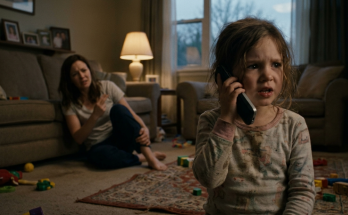
Then my son’s tiny voice came through.
“Dad?”
I nearly drove into the curb.
“I’m here, buddy. I’m coming. Derek has you. You’re safe with Uncle Derek.”
“He said Mommy would be mad.”
The world narrowed again.
Not to rage this time.
To something heavier.
A sadness so sudden it almost felt physical.
“No,” I said. “You did the right thing calling me.”
Noah breathed in little pieces.
“I didn’t want to be bad.”
“You are not bad,” I said, too loudly, then softer. “You are not bad, Noah.”
Behind his breathing, I heard Lena crying inside the house.
Not coming outside.
Not yet.
That hurt more than I expected.
Because some weak part of me still wanted her to burst through the door, fall to her knees beside our son, and become the mother I needed her to be.
I wanted one clean villain.
Travis with the bat.
Travis with the threats.
Travis with his cheap work boots on my kitchen tile.
But life rarely offers clean shapes.
Sometimes the person who breaks your heart is the one standing three feet from the harm, whispering please instead of stop.
I turned onto our street just as the first police cruiser came into view.
Its lights painted the afternoon red and blue across parked cars and mailboxes.
Neighbors had begun stepping onto porches.
Mrs. Alvarez from next door stood with one hand over her mouth.
Derek was at the edge of the driveway, kneeling beside Noah, his jacket wrapped around my son’s shoulders.
Noah looked impossibly small.
His face was blotchy, hair stuck to his forehead, one arm held tight against his body.
I parked badly, half over the curb, and ran before the engine fully stopped.
Noah saw me and tried to stand.
The pain stopped him.
His face twisted, and he made that same broken sound from the phone.
I dropped beside him and reached carefully, afraid my own hands might hurt him.
“Hey, hey, don’t move. I’ve got you. I’m here.”
He pressed his face into my chest with his good arm and held on like I was the last solid thing left.
Derek stood behind him, breathing hard now.
There was redness along his knuckles, but his eyes were clear.
“I didn’t chase him,” he said quietly, before I could ask. “I only got between them.”
I nodded once.
I could not speak.
Two officers moved toward the house.
Another knelt near us, asking Noah questions in a voice so gentle it made me want to weep.
Noah did not answer.
He only gripped my shirt tighter.
Then Lena appeared in the doorway.
She looked smaller than I remembered.
Her cardigan hung wrong off one shoulder, and mascara had made thin gray lines down her cheeks.
For one second, her eyes met mine.
There was apology there.
There was fear.
There was also a plea, familiar and terrible, asking me to understand before I even knew what she had done.
“Mark,” she said.
I had not heard my name in her voice like that since the divorce papers.
Derek stepped slightly in front of Noah.
The movement was small, almost polite.
Lena noticed.
Her face folded.
“I didn’t know,” she said again.
This time, nobody answered.
The officer by the porch asked her to step outside and keep her hands visible.
She obeyed like someone moving through water.
Travis came next.
He was not dragged out, not thrown down, not made into the monster I wanted him to look like.
He looked ordinary.
That was the worst part.
A man in a gray T-shirt, jaw tight, hair damp with sweat, eyes darting from officers to neighbors.
He kept saying, “This is a misunderstanding.”
Noah trembled against me.
I felt it before I heard him whisper.
“That’s what he said before.”
The sentence entered the air softly.
The officer beside us heard it.
Derek heard it.
Lena heard it too.
Her hands lifted toward her mouth, but stopped halfway, as if even comfort had become something she no longer deserved.
An ambulance turned onto the street.
Its siren was off, but the lights flashed silently, staining the windows of our house.
Silent lights felt worse somehow.
A paramedic approached with a soft bag and asked permission to look at Noah’s arm.
Noah shook his head hard and buried himself deeper against me.
I wanted to say no.
I wanted to wrap him in my body and keep every stranger away.
But love is not always holding tighter.
Sometimes it is letting the right person touch the wound.
“Buddy,” I whispered, “they need to help you. I won’t move.”
His fingers clutched my shirt.
“Promise?”
“I promise.”
The paramedic worked slowly.
Derek stood nearby with his arms folded, watching every movement.
Lena took one step closer.
Noah saw her and flinched.
It was small.
Almost nothing.
But I saw it.
So did she.
That flinch changed her more than any accusation could have.
She stopped walking.

Her lips parted, but no words came out.
For years, Lena had been able to explain pain into something softer.
A hard childhood.
Anxiety.
Bad timing.
Loneliness.
Men who needed saving.
Money that never stretched far enough.
But a child’s flinch leaves no room for poetry.
It is a fact.
Plain.
Sharp.
Unwilling to become anything else.
An officer asked me if I could give a statement.
I looked down at Noah.
His eyes were half closed now from exhaustion, his cheek pressed against my chest.
I wanted to say later.
I wanted to follow him into the ambulance and pretend statements, courts, custody, and Lena did not exist.
But Travis was still talking near the cruiser.
Lena was still crying without saying the one sentence that mattered.
And my son had already done the brave thing before any adult did.
So I looked at the officer and said, “Yes.”
The word surprised me.
It sounded calm.
Almost like Derek.
I gave the statement beside the ambulance doors.
I repeated Noah’s call exactly.
I described Travis’s threat.
I said Lena was present when Derek arrived, though I did not know when she had arrived before that.
Each sentence felt like placing a stone on a scale.
On one side was the truth.
On the other was every easy lie I had ever wanted to believe.
That Lena was careless, not dangerous.
That Travis was unpleasant, not unsafe.
That divorce had made me suspicious.
That Noah’s quiet weekends were normal.
Lena watched me from beside the porch.
When I said her name, she closed her eyes.
For a moment, I almost stopped.
I remembered her asleep on the couch with newborn Noah across her chest.
I remembered her singing the wrong words to cartoons because she was too tired to read subtitles.
I remembered the way she used to smooth Noah’s hair with two fingers whenever he cried.
The past rose up, soft and persuasive.
It asked me to protect the version of her that I had loved.
Then Noah whimpered from inside the ambulance.
The sound cut through memory like a light being switched on.
I finished the statement.
The officer wrote slowly, nodding once.
Then he asked, “Do you have somewhere safe for your son tonight?”
I looked toward the house.
The front door still hung open.
Inside, I could see one of Noah’s small sneakers on its side near the hallway.
A blue dinosaur sticker was stuck to the sole.
I had put it there last weekend because he said it made him run faster.
That stupid sticker nearly broke me.
“Yes,” I said. “With me.”
Lena stepped forward.
“Mark, please. Can I just talk to him?”
Noah heard her voice and turned his face away.
There it was.
The choice.
Not loud.
Not cinematic.
Just a mother asking for one more chance, and a child silently begging not to be asked to give it.
I wanted to believe talking could fix something.
I wanted to believe Lena’s tears meant she had finally understood.
I wanted to believe a family could bend badly and still not break.
But wanting is not the same as knowing.
And I knew what my son’s body had already told me.
I stood between Lena and the ambulance door.
“Not today,” I said.
Her eyes filled again, but this time she did not argue.
Maybe she hated me in that moment.
Maybe she understood.
Maybe both could be true.
The paramedic climbed in beside Noah, and I followed.
Derek stopped at the door.
“You want me to come?”
I looked at my brother.
At the dust on his jeans.
At the careful way he held his sore hand like it did not matter.
At the man who had reached my son before I could.
“Meet us there,” I said.
He nodded.
As the ambulance doors closed, the outside world narrowed into a rectangle of flashing light.
Lena stood beyond it, arms wrapped around herself.
Travis was lowered into the back of the cruiser, still insisting no one understood.
The doors shut.
For the first time since the phone rang, there was no yelling.
Only the hum of the ambulance, the soft beep of equipment, and Noah’s breathing beside me.
He looked at me with wet, heavy eyes.
“Dad?”
“I’m here.”
“Is Mommy mad?”
I swallowed hard.
The honest answer was too large for a four-year-old.
So I gave him the only truth small enough to hold.
“You are safe. That is what matters right now.”
He blinked once, then let his eyes close.
I kept my hand on his blanket all the way to the hospital.
Outside the small back window, our street disappeared behind us.
I understood then that we were not just leaving the house.
We were leaving the version of our lives where silence could still pretend to be peace.