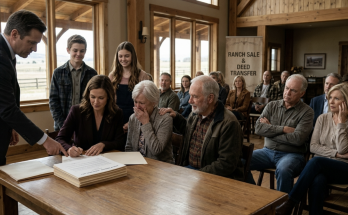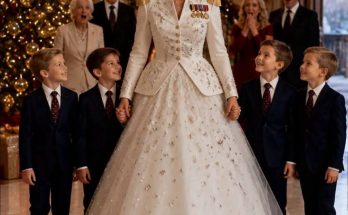
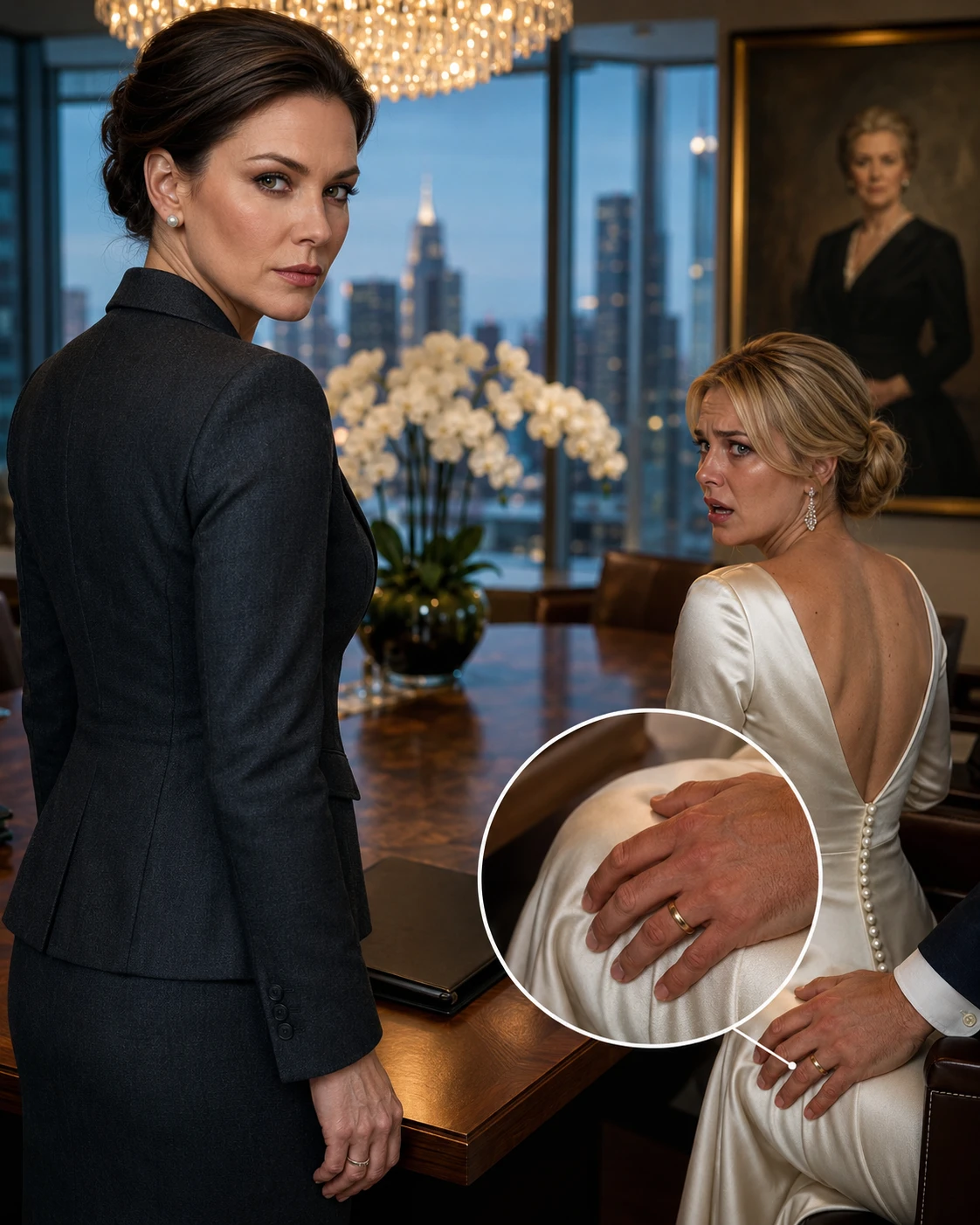
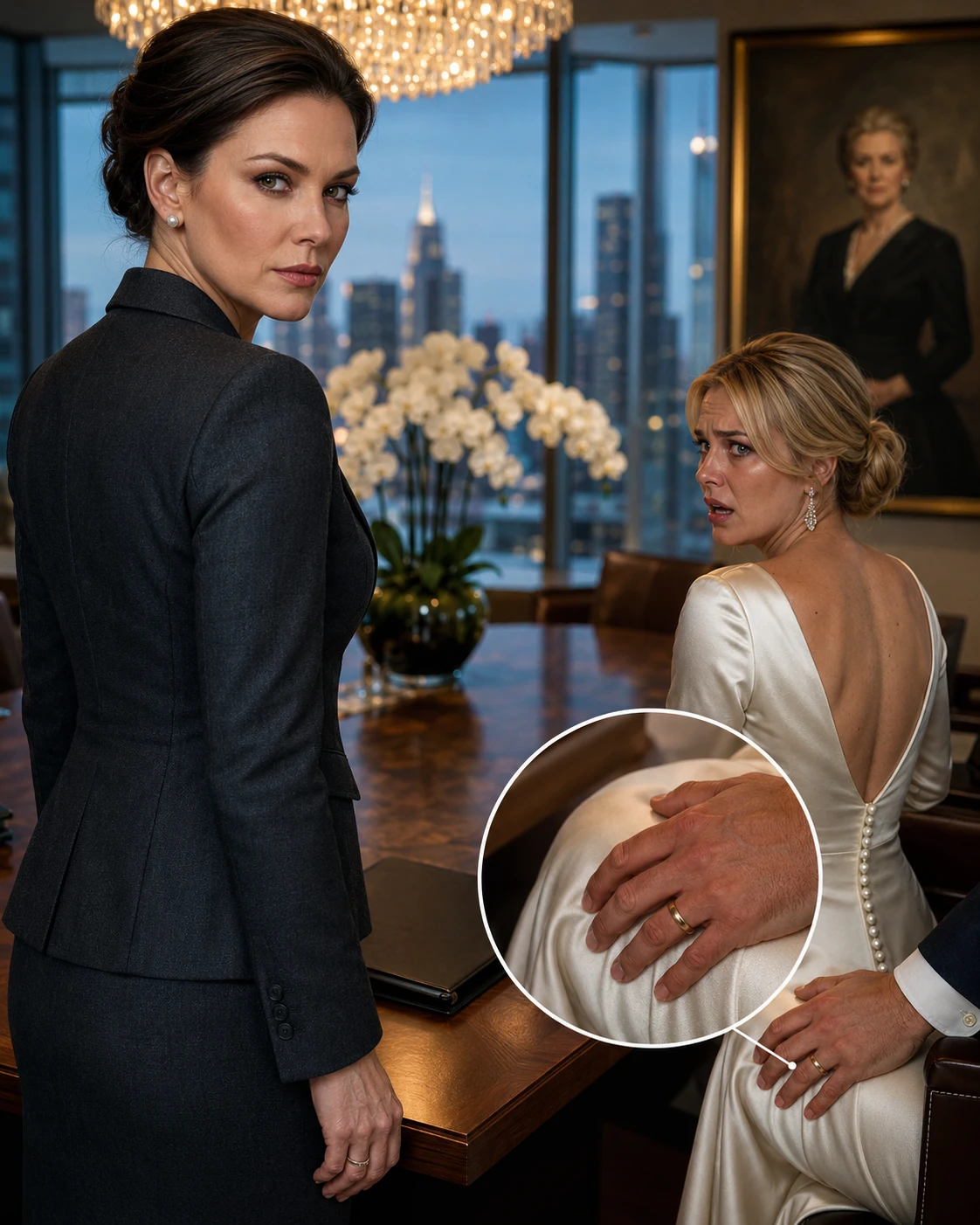
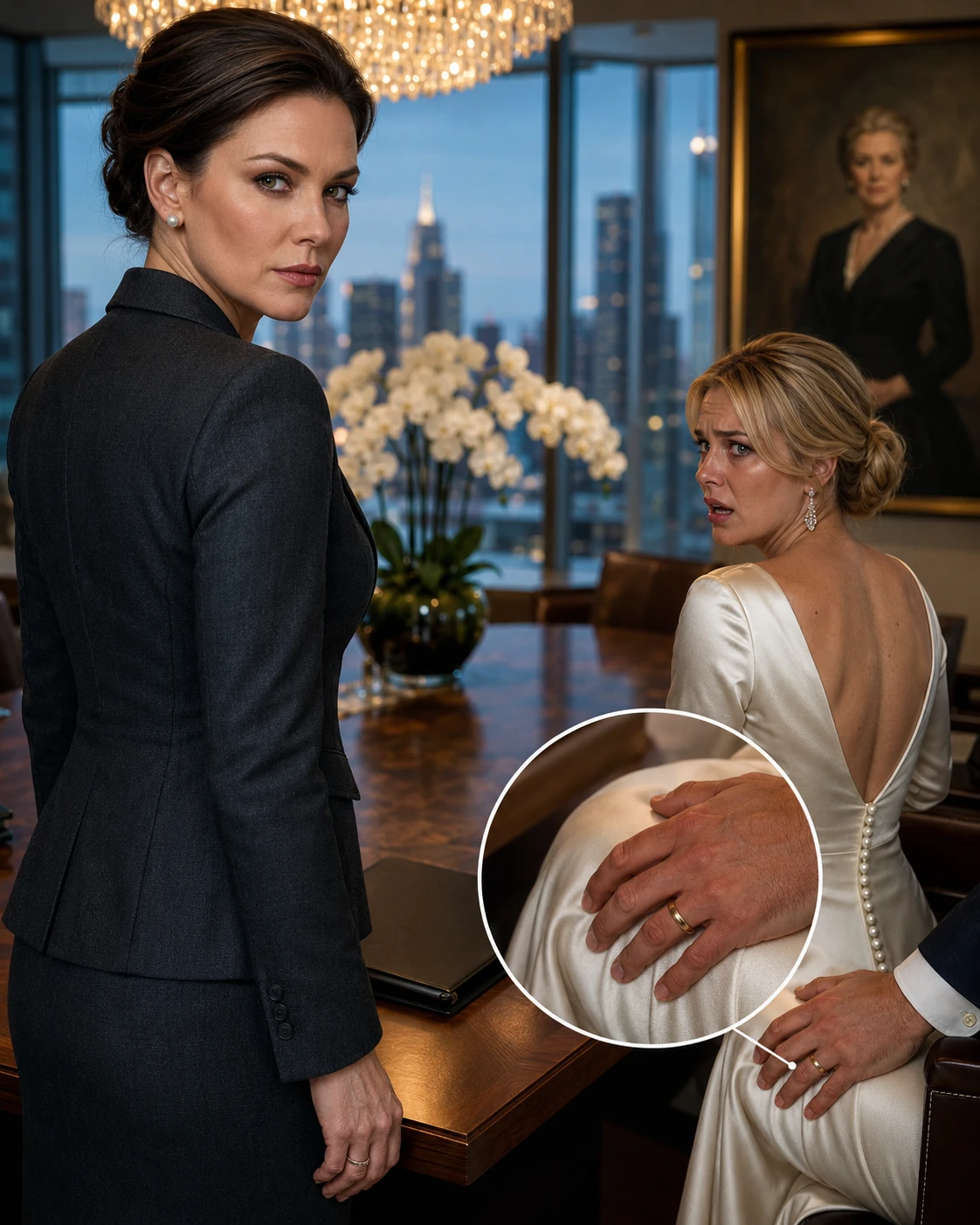
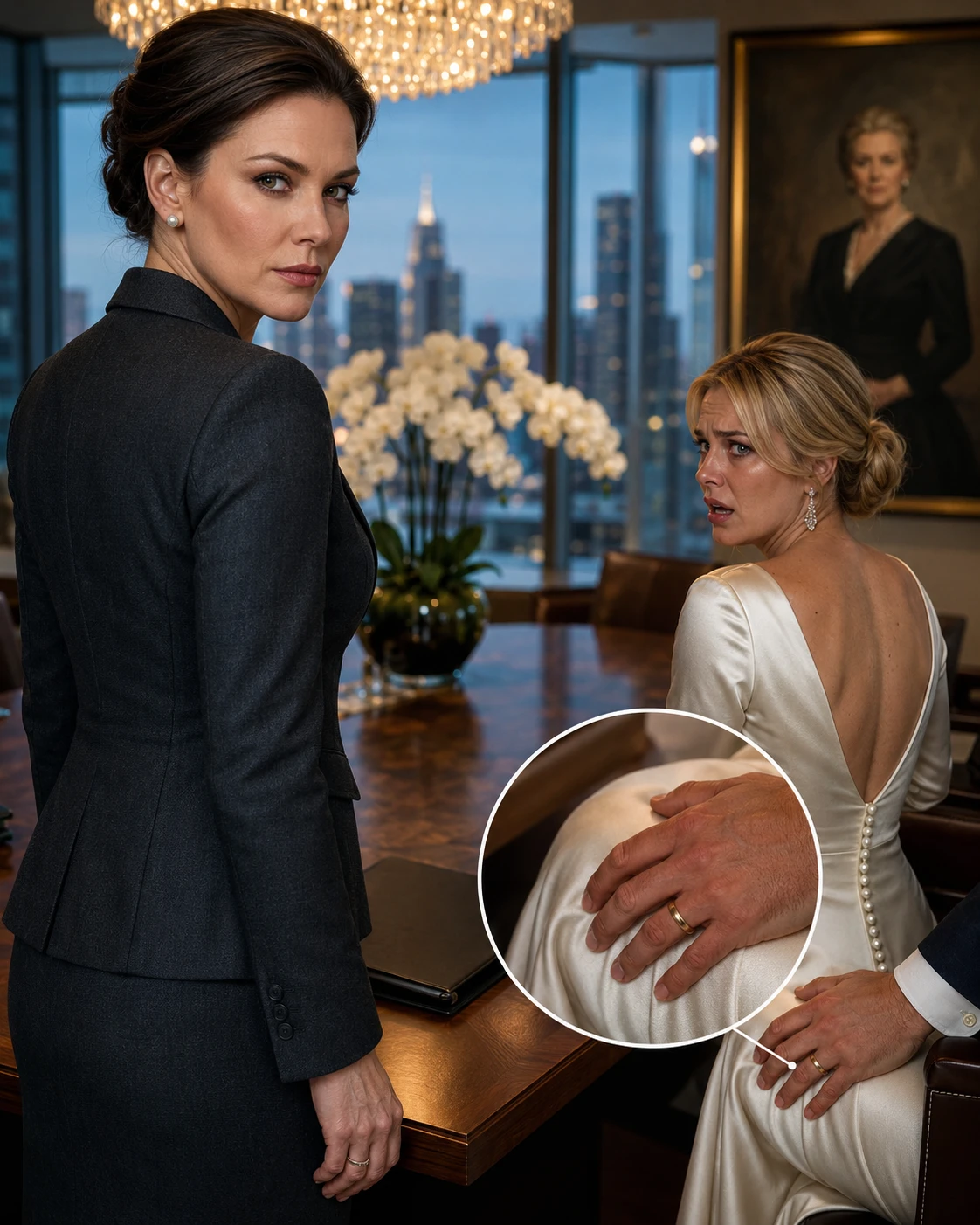
My husband’s mistress wore my white gown to my mother’s will reading.
Not a white dress.
My white gown.
The ivory silk one from my mother’s private collection, the one she had given me the night before my wedding with her cool hands on my shoulders and tears she refused to let fall. The gown had a low back, pearl buttons down the spine, and the kind of quiet luxury that did not need sequins to announce itself. It was made for candlelight, not cameras. For vows, not betrayal.
And Sloane Mercer wore it like she had won me.
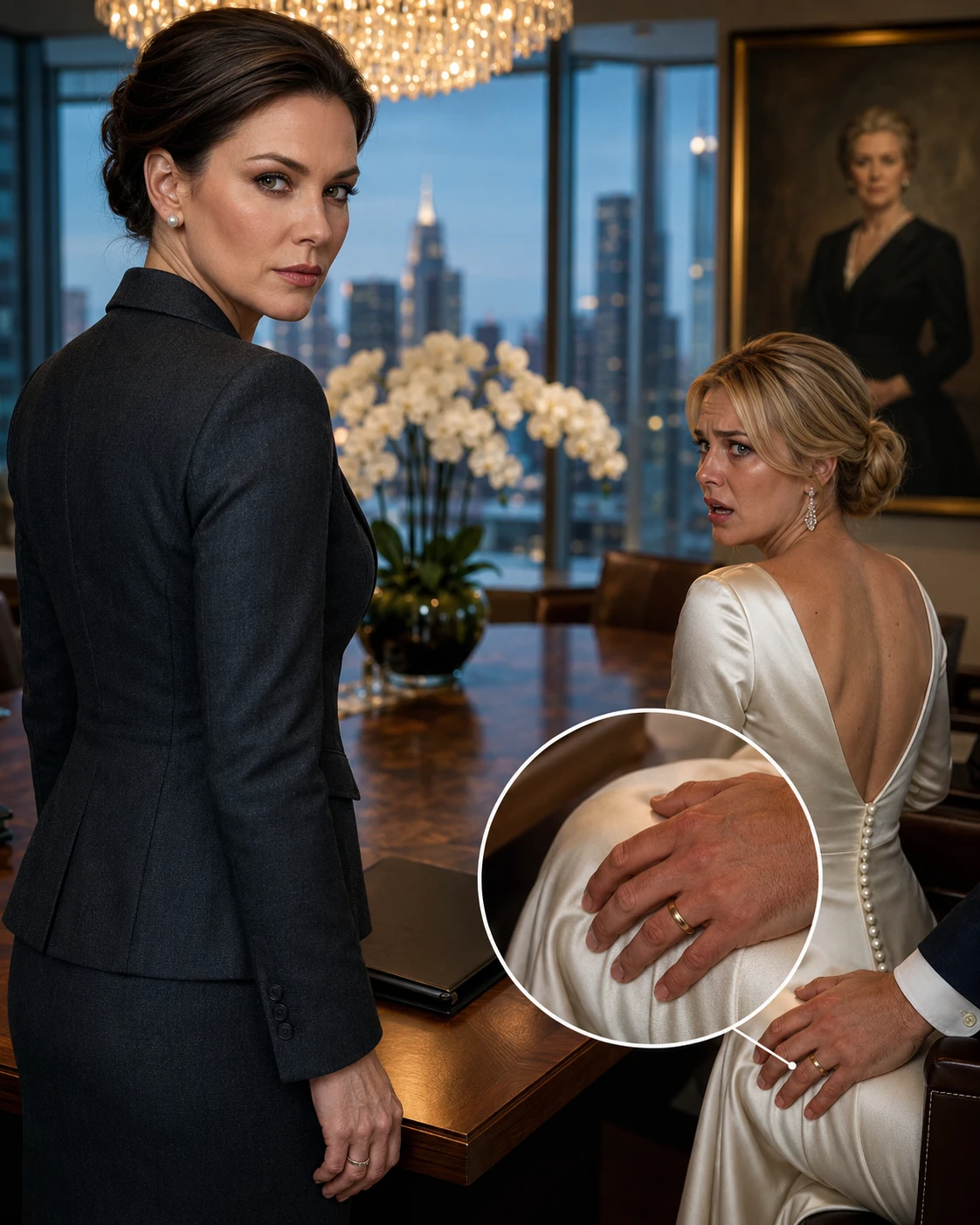
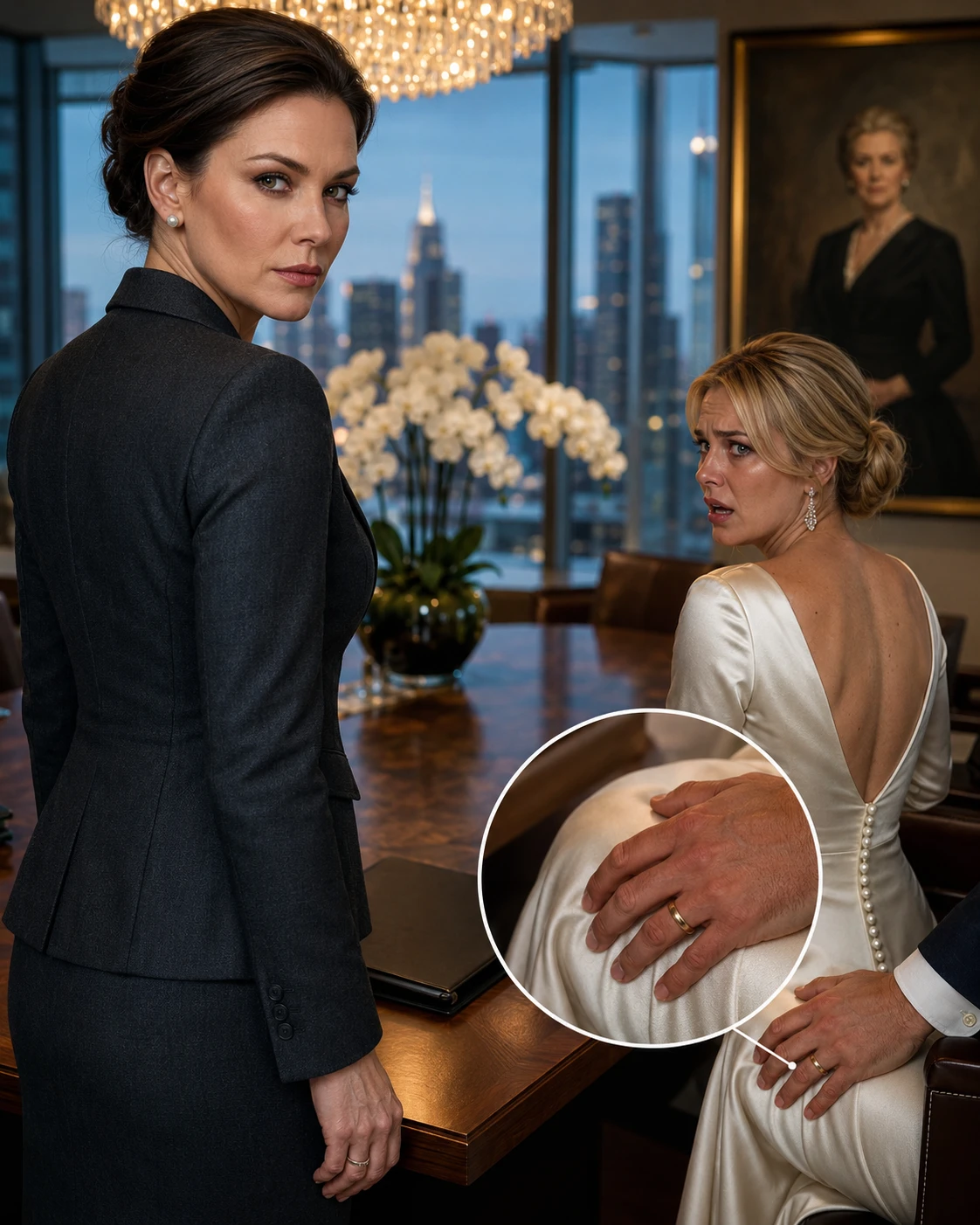
She walked into the penthouse conference room glowing like she expected inheritance to look at her kindly. Her blond hair was swept into a low chignon. Diamond drops trembled at her ears. She smiled with the delicate cruelty of a woman who had practiced innocence in a mirror.
My husband, Graham Hale, rose to pull out her chair.
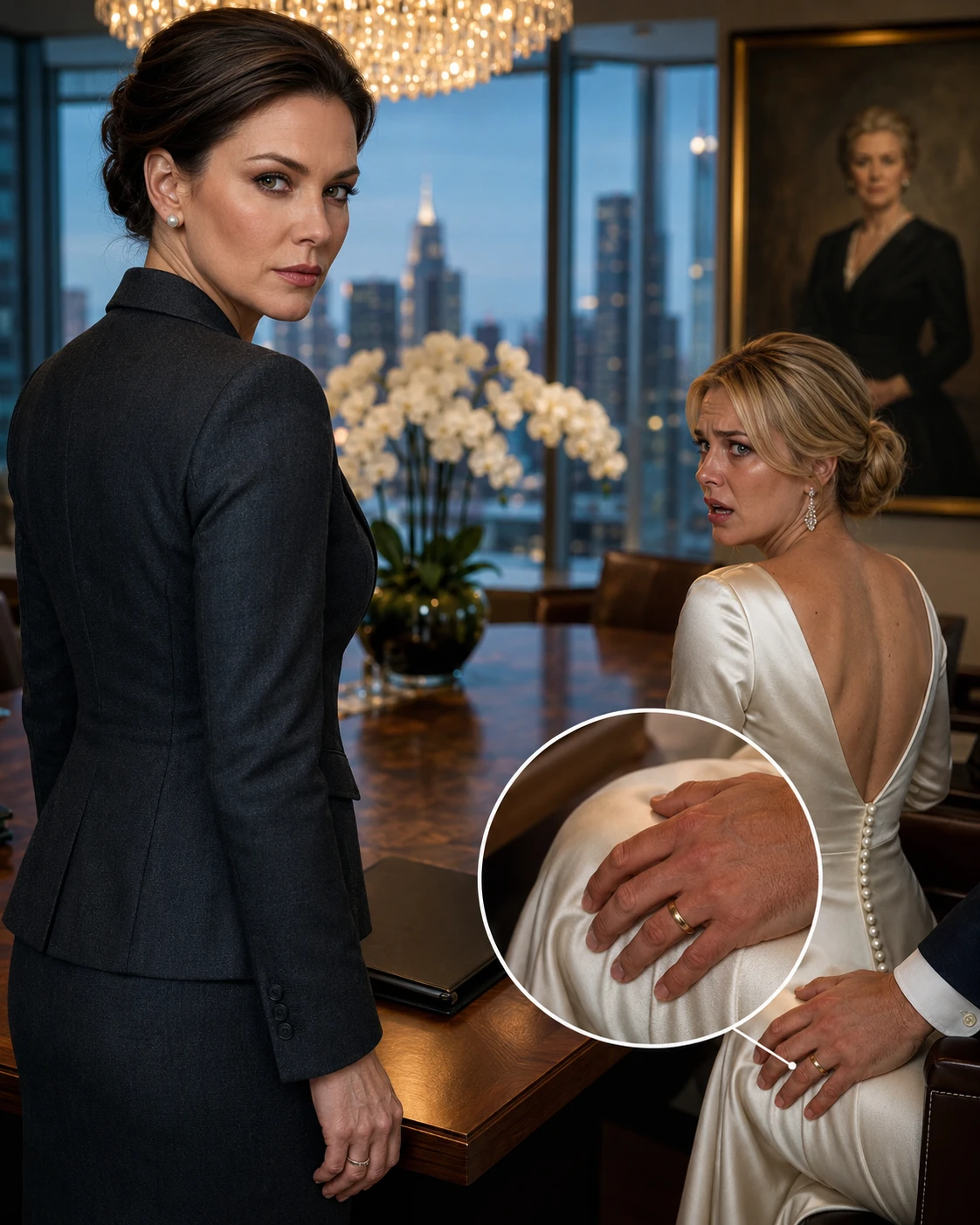
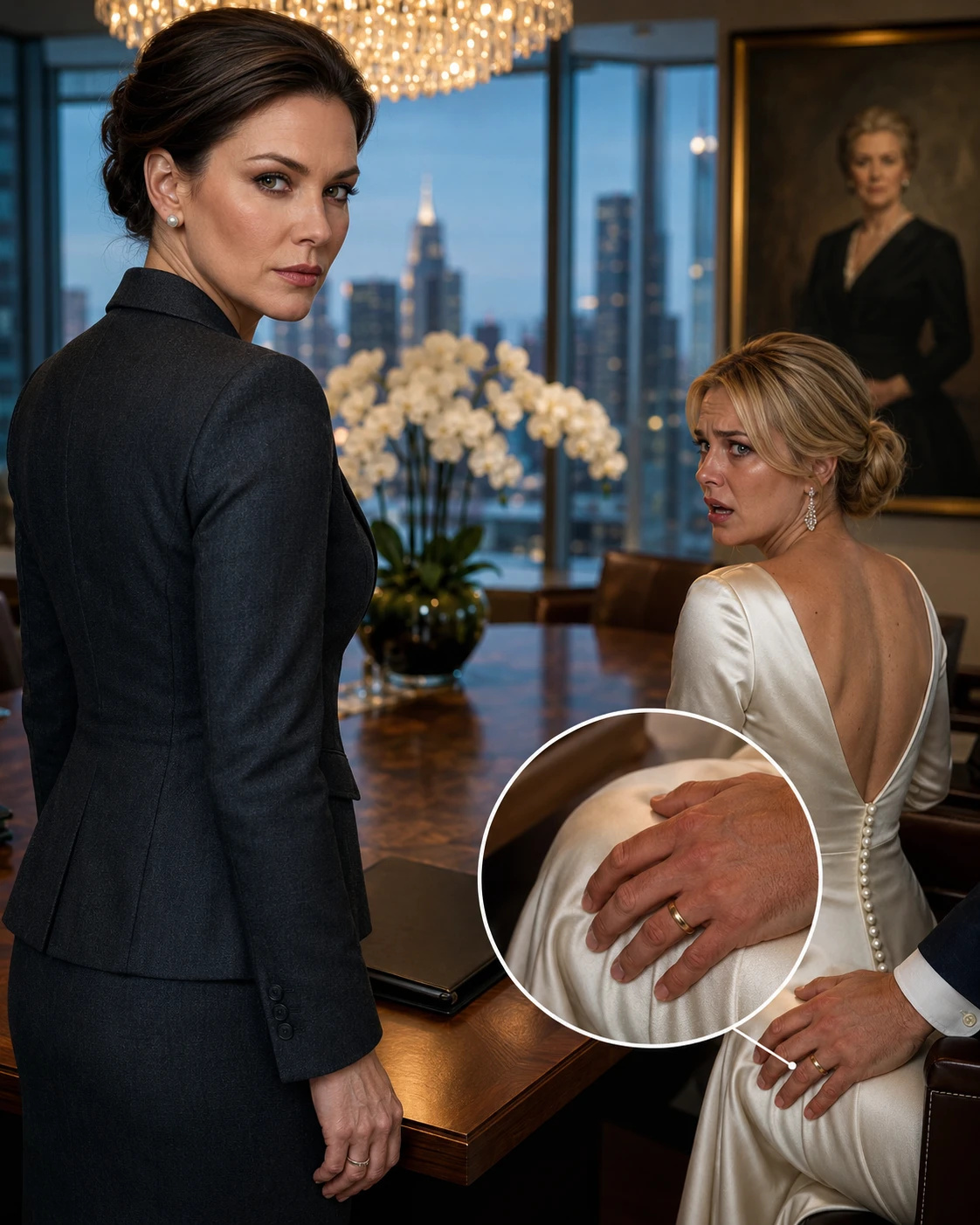
Then he sat beside her, placed his hand on her knee, and let my family stare.
No apology.
No shame.
Just his wedding ring flashing under the chandelier while his thumb moved lazily over the silk covering her thigh.
For one full minute, no one spoke.
My younger cousins looked down at their laps. My uncle coughed into his fist. My father, long divorced from my mother but still careful with her name, went pale. Even the staff seemed to freeze, trays of mineral water and black coffee suspended in air.
I stood by the window overlooking Manhattan, wearing a charcoal suit, pearl studs, and nothing on my face except the expression my mother had taught me when I was seven.
Never flinch where people can see you.
The attorney opened the will.
Then she read my mother’s final clause.
Any spouse who publicly humiliated her daughter would lose every connection to the estate.
Sloane’s smile faltered.
Graham’s hand stopped moving.
And that was the first time all morning I allowed myself to breathe.
Chapter 1: The Woman in White
My mother, Vivienne Ashcroft Whitmore, believed grief should be tailored.
“People will inspect your pain like a hemline,” she used to say, standing behind me in the mirror of her dressing room while fastening pearls at my throat. “Give them nothing uneven.”
She was not a warm woman in the way greeting cards define warmth. She did not bake cookies or leave lipstick kisses on napkins. She did not cry at graduations. She did not say “I love you” unless the room was empty and the world had been forced outside.
But she knew every person who had ever underestimated me.
She kept lists.
That was the thing people never understood about my mother. They mistook her silence for distance, her elegance for vanity, her patience for weakness. Vivienne Whitmore did not raise her voice because she never needed to. She bought buildings instead. She ended partnerships over lunch without smudging her lipstick. She turned betrayal into paperwork, and paperwork into ruin.
When she died, the headline in the New York society pages read:
VIVIENNE WHITMORE, REAL ESTATE HEIRESS AND PHILANTHROPIST, DEAD AT 68.
A clean sentence for a complicated woman.
No mention of the nights she sat on the marble floor of her bathroom after chemo, gripping my hand so hard her rings cut crescents into my skin.
No mention of the fact that she refused to let Graham visit during her final month.
No mention of the envelope she pressed into my palm three days before she died, sealed in black wax and marked with two words:
After silence.
I still had not opened it.
Some instructions feel less like gifts and more like loaded weapons.
The will reading took place eleven days after the funeral in the private conference room atop Whitmore House, the limestone tower my grandfather built on Park Avenue and my mother turned into an empire. Forty-two stories of glass, stone, money, and memory. My mother owned the penthouse floor entirely, though she never lived there. She said homes should have scars, and corporate apartments had only views.
I arrived early.
Of course I did.
The room had been arranged with painful perfection. Cream chairs. Walnut table. Silver carafes. White orchids. A skyline sharpened by winter light.
My mother’s portrait watched from the far wall.
She wore black velvet in the painting, her dark hair swept back, one diamond brooch pinned near her collarbone like a small weapon. The artist had captured the most dangerous thing about her: the calm.
I stood beneath that portrait and felt twelve years old again, waiting to be told how to survive.
At 9:57, my father arrived.
Richard Ellison had not been married to my mother in twenty years, but he still moved around her memory like a man avoiding broken glass. He kissed my cheek, held my shoulders, and searched my eyes.
“Evelyn,” he said softly. “Are you sleeping?”
“No.”
“Eating?”
“No.”
“Lying?”
“Yes.”
He smiled sadly. “Good girl.”
Then came my aunt Celeste, dripping Chanel and resentment. Her twin sons followed with their wives. My mother’s board members arrived next, their grief polished and professional. They all greeted me carefully, as if I were either fragile or radioactive.
At 10:03, Graham walked in.
My husband of six years.
Beautiful, expensive Graham Hale, with his dark blond hair, his navy cashmere coat, his Harvard posture, his old Connecticut smile. He was the kind of man women trusted with secrets and men trusted with money, which made him dangerous in both directions.
He paused at the door when he saw me.
For one second, I thought I saw shame.
Then Sloane stepped from behind him.
She had been my assistant once.
Not personal assistant. That would have been too intimate, too easy to explain. She was hired as a development associate at the Whitmore Foundation, bright and eager from Dallas, with a voice like honey poured over glass. She remembered birthdays. She volunteered for late nights. She brought me oat milk lattes exactly the way I liked them.
Two years later, she brought my husband to the Carlyle Hotel under a false name.
I had known for eight months.
The first photo arrived in an anonymous email at 2:14 a.m. Graham in a hotel elevator, his hand low on her back. The second came a week later: Sloane wearing his Yale sweatshirt on the balcony of a rented house in Montauk. Then receipts. Messages. Flight confirmations. Jewelry invoices. A wire transfer from one of Graham’s shell companies to a Delaware LLC under Sloane’s control.
I said nothing.
Not because I was weak.
Because my mother had asked me not to.
“Let him finish building the cage,” she whispered from her hospital bed, eyes closed, voice thin but steady. “Men like Graham always think the trap is for someone else.”
Now Sloane stood in the doorway wearing my white gown.
For a second, sound vanished.
The room blurred at the edges.
I knew every seam of that gown. My mother had kept it in cedar and tissue, stored in the west dressing room of the house in Newport. It was not famous enough to be recognized by strangers, but in my family it was sacred. My grandmother wore it in 1962 for a portrait at Marble House. My mother wore it at her engagement dinner before she wisely broke off the marriage and chose my father instead. I wore it once, the night before my wedding, when my mother told me, “Never marry a man who is impressed by your money. Marry one who is afraid of your mind.”
I married Graham anyway.
Sloane’s eyes found mine.
She touched the gown lightly, two fingers skimming the silk.
A message.
I can enter your rooms.
I can wear your history.
I can sit beside your husband.
I can take your place.
Graham looked straight at me and did not blink.
“Evelyn,” he said, as if greeting me at brunch.
I looked at Sloane.
“Lovely dress.”
Her smile widened. “Thank you. Graham chose it.”
My aunt Celeste made a small sound in her throat.
My father’s hand curled around the back of a chair.
Graham’s jaw tensed, just slightly. He had expected tears. Accusations. A public unraveling fit for gossip columns and private group chats.
Instead, I nodded once.
“Of course he did.”
Sloane sat at the table on Graham’s right. He placed his hand on her knee, visible to everyone, and my humiliation became a centerpiece.
That was the performance.
That was the point.
My mother had been dead for eleven days, and my husband had brought his mistress to the will reading in my heirloom gown to tell the room I had already lost.
Our attorney, Beatrice Cross, entered at 10:06.
She was seventy-one, silver-haired, and built like a locked door. She had represented my mother for thirty-four years and feared no one who wore a tie. Her briefcase was black crocodile. Her reading glasses hung from a gold chain. When she saw Sloane, her gaze passed over the gown, Graham’s hand, my face, and finally my mother’s portrait.
She did not react.
That frightened me more than if she had.
“Good morning,” Beatrice said. “We are here for the formal reading of the last will and testament of Vivienne Ashcroft Whitmore.”
Chairs shifted. Coffee cups settled. The city moved beyond the glass, unaware.
I remained standing near the window.
Graham frowned. “Evie, sit down.”
He was the only person in the world who called me Evie after I asked him not to.
“I’m comfortable here.”
Sloane leaned toward him, whispering something.
He smiled.
Beatrice opened the file.
The first portions were expected. Donations. Board transitions. Art bequests. My mother left her Matisse sketch to the Met, her emerald earrings to my aunt, and a brutal one-dollar bequest to her cousin Theodore, “in recognition of his lifelong commitment to earning no more.”
A few people laughed nervously.
Then Beatrice turned a page.
“Now we proceed to the personal and controlling clauses concerning the primary beneficiary, Mrs. Evelyn Whitmore Hale.”
Graham straightened.
Sloane’s diamond earrings caught the light.
Beatrice continued, “The primary estate, including the controlling interest in Whitmore Holdings, the Newport property known as Bellweather, the charitable foundation endowment, and related financial instruments, shall pass in trust to my daughter, Evelyn Ashcroft Whitmore Hale, subject to the following protective provisions.”
Protective.
The word slid through the room like a blade being unsheathed.
Graham’s expression changed.
He had always hated that my mother used lawyers the way other women used perfume: daily and with intention.
Beatrice read:
“If, at the time of my death or at the time of this reading, my daughter remains legally married to Graham Everett Hale, then the trustees shall review any conduct by said spouse that may constitute financial coercion, reputational harm, marital fraud, or public humiliation of my daughter.”
A chair creaked.
Sloane’s smile faltered.
Graham laughed once, too sharply. “Is this a joke?”
Beatrice did not look up. “No, Mr. Hale.”
She read on.
“Should said spouse be found to have publicly humiliated my daughter, including but not limited to appearing with a romantic partner in a family, legal, ceremonial, or estate-related setting, all direct and indirect access previously granted to him through marriage, board appointment, advisory position, investment partnership, residence license, or family trust courtesy shall be immediately revoked.”
The room went still.
My pulse sounded like rain on marble.
Graham removed his hand from Sloane’s knee.
Too late.
Beatrice turned another page.
“In addition, any person knowingly participating in said humiliation for the purpose of claiming, implying, or benefiting from proximity to the Whitmore estate shall be barred from employment, grants, residence, social sponsorship, or financial benefit connected to the estate or its affiliates.”
Sloane’s face drained slowly, beautifully, completely.
Beatrice finally looked at her.
“Miss Mercer, I believe this concerns you.”
Graham stood. “You can’t enforce that.”
Beatrice closed the will with a soft, final sound.
“Your wife can.”
Every eye turned to me.
I thought of my mother’s hand in mine. Her voice in the dark. Her last breath, quiet and unwilling. I thought of the white gown on Sloane’s body and Graham’s ringed hand on her knee.
Then I smiled.
Not warmly.
Not kindly.
Just enough.
“I already have.”
Chapter 2: The Cage He Built
Before Graham betrayed me in public, he practiced in private.
He began with small erasures.
At first, they looked like care.
“You’re exhausted, Evie. Let me handle the board dinner.”
“You shouldn’t have to deal with contractors. I’ll take the Newport renovation.”
“Your mother overwhelms you. I can speak to her lawyers.”
“Just sign here. It’s administrative.”
He was never loud. Loud men are easy to identify. Graham’s cruelty wore cufflinks and sent flowers afterward. He did not slam doors. He closed them gently, then kept the key.
By year three of our marriage, he had inserted himself everywhere.
Whitmore Foundation strategy meetings.
Investment dinners.
Donor calls.
Family office reviews.
He called it support.
My mother called it appetite.
“You do understand what he is doing,” she said one spring afternoon at Bellweather, our Newport estate, while pruning white roses with surgical aggression.
I was thirty-one then, still defending the marriage out of habit.
“He wants to be useful.”
“No,” she said. “He wants to be necessary.”
“He’s my husband.”
“So was your grandfather to my mother,” she replied. “He tried to sell her voting shares while she was postpartum.”
I laughed because I thought she was joking.
She cut a rose head clean off.
“History is only funny when you inherit the house instead of the bruise.”
I should have listened sooner.
But love, when mixed with ambition and fear, becomes an excellent blindfold.
I loved Graham. Or I loved the version he had sold me.
We met at a fundraiser in Boston, under a ceiling painted with angels neither of us believed in. He was charming without appearing hungry. He asked about the affordable housing initiative I had built in Queens, not the Whitmore hotels or my mother’s collection or whether Bellweather had a private beach.
Three weeks later, he sent a handwritten note.
Six months later, he proposed in the reading room of the Boston Athenaeum.
My mother disliked him immediately.
“He studies rooms too quickly,” she said after their first dinner.
“He’s observant.”
“He’s inventorying.”
On our wedding day in Newport, she pinned a diamond comb into my hair and said, “If he ever makes you feel small, do not argue with the feeling. Investigate it.”
I laughed then too.
The worst mistakes of my life began as laughter.
The affair with Sloane was not his first betrayal. Just the most theatrical.
The first was financial.
In marriage, Graham signed documents like a man building a bridge. Calmly, steadily, always with an engineer’s confidence. He created advisory entities to “streamline” my philanthropic giving. He recommended accountants. He suggested we consolidate assets “for simplicity.” He persuaded me to appoint him to the board of Whitmore Urban Renewal, a subsidiary tasked with turning distressed properties into mixed-income housing.
That subsidiary became his playground.
He rerouted contracts to companies owned by his college friends. He delayed construction to pressure city officials. He accepted private consulting fees through a Cayman account while publicly praising transparency at charity galas.
I discovered the first discrepancy because of a janitor named Luis.
Luis had worked at a Whitmore building in Brooklyn for seventeen years. He sent a handwritten letter to my office saying the promised tenant repairs had not been made, though public records showed them completed and paid for. His grandson scanned photos of mold, broken locks, exposed wiring.
I brought it to Graham.
He kissed my forehead and said, “You shouldn’t carry every sad story personally.”
Then he fired Luis through a management company two weeks later.
That was when I stopped laughing.
I began copying files.
Quietly.
I learned from my mother’s old assistants, the women nobody noticed because they wore beige and carried calendars. I learned where duplicate servers lived. I learned how Graham labeled documents when he thought no one would ever search them. I learned the difference between negligence and fraud, between gossip and evidence, between heartbreak and admissibility.
My mother helped.
By then, she was already sick, though she hid it beneath silk scarves and rage.
“Do not confront him,” she told me in her library, the day I showed her the first folder.
“He’s stealing from housing projects.”
“Yes.”
“He used my name.”
“Yes.”
“He could hurt people.”
“He already has,” she said. “That is why you will not give him the mercy of an emotional warning.”
Her body was failing. Her mind sharpened.
Together, we built the record.
Emails.
Invoices.
Photos.
Bank transfers.
Recorded board calls, all legal under New York’s one-party consent rules.
Hotel receipts.
An expense coded as “community engagement” that paid for Sloane’s diamond bracelet.
I still remember the bracelet.
White gold, emerald-cut diamonds, $48,600.
On Instagram, Sloane captioned it:
Sometimes life gives you exactly what you deserve.
I stared at that sentence in my kitchen at 3:00 a.m. while Graham slept upstairs in our bed.
Sometimes life does.
By the time my mother entered hospice, she had already rewritten her will four times.
The final version was not just a distribution of wealth.
It was a map of consequences.
She created a trust structure Graham could not touch. She moved voting shares into a Delaware dynasty trust. She transferred Bellweather into a separate preservation entity with me as sole steward. She added morality clauses, conduct clauses, fiduciary review triggers, and one clause so specific I had cried when Beatrice first hinted at it.
Public humiliation.
My mother knew.
Not because I told her everything.
Because Graham grew careless.
Men who believe they have won begin decorating the battlefield.
He started taking Sloane to places where people could see. Hotel bars. Charity auctions. A private box at the U.S. Open. A Miami art fair event hosted by a Whitmore donor. Always close enough to rumor, never close enough to consequence.
Then my mother died.
And Graham made the mistake of mistaking grief for weakness.
The day before the will reading, I went to Bellweather alone.
The Newport house stood against a bruised Atlantic sky, all gray stone, black shutters, and winter roses. Inside, it smelled of beeswax, old books, and my mother’s Diptyque candles. The staff had covered the mirrors after her death, an old family custom no one admitted we followed.
I went upstairs to the west dressing room.
The cedar wardrobe was open.
The white gown was gone.
Not misplaced.
Gone.
The tissue paper lay torn on the floor.
For a moment, I could not move.
I did not cry at the funeral. I did not cry when the nurse called the time of death. I did not cry when my mother’s lipstick-stained coffee cup remained beside her bed like she had only stepped away.
But I almost cried over the empty hanger.
Then I saw the small gold hairpin on the carpet.
Not mine.
Sloane’s.
She had been in my mother’s house.
In my mother’s room.
Touching my mother’s things with mistress hands.
I picked up the hairpin and placed it in a plastic evidence sleeve I had learned to carry.
Then I checked the security system.
Graham had disabled the upstairs hall cameras for ninety-two minutes.
The service entrance camera caught Sloane leaving with a garment bag.
Perfectly.
My mother would have been delighted.
I drove back to Manhattan that night in silence, the evidence stored in a locked folder on the passenger seat. Snow began near Stamford, soft against the windshield. By the time I reached the city, the skyline looked carved from black ice.
Graham was home.
He sat in the living room with a drink, wearing the cashmere sweater I bought him for Christmas.
“You were in Newport,” he said.
“Yes.”
“Should I ask why?”
“No.”
He studied me over the rim of his glass. “You’ve been strange lately.”
“My mother died.”
“That isn’t what I mean.”
I took off my gloves finger by finger.
“What do you mean, Graham?”
There it was, a flicker. Irritation under polish.
“I mean you’re becoming cold.”
Cold.
The accusation men use when a woman stops providing warmth they no longer deserve.
I looked at my husband, at the mouth I had kissed for six years, at the face that had lied into mine with astonishing ease.
“I learned from the best.”
He smiled thinly. “Your mother?”
“No,” I said. “You.”
The next morning, he walked into the will reading with Sloane wearing my gown.
He thought it was a coronation.
It was evidence.
Chapter 3: Black Ink
After Beatrice read the clause, Graham did what men like Graham always do when caught.
He performed disbelief.
“This is absurd,” he said, pushing back his chair. “Vivienne was ill. She was medicated. This is clearly the product of paranoia.”
Beatrice looked at him over her glasses. “Mrs. Whitmore executed this will six weeks before her death, in the presence of two physicians, three witnesses, and a court-approved capacity evaluator.”
My aunt Celeste whispered, “Of course she did.”
Sloane’s hands twisted in her lap. The white silk wrinkled under her fingers.
Graham ignored her.
He focused on me.
“Evelyn, this is a family matter. We should step outside.”
For six years, step outside meant let me control the room.
For six years, we should talk meant let me rearrange reality.
For six years, family matter meant silence.
“No,” I said.
The word was small.
It landed hard.
Graham’s smile tightened. “You don’t want to do this in front of everyone.”
“You wore your affair in front of everyone.”
Sloane flinched.
Not from guilt, I think. From being named.
Graham’s eyes darkened. “Careful.”
There it was.
The real man, briefly visible beneath the tailoring.
My father stood. “Don’t threaten my daughter.”
Graham turned toward him with polite contempt. “Richard, respectfully, you have been financially irrelevant to this family since the divorce.”
My father smiled.
It surprised everyone, including me.
“You’re right,” he said. “Which means I have nothing to lose by breaking your jaw.”
For the first time that morning, I almost laughed.
Beatrice lifted one hand. “Gentlemen.”
The room settled.
I stepped away from the window and walked to the table. My heels made almost no sound on the carpet. Sloane watched me approach. Up close, the gown was even more insulting. She had had it altered. The bodice taken in. The hem shortened. My grandmother’s silk cut to fit another woman’s ambition.
I stopped behind the empty chair at the head of the table.
My mother’s chair.
“I have a statement,” I said.
Graham exhaled. “Evie.”
“My name is Evelyn.”
His face hardened.
I opened the black folder I had placed on the table before anyone arrived.
The first document was a photograph.
Graham and Sloane in the Carlyle elevator.
I slid it across the table.
No one moved.
The second: hotel receipts under the name Mr. and Mrs. Grant.
The third: jewelry invoices.
The fourth: the wire transfer.
The fifth: screenshots of messages between Graham and Sloane.
I did not read them aloud. I had too much respect for myself and too little mercy for him. But I let the room see enough.
Sloane whispered, “Graham.”
He did not look at her.
I placed the final image on the table.
Sloane leaving Bellweather with the garment bag.
Timestamped. Clear. Damning.
My aunt Celeste leaned forward. “Is that the west service entrance?”
“Yes.”
“She stole the gown?”
Sloane found her voice. “I didn’t steal anything. Graham said it was his wife’s and that she wouldn’t care.”
The stupidity of betrayal is how quickly lovers become witnesses.
Graham turned on her. “Be quiet.”
But Sloane, realizing the ship was sinking, began searching for a lifeboat made of blame.
“You told me Evelyn was cruel to you,” she said. “You said the marriage was over. You said this family owed you.”
Graham’s face went still.
Not angry.
Calculating.
I knew that look. He was choosing which version of the truth would cost him least.
Beatrice cleared her throat. “For the record, Miss Mercer, are you stating that Mr. Hale provided you access to Bellweather and instructed you to remove a gown belonging to the estate or to Mrs. Hale?”
Sloane blinked. “I—”
Graham snapped, “Do not answer that.”
Beatrice smiled faintly. “Interesting advice from someone not acting as her attorney.”
Sloane swallowed.
I looked at her then, truly looked.
She was younger than me by seven years. Beautiful in the curated way of women who mistake visibility for power. But beneath the makeup and diamonds, she looked terrified. Not sorry. Not yet. Just frightened that the elevator she had taken upward had opened over empty air.
“You wanted my life,” I said to her.
Her eyes shone.
“No,” she whispered.
“Yes,” I said. “But you didn’t study the architecture.”
Graham laughed coldly. “Architecture? Evelyn, listen to yourself.”
I turned back to him.
“Whitmore Urban Renewal.”
The words changed the air.
His expression froze.
“That,” I said, “is why you should have stayed home today.”
Beatrice opened a second file.
Graham stared at it, and I watched him understand that the will reading was not the trap.
It was the invitation.
Beatrice began distributing packets to the trustees and board members in attendance.
“Mrs. Hale, as controlling beneficiary and acting trustee under the emergency succession provisions, has authorized a fiduciary review of Whitmore Urban Renewal and related advisory entities. Preliminary findings indicate possible self-dealing, fraudulent invoicing, misappropriation of restricted charitable funds, and undisclosed conflicts of interest involving Mr. Hale.”
One of the board members, Malcolm Pierce, removed his glasses. “How preliminary?”
I answered. “Enough for federal counsel.”
Graham’s voice dropped. “You have no idea what you’re accusing me of.”
“I know exactly what I’m accusing you of.”
“This is grief.”
“No,” I said. “Grief was burying my mother. This is accounting.”
His eyes flicked toward the door.
There are moments when a powerful man realizes the room has become smaller than his ego.
He sat down.
Good.
I wanted him seated for the rest.
Beatrice continued. “Effective immediately, Mr. Hale is removed from all advisory roles connected to Whitmore entities. His building access is revoked. His corporate cards have been frozen. All pending transfers involving Hale Strategic Partners are suspended. The trustees have voted to refer the matter to outside counsel and relevant authorities.”
“You voted?” Graham looked around the table. “When?”
Malcolm Pierce said quietly, “Last night.”
Graham’s gaze cut to me.
I thought he might hate me then.
But hatred would have required seeing me clearly.
What I saw in his face was worse.
He was offended I had acted without permission.
Sloane began to cry.
Softly at first. Then with more confidence when no one comforted her.
“I didn’t know about any money,” she said. “I swear. I thought he loved me.”
My aunt Celeste muttered, “They always do, darling. That’s how invoices get romantic.”
I would have laughed if I had not been so tired.
Graham stood again, but slower now. “Evelyn, whatever you think you have, we can resolve this privately.”
“Privately?”
He took a step toward me. “You don’t want your name dragged through court.”
“My name is on buildings, hospitals, scholarships, and the baptism records of three generations of women who survived men like you. I’m not afraid of seeing it in court.”
His nostrils flared.
“The press will devour this.”
“Only if someone leaks it.”
His eyes narrowed.
I let him see it then.
The smallest edge of the knife.
“I already did.”
Sloane stopped crying.
Graham stared.
At that exact moment, everyone’s phones began vibrating.
One by one. Across the table. In pockets. In handbags. On silent mode, lighting up like city windows at dusk.
My father checked his first.
His eyebrows rose.
My aunt Celeste opened hers and whispered, “Oh, Vivienne.”
Graham grabbed his phone.
The New York Ledger alert was simple:
WHITMORE HEIRESS MOVES TO REMOVE HUSBAND FROM FAMILY EMPIRE AMID ALLEGATIONS OF AFFAIR AND FINANCIAL MISCONDUCT
Beneath it was a photograph.
Not of Graham and Sloane in a hotel.
Not of the gown.
Not yet.
It was a portrait of my mother in black velvet.
The subheading read:
Sources close to the estate cite protective clauses drafted by late philanthropist Vivienne Whitmore before her death.
Graham looked up at me.
“You leaked this?”
“No.”
“Don’t lie.”
“I didn’t leak it.” I closed the folder. “My mother did.”
That was not entirely accurate, not in the way lawyers define accuracy.
But it was true in the way endings are true.
Three weeks before her death, my mother had dictated letters to three journalists she trusted and sealed them with instructions. If Graham triggered the clause, if I authorized the review, if Beatrice confirmed the evidence, the packets would be released.
My mother had always believed timing was a form of inheritance.
Sloane pushed back from the table.
“I’m leaving.”
But as she stood, the altered hem of the gown caught beneath the chair leg. Silk tore with a sound so soft and horrible I felt it in my teeth.
Everyone heard.
Sloane froze.
My grandmother’s gown ripped from knee to thigh.
For one second, she looked like a child caught playing queen in a dead woman’s closet.
Then my mother’s portrait seemed to stare through her.
I stepped closer.
“Take it off before you leave my building.”
Her mouth opened. “Excuse me?”
“That gown belongs to the estate.”
Graham said, “You cannot make her undress.”
“No,” I said. “Security will escort Miss Mercer to a private room. My staff will provide appropriate clothing. The gown will be returned for documentation and restoration.”
Sloane’s face flushed red. “You’re humiliating me.”
The word hung there.
Humiliating.
I almost admired the symmetry.
“No,” I said. “I’m collecting property.”
Two security officers entered.
They did not touch her. They did not need to.
Sloane looked at Graham.
“Do something.”
He looked at the phones, the lawyers, the board members, the documents, the doors.
Then he looked away.
That was the first honest thing he did all day.
Sloane understood.
The mistress came for status.
But status is only affection from people who value access.
And access had just been revoked.
She walked out in my mother’s ruined gown, escorted by security, crying in a way that would have moved me if she had not worn my grief like a costume.
Graham remained.
Of course he did.
He still believed there was something to negotiate.
When the doors closed behind Sloane, he leaned toward me and whispered, “You think you’ve won?”
I met his eyes.
“No, Graham. I think my mother has only started.”
Chapter 4: The House Always Remembers
By noon, the internet had chosen its villain.
By one, it had chosen its queen.
I did not ask for either title.
The first clip came from a staff member’s phone, filmed through the frosted glass of the conference room doors. It showed only six seconds: Sloane entering in the white gown, Graham guiding her by the waist, my stillness by the window. No sound. No context. Just enough.
The caption spread faster than truth usually travels.
HE BROUGHT HIS MISTRESS TO HIS WIFE’S MOTHER’S WILL READING IN THE FAMILY GOWN.
By evening, strangers had become fluent in my humiliation.
Women on Facebook wrote paragraphs about their ex-husbands.
TikTok editors set my silence to cinematic music.
A law student on Reels explained morality clauses with red nails and excellent lighting.
Someone posted a side-by-side of Sloane in the torn gown and my mother’s black-velvet portrait with the words:
SHE WORE WHITE. MOM WROTE IN BLACK.
I should have hated it.
Part of me did.
Pain becomes strange when strangers turn it into content. They polished it, captioned it, looped it, argued over it in comment sections between skincare ads and recipes for lemon pasta. They called me iconic. Cold. Elegant. Ruthless. A goddess. A victim. A warning. A brand.
But beneath the noise, something else happened.
Women began sending messages to the Whitmore Foundation.
Not gossip.
Evidence.
My ex did this with our mortgage.
My husband moved money before filing.
My boss used charity funds for his girlfriend.
How did you stay so calm?
How did you know?
How do I prove it?
I read them at midnight in my mother’s library while snow pressed against the windows.
How did I stay calm?
I did not.
Calm was the dress grief wore in public.
Inside, I was a house with every light smashed.
Three days after the will reading, Graham filed for divorce.
He asked for privacy, compassion, and a fair division of marital assets.
His lawyer, a silver fox named David Kellerman who had built a career saving men from consequences, released a statement calling the allegations “emotionally motivated” and “grossly misleading.”
I read it over coffee.
Then I forwarded it to Beatrice with one note:
Release batch two.
Batch two included invoices.
People understand affairs emotionally.
They understand theft mathematically.
The story changed overnight.
The public no longer saw only a cheating husband. They saw delayed housing repairs, missing funds, sweetheart contracts, shell companies. They saw Luis, the janitor from Brooklyn, interviewed outside his daughter’s apartment, holding photos of mold beside a picture of his asthmatic grandson.
Graham’s elegance began to curdle.
Sponsors withdrew from his charity golf event. Two board seats vanished. The club in Greenwich placed his membership under review, which in old-money language meant please disappear before we are forced to vote.
Sloane tried to save herself.
She posted a Notes app apology against a beige background.
I was misled by a powerful man during a vulnerable time.
The internet was not kind.
Not because the internet is moral. It is not. It is hungry.
And Sloane had given it a perfect meal: beauty, arrogance, stolen couture, and the fatal mistake of underestimating a dead mother with lawyers.
Still, I did not enjoy watching her fall.
That surprised me.
I had imagined revenge would taste like champagne.
Instead, it tasted like metal.
My mother’s funeral lilies were still wilting in the foyer when I returned to Bellweather for the inventory. The house sat above the Atlantic in gray winter light, enormous and watchful. Reporters waited at the gate, bundled in wool coats, shouting my name as the SUV rolled past.
Inside, the staff moved gently.
Mrs. Alvarez, the housekeeper, hugged me without asking. She had been with my mother for twenty-eight years and smelled like lavender starch.
“She would be proud,” she whispered.
I closed my eyes.
“Would she?”
Mrs. Alvarez pulled back, offended. “Of course. She planned half of it.”
I laughed for the first time in weeks.
A real laugh. Broken, but mine.
We spent the afternoon cataloging the west dressing room. Every drawer held my mother’s handwriting. Labels. Dates. Provenance. She had documented silk scarves more carefully than some families document births.
The white gown had been returned from New York in a preservation box.
Ruined.
The tear could be repaired, but the gown would never again be what it was.
I stood over it, gloved hands hovering.
Mrs. Alvarez crossed herself.
“I am sorry, Miss Evelyn.”
“So am I.”
The gown looked smaller now. Less sacred. Or perhaps I had made it too sacred because grief needed an object.
My mother would have hated that.
She never worshipped fabric. She worshipped leverage.
Beatrice arrived near dusk with another black folder and a bottle of Macallan she claimed was medicinal.
We sat in my mother’s study while the ocean beat itself against the cliffs below. The room had dark green walls, a fireplace big enough to roast a childhood in, and shelves filled with books my mother had actually read.
Beatrice poured two fingers of scotch into crystal glasses.
“Your mother left one more instruction.”
I stared at her.
“Of course she did.”
Beatrice handed me the folder.
On the tab, in my mother’s handwriting:
BELLWEATHER — PRIVATE TRANSFER
My chest tightened.
“What is this?”
“Open it.”
Inside were property records, trust amendments, and a letter.
Not the black-wax envelope. Another one.
Evelyn,
If you are reading this, Graham has behaved predictably, which is disappointing but useful.
You will be tempted to preserve everything exactly as I left it. Do not. That is not love. That is taxidermy.
Bellweather is not a museum. It is a weapon if you point it correctly and a prison if you do not.
I have transferred the house into a new entity under your sole control, but with one condition: for ten years, a portion of the property must be used for women rebuilding after financial betrayal, coercive marriages, or reputational abuse. Lawyers will call this philanthropy. I call it housekeeping.
Make rooms.
Mother
I read the letter twice.
Then a third time because my eyes blurred.
Make rooms.
She had known me too well.
She knew I would turn grief into preservation, freeze myself inside her choices, keep the furniture angled the same way for thirty years and call it devotion.
Instead, she had left me a command.
Not to mourn her perfectly.
To become useful.
Beatrice watched me carefully. “There is funding attached. Substantial.”
“How substantial?”
“Your mother sold the Aspen property last year through an intermediary. The proceeds are in a restricted operating trust.”
“My mother loved Aspen.”
“Your mother hated Aspen. She loved telling people she had a house there.”
Another laugh escaped me.
Then faded.
“What else don’t I know?”
Beatrice’s expression changed.
There are silences lawyers keep not because they lack words, but because words have consequences.
“Beatrice.”
She reached into her briefcase and removed a small black envelope.
Wax seal.
Two words.
After silence.
My lungs forgot themselves.
“I already have that,” I whispered.
“No,” Beatrice said. “You have your copy. This is mine. She instructed me to give it to you only after the public clause was triggered and the Bellweather transfer reviewed.”
I did not touch it.
“Is it about Graham?”
“In part.”
The fire snapped.
Outside, winter swallowed the last light.
I thought about my mother in her final days, all bone and silk, still moving people across the board. I thought about Graham’s hand on Sloane’s knee. Sloane crying in the stolen gown. The internet chanting justice without knowing the cost.
“I’m tired of secrets,” I said.
Beatrice’s voice softened. “Then open it.”
So I did.
My mother’s handwriting was thinner than usual, but unmistakable.
My dearest Evelyn,
I taught you dignity because I mistook it for armor. It is not. Dignity is a door. It keeps out the weather, but it can also keep you trapped inside a burning house.
There are things I did not tell you because I wanted you to have one parent who seemed unbreakable. That was vanity, not love.
Graham did not choose you by accident.
Three months before he met you, he requested a private meeting with me through a mutual donor. He proposed an investment partnership. I declined. He then asked questions about you. Too many. Too precise.
I warned you badly. I should have warned you plainly.
He studied us before he entered our lives.
I am sorry.
I covered my mouth.
The room tilted.
Beatrice looked away, giving me privacy she could not truly provide.
The letter continued.
There is more.
Your father knows some of this. Do not punish him for honoring my request. I made many people keep many silences. It was one of my less charming talents.
Before your marriage, I hired investigators. They found debts, hidden investors, and a pattern of attaching himself to women with access. Nothing criminal enough to stop him. Enough to frighten me.
I should have told you. Instead, I thought I could outmaneuver him while letting you keep the man you believed you loved.
That was arrogance.
If he humiliates you publicly after I am gone, it means he believes you are isolated enough to endure it. Prove him wrong.
Not for me.
For the woman you were before he taught her to ask permission.
At the bottom, beneath her signature, was one final line:
P.S. The house remembers everything. Ask Mrs. Alvarez about the blue room.
I lowered the letter slowly.
“The blue room?”
Beatrice took a drink.
“I was hoping you knew.”
I stood.
The blue room was on the third floor, facing the sea. As a child, I used it during summer storms because it had the best view of lightning over the water. Later, my mother used it for storage: rolled rugs, old lamps, broken chairs too expensive to throw away.
Mrs. Alvarez was in the kitchen when I found her.
At the mention of the blue room, her face changed.
Not surprise.
Recognition.
“Your mother said you would ask,” she said.
We climbed the back staircase together. The house creaked around us like an old witness preparing to speak.
The blue room smelled of dust and salt.
Mrs. Alvarez crossed to the far wall, reached behind a faded tapestry, and pressed a hidden latch.
A panel opened.
Behind it was a narrow safe.
I stared.
“How long has that been there?”
“Since your grandmother.”
“Do you know the code?”
Mrs. Alvarez smiled sadly. “Your birthday.”
Of course.
Inside the safe were hard drives, ledgers, photographs, and a stack of letters tied with black ribbon.
On top sat a flash drive labeled:
G.E.H. — ORIGINAL CONTACTS / INSURANCE
Graham Everett Hale.
My hands went cold.
Beatrice, who had followed us silently, put on her glasses.
“Evelyn,” she said, “we need to review this before anyone else knows it exists.”
But I already knew.
Somewhere inside that safe was not just proof that Graham had stolen.
It was proof that he had hunted.
And my mother, wearing black ink from beyond the grave, had kept the arrow.
Chapter 5: The Final Clause
The final twist did not arrive with sirens.
It arrived with a spreadsheet.
That is the thing revenge stories often forget. The beautiful moment in the black dress, the perfect line, the public downfall — those are only the scenes people share. The real destruction happens in cells and columns. Dates. Amounts. Beneficiaries. Signatures. Metadata.
The flash drive from the blue room contained eleven years of Graham Hale’s life.
Not all of it.
Enough.
There were emails between Graham and a man named Porter Voss, a private “capital introducer” in Miami who specialized in marrying desperation to opportunity. There were notes from Graham’s meeting with my mother before he met me. There were background profiles on me, my father, my mother, Beatrice, the foundation, the board.
He had known my favorite books before our first date.
He had known I hated public proposals.
He had known I visited the Boston Athenaeum every Thursday.
He had chosen the reading room because someone had told him it would feel intimate, intelligent, safe.
Our love story had been assembled like a pitch deck.
I did not cry when I learned that.
The injury was too clean for tears.
I sat at my mother’s desk at Bellweather while outside counsel, forensic accountants, and two former federal prosecutors worked through the files. Everyone spoke carefully around me, as if volume might break something.
But I did not feel breakable.
I felt clarified.
By the second week, the pattern emerged.
Graham owed millions before we married. Not gambling exactly. Not drugs. Something more American and more boring: leverage, failed funds, reputation loans, private notes from men who considered shame collateral. He needed access to capital, legitimacy, and a woman whose last name could open doors his balance sheet could not.
Then came me.
Then came Whitmore.
Then came Sloane.
Sloane, too, had been studied.
Not as deeply. Not with the same patience. She had debts from her mother’s medical bills, a taste for luxury, and a desperate need to be chosen in rooms that made her feel provincial. Graham found the crack and poured himself into it.
That did not absolve her.
It explained the shape of her hunger.
By February, the case had moved beyond family scandal.
Subpoenas went out. Bank accounts froze. Hale Strategic Partners became a phrase whispered on business channels by men pretending they had never taken Graham’s calls. The New York Attorney General opened an inquiry into charitable funds. Federal investigators circled the shell companies.
Graham disappeared from Manhattan.
For nine days, no one knew where he was.
Then he called me.
I was at Bellweather, in the room my mother wanted converted into the first residence suite for the women’s program. Blueprints covered the table. Mrs. Alvarez argued with an architect about closet space because, as she said, “A woman starting over needs somewhere to put what remains.”
My phone lit up.
GRAHAM.
Everyone in the room stopped.
I answered and placed it on speaker.
“Evelyn,” he said.
His voice was different.
Still smooth, but thinner. Like expensive paper held to flame.
“Yes.”
“I want to see you.”
“No.”
A pause.
“This is still a marriage.”
“No, Graham. This is litigation with old photographs.”
He exhaled. “You sound like her.”
“Thank you.”
“That wasn’t a compliment.”
“I know.”
Silence stretched.
Then he laughed softly. “Do you really think your mother was better than me?”
The room shifted.
Beatrice, seated near the window, looked up.
Graham continued, “Vivienne manipulated everyone. You most of all. She built clauses around you like a cage and called it protection.”
“She also built hospitals.”
“With money,” he snapped. “Money makes monsters look generous.”
I heard something then beneath his anger.
Fear.
Not of prison. Not only that.
Fear of losing the story in which he was exceptional.
“You’re finished,” I said.
“No,” he replied. “I’m inconvenienced.”
There he was. Still.
“I have documents too, Evelyn.”
Beatrice’s pen paused.
“What documents?”
“Enough to make people question how clean the Whitmore empire really is. Your grandfather. Your mother. Zoning deals. Offshore accounts. Judges at dinner. Do you think I didn’t keep insurance?”
My blood chilled.
Around me, the room went very still.
Graham heard my silence and mistook it for panic.
“You see?” His voice softened. “This can all stop. We announce an amicable separation. I retain certain assets. You withdraw the referrals. I keep my dignity.”
I looked at my mother’s portrait above the temporary worktable, brought from Manhattan to oversee the renovation. Black velvet. Calm eyes.
“You wore your mistress to my mother’s will reading.”
“I made a mistake.”
“No,” I said. “A mistake is forgetting a birthday. You staged a coup in couture.”
His breath sharpened.
“Do not force me to burn your family down.”
At last, I understood the true final shape of him.
Graham did not only want money.
He wanted the power to decide what everyone’s pain was worth.
I leaned closer to the phone.
“Try.”
Then I hung up.
Beatrice was already standing.
“We need to assume he has real material.”
For three days, we searched my family’s ghosts.
I did not sleep.
My grandfather, Charles Whitmore, had not been a saint. Men who build fortunes rarely are. There were ugly deals in the seventies, tax shelters in the eighties, political friendships that aged badly. My mother had spent half her career cleaning his messes while pretending the floor had always shone.
If Graham had enough, he could not destroy the estate legally.
But reputationally?
He could poison everything.
The housing program. The foundation. My mother’s legacy. My name.
On the fourth night, my father arrived at Bellweather.
He wore an old fisherman’s sweater and carried a manila envelope.
He looked older than I remembered.
“Your mother warned me this might happen,” he said.
We sat in the kitchen because grief had made formal rooms unbearable.
Mrs. Alvarez placed coffee in front of us and disappeared without being asked.
My father turned the envelope between his hands.
“Before your mother divorced me, she found out I had hidden losses in a business deal. Nothing illegal. Stupid. Prideful. I borrowed against assets I shouldn’t have touched. She could have ruined me.”
I listened.
“She didn’t. She paid it off through a structure that protected you and made me sign away any future claim to Whitmore assets. That’s part of why Graham thinks I’m irrelevant.”
I had never heard this.
My father’s eyes filled, but he did not look away.
“I was ashamed. Vivienne let me keep my relationship with you without making my failure the headline of your childhood.”
“She should have told me.”
“Yes,” he said. “She should have told you many things. So should I.”
He pushed the envelope toward me.
“What is it?”
“The one thing your mother never had the heart to use.”
Inside was a copy of a letter from Graham.
Dated four months before our wedding.
Addressed to my father.
Mr. Ellison,
You may wish to speak privately before Evelyn makes a decision that permanently alters her financial exposure. I am aware of your past settlement with Vivienne and the documents surrounding your debt. I have no interest in embarrassing Evelyn with family history. However, marriage creates opportunities for all of us if handled intelligently.
I read it once.
Then again.
Graham had blackmailed my father before marrying me.
My father’s voice broke. “I thought if I objected, he would tell you everything and make it look like I only opposed him to protect myself. Your mother wanted to intervene. I told her not to. I thought I was protecting you from the scandal.”
The room blurred.
Not from tears.
From the violent rearrangement of memory.
My father quiet at my wedding.
My mother’s cold face.
Graham’s perfect vows.
The white gown.
Everyone had been standing inside a trap, smiling for photographs.
“Why give me this now?” I asked.
“Because your mother made me promise to stop being protected by your ignorance.”
On the back of the letter, my mother had written a note in black ink.
If he threatens the dead, answer with the living.
I looked up.
“The living?”
My father nodded toward the hallway.
Beatrice entered with a woman I had never seen before.
She was in her late thirties, with auburn hair cut blunt at her jaw and a camel coat belted tight. Her face was pale but composed in the way of someone who had rehearsed courage all the way up the driveway.
“This is Claire Maddox,” Beatrice said. “She was engaged to Graham before you.”
I stood slowly.
Claire looked at me with eyes full of recognition I had not earned yet.
“I’m sorry,” she said.
“For what?”
“For not warning you.”
We sat until dawn.
Claire told me the first version of Graham.
Nashville, eleven years earlier. She was the daughter of a hospital developer. Graham was charming, attentive, fascinated by her work, her family, her access. They became engaged after ten months. Then money disappeared from a joint venture. When Claire questioned him, private photos from her college years appeared in anonymous emails to her father’s board.
She stayed quiet.
She paid.
Graham vanished.
“I signed an NDA,” she said. “He made me feel like no one would believe me. Your mother found me two years ago.”
My breath caught.
“She found you?”
Claire nodded. “She said she was building a weather report.”
Despite everything, I smiled.
Of course my mother had called a list of ruined women a weather report.
Claire opened her bag and removed a small recorder.
“I kept one conversation. Tennessee is a one-party consent state. I never used it because I was afraid.”
“What’s on it?”
“Graham admitting he targeted me.”
Her hand trembled.
“And mentioning Porter Voss.”
The room fell silent.
Porter Voss was the missing bridge.
The man who connected Graham to investors, debts, introductions, and women with fortunes.
The next morning, outside counsel contacted federal investigators.
By the end of the week, Claire Maddox was no longer a ghost.
She was a witness.
And Graham’s threat became his confession.
The final confrontation happened in Manhattan, not a courtroom.
That came later, and like most courtrooms, it was less cinematic than people hope. Fluorescent lights. Bad coffee. Lawyers arguing over admissibility while everyone pretended not to enjoy the drama.
No, the true ending happened at the Winter Preservation Gala.
My mother had chaired it every year at the Metropolitan Museum of Art. Canceling would have looked like fear. Attending would look like either strength or madness. I chose both.
The theme had been set months earlier.
Black and White.
By then, everyone knew enough. The mistress. The gown. The will clause. The fraud inquiry. The missing ex-fiancée who had stepped forward. The viral clips. The think pieces. The jokes. The outrage. The endless comments from people who believed they understood my life because they had watched twelve seconds of it on a phone.
I arrived alone.
I wore black.
Not because I was mourning.
Because my mother had.
A column gown of black silk velvet, high at the throat, bare at the back, with my mother’s diamond brooch pinned at my collarbone like a star that had learned to cut. My hair was swept low. My lipstick was dark. My hands were steady.
The museum glowed.
Cameras flashed against marble. Donors murmured beneath the Temple of Dendur. Champagne passed in crystal flutes. Outside, February rain turned Fifth Avenue into a black mirror.
I had not planned to speak beyond the foundation announcement.
Then Graham arrived.
Of all his miscalculations, this was the most desperate.
He entered in a tuxedo, thinner than before, still handsome in the way a cracked statue remains recognizable. Conversations died as he crossed the room. People stepped aside, not out of respect, but fear of proximity.
He came alone.
No Sloane.
She had signed a cooperation agreement two days earlier.
He stopped in front of me beneath the museum lights.
“Evelyn.”
“Graham.”
Cameras shifted toward us like flowers turning to poison sunlight.
“You look like your mother,” he said.
“I know.”
His smile flickered. “That should worry you.”
“It used to.”
He leaned closer, lowering his voice. “You think Claire saves you? You think some old recording proves anything? I know where bodies are buried in your family.”
“No,” I said. “You know where rumors are buried. My mother knew where documents were filed.”
His eyes sharpened.
I turned slightly and nodded to Beatrice.
Across the room, the large projection screen behind the podium changed.
The gala program vanished.
A black-and-white image appeared: Bellweather, the Newport house, waves striking the cliff below.
Then my mother’s signature.
Gasps moved through the room.
Beatrice stepped to the microphone.
“Ladies and gentlemen, before tonight’s preservation grant announcement, Mrs. Evelyn Whitmore Hale would like to share a final initiative established by the late Vivienne Ashcroft Whitmore.”
Graham’s face changed.
“What did you do?” he whispered.
I did not answer him.
I walked to the podium.
The room quieted in layers. First the donors. Then the cameras. Then the waiters at the edges. Silence gathered beneath the glass ceiling until even the rain seemed to pause.
I looked out at them.
Society faces.
Business faces.
Media faces.
Friends who had been kind. Enemies who had been patient. Strangers waiting to decide which version of me to repeat.
“My mother believed houses remember,” I began. “Not because walls have souls, but because people hide the truth inside them and assume no one will open the right door.”
A ripple moved through the crowd.
“Bellweather, my family’s home in Newport, will no longer serve as a private summer residence. Beginning this spring, a portion of the estate will become The Black Ink House, a legal and financial recovery residence for women leaving coercive marriages, reputational abuse, and economic betrayal.”
Cameras flashed.
I continued.
“The program will provide housing, forensic accounting support, legal referrals, security planning, and unrestricted transition grants. Its first advisory witness council will include women who understand what it means to be targeted for access, silenced by shame, and underestimated by men who confuse patience with surrender.”
Claire stood near the front, eyes shining.
My father stood beside her.
Mrs. Alvarez, invited for the first time as an honored guest, dabbed her eyes with a cocktail napkin and pretended she was not crying.
Graham stepped back.
The screen changed again.
Not to scandalous photos.
Not to texts.
Not to anything vulgar.
To documents.
A timeline.
Graham Hale’s meeting request to Vivienne Whitmore.
His letter to my father.
Claire Maddox’s signed affidavit.
Corporate structures tied to Porter Voss.
Transfers from Whitmore Urban Renewal.
The Bellweather security image of Sloane with the garment bag.
Clean.
Elegant.
Legal.
Black ink on white.
The room inhaled.
Graham lunged toward the podium. “This is defamation.”
A man in a dark suit intercepted him.
Not security.
Federal.
Another appeared at his left.
Then another.
The sound of handcuffs is quieter than people think.
Almost intimate.
A small metal truth.
The room erupted.
Graham’s face went white.
He looked at me, and for the first time since I had known him, there was no performance left.
Only disbelief.
Not that he had lost.
That I had let him arrive before closing the door.
“You planned this,” he said.
I stepped down from the podium and stood close enough that only he and the nearest cameras could hear.
“No,” I said. “My mother planned this.”
His eyes burned.
“And you?”
I thought of the woman I had been in the Boston Athenaeum. The woman who mistook study for devotion. The woman who signed papers because marriage had made doubt feel disloyal. The woman by the window while a mistress wore her gown.
Then I thought of Bellweather’s rooms opening to women who needed locks changed, accounts traced, names restored.
“I inherited the ending,” I said. “But I chose the door.”
They took him out beneath the museum lights.
No shouting.
No chase.
Just a disgraced man in a tuxedo escorted past donors who had once laughed at his jokes and now stared through him like glass.
The clip went viral before dessert.
Of course it did.
But the part people shared most was not the arrest.
It was what happened after.
Sloane Mercer appeared at the edge of the room.
No diamonds. No white gown. No glow.
She wore a simple black dress and looked as if sleep had become a country she could not enter. I had not known she was coming. Later, Beatrice admitted she had invited her as part of her cooperation agreement, though not to the gala itself. Sloane had come anyway.
People turned.
Whispers sharpened.
I could have destroyed her with one sentence.
The internet would have loved it.
My mother might even have approved, depending on the sentence.
Sloane walked toward me slowly. Every step cost her.
When she reached me, her eyes filled.
“I’m sorry,” she said.
The room leaned in.
I looked at her.
There were a thousand things I could say.
That sorry did not restore silk.
That hunger was not innocence.
That women who help men humiliate other women should not expect softness when the lights turn.
All true.
But revenge, I had learned, is only useful until it starts renting rooms inside you.
So I said, “Be better with what you know now.”
She covered her mouth.
Then nodded.
It was not forgiveness.
It was a boundary with a door left somewhere far in the distance.
The next morning, every headline used the same phrase.
BLACK INK HOUSE.
Not Graham.
Not Sloane.
Not mistress.
Not humiliation.
My mother would have liked that best.
Conclusion: What Remained Warm
Spring came late to Newport.
It arrived first as weak sunlight on the eastern windows, then as green pushing through the stubborn brown gardens, then as gulls screaming over the cliffs like they owned grief and were raising rent.
Bellweather changed slowly.
We did not erase my mother.
That would have been another kind of death.
Her portrait remained in the library. Her books stayed in their impossible order. Her black cashmere coat still hung near the back stairs because Mrs. Alvarez refused to move it and I refused to ask twice.
But rooms opened.
The blue room became a counseling office with sea-facing windows.
The west dressing room, where the white gown had been stolen, became a wardrobe suite for women arriving with nothing but emergency bags and court orders. We filled it with new clothes, warm coats, interview suits, soft sweaters, shoes in every size. No heirlooms. No ghosts. Just choices.
The old ballroom became a legal clinic twice a week.
The sunroom became a playroom because many women arrived with children who had learned to whisper too early.
Luis, the janitor from Brooklyn, was hired as facilities director after Whitmore Urban Renewal settled its repair claims and reinstated displaced workers. His grandson visited one weekend and ran through the back lawn with a kite shaped like a dragon.
My divorce finalized in July.
I took back my name before the judge finished speaking.
Evelyn Ashcroft Whitmore.
Not because Hale had stained me.
Because it had never fit.
Graham pleaded not guilty to several charges, then guilty to fewer when the evidence grew teeth. Porter Voss followed him down. Men who had once called Graham brilliant began describing him as someone they “barely knew.” That, too, is a kind of American justice: the sudden loneliness of the exposed.
Sloane left New York.
I heard she moved back to Texas for a while, then later worked with a nonprofit helping women identify financial manipulation. Maybe that was image repair. Maybe it was penance. Maybe both. People are rarely clean enough to be one thing.
I did not follow her.
The white gown could not be restored to its original state.
The preservationist was very gentle when she told me. Too much alteration. Too much stress to the silk. The tear could be stabilized, the structure supported, but the garment would always show what had happened.
I thought about storing it forever.
Then I thought about burning it.
In the end, I did neither.
We framed a piece of the original silk beside my mother’s final clause and hung it in the entrance hall of Black Ink House.
Not as a relic of humiliation.
As a warning.
Beneath it, on a small brass plaque, I had engraved:
DIGNITY IS NOT SILENCE.
On the first anniversary of my mother’s death, I returned to the cliff path alone at sunrise.
The Atlantic was silver. The sky looked rinsed clean. I carried the black-wax envelope, now softened at the folds from being read too many times. My mother’s words had become less of a weapon over the months and more of a voice I could visit without bleeding.
I had spent so long trying to become her strongest daughter that I nearly missed the better inheritance.
Not the money.
Not the house.
Not the revenge.
The rooms.
The proof.
The permission to stop mistaking endurance for love.
My father joined me halfway down the path, holding two paper cups of coffee from the bakery in town.
“Your mother would complain this is too sweet,” he said, handing one to me.
“She complained about joy when it wasn’t properly plated.”
He laughed.
We stood together watching the water.
After a while, he said, “Are you happy?”
The question startled me.
Not because I was sad.
Because happiness had become unfamiliar, like a language I understood but had not spoken in years.
“I’m learning.”
He nodded. “That sounds honest.”
Below us, waves struck the rocks and withdrew, struck and withdrew. Not defeated by retreat. Just gathering themselves again.
Behind us, Bellweather woke.
A child laughed somewhere near the garden. A door opened. Mrs. Alvarez shouted at someone not to carry coffee near the new rugs. The house, once a monument to one family’s secrets, had become noisy with survival.
I looked back at it.
For the first time, it did not feel like my mother’s house.
It felt like mine.
That afternoon, we held a small dedication in the garden.
No press.
No donors.
No viral clips.
Just the women living there, the staff, my father, Beatrice, Claire, Luis and his family, Mrs. Alvarez, and a string quartet my mother would have found too sentimental but secretly enjoyed.
I gave no grand speech.
Only this:
“My mother believed black ink could outlive almost anything. Contracts. Wills. Warnings. Names on deeds. But I think she also believed people could rewrite themselves if someone gave them a safe place and a pen.”
The women planted white roses along the south wall.
White, because the color itself had done nothing wrong.
That evening, after everyone left, I sat in my mother’s library and opened the window to the sea. Warm air moved through the room. The portrait above the fireplace watched me with its old, impossible calm.
For once, I did not ask it for instructions.
I poured two fingers of scotch, one for me and one for the woman who taught me to survive imperfectly. I placed her glass on the mantel beneath the portrait.
“To black ink,” I said.
The house settled around me.
Not haunted.
Listening.
And somewhere in the soft dark, I finally understood the ending my mother had written was never about destroying Graham.
It was about returning me to myself.
She wore white to the will.
My mother wore black ink.