My husband’s mistress wore my wedding gown to announce her pregnancy on TikTok.
Not a white dress.
Not a similar dress.
My wedding gown.
The one my mother had buttoned me into with trembling fingers. The one my grandmother had paid to preserve in a cedar-lined archive room behind a biometric lock. The one stitched with antique Belgian lace and seed pearls so small they looked like frost under candlelight.
She stood in my garden at golden hour, one hand curved over her stomach, the lace glowing against her tanned skin like she had earned every thread of it. Behind her, my white roses climbed the stone wall of Hartwell House, the estate I inherited before I ever met my husband.
Then Julian shared the video.
My husband.
The man whose name still sat beside mine on charity invitations and bank statements and the kind of engraved silver frames people give couples they expect to last forever.
He reposted the video to his own account with one caption.
“My real family.”
I was standing in the kitchen when I saw it, barefoot on Italian marble, wearing his old Columbia sweatshirt and waiting for the kettle to boil. The house was quiet except for rain tapping against the glass ceiling above the conservatory. I remember the sound because it was the last ordinary sound of my marriage.
The video had already passed two million views.
People were calling it romantic.
People were asking where she got the dress.
People were congratulating them.
People were tagging me.
I watched the clip once. Then twice. Then a third time, with the sound off.
She smiled like a woman who had stolen a crown and mistaken silence for surrender.
I saved both posts.
Then I opened the estate file on my phone, the one Julian used to tease me about because I had records for everything.
The gown was protected estate property.
The garden was mine.
And the pregnancy timeline had already failed the DNA request.
I set my phone facedown beside the kettle and took one breath.
Not because I was calm.
Because I had learned a long time ago that a woman who screams gives people a performance.
A woman who goes quiet gives them discovery.
Chapter 1: The Lace Thief in the Rose Garden
By dawn, the internet had turned me into a supporting character in my own humiliation.
“Wife must be devastated.”
“Honestly, mistress ate.”
“Maybe the husband finally chose happiness.”
“Imagine being so irrelevant that another woman wears your wedding dress better.”
Strangers dissected my face from old gala photos. They compared my jawline to hers, my black gowns to her pastel sundresses, my diamond studs to her glossy influencer hoops. They called me cold. Boring. Old money beige. A woman who looked expensive but not loved.
Sienna Vale was twenty-six, soft-voiced, camera-pretty, and professionally wounded. She had the kind of blonde hair that looked like it had been dipped in champagne and a face that always seemed moments away from tears. Her online brand was built around “healing,” though every caption somehow healed her into another sponsored silk slip dress.
She had started as Julian’s interior content consultant.
That was what he called her when I first saw her name appear on an invoice.
“She understands younger buyers,” Julian told me, kissing my temple while scrolling through his phone. “Mercer & Locke needs a softer public image.”
His firm designed boutique hotels, private clubs, wellness estates, and glass mansions for men who wanted nature without mosquitoes. Julian liked to describe himself as an architect of desire.
I used to think that was charming.
Now it sounded like evidence.
The first time I met Sienna, she came to Hartwell House for a design shoot. She arrived in cream trousers, a cashmere cardigan, and humility so polished it felt rehearsed. She touched the carved banister in the entry hall like she was petting an animal.
“This house feels like a secret,” she said.
“It is,” I answered.
Julian laughed too quickly. “Evelyn is protective.”
I was. I am.
Hartwell House sat on a ridge above the Atlantic in Newport, Rhode Island, all gray stone, ivy, copper gutters, and windows that went dark blue at dusk. My great-grandfather built the original wing after he made his fortune in shipping, then spent the rest of his life pretending he had been born to marble. My grandmother softened it with gardens. My mother filled it with books.
By the time the house came to me, it had stopped being an asset and become a body.
Every room had a pulse.
Every portrait remembered.
Every rose in the west garden had been planted by women who understood endurance better than romance.
Julian moved in after our wedding and called it “ours” before the ink on the marriage certificate dried. I let him. That was my first mistake.
Love makes generous fools of women who know better.
At thirty-four, I had been trained to read contracts, boardrooms, and men who wanted proximity to power. I ran the Hart Foundation, chaired two museum committees, and held voting shares in companies most people never knew I touched. I could spot a predatory donation clause at twenty paces.
Yet when Julian Mercer looked at me in a candlelit restaurant on Madison Avenue and said, “I don’t want your world, Evelyn. I want you,” I believed him.
Maybe because he had never seemed impressed by my money.
Maybe because he sketched me sleeping on hotel stationery in Paris.
Maybe because his hands shook when he proposed beneath the copper beeches.
Maybe because every woman has one locked room in her heart where she is still sixteen and waiting to be chosen.
For seven years, I chose him back.
I funded the firm he insisted he wanted to build alone. Quietly. Through an investment vehicle my attorneys structured so cleanly even Julian never saw my name. I hosted clients at Hartwell, introduced him to trustees, smoothed over his arrogance with a smile and a checkbook.
And in return, he gave my wedding gown to a woman who filmed herself in my garden and called it destiny.
At 8:04 that morning, Julian came home.
I was in the breakfast room with coffee, legal pads, and a silver pen my father used during hostile acquisitions. The room smelled faintly of orange blossoms from the conservatory. Outside, the same garden from Sienna’s video dripped after the rain.
Julian walked in wearing last night’s tuxedo shirt under a navy coat, his dark hair damp, his jaw rough with stubble. He had the indecent beauty of a man who had been forgiven too often.
He paused when he saw me.
“Evelyn.”
Not Evie.
Not darling.
Evelyn.
A name placed carefully on a table between two people at war.
I looked up. “Julian.”
His eyes flicked to the papers in front of me. “I was going to tell you.”
“I imagine the production schedule got away from you.”
He exhaled hard. “Don’t do that.”
“Do what?”
“Act like this is a board meeting.”
I closed the cap of my pen. “Is it not?”
His mouth tightened. He had expected tears. Perhaps a thrown glass. Perhaps a dramatic collapse near the orchids. Julian understood passion when it arrived messily. He did not understand control. Men like him confuse volume with damage.
“I didn’t plan for it to go public like that,” he said.
“Interesting. The lighting suggested otherwise.”
He looked away first.
There it was. The first small victory.
“I love her,” he said.
Something inside me moved, not like a break, but like ice shifting on a lake.
“Then why dress her as me?”
His face colored.
I had never seen guilt make him handsome before. It made him younger, almost boyish, and for one sick second I remembered him at our wedding, whispering, “I can’t believe you’re mine.”
Mine.
How easily men say it when they mean access.
“Sienna found the dress,” he said. “She thought it was symbolic.”
“It was archived in a locked preservation room.”
He swallowed. “I gave her the code.”
“You didn’t have the code.”
His silence answered for him.
I turned one page of my legal pad. “Who gave you the code, Julian?”
He moved toward the window. “This is exactly why I didn’t tell you. You turn everything into a crime scene.”
“No,” I said. “You turned my marriage into one.”
He faced me then, and the softness vanished. There was the man beneath the architect: sharp, vain, and cornered.
“You want the truth? Fine. I have been unhappy for years. You live like a museum curator. Everything in this house is untouchable. The rooms, the gowns, the silver, even you.”
I let him continue. People reveal the most when they think they are finally being honest.
“Sienna makes me feel alive,” he said. “She’s carrying my child. I won’t apologize for choosing my family.”
“My family,” I repeated.
He winced, but not enough.
“I’ll make this clean,” he said. “I’ll be generous.”
I almost laughed.
Julian standing in my inherited breakfast room, beneath my mother’s portrait, promising to be generous with a life he had borrowed.
“What do you want?” I asked.
Relief moved over his face. He mistook the question for surrender.
“The Newport house is impossible for you to maintain alone. We can transfer it into a family trust for the baby. You can keep the Manhattan apartment. We’ll structure support quietly. I don’t want this ugly.”
“There it is.”
“What?”
“The nursery hidden inside the apology.”
He stiffened. “Don’t punish a child.”
“I have no intention of punishing a child.”
His phone buzzed. He glanced down and softened.
Sienna.
Of course.
I watched his thumb move across the screen and felt the last ember of my marriage go out.
“Tell her,” I said, “that the roses look prettier when you own the dirt.”
His eyes narrowed. “Meaning?”
“Meaning I hope she enjoyed the garden.”
I stood and gathered my papers.
“Evelyn,” he said, suddenly cautious. “What are you going to do?”
I walked past him, close enough to smell his cologne and the faint trace of another woman’s vanilla perfume.
“Nothing public,” I said.
His shoulders loosened.
Men hear “nothing public” and think mercy.
I meant court.
Chapter 2: Women Like Me Don’t Cry in Hallways
My attorney, Nora Ashford, arrived at Hartwell House in a black Range Rover at noon.
Nora was sixty-two, silver-haired, and terrifying in the way only a woman who has outlived male condescension can be. She wore navy suits, pearls, and the expression of someone who had once made a billionaire cry during mediation and found it nutritionally insufficient.
She stepped into the library, placed her leather folder on the table, and looked at me for three full seconds.
“Are we grieving or hunting?”
“Yes,” I said.
She smiled. “Good.”
Behind her came Mateo Rivera, the private investigator my family used when problems required discretion rather than drama. Former federal agent. Soft voice. Eyes like locked doors.
I had known them both since my father died and left me with a board full of men who thought grief would make me pliable. Nora taught me that signatures are stronger than sobs. Mateo taught me that people lie beautifully until metadata enters the room.
I handed them my phone.
“The posts,” I said. “Saved with timestamps. Screen recordings. Comments. Julian’s repost. The caption.”
Nora watched the video once.
Her face did not change, but she removed her glasses very slowly.
“That,” she said, “is a gift.”
Mateo leaned over the phone. “She’s in the west garden.”
“Yes.”
“Gate access?”
“No scheduled guests. Staff dismissed at six. Security logs should show entry.”
“Cameras?”
“Every exterior angle except the old fountain walk. My grandmother hated visible cameras, so we hid them in lanterns.”
Nora tapped the screen where Sienna turned, letting the train of the gown sweep across the wet grass.
“Tell me about the dress.”
“Hart Estate Collection, item seventeen-B. Insured separately. Preserved under climate control. Not marital property. Not loanable. Not wearable without written approval from the estate trustee, which is me.”
Nora’s eyes brightened.
Lawyers have their own version of romance.
“And Julian accessed it?”
“He admitted giving her the code.”
“Did you record him?”
I looked at Mateo.
Mateo looked at the ceiling.
Nora sighed. “Evelyn.”
I opened my laptop and pressed play.
Julian’s voice filled the library.
“I gave her the code.”
Nora closed her eyes as if hearing a choir.
“I could kiss you.”
“Please don’t,” Mateo murmured. “The paperwork would be terrible.”
The recording had come from the breakfast room’s internal security system, installed after a charity guest pocketed a Fabergé frame in 2019. Julian had signed the household privacy acknowledgment himself, complaining that rich people had too many forms while uncapping my fountain pen.
I wondered if he remembered.
Betrayal is often just arrogance with a deadline.
We worked for six hours.
Not with rage.
With precision.
Nora pulled the prenuptial agreement. Julian had insisted on a modern, emotionally mature prenup because, as he said at the time, “I never want money to stand between us.” My father’s attorneys had translated that into something less poetic.
Infidelity clause.
Dissipation of marital assets clause.
Estate property protection clause.
Confidentiality provisions.
Reputation damage provisions.
Mandatory forensic accounting upon breach.
Julian signed every page.
He joked afterward that it felt like marrying the Federal Reserve.
I kissed him and said, “The Federal Reserve has better lighting.”
That memory hurt more than I expected.
Pain comes strangely during strategy. Not when you see the video. Not when you hear the words “my real family.” Pain waits until someone says “section twelve, subsection C,” and suddenly you remember the champagne at your engagement party, his palm warm at the small of your back, your mother whispering, “He looks at you like you hung the moon.”
No, Mother.
He looked at me like the moon was collateral.
At twilight, Mateo confirmed the first piece.
“Sienna entered through the service gate at 6:47 p.m. with Julian’s secondary access card,” he said, placing stills on the table. “He arrived at 6:52. They left at 8:13. She carried a garment bag in. Not out.”
“Meaning?” Nora asked.
“Meaning the gown may still be in the house.”
My spine went cold.
We found it in the blue guest room, thrown over a velvet chair as if it were a costume after a party.
The hem was damp. The train held grass stains and a smear of mud from the rose beds. One sleeve had torn near the wrist where Sienna must have forced the antique lace over her hand. A faint shimmer of body oil marked the bodice.
I stood in the doorway and forgot how to breathe.
The gown had outlived wars, recessions, scandals, and three generations of Hart women who married badly but dressed magnificently. My mother had worn it in the garden for portraits before pancreatic cancer hollowed her cheeks. I had worn it while she smiled bravely from the front pew, already too sick to stand.
Sienna had used it for content.
My knees weakened once.
Only once.
Nora touched my elbow.
“Evelyn.”
“I’m fine.”
“No,” she said. “You’re not. But you’re functional. There’s a difference.”
The restoration specialist arrived that night from Boston, driving through rain with a kit that looked like it belonged to a surgeon. She documented everything before touching a thread.
Chain of custody.
Photos.
Fiber samples.
Cosmetic residue.
Soil trace.
A legal ballet performed over lace.
At midnight, after everyone left, I sat alone in the preservation room with the empty mannequin.
That was when my phone lit up.
A text from Sienna.
I did not know she had my number.
Evelyn, I know this is painful, but I hope someday you understand that love can’t be owned. Julian and I never wanted to hurt you. The dress felt like a blessing from the women before us. I hope we can handle this with grace.
I stared at the screen.
Grace.
Women like Sienna adore words they have never had to earn.
I typed nothing.
A minute later, another message came.
The baby deserves peace.
Then a third.
Julian says you’re reasonable. Please don’t make this about money.
I finally replied.
Congratulations on your reveal.
The bubbles appeared immediately.
Thank you. That means more than you know.
I smiled for the first time all day.
It did, actually.
More than she knew.
Because now I had direct contact.
A civil reply.
No threats.
No rage.
No defamation.
Only a doorway.
The next morning, Nora filed emergency preservation notices to Julian, Sienna, Mercer & Locke, Sienna’s management company, and every brand account that had reposted the video. She requested removal of the posts for unauthorized use of estate property and private grounds. The notice was elegant, restrained, and sharp enough to draw blood.
By lunch, half the posts vanished.
By dinner, the internet noticed.
Sienna posted a tearful video from a white couch.
“I just want to say, my pregnancy announcement was never meant to hurt anyone. Sometimes powerful women use legal language to silence softer women. I won’t be bullied for loving someone.”
The comments exploded.
Julian reposted it with a broken heart emoji.
Then he called me.
I let it ring.
He called again.
I made tea.
He sent a text.
You’re making her sick. She’s pregnant.
I forwarded it to Nora.
Nora replied with three words.
Excellent. Keep breathing.
At 9:20 p.m., Julian arrived at Hartwell without warning. Security called from the gate. I allowed him in because part of revenge is letting people leave fingerprints on the knife they think they’re holding.
He found me in the conservatory, pruning white camellias under glass.
“This stops now,” he said.
I clipped a dead bloom. “Does it?”
“Sienna is getting death threats.”
“That’s awful.”
“You don’t sound concerned.”
“I am concerned. She should report them.”
He stepped closer. “You know what you’re doing.”
“Yes.”
“Then stop.”
I looked at him.
For the first time since the video, he seemed afraid. Not of losing me. Men like Julian only fear losing mirrors. He was afraid because the reflection had started to crack.
“You humiliated me publicly,” I said. “Now you want privacy because I have documents.”
“This isn’t you.”
“No,” I said softly. “This is the part of me you never had to meet.”
He tried another angle.
“I know you’re angry. But this baby is innocent.”
“The baby is not yours.”
Silence.
The rain against the glass grew loud.
Julian’s face emptied.
“What did you say?”
“You heard me.”
“That’s not possible.”
“It’s documented.”
His lips parted, then closed. He turned away, dragged both hands through his hair, and for one second I saw not a villain but a man watching the stage collapse under his feet.
I almost pitied him.
Almost.
“The prenatal paternity request failed,” I said. “Twice. The lab excluded you.”
He shook his head. “No. Sienna said the sample was compromised.”
“She said many things.”
“You don’t know that.”
“I know enough.”
He spun back. “You had no right.”
I laughed then. It was small and humorless. “No right? You brought your mistress into my house, gave her access to protected estate property, let her film in my private garden, reposted the video, and captioned it ‘my real family.’ Julian, I had every right. I simply exercised them quietly.”
His eyes darkened.
“Careful, Evelyn.”
There it was.
The threat beneath the charm.
I set down the pruning shears.
“No,” I said. “You be careful. Because you are standing in a glass room on a property you do not own, speaking to a woman whose attorneys bill in six-minute increments and enjoy discovery the way priests enjoy confession.”
He stared at me.
Then he said the stupidest thing a man can say to a woman he has underestimated.
“You’ll regret making an enemy of me.”
I walked to the conservatory door and pressed the security call button.
“Julian,” I said, “you were never important enough to be my enemy.”
Chapter 3: The House Always Knows
The public story became uglier before it became useful.
That is how public stories work.
First, they feed on beauty.
Then blood.
Sienna’s followers began calling themselves “Team Real Family.” They made edits of her in my gown, slowing the footage so the lace floated behind her like smoke. They set it to sentimental piano music. They framed me as the bitter heiress with a frozen heart, the rich wife who could not bear that her husband had chosen love over legacy.
A beauty brand sent her a maternity sponsorship.
A podcast invited her to discuss “surviving emotional intimidation from powerful women.”
A lifestyle magazine published a piece titled, “When the Other Woman Becomes the Main Character.”
I read every word.
Not because I cared what strangers thought.
Because every monetized lie has a paper trail.
Nora’s team documented each sponsored post, each claim of victimhood, each reference to the gown, the garden, the pregnancy, and Julian’s supposed fatherhood. Mateo traced Sienna’s management contracts. My forensic accountant, Priya Shah, began examining Julian’s accounts under the mandatory breach clause.
Within a week, the first hidden door opened.
Julian had used marital funds to pay for Sienna’s apartment in Tribeca.
Not directly, of course.
Men who cheat poorly still think they cheat cleverly.
The payments moved through a design vendor, then a consulting retainer, then a shell company called Larkspur Media, which belonged to Sienna’s cousin in Scottsdale. From there, money paid her rent, her stylist, her fertility appointments, and one rather ambitious invoice for “luxury brand positioning.”
Priya showed me the chart on a Thursday morning.
“Three hundred eighty-two thousand dollars that we can prove,” she said. “Possibly more.”
Nora smiled. “Dissipation.”
“Fraud,” Mateo added.
“Both,” I said.
Priya clicked to the next page. “There’s another issue.”
There is always another issue.
“Julian borrowed against his equity in Mercer & Locke,” she said. “He represented that he had spousal consent for certain collateral.”
“I gave no consent.”
“We know. The signature is digital. It appears copied from an old museum loan agreement.”
Nora’s smile disappeared.
Forgery changes a room.
Even a beautiful one.
My husband had not only betrayed me. He had imitated me.
There is something intimate about forgery. A stranger steals your money. A forger studies the shape of your name. He practices your hand. He learns where you hesitate, where you press harder, where the final letter lifts as if escaping.
Julian had watched me sign Christmas cards, checks, condolence notes, foundation grants.
Then he took my signature and used it as a tool.
I walked to the window.
Outside, gardeners were cutting back the roses damaged during Sienna’s little fairytale. The west garden looked wounded but disciplined. A Hart woman’s garden always knew how to survive pruning.
“How much?” I asked.
Priya hesitated.
Nora answered. “Enough to trigger criminal exposure if we choose that path.”
I watched a gardener lift a broken branch.
“Not yet.”
Nora nodded. She understood.
Revenge is not a firework.
It is architecture.
You do not detonate the first floor just because you find a crack. You examine the load-bearing beams. You map exits. You wait until everyone who thought the building belonged to them is standing in the ballroom.
That afternoon, I went to Manhattan.
I had not visited the Orchard Gate office in almost a year.
No sign on the door. No glossy lobby branding. Just an unremarkable floor in a limestone building off Park Avenue, where old money and new money came to hide from each other. Orchard Gate Holdings was the kind of company people referenced in whispers after auctions, acquisitions, and boardroom coups they pretended were strategic realignments.
Julian thought Orchard Gate belonged to a family friend.
In a way, it did.
Me.
I founded it at twenty-nine after realizing people treated Evelyn Hart like a decorative trustee and anonymous capital like God. Through Orchard Gate, I invested in hotels, restaurants, media companies, art storage facilities, and, most importantly, distressed debt.
Including a quiet, controlling position in Mercer & Locke’s expansion loan.
Julian’s dream firm had been built on my introductions.
But its throat was held by my hidden hand.
I had never planned to use that.
Love, again, had made me merciful.
Mercy is a luxury best reserved for people who do not mistake it for weakness.
Adrian Blackwell was waiting in the conference room when I arrived.
He stood as I entered, tall and still in a charcoal suit, his black hair threaded with early silver at the temples. Adrian was Orchard Gate’s outside counsel for aggressive matters. He had the kind of beauty that did not ask to be liked. Severe cheekbones, calm eyes, voice like winter over expensive glass.
We had known each other for eleven years.
He had been my father’s last great hire and my first great mistake not made.
There had been a night in London after my father’s funeral when Adrian found me on a hotel balcony in the rain, trying not to collapse before a meeting with investors who thought mourning daughters were soft targets. He put his coat around my shoulders and said, “You do not owe them your tears.”
I had loved him for exactly four seconds.
Then I married Julian two years later because Julian was warm where Adrian was controlled, charming where Adrian was unreadable, sunlight where Adrian was shadow.
Women are often warned away from darkness.
No one warns us that sunlight can blind.
Adrian looked at me now with no pity. That was one of his gifts.
“I saw the video,” he said.
“Everyone saw the video.”
“Not everyone understood it.”
I sat across from him. “And you did?”
“Stolen estate property. Trespass. Misappropriation of image. Marital dissipation. Reputation attack. A man desperate enough to be sloppy.”
“Romantic,” I said.
His mouth almost moved. With Adrian, that counted as a laugh.
“We hold thirty-seven percent of Mercer & Locke’s senior debt through Orchard Gate vehicles,” he said. “If he breached loan covenants using forged consent, we can call it. If we call it, his partners will remove him before lunch.”
“Not yet.”
“No,” he agreed. “Not yet.”
The phrase sat between us like a vow.
Adrian slid a folder across the table.
“What is this?”
“Additional exposure.”
Inside were documents from Mercer & Locke’s proposed development in Palm Beach, a luxury wellness resort called Vale House.
Vale.
I looked up slowly.
Adrian’s eyes were cold. “He planned to put her name on it.”
The page blurred for one second.
Not from tears.
From insult.
Julian had pitched Vale House to investors as a celebration of feminine rebirth, coastal purity, generational healing. The renderings showed white stone courtyards, reflective pools, herb gardens, linen cabanas, a chapel-like spa with arched windows.
My money.
Her name.
His redemption.
I turned the page.
Then another.
Then I saw the acquisition map.
The Palm Beach land was not fully secured. One parcel remained unresolved through a complicated estate dispute.
I knew the parcel.
Everyone in our world knew the parcel.
Briar Key, a narrow strip of oceanfront land held for decades by a reclusive widow who refused to sell to developers. After she died, it passed through probate, then into a private trust.
I looked at Adrian.
He waited.
“Tell me,” I said.
“Orchard Gate bought the note eighteen months ago.”
I stared at him.
“Why didn’t I know?”
“You signed the authorization. It was bundled inside the coastal preservation package.”
For the first time in days, I laughed properly.
Not loud.
Not happy.
But alive.
Julian’s future resort depended on land I owned.
A hidden asset inside a hidden company inside a story he thought he was writing without me.
“How much does he know?” I asked.
“Nothing.”
“And Sienna?”
“Less than nothing.”
I closed the folder.
Adrian watched me with that stillness of his, and for a dangerous second the conference room seemed too quiet.
“Say it,” I said.
His gaze did not move. “You want them to walk into the gala believing they have already won.”
The Hart Foundation Winter Gala was six weeks away, held every February at the Mayfair Room of the Whitmore Hotel in Manhattan. Old donors, new celebrities, socialites, senators, museum directors, luxury sponsors, and cameras everywhere. This year, Mercer & Locke had been scheduled to unveil a philanthropic design partnership for maternal wellness spaces.
Julian had fought for that spotlight.
Of course he had.
He and Sienna had already begun hinting online at “a major announcement about family, healing, and the future.”
I knew then what he wanted.
He planned to appear with her publicly, turn scandal into branding, and pressure me into a settlement before anyone looked too closely at his finances. If the world saw Sienna as the pregnant future of his life and business, I would become the bitter past.
He had picked the wrong ballroom.
“I want every document ready,” I said.
Adrian leaned back slightly. “Civil or criminal?”
“Civil first.”
“And after?”
I thought of the gown’s torn sleeve.
My mother’s hands.
Sienna’s caption about grace.
Julian’s stolen signature.
“After,” I said, “depends on how pretty they try to look while lying.”
Adrian’s expression softened by almost nothing.
“Evelyn.”
I lifted my eyes.
“There will be a moment,” he said, “when people will ask you to be kind because you are winning.”
“Yes.”
“Do not confuse kindness with giving a drowning man your lungs.”
I looked at him for a long time.
“You always did have a talent for making cruelty sound like scripture.”
“It is not cruelty to remove a knife.”
“No,” I said. “But it can feel intimate.”
Something changed in the air.
Only slightly.
Only enough.
Adrian’s gaze dropped to my wedding ring, still on my finger.
I removed it that night.
Not dramatically.
No shattered glass.
No sobbing on a bathroom floor.
I simply walked into my bedroom, opened the top drawer of my jewelry cabinet, and placed the ring in a velvet box beside a pair of emerald earrings Julian had once said made me look dangerous.
Then I slept for nine hours.
For the first time since the video.
Chapter 4: The Gala Where the Knives Wore Diamonds
The week of the Hart Foundation Winter Gala, Sienna posted a photo of her ultrasound beside a pair of tiny cashmere booties.
The caption read:
A baby is proof that love always finds its rightful home.
Julian commented:
My miracle.
I was in Nora’s office when it appeared.
She looked over her glasses. “Are we still pretending patience is a virtue?”
“For six more days.”
“I dislike virtue.”
“That’s why I pay you.”
Nora slid a new document across the table. “The lab is prepared to certify the prenatal paternity exclusion. Chain of custody is clean. Julian provided the sample. Sienna provided consent through counsel when she believed confirmation would strengthen her position.”
“And when it didn’t?”
“She tried to withdraw consent retroactively.”
“Can she?”
Nora smiled. “No.”
I turned the page.
There was the report.
Clinical.
Unemotional.
Devastating.
Julian Mercer is excluded as the biological father.
A sentence with no adjectives.
Perfect.
Mateo arrived twenty minutes later with coffee and the final private investigation packet.
“Sienna’s timeline,” he said. “She was in Los Angeles during the conception window for three brand events and a private weekend in Malibu with Calvin Rhodes.”
I knew the name.
Former NFL quarterback turned sports broadcaster. Divorced. Handsome in the polished, damaged way tabloids loved. He had appeared once in Sienna’s content months before she began posting from Julian’s world.
“Calvin filed a sealed paternity action in California,” Mateo said. “We can’t access sealed records, but the docket confirms filing and withdrawal. The withdrawal happened two days after Julian transferred funds to Larkspur Media.”
Nora sat forward.
“How much?”
“Seven hundred fifty thousand.”
Even Nora blinked.
I stared at the report.
Julian had not been fooled.
Not fully.
He had paid to make the other man disappear.
Why?
The answer arrived with Priya that afternoon.
She brought a spreadsheet and the expression of a woman who had found rot beneath marble.
“Julian’s loan covenants were due for review,” she said. “His personal financial statements were weakening. He needed leverage in the divorce and investor sympathy for Vale House.”
Nora’s mouth hardened. “He used the pregnancy as a business asset.”
“More than that,” Priya said. “He prepared a narrative package for investors. Sienna as muse, baby as legacy, Evelyn as obstruction. He was planning to argue that public backlash from your legal action created instability, then pressure you into releasing claims and possibly transferring certain estate rights to avoid scandal.”
I read the investor deck.
There were phrases highlighted in pale blue.
Authentic family values.
New chapter.
Female-centered healing.
A generational estate partnership.
Generational estate.
My estate.
My garden.
My gown.
My dead mother’s lace.
All folded into a pitch deck.
For a moment, nobody spoke.
Then Nora said, very quietly, “I want his head.”
I closed the folder.
“You may have it after dessert.”
The gala arrived under a hard, glittering Manhattan cold.
The Whitmore Hotel rose above Fifth Avenue like money had learned architecture and manners. Its limestone facade glowed beneath uplights. Black cars lined the curb. Photographers stood behind velvet ropes. Women stepped out in satin, velvet, diamonds, and the mild panic of being seen by the wrong camera from the wrong angle.
I arrived alone.
That was important.
No husband. No date. No visible wound.
I wore black.
A column gown of silk crepe with a high neckline, bare shoulders, and no jewelry except my mother’s diamond drop earrings. My hair was swept back. My mouth was painted the deep red Julian once said made me look unapproachable.
Good.
Some doors should not invite entry.
The photographers shouted my name.
“Evelyn, over here!”
“Mrs. Mercer, are you still wearing your ring?”
“Any comment about Julian and Sienna?”
I paused at the top of the steps, turned slightly, and gave them exactly three seconds of perfect stillness.
Then I went inside.
The Mayfair Room had been transformed into winter under glass. White branches arched over mirrored tables. Thousands of candles flickered in hurricane vases. The ceiling dripped with crystal. Orchids floated in shallow silver bowls. Every surface reflected light, wealth, and the quiet violence of people pretending not to stare.
I felt the room take my measure.
Pity.
Curiosity.
Admiration.
Hunger.
Scandal makes even polite people carnivorous.
Nora stood near the stage, wearing midnight blue and the serene expression of a woman with subpoenas in her clutch. Mateo was by the north exit. Priya sat with foundation trustees. Adrian was near the bar, speaking to a senator with the bored elegance of a man who could ruin someone by lunchtime and still make dinner.
His eyes found mine.
He did not smile.
He lifted his glass slightly.
A salute.
I looked away before the moment became something softer than war.
Julian arrived at 8:17.
Sienna was on his arm.
The room inhaled.
She wore pale gold.
Not my wedding gown again; even she was not that foolish. But the dress was bridal enough to be a message, satin clinging to her body, a small cape falling from her shoulders, her hand resting constantly on her stomach.
Julian wore a black tuxedo and the expression of a man forcing destiny to behave.
They walked in slowly, deliberately, allowing cameras to capture the image: the handsome architect, the glowing pregnant woman, the future.
Sienna saw me first.
Her eyes widened with that practiced softness.
Then she smiled.
It was a small smile.
A victorious one.
I returned it.
Hers faltered.
Good girl, I thought. You felt the temperature change.
Julian approached with Sienna beside him.
“Evelyn,” he said.
“Julian.”
Sienna touched my arm.
A bold mistake.
“You look beautiful,” she said, voice low enough to seem private and loud enough for nearby donors to hear. “I hope tonight can be peaceful.”
I looked at her hand on my skin until she removed it.
“Peaceful,” I said. “What a generous ambition.”
Her smile tightened.
Julian leaned closer. “Don’t cause a scene.”
I glanced around the ballroom. “Darling, you brought one.”
His jaw clenched.
A camera flash went off.
Sienna turned slightly toward it, hand on stomach, face tilted with saintly restraint.
I almost admired her.
Almost.
Dinner began.
Speeches followed.
A trustee spoke about maternal health initiatives. A hospital director spoke about architectural dignity in recovery spaces. A young mother told a story about receiving care in an underfunded clinic and made half the room cry into their champagne.
Through it all, Julian held Sienna’s hand.
I watched him from the head table and felt nothing.
That was the strangest part.
Not rage.
Not grief.
Nothing.
He had become a man-shaped document awaiting execution.
At 9:42, Julian took the stage.
This was not on the final program.
But he had lobbied the gala committee, charmed two trustees, and convinced them that his “family-forward partnership announcement” would move donors. I had allowed it because traps work best when bait believes it is the hunter.
He stood beneath the crystal lights, handsome and earnest.
“Thank you,” he began. “Tonight is about care. About the spaces we build for women, children, and families.”
Sienna sat at the front table, glowing for the cameras.
Julian continued.
“For years, Hartwell House has represented legacy. Tradition. Beauty. But legacy must evolve. It must make room for new life.”
Several people turned toward me.
I lifted my wineglass and did not drink.
Julian looked directly at me.
“Sometimes love asks us to be brave enough to disappoint the past.”
There it was.
The line rehearsed for virality.
The room went still.
He gestured toward Sienna.
“Sienna and I are beginning a new chapter, one rooted in authenticity, healing, and family. And tonight, in partnership with Mercer & Locke, we are proud to announce Vale House—an innovative coastal retreat dedicated to maternal wellness, restoration, and generational care.”
Applause began.
Careful applause.
Confused applause.
Camera applause.
The screen behind him lit up with renderings.
White stone.
Reflecting pools.
Linen cabanas.
A spa like a chapel.
Then the final slide appeared.
VALE HOUSE AT BRIAR KEY
A Mercer & Locke Legacy Project
My table went silent.
Adrian’s eyes flicked to mine.
Nora touched her earring, our signal to begin.
I rose.
Not quickly.
Not dramatically.
I simply stood.
The applause thinned.
Julian saw me and lost half a shade of color.
I walked toward the stage.
Every camera turned.
Every whisper sharpened.
Sienna’s hand tightened over her stomach.
Julian covered the microphone. “Evelyn, don’t.”
I stepped onto the stage and took the second microphone from the stand.
“Thank you, Julian,” I said, my voice clear through the ballroom. “That was moving.”
A few nervous laughs.
Julian’s eyes burned. “This isn’t the time.”
“No,” I said. “It is exactly the time. You chose it.”
The room went quiet enough for crystal to tremble.
I turned to the audience.
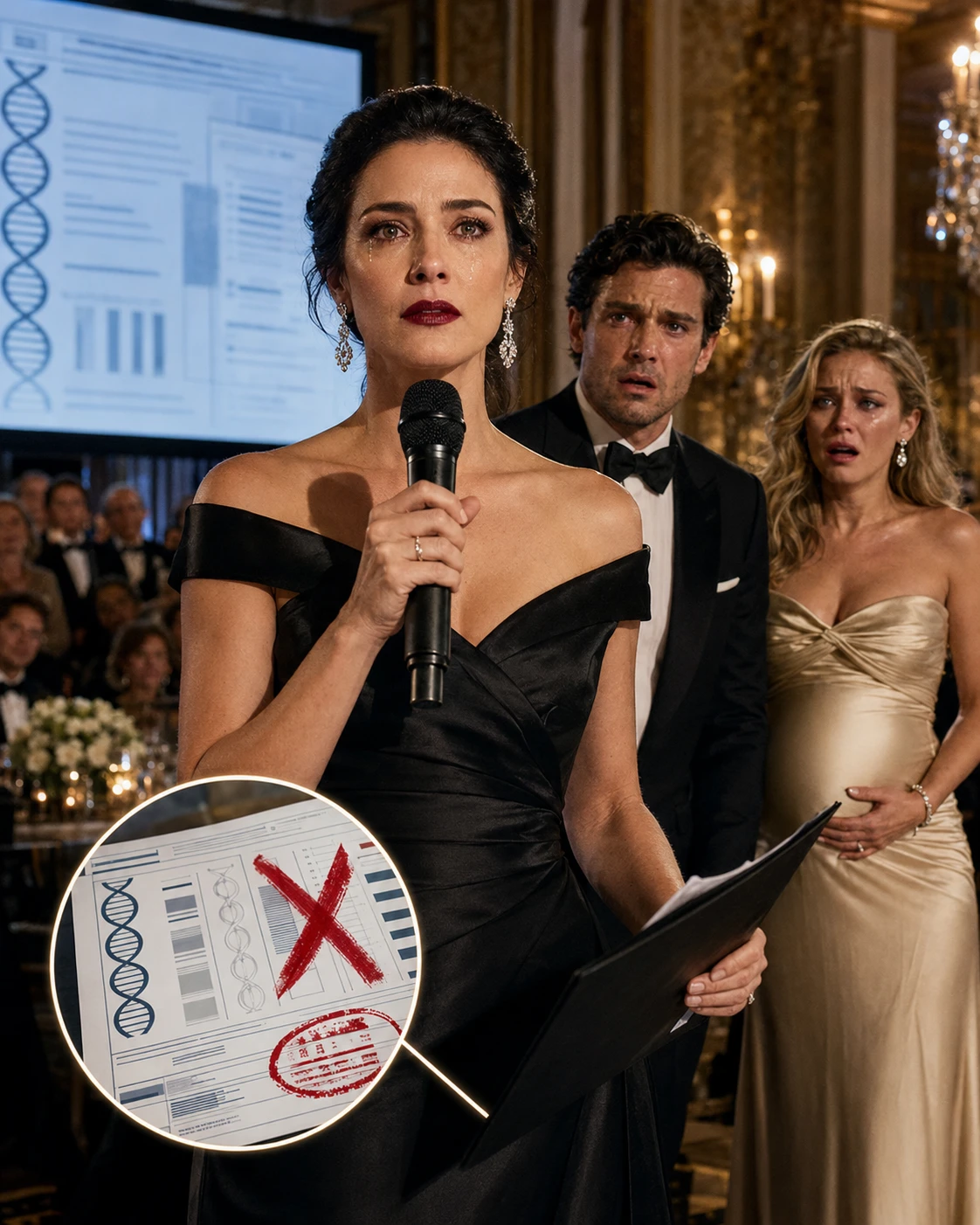
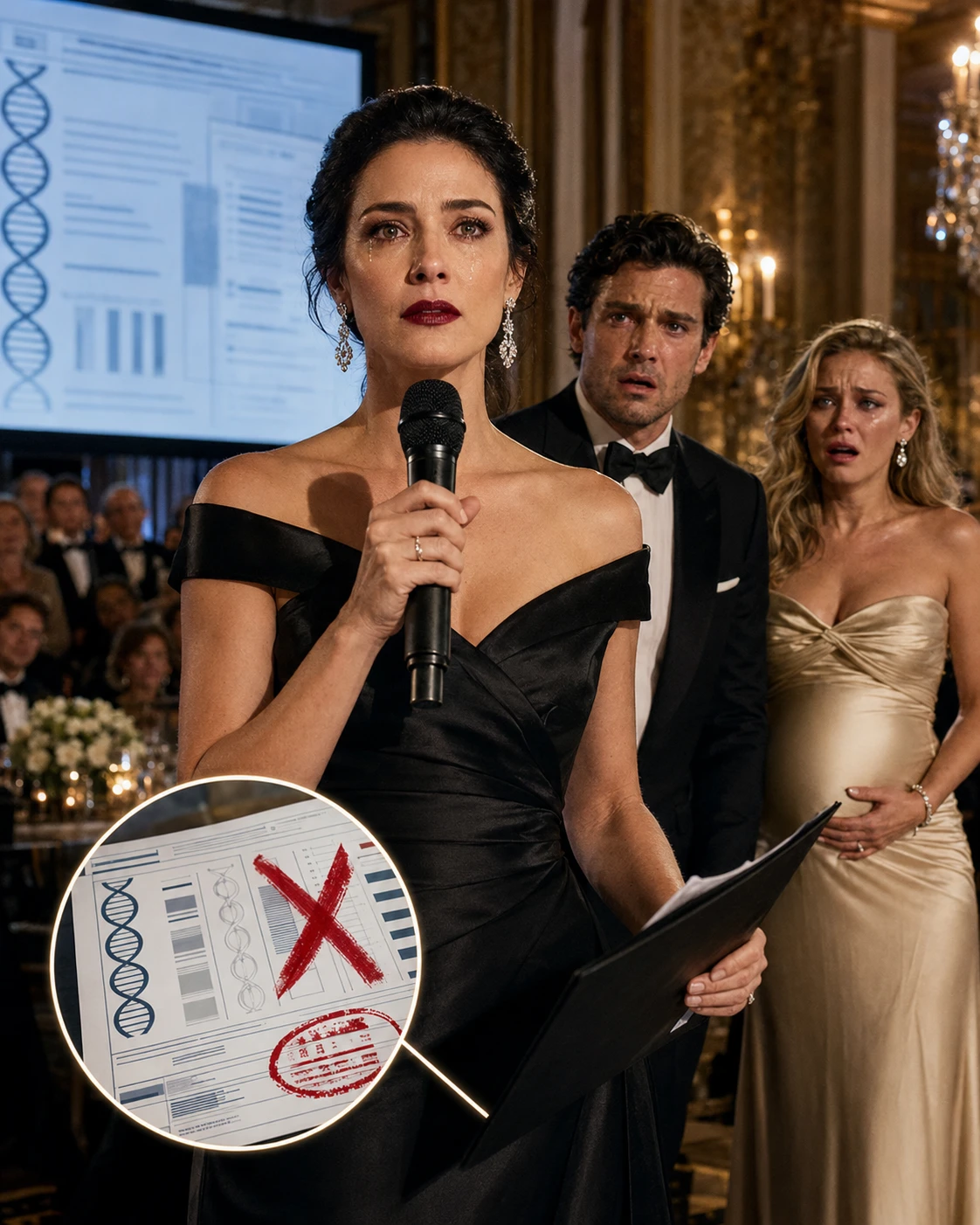
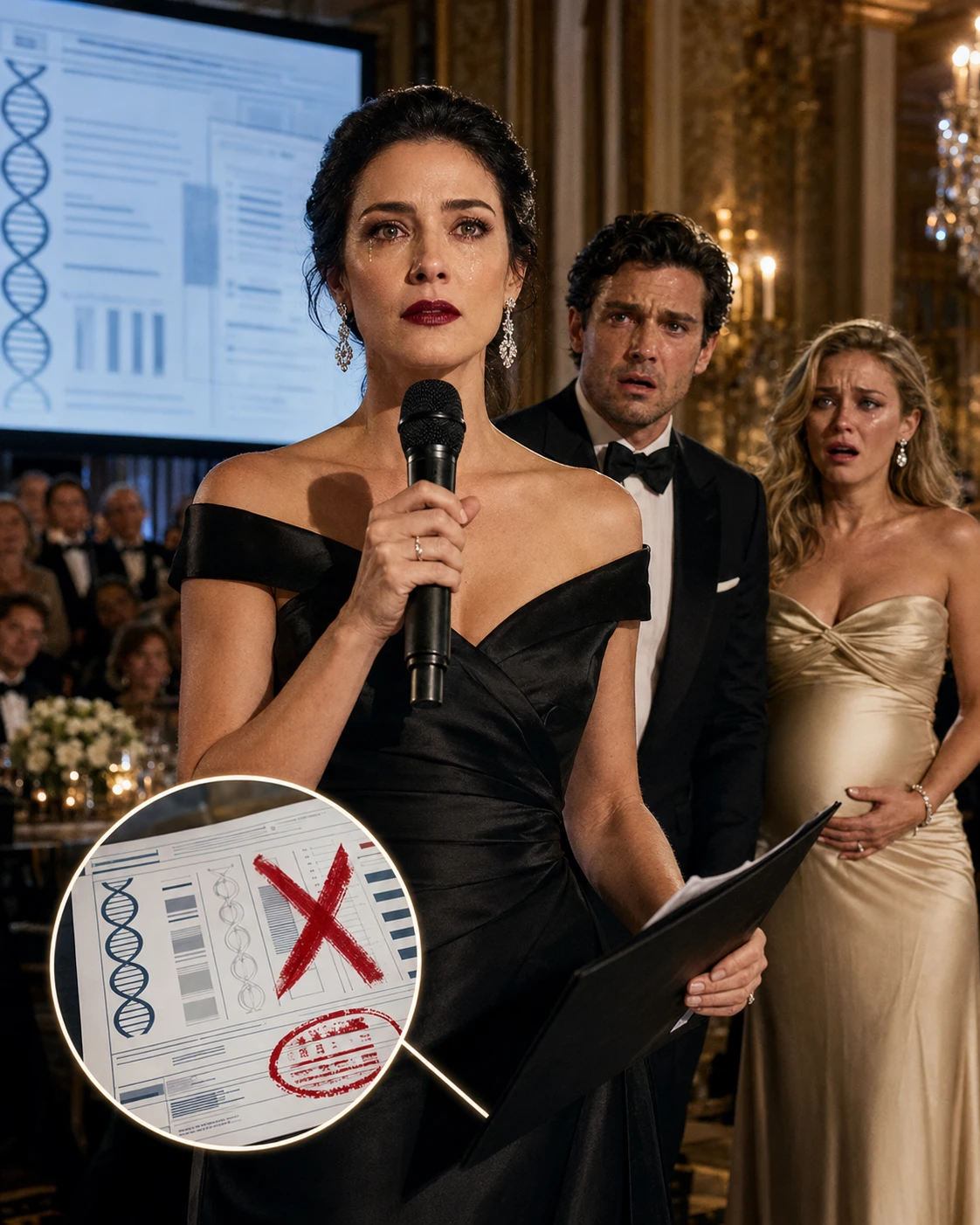
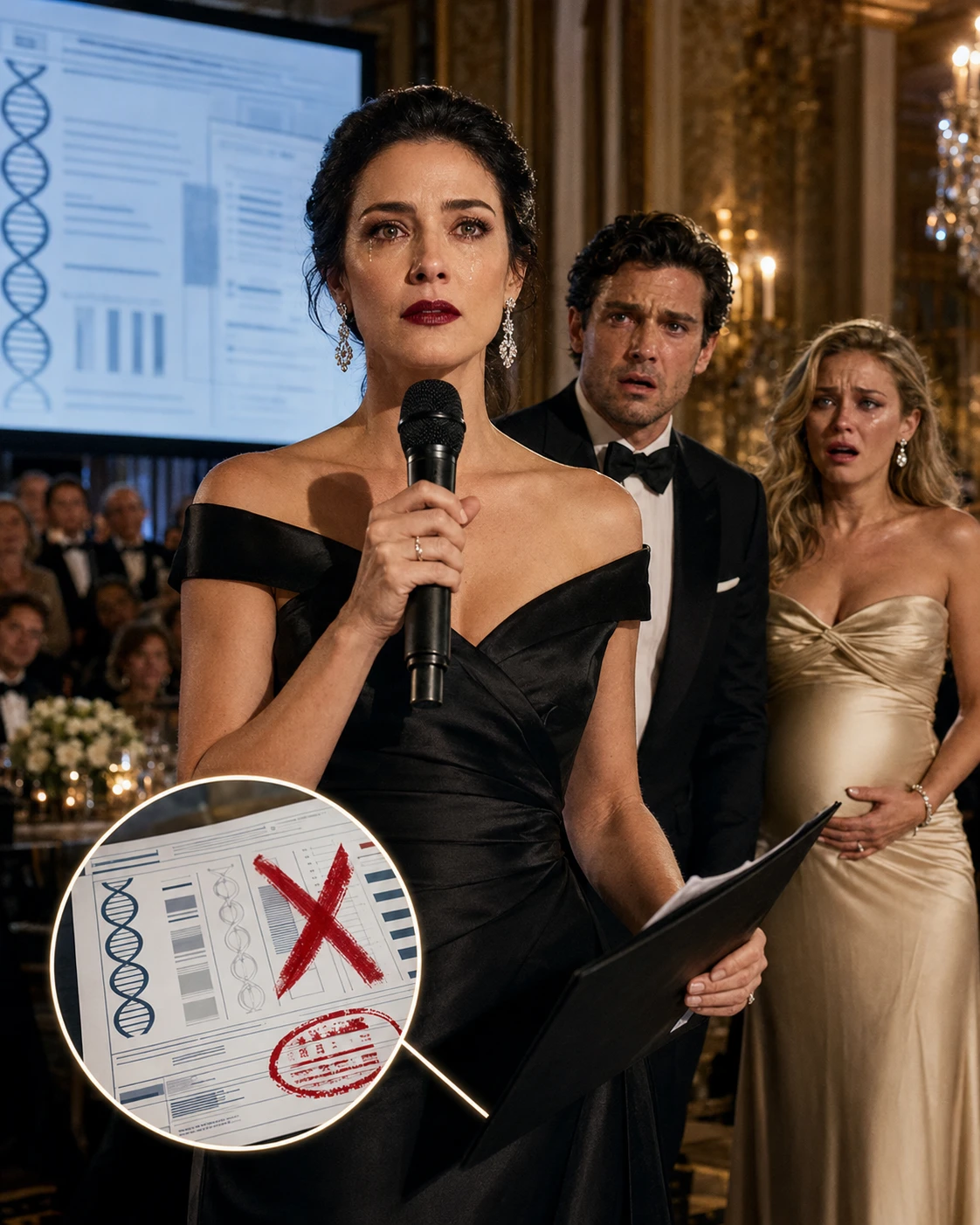
“My family foundation is built on a simple principle: care without exploitation. Tonight, since Mercer & Locke has announced a project using my family’s legacy, my estate imagery, and land connected to my private holdings, I believe transparency is appropriate.”
Julian whispered, “Evelyn.”
I did not look at him.
The screen behind us changed.
Slide one.
A legal document: Hart Estate Collection Inventory, Item 17-B.
My wedding gown.
Gasps moved through the room as the image appeared beside a still from Sienna’s TikTok.
“The gown worn in a recent viral pregnancy announcement,” I said, “is not a costume, not a loan, and not marital property. It is protected estate property belonging to the Hart Estate Collection.”
Slide two.
Security footage.
Sienna entering Hartwell’s service gate with Julian.
A garment bag over her arm.
“The garden used in the announcement is private property. Access was neither requested nor granted.”
Slide three.
Julian’s recorded admission.
I gave her the code.
His own voice, calm and unmistakable, filled the ballroom.
Someone near the front whispered, “Oh my God.”
Sienna stood abruptly.
“This is illegal,” she said.
Nora’s voice cut from the side of the stage. “It is not.”
Sienna looked at her and sat down.
Julian reached for my arm.
Adrian appeared at the stage steps without moving quickly. He did not touch Julian. He did not need to.
Julian lowered his hand.
I continued.
“Because the video and subsequent public statements were monetized, sponsored, and used to promote a business narrative, my counsel issued preservation notices. That process revealed additional concerns.”
Slide four.
A payment chart.
Mercer & Locke vendor accounts.
Larkspur Media.
Sienna’s apartment.
Luxury brand positioning.
A murmur became a wave.
“This chart reflects funds traced by a forensic accountant from marital and business accounts to expenses associated with Ms. Vale.”
Sienna’s face went white beneath her makeup.
Julian said through clenched teeth, “Stop.”
I looked at him then.
“No.”
One word.
The whole marriage inside it.
Slide five.
Digital signature analysis.
My signature, copied.
Loan documents.
Unauthorized collateral representations.
“This signature,” I said, “is mine. I did not place it on these documents.”
The room changed.
Scandal is delicious.
Forgery is dangerous.
Men who had been enjoying the show suddenly checked their own exposure. Women who had pitied me sat straighter. Donors whispered to attorneys. Board members stopped pretending they had not known Julian was messy.
Julian’s charm fell from his face in pieces.
“You don’t understand what you’re doing,” he said.
“I do.”
“Evelyn, please.”
Ah.
There it was.
Please.
The word men discover when consequence stops knocking and enters.
I turned back to the audience.
“Regarding Vale House at Briar Key, there is one final correction.”
The screen shifted to the land ownership structure.
Orchard Gate Holdings.
Briar Key Coastal Parcel.
Managing Member: Evelyn Hart Mercer.
For a full second, nobody understood.
Then Adrian smiled.
Barely.
But I saw it.
“Briar Key,” I said, “is not available for the Vale House project. It is held by my private company, and as of this evening, Orchard Gate has exercised its right to suspend all negotiations with Mercer & Locke due to covenant breaches and potential fraud.”
Julian stared at the screen as if it had betrayed him.
Sienna whispered, “What does that mean?”
No one answered her.
So I did.
“It means there is no Vale House.”
Her mouth opened.
“It means the legacy project does not have land, financing, or permission to use my family’s name.”
Julian’s face twisted. “You vindictive—”
The microphone caught it.
Every camera caught it.
The internet would feast.
But I was not finished.
Sienna made the mistake of standing again.
“You’re doing this because Julian loves me,” she cried. Tears slipped down her cheeks right on cue. “Because I’m carrying his child.”
The room froze.
There are moments when destiny hands you a blade polished clean.
You can refuse it.
Or you can cut.
I looked at Nora.
Nora gave the smallest nod.
The screen changed one last time.
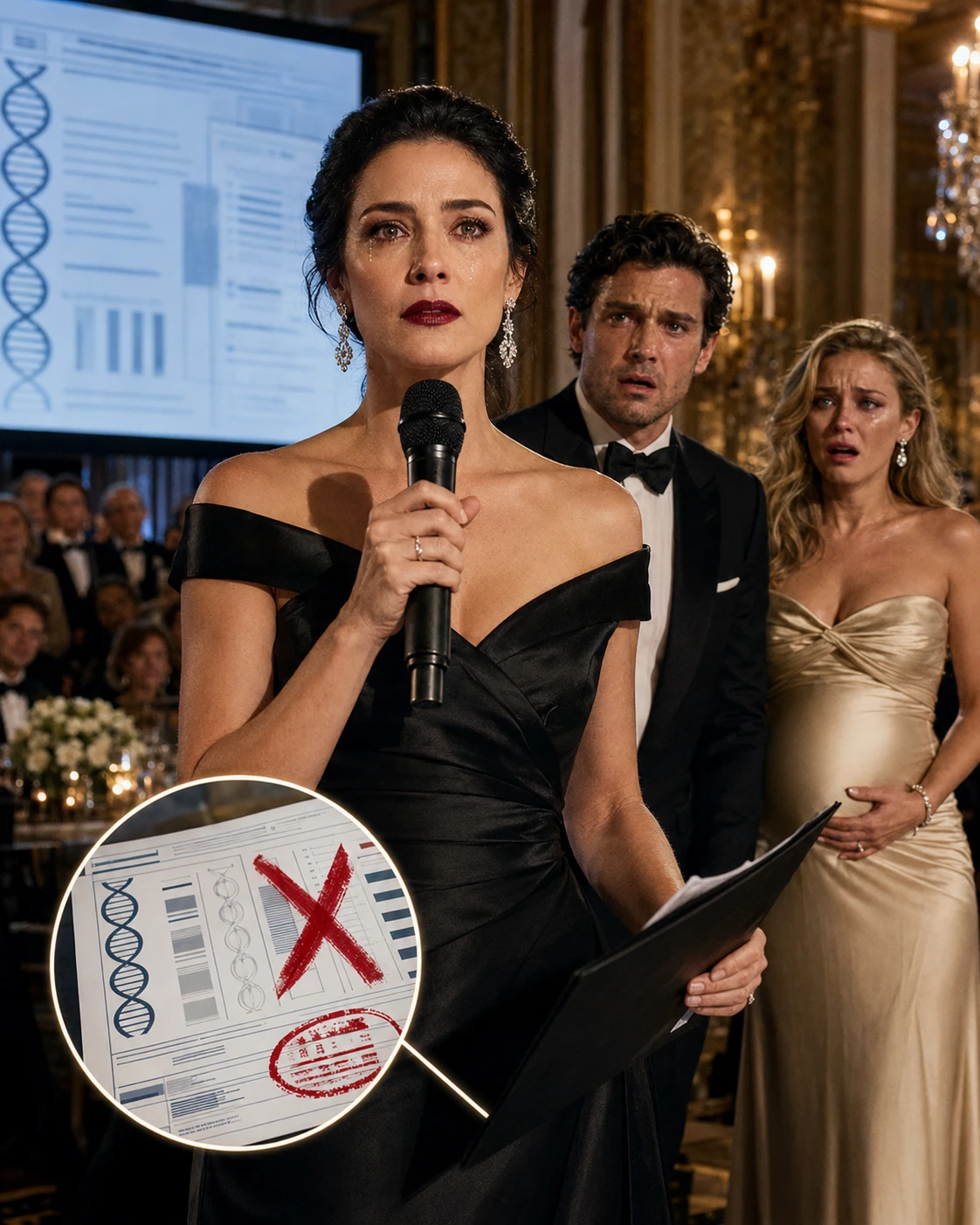
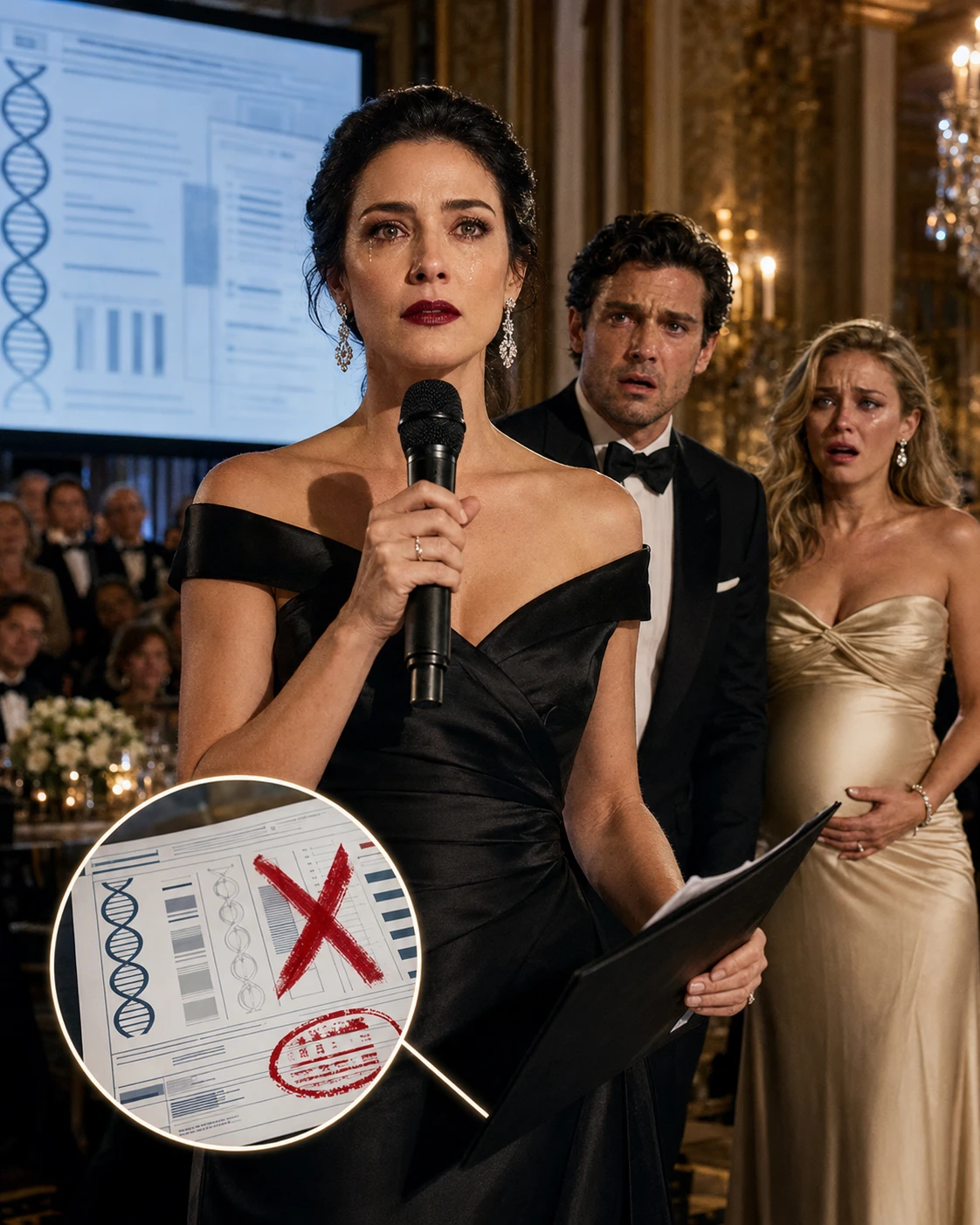
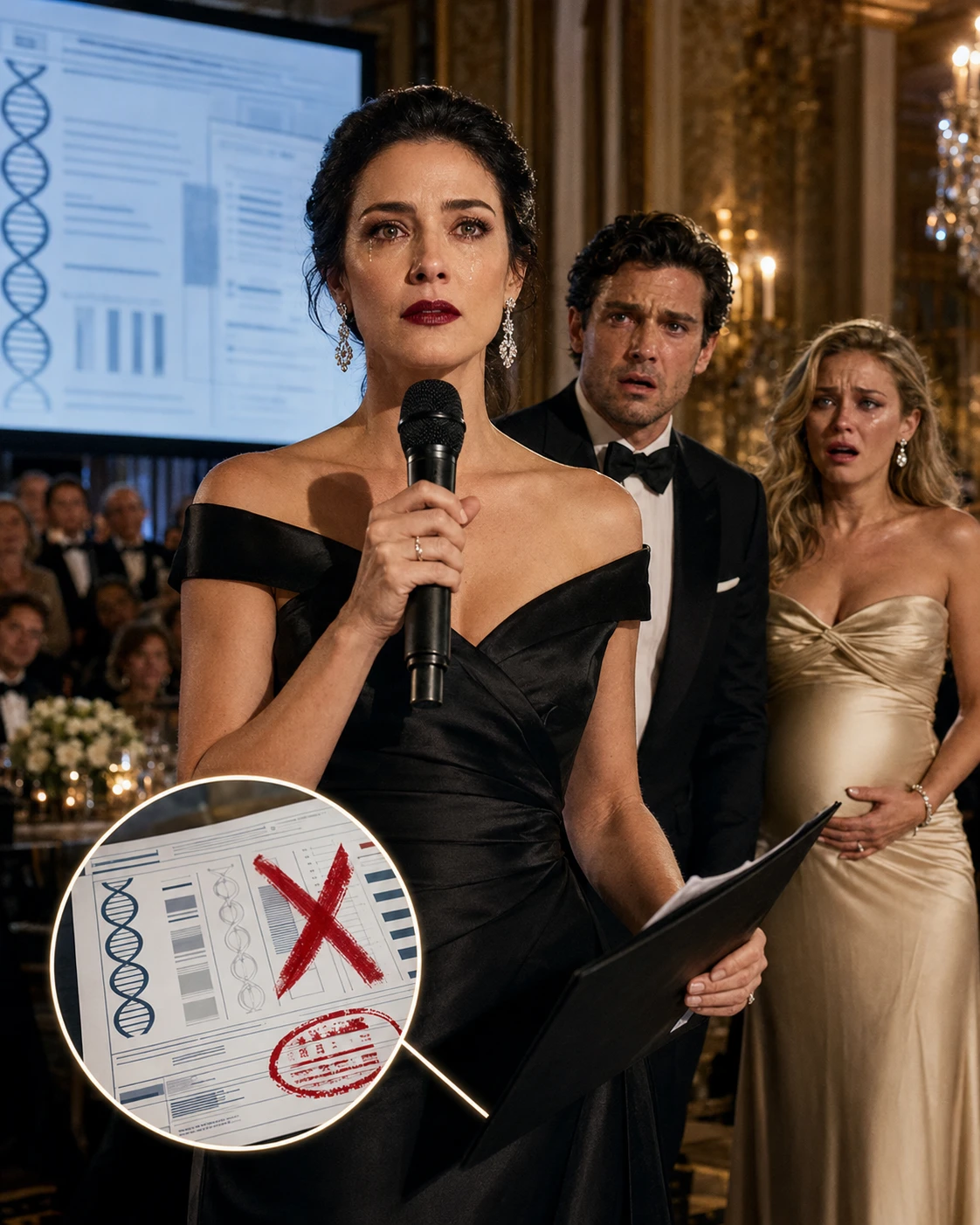
A certified laboratory report.
Julian Mercer is excluded as the biological father.
No one breathed.
The sentence sat in black letters twenty feet tall.
Sienna made a sound like silk tearing.
Julian turned to her.
Not angry at first.
Confused.
Boyish.
Almost broken.
“Sienna?” he said.
She shook her head. “No. No, it was wrong. I told you—”
“You told me it was contaminated.”
“It was.”
“Twice?”
The microphone still carried him.
Sienna reached for his hand, but he stepped back.
That was the moment the room understood the cruelty had not belonged to one woman, but two people who had tried to build a fairytale out of stolen things and found the foundation missing.
I could have stopped there.
A kinder woman might have.
But kindness had not preserved my mother’s gown.
Kindness had not stopped him from forging my signature.
Kindness had not kept them from turning my grief into a brand deck.
I lifted the microphone.
“To be clear, the child is not responsible for the conduct of adults. No child should be punished for the lies told around them. But lies used to obtain money, property, sympathy, business advantage, or public harm are not romance. They are evidence.”
I placed the microphone back on its stand.
Then I walked down from the stage.
Not rushed.
Not shaking.
The room parted for me.
A sea of diamonds, silk, cameras, and consequences.
At the edge of the ballroom, Adrian fell into step beside me.
“Car is ready,” he said.
“Of course it is.”
Behind us, chaos bloomed.
Sienna was sobbing now, but not beautifully. Julian was speaking to Nora, who was handing him a card with the name of a criminal defense attorney because Nora enjoyed theater when it was educational. Mercer & Locke’s senior partner was shouting into a phone. Donors were forwarding clips before dessert plates were cleared.
Outside, cold air hit my skin like absolution.
The photographers screamed questions.
“Evelyn!”
“Mrs. Mercer!”
“Did you know before tonight?”
“Is Julian being investigated?”
“What happens now?”
I paused by the car.
Snow had begun to fall, fine and silver under the hotel lights.
I turned back once.
Not to Julian.
Not to Sienna.
To the cameras.
And I smiled.
Not sweetly.
Never sweetly.
Then I got into the car and closed the door.
Chapter 5: After the Applause Comes the Reckoning
The video of the gala reached forty million views in thirty-six hours.
Not Sienna’s pregnancy reveal.
Mine.
The internet renamed it The Black Dress Deposition.
People clipped my lines and set them to dramatic music.
“You chose it.”
“There is no Vale House.”
“Lies used to obtain money, property, sympathy, business advantage, or public harm are not romance. They are evidence.”
Women stitched the video while removing engagement rings.
Law students used it to explain preservation notices.
Divorce attorneys posted reaction videos with captions like, “This is why you never underestimate the quiet wife.”
Someone made merchandise with Nora’s face and the words: I Dislike Virtue.
Nora pretended to hate it and ordered twelve.
For three days, my name lived everywhere.
Then, as all viral things do, the public story tried to simplify itself.
Was I iconic or cruel?
Was Sienna a villain or victim?
Was Julian a narcissist or merely stupid?
Had I gone too far?
People love a powerful woman’s revenge until they realize power means she does not ask permission to be liked.
I ignored most of it.
There was too much real work to do.
Within a week, Mercer & Locke’s board placed Julian on administrative leave. Within two, Orchard Gate called the debt. Within three, his senior partners voted to remove him. By the end of the month, Mercer & Locke became Locke Studio, then quietly entered restructuring.
Julian’s public statement arrived on a Friday afternoon, the traditional hour for cowardice.
It read like a man trapped between three attorneys and a mirror.
He apologized for “private decisions that caused public pain.” He denied intentional fraud but acknowledged “document irregularities under review.” He requested compassion for all families involved.
All families.
Still plural.
Still reaching.
Sienna posted once after the gala.
A black screen.
I am focusing on my baby and my healing. Please respect my privacy.
Then she deleted half her account.
Calvin Rhodes’s name surfaced in comment sections, then tabloids, then a legal gossip newsletter that specialized in making rich people sound like weather events. He released a statement denying wrongdoing and requesting privacy, which in America is often how people confirm they have hired expensive counsel.
I never spoke about the baby again.
That mattered to me.
The child had not trespassed.
The child had not stolen lace.
The child had not signed my name.
Adults build cages out of lies and call them protection. I had no desire to add bars.
My divorce moved quickly after the gala.
Not painlessly.
Quickly.
Julian fought at first. Men like him must perform resistance for their pride. He accused me of emotional cruelty, financial manipulation, reputational warfare, and “weaponized competence,” a phrase so perfect I almost sent flowers to his attorney.
Then Nora produced the full discovery file.
The fight became a negotiation.
The negotiation became surrender.
He waived claims to Hartwell House, the Manhattan apartment, the Palm Beach parcels, and any interest in Orchard Gate holdings he had pretended not to know existed. He repaid a portion of dissipated funds through asset liquidation. His remaining shares in the firm were consumed by debt obligations and partner claims.
The forged signatures stayed in a separate file.
Not forgiven.
Reserved.
There is a difference.
On the day Julian signed the final settlement, we met in a private conference room overlooking Bryant Park.
He looked thinner.
Not ruined exactly.
Men like Julian are rarely ruined in the way women imagine. They do not evaporate. They migrate. They become consultants, advisors, visiting fellows, men with podcasts about rebuilding after cancellation. They find younger rooms where nobody asks too many questions about the previous fire.
But he looked diminished.
That was enough.
His suit was expensive but slightly loose. His hair was still perfect. His eyes were tired in a way I had once wanted to soothe.
He signed first.
Then I did.
My signature was steady.
Nora collected the documents.
For several minutes, no one spoke.
Then Julian said, “Did you ever love me?”
Nora’s pen stopped.
Adrian, who had come as Orchard Gate counsel, looked out the window.
I studied the man across from me.
Seven years cannot be erased by betrayal. That is the inconvenient truth nobody wants in revenge stories. I had loved him in Paris rain and Newport summers. I had loved him across breakfast tables, flu seasons, foundation galas, terrible movies, and mornings when he reached for me before waking.
Love does not always leave when respect does.
Sometimes love stands in the doorway holding its coat, ashamed of how long it stayed.
“Yes,” I said.
His face changed.
The cruelty would have been to say no.
The mercy was worse.
“I loved you,” I continued, “when you were still capable of being embarrassed by your own selfishness.”
He looked down.
“I made mistakes.”
“You made choices.”
“I was unhappy.”
“So was I. I didn’t turn you into content.”
His mouth tightened, then loosened. For once, he did not argue.
“I didn’t know how to be married to you,” he said quietly.
“No,” I said. “You knew how. You just wanted the benefits of marriage and the applause of escape.”
He closed his eyes.
When he opened them, they were wet.
“I lost everything.”
I stood.
“No, Julian. You lost access.”
That was the last private sentence I ever gave my husband.
Spring came late to Newport.
The roses looked dead until they didn’t.
I spent March restoring the west garden.
Not personally, though I liked the romance of saying so. In truth, a team of brilliant gardeners did most of the work while I stood nearby with coffee and opinions. We removed the damaged climbing roses along the stone wall and replaced them with a white variety called Iceberg, chosen for resilience and a name that amused me.
The gown took longer.
The restoration specialist worked for months, unstitching damaged lace, treating stains, stabilizing the sleeve. She warned me it would never be exactly as it had been.
“Nothing is,” I said.
When the gown returned, I did not lock it away immediately.
I brought it to the west bedroom, the room with the best morning light, and laid it across the bed.
For a long time, I stood there.
I thought I would feel grief.
Instead, I felt lineage.
My grandmother, who survived a husband with a mistress in Boston and learned to invest in railroads.
My mother, who smiled through illness because she wanted my wedding day untouched by fear.
Me, who had mistaken silence for dignity until silence became strategy.
The gown was not pure.
It never had been.
It was not magic, not blessing, not proof of love. It was fabric carried by women through imperfect lives. Its beauty came not from being untouched, but from surviving contact with the world.
I had it displayed in the Hartwell archive beside a small engraved plaque.
HART ESTATE COLLECTION, ITEM 17-B
Restored 2026
Not all heirlooms are fragile.
Nora cried when she saw it and threatened me if I told anyone.
By May, the Hart Foundation announced a new initiative for women leaving financially abusive marriages. Legal support. Emergency housing. Forensic accounting grants. Private security consultations. Quiet things that save lives before anyone films a speech about empowerment.
I named it The West Garden Fund.
The internet called it iconic.
I called it overdue.
Adrian came to Hartwell for the launch dinner.
He arrived at dusk, carrying no flowers because he knew I distrusted romantic clichés, and a first edition of Edith Wharton because he knew I trusted books more than men. He wore a dark suit without a tie and looked unfortunately beautiful against the gray stone terrace.
“You look happy,” he said.
“I look rested. People confuse the two.”
“Are you?”
“Rested?”
“Happy.”
I looked toward the garden.
The roses had begun to climb again.
“I am becoming less interested in happiness as a permanent address,” I said. “I prefer peace. It has better security.”
Adrian nodded.
We walked along the gravel path as guests laughed behind us, their voices soft under string lights. The ocean moved in the dark beyond the lawn. Somewhere in the house, a pianist began playing something slow and old.
“I owe you thanks,” I said.
“No.”
“No?”
“You paid my invoices.”
I glanced at him. “You are emotionally impossible.”
“I’ve been told.”
“By women?”
“Mostly judges.”
I laughed.
It surprised us both.
Adrian stopped near the fountain, where Sienna had turned in my gown months earlier, letting the train catch the light. The stones had been cleaned. The fountain repaired. The scene had lost its violence.
That was healing, I thought.
Not forgetting.
Reclaiming the background.
Adrian looked at the water.
“I wanted to ask you something.”
The tone of his voice made me still.
“Careful,” I said. “If you propose anything tonight, I will push you into the fountain.”
His mouth curved.
A real smile this time.
It changed his face so completely I had to look away.
“I was going to ask whether you would have dinner with me next week,” he said. “Somewhere with terrible lighting and no photographers.”
“That sounds suspiciously like a date.”
“It is entirely a date.”
“I am recently divorced.”
“I am famously patient.”
“You are famously terrifying.”
“That too.”
I watched the fountain water catch the last blue of evening.
Once, I thought romance meant being chosen loudly. A man announcing you. Displaying you. Turning love into a room everyone could admire.
Now I wondered whether romance might be quieter.
Someone keeping the car ready.
Someone telling you not to give a drowning man your lungs.
Someone standing beside you without reaching for ownership.
“I’ll consider it,” I said.
Adrian’s smile deepened by one dangerous degree.
“Of course you will.”
“Do not sound so confident.”
“I’m not confident,” he said. “I’m hopeful. There’s a difference.”
That was the moment I began to forgive the future.
Not Julian.
Not Sienna.
Not what happened.
The future.
It had been standing at a distance, hands in its pockets, waiting for me to stop confusing safety with stone.
The months that followed were quieter than people expected.
No tell-all interview.
No memoir announcement.
No podcast tour.
I had been humiliated in public, but I did not owe the public my healing.
I learned to sleep diagonally in the bed.
I learned that Sunday mornings did not have to include Julian’s coffee mug in the sink.
I learned that some rooms feel larger after betrayal, not emptier.
I learned that legal documents can be love letters to your future self.
And I learned that a woman can be soft without being available for harm.
Sienna eventually returned online with a smaller account and a new vocabulary. Accountability. Growth. Boundaries. She never mentioned me by name again. Julian surfaced months later in Austin, advising a hospitality startup and appearing in photographs with people too young to remember the gala clearly.
I did not follow either of them.
Occasionally, someone sent me screenshots.
I deleted them.
Peace requires maintenance.
So do gardens.
On the first warm evening of June, I hosted dinner at Hartwell House for the West Garden Fund’s first grant recipients. Twelve women sat beneath the pergola, eating lemon pasta and laughing with the startled brightness of people who had not expected to feel safe so soon.
One woman wore a navy dress and kept touching the tablecloth as if checking that the evening was real. Another cried when Nora explained emergency injunctions over dessert. A third asked if she was allowed to take leftover cake home to her daughter.
“Allowed?” Nora said, horrified. “My dear, you are legally required.”
The woman laughed so hard she cried again.
I watched them from the end of the table, my heart aching in a way that did not hurt.
Adrian sat to my right.
Not as my savior.
Not as my secret.
Simply there.
When the guests left, each carrying flowers from the garden, I walked alone to the rose wall.
The house glowed behind me. Candlelight in old windows. Music fading. Silver being cleared. Life continuing in all its stubborn elegance.
My phone buzzed.
A notification from a stranger who had commented on an old clip of the gala.
You embarrassed them so perfectly. How did you stay so calm?
I looked at the garden.
At the roses climbing over stone.
At the fountain where theft became evidence.
At the house that had watched generations of women learn the difference between endurance and surrender.
Then I typed a reply I never posted.
I was not calm. I was prepared.
I deleted it.
Some truths belong only to the woman who survived them.
Adrian came outside and stood beside me.
“Ready?” he asked.
“For what?”
“Dessert. Nora is threatening to litigate over the last tart.”
I smiled.
“In that case, we should hurry. She’ll win.”
We walked back toward the house, side by side, not touching until our hands brushed once in the dark.
Neither of us pulled away.
Conclusion: The Warmth After Winter
People still ask about the gown.
They ask whether I regret restoring it instead of burning it. They ask whether I ever wear it around the house like some dramatic widow of the internet age. They ask whether seeing it reminds me of Julian, of Sienna, of that video, of the night my humiliation became a spectacle and then a weapon.
The truth is simpler.
The gown reminds me of my mother’s hands.
Of my grandmother’s spine.
Of my own reflection the morning after I stopped begging life to be fair and decided to be precise.
It reminds me that beauty can be stolen for a moment, but ownership is not the same as possession. A thief can wear lace. A liar can stand in golden light. A husband can call betrayal a family. A crowd can applaud the wrong woman because the camera got there before the truth.
But records remain.
Land remains.
Signatures remain.
Women remain.
And sometimes, if a woman is very patient and very done, the house itself becomes a witness.
Hartwell is warmer now.
Not because scandal left it.
Because I stopped treating my life like a museum dedicated to what I had lost.
The west garden blooms every summer. The roses are reckless. The fountain runs clear. The archive room still holds the gown behind glass, but the door is opened often now for students, historians, and women from the fund who want to see it after hearing the story.
They stand before the lace and read the plaque.
Not all heirlooms are fragile.
Some of them smile.
Some of them cry.
Some of them straighten their shoulders before they leave.
That is enough for me.
I used to believe revenge was the coldest thing a woman could carry.
I was wrong.
The coldest thing is being betrayed and still pretending not to know.
Revenge, done right, is heat returning to the body.
It is the first full breath after years underwater.
It is roses after winter.
It is a black dress beneath crystal lights.
It is the sound of your own voice saying no.
And it is the quiet, golden morning when you wake up in a house that is yours, in a life that is yours, with nothing left to prove to anyone who mistook your grace for permission.
She wore my gown for a reveal. I revealed everything.