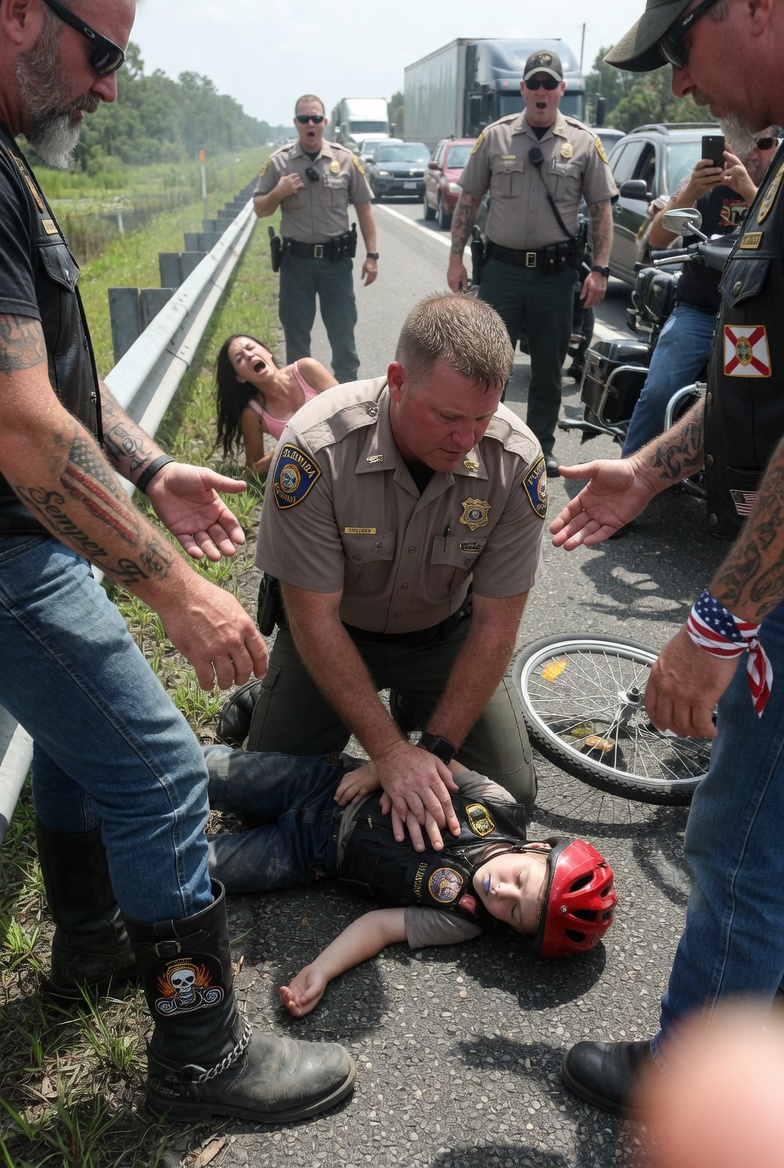
PART 2: I didn’t look up. My hands were locked in that rhythm—thirty compressions, two breaths—and I couldn’t afford to break it. Not for the growl of motorcycle engines dying one by one around me. Not for the backup officer screaming from somewhere behind my left shoulder. Not even for the face I knew was standing five feet away, watching.
The boy’s lips stayed blue. A pale, washed-out blue like the underside of a wave. I’d seen that color before on a drowning victim three summers ago, and that kid hadn’t made it. My own breath started coming in short, sharp pulls through my nose. I pressed down again and counted out loud so I wouldn’t lose my place.
“Twenty-eight, twenty-nine, thirty.”
The tiny chest gave under my palms and I felt something shift—not a crack, thank God, not that—just the small, stubborn resistance of a body that hadn’t yet decided whether to stay or go. I tilted his head back, pinched his nose, and covered his mouth with mine. His lips were cold and tasted like dust and cherry ChapStick. I blew twice. Watched his chest rise and fall. Nothing spontaneous followed.
Behind me, the second patrol unit had stopped at an angle that made their lights wash over the circle of leather and denim in strobes of red and blue. I heard boots crunch on loose gravel. A car door slammed. Then a voice I recognized—Officer Tomlinson, a ten-year veteran who’d trained me in CPR six years ago but had never stopped treating me like a rookie.
— Daniels, what the hell is going on? He called me Daniels. I didn’t correct him.
— Child down. Bicycle accident. Unresponsive on arrival.
— I can see that. I’m talking about the damn motorcycle club.
I couldn’t answer because I was counting again. My voice sounded like gravel. My knees ached from the asphalt. I’d knelt in something wet—maybe water from a blown radiator, maybe something worse—and I could feel it soaking through the fabric of my uniform pants. The humidity was a blanket. My shirt clung to my back. Sweat dripped off my forehead and landed on the boy’s Spider-Man T-shirt. I kept pressing.
The bikers didn’t move.
I heard Tomlinson’s boots stop about eight feet away. His hand would be on his belt, I knew. Thumb resting near the holster. The posture you take when you’re not drawing but you’re counting exit routes anyway. I couldn’t see his face but I could picture it—jaw tight, eyes scanning the circle, doing the same risk calculation every cop does when they roll up on a scene that looks like the opening shot of a riot.
— Sir, I need you to step back, he said. His tone had shifted into the controlled, deliberate cadence we use when things are about an inch from sideways.
The response didn’t come as a shout. It came as a quiet, steady voice from directly in front of me.
— We’re not moving.
That voice. I knew it. Ten years and I still knew it. Marcus Hale. The kid I’d pulled over on a humid night just like this one, back when I was twenty-five and so rigid you could’ve snapped me in half. He’d been twenty-three, mouthy, scared underneath all the swagger. Suspended license. A minor warrant from a missed court date for a speeding ticket he couldn’t afford to pay. I’d cuffed him by the book. Didn’t bend. Didn’t listen when he begged me not to because he’d lose his job at the warehouse. He did lose it. And then his girl left and took their baby boy with her. I’d found all that out later, lying awake at three in the morning, staring at the ceiling of my empty apartment and wondering why some arrests felt heavier than others.
Now his voice was right there, and I still couldn’t look up because the boy’s pulse wasn’t back yet.
— Sir, I’m not going to ask again. Tomlinson’s voice tightened.
— Officer. Marcus said it like a name, not a title. There was something in his tone I couldn’t decode—exhaustion, maybe. Or something else. The man standing here isn’t being threatened. Look at his hands. What are they doing?
I was mid-compression. One-two-three-four. The boy’s Spider-Man shirt had ridden up. His belly was pale and soft. I saw a little scar near his belly button—an umbilical hernia repair, probably, something my sister’s kid had too—and it made him so real and so small that my throat closed for half a second.
Tomlinson didn’t answer right away. I heard him take a step closer. Then another. I knew the exact moment he registered what I was doing because his breathing changed.
— How long have you been at it?
— Seven minutes, I grunted. Maybe eight.
— Where’s the bus?
— En route. I heard the siren maybe a minute ago. It’s still a ways out.
The sirens were there, way off in the distance, a thin wail threading through the heavy air like a needle through canvas. Not close enough. Not nearly close enough.
And then the mother started screaming again.
I’d almost blocked her out—some animal part of my brain had shut off everything except the rhythm of my hands—but her voice cut through now, raw and shattered. She was maybe thirty feet away, sitting in the tall grass beside the guardrail where someone had helped her down. I couldn’t see her, but I could hear every word.
— Lucas! Baby, please! Please, God, please—
Her voice cracked and broke and started again. Over and over. The kind of sound that digs into your spine and stays there for years. I’d heard it before on domestic calls, on accident scenes, in hospital waiting rooms at two in the morning. It never got easier.
One of the bikers—older, gray beard, thick arms crossed over his chest—shifted his weight. I saw his boots turn slightly. He was looking toward the mother. Then he looked back at me. I still couldn’t see his face clearly, just the outline of his jaw and the way his shoulders were set. But something about the way he stood there, planted like a tree, made the hair on my arms rise.
Tomlinson was still tense. I could feel it radiating off him. The backup officer with him—a younger cop named Rojas who’d only been out of the academy for six months—had circled around to the other side of the scene. I heard his voice, high and tight, trying to project authority he didn’t yet own.
— Ma’am, I need you to stay back. Ma’am!
The mother must have tried to get up, to run toward her son. I heard a scuffle in the grass. Rojas was probably blocking her, trying to keep her from contaminating the scene or getting in the way of the paramedics who still weren’t here yet. She fought him. I heard her fists hitting his chest.
— Let me go! That’s my son! That’s my baby!
My rhythm stuttered for half a beat. I forced myself back into it. One-two-three-four. Don’t stop. You stop, and the oxygen stops, and the brain starts dying, and you will carry that weight for the rest of your life. I knew the statistics. Four to six minutes without oxygen and the damage becomes permanent. After ten, survival rates drop below five percent. I didn’t know exactly how long the boy had been down before I arrived. The call had come in as a minor collision—bicycle versus guardrail, dispatch said, probably nothing serious—but when I pulled up and saw the twisted training wheel and the small, motionless shape on the asphalt, my whole body had gone cold.
I was on my knees before the car stopped rolling.
— Hey, I said suddenly. My voice came out ragged. I wasn’t talking to Tomlinson or Rojas or the bikers. I was talking to her. The mother. Ma’am. Ma’am, what’s his name?
She stopped fighting. I heard her breathing, harsh and wet.
— Lucas. His name is Lucas.
— Lucas, I repeated. I said it loud enough for the boy to hear, if he was still in there somewhere. Lucas, my name is Daniel. I’m a police officer. I’m right here with you, buddy. We’re going to get you some help. You just hang on for me, okay? You hang on.
I don’t know if he could hear me. The medical part of my brain said probably not. The human part said talk anyway. So I kept talking. I told him about the ambulance that was coming, about the doctors who were going to fix him up, about how his mom was right over there and she was so proud of him for being so brave. I said his name again and again like a prayer I didn’t know I remembered.
And then, underneath the rhythm of my hands and the sound of my own voice, I heard something change.
The biker in front of me—the one I knew without looking was Marcus Hale—shifted his weight. His boots scraped against the pavement. I felt him step closer, not toward me, but toward the space beside me. The perimeter shifted with him. Two of the other bikers moved to close the gap he left. It was like watching a flock of birds adjust mid-flight—silent, coordinated, instinctive.
— Lucas, Marcus said. His voice was different now. Lower. Softer. Like the name itself hurt him. Lucas.
And in that one word, I knew.
I knew before my brain could assemble the pieces. I knew the way you know a storm is coming before the first drop hits. The boy’s face—I’d barely looked at it except to check his airway, his color, the response of his pupils. But now I saw it. The same jawline. The same brow. The same dark hair, sweated down against his forehead. Five years old. The age Marcus’s son would be now. The son he’d lost custody of when everything fell apart.
The boy I was trying to save was his.
My hands kept moving. They had to. There was no room in my chest for the full weight of that realization—not yet—so I shoved it into a corner of my mind and locked the door. But some part of me stumbled. Some part of me looked at the forty men standing silent around me and understood that this was not a confrontation. This was a vigil.
Tomlinson must have seen something change in my posture because his voice sharpened.
— Reeves, what is it? What’s wrong?
I couldn’t answer. I was pressing down on the chest of the son of a man I’d once sent to jail, and the universe had folded itself into a shape so cruel and so precise that I couldn’t breathe around it.
Marcus Hale knelt down on the other side of his son.
He didn’t get in my way. He didn’t push me aside. He just knelt there on the hot asphalt, his leather vest creaking with the movement, and he put one hand on the pavement next to his boy’s head. His face was stone. His eyes were wet.
— I’m here, Lucas. Daddy’s here.
I kept going. Thirty and two. Thirty and two. My shoulders were burning. My wrists ached. My back was a knot of fire. But I didn’t stop. I couldn’t. Because the father of this child was kneeling beside me, and ten years of history were pressing on my chest harder than my hands were pressing on his son’s.
The siren got closer.
And the circle of bikers held.
No one drove through.
No one escalated.
And the cameras kept rolling, and the drivers kept watching, and none of them knew what they were really seeing. None of them knew that the cop in the center had once ruined this man’s life, and that the same man had just ordered forty of his brothers to stand down, to protect the scene, to give that cop space to work.
They only saw leather and badges and the thin, trembling line between violence and grace.
I tilted the boy’s head back and gave him two more breaths.
— Come on, Lucas, I whispered against his lips. Come on, buddy. Your dad’s here. Don’t you leave him. Don’t you leave him now.
And then, faint and thready under my fingers, I felt it.
A pulse.
It was weak—barely there—but it was a pulse. A real one. Beating against my fingertips like a moth trapped in a jar. I pulled my hands back just enough to feel it again, pressing two fingers to the side of his neck. There. Bump-bump. Bump-bump. Slow. Irregular. But there.
— I’ve got a pulse, I said. My voice cracked on the last word. I’ve got a pulse!
Marcus made a sound I cannot describe. It was not a word. It was not a sob. It was something raw and primal, dragged up from a place words don’t reach. He pressed his forehead to the pavement and his shoulders shook once. Just once. Then he lifted his head and looked at his son’s face with an expression that tore something open in my own chest.
— Stay with me, he said. His voice was steady now. Steadier than mine. You stay with me, Lucas. You hear me? You stay.
The siren was close now. I could see the ambulance in my peripheral vision, swinging wide around the stopped traffic, its red lights cutting through the haze. The bikers parted to let it through like water around a stone—smooth, silent, without a single word. I’d never seen anything like it. Forty men in leather and denim, moving as one to clear a path for the paramedics who were about to take over.
Tomlinson stepped back. Rojas stepped back. The scene that had looked like a standoff five minutes ago now looked like a carefully orchestrated rescue, and I was still on my knees in the center of it, hands shaking, uniform soaked, watching the medics rush toward us with a stretcher and a bag of equipment.
— Sir, we’ve got it from here.
A young woman in navy blue knelt beside me, gloved hands already moving. She was calm and fast and utterly focused. I leaned back and let her take over, and the moment my hands left the boy’s chest I felt the full weight of what I’d just done crash into me like a wave.
My arms were trembling. My vision swam. I tried to stand and my knees buckled. Somebody caught my elbow—one of the bikers, I think, though I never saw his face. He steadied me without a word and then let go.
I watched them work. Watched the oxygen mask go over Lucas’s face. Watched the IV line slide into his arm. Watched the monitor beep to life with a rhythm that wasn’t mine. The boy’s color was still bad—grayish, shallow—but it was improving. Pink crept slowly back into his lips. His eyelids fluttered once and then stilled.
— We’ve got a sinus rhythm. Pressure’s low but stabilizing. Let’s move, let’s move.
They lifted him onto the stretcher with practiced efficiency. The mother—her name was Sarah, I would learn later—pushed past Rojas and grabbed the rail. She was crying so hard she couldn’t speak, but her hand found her son’s hand and held it. Marcus stood up. His eyes tracked the stretcher as it rolled toward the ambulance doors.
He didn’t look at me.
Not yet.
One of the paramedics turned back. — Any family riding with us?
Sarah climbed in without hesitation. Marcus took one step toward the ambulance, then stopped. He turned his head. His eyes found mine across twenty feet of asphalt and flashing lights and the dissolving perimeter of his brothers. The look he gave me was not gratitude. It was not forgiveness. It was something else entirely—something I didn’t have a name for yet.
He got into the ambulance.
The doors slammed shut.
The siren wailed back to life and the ambulance pulled away, heading east toward St. Mary’s Medical Center, and I was left standing on the side of Highway 17 with sweat drying on my neck and a circle of bikers who had not come to hurt me.
The drivers who had been recording from their cars slowly lowered their phones. Some of them looked confused. Some of them looked moved. A few looked disappointed, and that made me sick in a way I couldn’t quite articulate. They had wanted a story about violence. What they got was a story about a child and the strangers who stood guard while a cop tried to bring him back.
Tomlinson walked over to me. His face was a mess of emotions he was trying to keep professional.
— You okay, Reeves?
— I’m fine.
— You’re shaking.
I looked down at my hands. They were shaking. Badly. I pressed them against my thighs to make them stop. It didn’t work.
— That kid, I said. My voice sounded like it belonged to someone else. His father. I arrested him. Ten years ago.
Tomlinson’s expression didn’t change, but something behind his eyes flickered. He’d been on the force long enough to know that small towns have long memories, and cops don’t always get to choose which of their decisions come back to find them.
— We’ll deal with that later, he said. Right now, let’s clear the scene.
Clearing the scene meant talking to the bikers. The forty men who had formed a human barricade were still standing in loose clusters near their motorcycles. None of them had left. None of them looked like they wanted to. The tall one with the gray beard—I would learn his name was Frank, the club’s road captain—was speaking quietly to a few others near the front of the formation. They nodded and glanced at me and then looked away.
I walked toward them. My legs felt like they belonged to a stranger. My uniform was ruined—dirt, sweat, something I didn’t want to identify on my knees. My cap was still on the ground somewhere near where the boy had lain. I didn’t pick it up.
Frank saw me coming and straightened. He was maybe fifty-five, weathered in a way that spoke of decades on the road. His cut was faded but clean. The patches were Road Saints—I could read them now—and they didn’t carry the kind of insignia that meant trouble with rival clubs. These were riders. Riders with pasts, maybe, but not predators.
— Officer, he said. His voice was gravel and patience.
— I need to get some statements, I said. For the report.
— We figured.
I pulled out my notebook. My hand was still trembling. I ignored it. — Can you tell me what happened? How you all came to be here?
Frank glanced at the man beside him—younger, thirties, sleeve tattoos—and then back at me. — We were on a run. Charity ride. Raising money for the children’s hospital, if you can believe it.
I didn’t say anything. He continued.
— We were about five miles back when Marcus got the call. His ex-wife, Sarah. She was screaming, couldn’t make sense. Just kept saying Lucas, accident, highway. We were the closest thing to help she had. So we came.
— Forty of you.
— Forty of us, he agreed. The rest stayed back. Didn’t want to overwhelm the scene. He paused, and something wry touched the corner of his mouth. Guess we overwhelmed it anyway.
I wrote it down, though my handwriting was a mess. — And when you arrived? What did you see?
— We saw you. On your knees. Doing what you were doing. Traffic was still moving in the right lane. Cars were slowing down to gawk. Somebody was going to cause another accident, or worse, drift into the shoulder and hit you both. So Marcus gave the signal, and we made a wall. That’s all.
That’s all. Like it was simple. Like forty men forming a human shield around a cop was just the obvious thing to do.
— You didn’t know the officer in the middle was me? I asked.
Frank’s expression didn’t flicker. — Oh, we knew.
I stopped writing.
— Marcus knew, Frank said. He knew the minute he saw your face. Told us over the comms. Said it didn’t change anything. Said his boy was in your hands and we were going to make sure those hands had room to work. So that’s what we did.
I stared at my notebook. The words blurred. I blinked and they cleared.
— I arrested him, I said. My voice was hoarse. Ten years ago. It cost him everything.
Frank was quiet for a long moment. The younger biker beside him shifted his weight but didn’t speak.
— You think we don’t know that? Frank said finally. Marcus has carried that for a decade. He’s talked about it. Some of us were there when he got out, when he lost his job, when Sarah left. We know exactly who you are, Officer Reeves.
I didn’t have a response. There was no response that would fit.
— And he still gave the order to protect you, Frank said. So maybe sit with that for a while.
He turned and walked back toward his bike. The others followed. One by one, the engines started—low, respectful rumbles, not the aggressive roar I’d braced for. They pulled onto the highway in formation and disappeared into the late-afternoon haze, heading in the direction of the hospital.
Tomlinson walked up beside me. — You get what you needed?
— Yeah, I said. I got it.
— You okay to drive?
— Yeah.
— You don’t look okay.
I looked at him. — I’m not. But I’ll get there.
The hospital was twenty minutes east. I drove with the window down and the radio off. My hands had stopped shaking but my chest hadn’t. There was a pressure there—not pain, exactly, but something dense and heavy, like a stone that had been dropped into deep water and was still sinking.
St. Mary’s Medical Center was a low, white building with a red cross on the sign and a parking lot that was half empty at this hour. I parked in the visitor section and sat in the car for a long minute. I could see the motorcycles. Forty of them, lined up in neat rows at the far end of the lot. The bikers were there too—sitting on the curb, leaning against their bikes, talking quietly. None of them looked at me as I walked past, but I felt their attention like a physical weight.
The automatic doors opened with a soft hiss. The hospital smelled like every hospital—antiseptic, floor wax, something floral that was supposed to be calming but always made me think of funerals. The woman at the front desk looked up with the practiced neutrality of someone who has seen too many people walk in wearing fear.
— I’m looking for Lucas Hale, I said. He was brought in by ambulance about half an hour ago.
She typed something. — Are you family?
— No. I’m the officer who was on scene.
Her expression shifted—still professional, but softer. — Pediatric ICU, third floor. The waiting room is at the end of the hall. Someone will come talk to you when they can.
The elevator ride took about ten years. The doors opened onto a corridor painted in muted blues and greens, with cartoon animals on the walls and chairs that were too small for grown men to sit in comfortably. I walked past a playroom with a fish tank and a shelf of worn picture books. The contrast between that cheerful space and the weight in my chest was sharp enough to cut.
The waiting room was quiet. Sarah was in a corner chair, her face buried in her hands. A woman I assumed was a friend or relative sat beside her, rubbing her back in slow circles. And near the window, standing alone with his arms crossed over his chest, was Marcus Hale.
He looked up when I walked in.
His eyes were red. His jaw was set. He was still wearing his cut, though it hung open now over a plain black T-shirt. He looked exhausted—wrecked, really—but there was a steadiness in his posture that I recognized. It was the same steadiness I’d seen in him ten years ago, standing on the side of a different road with his hands cuffed behind his back and his life about to change.
I stopped in the doorway. I didn’t know where to stand, what to say, whether I even had the right to be here. My uniform was filthy. My badge was crooked. I was still missing my cap.
Marcus spoke first.
— You came.
— Yeah.
— Didn’t have to.
— I know.
A pause. The hum of the vending machine filled the silence. Somewhere down the hall, a child laughed—another child, in another room, with a different story—and the sound was surreal against the weight of everything else.
— They said his vitals are stabilizing, Marcus said. He’s still unconscious but the CT scan was clear. No brain bleed. They think he just hit his head hard enough to knock him out. The biggest danger was the lack of oxygen before you got there.
I absorbed that. The before you got there part. He could have said before anyone got there. He didn’t.
— That’s good, I said. That’s really good.
— They said if you’d stopped—if you’d waited for the paramedics—he wouldn’t have made it.
I had nothing to say to that. I’d done what I was trained to do. Any officer would have done the same. But I knew that wasn’t what he meant. He meant that I—the man who had once put him in handcuffs for a stupid, preventable mistake—had been the one to keep his son alive.
Marcus uncrossed his arms. He took a step toward me. Then another. He stopped about three feet away, close enough that I could see the deep lines around his eyes and the gray starting to thread through his beard.
— I need to ask you something, he said.
— Okay.
— When you saw it was my son—when you realized—did it change anything?
I thought about the moment on the highway. The instant I recognized Lucas’s face. The way my heart had stumbled and my hands had kept moving anyway.
— No, I said. It didn’t change anything. I was always going to do everything I could.
He stared at me for a long time. Long enough that I could feel the weight of ten years pressing against my skin. Then he nodded—once, slowly—and something in his face shifted. Not forgiveness. Not yet. But the possibility of it. The door opening just a crack.
— Thank you, he said.
Two words. Not loud. Not dramatic. Just direct. The same way he’d given the order to his club. The same way he’d knelt beside his son on the hot asphalt and said I’m here.
— You don’t have to thank me, I said.
— Yeah, I do. And you don’t have to understand why. But I do.
I didn’t know what to do with my hands. I couldn’t put them in my pockets because my uniform pants were still damp with whatever I’d knelt in. I couldn’t cross my arms because that felt too closed off. I just stood there, awkward and exhausted, while the man I’d once arrested thanked me for saving his child.
Sarah looked up from her corner. Her eyes were swollen but her expression had shifted from despair to something fragile and raw and beginning to mend. She looked at me, then at Marcus, then back at me.
— You’re the officer, she said. Her voice was scratchy. The one who did CPR.
— Yes, ma’am.
— They said you didn’t stop. Even when everyone thought something else was happening. You didn’t stop.
— I couldn’t, I said. He was a kid.
She pressed her lips together and nodded. A tear slipped down her cheek and she wiped it away with the back of her hand. — His favorite color is red. He loves Spider-Man. He just learned to ride that bike last week. He was so proud.
My throat tightened. — He’s tough, I said. He held on. He’s a fighter.
— He gets that from his dad.
She glanced at Marcus. There was history in that glance—complicated, unresolved, but not hateful. He met her eyes and something passed between them that I wasn’t part of. I looked away to give them privacy.
A nurse appeared in the doorway. She was young, with kind eyes and a clipboard.
— Mr. Hale? Lucas is awake. He’s asking for you.
Marcus’s whole body went still. For a heartbeat, I saw the fear flash across his face—the terror that after everything, something would still be wrong—and then he was moving toward the door. He paused at the threshold and looked back at me.
— Come on, he said.
I blinked. — I don’t want to intrude.
— You’re not. He asked for both of us.
Both of us. I didn’t know what that meant. I didn’t know how Lucas even knew I existed. But I followed Marcus down the hall, past the fish tank and the cartoon animals and the doors that led to rooms where children fought battles no child should ever fight.
Lucas’s room was small and pale. The blinds were drawn against the afternoon sun, casting everything in a soft, grayish light. The bed seemed enormous for such a small boy. He was propped up slightly, an oxygen tube resting under his nose, IV lines snaking out from his arm. His face was bruised and puffy. But his eyes were open. Dark brown, like his father’s.
He looked at Marcus first.
— Daddy.
Marcus crossed the room in three strides and knelt by the bed. He didn’t cry—not quite—but his voice was thick and rough when he spoke. — Hey, buddy. I’m here. I’m right here.
— My bike broke, Lucas said. His voice was a whisper. I fell.
— I know. You’re okay now. You’re going to be okay.
Lucas’s eyes drifted over to me. He studied my uniform, my face, the dirt on my knees. He looked at me with the uncomplicated curiosity of a child who hasn’t yet learned to be afraid of strangers.
— You’re the policeman, he said.
— Yeah. My name’s Daniel.
— You did the breathing.
I wasn’t sure what he meant at first. Then I realized: someone must have told him. His mother, probably. Or maybe he’d been aware on some level, floating in that gray space between consciousness and not, and had felt my breath in his lungs.
— I did, I said. You did the hard part, though. You came back.
— Mommy said I died a little bit.
My chest ached. — You scared us all pretty good.
He considered that. Then, with the solemn gravity of a five-year-old processing something far too large for him, he asked: — Will you teach me how to not fall off my bike?
I almost laughed. It wasn’t funny—nothing about this was funny—but the absurdity of the question, the innocence of it, hit me in a place I didn’t know was still soft.
— I think your dad’s probably a better teacher than me.
Lucas looked at Marcus. — Daddy doesn’t ride a bicycle. He rides a motorcycle.
— That’s true, Marcus said. His voice was steadier now. But I’ll learn. For you.
Sarah came in behind us. She went straight to the bed and gathered Lucas into her arms as carefully as she could around the wires and tubes. She was crying again, but it was the clean, relieved crying of someone who had been holding her breath for hours and was finally allowed to exhale.
I stepped back toward the door. This was a family moment, and I didn’t belong in it. But Marcus looked up and caught my eye, and something in his expression stopped me.
— Stay, he said. Just for a minute.
So I stayed.
We stood there in the soft gray light of that hospital room—a cop, a biker, a mother, and a boy who had almost slipped away—and for a few minutes, none of the old history mattered. There was only the beep of the monitor, the hiss of the oxygen, and the small, steady sound of Lucas breathing on his own.
The bikers were still in the parking lot when I left the hospital three hours later. I’d stayed longer than I meant to. Sarah had insisted on buying me a terrible cup of coffee from the vending machine, and Marcus and I had ended up in the hallway talking about nothing and everything—the town, the weather, the impossibly long wait for Lucas’s discharge papers. We didn’t talk about the arrest. Not yet. That conversation was coming, and we both knew it, but neither of us was ready.
When I walked out into the evening air, the sky was orange and pink and the heat had finally started to break. The motorcycles were still there, lined up in the same neat rows. Frank was leaning against his bike with a cup of gas-station coffee. He raised it in my direction.
— Officer.
— Frank.
— They say the kid’s going to be okay.
— They do.
He nodded. Took a sip of his coffee. — You know, in twenty years with this club, I’ve seen a lot of things. Good things. Bad things. Things I can’t unsee. But I’ve never seen Marcus give an order to protect a cop. Not once.
I didn’t know what to say.
— You must have done something right out there, he said. Or maybe he saw something in you he didn’t expect. Either way. Don’t waste it.
He crushed his coffee cup and tossed it in a nearby trash can. Then he swung a leg over his bike and started the engine. One by one, the others followed. The rumble filled the parking lot, not aggressive, just present. A quiet declaration.
I watched them ride out.
And then I got in my car and drove home.
The house was dark when I got there. It was always dark. I lived alone, had for years. The plants on the porch were dead because I kept forgetting to water them. The mail had piled up. I let myself in and stood in the kitchen for a long time, still in my ruined uniform, staring at nothing.
I thought about the boy. His small chest. The way his pulse had come back under my fingers. The way his father had knelt beside me on the asphalt and said I’m here.
I thought about the arrest. Ten years ago. A kid with a suspended license and a mouth full of fear. I’d read him his rights and cuffed him and put him in the back of my car, and I hadn’t thought about him again until tonight. That was the ugly truth. I hadn’t thought about him at all. He was a case number to me. A citation. A box checked. And while I’d moved on to the next call and the next arrest and the next shift, his life had fallen apart.
I thought about what Frank had said. Don’t waste it.
I didn’t sleep that night. I sat on my porch and watched the sky turn from black to gray to gold, and by the time the sun was fully up, I knew I had to do something. Not for absolution. I wasn’t naive enough to think a single good act could cancel out a decade of consequences. But for Lucas. For Marcus. For the forty men who had stood in a circle and chosen peace when every instinct and every camera expected war.
The next morning, I called the hospital. Lucas was still stable, they said. Probably going home in a couple of days. I called my supervisor and told him I needed a few personal days. He’d already heard about the scene on the highway—it had made the local news, though thankfully without the wild speculation I’d feared—and he told me to take all the time I needed.
I went back to the hospital. Sarah was there, looking less haunted than the day before. Lucas was sitting up in bed, eating Jell-O, watching cartoons on a tablet. He smiled when he saw me. A real smile. The kind that kids give without reservation.
— Daniel!
— Hey, champ. How are you feeling?
— My head hurts. But the Jell-O is green. That’s my favorite.
Marcus came in a few minutes later. He’d showered and changed—clean jeans, a plain white shirt, no cut. He looked younger without it. Or maybe just lighter.
— You’re back, he said.
— Told you I’d stick around.
He pulled up a chair next to mine. For a while we just sat there, watching Lucas explain the intricate plot of his cartoon to anyone who would listen. Sarah excused herself to get coffee, and the two of us were left alone with the beeping machines and the quiet hum of the hospital.
— I’ve been thinking, Marcus said.
— Yeah?
— About what happens now. When this is over. When Lucas gets out.
— What do you want to happen?
He was quiet for a moment. — I want him to grow up in a world where people don’t hate each other just because of what they wear or what they do. I want him to know that the man who saved his life was a cop. And that it mattered.
— It was my job, I said.
— No. He shook his head. Your job is to enforce the law. What you did out there wasn’t about the law. It was about being human. You don’t get to hide behind the badge on this one.
I looked at my hands. They were clean now. No dirt. No sweat. Just the same hands that had pressed into a child’s chest and felt his heart stutter back to life.
— I’ve been thinking too, I said. About ten years ago.
Marcus’s expression didn’t change, but something in his posture stiffened.
— I arrested you for a suspended license, I said. It was the right call by the book. But I didn’t listen to you. You tried to explain—you had a job, a family, a court date you’d missed because you couldn’t afford the fine—and I didn’t listen. I just cuffed you and moved on. And that cost you. I know it cost you.
— It did, he said quietly.
— I’m not asking for forgiveness. I just want you to know that I remember. And I’m sorry.
The word hung in the air between us. I’m sorry. Two words that cops aren’t supposed to say, not like this, not to the people we’ve arrested. But I said them anyway because they were true.
Marcus didn’t answer right away. He stared at the wall for a long moment, his jaw working. Then he let out a breath I hadn’t realized he was holding.
— That arrest, he said. It broke me for a while. I’m not going to pretend it didn’t. I lost my job. Sarah left. I didn’t see Lucas for three years. It was dark. Real dark.
I stayed silent.
— But you want to know something strange? He turned to look at me. If that hadn’t happened, I wouldn’t have found the club. I wouldn’t have gotten sober. I wouldn’t have fought to get my life back together. I’m not saying I’m grateful for what you did. I’m not. But I’m not the same person I was back then. And neither are you.
— No, I said. I’m not.
— So maybe that’s what we do with this. We don’t pretend it didn’t happen. We don’t let it define us either. We just… move forward.
Move forward. It sounded simple. It wasn’t. But maybe it was enough.
Lucas looked up from his tablet. — Daddy, is Daniel coming to my birthday party?
Marcus glanced at me. A question in his eyes.
— When is it? I asked.
— Three weeks, Lucas said. I’m gonna be six. We’re having cake and Spider-Man plates and a bounce house. You have to come.
I looked at Marcus. He shrugged, a small, tired half-smile touching the corner of his mouth.
— You heard the kid, he said. You have to come.
— I wouldn’t miss it, I said.
And I meant it.
Three weeks later, I stood in the backyard of a modest house on the edge of town, holding a paper plate with a slice of red-velvet cake, watching Lucas Hale bounce in a inflatable castle with five of his friends from kindergarten. The Spider-Man plates were exactly as promised. The cake had a web pattern. There were streamers on the fence and a piñata shaped like a motorcycle, which Frank had apparently insisted on.
Forty bikers were there. Not all of them—some had stayed back at the clubhouse, Frank said, because they didn’t want to overwhelm the neighbors—but enough that the street looked like a motorcycle dealership. They’d brought gifts. A tiny leather vest with Lucas’s name stitched on the back. A Spider-Man helmet. A brand-new bicycle—red, with training wheels and a bell—that they’d all chipped in for.
Marcus found me standing near the grill, watching the chaos.
— You came.
— Said I would.
He handed me a beer. I took it. We stood there for a while, not talking, just watching the kids run and scream and be kids. The afternoon sun was warm but not punishing. Someone had put on music—classic rock, low enough not to disturb the neighbors. A few of the bikers were playing cornhole in the driveway. Sarah was laughing with a group of women near the snack table. Lucas was shrieking with joy in the bounce house, his bruises long healed, his laughter bright and wild and alive.
— You know, Marcus said, a year ago I never would have imagined this.
— What, a cop at your son’s birthday party?
— A cop I didn’t hate. He took a sip of his beer. Don’t get me wrong. I still got issues with the system. A lot of us do. But you’re not the system. You’re just a guy who did the right thing when it mattered.
— I’m trying to be, I said.
— That’s all any of us can do.
The afternoon wore on. The cake got eaten. The piñata got destroyed. Lucas opened his presents with the wild, tearing enthusiasm of a child who had almost lost everything and was now drowning in joy. When he got to the bicycle, he insisted on riding it immediately, so we cleared a path on the sidewalk and I found myself jogging alongside him, one hand on the seat, promising not to let go.
— Don’t let go yet! he yelled.
— I won’t.
— Promise?
— Promise.
And I didn’t. Not until he was ready. And when he finally pedaled away on his own, wobbling but upright, he let out a whoop of pure, unfiltered triumph that made every adult in the yard stop and cheer.
Marcus walked over and stood beside me. He was wearing his cut again, but it hung open and easy. The patch on the back caught the light: Road Saints.
— You’re good with him, he said.
— He’s easy to be good with.
— Still. He paused. I never thought I’d say this to you, of all people. But I’m glad you were there that day.
— So am I, I said. So am I.
The sun dipped lower. The party wound down. The bikers mounted their rides and pulled away in groups of two and three, engines rumbling in a familiar, steady rhythm. Frank gave me a nod as he left. A few others waved. I was still the cop. They were still the club. But something had shifted. Something permanent and real.
I stayed until the last streamer was taken down and the last paper plate was thrown away. Sarah hugged me. Lucas demanded one more promise—that I would come to his next birthday too. I told him I would try. Marcus walked me to my car.
— Before you go, he said. I’ve been thinking about something.
— What’s that?
— The community outreach thing. The police department does those events, right? Coffee with a Cop, that kind of stuff.
— Yeah. We do.
— I was thinking. Maybe the club could come. Not as a stunt. Just to show people that we can be in the same room. That we don’t have to be enemies.
I thought about what that would look like. Forty bikers and a roomful of cops, drinking coffee and making small talk. It sounded impossible. It sounded absurd. It sounded exactly like the kind of thing that needed to happen.
— I’ll talk to my supervisor, I said.
— And I’ll talk to the club. No promises. But maybe.
— Maybe is enough.
He stuck out his hand. I took it. His grip was firm and calloused and steady. We stood there in the quiet suburban twilight, two men who had once been on opposite sides of handcuffs, and we shook hands like equals.
— Take care of yourself, Reeves.
— You too, Hale.
I got in my car and drove home. The sky was the same orange and pink it had been the night I left the hospital. But it felt different now. Lighter. Like the weight I’d been carrying for ten years had finally started to lift.
The house was still dark when I got there. The plants on the porch were still dead. But I stood in the driveway for a long minute anyway, looking up at the stars as they blinked into view one by one, and I thought about second chances.
I thought about Lucas, breathing on his own. About Marcus, kneeling in the asphalt. About forty bikers who had formed a circle not to trap a cop but to protect a child. About the cameras that had caught the wrong story and the truth that had unfolded anyway. About the fact that the hardest thing any of us can do is stop seeing each other as symbols and start seeing each other as people.
I thought about all of that. And then I went inside, and I watered the dead plants, because maybe some things could still come back.
The days after Lucas’s birthday party passed in a strange, suspended quiet. I went back to work. The routine of patrol—morning briefing, traffic stops, paperwork, the endless cycle of small-town calls—settled back over me like a familiar coat. But I moved through it differently now. The badge on my chest felt heavier in some moments and lighter in others. I found myself lingering longer on certain calls, listening harder to the people I encountered. I couldn’t change the system overnight. I couldn’t undo the arrests I’d made without compassion. But I could be different from here forward. I could choose differently.
A week after the party, my supervisor called me into his office. Captain Morrison was a gruff man in his late fifties, with a silver mustache and a desk covered in commendations and coffee rings. He had the look of someone who had seen too much but still believed in the job.
— Reeves, he said. Shut the door.
I shut the door. Sat down. Waited.
— I read your report on the Highway 17 incident. He tapped a folder on his desk. Hell of a thing.
— Yes, sir.
— The bikers. The Road Saints. You’re aware they’ve got a bit of a reputation?
— I’m aware they’ve been labeled. I’m not sure the label fits.
Morrison studied me for a long moment. — That’s an interesting thing for a patrol officer to say.
— Sir, I was there. What happened on that highway wasn’t a confrontation. It was a rescue operation. Those men didn’t threaten anyone. They formed a perimeter to keep traffic away from a child. The child’s father is a club member. He gave the order.
— The same father you arrested ten years ago.
— Yes, sir.
— And he didn’t take the opportunity to settle a score.
— No, sir. He didn’t.
Morrison leaned back in his chair. The springs creaked. — The public affairs office has been getting calls. Some people want to do a story on it. Human interest. Cop and biker come together. That sort of thing. The chief is cautious. Doesn’t want to look like we’re endorsing a motorcycle club.
— What does the chief want?
— He wants my recommendation. So I’m asking you. Should we engage with these people? The outreach idea you mentioned—Coffee with a Cop, inviting the Road Saints—is that something we can do without it blowing up in our faces?
I thought about Marcus. About Frank. About the forty men who had stood in silence and protected a scene when every stereotype said they should have done the opposite.
— Sir, I think we should do more than invite them. I think we should learn from them.
Morrison raised an eyebrow. — Go on.
— The community doesn’t trust us. Some of them never have. The Road Saints aren’t saints, but they’re not a gang either. They’re just people. Riders. A lot of them have records—small stuff, mostly—but they’ve built something that matters to them. If we can sit down in the same room and talk like human beings, it sends a message. Not just to them. To everyone.
He was quiet for a long time. Then he nodded slowly.
— Set it up, he said. I’ll deal with the chief.
The first Coffee with a Cop event that included the Road Saints happened on a Saturday morning in early October. The community center on Maple Street had a low ceiling and fluorescent lights and not enough chairs. I’d spent the week before spreading the word—flyers at the gas station, announcements on the local radio station, a post on the department’s Facebook page that got more comments than any post we’d ever made.
Most of the comments were supportive. Some weren’t.
I expected that.
What I didn’t expect was the turnout. By nine o’clock, the parking lot was full. Cars, motorcycles, a few bicycles that kids had ridden over. I counted twenty bikers—not the full forty, but a solid showing. Marcus was there, of course, with Sarah and Lucas. Lucas had insisted on wearing his tiny Road Saints vest, which he’d barely taken off since the party. Frank was there, holding a cup of black coffee and looking profoundly uncomfortable. A dozen other club members stood in small clusters, talking to anyone who approached.
And people approached. That was the surprising part. Neighbors. Parents. A few local business owners. An elderly woman who had seen the news coverage and wanted to thank the bikers herself. A young couple who were new to town and just curious. A reporter from the local paper, who spent most of her time talking to Lucas about his bicycle.
Captain Morrison came. So did Tomlinson and Rojas and half a dozen other officers. We all wore our uniforms. They all wore their cuts. And for two hours, we just talked. About traffic safety and community events and what it was like to ride a motorcycle across three states with forty of your closest friends. About the fear that people felt when they saw a group of bikers and the frustration the bikers felt at being judged. About the fear people felt when they saw a police car in their rearview mirror and the frustration officers felt at being reduced to a uniform.
It wasn’t easy. There were tense moments. A man in a plaid shirt asked Marcus directly if he’d ever been arrested, and Marcus looked him in the eye and said, “Yes, I have. And the officer who arrested me is standing right over there, and we’re fine. So maybe ask a better question.” The man turned red and walked away, but a few other people nodded.
By the end of the event, someone had set up a folding table with donuts and more coffee, and a group of bikers and cops were playing an impromptu game of cornhole in the parking lot. Lucas was sitting on the hood of a patrol car, wearing Rojas’s cap, while Rojas showed him how to work the siren button. Sarah was laughing with Tomlinson’s wife. Frank was having a quiet, intense conversation with Captain Morrison that I couldn’t hear but that ended with both men shaking hands.
Marcus found me standing near the door.
— You did this, he said.
— We did this.
— No. I mean it. You could have written your report and moved on. You didn’t. He gestured at the room. This is because you didn’t let it go.
— I couldn’t let it go, I said. Not after what happened. Not after Lucas.
— Lucas is fine. He’s better than fine. He’s started telling everyone at school that his best friend is a police officer.
I laughed. — I’m honored.
— You should be. He doesn’t give that title out easily.
We stood there in comfortable silence, watching the room hum with conversation. It wasn’t perfect. It wasn’t going to fix everything. But it was a start. And sometimes a start is all you need.
— I want to do something else, Marcus said. Something bigger.
— Like what?
— There’s a charity ride next month. The children’s hospital again. We do it every year. I want the department to be part of it. Not just a police escort. I want officers to ride with us. To stand at the finish line. To show the kids that the people in uniform and the people in leather are all on the same side.
I thought about the highway. The flashing lights. The circle of boots and engines and held breath. I thought about how close we’d all come to disaster and how, instead, we’d found something else.
— I’ll make it happen, I said.
And I did.
The charity ride took place on a crisp November morning, the sky a pale, clean blue. Forty motorcycles lined up in the parking lot of St. Mary’s Medical Center, their chrome shining, their engines idling in a low, respectful rumble. Marcus was at the front, Frank beside him. Behind them, the rest of the Road Saints waited in formation. And behind them—flanked by two patrol cars with their lights flashing in steady, non-emergency pulses—were three police motorcycles. I wasn’t on one. I was in a patrol car, coordinating traffic. But Rojas had gotten his motorcycle certification that summer, and he was up there in his riding gear, looking nervous and proud. Tomlinson was with him. Another officer from a neighboring town had joined too.
The ride wound through downtown, past the library and the school and the park where Lucas had learned to ride his bike. People lined the streets. Some held signs. Some just watched. Children waved. Parents took pictures. It was the kind of scene that doesn’t make national news because it isn’t tragic or sensational. It’s just ordinary. And sometimes ordinary is the most radical thing there is.
At the finish line, Lucas was waiting. He’d been given the honorary job of holding the checkered flag, and he waved it so enthusiastically that he nearly fell over. The motorcycles pulled in one by one, and the riders dismounted, and the hospital courtyard filled with the smell of exhaust and fried food from the fundraising tent. Donations were collected. Speeches were made. The hospital administrator cried a little when she thanked everyone for coming.
And then, after the crowd had thinned and the sun had started its slow descent, Marcus and I found ourselves standing in the same spot where we’d stood after the accident—the parking lot outside the ER entrance. The same pavement. The same orange-pink sky.
— You ever think about that day? he asked.
— Every day.
— Me too.
— Does it get easier?
He considered the question. — It gets different. The fear fades. What stays is the knowing. The knowing that it almost went another way. That’s not always comfortable. But it keeps things in perspective.
— Yeah, I said. It does.
— I used to think about you, he said. Before all this. I used to think about what I’d say to you if I ever saw you again.
— What did you think you’d say?
— A lot of things. Most of them I’m not proud of. But I never imagined this. He gestured at the hospital, the remnants of the event, the motorcycles parked in neat rows. I never imagined I’d be standing here with you, feeling grateful.
— Life’s strange, I said.
— Life’s strange.
A long pause. The wind picked up, rustling the leaves that had started to turn. Fall was coming. The seasons were changing. Everything was changing.
— I’m not the same man I was ten years ago, I said.
— Neither am I.
— I think that’s the point.
He looked at me. The scar above his eyebrow caught the fading light. His eyes were clear and steady. The same eyes his son had. The same eyes that had watched me on the highway while I pressed life back into a small, still chest.
— You know, he said, I never thought I’d say this. But I’m glad it was you.
— Me too, I said. I’m glad it was me.
We didn’t shake hands this time. We didn’t need to. We just stood there, two men who had been enemies and were now something else—something harder to define but easier to carry—and watched the sun go down on a world that had, for one moment, chosen grace over vengeance.
And in the distance, a little boy in a red Spider-Man helmet rode his bicycle in wobbly circles, laughing.
Alive.