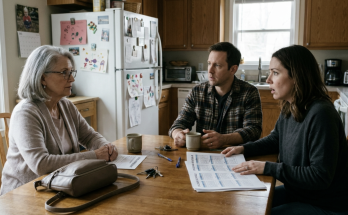
I came home from my last appointment before maternity leave and found my baby’s nursery door repainted in his mistress’s favorite color.
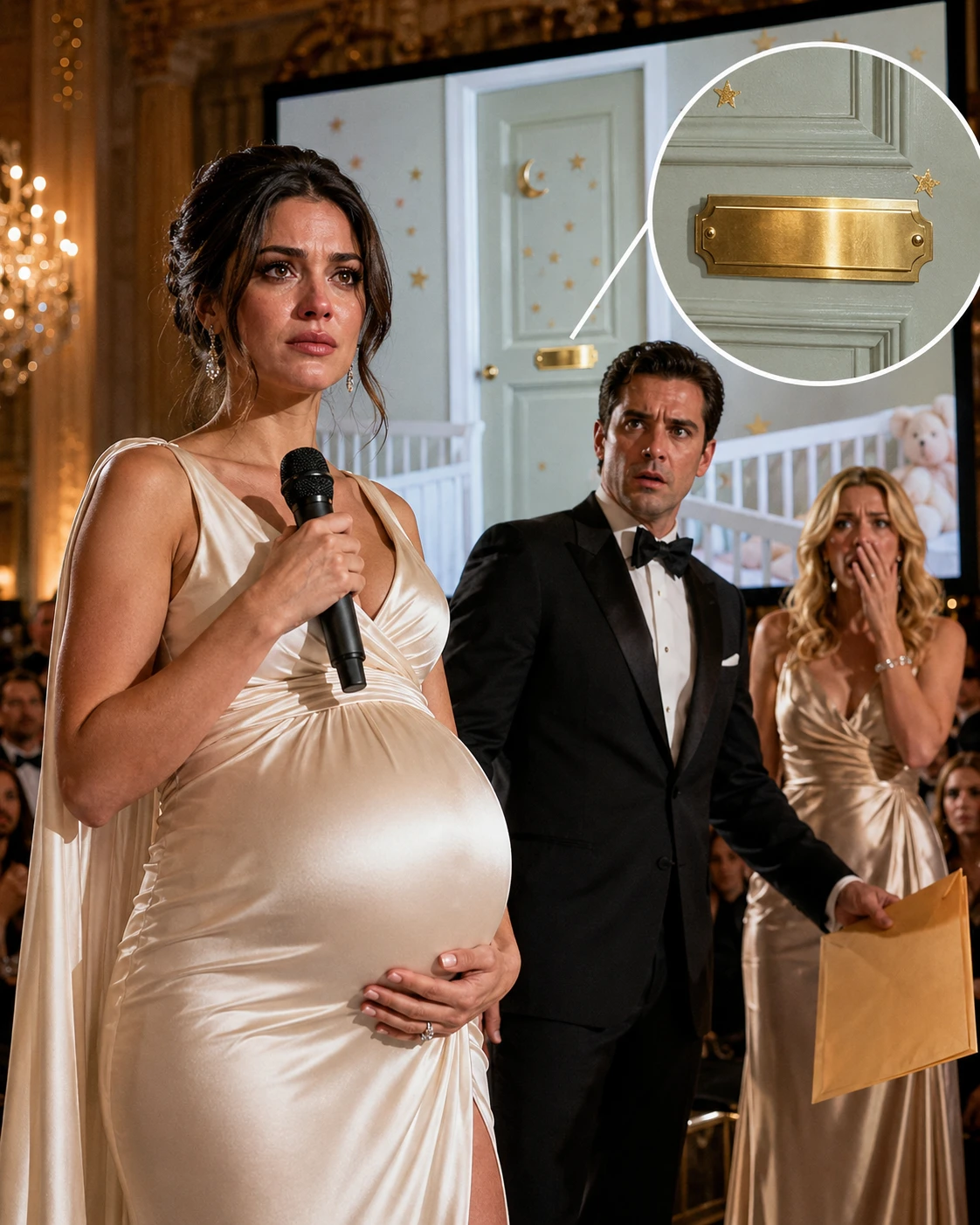
The soft yellow I had chosen during pregnancy was gone. In its place was a pale, expensive green, the kind of green women like Sloane Vale called “sage” when they wanted it to sound peaceful and “heritage” when they wanted it to sound rich. Gold stars glimmered across the door in a pattern I recognized from a mood board I had never approved.
My husband stood beside it in a charcoal Tom Ford suit, smiling as though he had just surprised me with diamonds instead of erased me from my own child’s room.
“It’s more modern,” Nathan said.
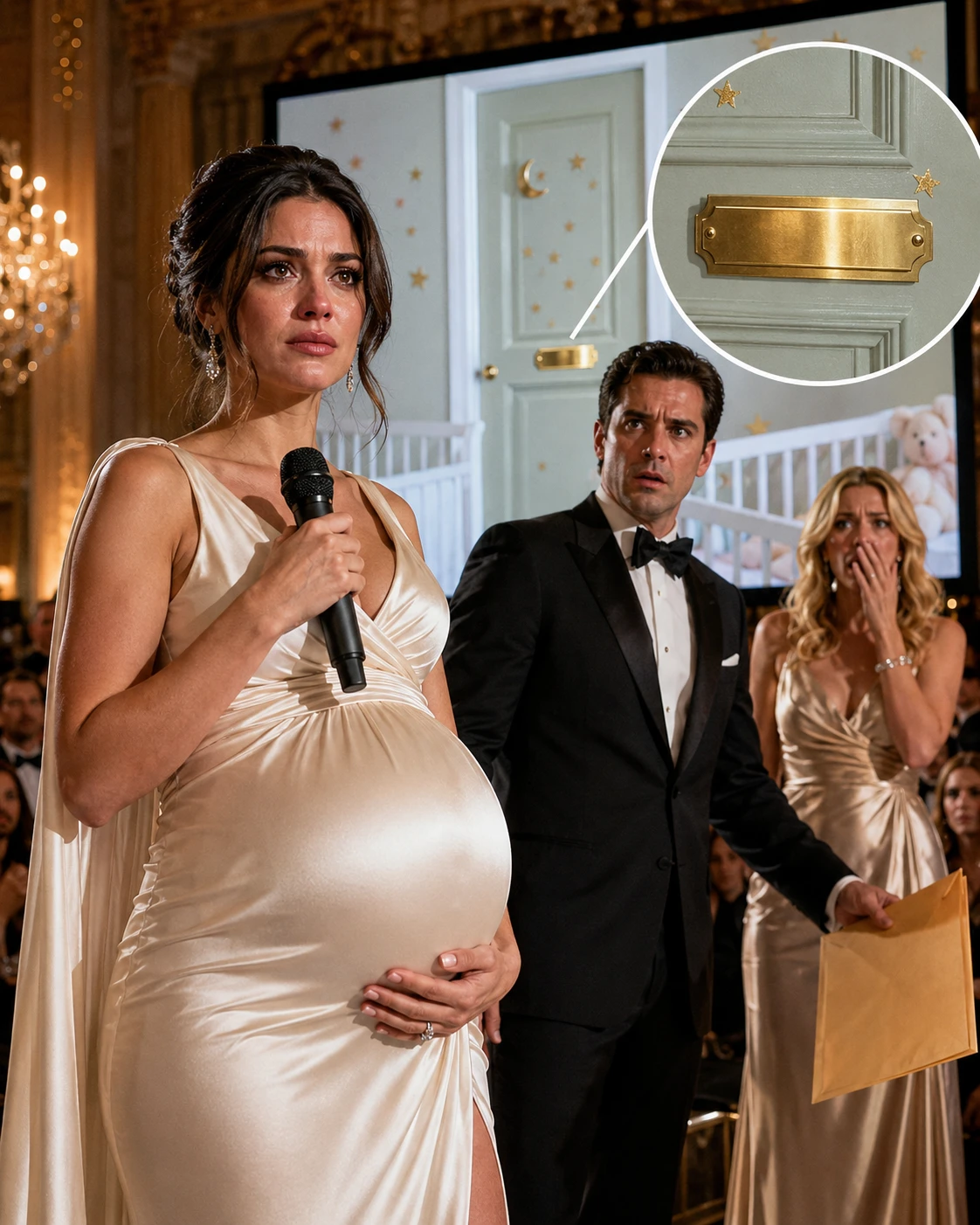
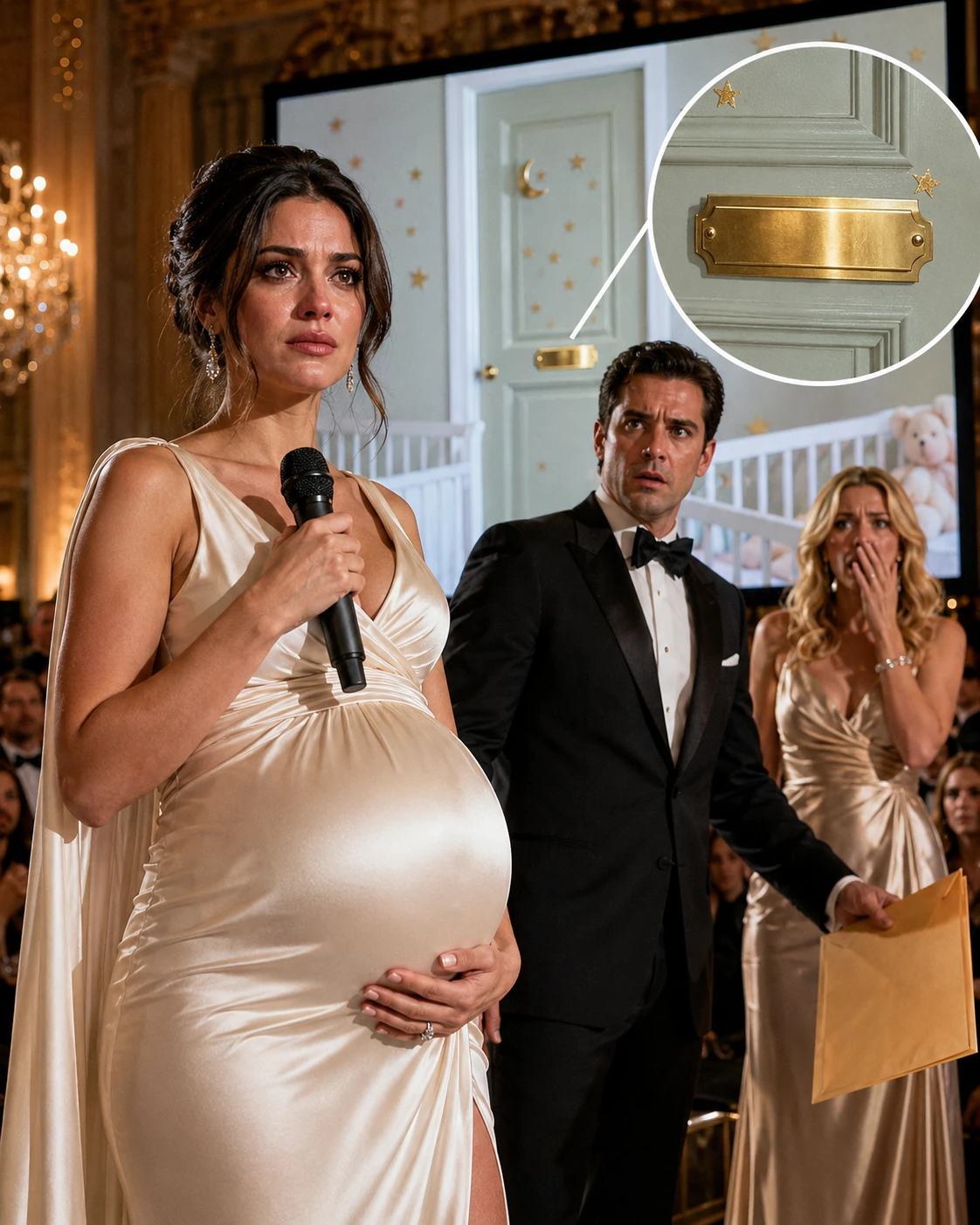
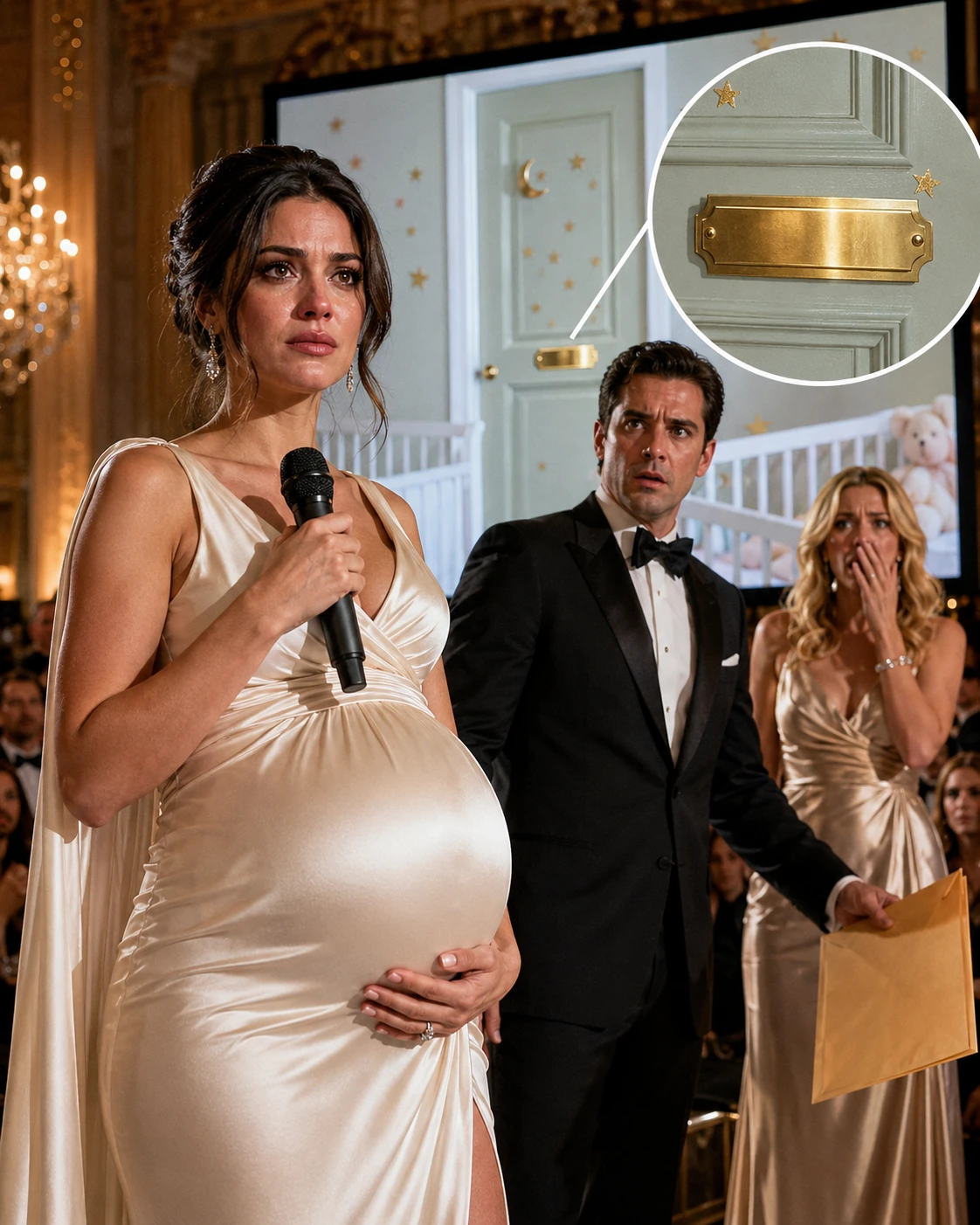
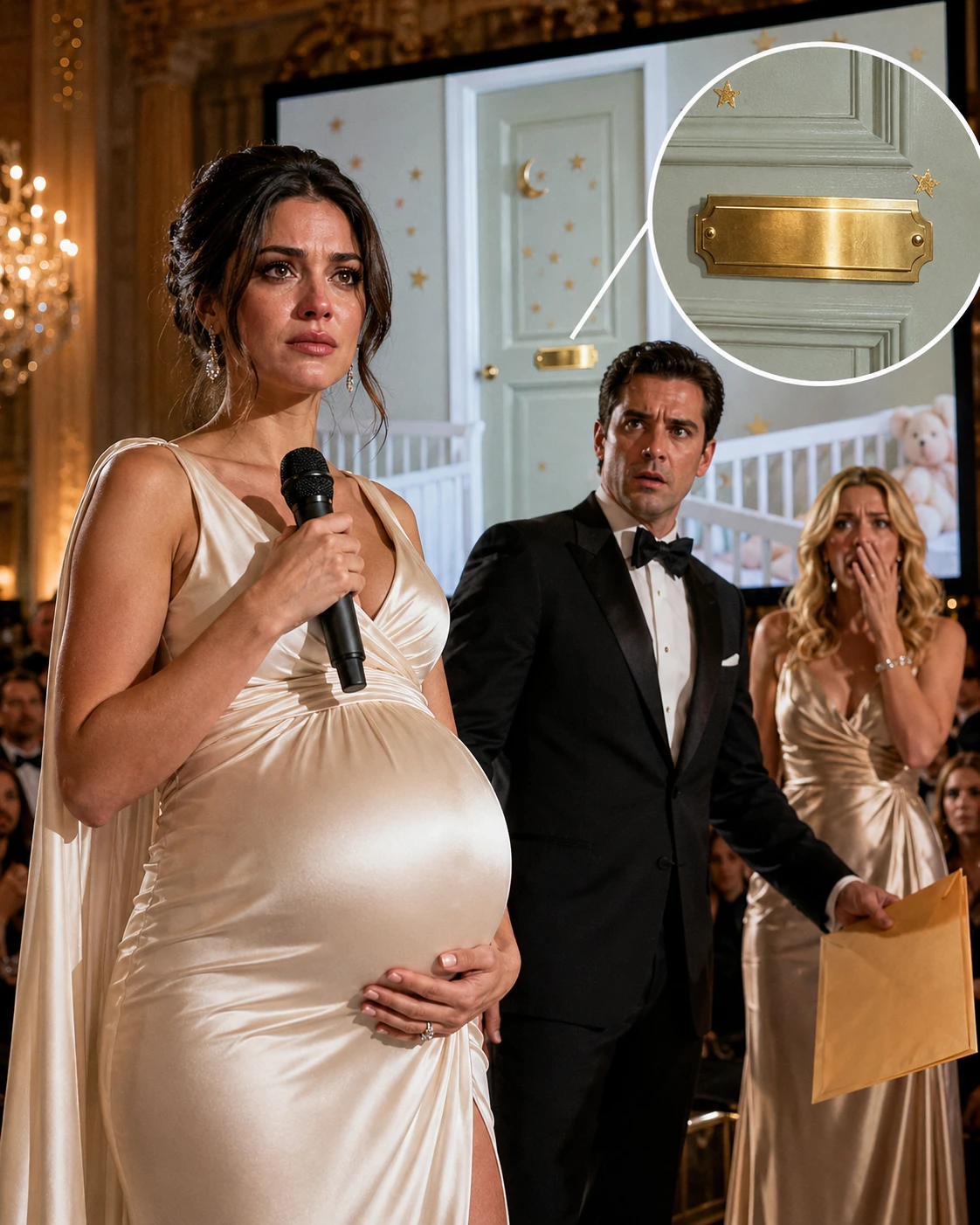
I looked at the wet paint. I looked at the crib inside. Then I looked at the tiny brass plaque newly screwed into the door, polished so bright it reflected my face back at me.
Designed by Sloane Vale Interiors.
I did not scream.
I did not cry.
I smiled so softly that Nathan relaxed.
And that was his first mistake.
Nothing dried before his bags were packed.
Chapter 1 — The Door That Looked Like a Confession
In Manhattan, betrayal rarely walks in wearing cheap shoes.
It arrives in polished leather, scented with bergamot and money. It smiles across marble countertops. It kisses your forehead in front of donors at a museum gala, then sends a text beneath the table to the woman who has already chosen the curtains for your baby’s nursery.
My husband had always loved beautiful things.
Nathan Alden loved French watches, glass staircases, private elevators, and the clean cruelty of numbers on a balance sheet. He loved women who knew when to laugh, men who knew when to invest, and rooms that made other people feel underdressed.
When we met, I thought he loved me because I was different.
I was not cold. I was not hungry for attention. I was the girl from Charleston with a law degree, old family manners, and a laugh that came too easily. At least, that was what he told me at the beginning. Back then, Nathan used to watch me like I was the only unpriced thing in the room.
“You make everything feel human,” he once said, standing beside me on a balcony above Park Avenue, while winter glittered over the city like broken glass.
I believed him.
That is the first luxury a woman gives a man: belief.
Six years later, I stood in our Upper East Side apartment with one hand on my eight-month pregnant belly and the other hand clenched around my Hermès bag so tightly my knuckles went white.
The nursery door was still wet.
The paint smell clung to the hallway, sweet and poisonous. The gold stars caught the late afternoon light. Every delicate brushstroke said someone had been in my home, in my baby’s room, touching what I had prepared with the trembling tenderness of a mother who had already lost one child.
The original door had been soft yellow.
Not bright. Not childish. It was a warm, creamy yellow I found in a tiny paint shop in Brooklyn after three weeks of pretending I did not care about nursery colors because caring felt like tempting God.
I had named it in my head: sunlight after rain.
Nathan had called it “a little sentimental.”
I had said, “That’s the point.”
He had kissed my temple and said, “Whatever makes you happy, Evie.”
That was before Sloane Vale started appearing in our life like a reflection I had not invited.
At first, she was just an interior designer.
Then she was “brilliant.”
Then she was “a friend.”
Then she was at our table at The Mark, laughing too intimately at Nathan’s jokes. Then she was in Aspen with our group in January, wearing white cashmere and calling my husband “Nate,” a name he had always told everyone he hated.
And then she was on my nursery door.
Designed by Sloane Vale Interiors.
That plaque was not design. It was a signature.
A claim.
Nathan’s phone buzzed in his hand. He glanced down too quickly, then turned the screen toward his body. His wedding ring caught the light, still on his finger, still pretending.
“Evie,” he said, using the voice he used with investors before disappointing them, “you’re being quiet.”
I looked at him.
His face was perfect. That had been part of the problem. Nathan was the kind of man photographers loved at charity events: dark hair, sharp jaw, blue eyes, broad shoulders under Italian tailoring. He did not look like a villain. Villains never do. They look like husbands in magazines titled “Power Couples of New York.”
“I am looking,” I said.
“At paint?”
“At choices.”
His mouth tightened.
The painters had left drop cloths rolled against the wall. A ladder stood folded beside the door. Through the open nursery, I could see the crib, the rocker, the shelves. The yellow walls inside remained, but the door had been transformed into Sloane’s fantasy: pale green, gold stars, a tiny painted crescent moon near the knob.
Above the crib, the framed print of a rabbit I bought in Vermont had been moved. In its place hung a minimalist constellation map in brushed gold.
Not mine.
Not my baby’s.
Hers.
Nathan stepped closer. “I wanted to surprise you.”
“With another woman’s name on my child’s room?”
His face flickered. Only for a second. Irritation, then calculation.
“It’s her company plaque,” he said. “Designers do that all the time.”
“Not in private nurseries.”
“It’s a courtesy.”
“It’s a warning.”
He exhaled through his nose, a small sound of expensive impatience. “You’re hormonal.”
There it was.
The word men use when truth becomes inconvenient.
Hormonal.
I had been called many things in my life. Bright. Charming. Difficult. Strategic, once, by a judge who had underestimated me and regretted it. But nothing had ever entered my body like that one word, spoken by my husband in front of the door where our daughter was supposed to sleep.
Our daughter.
We had decided to name her Lillian after my grandmother, though Nathan had pushed for Charlotte because “Lillian sounds like a lace tablecloth.”
My grandmother Lillian Hart had been the richest woman I had ever known and the least impressed by wealth. She wore pearls to breakfast and kept a loaded silence sharper than any insult. She had raised me after my mother died, taught me how to read contracts before I knew how to drive, and once told me, “Never fight a man in the room where he expects you to cry. Fight him where he signs.”
I wished she were alive to see that door.
No.
That was not true.
I was grateful she was not.
Because she would have burned down the apartment and bought the building next door just to watch the smoke from a better angle.
Nathan’s phone buzzed again.
This time, I saw the name before he turned it away.
Sloane.
Not saved as “Sloane Vale Interiors.”
Just Sloane.
I smiled.
“You should answer,” I said.
He blinked. “What?”
“She must be nervous.”
He stared at me, trying to decide whether I knew enough to be dangerous.
I made the decision for him.
“I’m tired,” I said. “The appointment ran long. I’m going to lie down.”
Nathan softened immediately, but not from love. From relief.
“Good idea,” he said. “We can talk later when you’re calmer.”
Calmer.
I nodded. “Yes. Later.”
I walked past him into our bedroom, closed the door gently, and sat on the edge of our bed.
Our bedroom was gray silk, walnut, and glass. A room designed for a woman who hosted champagne breakfasts and did not bleed in private. On the opposite wall, above the fireplace, hung a black-and-white wedding photo from our Newport ceremony. I was laughing in it. Nathan was looking at me like he had won something.
I had not noticed that before.
I removed my heels. I placed my bag on the bed. Then I took out my phone and called the one person in New York who had never confused my softness for weakness.
“Evelyn,” Margaret Crane answered on the second ring.
Margaret was my family attorney, though that title did not cover what she really was. She had handled my grandmother’s estate, my mother’s medical trust, my marriage settlement, and three quiet disasters before they became public. She was seventy-one, silver-haired, terrifyingly elegant, and incapable of wasting a syllable.
“I need you,” I said.
There was a pause. Not concern. Assessment.
“Is the baby all right?”
“Yes.”
“Are you safe?”
“Yes.”
“Is this about Nathan?”
I looked toward the bedroom door. Beyond it, my husband was probably whispering into his phone, telling another woman I was upset but manageable.
“Yes.”
Margaret’s voice cooled. “How soon?”
“Now.”
“Then start with facts.”
I told her everything.
The nursery. The paint. The plaque. The texts I had seen in passing over the last few months. The Aspen trip. The late dinners. The way Nathan had begun talking about Sloane’s “taste” as though taste were a moral virtue. The way he had dismissed every instinct I had.
Margaret did not interrupt.
When I finished, she said, “Photograph the door from every angle. Include the wet paint, plaque, crib, and any materials left behind. Do not confront him further. Do not leave the apartment tonight unless you feel unsafe. Do not text him anything emotional.”
“I’m not emotional,” I said.
“Good. Then you may survive this.”
I almost laughed.
Almost.
“There is something else,” Margaret added.
Her tone changed, just slightly, and the hair lifted on the back of my neck.
“What?”
“I received a request this morning from Alden & Crest’s counsel. Nathan wants your signature on a marital asset clarification.”
I stared at my reflection in the dark window.
“What does that mean?”
“It means he is trying to make you confirm that certain properties and accounts acquired during the marriage are jointly managed marital assets.”
“Which properties?”
“The East Hampton house. The Palm Beach investment account. Two minority holdings under Hartwell Reserve. And your grandmother’s Madison Avenue apartment.”
My hand went still on my belly.
The baby shifted beneath my ribs, a slow roll like she had heard.
“My grandmother’s apartment is mine,” I said.
“Yes.”
“It’s in the Hart Trust.”
“Yes.”
“He knows that.”
“He is hoping pregnancy made you tired enough not to care.”
Outside the bedroom, Nathan laughed softly. Not with me. Not for me.
For her.
Something in my chest went very quiet.
It was not heartbreak. Heartbreak is loud. It bangs against your ribs and begs for understanding.
This was colder.
This was the sound of a door locking.
“Margaret,” I said, “what do we have in the prenup?”
“More than he remembers.”
“Tell me.”
“You have an adultery clause, but adultery alone only affects discretionary support. However, your grandmother insisted on a domestic sanctity provision.”
I closed my eyes.
Grandmother.
“What does it say?”
“If Nathan allows a romantic partner into any Hart-owned residence, or uses Hart-owned property to benefit said partner, he forfeits all claims to any increase in value connected to your premarital assets. If he attempts to transfer, encumber, redesign, market, leverage, or claim such property for the benefit of that partner, the forfeiture expands.”
My eyes opened.
“The apartment is Hart-owned.”
“Yes.”
“The nursery is in the apartment.”
“Yes.”
“The designer plaque has her name on it.”
“Yes.”
I looked toward the hallway.
Wet paint.
Gold stars.
A signature.
Margaret continued, “Take the photographs.”
I stood slowly.
My body felt heavy, but my mind felt newly sharpened, each thought laid out like silver cutlery before a very formal execution.
“Margaret?”
“Yes?”
“Can I ask you something personal?”
“You may.”
“If a woman wanted to destroy her husband without becoming ugly, where would she begin?”
For the first time in all the years I had known her, Margaret Crane laughed.
Not loudly.
Just enough.
“With lighting,” she said. “Men like Nathan always choose the stage. You choose the spotlight.”
I went back into the hallway.
Nathan was still by the nursery door, phone pressed to his ear. When he saw me, he ended the call too quickly.
“Feeling better?” he asked.
“Much.”
I raised my phone and took the first picture.
His smile faded.
“What are you doing?”
“Remembering.”
I photographed the door. The plaque. The gold stars. The open crib. The paint cans stacked by the wall.
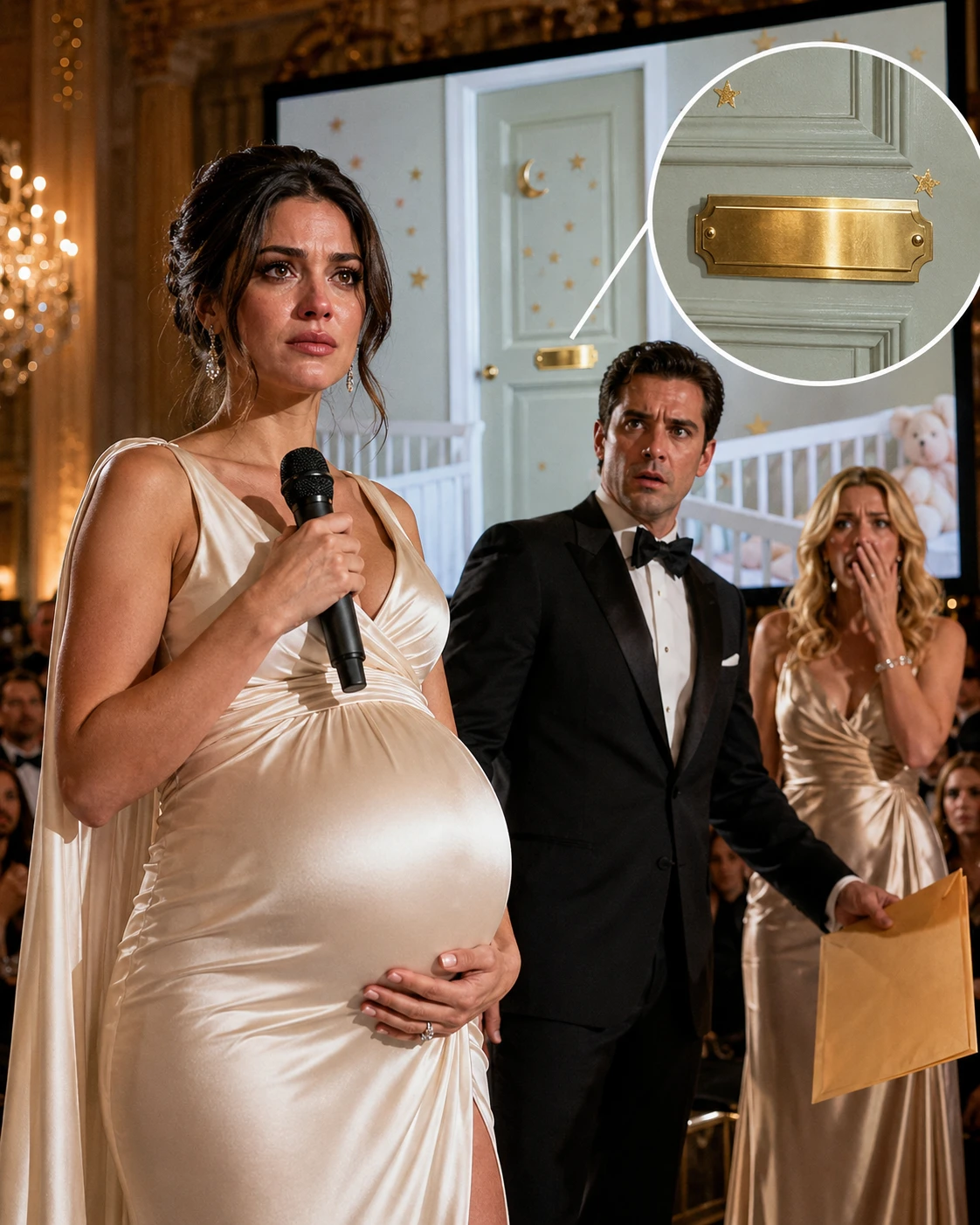
One label read: Vale Green No. 7.
Of course.
Nathan stepped forward. “Evie.”
I angled the camera toward him.
“Stand there,” I said softly. “You look so proud.”
He did not move.
I took the picture anyway.
Chapter 2 — A Woman Who Smiles Has Already Decided
Two days later, Nathan hosted a dinner party.
That was his solution to everything: add linen napkins, pour Burgundy, invite people too important to behave badly, and make the truth feel impolite.
The dinner had been planned for weeks, he said. Investors were flying in. A senator’s wife was coming. The board chair from Whitcomb Bank expected lobster ravioli and Montrachet. Canceling would look dramatic.
“You don’t want to look dramatic, do you?” he asked.
We were standing in the dressing room while a stylist zipped me into a black velvet maternity gown that made my body look like a secret wrapped in night.
I studied him in the mirror.
Nathan looked tired. Not guilty. Just annoyed that my pain had become a scheduling issue.
“I would hate to embarrass you,” I said.
His shoulders dropped.
He thought that was obedience.
Men like Nathan are easiest to trap when they mistake restraint for surrender.
At seven-thirty, the apartment filled with perfume, laughter, and old money pretending not to notice new money. Candlelight trembled on crystal. White orchids leaned from silver bowls. A pianist played in the gallery because Nathan believed silence made wealthy people nervous.
I stood beside him at the entrance, accepting kisses and compliments.
“Evelyn, you look radiant.”
“Motherhood suits you.”
“When are you due?”
“Any day now,” I said, smiling.
Nathan placed a hand on my lower back for photographs. His palm felt like a brand from a man who no longer owned the ranch.
Then Sloane arrived.
She wore ivory.
Of course she did.
An ivory silk slip dress under a winter-white coat, diamonds at her ears, hair swept into an effortless knot that had taken someone ninety minutes. She was thirty, maybe thirty-one, with a face made for candlelight and betrayal: delicate mouth, feline eyes, cheekbones sharp enough to cut ribbon.
She brought no date.
She carried a gift.
A pale green box tied with gold ribbon.
For one second, the room changed temperature.
Not enough for everyone to notice. Just enough for me.
Nathan moved toward her before he caught himself.
Sloane saw it. I saw her see it.
Then she looked at me.
There was pity in her smile, and that was when I stopped feeling anything for her at all.
Pity requires a woman to believe she has already won.
“Evelyn,” she said, leaning in to kiss the air beside my cheek. “You look beautiful.”
“So do you,” I said. “Very bridal.”
Her smile twitched.
Nathan cleared his throat. “Sloane brought something for the baby.”
“How thoughtful,” I said.
I took the box from her.
It was heavier than I expected.
“Open it,” she said. “I hope you don’t mind. Nathan told me you were updating the nursery.”
Updating.
The word struck the table like a dropped knife, though the table was thirty feet away.
Several guests turned subtly.
Nathan’s fingers tightened around his glass.
I smiled and untied the ribbon.
Inside was a cashmere baby blanket embroidered with tiny gold stars.
And in the corner, in pale green thread, was a name.
Not Lillian.
Not even Charlotte.
Celeste.
For a moment, the entire room narrowed to that stitched word.
Celeste.
I had never heard Nathan say it. I had never chosen it. I had never written it in a notebook, whispered it to my belly, or imagined calling it across a garden.
But Sloane knew it.
Sloane had named my child in her mind.
Maybe in their conversations.
Maybe in their bed.
The guests watched with the bright discomfort of people witnessing a car accident from inside a limousine.
Sloane’s eyes widened with false innocence. “Oh. Did Nathan not tell you? We were brainstorming.”
We.
Nathan whispered, “Sloane.”
Too late.
I touched the embroidered name.
Then I laughed softly.
It was not the laugh of a wounded wife.
It was the laugh my grandmother used when someone made a fatal mistake in public.
“How charming,” I said.
Sloane blinked.
I held the blanket up so everyone could see.
“Ladies and gentlemen,” I said, still smiling, “a gift from Miss Vale. She has redesigned the nursery door, selected the color palette, and now apparently named my daughter.”
The room fell silent.
Nathan’s face drained.
Sloane went still.
I lowered the blanket into the box with great care.
“Creative women are such a blessing,” I continued. “Always imagining futures that do not belong to them.”
A cough near the fireplace.
A champagne glass lowered.
The senator’s wife, a woman named Patricia Bell who had survived two husbands and one federal investigation, tilted her head like she had just found the evening interesting.
Nathan leaned close. “Evelyn,” he said through his teeth, “stop.”
I turned toward him.
“Stop what?”
His eyes begged and warned at the same time.
I let the silence stretch.
Then I placed my hand over my belly and smiled at our guests.
“Forgive me. Pregnancy has made me sentimental about boundaries.”
The room exhaled.
Some people laughed because the alternative was admitting they had seen too much.
Dinner proceeded because rich people can step around a bleeding body if the wine is good enough.
Sloane sat three seats from Nathan.
I noticed because he did not look at her.
Not once.
That was how I knew he was terrified.
Men look at what they desire. They avoid looking at what can ruin them.
During the first course, Whitcomb Bank’s chairman, Charles Voss, praised Nathan’s upcoming luxury development on the Hudson.
“Alden House is the most exciting private residential concept in New York right now,” he said. “If the family branding lands right, investors will follow.”
Family branding.
I sipped water from a crystal glass.
Nathan nodded. “We’re positioning it as legacy living. Privacy, heritage, continuity.”
“Continuity matters,” I said.
Every head turned toward me.
Nathan’s smile froze.
Charles Voss lifted his brows. “Indeed.”
I placed my glass down. “A family brand only works when the family still exists.”
Patricia Bell smiled into her wine.
Nathan said, “Evelyn is passionate about authenticity.”
“I am,” I said. “Especially in documents.”
That was the second mistake Nathan made that week: he underestimated the number of people at the table who understood what a document could do.
By dessert, Sloane had recovered enough to perform.
She told a story about restoring a townhouse in Brooklyn Heights. She spoke about texture, restraint, the “psychology of color.” She had that influencer fluency, all glossy phrases and no weight beneath them.
“Green is renewal,” she said, eyes drifting toward me. “It’s life after stagnation.”
I dabbed the corner of my mouth with a linen napkin.
“In old portraits,” I said, “green was also associated with poison.”
The senator’s wife laughed outright.
Sloane’s cheeks flushed.
Nathan pushed back from the table. “Coffee in the library.”
The men rose too eagerly. The women lingered because women always know when war has entered the room wearing perfume.
When the guests shifted away, Sloane approached me near the windows.
Central Park lay dark below us, the trees bare and silver under February moonlight.
“You embarrassed yourself tonight,” she said quietly.
I turned.
Up close, she was less perfect. There was a tiny flake of mascara beneath one eye. A pulse beating too fast at her throat.
“No,” I said. “I introduced you.”
Her mouth tightened. “Nathan told me you two were basically separated.”
“Did he?”
“He said the marriage was dead.”
“How convenient. Did he mention he still lives here?”
“He said he stayed because of the baby.”
I looked at her then, really looked.
There are women who fall in love with married men because they are lied to.
There are women who fall in love with married men because they enjoy being chosen over another woman.
Sloane’s face told me which one she was.
She glanced at my belly. “I didn’t mean for this to be messy.”
“You painted my nursery.”
“Nathan asked me to.”
“You embroidered another name on my daughter’s blanket.”
Her chin lifted. “He liked Celeste.”
“And you liked imagining me gone.”
For the first time, something naked flashed in her eyes.
“Yes,” she said.
I almost admired the honesty.
Almost.
She stepped closer. “You have no idea what he says when you’re not around.”
I smiled.
“And you have no idea what he signs.”
Her confidence faltered.
Before she could answer, Nathan appeared in the doorway.
“Sloane,” he said sharply. “The car is waiting.”
That sentence told me everything.
He had arranged her car.
He had expected her to leave when he chose.
He managed her too.
Poor Sloane. She thought she was the knife.
She was only another handle.
After the final guest left, the apartment smelled of extinguished candles and expensive exhaustion.
Nathan found me in the nursery.
I was standing before the green door, barefoot, one hand against the curve of my belly.
Behind me, the baby’s room glowed softly in lamplight. Yellow walls. White crib. Pale green door. Gold stars. Sloane’s plaque.
It looked like a crime scene staged for Architectural Digest.
Nathan stopped behind me.
“I need you to understand how damaging tonight was,” he said.
“To whom?”
“To both of us.”
“I felt fine.”
“You humiliated Sloane.”
I turned slowly.
His mistake was immediate and complete.
Not “you humiliated me.”
Not “you hurt our guests.”
Sloane.
The name landed between us, alive and ugly.
I nodded once.
“Thank you.”
“For what?”
“For finally sounding honest.”
He dragged a hand through his hair. “This is exactly why I didn’t tell you.”
I laughed once. “Tell me what?”
“That she helped with the nursery.”
“With the nursery? Nathan, she chose a name for our daughter.”
“You’re overreacting.”
“That word is getting old.”
“And this martyr act is getting old too.”
The air changed.
There he was.
Not the charming husband. Not the careful host.
The man beneath.
“I have been patient,” he said.
“With your pregnant wife?”
“With your fragility.”
I felt Lillian move.
His daughter.
My daughter.
A small, living answer inside me.
Nathan continued, voice low. “Ever since the miscarriage, everything became about what you needed. The right doctors. The right house. The right silence. The right paint color. I disappeared in my own marriage.”
It should have hurt.
Maybe it would have, if he had said it a year earlier, in a therapist’s office, with tears in his eyes.
But he said it in front of the nursery door he had allowed another woman to mark.
So it did not hurt.
It clarified.
“You disappeared?” I asked.
“Yes.”
“No, Nathan. You wandered.”
His jaw tightened.
I walked past him, opened the small drawer of the changing table, and removed a folded sheet of paper.
His eyes narrowed. “What is that?”
“The guest list from tonight.”
“Why?”
I picked up a pen and circled names.
Patricia Bell.
Charles Voss.
Diane Mercer, editor of a society magazine.
Two board members.
One judge.
One woman from the museum trustees who had once told me she hated cheaters because her first husband had bought his mistress a horse with marital funds.
Nathan watched me.
“What are you doing?”
“Noting witnesses.”
His face went pale.
“Evelyn.”
“Yes?”
“Don’t make this legal.”
I looked at the green door.
“Oh, sweetheart,” I said. “You already did.”
Chapter 3 — The Receipts Were Wearing Gold Stars
For the next nine days, I became the easiest wife in New York.
I did not ask where Nathan went.
I did not question why he came home smelling like Sloane’s orange blossom perfume.
I did not mention the blanket, the door, the plaque, or the name Celeste.
I slept on my side with a pregnancy pillow between us like a quiet border. I drank raspberry leaf tea. I attended my appointments. I wrote thank-you notes for baby gifts in blue-black ink on cream stationery.
And every afternoon, while Nathan believed I was napping, I built a file that would ruin him.
Margaret called it “The Green Door File.”
It began with photographs.
Then invoices.
The painters had been hired through Sloane Vale Interiors, but paid by Alden & Crest Development.
That mattered.
A business account had paid for modifications to a Hart Trust residence for the benefit of the CEO’s romantic partner’s design portfolio. The plaque made it promotional. The photographs on Sloane’s private Instagram, which one of Margaret’s associates captured before Sloane deleted them, made it worse.
In one photo, Sloane posed in my hallway wearing linen trousers and a sleeveless cream sweater.
Caption: A private nursery for a very special little star. Sometimes the future arrives in sage and gold.
She had not tagged me.
She had tagged Nathan.
He had liked it from his private account.
His third mistake was vanity.
Vanity is evidence with better lighting.
Margaret sent a forensic accountant named Jonah Reeves to meet me in the café beneath the Carlyle. Jonah looked like a tired math professor and spoke with the calm of a man who could find fraud in a church bake sale.
He ordered black coffee and opened a leather folder.
“Your husband is moving money,” he said.
I stared at him.
“How much?”
“Enough to panic.”
The café hummed around us. Silver spoons. Low conversations. An elderly woman feeding crumbs of scone to a dog that probably had better health insurance than most Americans.
Jonah slid a chart toward me.
“Alden & Crest is overleveraged on the Hudson project. Whitcomb Bank is hesitant. Nathan has been courting private capital, but the collateral package appears weak.”
“Meaning?”
“He needs assets. Clean, prestigious assets. Preferably connected to the Hart name.”
My grandmother’s name had been printed on museum wings, hospital research grants, and scholarship funds. Nathan had once called it “inspiring.” Later, he called it “useful” when he thought I was asleep.
“He wants my trust.”
“He wants investors to believe your trust is backing him.”
“But it isn’t.”
“No. Which is why he requested your signature on the clarification.”
I looked down at the chart.
There were arrows from Alden & Crest to shell companies, from shell companies to project vendors, from vendors to something called Vale Design Holdings.
My hand went cold.
“Vale?”
Jonah nodded.
“Sloane?”
“Likely. She owns an LLC registered in Delaware. Alden & Crest paid it two hundred eighty thousand dollars over fourteen months.”
“For interior design?”
“Some invoices claim consulting. Others claim brand development. One says ‘residential legacy concept.’”
I almost smiled.
Residential legacy concept.
That was a beautiful phrase for adultery.
Jonah leaned forward. “Mrs. Alden, I need to ask carefully. Did you authorize any transfer of funds, branding rights, or residential access involving Sloane Vale?”
“No.”
“Did you consent to your nursery being used in a design portfolio?”
“No.”
“Did you approve your child’s image, name, or expected birth announcement for Alden & Crest marketing?”
My heart stopped.
“What?”
He took out another page.
It was a draft campaign mock-up.
Alden House: A New Generation of Legacy.
There was a silhouette of a pregnant woman standing in front of a nursery door.
A pale green nursery door with gold stars.
Beneath it, in elegant serif font:
Inspired by the Alden family’s newest arrival.
Not Hart.
Alden.
Nathan was using my pregnancy to sell apartments.
And Sloane had designed the image.
I stared at the page until the words blurred.
“Does he know you have this?” I asked.
Jonah’s expression did not change. “No.”
“How did you get it?”
“Your grandmother believed in redundancies.”
That answer made no sense.
Then Margaret arrived.
She slid into the booth beside me, wearing a navy coat and pearls, and placed one gloved hand on the folder.
“Evelyn,” she said, “there is something your grandmother arranged before she died.”
I looked at her.
“Of course there is.”
Margaret’s mouth softened slightly.
“Lillian never trusted Nathan.”
I sat back.
The baby pressed under my ribs.
“She liked him,” I said.
“She had exquisite manners. That is not the same thing.”
The café seemed to recede.
“She told me he was ambitious.”
“She told me privately that ambition without reverence becomes appetite.”
I closed my eyes.
That sounded like her.
Margaret continued, “When you married, she gifted Nathan a small minority interest in Hartwell Reserve as a gesture of trust. Publicly, it looked generous.”
“I remember. He was thrilled.”
“Yes. Privately, she created a mechanism.”
“What kind?”
“A conditional voting proxy. If Nathan attempted to claim, encumber, exploit, market, or transfer Hart assets without your written consent, his minority interest could be repurchased by the trust for one dollar.”
I opened my eyes.
“One dollar?”
“Your grandmother enjoyed symbolism.”
For the first time in days, I felt something like air enter my lungs.
“Nathan doesn’t know?”
“He knew the agreement existed. He did not read it carefully.”
I laughed softly.
Of all his sins, that one was almost insulting.
Nathan read everything he respected.
He had never respected what came from me unless it came wearing my grandmother’s name.
Margaret tapped the campaign mock-up.
“This may trigger the proxy. The nursery door may trigger the domestic sanctity clause. The payments to Vale may trigger corporate self-dealing issues, depending on board disclosures. And if he presented your assets as collateral without authorization, he may have committed bank fraud.”
The word sat between us like a loaded gun.
Bank fraud.
Nathan Alden, who ironed even his weekend shirts, who corrected waiters on vintages, who believed reputation was the highest form of currency.
Bank fraud would terrify him more than hell.
“What do we do?” I asked.
Margaret’s eyes met mine.
“We allow him to step fully into the room.”
I understood.
Not yet.
That is the hardest lesson in revenge: patience feels like swallowing glass until the cut becomes useful.
That night, Nathan came home at midnight.
I was awake in the library, reading an old novel beneath a brass lamp. Outside, snow had begun to fall across the city, softening every ledge, every rooftop, every lie.
He paused in the doorway.
“You’re up.”
“I couldn’t sleep.”
His expression shifted into concern with the speed of a man selecting a tie.
“Is it the baby?”
“No.”
He crossed the room and poured himself scotch from the crystal decanter.
That decanter had belonged to my grandfather. Nathan loved using it. He liked objects with lineage. They made his hands feel older than his money.
“I’ve been thinking,” he said.
I turned a page.
“About?”
“Us.”
I looked up.
He stood by the bar cart, glass in hand, snow behind him, handsome enough to fool the lonely.
“I don’t want us to become enemies,” he said.
“We’re not enemies.”
“Good.”
“Enemies respect each other.”
His mouth hardened.
I returned to my book.
He took a drink. “There’s a document I need you to sign.”
There it was.
Fourth mistake: timing.
“Now?”
“Tomorrow is fine.”
“What is it?”
“Just a clarification. Estate-related. Investors want certainty around family assets.”
“Which investors?”
“Whitcomb. Some private partners.”
I let my face remain empty.
“Why would investors need certainty about my grandmother’s assets?”
“They need to understand the broader family platform.”
“Family platform,” I repeated. “That sounds stable.”
“It is stable.”
“Then why rush?”
He set the glass down. “Because opportunities have windows.”
“And wives have due dates.”
His jaw flexed.
“Evie, I have carried this family financially for years.”
That was so absurd I almost felt sympathy for him.
The apartment, Hart-owned.
The Hamptons house, Hart-owned.
The art, mostly mine.
The charitable connections, inherited.
The quiet introductions that had lifted Alden & Crest from aggressive developer to legacy brand, arranged by Margaret through people who still took my grandmother’s calls years after her death.
Nathan had not carried the family.
He had learned to stand on it and call the height his own.
I placed the book on my lap.
“Do you need my signature because Alden House is in trouble?”
His face froze.
A small thing.
A blink too late.
The scotch glass between his fingers.
“Who told you that?”
“No one. You just did.”
He laughed, but it came out wrong. “You don’t understand development finance.”
I looked at him for a long moment.
Then I stood.
Pregnancy made standing an act of theater. Nathan watched with impatience disguised as caution.
“You’re right,” I said. “I don’t understand development finance.”
Relief loosened his shoulders.
“But I understand permission.”
I walked to the doorway.
Behind me, he said, “Sloane says you’ve always been passive-aggressive.”
I stopped.
There was the fifth mistake.
He had brought her voice into my library.
I turned back.
“She should be careful,” I said.
Nathan gave a short laugh. “Of you?”
“No,” I said. “Of believing men who borrow power and call it love.”
For a moment, something almost like fear crossed his face.
Then it vanished.
“Sign the papers, Evelyn.”
“No.”
The word was quiet.
It still made the room contract.
Nathan set down his glass. “Excuse me?”
“No.”
“You haven’t even read them.”
“I don’t need to.”
His voice lowered. “Do not embarrass me with this.”
“You keep using that word.”
“What word?”
“Embarrass.”
He stared.
I smiled.
“You’re not afraid of losing me, Nathan. You’re afraid of being seen.”
That night, he slept in the guest room.
I slept better than I had in months.
The next morning, the nursery door was dry.
The green had settled into something smug and permanent-looking.
I ran my fingers over the brass plaque.
Designed by Sloane Vale Interiors.
Then I called the building manager.
“Mr. Keane,” I said, “I need the security footage from last Thursday.”
He hesitated.
“Mrs. Alden, Mr. Alden requested—”
“This apartment is owned by the Hart Trust,” I said. “Please send the footage to Margaret Crane within the hour.”
Silence.
“Yes, Mrs. Alden.”
That afternoon, Margaret sent me a still image from the footage.
Sloane in my hallway.
Nathan beside her.
His hand on the small of her back.
A painter holding the door open.
And Sloane laughing as she pressed a kiss to Nathan’s mouth beneath the gold stars she had chosen for my child.
There are betrayals you suspect.
There are betrayals you prove.
Only one can be weaponized.
Chapter 4 — The Gala Where the Wife Did Not Cry
Alden & Crest’s winter gala was held at the Metropolitan Club on Fifth Avenue, because Nathan believed marble made debt look respectable.
The invitation read:
An Evening of Legacy — Celebrating Alden House and the Future of New York Living.
Legacy again.
Future again.
Men who betray their families become obsessed with those words. They use them like perfume over rot.
I was not expected to attend.
Two days before the gala, Nathan stood in the nursery doorway while I folded tiny white onesies into a drawer.
“I think you should stay home Friday,” he said.
“Do you?”
“It’ll be a long evening. Crowded. Stressful.”
I smoothed one sleeve.
“Sloane will be there?”
“She designed the showcase suite.”
“The one based on my nursery?”
His face darkened. “You’re twisting this.”
“No. I’m folding laundry.”
He stepped inside the room, careful not to touch the crib.
Since the dinner party, he avoided the nursery like it contained witnesses.
“Evelyn, please. We need calm right now.”
“Who is we?”
He looked exhausted.
Good.
“It’s important,” he said. “For the company.”
“Then I’ll come.”
“That’s exactly what I don’t want.”
I looked up.
His honesty had become sloppy.
“Because I am pregnant, or because I am inconvenient?”
His silence answered.
Friday arrived cold and bright.
I dressed slowly.
Not in black this time.
Black is for mourning.
I chose deep ivory satin, long-sleeved and cut high at the neck, draped over my pregnancy like something sacred. My hair was pinned low. My earrings were my grandmother’s diamond drops. On my left hand, I wore my wedding ring. On my right, her emerald.
The emerald was a message.
Hart money.
Hart blood.
Hart memory.
When Nathan saw me in the foyer, his face did something complicated.
Desire. Fear. Anger.
“You look,” he said, then stopped.
“Expensive?” I offered.
“Beautiful.”
“Those are often confused.”
In the car, we did not speak.
Manhattan moved outside the windows, wet streets reflecting traffic lights, doormen lifting gloved hands, women in heels stepping over dirty snow as if the city itself were beneath them.
Nathan checked his phone twelve times.
At the twelfth, I said, “You can tell Sloane I’m coming. She’ll see soon enough.”
He turned on me. “Do not make a scene tonight.”
I looked out the window.
“I never make scenes.”
That was true.
I arranged them.
The Metropolitan Club glowed like a palace built to intimidate immigrants. Inside, gold light spilled over marble columns, floral installations, and waiters carrying champagne no one needed.
Alden House renderings lined the walls.
Glass towers.
Private gardens.
Sky pools.
A nursery concept displayed near the center beneath soft lighting.
My breath paused.
There it was.
The green door.
Not the actual door, but a replica. Pale green, gold stars, brass knob, crescent moon.
Beside it stood Sloane, glowing in champagne silk, accepting compliments.
A small placard read:
The Celeste Nursery
Designed by Sloane Vale for Alden House
Inspired by the next generation of the Alden family
The Celeste Nursery.
My daughter had been renamed in a sales exhibit.
Something old and Southern woke inside me then. Something that smiled at funerals and remembered exactly where the silver was buried.
Nathan saw the placard and went still.
He had not expected that.
Interesting.
Sloane had made her own move.
She was not just his mistress.
She was trying to become the mother of the brand.
For the first time, I realized Nathan had not fully controlled her.
That made her more dangerous.
And more useful.
Cameras flashed near the step-and-repeat wall. Society reporters drifted in silk. Investors gathered around architectural models, drinking and nodding at square footage priced like ransom.
Charles Voss from Whitcomb Bank greeted Nathan with a firm handshake.
“Big night.”
“Important night,” Nathan said.
Charles kissed my cheek. “Mrs. Alden. Wonderful to see you.”
“Mr. Voss.”
His eyes flicked to my belly, then to the nursery display.
Something passed over his face.
He was smart enough to notice names.
“Beautiful concept,” he said carefully.
“Isn’t it?” I replied. “I was surprised too.”
His expression sharpened.
Nathan guided him away.
At eight-thirty, the speeches began.
Nathan stood on stage beneath chandeliers while a hundred wealthy people turned their faces toward him like flowers toward heat.
He was magnificent.
I will give him that.
Some men lie clumsily. Nathan lied like a concert pianist, every note practiced, every pause elegant.
He spoke of legacy. Of homes that held generations. Of New York as a city built not just upward, but forward. He thanked investors, partners, designers.
Then his eyes found mine.
“And most of all,” he said, voice warming, “I want to thank my wife, Evelyn. She has been the heart behind everything I build.”
Applause.
People looked at me.
I smiled.
Cameras turned.
Nathan continued, “As we prepare to welcome our daughter, I am reminded that the future is not abstract. It has a name. A room. A home.”
Behind him, the screen changed.
A photo appeared.
My nursery door.
The real one.
Pale green, gold stars, brass plaque.
A soft gasp moved through the audience.
I looked at Sloane.
She was staring at the screen, smiling.
Nathan had no idea.
That was not part of his speech.
She had inserted the photo.
The next slide appeared.
A close-up of the embroidered blanket.
Celeste.
The audience made a sound: admiration from those who did not know, discomfort from those who did.
Nathan turned slightly, saw the screen, and froze.
For one delicious second, everyone watched him understand that his mistress had gone off-script.
Then Sloane stepped onto the stage.
“Nathan,” she said, laughing lightly, as if rescuing him, “let me.”
A few people laughed with relief.
She took the microphone from a stunned event assistant.
“This project has been so personal,” Sloane said. “When Nathan first invited me to imagine a nursery for his daughter, I thought about what every child deserves: beauty, serenity, a sense of belonging.”
His daughter.
Not their daughter.
Not Evelyn’s daughter.
His.
I placed my hand over my belly and felt Lillian kick hard.
Not yet, sweetheart.
Almost.
Sloane continued, radiant and doomed. “The Celeste Nursery represents a new kind of luxury. Not cold. Not performative. Intimate. Tender. A space where a child can feel chosen from the beginning.”
Chosen.
I almost laughed.
Patricia Bell appeared beside me with a glass of champagne in one hand and war in her eyes.
“Is that woman suicidal?” she whispered.
“Professionally, yes.”
“Do you need anything?”
I looked at the stage.
Sloane was speaking now about motherhood though she had never carried my child through fear, nausea, blood tests, grief, or hope.
“I need everyone to keep listening,” I said.
At that moment, Margaret entered the ballroom.
She wore black velvet.
Behind her walked Jonah Reeves, Charles Voss’s general counsel, and two men I did not recognize but who had the posture of people who served papers without apologizing.
Margaret did not rush.
She never rushed.
Rushing suggests uncertainty.
She moved along the side of the room like a blade across silk.
Nathan saw her first.
His face changed.
Then Charles Voss saw her.
Then Sloane.
Then me.
I walked toward the stage.
The room parted. Not dramatically. Not like a movie.
Worse.
Politely.
Nothing is colder than a hundred rich people making space for your humiliation because they do not want it to stain their shoes.
I climbed the steps carefully. Nathan moved toward me.
“Evelyn,” he whispered, “don’t.”
I took the microphone from Sloane’s hand.
She resisted for half a second.
I looked at her fingers.
She let go.
I turned to the audience.
My voice did not shake.
“Good evening.”
Silence.
“My husband is right about one thing. The future is not abstract.”
Nathan’s lips parted.
I continued, “It has a name. Her name is Lillian Hart Alden. Not Celeste.”
The room went still.
Sloane’s face flushed.
“And the room you have just seen is not part of Alden House. It is a private nursery inside a Hart Trust residence. It was altered without my consent while I was at a medical appointment.”
A murmur moved through the ballroom.
Nathan stepped closer. “Evelyn—”
I turned slightly.
“Do not interrupt me again.”
He stopped.
That was the first time in our marriage he obeyed me immediately.
I faced the audience again.
“The designer credited on that nursery is Miss Sloane Vale, who has been involved in a personal relationship with my husband while receiving payments through Alden & Crest Development.”
The ballroom erupted into whispers.
Sloane whispered, “You bitch.”
The microphone caught it.
Every head turned.
Patricia Bell made a small delighted sound near the front row.
I looked at Sloane.
“No, Miss Vale. I am the homeowner.”
Margaret reached the stage and handed me a slim folder.
I opened it.
Nathan’s face had gone gray.
I did not need to read the documents. I knew them by heart.
“Tonight, copies of the relevant invoices, payment records, security footage, and unauthorized marketing materials are being delivered to Alden & Crest’s board, Whitcomb Bank’s counsel, and my attorneys.”
Charles Voss had already stepped away from Nathan’s CFO.
Good.
Banks do not like surprise mistresses in collateral packages.
I continued, “Effective immediately, the Hart Trust withdraws all implied affiliation from Alden House. Any use of my name, my daughter’s expected birth, my image, or any Hart property in connection with this project is unauthorized.”
Nathan reached for my arm.
I looked down at his hand.
He dropped it.
I smiled at the audience.
“My grandmother used to say luxury is not marble, silk, or a view of the park. Luxury is control over who crosses your threshold.”
Margaret’s mouth twitched.
I closed the folder.
“Tonight, I am reclaiming mine.”
Then Margaret stepped forward.
She did not take the microphone. She did not need to.
“Nathan Alden,” she said clearly, “you have been served.”
A man in a dark suit handed Nathan an envelope.
The cameras caught everything.
His hand receiving it.
Sloane’s face collapsing.
Charles Voss turning away.
The gold stars on the screen behind us, enormous now, glittering like evidence.
Nathan opened the envelope with numb fingers.
“What is this?” he said.
Margaret answered, “Notice of marital dissolution. Notice of injunction. Notice of asset preservation. Notice of forfeiture under the domestic sanctity clause. Notice of Hartwell Reserve proxy execution. And a demand letter regarding unauthorized commercial use of Hart property.”
Sloane’s eyes darted to Nathan.
“Nate?”
He did not look at her.
He was reading.
Finally.
The most intimate moment of our marriage might have been that one: Nathan truly reading what my family had written.
His mouth moved slightly over the words.
One dollar.
I saw when he reached that part.
His eyes lifted to mine.
“You can’t do this.”
“I didn’t,” I said. “You did.”
The ballroom was silent except for the soft clicking of phones. Someone was recording. Many someones.
Of course they were.
This was America. A public fall from wealth is the one show no one cancels.
Sloane grabbed Nathan’s sleeve. “Tell them this isn’t true.”
He shook her off without looking.
That was when her face changed.
Not heartbreak.
Realization.
She had believed she was special because he betrayed me for her. She did not understand that men like Nathan do not betray one woman for another.
They betray whatever is closest to what they want.
Tonight, that included her.
“You told me she knew,” Sloane said.
Nathan said nothing.
“You told me the nursery was for the brand. That she approved it.”
Silence.
“You told me the name was decided.”
I watched her collapse from mistress to witness in under thirty seconds.
Margaret noticed too.
So did Jonah.
The two men in dark suits did not blink, but one of them wrote something down.
Nathan finally turned to Sloane. “Stop talking.”
She stared at him.
The microphone was still near me. It caught everything.
The audience heard him.
Stop talking.
That did it.
Sloane laughed once, a broken little sound.
“Oh my God,” she said. “You used me.”
Nathan’s head snapped toward her.
“Sloane.”
“No. No, you told me—”
I lowered the microphone slightly, but not enough.
She continued, voice rising, “You told me Evelyn was medicated half the time. You told me the trust would sign because she signed whatever you put in front of her. You told me Whitcomb just needed the family materials until funding closed.”
Charles Voss turned white.
There it was.
The final thread.
Funding.
Family materials.
Until funding closed.
Sloane realized too late that she was no longer hurting me.
She was helping me.
Nathan lunged toward the microphone.
Margaret stepped between us.
She was seventy-one and five foot five.
Nathan stopped as if she were armed.
Maybe she was.
With paper.
The deadliest weapon in any room full of rich men.
I handed the microphone to Margaret.
She looked at the audience.
“This event is concluded.”
And somehow, because she said it like law, people began to leave.
They left in whispers, in silk, in tuxedos, in scandal.
They left with phones full of video.
They left Nathan Alden standing beneath his own legacy signage while the word future glowed behind him like a threat.
Sloane stood alone on the stage, tears shining but not falling.
For one second, I pitied her.
Then I remembered the blanket.
Celeste.
I walked down the steps.
Nathan followed.
“Evelyn,” he said. “Please.”
Please.
A beautiful word when it arrives too late.
I kept walking.
Outside, snow had begun again.
Margaret’s car waited at the curb, black and warm and silent. She helped me into the back seat, then sat beside me.
Through the window, I saw Nathan rush onto the steps of the Metropolitan Club.
No coat.
No dignity.
Sloane came after him, shouting something I could not hear.
Behind them, photographers raised cameras.
Margaret closed the door.
The city blurred as we pulled away.
For the first time that night, my hands began to shake.
Margaret placed her gloved hand over mine.
“You did well.”
“I feel sick.”
“That is normal.”
“I thought it would feel better.”
“No,” she said. “Revenge rarely feels good. It feels clean.”
I looked down at my belly.
Lillian had gone quiet, as if sleeping through the end of a dynasty.
My phone began to buzz.
Messages.
Calls.
Videos.
Headlines, probably, by morning.
I turned it off.
Not because I was afraid.
Because I wanted one silent hour before the world learned what my husband already knew.
I was not the woman he had humiliated.
I was the house he had broken into.
And every door in me had locked.
Chapter 5 — The Woman Behind the Trust
The video went viral before sunrise.
By seven a.m., half of New York had seen Sloane whisper “you bitch” into a live microphone.
By eight, gossip accounts had posted side-by-side screenshots of my nursery door and the Alden House display.
By nine, someone had slowed the footage at the exact moment Nathan opened the legal notice and captioned it:
When he realizes the prenup had better lawyers than he did.
By noon, the clip had spread to Facebook, Reels, TikTok, and every group chat where women pretended not to enjoy justice served in formalwear.
The comments were merciless.
She didn’t raise her voice once.
The emerald ring was the real main character.
Not Celeste catching strays.
Grandma wrote that prenup from heaven.
My personal favorite came from Patricia Bell, who had apparently created a private account just to comment:
A woman who says “I am the homeowner” should be feared by nations.
Nathan called forty-three times.
I did not answer.
Sloane called twice.
I blocked her after the second.
By afternoon, Alden & Crest released a statement about “personal matters being handled privately.”
By evening, Whitcomb Bank froze review of the Alden House financing package pending “documentation clarification.”
The phrase documentation clarification is how banks say blood in the water without alarming shareholders.
Nathan showed up at the apartment at six.
He could not enter.
That was the first visible consequence.
The Hart Trust had revoked his building access. His key card failed in the lobby. His face, once welcomed by doormen, security staff, private elevator systems, and hostesses across Manhattan, was stopped by Mr. Keane behind a walnut desk.
I watched from the apartment security feed.
Nathan stood in the lobby wearing yesterday’s suit beneath an overcoat thrown on too quickly. His hair was messy. His jaw unshaven.
He looked less like a prince now.
More like a man who had finally received the bill.
He leaned toward Mr. Keane.
“My wife is upstairs.”
Mr. Keane’s face remained professional. “Mrs. Alden is unavailable.”
“I live here.”
“No, sir. You resided here as her spouse.”
Nathan looked around. A woman with a small dog pretended not to stare.
“Call her.”
“She has declined contact.”
“This is ridiculous.”
“I understand.”
“You don’t understand anything.”
Mr. Keane folded his hands.
“I understand employment contracts, sir.”
I almost smiled.
Then Nathan looked up at the camera.
He knew I was watching.
For one second, I saw the man I had married.
Not the man he truly was.
The man I had imagined.
He mouthed, Evie.
I stepped away from the screen.
That was the hardest part.
Not exposing him.
Not seeing the videos.
Not reading the affidavits.
The hardest part was refusing the old reflex to comfort him when he looked wounded by the consequences of wounding me.
Love teaches your body habits that betrayal does not immediately erase.
For three days, I lived quietly.
Margaret handled the legal storm. Jonah handled the financial one. I handled the baby.
I washed Lillian’s clothes in fragrance-free detergent. I organized tiny socks. I replaced the Celeste blanket with a quilt my grandmother had stitched before arthritis claimed her fingers. I hired painters to restore the door.
They asked what color.
“Yellow,” I said.
The older painter, a woman named Rosa with kind eyes, nodded like she understood more than I had said.
“Soft yellow?”
“Yes.”
“Like morning?”
My throat tightened.
“Exactly.”
While the first coat went on, I sat in the rocker and watched the green disappear.
Paint is an interesting thing.
People believe it changes a room.
Mostly, it reveals who thought they had permission.
On the fourth day, Sloane came.
She made it past the lobby because she arrived not as a guest but as a woman with legal counsel and a request for a statement.
Margaret allowed it.
Not because she trusted Sloane.
Because every desperate person is a possible archive.
We met in the building’s private conference room, not upstairs.
No mistress was crossing my threshold again.
Sloane wore black trousers, a gray cashmere sweater, no jewelry except tiny studs. Her face was pale beneath careful makeup. Without champagne silk and stage lighting, she looked young.
Beside her sat a nervous attorney named Brad who appeared to have realized his client was a grenade with lipstick.
Margaret sat beside me.
Jonah sat near the wall.
The room smelled of coffee and polished wood.
Sloane looked at my belly and then at the table.
“I’m sorry,” she said.
I said nothing.
She swallowed.
“I know that’s not enough.”
“No,” I said. “It isn’t.”
Her eyes lifted.
“He told me you were separated.”
“I know.”
“He told me the marriage was over.”
“I know.”
“He told me you didn’t want the baby.”
The room went very still.
My hand closed around the edge of the table.
Margaret’s voice sharpened. “Careful.”
Sloane’s eyes filled. “I’m not saying I believed it because it was reasonable. I believed it because I wanted to.”
There.
That was almost truth.
“I wanted what he promised,” she continued. “The apartment. The family. The name. He said you were fragile and cold and that your grandmother’s money had trapped him. He said Alden House would free him. Free us.”
I studied her.
“What did he ask you to do?”
Sloane looked at her attorney.
Brad sighed like a man watching his malpractice premiums rise.
“Answer carefully,” he said.
She nodded.
“He asked me to create visual materials showing family continuity. He said Whitcomb needed emotional proof that the project had legacy credibility. He told me the Hart Trust was verbally committed but slow on paperwork.”
Jonah wrote something down.
Sloane continued, “The nursery was supposed to be a private design first, then a concept suite. He said if I designed it, he could make me creative director for Alden House after the financing closed.”
“And the name Celeste?”
Her face crumpled.
“He said you hated Lillian.”
I closed my eyes briefly.
“He said the baby needed a name that sounded less old-fashioned for the campaign. I suggested Celeste. He said he loved it.”
I opened my eyes.
Sloane whispered, “I thought that meant he loved me.”
It would have been easy to hate her forever.
Part of me still did.
But sitting across from her, I understood something colder than hatred: Nathan had not loved either of us.
He had loved access.
To my trust.
To her image.
To investors.
To a future where women were rooms he could redecorate when the old palette bored him.
Sloane reached into her bag and removed a small drive.
“I have texts,” she said. “Voice notes. Drafts. He told me to delete them, but I didn’t.”
Margaret’s face did not change, but the air around her sharpened.
“Why bring this to us?”
Sloane looked at me.
“Because he called me last night.”
“And?”
“He asked me to say I acted alone. That I misunderstood. That I used his family without his approval.”
Of course.
Mistresses are muses until prosecutors arrive.
“What did you say?” I asked.
“I said no.”
“Why?”
She laughed weakly. “Because I finally realized I was never going to be his wife. I was going to be his excuse.”
There are moments when justice arrives not as triumph, but as exhaustion shared across a table by women who should have met under kinder circumstances.
I took the drive.
Our fingers did not touch.
“I am still suing you,” I said.
A tear slid down her cheek.
“I know.”
“But if this is real, I won’t destroy you for sport.”
She nodded.
“Thank you.”
“No,” I said. “Don’t thank me. Become someone who never enters another woman’s home as a thief and calls it design.”
Her face collapsed fully then, not prettily.
Good.
Pretty tears are often decorative. Ugly tears sometimes cleanse.
After she left, Margaret plugged the drive into an offline laptop.
The evidence was worse than we expected.
Texts from Nathan:
Need green door photographed before Evie sees it.
Don’t worry about her. She won’t fight while pregnant.
Once she signs, we’re untouchable.
Whitcomb only needs to believe Hart backing is implied.
After closing, I’ll handle divorce quietly.
Sloane, stop asking about the baby name. Use Celeste. It sounds cleaner.
Cleaner.
He had called my daughter’s stolen name cleaner.
There was also a voice note.
Nathan’s voice, low and intimate:
“Evie’s sentimental about the nursery because of the miscarriage. It makes her easier to steer. Just make it beautiful enough that she feels guilty rejecting it.”
I got up before it ended.
I walked to the bathroom, closed the door, and vomited until my throat burned.
When I came back, Margaret paused the recording.
“I’m sorry,” she said.
I wiped my mouth with a paper towel.
“Play the rest.”
She hesitated.
“Evelyn.”
“Play it.”
She did.
There were twenty-seven minutes of Nathan explaining exactly how he planned to use my pregnancy, my grief, my grandmother’s trust, and Sloane’s ambition to secure financing, close Alden House, and leave me with a quiet settlement before the baby was six months old.
At one point, Sloane asked, “What if she finds out?”
Nathan laughed.
“She won’t. Evelyn was raised to be graceful. Graceful women don’t go nuclear.”
I looked at Margaret.
She looked back.
Then, very calmly, I began to laugh.
Not because it was funny.
Because my grandmother had raised me to understand the difference between grace and permission.
That evening, I painted over the final corner of green myself.
Rosa had left me a small brush for the edges.
I stood before the nursery door in old leggings and one of Nathan’s shirts, which I planned to burn later, and covered the last pale strip beneath the hinge.
Yellow returned slowly.
Not all at once.
Layer by layer.
Like a woman.
Two weeks later, Nathan’s world broke publicly.
Not in one explosion.
That would have been too kind.
It broke like fine porcelain dropped down a marble staircase, piece after piece, each sound more humiliating than the last.
First, Whitcomb Bank withdrew from Alden House.
Then two private investors followed.
Then Alden & Crest’s board announced an internal review.
Then the society magazine ran Diane Mercer’s article, titled: The Green Door Scandal and the Price of Borrowed Legacy.
It was brutal.
Elegant.
Thorough.
Diane quoted no private medical details, no vulgar gossip, nothing that would make me look small. She wrote about unauthorized branding, asset misuse, and the dangerous mythology of male founders who believe marriage is infrastructure.
Patricia Bell shared it with one sentence:
Some doors should not be opened.
The comments did the rest.
Nathan’s lawyers tried to negotiate.
Margaret declined.
Nathan tried to offer me the Hamptons house.
It was mine.
He tried to offer confidentiality.
I had already survived visibility.
He tried to offer apology.
He sent it through counsel.
Then he sent flowers.
White roses.
I had them delivered to Sloane’s office with a note:
These were meant for whatever woman he needs next.
It was petty.
I allowed myself one petty thing.
The rest was architecture.
The injunction held. The forfeiture clause held. The Hartwell proxy executed. Nathan’s minority interest in Hartwell Reserve transferred back to the trust for one dollar plus administrative fees, which Margaret insisted he pay by cashier’s check.
She framed a photocopy of the check and sent it to me.
The original went into the file.
Alden & Crest spiraled.
Not bankrupt yet. Nathan was too slippery, and the rich rarely fall all the way unless other rich people stop cushioning them. But he lost control. The board removed him as CEO pending review. His photograph disappeared from the company website. His old interviews about legacy became memes.
One evening, I watched a clip of him leaving a law office downtown.
Reporters shouted questions.
“Mr. Alden, did you misuse Hart Trust assets?”
“Was the nursery part of a financing scheme?”
“Did your wife know about Celeste?”
That last one made him flinch.
Good.
He ducked into a car.
I turned off the video.
I had no interest in watching him shrink forever.
Only enough to know he could no longer stand over me.
Three weeks before my due date, Nathan finally wrote me a letter.
Not an email.
Not a text.
A letter on thick cream paper, hand-delivered through attorneys.
I almost threw it away.
Instead, I opened it in the nursery.
The door was yellow again.
The rabbit print was back above the crib.
The quilt lay folded over the rocker.
Snow tapped lightly against the windows.
Evelyn,
I don’t know how to write this without sounding like a man trying to save himself. Maybe I am. Maybe that is all I have been for a long time: a man trying to save himself from feeling small.
I betrayed you.
I betrayed our daughter.
I used your grief against you.
There is no explanation that doesn’t become another insult.
I loved you once. I think I loved you badly. I loved what being near you gave me. Calm. History. Belonging. I mistook access for intimacy and ambition for purpose.
I am sorry for the nursery.
I am sorry for Celeste.
I am sorry for making you stand alone in rooms where I should have protected you.
I know you will not forgive me. I do not deserve it.
But I hope one day Lillian knows that my worst choices were mine, not hers.
Nathan
I read it twice.
Then I folded it and placed it in a box with every other document.
Some apologies are not bridges.
They are receipts with better handwriting.
Still, that night, I cried.
Not for him.
For the version of myself who had waited for that letter while he was still capable of being the man who wrote it.
Grief is strange after betrayal.
You do not only mourn what happened.
You mourn all the moments you spent defending a man from the truth of himself.
Lillian arrived on a rainy morning in March.
Not dramatically.
Not during a gala or confrontation or court hearing.
She came while the city was gray and soft, while Margaret sat in the waiting room reading a contract, while Patricia Bell sent wildly inappropriate supportive messages, while Rosa the painter left a yellow baby blanket with the doorman.
Nathan was not in the delivery room.
That was my choice.
He waited in the hospital chapel, I was told, though I did not ask.
When the nurse placed Lillian on my chest, the world became very small.
Not smaller in a frightening way.
Smaller like a jewel box.
Her skin was warm. Her cry was furious. Her tiny fist opened against me as if she had arrived ready to sign something.
“Hello, my love,” I whispered.
She stopped crying for half a second.
I cried harder.
In that moment, all the polished rooms, all the lawsuits, all the headlines and whispers and green paint fell away.
There was only this.
A child with my grandmother’s name.
A child with her own future.
A child who would never have to earn a place in her own home.
Two days later, Nathan requested permission to see her.
Margaret brought me the message.
I was sitting in the hospital bed, hair unwashed, body aching, Lillian asleep against me in a white blanket.
“No,” I said first.
Margaret nodded.
Then I looked at my daughter.
I thought about thresholds.
About punishment.
About dignity.
About the difference between protecting a child and using one.
“Wait,” I said.
Margaret paused.
“He can see her through the nursery glass. Ten minutes. No photos. No holding. Not yet.”
Margaret studied me.
“That is generous.”
“No,” I said. “It is controlled.”
Nathan saw Lillian that afternoon.
Through glass.
He stood on the other side wearing a navy sweater and no wedding ring. He looked older by ten years. When he saw her, his hand rose to the window.
His mouth broke.
For a moment, he was not a headline, not a defendant, not a man who had tried to sell my future.
He was a father looking at the only innocent thing his life had produced.
I did not soften.
But I did not look away.
There would be lawyers. Custody agreements. Supervised visits. Boundaries written so clearly even Nathan could not reinterpret them.
There would be years of navigating the damage.
But in that hallway, with my daughter sleeping behind glass, I understood the final twist my grandmother had prepared and Nathan had never seen coming.
It was not the proxy.
Not the one-dollar clause.
Not the domestic sanctity provision.
Not even the trust.
It was me.
All those years, Nathan believed my power was inherited.
He thought the money was the weapon. The name. The apartment. The lawyers. The grandmother who had loved me enough to build walls before I knew I would need them.
But he was wrong.
The money had only revealed what was already there.
My grandmother had not left me a fortress.
She had taught me how to become one.
Conclusion — The Yellow Door
Six months later, the nursery door was still yellow.
Not pale from fear.
Not green from someone else’s ambition.
Yellow.
Warm as morning.
Every day, light crossed it differently. At dawn, it looked like butter and honey. At noon, like polished cream. At night, beneath the hallway lamp, it glowed softly, a little stubborn sun inside the apartment.
The brass plaque was gone.
In its place hung a small wooden sign I ordered from a woman in Vermont.
Lillian’s Room.
That was all.
No designer credit.
No brand concept.
No stolen name.
Just belonging.
Alden House was eventually renamed after Nathan’s board forced a sale. Sloane Vale closed her studio for three months, then reopened under a smaller name and gave one carefully worded interview about accountability, ambition, and the danger of confusing proximity to power with love.
I did not read it.
Nathan settled.
Not because he wanted peace.
Because discovery is the locked drawer every liar fears.
The divorce finalized quietly on a Tuesday morning. I wore navy. Margaret wore gray. Nathan wore regret like it had been tailored too late.
Afterward, outside the courthouse, he asked for one minute.
Margaret looked at me.
I nodded.
Nathan stood three feet away, hands in his coat pockets, city wind cutting between us.
“How is she?” he asked.
“Happy.”
He swallowed.
“And you?”
I looked past him at the courthouse steps, at the taxis, at the winter trees beginning to bud.
“I’m not what you left,” I said.
His eyes lowered.
“No,” he said. “You’re not.”
There was nothing else to say.
That is the mercy of endings. Eventually, even pain runs out of new sentences.
I went home to my daughter.
That evening, Lillian fell asleep in my arms while rain touched the windows. I sat in the rocker beneath the rabbit print, breathing in the clean scent of baby shampoo and folded cotton.
For a long time, I watched the yellow door.
I thought about the woman who had come home and found another woman’s name on it.
How still she had been.
How cold.
How close to breaking.
I wanted to reach back and touch her shoulder.
To tell her the paint would not last.
The humiliation would not last.
The man would not last.
But the child would.
The self she rebuilt would.
The future she repainted would.
Outside, Manhattan glittered in the rain, all those towers shining like they had never known betrayal.
Lillian sighed against my chest.
I kissed her forehead.
In the hallway, the yellow door stood closed and peaceful.
This time, no one had crossed it without permission.
And nothing dried before his bags were packed.