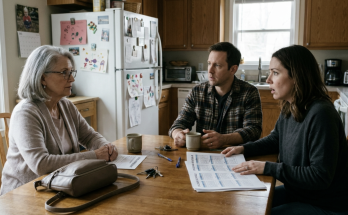

The Woman She Thought Was Nobody
My daughter-in-law pushed me against the marble wall outside the courthouse and whispered, “You are an embarrassment to this family.”
My son stood three steps away.
He looked at the floor.
Not at me.
Not at his wife.
Just at the polished tiles beneath his expensive shoes, as if silence could make him innocent.
I fixed the sleeve of my beige cardigan, picked up my old brown purse, and said nothing. To everyone in that hallway, I looked like a tired seventy-year-old woman who had wandered into the wrong building.
That was exactly what my daughter-in-law, Lauren Whitcomb, believed.
She thought I was harmless.
She thought I was weak.
She thought I had spent my life behind a courthouse desk, stamping papers and making coffee for people who mattered.
Ten minutes later, the bailiff called, “All rise.”
And when Lauren finally looked up, she saw me seated in the judge’s chair.
The Life I Never Explained

My name is Margaret Holloway, and for most of my life, I believed humility was a virtue.
Maybe I believed it too much.
Years before I moved to Asheville, North Carolina, I had served as a judge in Oregon. I spent nearly three decades in courtrooms, listening to people argue over contracts, families, homes, businesses, and broken promises.
But after I retired, I left that life behind.
I bought a quiet house on the edge of Asheville, planted hydrangeas in the backyard, and became simply “Mom” again.
My son, Andrew, had left home young. He went to college across the country, then law school, then built a life that rarely had room for questions about mine. He knew I had “worked at the courthouse.” That was the phrase we always used.
I never corrected him.
At first, I thought I was protecting him from pressure. Later, I told myself it no longer mattered.
By the time he married Lauren, the truth had become an old coat hanging in a closet. Still mine, but rarely worn.
Lauren only heard that I used to work at a courthouse in Oregon. From that moment on, she treated me like a retired clerk with no influence, no money, and no importance.
The first time she came to dinner, she looked around my living room and smiled the way people smile at things they secretly dislike.
“This house is… cozy,” she said.
The pause before “cozy” told me everything.
The Woman Who Wanted Control

Lauren was elegant, polished, and cold in the way only deeply insecure people can be.
She wore cream suits, gold earrings, and soft perfume that lingered long after she left a room. She spoke gently in public and sharply in private. She knew how to make cruelty sound like concern.
“Margaret, you should really update your wardrobe,” she once told me. “People might think Andrew doesn’t take care of you.”
Another time, she touched my curtains and said, “These are very old-fashioned. You probably don’t notice anymore.”
Andrew heard her.
He always heard her.
But he rarely answered.
He was not a bad son at heart. That was what made it hurt more. He was simply tired of conflict, afraid of losing his marriage, and too willing to let his mother absorb the discomfort.
When my granddaughters were born, I thought things might soften.
They did not.
Birthday parties happened without me. Family dinners somehow never included my name. Photos appeared online of smiling children, balloons, cakes, and Lauren’s parents sitting proudly at the table.
I sent gifts.
Sometimes I never knew whether the girls received them.
Once, I stopped by with a picture book and a pink sweater I had knitted by hand. I could hear laughter inside the house before Lauren opened the door.
Her smile appeared first.
Her warmth did not.
“Margaret,” she said. “We weren’t expecting you.”
“I just wanted to bring this for the girls.”
She glanced behind her, then lowered her voice.
“They barely know you. It might confuse them if you keep showing up like this.”
Then she took the gift and closed the door.
I stood on the porch for a long moment, holding nothing but air.
The Message On The Phone
The truth arrived by accident.
Andrew came to my house one Thursday afternoon looking for old insurance papers from his father’s files. He had a court deadline and looked exhausted.
“Mom, do you still have Dad’s old documents?”
“In the study,” I said. “Bottom drawer. I labeled everything.”
He smiled quickly and left his phone on my kitchen table.
While I made coffee, the screen lit up.
I did not mean to read it.
But the preview was impossible to ignore.
Lauren: Once we have her declared unable to manage things, we can sell the house.
My hand froze on the coffee pot.
Another message appeared.
Lauren: It’s worth enough to cover the loan. She can move into assisted living and won’t even understand what happened.
For a few seconds, I could not breathe.
My house.
The house where Andrew had once done homework at the kitchen table. The house where his father’s last photograph still sat on the mantel. The house I bought after retiring because I wanted one peaceful place that belonged to me.
Lauren did not see a home.
She saw money.
When Andrew came back into the kitchen, I handed him coffee with steady hands.
“Thanks, Mom,” he said. “You’re the best.”
I looked at my son, this man I had raised, and wondered how much of him was still mine.
“Andrew,” I asked softly, “are you worried about me living alone?”
He blinked. “What? No. Why?”
I watched his face. Confused. Tired. Guilty, maybe, but not fully aware.
That was when I understood.
Lauren had been driving the plan.
But Andrew had been letting her hold the wheel.
The Folder For The Record
The next morning, I called an old friend named Thomas Bell.
Years earlier, Thomas had been a young attorney in my courtroom. Smart, careful, and honest even when honesty cost him. He now ran a respected law office in Charlotte.
When he answered, his voice was warm.
“Judge Holloway? I haven’t heard that name on my phone in years.”
“Thomas,” I said, “I need help. Quietly.”
We met two days later.
I told him everything: Lauren’s insults, the closed doors, the message, the plan to question my ability to manage my own life.
He listened without interrupting. Then he removed his glasses and said, “They picked the wrong woman.”
We built a wall around my life.
Medical evaluations. Cognitive reports. Updated property documents. A revised will. Financial protections. Written statements. Dates, messages, records.
Everything went into a blue folder labeled:
FOR THE RECORD.
Then Thomas found something else.
Lauren had debts.
Large ones.
A second mortgage on her own home, taken out with Andrew’s signature appearing in places he claimed he never signed. Credit cards close to their limits. Questionable transfers from her small legal practice. Business expenses that looked more personal than professional.
Thomas placed the documents in front of me.
“Your house was not family concern,” he said. “It was her escape plan.”
I sat very still.
I did not want revenge.
I had spent too many years on the bench to confuse justice with anger.
But I did want the truth protected.
The Case In Asheville
Three weeks later, Thomas called again.
“You may want to sit down,” he said.
“At my age, people say that before everything.”
He gave a dry laugh. “The Asheville court needs a visiting judge for a civil hearing next Tuesday. Their assigned judge has a medical emergency. They want someone retired, experienced, and neutral.”
I already knew where this was going.
“Whose case?”
There was a pause.
“Lauren Whitcomb is representing one side.”
I looked out at my backyard, where the hydrangeas were just beginning to bloom.
“Does she know?”
“No. Your appointment is not on the public schedule yet.”
I closed my eyes.
Not from fear.
From clarity.
“Accept it,” I said.
The Hallway
On Tuesday morning, I dressed simply.
Beige cardigan. Black slacks. Comfortable shoes. My gray hair pinned low at the back of my neck. No jewelry except my wedding ring.
To Lauren, I would look exactly as she expected: old, soft, forgettable.
I arrived early and waited near the marble hallway outside Courtroom Four.
Lauren appeared in a navy blazer, walking beside Andrew. Her heels clicked like punctuation marks.
When she saw me, her smile vanished.
“What are you doing here?”
“Good morning, Lauren.”
Her eyes narrowed. “This is not a place for family drama.”
“I agree.”
That seemed to irritate her more.
She stepped closer, lowered her voice, and gripped my arm.
“Did you come here to embarrass Andrew? To make people feel sorry for you?”
“Let go of my arm.”
Instead, she pushed me back against the wall.
Not enough to send me to the floor.
Enough to show me what she believed she could do.
“You are an embarrassment to this family,” she whispered. “A lonely old woman who doesn’t know when to disappear.”
People stared.
Andrew stood frozen.
I looked at him once.
Only once.
His silence answered every question I still had.
Lauren turned away, straightened her blazer, and said, “Come on, Andrew. We’re late.”
They walked into the courtroom.
I picked up my purse and went through the staff entrance.
The guard behind the desk looked up and smiled.
“Good morning, Judge Holloway.”
“Good morning.”
All Rise
In chambers, my black robe waited on a hanger.
For years, I had avoided wearing anything that reminded people of who I had been. That morning, I slipped my arms into the sleeves and felt the weight settle across my shoulders like memory returning home.
When the side door opened, the courtroom was already full.
Lauren sat at counsel table, arranging her papers with controlled confidence.
Andrew sat behind her.
The bailiff lifted his chin.
“All rise. The Honorable Margaret Holloway presiding.”
The room stood.
Lauren looked up.
At first, she simply frowned, as if her mind refused the image in front of her.
Then her face changed.
Confusion became recognition.
Recognition became fear.
Her papers slid from her hand and scattered across the table.
Andrew stood so quickly his chair scraped the floor.
I took my seat.
I did not smile.
“Please be seated.”
No one moved for half a second.
Then the room obeyed.
I looked at the case file before me.
“We are here for Whitcomb Development versus Carver Ridge Properties. Counsel, are you prepared to proceed?”
The opposing attorney stood. “Ready, Your Honor.”
Lauren rose slowly.
Her voice was smaller than I had ever heard it.
“Ready, Your Honor.”
The Woman On The Bench
The hearing was not about me.
That mattered.
I asked fair questions. I followed procedure. I allowed both sides to speak. I did not punish Lauren for what she had done in the hallway.
But truth has a way of changing the temperature in a room.
Lauren stumbled over dates. She cited the wrong section of a contract. She mixed up two exhibits. Her confidence, the thing she had always used like armor, cracked under the pressure of being seen by the one woman she had dismissed.
At one point, I said calmly, “Attorney Whitcomb, please review the document before representing its contents to the court.”
A quiet murmur moved through the room.
Lauren swallowed hard.
Behind her, Andrew looked as if he were watching two versions of his life collide.
After ninety minutes, I called a recess.
“Court will reconvene in thirty minutes.”
I left through the side door.
In the hallway, Thomas was waiting with the blue folder.
“You were fair,” he said.
“I was a judge,” I replied. “That is what judges are supposed to be.”
The Truth At Home
That evening, Andrew came to my house alone.
He stood on my porch with red eyes and no tie.
For the first time in years, he looked like my son instead of Lauren’s husband.
“Why didn’t you tell me?” he asked.
“That I was a judge?”
He nodded.
“I tried, in small ways. You were always busy. And later, I suppose I wanted to see whether you would respect me without a title.”
He looked down.
“I failed.”
I did not answer quickly.
Then he whispered, “Lauren told me you were confused. She said your memory was slipping. She said selling the house would protect you.”
“And did you believe her?”
His face tightened.
“I wanted to. It was easier than arguing.”
I opened the blue folder and placed it on the table.
He read the reports first. Then the property protections. Then the messages. Then the financial records Thomas had gathered.
By the time he reached the forged signature, his hands were shaking.
“That isn’t mine,” he said.
“I know.”
He covered his face.
“Mom, I am so sorry.”
I wanted to comfort him immediately. A mother’s hands remember their work.
But love without truth had brought us here.
So I said, “Sorry is a beginning, Andrew. It is not a repair.”
He nodded through tears.
“Tell me what to do.”
“No,” I said gently. “You are a grown man. You must decide what kind of man you want to be.”
What Was Lost And What Returned
The months that followed were not dramatic in the way people imagine.
There were no public speeches. No grand revenge. No shouting in court.
Lauren’s own choices caught up with her. Her firm investigated the records. Andrew filed for divorce. The forged documents became part of a legal process I did not control and did not attend.
I had already done my part.
I protected my home.
I protected my name.
Most importantly, I stopped shrinking.
Andrew began visiting every Sunday. At first, he came alone, carrying flowers or groceries he did not know how to arrange. We spoke carefully, like people rebuilding a bridge plank by plank.
Then, one afternoon, he brought my granddaughters.
The older one ran into my arms as if she had been waiting all her life to do it.
“Grandma!”
That one word nearly broke me.
We made pancakes. We planted basil in small clay pots. I told them stories about their father as a boy, how he once hid peas in his socks and thought no one would notice.
Andrew laughed harder than I expected.
Later, as the girls played in the backyard, he sat beside me on the porch.
“Thank you for not giving up on me,” he said.
I watched the children chasing bubbles through the grass.
“I never gave up on you,” I said. “But I did stop pretending your silence did not hurt me.”
He nodded slowly.
“I know.”
All Rise Again

People often think age makes a woman smaller.
They are wrong.
Age can strip away the need to impress people who never intended to value you. It can teach you the difference between peace and surrender. It can show you that silence is not always grace; sometimes it is simply fear wearing polite clothes.
For years, I let people underestimate me because I thought love required softness without boundaries.
I know better now.
My beige cardigan still hangs by the door. My old brown purse still sits on the hall table. Most days, I look like any other retired grandmother in Asheville, buying peaches at the farmers market and waving to neighbors from my porch.
That is fine.
I do not need strangers to know who I was.
I know.
I was the widow who studied law after her son went to sleep.
I was the judge who served three decades without needing applause.
I was the mother who learned that protecting her child should not mean disappearing inside his life.
And I was the woman who walked into a courtroom after being pushed against a wall, took the highest seat in the room, and let the truth stand up for itself.
So when someone tries to make you feel small, remember this:
You do not need to shout to rise.
Sometimes, you only need to stand where you belong.
Never mistake an older person’s quiet nature for weakness, because many people who speak softly have survived chapters that would have broken louder souls.
A family built on silence may look peaceful from the outside, but inside, silence can slowly turn into permission for disrespect.
True love does not ask a mother to disappear so a marriage can feel comfortable.
When someone constantly insults your appearance, your age, or your home, they may not be giving advice; they may be testing how much disrespect you will accept.
Greed often hides behind concern, especially when someone says they are “helping” while quietly reaching for what belongs to you.
A person’s title does not create their worth, but the way others treat them before knowing that title reveals their character.
Children can grow up and still lose their way, but accountability is the only path that can lead them back.
Protecting yourself is not revenge; sometimes it is the most dignified form of survival.
Do not shrink your life to fit inside someone else’s comfort, because the people who truly love you will never need you to become smaller.
There comes a time when every person must rise—not with anger, not with cruelty, but with truth, dignity, and the quiet courage to stand tall again.