My husband scheduled an anniversary email to his mistress and accidentally copied me.
It arrived at midnight, bright and clean on my phone screen while Manhattan glittered behind our bedroom glass like a tray of diamonds.
“Three years of choosing you,” it said.
Three years.
I had spent those same years defending Carter Whitmore to my friends, forgiving his silences, excusing his empty chair at dinner, blaming stress, board meetings, mergers, grief, ambition—anything but another woman.
I read the email without blinking.
Beside me, Carter slept in our California king bed, one hand resting on the gray silk duvet I had chosen for our tenth wedding anniversary. The sheets smelled faintly of bergamot and betrayal.
The message had been scheduled for 12:00 a.m.
Not sent in passion. Not typed after wine. Not a mistake of impulse.
Scheduled.
Planned.
Curated.
Like everything Carter loved.
Happy anniversary, my Sloane.
I smiled so slowly it didn’t feel like my face anymore.
Then I replied all:
“Four people are in this marriage now—me, you, her, and my lawyer.”
CHAPTER 1: THE EMAIL THAT BURNED IN SILK
Carter woke to the sound of my message leaving.
Not a scream. Not a thrown glass. Not a wife collapsing into the dramatic ruin men imagine when they betray women who have learned to survive disappointment in pearls.
Just one clean little whoosh.
He opened his eyes.
For a second, he looked young. Disoriented. Human. His dark hair fell over his forehead, and the moonlight softened the arrogant architecture of his face. At thirty-nine, Carter Whitmore still looked like the kind of man magazines put on covers beside words like legacy, discipline, empire.
Then his gaze dropped to my phone.
He knew.
The blood left his face so quickly I could almost hear it retreat.
“Evelyn,” he said.
My name sounded expensive in his mouth. Like something he had bought and forgotten to insure.
I placed the phone on the nightstand and sat against the pillows. “Don’t rush. Read it first.”
He grabbed his phone so fast the charging cord snapped loose and slid across the rug. His thumb moved. His eyes scanned. His jaw tightened.
Then came the performance.
“What is this?”
I let the silence answer.
He tried again. “This is not what it looks like.”
I laughed once.
It was not a loud laugh. It was not even angry. It was the kind of laugh that makes a room colder.
“Carter, it is written with your initials, from your private email, scheduled through your assistant’s server, attached to a reservation at the Carlyle and a receipt for a bracelet that costs more than my first car.”
His mouth closed.
Outside, far below our penthouse on Central Park South, traffic moved like blood through the city’s veins. New York did not pause for heartbreak. That was one of the reasons I loved it.
He sat up, dragging a hand down his face. “Evelyn. Listen to me.”
“I did,” I said. “For ten years.”
“That email was—”
“Scheduled?”
His eyes flashed. “A mistake.”
“No. A mistake is putting salt in your coffee. A mistake is texting the wrong group chat. Three years is a lifestyle.”
He stood and reached for his robe. Navy cashmere. A gift from me last Christmas. He wore it like armor.
“Keep your voice down,” he said.
There it was.
Not I’m sorry.
Not I hurt you.
Not I have destroyed the woman who helped build my life.
Keep your voice down.
I looked at him, really looked at him, and felt something inside me detach with a soft, final click. It was not love dying. Love does not die in one moment. Love is murdered slowly, and then one day you find the body.
Mine had been dead for years. I had simply been sleeping beside it.
“Who is Sloane?” I asked.
His silence had an answer.
I unlocked my phone and opened the attachment again. A reservation confirmation. The Carlyle Hotel. Two nights. Champagne. Roses. A suite overlooking Madison Avenue.
Below it, a jewelry invoice from Bexley & Vale.
One platinum bracelet. Emerald clasp. Inscription: For the woman who made me feel chosen.
I almost admired the cruelty.
Our tenth wedding anniversary was tomorrow. Or today, technically.
Carter and I were hosting the Whitmore Foundation’s winter gala at The Plaza. Five hundred guests. Donors, senators, CEOs, art collectors, women with diamond wrists and hungry eyes. The entire city’s polished class would gather beneath chandeliers to celebrate our marriage, our charity, our immaculate life.
And somewhere in that room, apparently, would be Sloane.
“Does she know?” I asked.
He swallowed. “Know what?”
“That I exist?”
His face hardened. “Don’t do this.”
“Do what?”
“Turn this into a scene.”
“A scene?” I repeated softly.
I looked around our bedroom. The hand-painted de Gournay wallpaper. The marble fireplace. The framed Vogue profile calling us Manhattan’s Quiet Power Couple. The wedding photograph on my vanity, where I stood in white satin beside a man who had promised to honor me before God, my dying father, and half of New York.
A scene.
That was what men called pain when it escaped its cage.
“I am not turning anything into a scene,” I said. “You wrote the script.”
He stepped closer. “Evelyn, tomorrow matters. The gala matters. The foundation matters. We can discuss this privately after.”
“After what? After you thank me onstage and take her to bed afterward?”
His expression flickered.
There it was again.
Proof.
Not in documents, not yet. But in the tiny betrayals of the face.
I got out of bed. The silk slip I wore was the color of smoke. Carter watched me cross the room to my closet, as if he expected me to pull out luggage or a gun.
Instead, I selected tomorrow night’s gown.
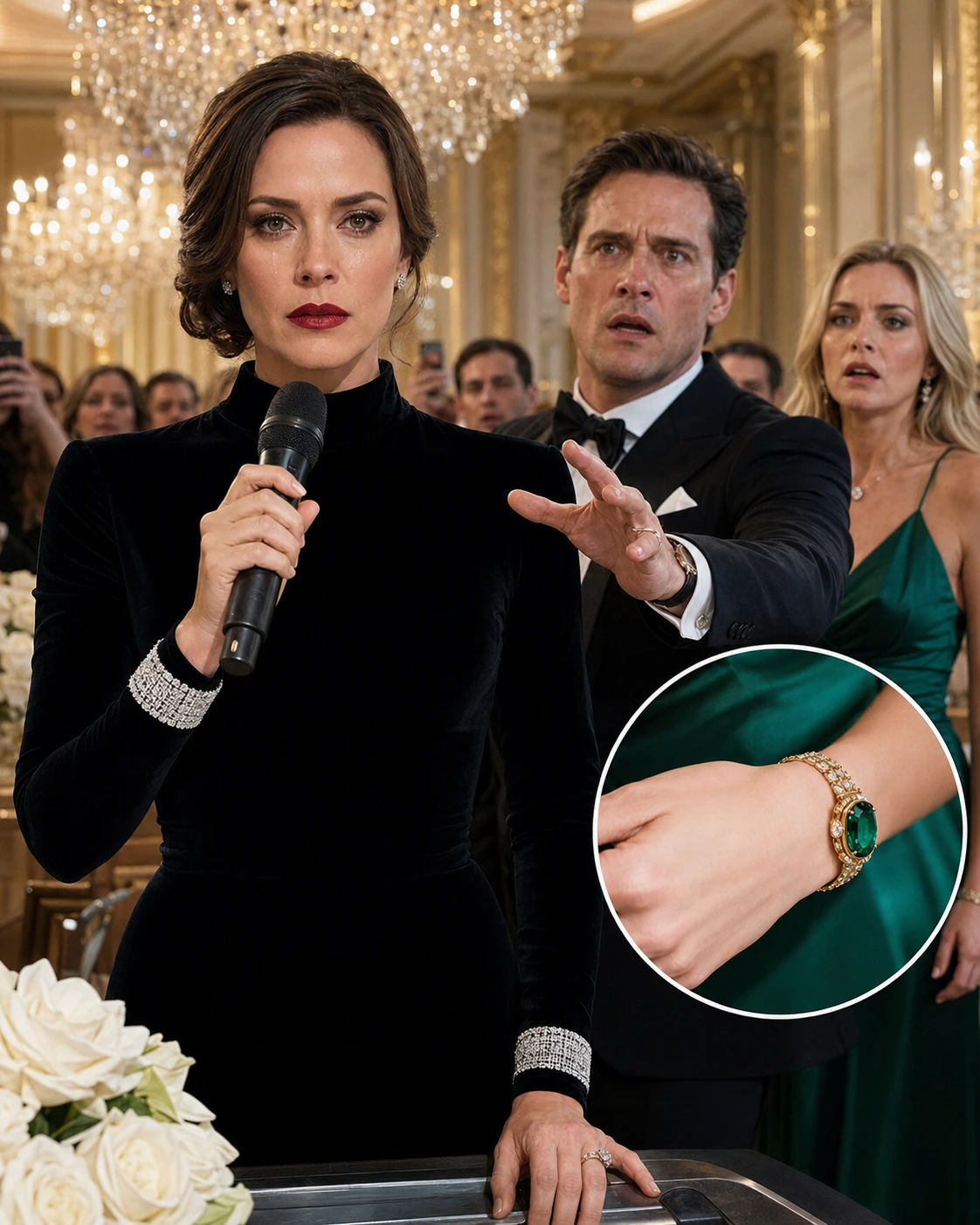
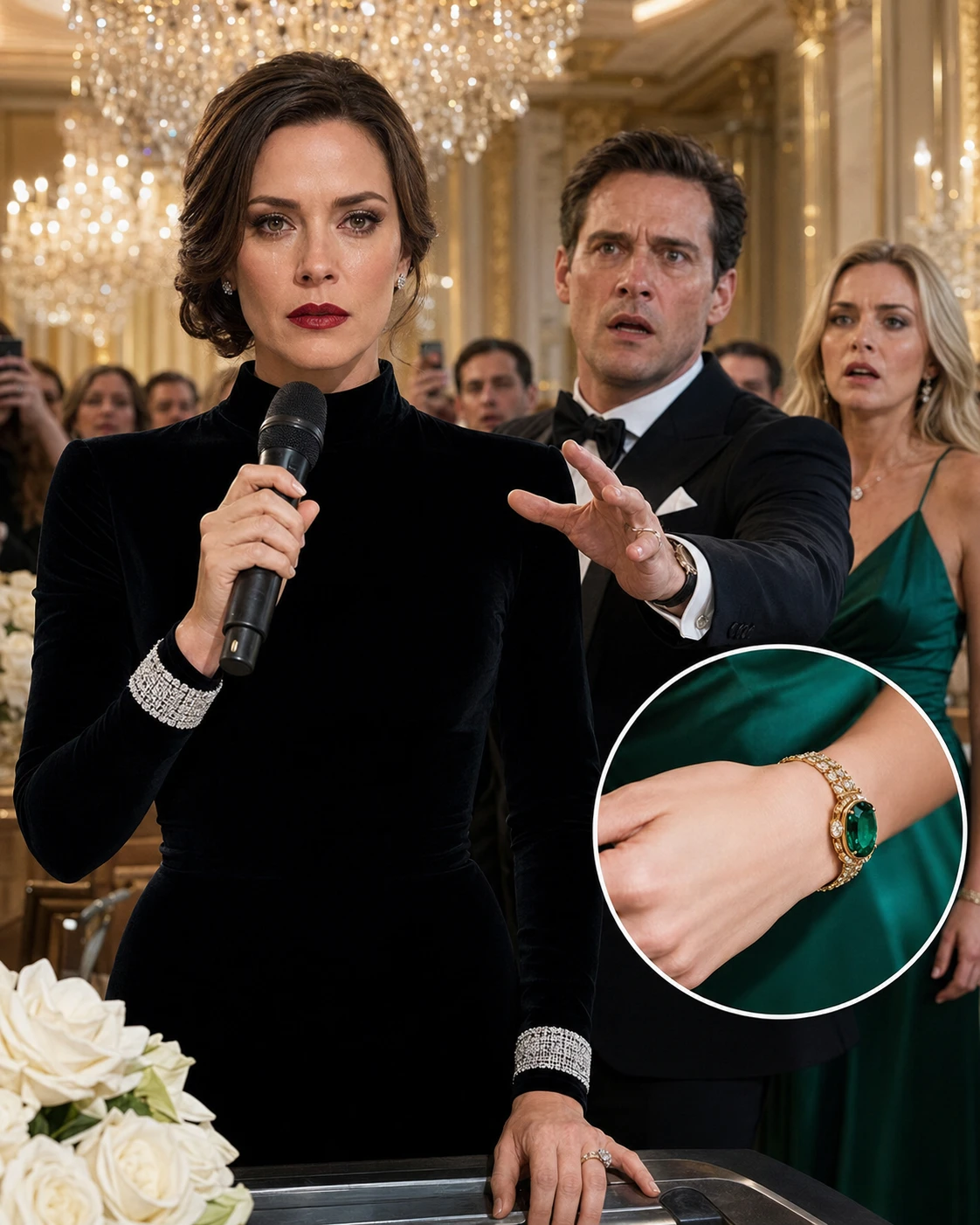
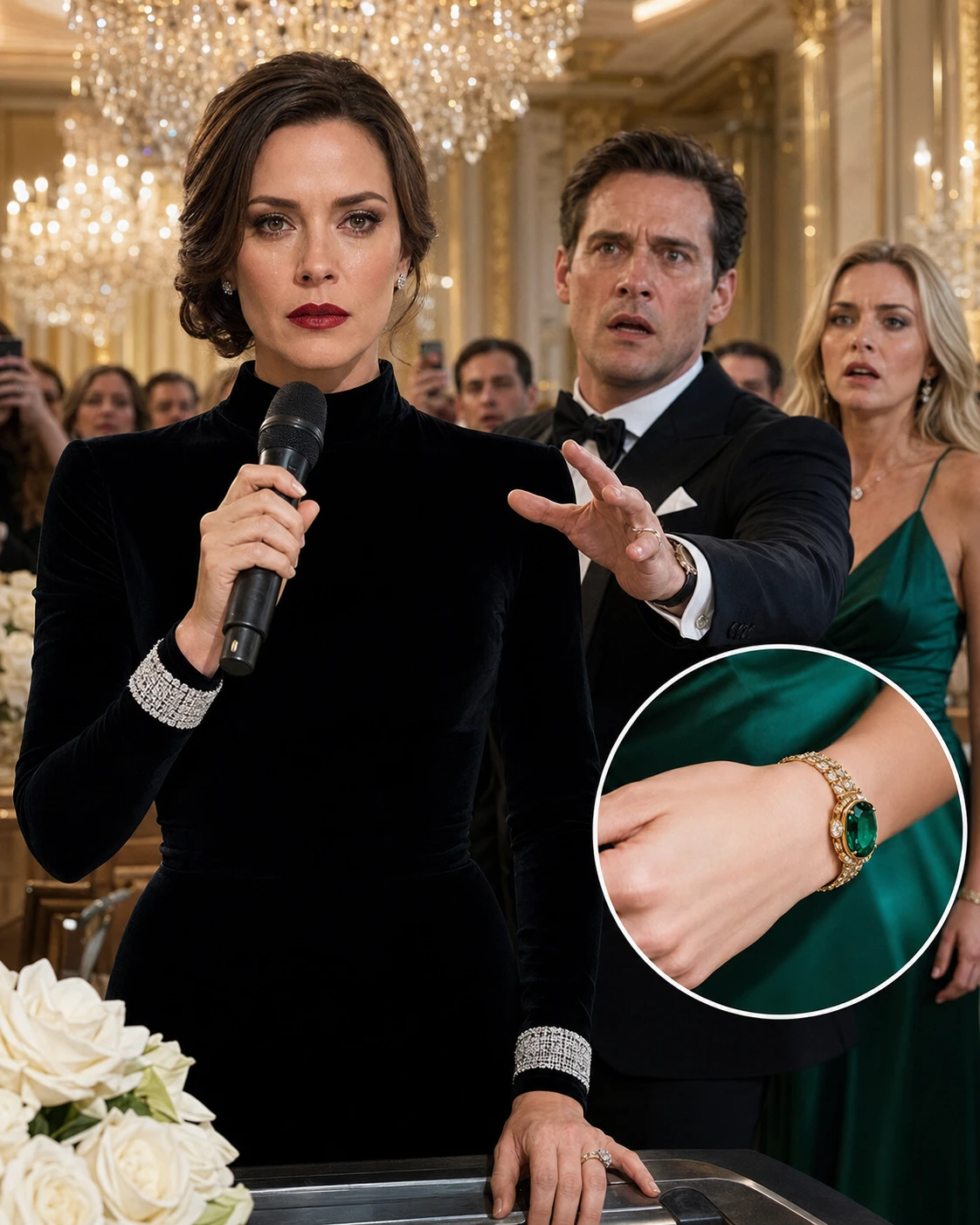
Black velvet. Long sleeves. High neck. No sparkle except for the line of diamonds at the cuffs. It had been custom-made in Paris and had arrived that morning in a white box tied with ribbon.
Carter frowned. “You’re still going?”
I ran my fingers over the velvet.
“Of course.”
“That’s not a good idea.”
I turned.
“My father once told me that wealth is not the same thing as power,” I said. “Wealth makes noise. Power waits.”
Carter stared at me.
For the first time in years, I saw something like fear behind his eyes.
He covered it quickly. Carter had built an entire career on covering fear with charm. “You’re upset. I understand that. But you have no idea what’s really happening.”
“No,” I said. “But I will.”
He moved toward my phone.
I picked it up first.
“Don’t,” I said.
One word. Quiet.
He stopped.
The strange thing about living with a man like Carter Whitmore is that everyone assumes you are protected. They see the penthouse, the drivers, the Hamptons house, the charity galas, the black cards, the security staff, the private dining rooms. They do not see the small ways control enters a marriage.
The shared accounts he manages because finance is his world.
The public smile you maintain because reputation is both currency and prison.
The assistant who schedules your husband’s calendar but never yours.
The friends who say, “He’s under so much pressure,” until you begin apologizing for being lonely.
For years, Carter had mistaken my grace for weakness.
That was his first legal error.
At 12:17 a.m., my phone buzzed.
Unknown number.
A single message.
You should have stayed asleep, Evelyn.
No signature.
I stared at it for a long second.
Then another message arrived.
He was never yours the way he is mine.
I showed the screen to Carter.
His face changed.
Not guilt. Panic.
“Is that her?” I asked.
He reached for the phone again. “Give me that.”
I stepped back.
“Interesting,” I said. “She has my number.”
“Evelyn.”
“Does she have my closet inventory too? My medical records? My dinner reservations?”
He said nothing.
I took a screenshot, forwarded it to myself, and uploaded it to a secure cloud folder I had not used since my father’s estate battle eight years earlier.
The folder’s name was simple.
Weather.
Because when a storm is coming, you prepare quietly.
By morning, Carter had not slept. I had.
There is a particular kind of peace that arrives when the worst thing finally becomes visible. For years, I had lived in fog. Now I had a shape. A name. A timestamp.
At ten, my glam team arrived.
Carter hovered in the doorway while my hairstylist pinned my chestnut hair into a low chignon and my makeup artist painted my mouth a shade of red called Obsidian Rose.
He had tried apologies over coffee.
He had tried anger in the hall.
He had tried tenderness while I stood at the window overlooking the park, telling me he “lost himself,” that Sloane “didn’t mean anything,” that men under pressure “make catastrophic choices.”
I had listened politely.
Then I had asked for her last name.
He refused.
So I found it myself.
Sloane Prescott.
Thirty-two. Former gallery director. Newly appointed creative consultant to the Whitmore Foundation. Apartment in Tribeca. Social media full of tasteful black-and-white photographs, antique mirrors, vintage champagne, and captions about becoming the woman you were always meant to be.
Three years of choosing you.
She had been standing beside me at last year’s gala.
I remembered her now.
Emerald dress. Pale blonde hair. A smile like a knife wrapped in silk.
She had complimented my earrings.
Women always know. Not always consciously. But the body knows when another woman enters your house wearing your husband’s attention like perfume.
At six that evening, Carter appeared in my dressing room wearing a tuxedo and the expression of a man walking into a boardroom where the numbers had turned against him.
“You look beautiful,” he said.
“I know.”
He flinched.
Good.
We rode to The Plaza in silence.
Fifth Avenue shone wet under December rain. Holiday lights glittered in the trees. Inside the car, Carter’s knee bounced once, twice, then stopped when he noticed I was watching.
“Evelyn,” he said, voice low, “whatever you think you’re going to do tonight—don’t. We have donors in that room. Press. Board members.”
“Then behave like a faithful husband.”
His jaw tightened. “This is bigger than us.”
“It always was, wasn’t it?”
He looked away.
When we arrived, flashes exploded outside the hotel. Carter stepped out first, then offered me his hand. For a moment, cameras caught us exactly as the world knew us: Carter Whitmore, golden financier, and Evelyn Hartwell Whitmore, the elegant wife who made his ambition look civilized.
I took his hand.
Not because I needed it.
Because evidence sometimes wears diamonds.
Inside, the ballroom glowed like a dream built by people who had never worried about money. White roses climbed silver columns. Crystal chandeliers poured light over black tuxedos and silk gowns. A string quartet played near the champagne tower.
And there she was.
Sloane Prescott stood beneath the archway leading to the donor salon, wearing emerald satin.
Of course she was.
The bracelet glittered on her wrist.
My bracelet, bought with my marriage.
Her eyes found mine across the room.
She smiled.
Not nervously. Not apologetically.
Triumphantly.
Carter saw her too. His body betrayed him before his mouth could. One small pause. One softened breath.
I leaned toward him and whispered, “You may want to blink. The photographers are watching.”
He did.
For the first hour, I performed flawlessly.
I greeted donors. Kissed cheeks. Laughed at appropriate moments. Spoke to Senator Halston about foster-care scholarships. Complimented Mrs. Van der Meer’s sapphire brooch. Raised money with the serene efficiency of a woman who had been underestimated by everyone in the room.
Carter stayed close.
Too close.
Sloane watched us with growing irritation.
At 8:30, Carter took the stage.
The ballroom quieted. Champagne glasses lowered. Cameras lifted.
He stood beneath the chandelier, handsome and composed, one hand in his pocket, the other resting on the podium.
“My wife, Evelyn, and I are honored to welcome you tonight,” he began.
Applause.
I stood near the front, smiling.
He spoke about legacy. Community. Responsibility. The Whitmore Foundation’s new arts initiative. His voice was warm, practiced, expensive.
Then his eyes shifted.
To Sloane.
“And tonight,” he said, “I want to acknowledge someone whose vision has transformed this foundation from an obligation into something alive.”
The air changed.
Beside me, my friend Margot’s fingers tightened around her clutch.
Carter continued.
“Sloane Prescott has reminded me what passion looks like.”
A murmur moved through the crowd.
My smile did not move.
“She has challenged me, inspired me, and shown me that sometimes the life expected of us is not the life that saves us.”
The first phone rose.
Then another.
People can smell blood under perfume.
Carter should have stopped. But arrogant men rarely recognize cliffs. They only admire the view.
“Sloane,” he said, looking directly at her, “thank you for making me brave.”
The ballroom froze.
Sloane’s eyes shone.
She walked toward the stage as if summoned by destiny.
My humiliation became public property in real time.
I heard whispers behind me.
Is he serious?
Where is Evelyn?
Oh my God.
Is that the consultant?
Carter reached for Sloane’s hand.
The cameras loved it.
I lifted my champagne glass and took one slow sip.
That was when Carter’s microphone, still live, caught his whisper to her.
“Tonight ends the pretending.”
Five words.
Clear as crystal.
The room erupted without making a sound.
A scandal among the wealthy is never loud at first. It is a thousand silent calculations happening behind lifted brows.
Sloane turned toward me.
Her smile said: He chose me.
Mine said: Thank you.
Because Carter had just given me something no private investigator could buy.
Public proof of contempt.
A donor’s wife near the front whispered, “Evelyn, are you all right?”
I set my glass on a passing tray.
“Yes,” I said. “I believe I finally am.”
Then I walked toward the stage.
Every camera followed.
Carter’s face drained again when he saw me coming. Sloane’s fingers tightened around his.
I climbed the three steps slowly, velvet moving around my legs like smoke.
Carter leaned toward the microphone. “Evelyn—”
I took it from him.
Not grabbed. Took.
The room held its breath.
I looked out at five hundred witnesses, twenty-seven reporters, fourteen board members, my husband’s mistress, and the man who had mistaken my silence for consent.
“Thank you all for being here,” I said. “Tonight was meant to celebrate commitment.”
A few people shifted.
“Instead, it appears we are celebrating clarity.”
Carter whispered, “Don’t.”
I smiled.
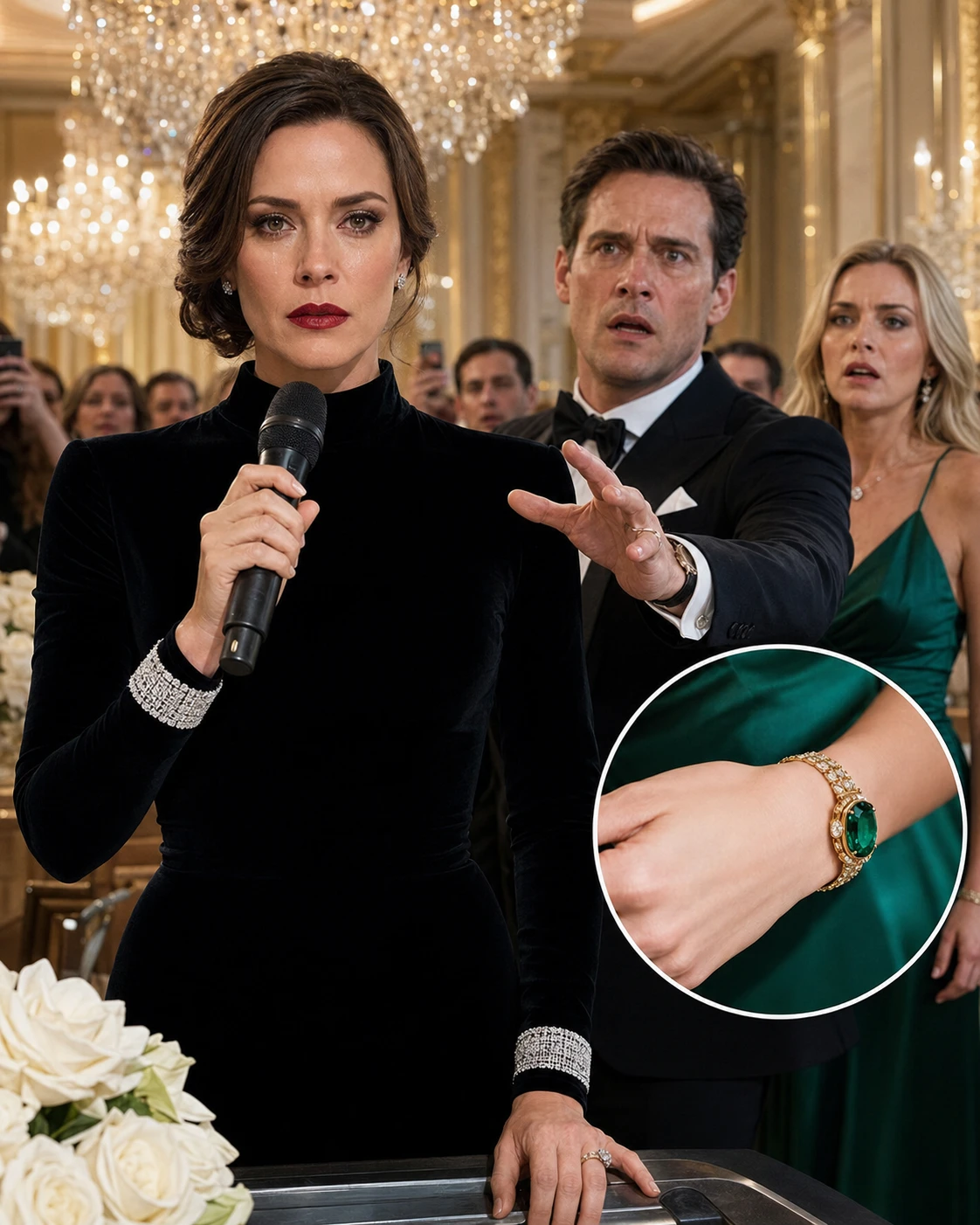
Not at him.
At the cameras.
“Please enjoy the champagne,” I said. “It was paid for by my family trust, not my husband’s courage.”
Then I handed the microphone back to him and walked off the stage.
No tears.
No shaking.
No shattered dignity.
Only the sound of my heels on marble, counting down the seconds until war.