
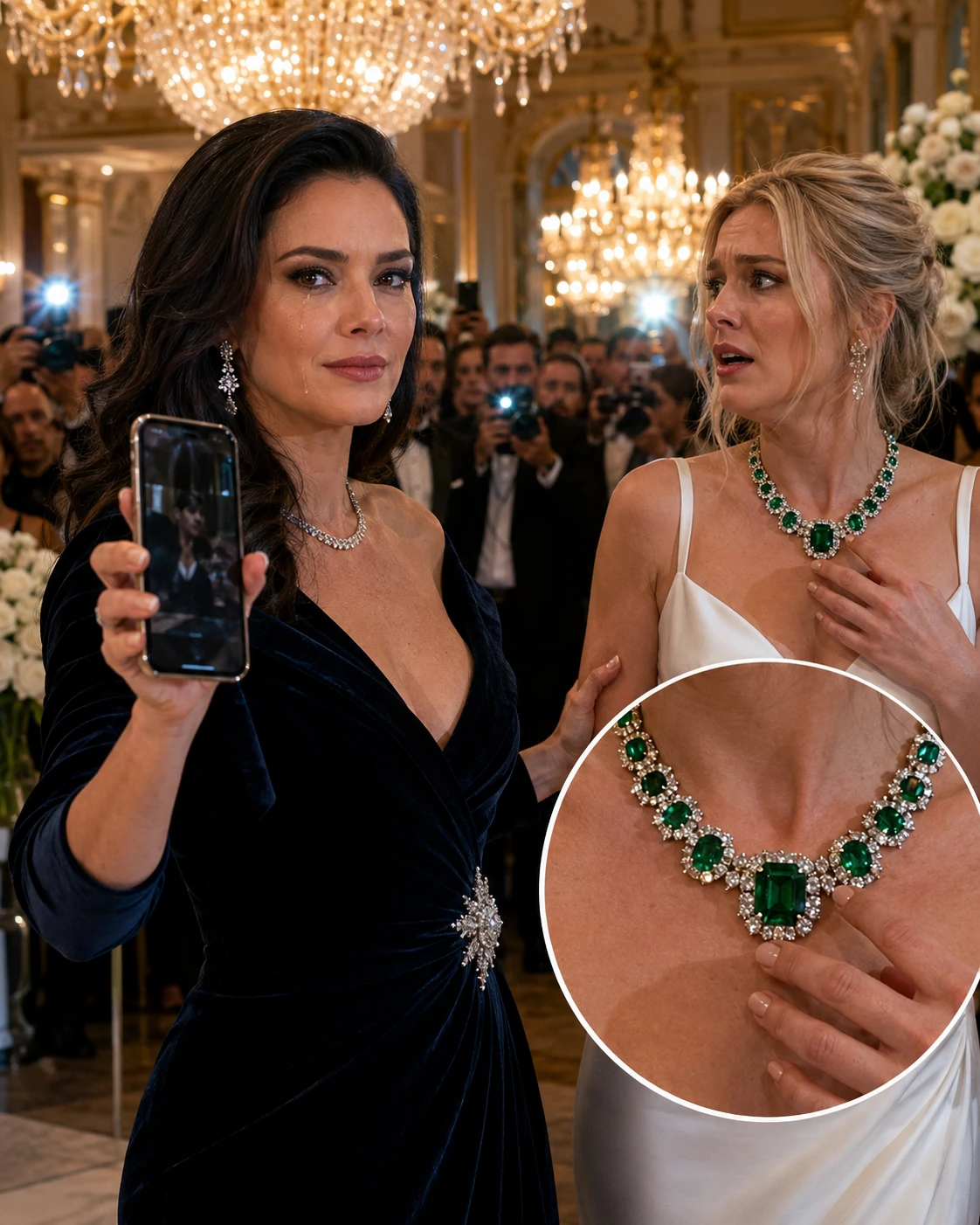
The first time my husband’s mistress touched my arm, forty-seven cameras turned toward us.
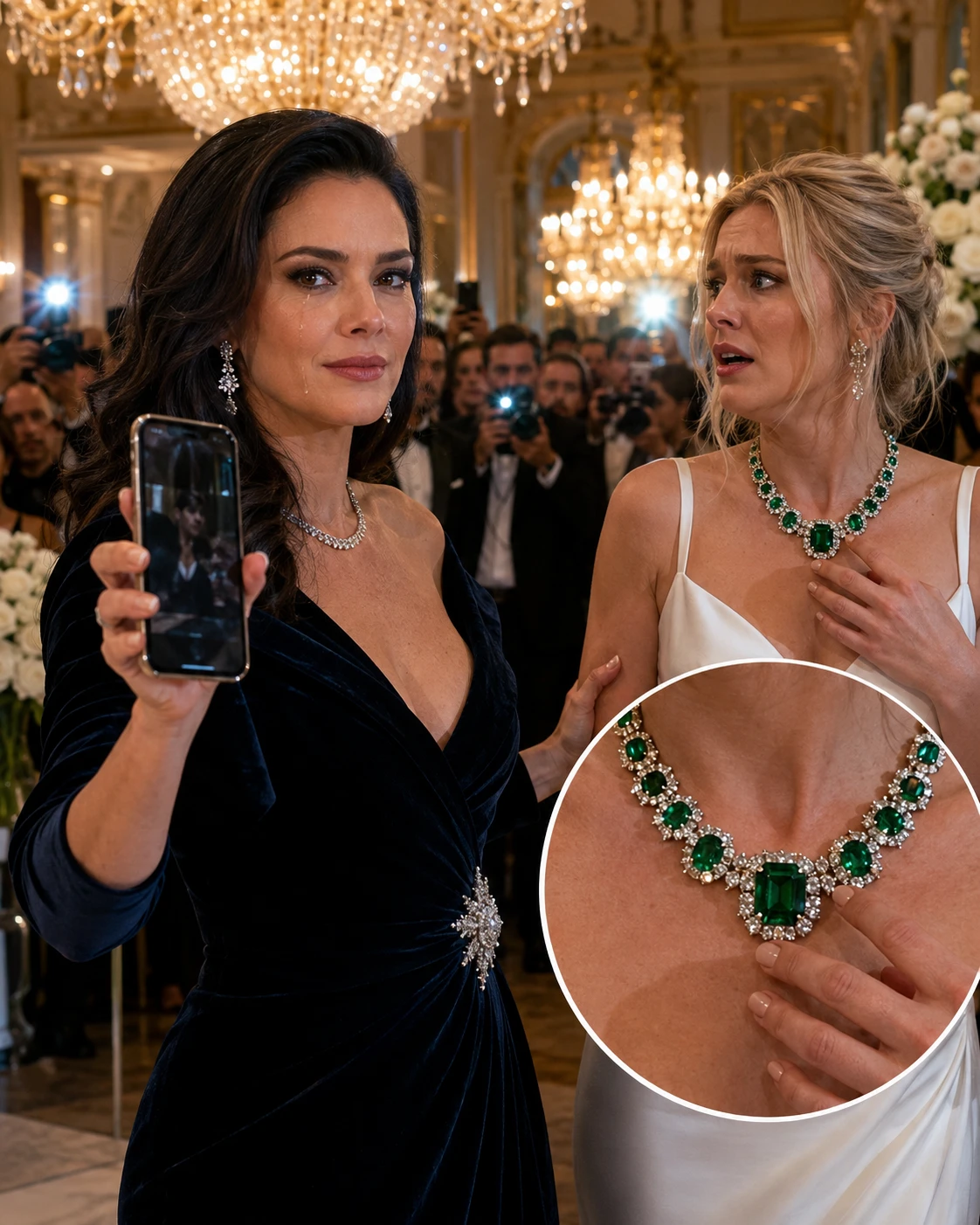
She leaned in beneath three million dollars’ worth of chandeliers, her perfume sweet as champagne and poison, and whispered, “I’m so sorry, Evelyn. I never meant to hurt you.”
Around her throat sat my father’s emerald necklace.
The one he fastened on me with trembling hands eleven days before he died.
The one that had disappeared from my locked safe three weeks ago.
The one Grant swore he had never seen.
My husband stood two steps behind her, beautiful in his black tuxedo, his smile polished for donors and newspaper photographers. He looked everywhere but at me, because cowardice loves expensive lighting.
The room waited for me to break.
I smiled instead.
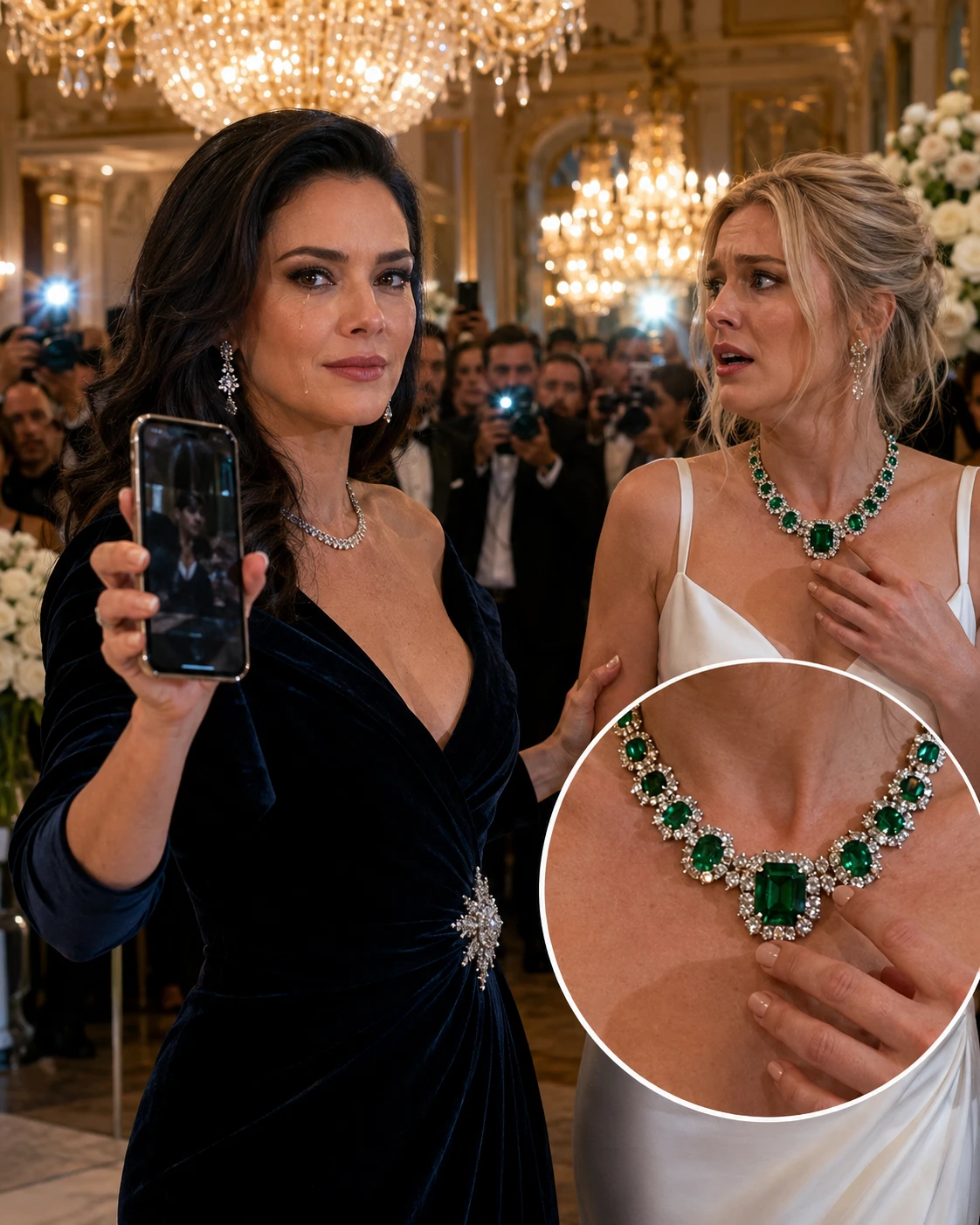
Addison Blake’s fingers tightened around my arm, soft pink nails pressing into the silk of my gown. She tilted her chin so the emeralds caught the light.
Then she said, still smiling for the cameras, “Grant told me you wouldn’t mind if I kept it.”
I looked at the necklace.
Then at my husband.
Then at the lenses flashing like a storm of tiny executions.
“Keep smiling,” I said gently. “The police report needs a clear photo.”
CHAPTER 1: The Woman Wearing My Father’s Last Goodbye
There are two kinds of silence in rooms full of rich people.
The first is polite silence, the kind that settles over a table when someone mentions tax audits, divorce settlements, or a son who dropped out of Yale to become a DJ in Austin.
The second is predatory silence.
That was the kind that fell over the Grand Ballroom of The Whitmore Hotel after I spoke.
It slipped between champagne flutes and diamond bracelets. It curled around the white roses stacked in mirrored vases. It moved through the gala guests like cold smoke.
Addison’s smile flickered.
Only for half a second.
But half a second is enough when photographers are hungry.
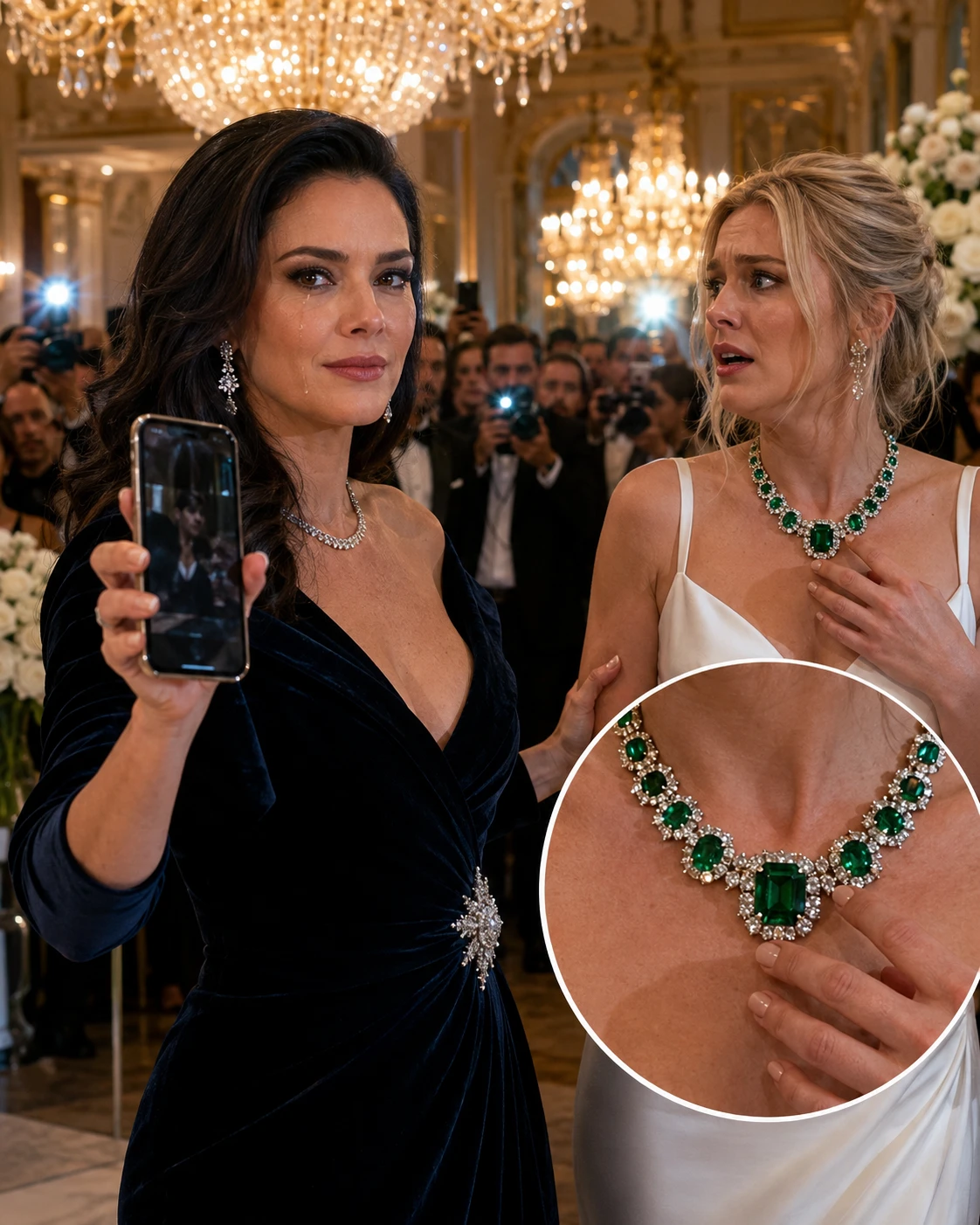
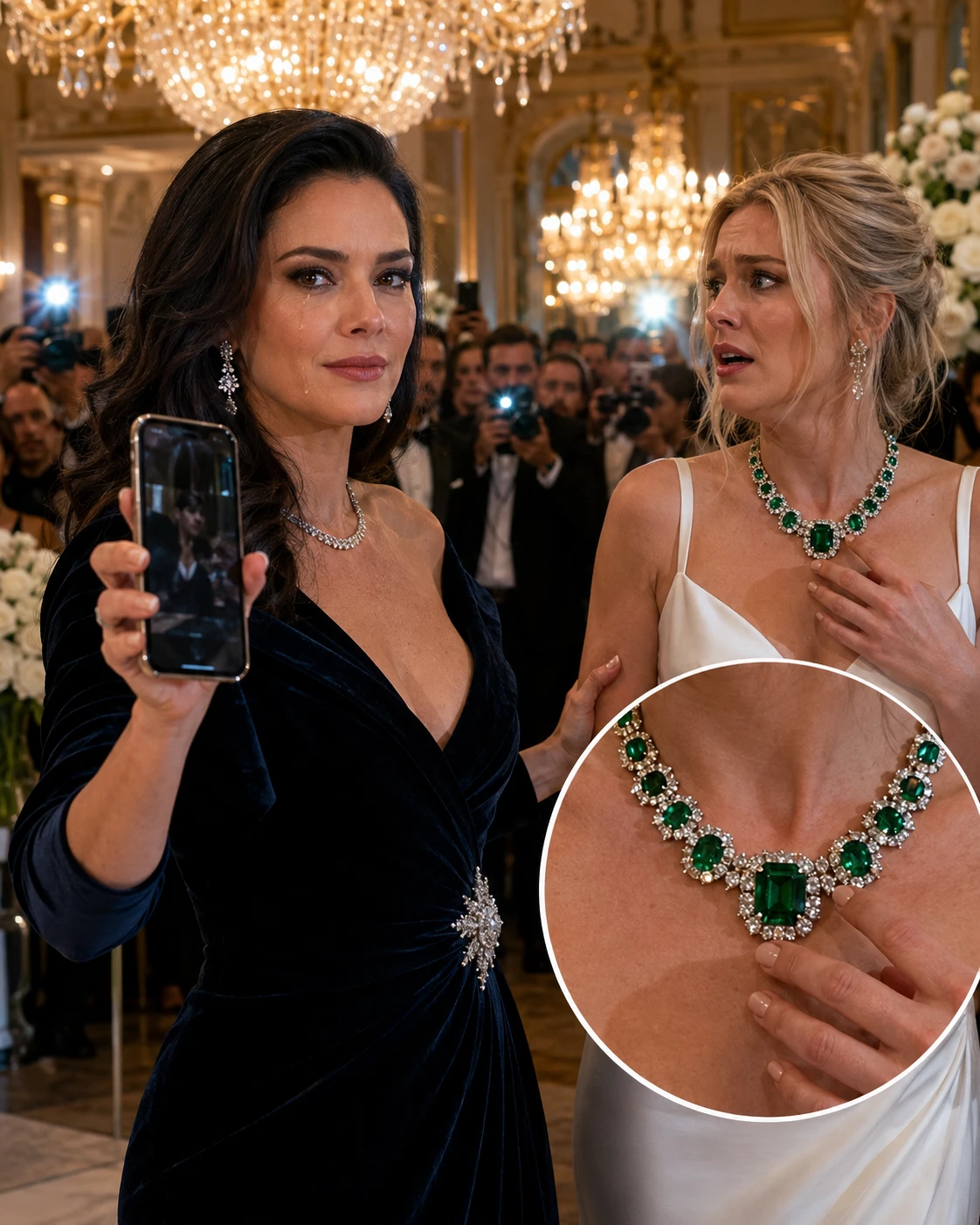
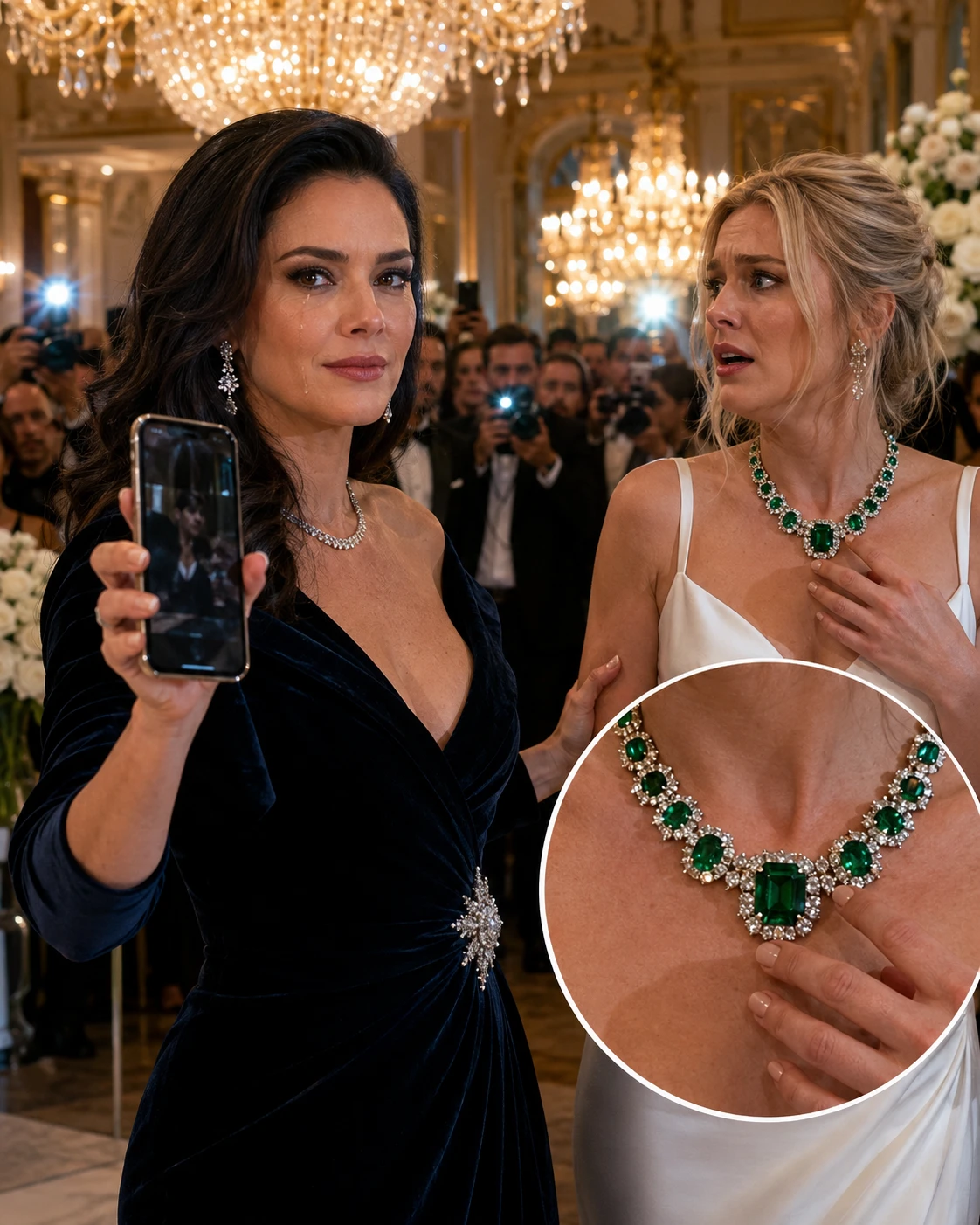
The necklace rested against her throat like it belonged there. Five Colombian emeralds, deep green and almost black at the center, surrounded by a river of old mine diamonds. My father had called it the Larkspur Necklace because my mother loved larkspurs and because Elias Hart had always believed grief should be named after flowers when possible.
He had bought it at auction the year my mother died.
He did not give it to me then. I was nineteen and furious at the world, the kind of girl who smoked on balconies and pretended money made loss less humiliating. He waited sixteen years. He waited until the cancer had hollowed him out and made him honest in ways health had never managed.
“Don’t wear it for beauty,” he had told me.
His hands shook when he clasped it around my neck in his study in Newport. Beyond the windows, the Atlantic beat itself against the cliffs. He smelled like sandalwood, antiseptic, and the peppermint candies he pretended not to eat.
“Wear it when you need to remember who you are.”
I had laughed then, because crying felt too small.
“Dad, it’s a necklace.”
“No,” he said, turning me toward the mirror. “It’s proof.”
I did not understand him.
Not then.
Three years later, in the ballroom of the very hotel my father had built before marrying it to the Mercer name, I understood enough not to scream.
Grant’s hand found Addison’s lower back.
Possessive. Protective. Stupid.
“Evelyn,” he said quietly.
He used the voice he reserved for staff, nervous investors, and me whenever he wanted to remind me there were people watching.
I lifted my champagne flute.
“Yes, darling?”
A photographer from Manhattan Society Weekly stepped closer. I knew him. Peter Lowell. He had photographed our wedding on Martha’s Vineyard and my father’s funeral in Newport. His camera was now aimed directly at Addison’s throat.
Grant noticed.
His jaw tightened.
Addison did not move. For all her softness, she had a talent for cruelty. She was twenty-seven, with honey-blonde hair, wide blue eyes, and the tender expression of a woman who had learned that innocence photographed better than guilt. She wore a white satin gown cut low enough to turn the necklace into an announcement.
The message was not subtle.
Grant chose me.
Grant gave me what was yours.
Grant can take from you in public, and you will still smile.
That was the plan, I realized.
Not the affair. I had known about the affair for months. Affairs have smells. Expensive hotels, late-night showers, sudden gym memberships, a man who places his phone facedown even in his own home. No, the affair was ordinary. Disappointing, but ordinary.
The plan was the humiliation.
My husband had brought his mistress to the St. Aurelia Children’s Foundation Gala wearing my stolen inheritance because he wanted me unstable.
He wanted me emotional.
He wanted me photographed looking bitter, jealous, hysterical, old beside Addison’s youth.
He wanted the board to whisper that Evelyn Hart-Mercer, the woman who controlled thirty-eight percent of the voting shares in Mercer House, was unraveling.
He wanted me to make his next move easier.
A generous divorce.
A private settlement.
A quiet removal.
Men like Grant rarely want freedom. They want ownership without witnesses.
“Is there a problem?” Addison asked.
Her voice was soft enough to bruise.
I turned my smile on her. “With the necklace? Yes.”
Her hand flew to it.
I could have said more. I could have told the room that my bedroom safe had been opened with a duplicate key three weeks earlier. I could have described the security report, the missing inventory logs, the police officer who had taken my statement while Grant stood beside me pretending sympathy. I could have mentioned the insurance claim Grant encouraged me to file before the investigation had even begun.
Instead, I took one step closer.
The emeralds were so familiar that seeing them on her felt less like theft than grave robbery.
“My father had the clasp repaired in Paris after the center stone came loose,” I said. “The jeweler engraved my initials inside it.”
Addison swallowed.
Grant finally looked at me.
There he was.
My husband of seven years.
The man I married on a windswept September afternoon in front of white hydrangeas and old money that was mostly borrowed. He had looked at me then like I was rescue. Maybe I was. Grant Mercer had inherited a name, a failing luxury hotel group, and enough debt to make legacy look like a costume. I had brought Hart capital, Hart discipline, and my father’s unromantic refusal to lose.
I had loved him once.
That was the part people forget in revenge stories.
You do not become dangerous because you never loved someone.
You become dangerous because you did.
“Evelyn,” Grant said again. “Not here.”
I almost laughed.
Not here.
Not under the chandeliers he chose.
Not in front of donors he courted.
Not beside the woman he dressed in my dead father’s gift.
“Where would you prefer?” I asked. “The bedroom where you lied to me? The office where you forged my signature? Or the police station, since we’re already halfway there?”
A sound went through the crowd.
Not a gasp exactly. Rich people try not to gasp. It is vulgar. But their breath changed. Their eyes sharpened. Their bodies leaned forward by inches.
Grant’s face went still.
Addison’s fingers trembled against the emeralds.
I set my champagne flute on a passing waiter’s tray. The crystal clicked softly against other glasses, a tiny sound, clean and final.
Then I reached into my clutch and removed my phone.
Grant took one step toward me.
“Don’t,” I said.
He stopped.
Not because I raised my voice.
Because I didn’t.
A man who knows you can be made to beg is terrified the first time you choose not to.
I tapped the screen and turned it toward him.
On it was a photograph from my home security system, captured at 2:14 a.m. three Thursdays earlier. Grant stood in my dressing room, opening the black lacquer safe behind the full-length mirror. His face was clear. His cufflinks were clear. The velvet necklace case in his hand was clear.
Behind him, reflected faintly in the mirror, was Addison Blake.
Wearing my robe.
The same pale blue silk robe my mother had bought in Paris.
Addison made a small, wounded sound.
That sound saved her nothing.
“You said the cameras in my dressing room were excessive,” I told Grant. “My father called them necessary.”
Peter Lowell’s camera flashed again.
Grant’s eyes dropped to my phone, then lifted to mine.
For a moment, beneath the expensive haircut and handmade tuxedo and the Mercer family arrogance, I saw the truth of him.
Not a villain.
Worse.
A small man who had mistaken access for power.
“You’re making a mistake,” he said.
“No,” I said. “I made one seven years ago. Tonight I’m correcting it.”
Security moved first.
Not hotel security. Mine.
Two men in dark suits emerged from the west entrance and positioned themselves near the ballroom doors. A woman in a navy evening jacket, Detective Mara Ellis of the NYPD, entered behind them with the calm expression of someone who had seen enough rich people misbehave to find them boring.
Grant saw her.
His color changed.
Addison stepped back so quickly the necklace swung against her collarbone.
“Grant?” she whispered.
He did not answer.
He was looking at me the way men look at locked doors after realizing they left the key inside.
Across the ballroom, the string quartet continued playing because professionals understand that catastrophe needs music.
I turned away from Grant and faced the donors.
“Ladies and gentlemen,” I said, lifting my voice just enough to carry. “I apologize for the interruption. Please continue enjoying the gala. Tonight’s auction benefits the pediatric cardiac wing at St. Aurelia, and nothing—not even my husband’s poor judgment—should take attention away from those children.”
A few nervous laughs flickered.
Good.
Control the room, my father used to say, and the room will decide you were never the one in danger.
Then I looked back at Addison.
“Take it off.”
Her eyes filled with tears so quickly they might have been rehearsed.
“I didn’t know,” she whispered.
I leaned close enough that only she, Grant, and the nearest camera could hear.
“Yes, you did.”
Because she had known.
Not everything, perhaps. Not the forged documents. Not the hidden accounts. Not the lovely little financial traps Grant had built with the confidence of a man who believed women were too sentimental to read bank statements.
But she had known the necklace was mine.
Women always know when they are wearing another woman’s warning.
Addison reached behind her neck. Her hands shook. The clasp resisted, as it always did unless you pressed the tiny ridge beneath the left side. She didn’t know that. Of course she didn’t.
I stepped behind her and opened it myself.
For one second, my fingers brushed the back of her neck, warm and fragile beneath the diamonds.
She flinched.
I did not.
The necklace slid into my palm with the weight of every lesson my father had ever taught me.
Detective Ellis stepped forward.
“Mrs. Mercer,” she said.
I handed her the necklace.
“Recovered stolen property,” I said.
Grant’s lips parted.
“Evelyn, think about what you’re doing.”
I looked at the emeralds resting in the detective’s gloved hand.
“I have.”
That was the first lie I told that night.
I had not just thought about it.
I had built it.
CHAPTER 2: Quiet Women Keep Better Records
Six months before the gala, I learned my husband was in love with a woman who posted inspirational quotes over photographs of herself getting out of black cars.
Her name was Addison Blake, though her birth certificate said Madison Bell from a town outside Tampa. Reinvention did not offend me. Half of New York was built on better lighting and new last names. What offended me was her caption beneath a photograph taken in the private garden of my Nantucket house.
“Soft mornings are for women who are finally chosen.”
Grant liked the post from his private account.
Then he commented with a single emerald emoji.
Men do not understand how much they reveal when they think they are being poetic.
I saw the comment at 5:42 on a Tuesday morning while drinking black coffee in the kitchen of our Fifth Avenue apartment. Grant was asleep down the hall. Rain moved against the windows. The city looked rinsed and innocent.
I opened Addison’s profile.
There were no pictures of Grant.
There never are at first.
There was, however, the edge of his watch on a breakfast table at The Whitmore. A corner of his charcoal coat in the back of a car. A reflection in a hotel elevator polished bright enough to betray him.
I did not throw the phone.
I did not wake him.
I sat very still and scrolled.
My father raised me in hotels. Not in ballrooms or penthouses, though I knew both. He raised me in service corridors, laundry rooms, loading docks, and accounting offices where the real story of luxury is told. He taught me that people reveal themselves in receipts, not speeches.
“Never ask a liar to confess,” he said. “Ask the paper.”
So I asked the paper.
I started with Grant’s calendar.
Then expense accounts.
Then shell vendors.
By the end of the week, I knew the affair had lasted nine months. By the end of the month, I knew he had spent $486,000 in company money on Addison under vendor codes labeled wellness consulting, event strategy, and digital donor engagement.
By the second month, I knew he had created three Delaware LLCs, transferred two million dollars through them, and used one to buy a penthouse apartment in Tribeca.
By the third, I knew the penthouse had a closet painted the same shade of pale blue as my mother’s dressing room.
That was when I stopped feeling heartbroken and began feeling organized.
Heartbreak is loud when it arrives.
Revenge is quiet because it needs time to dress properly.
I hired Nathaniel Rowe on a Wednesday in June.
His office occupied the top two floors of a narrow limestone building near Bryant Park. There was no brass sign outside, no dramatic lobby, no receptionist wearing a headset and fear. Nate Rowe did not advertise. People found him when they had too much money to panic publicly and too much evidence to trust an ordinary lawyer.
He had been a federal prosecutor before becoming the most expensive crisis attorney in Manhattan. He was also the son of my father’s oldest friend, which meant he had seen me at twelve with braces and rage, seventeen in a black prom dress, and thirty-two weeping into a linen handkerchief at Elias Hart’s funeral.
When I entered his office, he looked up from a file and did not pretend surprise.
That was Nate’s first kindness.
He was tall in a severe way, with dark hair threaded faintly silver at the temples and eyes the color of storm glass. His suit was charcoal. His office was colder than necessary. Men like Grant decorated to impress. Nate decorated to think.
“Evelyn,” he said.
“Nathaniel.”
He glanced at the sealed envelope in my hand.
“How bad?”
“I’m not sure yet.”
“That usually means very.”
I sat across from him and placed the envelope on his desk.
Inside were copies of transfers, photographs, building records, hotel key logs, burner phone invoices, and screenshots from Addison’s social media. I had organized them by date, color-coded by financial relevance, and tabbed the documents most likely to make Grant lose sleep.
Nate opened the envelope.
He read for twenty minutes without speaking.
I watched his expression change once.
Only once.
When he reached the signature page on the loan amendment Grant had submitted to expand Mercer House’s credit facility. My signature appeared beneath Grant’s. It was a very good forgery.
Almost affectionate in its accuracy.
Nate laid the page flat on his desk.
“You didn’t sign this.”
“No.”
“Does Grant have access to your electronic signature certificate?”
“He has access to many things he shouldn’t.”
“That isn’t an answer.”
“It is the married woman’s version of one.”
He looked at me then.
Not with pity.
I would have left if he had.
“With this,” he said, tapping the page, “we’re no longer discussing adultery. We’re discussing fraud.”
“Good.”
His eyes narrowed.
“Good?”
“Adultery is embarrassing. Fraud is useful.”
For the first time that morning, his mouth almost moved into a smile.
Almost.
“What do you want?” he asked.
It was a clean question.
Not what happened.
Not how do you feel.
Not are you sure.
What do you want?
I looked out his window at the city, all glass and teeth.
“I want my company protected. I want my father’s assets untouched. I want every dollar Grant moved recovered. I want proof admissible enough that no board member can call this a marital dispute. I want Addison unable to sell her tears for sympathy.”
“And Grant?”
My wedding ring felt suddenly heavy.
The diamond was flawless, because Grant had insisted on flawless. My father had told me privately that flawless stones made him nervous.
“Everything beautiful has a flaw,” he said. “If it doesn’t, someone polished the truth out of it.”
I twisted the ring once.
“I want Grant to understand,” I said, “that he was never the prize.”
Nate leaned back.
There are looks men give women when they decide whether to underestimate them. I had seen them in boardrooms since I was twenty-four. Nate did not give me that look.
He gave me something more dangerous.
Recognition.
“I’ll need forensic accountants,” he said. “A private investigator. A trust litigator. Possibly criminal counsel, depending on what we find. We’ll move slowly. We won’t confront him until we can prove intent.”
“I know.”
“You’ll have to keep living with him.”
“I know.”
“You’ll have to smile.”
I laughed softly.
“Nathaniel, I have been married to Grant Mercer for seven years. I can smile through anything.”
That was the second lie.
I could smile, yes.
But not through anything.
Some nights I stood in my dressing room and looked at the safe where my father’s necklace lay beneath velvet, and I hated myself for still remembering the first year of my marriage.
Grant bringing me coffee in bed.
Grant reading hotel reviews aloud in ridiculous accents until I laughed.
Grant standing beside me at my father’s bedside, his hand warm between my shoulder blades.
Had that been real?
This is the question betrayal leaves behind like broken glass.
Not “Why did he do it?”
People do what they do because they want to.
The real question is worse.
“Which parts of my life were mine?”
Nate never asked me that question.
But sometimes, late at night, he answered emails within minutes, as if he knew I was awake in the same city, staring at the ceiling while Grant slept inches away with another woman’s name hidden in his phone.
The investigation grew teeth by August.
Grant had diverted company funds through a shell called Arbor & Vale Strategic. Vale, as in Addison’s middle name. He had used another entity, Blackline Hospitality, to park consulting fees in an offshore account. He had pledged restricted Hart family shares as collateral without authority. He had forged my signature on at least four documents.
Then came the hidden assets.
Not his.
Mine.
Or rather, my father’s.
Two weeks before his death, Elias Hart had transferred a substantial block of Mercer House debt to an entity called Vesper Capital Partners. The acquisition was private, legal, and executed through layers of ownership so discreet that even Grant’s attorneys had missed it.
Nate found the documents on a Friday evening.
He called me at 9:17 p.m.
I was in the wine room of our apartment pretending to choose a Bordeaux while Grant hosted a cigar night for three men who called their wives “the girls.”
“Are you alone?” Nate asked.
“Approximately.”
“Find a better answer.”
I stepped into the butler’s pantry and closed the door.
“Yes.”
“Did your father ever mention Vesper Capital?”
The name meant nothing.
“No.”
“He owned it.”
My hand tightened around the phone.
“What?”
“Through the Larkspur Trust. Evelyn, your father bought the senior debt on Mercer House before he died. Quietly. All of it.”
I turned toward the silver cabinet. My reflection stared back at me, pale and sharp in the polished doors.
“Why?”
Nate was silent for a moment.
“Because if Grant defaulted, committed fraud, or attempted an unauthorized transfer of restricted assets, Vesper could call the debt and take control of the company.”
The pantry seemed to tilt.
My father’s voice returned from years away.
It’s proof.
I pressed my palm flat against the cold marble counter.
“He knew,” I whispered.
“I don’t know what he knew.”
“He knew Grant might hurt me.”
“Evelyn.”
“No. He knew.”
There was grief in that realization, but also love so fierce it nearly brought me to my knees.
My father had not trusted my husband.
He had trusted me to discover why.
“What does this mean?” I asked.
“It means Grant has been trying to steal a house whose deed is already in your drawer.”
I closed my eyes.
In the dining room, men laughed.
Grant’s laugh rose above them, warm and confident and doomed.
Nate continued, voice low.
“But we cannot use this yet. If he realizes Vesper is yours, he’ll stop moving money. We need him to believe he’s winning.”
“How long?”
“Until he makes a public mistake.”
I opened my eyes.
On the counter, my phone lit up with a text from Grant.
Where are you, love? The boys want to toast you.
I looked at the word love until it became nothing.
Then I said to Nate, “I can give him public.”
CHAPTER 3: The Price of a Public Apology
By September, Grant was kind again.
That was how I knew he was about to become dangerous.
Cruel men are rarely cruel every day. That would be too easy. They bring flowers after they lie. They kiss your shoulder in the kitchen. They remember the name of a restaurant you loved when you were twenty-eight and book the corner table as if nostalgia can be weaponized into obedience.
Grant took me to Le Pavillon on a rainy Thursday and ordered the Sancerre I liked.
“You’ve been distant,” he said.
The dining room glowed around us, all brass and cream and money pretending not to notice itself. Outside, Park Avenue shone black beneath the rain.
“I’ve been busy.”
“You’re always busy.”
“So are you.”
His smile tightened.
There it was. The hairline crack.
He reached across the table and touched my hand. His wedding band caught the light.
I wondered if Addison liked seeing it.
“I miss us,” he said.
A waiter arrived with oysters.
I waited until he left.
“What do you miss?”
Grant blinked, as if the question had not occurred to him.
“Our life. How easy we used to be.”
“We were never easy.”
“You know what I mean.”
I did.
He missed my usefulness.
He missed my father alive enough to bless him but dead enough not to interfere. He missed access without audit. He missed a wife who believed exhaustion was the same as partnership.
He did not miss me.
Not the actual me.
The actual me had become inconvenient.
“I’m planning something,” he said.
My pulse remained steady.
“What kind of something?”
“A renewal.”
I looked at him.
He smiled.
“Vows. Small. Intimate. Maybe Nantucket in October. We could invite the board, a few major donors. Remind everyone what Mercer House is built on.”
There it was.
Not romance.
Optics.
Grant wanted photographs of me recommitting to him. He wanted the board reassured. He wanted investors calm before the debt covenants came under review in November.
He wanted me smiling beside him while he tightened the rope.
“How thoughtful,” I said.
Relief warmed his face. He mistook calm for surrender because men like Grant always do.
“I’ve made mistakes,” he said.
That almost stopped me.
Not because it was enough.
Because for one desperate second, some foolish part of me wanted him to name them.
Say her name.
Say forgery.
Say theft.
Say I hurt you because I wanted what you gave me and resented you for having it.
Say something true and watch me decide whether mercy has a door.
But Grant only lifted my hand and kissed my knuckles.
“I’ve neglected you,” he said.
I smiled.
There was no door.
A week later, my necklace vanished.
I discovered it on a Sunday afternoon.
The safe opened as usual. The velvet case sat inside between my mother’s pearls and a stack of old letters from my father. When I lifted it, I knew before I opened it. Weight has memory. The case was too light.
Empty.
I stood there for a long time.
The apartment was silent except for the hum of the air system and the faint traffic below. Sunlight lay across the carpet in one golden blade.
I did not call Grant first.
I called Nate.
He arrived forty minutes later with a private security consultant named Mara Ellis, who had been NYPD before becoming the sort of person wealthy families hired when they wanted discretion and truth, not necessarily in that order. By then, I had not touched the safe again. I had not cried. I had made coffee.
Mara examined the safe, the keypad log, the hidden camera, and the access panel behind the mirror.
“Professional?” I asked.
“No,” she said. “Comfortable.”
That word cut deeper.
Comfortable meant someone who knew the apartment.
Comfortable meant someone who believed they belonged.
We watched the footage in my sitting room.
There was Grant at 2:14 a.m., entering in shirtsleeves.
There was Addison behind him, barefoot, wearing my robe.
There was my husband opening my safe with the spare key he had sworn he did not know existed.
There was Addison touching the necklace after he lifted it from the case.
Her mouth formed one clear word.
Mine?
Grant kissed her forehead.
The camera did not capture his answer.
It did not need to.
Mara looked at me.
“Do you want to file a police report?”
Nate said nothing.
He knew the choice had to be mine.
Once I filed, the story could move beyond my control. Wealth can delay scandal, redirect it, soften it with statements about privacy and healing. But a stolen necklace over a million dollars, a forged signature, and company funds used to maintain a mistress? That had momentum.
Grant had made one mistake.
He believed I wanted dignity more than justice.
I thought of my father’s hands at my neck.
“File it,” I said.
When Grant came home that evening, I was standing in the dressing room with the empty case open on the velvet bench.
He played concern beautifully.
“What happened?”
“The Larkspur Necklace is gone.”
His face changed exactly enough.
Not too much.
Not too little.
He had rehearsed.
“God, Evelyn.”
He crossed the room and put his hands on my shoulders. I let him. That was the hardest part of the entire revenge. Not the waiting. Not the lies. Not watching Addison post photographs from rooms paid for by stolen money.
It was letting him touch me after I knew.
“We’ll call the police,” he said.
“I already did.”
His hands tightened.
Only once.
“Good,” he said.
“Is it?”
His eyes searched mine.
“Of course.”
He encouraged the insurance claim the next morning.
“Your father would want you protected,” he said over coffee.
I almost admired the nerve.
“Would he?”
“Evelyn.”
“I’m agreeing with you.”
He watched me carefully.
I buttered my toast.
The claim became the hook.
Nate explained it later in his office while rain striped the windows.
“If Grant gave the necklace to Addison and then encouraged an insurance claim, we have potential insurance fraud. If he transported stolen property across state lines, depending on where Addison took it, we have more leverage. If Addison wears it publicly after the report, knowing there’s a claim—”
“She becomes evidence.”
“She becomes very photographed evidence.”
“Excellent.”
Nate looked at me for a long moment.
“What?”
“You’re colder than you used to be.”
I expected judgment.
His voice held none.
I looked down at my hands. My nails were painted deep red, almost black.
“No,” I said. “I’m exactly as warm as I used to be. I’m just done spending it on people who stand near fires and call themselves the sun.”
Nate’s gaze softened.
That was more dangerous than desire.
Desire can be ignored.
Tenderness makes itself useful.
“Evelyn,” he said quietly, “when this ends, make sure there’s something left of you that isn’t built for war.”
I wanted to tell him there would be.
I wanted to tell him I had a plan for after.
But revenge is a house with no windows when you are inside it.
“I’ll consider that after he signs whatever you put in front of him,” I said.
Nate did not smile.
Grant announced the gala plan in October.
Not a vow renewal. Better for his purposes. Larger. Brighter.
The St. Aurelia Children’s Foundation Gala would be hosted at The Whitmore Hotel, flagship property of Mercer House. Grant would chair the event. I would present the Elias Hart Pediatric Cardiac Fund. Addison Blake, apparently, had been invited as a “digital philanthropy ambassador,” a title so empty it echoed.
I read the invitation at breakfast.
“Addison Blake?” I asked.
Grant did not look up from his phone.
“She has reach.”
“So does the flu.”
He sighed.
“Don’t be difficult.”
There it was.
The husband under the husband.
“About your influencer?”
“About the foundation. This matters.”
“To whom?”
“To the children, Evelyn.”
He said it with just enough moral injury to make me almost laugh.
Men caught doing wrong often borrow children, God, or business necessity as shields. Grant borrowed all three depending on the room.
I set the invitation down.
“Of course. We wouldn’t want to disappoint the children.”
That night, Addison posted a close-up of a white satin gown.
Caption: Something borrowed. Something new.
I sent the screenshot to Nate.
His reply came four minutes later.
Do not react.
I typed back:
I’m choosing diamonds.
He replied:
Choose witnesses.
So I did.
I approved the photographers.
I confirmed the society press.
I seated the board carefully.
I arranged for Detective Ellis, now officially consulting with NYPD on the theft report, to attend nearby with two officers waiting outside until the necklace appeared.
I let Grant believe the gala was his stage.
Then I dressed for it.
Black velvet. No necklace. No earrings except my mother’s diamond studs. Hair swept low. Lips the color of old wine.
When Grant entered my dressing room, he stopped.
For a moment, he looked at me the way he had before everything decayed.
“You look extraordinary,” he said.
“I know.”
His smile faltered.
He stepped closer.
“Tonight needs to go well.”
“It will.”
“For both of us.”
“No,” I said softly. “Not for both of us.”
He laughed because he did not understand.
Then he offered me his arm.
I took it.
The car ride to The Whitmore lasted twelve minutes.
Grant spoke about donors.
I watched New York pass in the window, all lit towers and moving headlights, a city that never apologized for hunger.
At the hotel entrance, cameras waited behind velvet ropes.
Grant stepped out first.
Then he turned and offered his hand.
I placed mine in it and let him help me from the car.
Flash.
Flash.
Flash.
The crowd called our names.
“Grant! Evelyn! This way!”
His arm settled around my waist.
To the cameras, we looked like legacy.
Inside, beneath my ribs, the last soft piece of my marriage went silent.
CHAPTER 4: The Gala Where Love Went to Trial
The Whitmore Hotel had been my father’s masterpiece.
Not the largest property in the Mercer House portfolio. Not even the most profitable. But it was the one he loved because he had built it from a bankrupt Beaux-Arts shell and a banker’s insult.
No one needs another luxury hotel in Manhattan, the banker had said.
My father bought the building anyway.
He restored the marble staircases, commissioned local artists, hired union craftsmen, and insisted the staff entrance be redesigned because “no one should enter a beautiful place through ugliness simply because they work there.”
Grant never understood that.
To Grant, luxury was what people saw.
To my father, luxury was what people could trust.
That night, the ballroom looked like winter had been instructed to marry gold. White roses. Crystal trees. Candlelight flickering in hurricane glass. A string quartet beneath the balcony. Women in couture. Men in tuxedos. Donors whose smiles sharpened when another donor pledged more.
Grant moved through them like a prince.
He was magnificent in public.
That was one of the reasons I married him. I mistook charm for generosity, fluency for intelligence, attention for devotion. In fairness to my younger self, Grant had been easy to love if you did not need him to be brave.
Addison arrived at 8:06 p.m.
I knew because every camera near the entrance turned.
She wore the white satin gown from her post. Her hair fell in soft waves over one shoulder. Her makeup was delicate. Her expression trembled between humility and triumph.
And there, around her throat, was my father’s necklace.
For one second, even prepared, I lost breath.
Not because of the money.
I had learned young that money is loud only to people who do not have enough of it. The necklace mattered because my father’s hands had closed it around my neck. Because grief had weight, and that weight now rested on a stranger smiling beside my husband.
Nate stood near the east bar, speaking with a board member.
He saw Addison.
Then he saw me.
He gave the slightest shake of his head.
Not yet.
I hated him for that.
Then I loved him a little for knowing I would.
Grant left my side almost immediately.
He crossed to Addison with the easy entitlement of a man walking toward something he has already claimed. He did not kiss her. He was not stupid enough for that. But his hand touched her elbow. His body angled toward hers. Their intimacy was quiet, practiced, and more obscene than a kiss would have been.
Mara Ellis appeared beside me.
In a black gown and low heels, she could have passed for a donor with excellent posture.
“That it?” she asked.
“Yes.”
“You okay?”
“No.”
“Good answer.”
I glanced at her.
She shrugged. “People who say yes in situations like this make me nervous.”
Despite myself, I smiled.
Across the room, Addison looked at me.
Then she looked away.
Then, after Grant whispered something to her, she began walking toward me.
The room sensed it before it happened.
Predators recognize fresh blood. So do donors.
Addison approached with a practiced softness, her face tilted toward remorse. Grant followed two steps behind. He looked tense but pleased. He thought this was the moment. The public apology. The humiliating little performance where the wife accepts the mistress as a necessary embarrassment because the cameras are watching and donors prefer wives who bleed internally.
Peter Lowell moved closer.
So did two photographers from Page Six.
So did Nate.
Addison reached me.
“Evelyn.”
“Addison.”
Her eyes glistened.
“I was hoping we could speak.”
“We are speaking.”
She glanced toward the photographers, then back at me.
“I know this must be hard.”
I looked at her throat.
“It has had its moments.”
Grant’s mouth tightened.
Addison touched my arm.
There it was.
The contact.
The ownership of public space.
She wanted the image: young mistress comforting wounded wife. Forgiveness staged as conquest.
“I’m so sorry,” she whispered. “I never meant to hurt you.”
That was when I said what I said.
About the police report.
About the photo.
About smiling.
The room turned predatory-silent.
Then everything began.
Not chaos.
That was the beauty of it.
Chaos gives guilty people places to hide.
This was order.
Detective Ellis stepped forward and identified herself quietly. Addison’s hand flew to the necklace. Grant’s face emptied. Nate moved to my left, not touching me, close enough that I felt his presence like a wall.
“Mrs. Mercer,” Detective Ellis said, “is this the item reported stolen from your residence on October second?”
“Yes.”
Addison stared at Grant.
“You said—”
He cut her off. “Don’t say another word.”
It was the first intelligent thing he had done in months.
Unfortunately for him, Addison was built for performance, not silence.
“You said she gave it to you,” she whispered.
The nearest camera flashed.
Grant’s eyes closed briefly.
There are moments in life when a person realizes the blade they sharpened has been placed in another hand.
I watched Grant arrive at that moment.
It suited him poorly.
Detective Ellis asked Addison to remove the necklace.
“She can’t,” I said. “The clasp sticks.”
Then I stepped behind her and opened it myself.
Her skin was warm. Her pulse jumped under my fingers. For a second, I saw not the mistress, not the thief, not the girl in my mother’s robe, but a frightened young woman who had believed a man because belief was more luxurious than truth.
I almost pitied her.
Almost.
Then I remembered the caption.
Soft mornings are for women who are finally chosen.
I unclasped the necklace.
“Thank you,” Detective Ellis said.
Grant took one step forward.
Nate spoke for the first time.
“I wouldn’t.”
Grant’s eyes cut to him.
“Nate,” he said, trying for friendliness and landing on threat. “This is a family matter.”
Nate’s expression did not change.
“No. It was a family matter before you forged her signature.”
The room heard that.
Not all of it.
Enough.
Grant’s face darkened.
“You have no idea what you’re talking about.”
“I usually do,” Nate said.
I turned to the ballroom again.
The guests looked thrilled and horrified, which is the natural emotional state of wealthy people near scandal.
I walked to the small stage at the front of the room.
Grant hissed my name behind me.
I did not stop.
The microphone stood beside a podium engraved with the St. Aurelia crest. I touched the necklace-shaped emptiness at my throat, then took the microphone.
“Good evening.”
My voice carried through the ballroom.
The quartet stopped.
Hundreds of faces turned up toward me.
“My father, Elias Hart, believed philanthropy was not generosity unless it cost the giver something they loved. Tonight, in his honor, we are raising funds for children whose families know the true price of fear.”
Grant stood frozen near the dance floor.
Addison had begun to cry.
The cameras loved her tears.
“I had planned,” I continued, “to announce a ten-million-dollar matching gift from the Hart Family Trust to the pediatric cardiac wing.”
A murmur moved through the room.
Grant’s head snapped up.
He had not known the amount.
“However,” I said, “given recent discoveries involving unauthorized transfers, forged signatures, and the misuse of Mercer House charitable partnerships, that gift will no longer pass through Mercer House channels.”
The room went utterly still.
Nate watched me with something like admiration and concern.
I had not told him I would say this part.
Some things a woman must keep even from her lawyer until the microphone is already warm.
“The Hart Family Trust will instead fund the wing directly,” I said. “Additionally, effective tomorrow morning, I will petition the board for an independent audit of Mercer House and all related philanthropic accounts.”
Grant moved toward the stage.
Security moved faster.
I looked directly at the board chairman, Richard Bellamy, seated front and center with his wife, who had stopped pretending not to enjoy herself.
“Richard,” I said, “I trust you’ll support transparency.”
Richard Bellamy had survived three recessions, one insider trading investigation, and a son with a podcast. He knew where the wind had turned.
He stood.
“Absolutely.”
One word.
Grant lost the board in it.
I thanked the room and stepped down.
The applause began uncertainly, then grew. Not because people were good. People are rarely good in groups. They applauded because power had shifted and no one wanted to be seen on the wrong side of it.
Grant reached me near the side corridor.
His face was white with fury.
“You have no idea what you’ve done.”
I looked past him at Detective Ellis, who was escorting Addison toward a private room.
“I recovered stolen property, protected a children’s hospital, and improved the evening’s press coverage.”
“You humiliated me.”
“No,” I said. “I stopped hiding what you did.”
His hand closed around my wrist.
The old Evelyn would have frozen.
The wife Evelyn would have whispered, Grant, please.
The woman my father raised looked at his hand until he understood everyone could see it.
He let go.
Nate appeared beside me.
“Touch her again,” he said, “and we add it to the list.”
Grant laughed, ugly and low.
“The list? You think paperwork scares me?”
“No,” Nate said. “Prison does.”
Grant looked at me then.
And for the first time all night, I saw fear.
Not regret.
Fear.
It was enough.
A uniformed officer entered the corridor and spoke softly to Detective Ellis. Addison, still crying, pointed toward Grant.
I could not hear her words.
I did not need to.
Grant heard them.
His face changed again.
This time, not from anger to fear.
From fear to calculation.
He turned back to me, and I recognized the man I had missed beneath the husband—the gambler, the survivor, the Mercer heir taught from birth that other people were stairs.
“You think Addison matters?” he said softly. “She’s nothing.”
From the private room, Addison heard him.
Even across twenty feet, she heard him.
Her tears stopped.
That was the moment Grant truly lost.
Not the necklace.
Not the board.
Not the audit.
He forgot that disposable people sometimes keep receipts because they know what they are.
Addison looked at me through the open door.
For the first time, she did not look triumphant or soft or sorry.
She looked awake.
CHAPTER 5: The Last Asset He Never Saw Coming
The arrest did not happen at the gala.
That disappointed the internet later.
People wanted handcuffs beneath chandeliers. They wanted Addison screaming, Grant dragged past white roses, me sipping champagne while sirens painted the windows blue.
Real justice is rarely that cinematic.
Real justice prefers conference rooms, court filings, audit trails, sworn statements, and men in expensive suits asking for delays they do not deserve.
Addison was questioned that night and released.
Grant left the gala through the service corridor, which would have amused my father beyond measure. Someone filmed him anyway. By morning, the clip had twelve million views.
The caption was predictable.
Billionaire hotel CEO flees gala after wife exposes mistress in stolen emeralds.
Grant was not a billionaire.
That was the first thing the internet got wrong.
The second was thinking the mistress was the story.
She was only the lighting.
The morning after the gala, I woke in the Fifth Avenue apartment alone.
Grant had not come home.
For the first time in months, the bed felt honest.
I made coffee and stood barefoot by the window as sunrise turned Central Park silver. My phone had three hundred twenty-seven unread messages. Board members. Reporters. Friends who had never asked if I was happy but suddenly wanted to know if I was okay. Women I barely knew sending heart emojis like small apologies for every dinner party where they had watched Grant flirt and said nothing.
Nate called at 6:12.
“You’re awake,” he said.
“I’m famous.”
“You’re calm.”
“Shock is elegant before breakfast.”
A pause.
Then, gently, “Are you okay?”
I watched a cab turn onto Fifth.
“No.”
“Good answer.”
I smiled despite everything.
“What happens now?”
“Now he tries to control the narrative. He’ll call you unstable. Vindictive. Grieving. He’ll say you weaponized a private marital issue.”
“He already has a statement drafted.”
“I know. We received it at five forty-eight.”
“Efficient.”
“Bad.”
“Worse for him or me?”
“For grammar, mostly.”
I laughed.
It surprised me. The sound came out cracked but real.
Nate heard it.
Something softened through the line.
Then he became all steel again.
“We file today.”
By noon, Mercer House was under emergency board review.
By two, the Hart Family Trust filed suit in New York Supreme Court alleging fraud, breach of fiduciary duty, conversion, and unauthorized encumbrance of restricted assets.
By four, Vesper Capital delivered notice of default on the senior debt.
Grant called me at 4:17.
I let it ring.
He called again at 4:18.
I let it ring.
At 4:20, he texted.
We need to talk like adults.
I replied:
Adults do not steal necklaces.
He wrote back immediately.
You’re enjoying this.
I stared at the message.
Was I?
Not in the way people think.
Revenge is not joy. It is not champagne and laughter and dramatic music swelling while your enemy falls.
Revenge is surgery without anesthesia.
You are relieved when the tumor comes out, but there is still blood everywhere.
I typed:
No. I’m surviving it.
Then I blocked him.
The next week became a procession of controlled violence.
Legal violence.
Financial violence.
The kind rich men respect because it speaks in numbers.
Grant’s attorneys argued that the forged signatures were administrative misunderstandings. Nate responded with metadata, notary logs, IP addresses, and video footage.
Grant claimed the funds transferred to Addison-related entities were legitimate marketing expenses. Our forensic accountants produced invoices created after the payments, stock photographs used in fake campaign decks, and emails in which Grant instructed his CFO to “bury it under donor engagement.”
The CFO resigned by Thursday and cooperated by Friday.
Grant claimed the necklace had been a gift from me to him and from him to Addison.
Detective Ellis produced the police report filed before the gala, insurance correspondence initiated by Grant, the safe footage, and forty-seven photographs of Addison wearing the necklace after it had been reported stolen.
Peter Lowell’s image made the cover of every society page in America.
Addison touching my arm.
Me smiling.
The emeralds burning at her throat.
The headline varied by outlet, but the internet chose its own.
She apologized wearing stolen emeralds.
It became a meme, then a sound, then a shorthand for any woman audacious enough to injure someone and request sympathy in the same breath.
Women posted stories.
My sister-in-law apologized wearing my wedding dress.
My boss apologized after stealing my project.
My ex apologized from the vacation I paid for.
By the time the phrase reached morning television, I had stopped looking.
Virality is just public opinion wearing running shoes.
Useful, but exhausting.
Addison requested a meeting through her attorney ten days after the gala.
Nate advised against it.
“Anything she wants to say can be said under oath.”
“Maybe she wants to apologize.”
“Then she can write fiction.”
I looked at him across his office.
He looked tired. We both did. His tie was loosened. His shirtsleeves were rolled. Outside, Manhattan was sinking into an early November dusk, all purple glass and red brake lights.
“I want to hear her,” I said.
“Why?”
“Because Grant called her nothing.”
Nate’s eyes held mine.
“And you felt sorry for her.”
“I felt interested.”
“That is not the same thing.”
“No,” I said. “But it’s safer to admit.”
He leaned back.
“Evelyn.”
There was my name in his voice again, not as a client, not as a file, but as a woman standing too close to the edge of something.
“What?” I asked.
“Do not confuse mercy with unfinished grief.”
I was angry because he was right.
“I won’t.”
“You might.”
“I’m not a child.”
“No,” he said softly. “You’re a woman who lost her father, then discovered her marriage was a crime scene. That’s not childhood. But it can make anyone reach for a version of themselves that still believes people become better when confronted with pain.”
The room went silent.
He had a talent for saying things I did not want to survive hearing.
“I hate when you talk like my father,” I said.
His expression changed.
“I’m not trying to.”
“I know.”
There it was again.
Tenderness.
Useful. Dangerous. Uninvited.
I looked away first.
Addison arrived the next morning wearing no makeup and a gray coat too expensive for contrition. Her attorney sat beside her. Nate sat beside me. The conference room table between us was long, black, and polished enough to reflect everyone’s sins.
Addison did not cry.
That was wise.
“I knew the necklace was yours,” she said.
Her attorney closed his eyes.
Nate’s pen stopped moving.
Addison continued.
“I didn’t know he stole it. Not when he first gave it to me. He said you had separated privately. He said you were cruel. He said your father never accepted him. He said the necklace made him feel humiliated because it reminded him everyone thought he married up.”
I said nothing.
“He said you gave it back to him after a fight.”
“And you believed him?”
“No,” she said.
That surprised me.
She looked down at her hands.
“I wanted to.”
There are honest answers that do not excuse anything but still cut cleanly.
Addison opened her bag and removed a phone.
“This is not my main phone. Grant gave it to me. He said it was for privacy.”
Nate’s eyes sharpened.
“May I?”
Her attorney nodded reluctantly.
Nate took the phone, connected it to his laptop, and began an extraction.
Addison looked at me.
“I have messages. Voice notes. Pictures. Bank transfers. He made me record videos thanking him for gifts, so he could prove they were gifts if you came after him.”
“How romantic,” I said.
She flinched.
“I deserve that.”
“Yes.”
“I also have something else.”
She reached into her bag again and withdrew a small black velvet pouch.
For one sick second, I thought there was another piece of my mother in her purse.
But she opened it and poured out a key.
Not a house key.
A safety-deposit key.
“He told me if anything happened, I should take what was in Box 914 at Empire Federal and leave the country for six months.”
Nate and I looked at each other.
Grant was many things.
Subtle was not one of them.
“Why give this to us?” I asked.
Addison’s mouth twisted.
“Because he called me nothing.”
There it was.
Not morality.
Pride.
Women have rebuilt entire lives from less.
Two hours later, with court authorization and law enforcement present, Box 914 was opened at Empire Federal Bank on Madison Avenue.
Inside were passports.
Cash.
A hard drive.
Two watches.
A set of documents creating trusts in Wyoming and South Dakota.
And a sealed envelope addressed to Grant in my father’s handwriting.
When Detective Ellis called me, I was in Nate’s office.
She put the envelope in a plastic evidence sleeve and sent a photograph.
I knew my father’s handwriting immediately.
Block letters. Heavy pressure. No patience for curves.
Grant,
If you are reading this, you have either become desperate or careless. I hope, for my daughter’s sake, that it is only the latter.
Beneath the letter was a second page.
A copy of a private agreement Grant had signed eleven days before our wedding.
I had never seen it.
Nate read over my shoulder.
His face went very still.
“What is it?” I asked.
He did not answer immediately.
He took the phone from my hand, enlarged the image, and read the clauses again.
Then he looked at me.
“Evelyn.”
The way he said my name made my heart slow.
“What?”
“Your father didn’t just buy the Mercer debt.”
I stood.
“What did he do?”
Nate’s eyes moved back to the screen.
“Grant signed a personal guaranty tied to the Hart capital infusion before your wedding. If he committed fraud against you, Mercer House, or Hart-restricted assets, his voting shares transfer to the Larkspur Trust as satisfaction for the debt.”
I stared at him.
“That can’t be legal.”
“It can be if structured as a secured pledge and not a marital penalty. Your father’s lawyers were terrifying.”
I almost smiled.
They had been.
Nate continued.
“Grant didn’t hide this letter because he forgot about it. He hid it because he knew exactly what would happen if anyone found it.”
The room went quiet.
Outside the window, Bryant Park’s trees had gone bare.
I thought of my father in Newport, thin and dying, clasping emeralds around my neck.
It’s proof.
I had thought he meant the necklace.
He meant all of it.
The necklace was the lure.
The safe footage was the witness.
The theft was the trigger.
My father had built a fortress around me and left the front gate disguised as grief.
I sat down slowly.
For the first time since the gala, my eyes filled with tears.
Nate knelt beside my chair.
He did not touch me.
That restraint undid me more than touch would have.
“He knew I would need help,” I whispered.
“He knew you would win,” Nate said.
I looked at him.
“No. He knew I would stay too long.”
Nate’s face softened with a sadness so precise it felt like mercy.
“Maybe,” he said. “But he also knew you would leave when you had proof.”
The transfer of Grant’s shares did not happen overnight.
Nothing involving men like Grant and money ever does. He fought. He appealed. He claimed coercion, confusion, emotional distress, clerical error, predatory lending, and one memorable afternoon, temporary amnesia regarding a signature notarized in front of three witnesses and a videographer.
The judge was not amused.
Addison cooperated fully.
Not nobly. Not sweetly. Not as a friend.
She cooperated because Grant had taught her the rules of selfishness, and she was a fast learner.
Her charges were reduced in exchange for testimony and restitution. She sold the Tribeca penthouse furnishings, two watches, a car, and every gifted bracelet she had posted under captions about feminine abundance. The money returned to Mercer House and the Hart Family Trust.
The internet wanted me to hate her forever.
I did not have the energy.
Hatred is expensive.
I had assets to recover.
Grant’s criminal case moved separately. Fraud. Forgery. Insurance fraud. Grand larceny-related charges. The language sounded dramatic on television and tedious in court, which is how most consequences sound when they become real.
The board removed him as CEO before Thanksgiving.
By December, Vesper Capital exercised control rights.
By January, I became interim chairwoman of Mercer House.
The vote was unanimous.
Not because they loved me.
Because they had watched me bleed in public without staining the carpet.
That is the sort of thing boards respect.
On my first day, I walked through The Whitmore before sunrise.
No cameras.
No donors.
No Grant.
The lobby smelled faintly of beeswax and coffee. Staff moved quietly through morning preparations. A bellman named Luis, who had worked there since my father’s time, saw me and placed his hand over his heart.
“Miss Hart,” he said, forgetting the Mercer.
I could have corrected him.
I did not.
“How does it feel?” Nate asked.
He stood near the concierge desk in a navy overcoat, hair damp from snow.
I had not known he was coming.
That was not true.
I had hoped.
“Like inheriting a house after surviving the fire,” I said.
“Accurate.”
“You always say that when you don’t know what else to say.”
“I’m a lawyer. That almost never happens.”
I smiled.
It was easier now.
Not easy.
Easier.
We walked through the lobby together. Outside, New York moved under soft snow, the kind that makes even taxis look briefly forgiven.
Near the grand staircase, I stopped.
A portrait of my father hung beside a wall of black-and-white photographs from the hotel’s restoration. Elias Hart stood in one of them wearing a hard hat and an expression of profound irritation, pointing at something above the plaster ceiling.
I touched the frame.
“You were unbearable,” I whispered.
Nate stood beside me.
“He was.”
“You’re allowed to lie and say he was charming.”
“He was charming to people he wasn’t paying.”
I laughed.
The sound rose into the quiet lobby and startled me with its warmth.
Nate looked at me.
The air changed.
Not dramatically. Life is kinder than cinema in that way. No swelling music. No chandelier trembling. Just a man looking at a woman as if he had waited through her winter without demanding spring.
“I need time,” I said.
“I know.”
“I’m not ready to become someone’s love story.”
“I’m not asking.”
“What are you doing?”
“Standing here.”
My eyes burned.
“That’s all?”
His voice softened.
“For now.”
For now.
Two words can be more intimate than a vow when spoken by someone who understands patience.
I looked back at my father’s portrait.
“Do you think he’d approve of you?”
Nate considered this seriously.
“No.”
I turned, surprised.
He continued, “Not immediately. He’d ask for financial statements, references, medical history, and my opinion on union labor. Then he’d threaten me politely over lunch.”
“That sounds like him.”
“After that, maybe.”
“Maybe?”
Nate’s mouth curved.
“If I survived dessert.”
The warmth in my chest was unfamiliar.
Not romance exactly.
Not yet.
Possibility.
It felt scandalous after so much ending.
KINDNESS AFTER THE FIRE
Three months later, the Larkspur Necklace returned to me from evidence.
I did not wear it right away.
For weeks, it sat in its velvet case on my dressing table, restored, polished, and heavier than I remembered. Sometimes I opened the case at night and looked at it. Sometimes I closed it without touching anything.
People online kept asking when I would sell it.
They did not understand.
Some things are not valuable because they can be sold.
Some things are valuable because someone tried to steal them and failed.
In April, St. Aurelia opened the Elias Hart Pediatric Cardiac Wing.
No gala.
No white roses.
No mistress.
Just a ribbon, a few doctors, children with bright eyes and tired parents, nurses who deserved every diamond in Manhattan and wanted only better staffing.
I wore a cream suit and my mother’s studs.
At the last moment, I added the Larkspur Necklace.
Nate saw it when I stepped out of the car.
His expression changed, quiet and unguarded.
“Too much?” I asked.
“No,” he said. “Exactly enough.”
Inside, a little girl named Sophie asked if I was a princess.
I crouched carefully so the emeralds swung forward.
“No,” I told her. “I’m a woman with excellent evidence.”
Her mother laughed.
So did Nate.
Later, after the ribbon was cut, after speeches and photographs and a tour of rooms filled with machines that would help small hearts keep time, I slipped away to the chapel on the hospital’s first floor.
It was empty.
Sunlight moved through stained glass and spilled blue and gold across the wooden pews. I sat in the last row and touched the necklace.
For a long time, I said nothing.
Then I whispered, “I left.”
The words broke something open.
Not grief.
Grief never breaks all at once. It thaws, reluctantly, like a river in March.
“I left, Dad,” I said again. “And I kept the hotel. And the money went where you wanted. And he didn’t win.”
My voice shook.
“I wish you were here to be impossible about it.”
The chapel held the silence gently.
When I came out, Nate was waiting in the hallway with two coffees.
He offered one to me.
“Black,” he said. “Because joy has limits.”
I took it.
Our fingers brushed.
This time, neither of us looked away.
Outside the hospital windows, spring had softened the city. Trees budded pale green along the curb. Somewhere nearby, a baby cried with astonishing strength.
“I have a question,” Nate said.
“Legal or personal?”
“Personal.”
“How brave.”
“Dinner?”
I looked at him.
No pressure. No conquest. No man trying to rescue what he had not been invited to hold.
Just dinner.
Just a door.
I thought about Grant, and the gala, and Addison’s hand on my arm. I thought about the photograph that had traveled the world, turning my humiliation into a weapon sharp enough to free me. I thought about my father’s emeralds, recovered and cold against my skin, no longer a wound.
Then I thought about warmth.
How strange it was to still want it.
How brave.
“Yes,” I said.
Nate smiled.
Not like victory.
Like sunrise.
Years from now, people would still tell the story wrong.
They would say I destroyed my husband because his mistress wore my necklace.
They would say I was ruthless, elegant, savage, iconic.
They would remember the emeralds.
The cameras.
The line about the police report.
They would not remember the months of silence before it. The documents. The nights without sleep. The way love sometimes dies quietly, not from one betrayal but from the thousand tiny negotiations a woman makes with her own dignity.
But I would remember.
I would remember that the most powerful thing I did was not exposing Grant.
It was believing myself before the world did.
And when I walked out of St. Aurelia with Nate beside me and my father’s necklace resting over my heart, New York shining around us like something newly forgiven, I understood at last what my father had meant.
It was never just jewelry.
It was proof.
Proof that love can protect you after death.
Proof that silence can be strategy.
Proof that a woman can be humiliated in front of everyone and still decide the ending belongs to her.
So yes, Addison apologized wearing stolen emeralds.
But I smiled for the cameras.
And the photo was perfect.