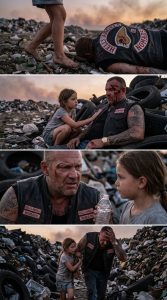
A homeless little girl finds a Hells Angels biker dumped like trash and her life changes forever. Some men spend their whole lives building something only to have it taken from them by the very people they trusted with their back and some men don’t survive long enough to realize what happened. But this man did, barely.

The landfill on the edge of the city didn’t care who you were. It smelled the same whether you were a king or a beggar, hot rot, smoke, the sweet sickening decay of things that had been used up and thrown away. Eight-year-old Valerie Ballard knew that smell the way most kids know the smell of breakfast. It wasn’t disgusting to her.
It was just morning. Her bare feet, toughened by years of cracked pavement and broken glass, moved carefully between the debris. She wasn’t playing. She hadn’t played in a long time. She was working because Grandma Rose’s breathing had turned wet and wheezy the night before and the medicine wasn’t free and the money didn’t come from anywhere unless Valerie went out and found it herself.
She scanned the ground with practiced eyes. Old copper wire, a cracked phone, a piece of aluminum that might be worth something if she stripped it right. She almost missed him. Her foot caught on something that wasn’t metal, wasn’t plastic. It had weight to it, density, the stubborn resistance of a human body.
Valerie looked down and her heart stopped. He was huge. Even lying collapsed and broken in the filth, the man looked like something built rather than born, 6’2 maybe more. His arms, covered in ink from wrist to shoulder, were thrown out at his sides like a man who’d been dropped from a height. His leather vest was torn, stained dark with blood and grime, but the patches on it were still visible.
A skull wreathed in flames. And above it, three words stitched in red, Hells Angels Nomads. His face was turned to one side, jaw clenched even in unconsciousness, a deep gash running above his left temple. The blood had dried black in the heat. On his wrist, incongruously, almost insultingly, a heavy gold watch caught the afternoon sun and threw it back like a challenge.
Valerie stood frozen. Every instinct her eight years had given her said, “Run. Big man, biker, blood, danger, run.” But then she heard it, a sound from somewhere deep in his chest. Low, guttural, a groan that didn’t sound like a threat. It sounded like a man begging the darkness not to take him yet. She crouched.
Her hand trembled as she reached for his neck, pressing two small fingers to the pulse point the way she’d seen doctors do on the old TV her grandma kept by the window. There. Faint, but there. “Sir,” she whispered. “Sir, you need to wake up. You can’t stay here.” He didn’t move. She looked around fast. The landfill had eyes in the late afternoon.
Scavengers, older kids, men who saw that gold watch and would make a very different calculation than she was making right now. Night was maybe two hours away. After dark, this man was dead. Not from the head wound, from what would find him in it. She dug into her backpack. Half a bottle of water, her only one saved for the hottest part of the day.
She poured a careful trickle over his cracked lips. His eyelids moved, fluttered, then opened. Gray eyes. Pale as river stones, completely lost. “Where?” His voice came out broken, scraped raw. “Where the hell am I?” “The landfill,” Valerie said quietly with a calm of someone who understood that panic cost time they didn’t have.
“On the edge of the city, and you need to get up right now if you want to keep breathing.” He tried to sit. The pain slammed him back down. He touched the side of his head, stared at the blood on his fingers like it belonged to someone else. “I don’t.” He stopped. Something moved behind his eyes. Fear, real fear. “I don’t remember anything. I don’t know who I am.
I don’t know how I got here.” Valerie studied him for a long second. The patches, the calloused hands, the jaw built for taking hits. This was not a man who scared easily, and right now he was terrified. She made her decision. “It doesn’t matter who you are,” she said, pulling his arm with both hands. “What matters is we move now.
” Getting a 200-lb biker upright using an 8-year-old girl as the only support system is not something they teach you anywhere, but Valerie managed. He swayed, she braced. He leaned, she held, and they walked. She guided him through hidden paths, trails she’d mapped over years of daily scavenging away from the main routes where the wrong people lingered.
He moved in silence except for the labor of his breathing and the occasional grunt when his boot caught on something. She moved fast, scanning every shadow. “What’s your name?” he managed after a few minutes. “Valerie.” “Thank you, Valerie,” he said, and the way he said it, quiet, stripped of everything, told her more about him than any patch on his back ever could. She didn’t answer.
She kept her eyes on the path. By the time they reached the landfill’s edge, the city lights were beginning to blink on in the distance. He stopped for a moment, staring at his own hands, the tattoos, the scars, the watch, like they belonged to a stranger wearing his skin. “Do you think I’m dangerous?” he asked, and she could hear him dreading the answer.
Valerie looked up at him, at those gray, unguarded eyes. “Dangerous men don’t look scared,” she said simply. “You look terrified, so you’re probably just in trouble.” He had nothing to say to that. They kept walking. Neither of them knew in that moment that the road they were walking together was going to change both their lives completely.
But that’s the thing about the moments that matter most. You never see them coming. What would you have done in Valerie’s place? Walked away or reached out a hand? Rose Ballard had survived things that would have broken most people. She’d buried a husband, raised a daughter alone, watched that daughter disappear and leave behind a granddaughter she was now raising on beans and willpower.
She’d lived through winters with no heat and summers with no fans and years where the only thing standing between her family and nothing was her. She did not scare easily, but when that door opened and she saw what her granddaughter had dragged home, her hand went to her chest before she could stop it.
The warm light inside the house made the man look even worse than he had in the landfill. He filled the doorway. That was the first thing Rose noticed. A mountain of leather and ink and dried blood. One arm draped over the shoulder of an 8-year-old girl who was struggling and refusing to show it under his weight. His vest was shredded at the collar.
The patches on it meant something. Rose was old, not ignorant. She knew what those patches meant. “Grandma, it’s me.” Valerie’s voice was calm in that infuriating way she had, the way that meant she’d already made up her mind and was simply informing the world. “I brought someone who needs help.” Rose stood up from her chair slowly.
Her joints protested every inch. She crossed the room and looked at the man the way a doctor looks at a patient, not with kindness first, but with assessment. Head wound. Real one, blood loss. The trembling in his legs wasn’t weakness. It was the body burning its last reserves. The man’s eyes found hers. Gray eyes, still confused, still lost, but in them something else.
Not aggression, not calculation, shame. He was ashamed to be seen like this. Rose had not expected that. “Who is this man?” she said, turning to Valerie, her voice carrying the full authority of a woman who had never once in her life been ignored. “And why is he in my house?” “I found him in the landfill, Grandma.
He was hurt and he doesn’t remember anything. We couldn’t leave him there to die.” “We?” Rose repeated flatly. “There is no we in this decision, child. There is only you, and now there is this.” The man spoke. His voice was rough, damaged, but steady. “Ma’am, I’m sorry. I didn’t ask her to bring me here.
If you want me to leave, I’ll leave.” He meant it. That was the thing. He actually tried to push himself upright away from Valerie’s shoulder, ready to walk back out into the dark. His legs buckled immediately. Valerie caught him. All 50-something pounds of her braced against his side, refusing to let him fall.
Rose watched this, said nothing for five long seconds. Then she sighed, the deep, total sigh of a woman surrendering to something she already knew was inevitable. “Get him to the sofa,” she said. “Don’t let him bleed on the floor. I just cleaned it.” The sofa was small. He barely fit. He sat on the edge of it with his elbows on his knees and his head down while Rose moved to the stove, heating water without ceremony or warmth.
Valerie hovered nearby, watching her grandmother with the careful attention of a child who knew when to speak and when to disappear. Rose returned with a clean rag and a basin of hot water. She sat in front of the man and began cleaning the wound on his head, her movements efficient, practiced, carrying no tenderness and no cruelty. Just competence.
He winced but didn’t make a sound. “Those patches on your vest,” Rose said without looking up. “You know what they mean? I know what they are,” he said carefully. “I don’t remember what they mean to me.” Rose worked in silence for a moment. “Hells Angels Nomads.” “Men with no fixed chapter. Men who ride alone but answer to the brotherhood when called.” She paused.
“That’s either very free or very dangerous. Sometimes both.” He looked at her. “You know about that world?” “I know about every world,” she said simply. “When you’re poor, you learn to read people fast. Survival depends on it.” She pressed the cloth to the wound. He absorbed the pain without flinching.
“The promises of men like you are worth nothing here, sir.” Rose said quietly, not unkindly. “Rich or rough, it makes no difference in this house. But you look like a man with a very expensive problem.” “Yes, ma’am.” He said, “I think that’s exactly what I am.” Dinner was three small plates of beans and handmade tortillas.
Rose put the fullest plate in front of the stranger without comment. Valerie noticed. She always noticed everything. They ate in a silence that was surprisingly bearable. The man ate slowly at first, like someone reminding themselves how, and then with the quiet intensity of a person tasting food for the first time. Not because it was exceptional.
Because he was hungry in a way that went deeper than his stomach. Halfway through the meal, his fingers brushed the watch on his wrist. He turned it over. His thumb found a small button on the side, barely a raised edge in the metal. He pressed it without thinking. A soft voice filled the small room.
Female, digital, but warm. “Recorded with care. For Jake, with all my love, Mary.” The name landed in his chest like a stone dropped into still water. Jake. He turned it over in his mind. Jake. It felt like trying on a coat that had been his once. Familiar in shape, strange in weight. Valerie had gone still across the table.
“Is that your name, Jake?” “I think so.” He said slowly. “And who’s Mary?” The question hung in the air. And the sensation that moved through him wasn’t warmth. It wasn’t longing. It was something darker, a coldness at the base of his spine that he couldn’t explain and couldn’t ignore. “I don’t know.” He said, “But something about that name doesn’t feel right.
” Rose looked at him from across the table. Her eyes were steady, unreadable. “Sometimes the things that hurt us most are the things closest to us,” she said. “Sleep on it. The truth has a way of finding you whether you look for it or not.” That night, after Rose had shown him the old blanket, clean, smelling of laundry soap, folded with a dignity that shamed him, and after Valerie had disappeared behind the curtain to her cot, Jake lay in the dark and stared at the ceiling. The house creaked around him.
Wind moved against the metal roof. He touched the place where the watch sat on his wrist and thought about the voice, about Mary, about the cold feeling her name left behind. He thought about the two women asleep a few feet away, one iron-spined and unafraid, one small and impossible and already more capable than most grown men he’d probably known.
He didn’t know who he was. He didn’t know what he’d done or what had been done to him or who had left him for dead in that landfill like a broken thing past its use. But he knew one thing with the absolute certainty of instinct, the only compass he had left. He would not let harm come to them. Whatever he had been before, whatever world he’d ridden through, whatever brotherhood he’d bled for, whatever enemies he’d made, that vow was the first solid thing he’d felt since opening his eyes in the garbage.
Outside, the moon moved across the landfill that had been his grave. Inside, for the first time in what felt like a long, long time, Jake Romero slept. But the men looking for him were already asking questions two streets over. And they weren’t the kind of men who stopped asking. What would you do if the only people keeping you safe were the ones with the least power to protect themselves? There’s a particular kind of fear that doesn’t announce itself.
It doesn’t rush in loud and obvious like a storm you can see coming from miles away. It creeps. It settles. It sits in the corner of a room and watches you quiet and patient until the moment you let your guard down. Jake had felt it every morning since waking up in that landfill. By the third day, he understood why.
The danger hadn’t passed. It had simply been waiting for him to feel safe. Dawn came the way it always did in that neighborhood without ceremony. No alarm clocks. No slow, gentle light. Just the sudden, flat brightness of a sun that had no interest in being poetic about it. Jake was already awake when Rose appeared in the kitchen.
He’d been awake for hours, lying still on the sofa, listening to the house breathe around him, cataloging the sounds the way a man does when some buried part of his brain refuses to stop being a soldier even when the rest of him has forgotten the war. Rose moved around the small kitchen without looking at him, heating water, measuring coffee with the focused economy of someone who had never once in her life wasted anything.
She set a cup in front of him without a word. He wrapped both hands around it. The warmth moved up through his palms and into his arms, and for a moment he just sat with that, the simple extraordinary fact of someone handing him something hot without being asked. “You were awake all night,” Rose said, not a question. “Most of it.
” “Thinking or remembering?” Jake looked at her. “Is there a difference?” Rose sat down across from him, folding her hands on the table with the unhurried dignity of a woman who had decided to say something and was going to say it properly. “There is a very large difference. Thinking is when your mind works. Remembering is when your past comes back to collect what it’s owed.
She studied him. Which one is it? Both, he admitted. I keep seeing fragments, pieces, like someone dropped a mirror and I’m finding the shards one at a time. What do you see in the shards? He turned the coffee cup slowly in his hands. A room, chrome and glass, the kind of place that costs money just to stand in.
Men in suits, a table long enough to land a plane on. He paused. Someone handing me a drink, smiling while they did it. Rose was quiet for a moment. And the smile, she said carefully, was it warm? No, Jake said. It was the kind of smile that means something else entirely. Rose nodded slowly as if something she’d suspected had just been confirmed.
She said nothing more, but she reached across the table and refilled his coffee, and in that small gesture was everything she wasn’t going to say out loud. Valerie appeared minutes later, hair wild, immediately awake in that particular way of children who haven’t yet learned to ease into the day. Good morning, Jake, she said, pulling out her chair with complete naturalness, as if a tattooed biker with a head wound sitting in their kitchen was simply the way mornings worked now.
Despite everything, Jake almost smiled. Can you work today? Valerie asked, already tearing off a piece of bread. The garden needs water and the back fence is leaning. Rose says if it falls, the neighbor’s dog gets in and ruins everything. Valerie, Rose began. He said he’d work, Valerie said reasonably.
So, he should work. Jake looked at Rose. Rose looked at Jake. Something passed between them, the silent, slightly exhausted acknowledgement of two people who had both just been outmaneuvered by an 8-year-old. She’s not wrong, Jake said. He worked. It was humbling in a way he hadn’t anticipated. His hands, which bore the evidence of a thousand miles of road and more than a few fights, turned out to be almost completely useless at drawing water from a well.
The rope burned his palms in new places. The rhythm of it escaped him. Valerie watched him struggle for approximately 40 seconds before stepping in with the calm, slightly pitying patience of an expert watching a beginner. “You’re fighting it,” she said. “Don’t fight it. Let the weight of the bucket do the work on the way down.
Save your strength for the pull.” He tried it her way. The bucket came up clean and full. “How do you know all this?” he asked. “Because I do it every day,” she said simply. “You learn things when you have to.” He stood there for a moment, water dripping from the rope onto the cracked earth, and felt something shift in him.
Not a memory, something newer than that. Respect. In the afternoon, while Rose rested, Valerie walked him through the small garden behind the house. She moved through it the way some people move through a library with reverence and ownership and the quiet authority of someone who knows exactly where everything is. “Mint,” she said, pointing.
“Good for stomach aches and headaches. Rose uses it for both.” She moved on. “Tomatoes, still green, don’t touch them yet. And those,” she pointed to a cluster of low-growing plants near the fence, “those are the ones that matter most. We eat those when everything else runs out.” Jake crouched beside them. His knee popped loudly on the way down, the complaint of old road miles, and Valerie glanced at it without comment.
“You ride a lot,” she said. He looked up. “What makes you say that?” “Your knees. Rose’s friend, Mr. Domingo, used to ride horses every day for 40 years. His knees sound the same as yours.” She tilted her head. “Also, the patches and the calluses on your left hand are different from the right, like you grip something that vibrates.
Jake stared at her. “I’m eight,” she said, reading his expression. “Not blind.” That night the three of them sat around the kitchen table after dinner, and for the first time since Jake had arrived, the conversation went somewhere real. “Do you have family?” Rose asked. “Besides Mary, whoever she is.” Jake turned the question over.
A fragment surfaced, not a full memory, just a texture. The feeling of a door he used to open, a voice on the other side that he’d been too busy to answer properly. “I think I have a daughter,” he said quietly. “I don’t know her name, but I can feel the shape of her, the way you can feel a word that won’t come.” He looked at the table.
“And I think I let her down before all this, whatever all this is.” Valerie was watching him with those eyes that missed nothing. “You should fix that,” she said, “when you remember how to find her.” “I know,” he said. “People wait longer than they should,” Rose added softly, and the weight in her voice said clearly that she was speaking from somewhere much closer than philosophy.
The silence that followed wasn’t empty. It was the kind of silence that holds things, grief, regret, the particular ache of time that can’t be reclaimed. Jake felt it settle over him and didn’t try to push it away. He was still sitting with it when the knock came, except it wasn’t a knock, it was a voice, outside on the street, educated, measured.
Asking questions in the tone of men who already knew the answers and were simply confirming what they’d come to do. Jake was on his feet before he’d made the conscious decision to move. He was at the window before Rose could speak, pressing himself against the wall beside the frame, angling one eye to see without being seen.
Two men, dark clothes, no cuts, no colors, these weren’t Brotherhood. These were suits wearing the posture of suits, back straight, chins up, the practiced authority of men paid to be intimidating. One was talking to the neighbor across the alley. The other was scanning the street with a slow, professional patience that told Jake everything he needed to know.
These weren’t police. Police don’t scan streets like that. These were clean-up men. His stomach turned to stone. Jake. Rose’s voice low, absolutely calm. She was already standing, already moving Valerie away from the window with one hand, the way a woman moves a child she’s protected a thousand times before. How many? Two that I can see.
Are they looking for you specifically or sweeping? He watched the one doing the scanning, the pattern of it, the way his eyes moved, not randomly, but systematically, working outward from a fixed point. They have an address range, Jake said. They’re narrowing it. Rose nodded once.
Then she did something that stopped him cold. She walked to the front door and opened it. Rose. She stepped outside before he could finish the sentence. Jake pressed back against the wall, heart hammering, watching through the cracked window as the 70-year-old woman walked directly toward the two men with the unhurried confidence of someone who owned every inch of ground beneath her feet. Evening, she said pleasantly.
You’re looking for someone? The taller man turned. We’re looking for a large man, tattoos, possible head injury. Seen anyone like that in this area? Rose tilted her head thoughtfully. A man like that came through here two days ago, scared my chickens. Headed south toward the rail yard, I think, looking for somewhere to sleep.
She paused. Is he dangerous? Should I be worried? The men exchanged a glance. The tall one smiled, polished, professional, completely empty. “Nothing to worry about, ma’am. Thank you for your time.” Rose watched them go. Then she turned and walked back inside, closed the door, and latched it. She looked at Jake.
He had no words. “Close your mouth.” she said quietly, moving back toward the kitchen. “I’ll make more coffee.” Valerie was watching her grandmother with an expression that was equal parts awe and complete unsurprise. The look of a child who has long since accepted that the person raising her is simply built differently from other people.
Jake sank back against the wall. His hands, which had been steady through all of it, were shaking now. Because he understood something with absolute clarity. Those men hadn’t come to ask questions. And Rose had just bought him time he hadn’t earned and couldn’t repay. But the real question, the one that kept him awake long after the house went dark again, wasn’t about the men.
It was about the drink. The smile. The chrome and glass room. And the name that still sat at the edge of his memory like a splinter working its way to the surface. Morris. He didn’t know yet what that name meant. But by the feeling it left in his chest, he was about to find out. Have you ever had someone protect you at a cost they never mentioned? Someone who stood between you and the danger without asking for a single thing in return. Hold that feeling.
Because what’s coming next, Jake didn’t see it coming either. There are moments in a man’s life when everything he thought he was get stripped away. The title, the money, the reputation, the brotherhood, the name, all of it gone. And what’s left underneath? That’s the only version of you that was ever real.
Jake Romero was about to meet that version of himself. And it was going to cost him everything to get there. The memory didn’t come back all at once. It came back the way a tide comes in, slowly, then suddenly, then all at once with a force that knocks you off your feet before you even realize the water has reached you. It started with a smell.
Rose had brewed coffee early that morning, and something in the steam, dark, bitter, carrying a sharpness underneath the warmth, pulled a door open in Jake’s mind that had been sealed shut since the landfill. He was standing in the kitchen when it hit him. A boardroom, chrome and glass 40 stories up, the city laid out below like something owned.
A long table, men in expensive suits who never once in their lives got their hands dirty, and at the head of it Morris Kellerman, his business partner of 11 years, his oldest friend, smiling that particular smile of his, the one that looked like warmth and function like a blade. “Here, Jake, you look tense. Drink.” The glass.
The bitter taste beneath the scotch that he’d noticed and ignored because Morris had handed it to him, and you don’t question the man who’s had your back since the beginning. Except Morris hadn’t had his back. Morris had been waiting patiently, systematically, with the cold precision of a man who plans things over years, not weeks, for the right moment to take everything.
The company, Romero Iron Works, built from nothing, from Jake’s own hands and vision and 15 years of brutal work. The accounts, the properties, and Mary, his wife, the woman whose voice was on that watch for Jake, “With all my love, Mary.” The nausea hit him so hard he had to grab the kitchen counter.
Valerie was beside him in seconds. “Jake, Jake, look at me.” He looked at her, those steady, serious eyes, eight years old and already the most grounded person in any room she entered. “I remember,” he said. His voice came out strange, flat, like something had been removed from it. I remember everything.” He told them at the kitchen table, all of it.
Rose sat across from him with her hands folded, listening without interrupting the way she always listened, as if every word deserved its full weight before she responded. Valerie sat beside him, close enough that her shoulder pressed against his arm. She didn’t move away. He didn’t ask her to.
Morris Kellerman, Jake said. My business partner, and marry my wife. They’d been planning it for over a year, draining accounts, moving assets, setting up the paperwork so that when I disappeared, the transition would look clean. And the drink, Rose said quietly. Sedative, strong enough that I wouldn’t fight back when they put me in the car.
His jaw tightened. They didn’t want a body found, too messy. So, they drove me to the landfill, took my phone, took my wallet, took everything that could identify me, and left me there to either die of exposure or get dealt with by whoever found me first. Silence. They didn’t count on me, Valerie said. It wasn’t boastful.
It was simply factual. The observation of a child stating what was plainly true. And despite the cold fury sitting in his chest like an engine block, Jake felt something crack open. Something that had been sealed up for a long time, longer maybe than the landfill. Longer maybe than he wanted to admit. He looked at this girl.
This small, serious, extraordinary girl who had walked through a landfill every morning of her life looking for something worth saving and had found him. No, he said softly. They didn’t count on you. Two days later, Rose collapsed, not slowly, not with warning. One moment she was moving from the stove to the table, and then she simply wasn’t moving at all, and the sound of her hitting the floor was the worst sound Jake had ever heard in his life.
He had her in his arms before the echo faded. Rose. Rose, stay with me. Her eyes were open but unfocused. Her lips pressed thin against the pain. One hand pressed to her chest with a grip that told him everything the doctors would later confirm. Her heart. Jake looked at Valerie. Valerie looked at Jake. No words. No hesitation.
He carried Rose out the front door at a run. He didn’t care who was on the street. He didn’t care about the cleanup men or Morris or any of it. There was only the weight of this woman in his arms. This woman who had opened her door to a broken stranger. Who had lied to dangerous men without blinking. Who had given him back pieces of himself he hadn’t known he’d lost.
And the distance between here and help. A taxi stopped for him because there was no other option when a 6-foot-2 tattooed man steps into the road holding an unconscious elderly woman and Valerie runs alongside screaming for help. The driver took one look and drove. The hospital waiting room was the particular kind of ugly that only public hospitals achieve.
Plastic chairs, fluorescent light. The antiseptic smell that is supposed to suggest cleanliness but mostly suggests desperation. Jake sat in it with Valerie tucked under his arm. Her face pressed against his side and waited. He looked at the watch. Turned it over in his hand one last time.
Then he stood up carefully making sure Valerie was settled and walked to the exit. He came back an hour later with his wrist bare and his pocket full. Valerie woke when she felt him sit down. She looked at his wrist immediately then at his face. “You sold it.” She said. “It was just metal.” He said. “It was your only proof of who you were.
” “I know who I am.” Jake said quietly. “I don’t need it anymore.” Valerie looked at him for for moment with those eyes that had never once in his presence failed to see straight through him. Then she nodded once and leaned back against his side. The doctor came out at midnight. Tired eyes, serious face. The words stable, heart surgery, high risk at her age, significant cost landed in the room like stones.
Jake pulled out the money without hesitation. “Do what needs doing,” he said. “I’ll cover the rest.” The surgeon looked at this man, leather vest, road-worn hands, a healing gash above his temple, and whatever he’d been about to say, he didn’t say it. “We’ll prepare the operating room,” he said instead. Rose came through the surgery at dawn.
When the doctor said the words, “She’s stable. She’s strong.” Valerie made a sound Jake had never heard from her before. Not crying, exactly. Something between relief and the particular grief of a person who has only just realized, in the moment the danger passes, exactly how frightened they were. He held her while she shook.
And something in that moment, the disinfectant smell, the cold fluorescent light, Valerie’s small hands gripping the front of his vest, broke the last sealed room in his memory wide open. He saw his daughter, Renee, 15 years old, standing in a doorway of the house he’d been too busy to come home to, looking at him with the specific, devastating disappointment of a child who has stopped expecting her father to show up and is no longer surprised when he doesn’t.
The pain of that memory was sharper than the wound on his head had ever been, because he’d done that. Not Morris, not Mary, him, his absence, his obsession with the company, the empire, the relentless accumulation of things that turned out to matter exactly as much as they’d always deserved to, which was not at all.
“I have to fix he said aloud. Valerie looked up at him. “The company, my daughter,” he said. He used the hospital payphone, the last one probably in the entire city, to call a lawyer named Garrison who had once been pushed out of Romero Iron Works by Morris and who answered on the third ring with the careful caution of a man who had learned not to trust unexpected calls until Jake spoke.
Then the caution disappeared entirely. “Mr. Romero?” The voice went thin. “Everyone thought you were dead.” “I know,” Jake said. “I need you to make sure they regret that assumption.” “Can you do that?” “Give me 48 hours,” Garrison said. “And Mr. Romero, don’t go anywhere near Morris or the company until I’ve moved the pieces into place.
Promise me.” Jake looked through the hospital window at Valerie asleep in the plastic chair, her head tilted at an angle that was going to hurt her neck when she woke up. “48 hours,” he agreed. He went back to Rose’s house one last time before he reclaimed his world. Rose home from the hospital and installed in her chair with the iron dignity of a woman who regarded convalescence as a personal insult, watched him pack the few things he’d accumulated, the notebook full of memory fragments, the old cap Valerie had given
him, the small medal he wore around his neck. “You know who you are now,” Rose said. It wasn’t a question. “Yes, and who is that?” Jake paused, considered it honestly. “Someone different from the man they threw in that landfill. I know that much.” Rose nodded slowly. “Good. That man wasn’t worth keeping.” Valerie appeared from behind the curtain. She’d known he was leaving.
She always knew everything before he said it. Her eyes were dry, she had made a decision about that, he could tell, but her jaw was set with a particular stubbornness of someone maintaining composure through significant effort. “You promised,” she said. “I promised,” he confirmed. He crouched down to her level. Took the metal from around his neck, St.
Christopher, patron of travelers, worn smooth by years of road miles, and pressed it into her hand. “Keep that,” he said, “until I come back to get it.” She looked at it, then she closed her fingers around it. “Take too long,” she said. “Rose needs the roof fixed again, and I can’t do it by myself.” He laughed, a real laugh, full and unguarded, the kind he suspected he hadn’t produced in years before any of this happened. Then he stood up.
Nodded once to Rose, and walked out into the city. The confrontation at the Romero Iron Works building was not what Morris had expected. He’d expected lawyers, possibly police. The slow, grinding machinery of legal processes that wealthy men are very good at navigating because they’ve built their entire lives on the understanding that the machinery moves in their favor if you know where to apply pressure.
He had not expected Jake, standing in the boardroom, wearing borrowed clothes that didn’t quite fit. A healing scar above his left temple. Hands that had spent weeks drawing water from a well and pulling weeds from hard ground. Hands that looked nothing like the soft, executive hands Morris remembered.
The eyes were different, too. That was the thing that stopped Morris cold before he could compose his expression into something useful. The eyes. They weren’t angry. They were clear. Still, the eyes of a man who has shed everything that wasn’t essential, and found, underneath it all, something that cannot be intimidated. “Surprised?” Jake said.
Morris’s mouth moved. Nothing came out. “Don’t,” Jake said quietly. “I remember everything. The drink, the car, all of it.” He set a folder on the table. “Garrison has already frozen the accounts and filed with the fraud division. The police are on their way for you specifically, and Mary” He paused. “Mary can talk to my lawyers, but right now I have somewhere more important to be.
” He walked out before the handcuffs arrived. He had a daughter to find. Renee was in her room when he opened the door. Headphones on. 15 years old and carrying the particular loneliness of a teenager who has learned not to need people because people, starting with her father, have a history of not being there.
She pulled the headphones off, stared. “Dad,” she whispered. And in that single syllable was a war between hope and the armor she’d built against it. Jake sat on the edge of the bed, kept his distance, let her look at him. “I’m not going to tell you your mother is a good person,” he said. “I’m going to tell you the truth, all of it, and let you make up your own mind.
That’s the least you deserve.” He told her. About Morris, about the landfill, about a little girl who had walked through garbage every morning of her life and had found him and had pulled him back from the edge using nothing but clean water and stubbornness and a compassion she’d learned from the strongest woman Jake had ever met.
Renee listened. Her eyes moved from his face to his hands, the new calluses, the rope burn marks, the evidence of a different life, and back again. “These people,” she said quietly. “This girl and her grandmother, they helped you without knowing who you were.” “They helped me,” Jake said, “because of who they are, not because of who I was.
” Renee was quiet for a long moment, then she got up, crossed the room, and hugged her father, not the careful, obligatory hug of a daughter performing a family ritual, but the grip of someone who had been holding on to something very heavy for a very long time and had finally found somewhere safe to put it down.
Jake held her and said nothing. Some things don’t need words. The first time he took Renee to Rose’s house, she wore designer shoes that were ruined within 10 minutes by the dirt roads. Valerie watched this happen with the careful neutrality of a diplomat. “You can borrow some of mine,” she offered. “They won’t fit,” Renee said.
“Then take them off,” Valerie said simply. “The dirt won’t hurt you.” Renee looked at her expensive, ruined shoes, then at the small, serious girl standing in front of her with bare feet on cracked earth. She took them off. Jake watched from the doorway of Rose’s house, the metal back around his neck where it belonged, and felt the last broken piece of something settle into place.
The years moved the way good years do, not quickly, not slowly, but with a particular fullness of time that is being properly used. Romero Iron Works was rebuilt from the inside out, not just as a company, but as something with a conscience, affordable housing projects, community construction, the kind of work that left neighborhoods better than it found them.
Renee joined the company as an architect. Her first project was an expansion of Rose’s house, now a free community clinic. Her drawings were extraordinary. Valerie became a doctor. Nobody who had watched her move through that landfill with the focused intensity of a person who sees value where others see waste was remotely surprised.
Rose lived long enough to see both of them become the women they were always going to be. She sat in the front row at Valerie’s medical school graduation, transported in a private ambulance because her heart was failing and she absolutely did not care, And raised one hand in a slow, deliberate victory sign when Valerie crossed the stage.
It was the last great public moment of her life. And it was enough. She went peacefully weeks later in her sleep. Valerie found her. And though the grief was the kind that reshapes a person permanently, there was alongside it something that felt like gratitude for the completeness of a life that had held nothing back and given everything forward.
The wake drew people from both sides of the city. Rich and poor, suited and tattooed, the kind of crowd that never assembles for any other reason because there is no other reason sufficient. Only the loss of someone who had made each of them feel, at some point, genuinely seen. Jake stood at the graveside and said three sentences.
She pulled me out of the garbage. Not just the landfill, all of it. Every part of me that had forgotten what it was for. That was all. It was enough. Years later, Jake walked with his granddaughter Susanna Rose, named for the woman who had made all of it possible through a city park built on the site of the old landfill.
Susanna was five. She held his hand and asked questions the way five-year-olds do, relentlessly. Each answer immediately generating the next question, an infinite chain of curiosity that Jake had learned to love completely. “Was it here, Grandpa? Where they found you?” “Right here,” he said. “Right where we’re standing.
” She looked at the grass, at the trees, at the joggers and the dog walkers and the children on the distant playground, trying to map what she knew onto what she could see. “You were lucky,” she said finally. Jake looked down at her. At this small person who existed because a chain of events had begun with an eight-year-old walking through garbage on a hot afternoon and choosing against every reasonable instinct to reach out her hand.
Yes, he said, “But not for the reason you’d think.” “What’s the reason?” He was quiet for a moment. “The luck wasn’t surviving,” he said. “The luck was who found me.” Susanna considered this with the profound seriousness of a 5-year-old processing something she knows is important but doesn’t quite have the vocabulary for yet. Then she squeezed his hand and pulled him toward the playground.
And Jake Romero, who had once been left for dead in a landfill by the people closest to him, and had been saved by the people who had nothing, followed his granddaughter into the afternoon sun with a full heart and not a single thing left unrepaid. The most dangerous thing a man can do is forget what he’s actually writing for.
Jake forgot. It took losing everything, his name, his memory, his world, to find the only things that ever mattered. If this story moved you, if it reminded you of someone who pulled you back from the edge, or of a moment when a stranger’s kindness changed the road you were on, drop their name in the comments below.
Let’s fill this comment section with the people who saved us without being asked. If you’re watching this alone tonight, share it with someone who needs to be reminded that the best things in life aren’t found in the places we expect. And if you believe that real wealth has nothing to do with what’s in your account, you already know where you belong.
Hit that subscribe button because every story we tell is for people who understand exactly that. This has been Light Whispers Tales. Ride safe, love harder, and never, ever leave someone worth saving behind.