
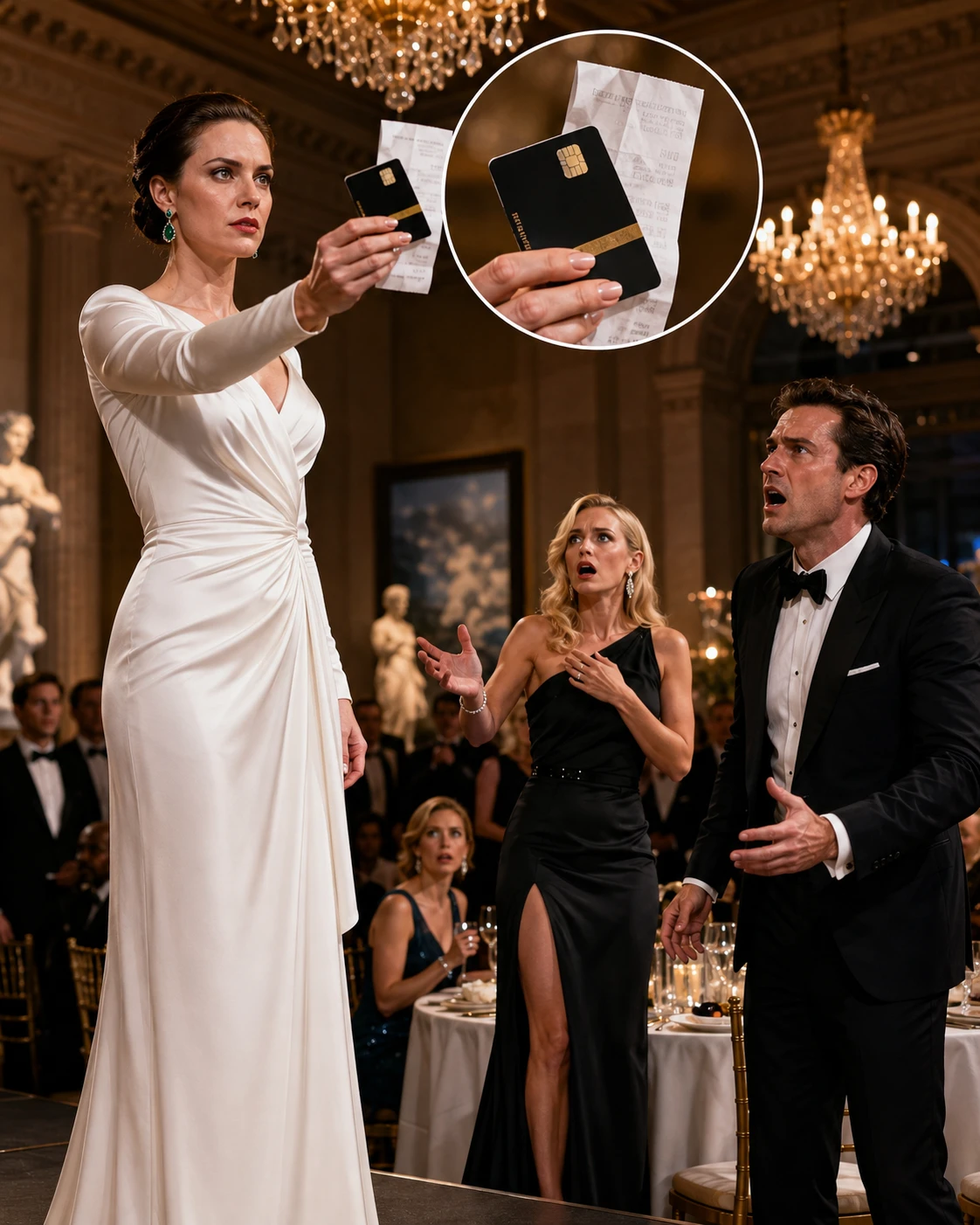
His mistress used my black card to buy the dress she wore to replace me at the gala.
Not a knockoff. Not something she found on a boutique rack and hid in the back of an Uber.
Custom black satin.
Hand-cut in SoHo.
A slit sharp enough to cut a room in half.
The invoice arrived at 7:12 on a Thursday morning while my husband was still asleep beside me, one arm thrown across my waist as if he had not spent the night texting another woman beneath the same sheets.
DUCHAMP & VALE ATELIER
Custom evening gown
Black satin, private fitting
Cardholder: Evelyn Pierce Caldwell
Client pickup: Sloane Mercer
Amount: $42,700.
I stared at that name until the coffee in my hand went cold.
Sloane Mercer.
The woman Grant called “a consultant.”
The woman whose perfume clung to the passenger seat of his Aston Martin.
The woman who would later walk into the Whitmore Winter Gala on my husband’s arm and smile like she had inherited my life.
Grant did not know I had the receipt.
He did not know I had the emails.
He did not know my mother had raised me in rooms where women learned to cry in marble bathrooms and take empires apart in silence.
He only knew the version of me he preferred: elegant, forgiving, useful.
A wife with diamonds at her throat and no teeth.
So when he stood beneath the crystal chandeliers of the Whitmore Museum and told four hundred donors, board members, cameras, and old-money vultures that Sloane represented his “new era,” I did not scream.
I did not throw champagne.
I did not ask him why.
I waited until the auctioneer asked for the sponsor’s opening remarks.
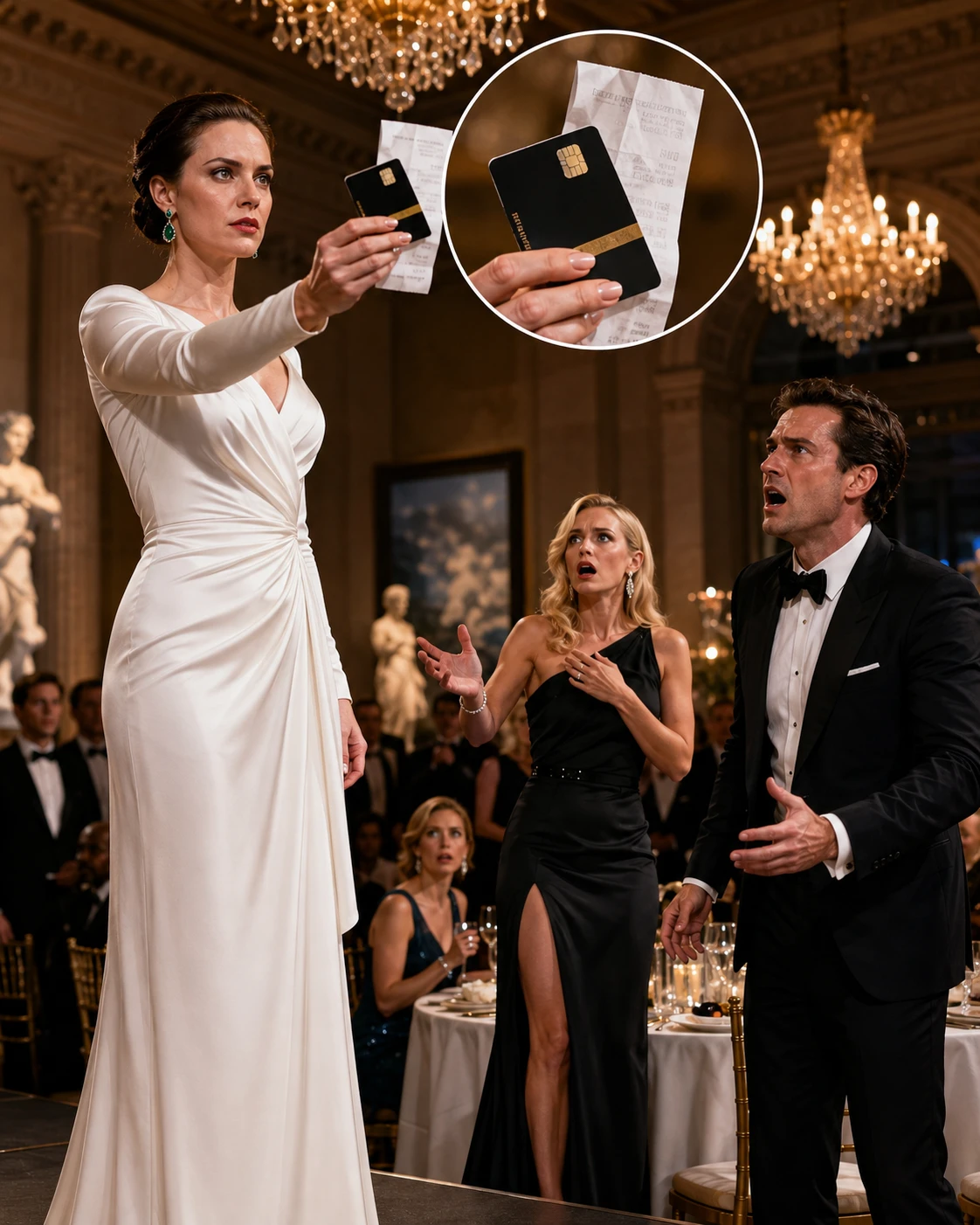
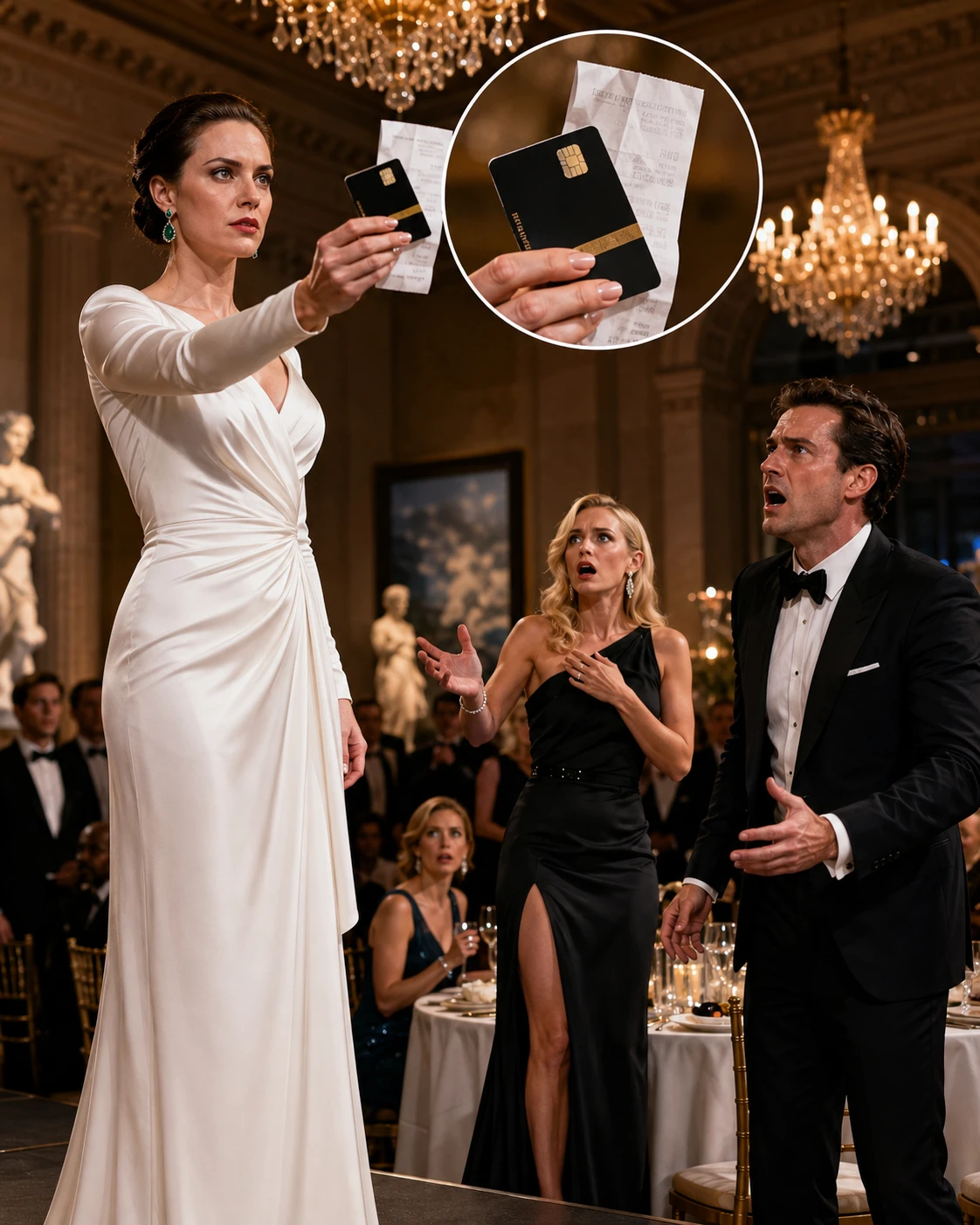
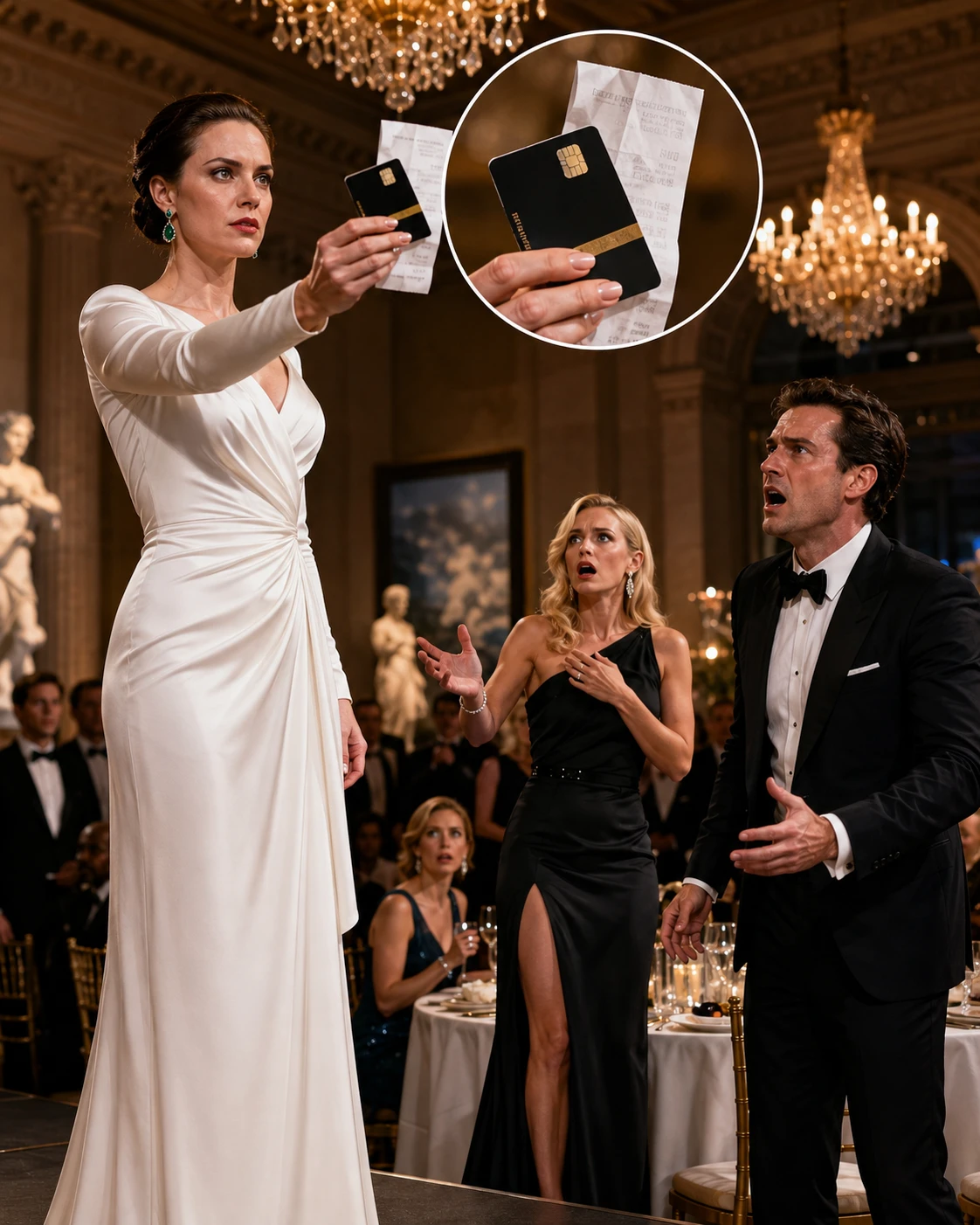
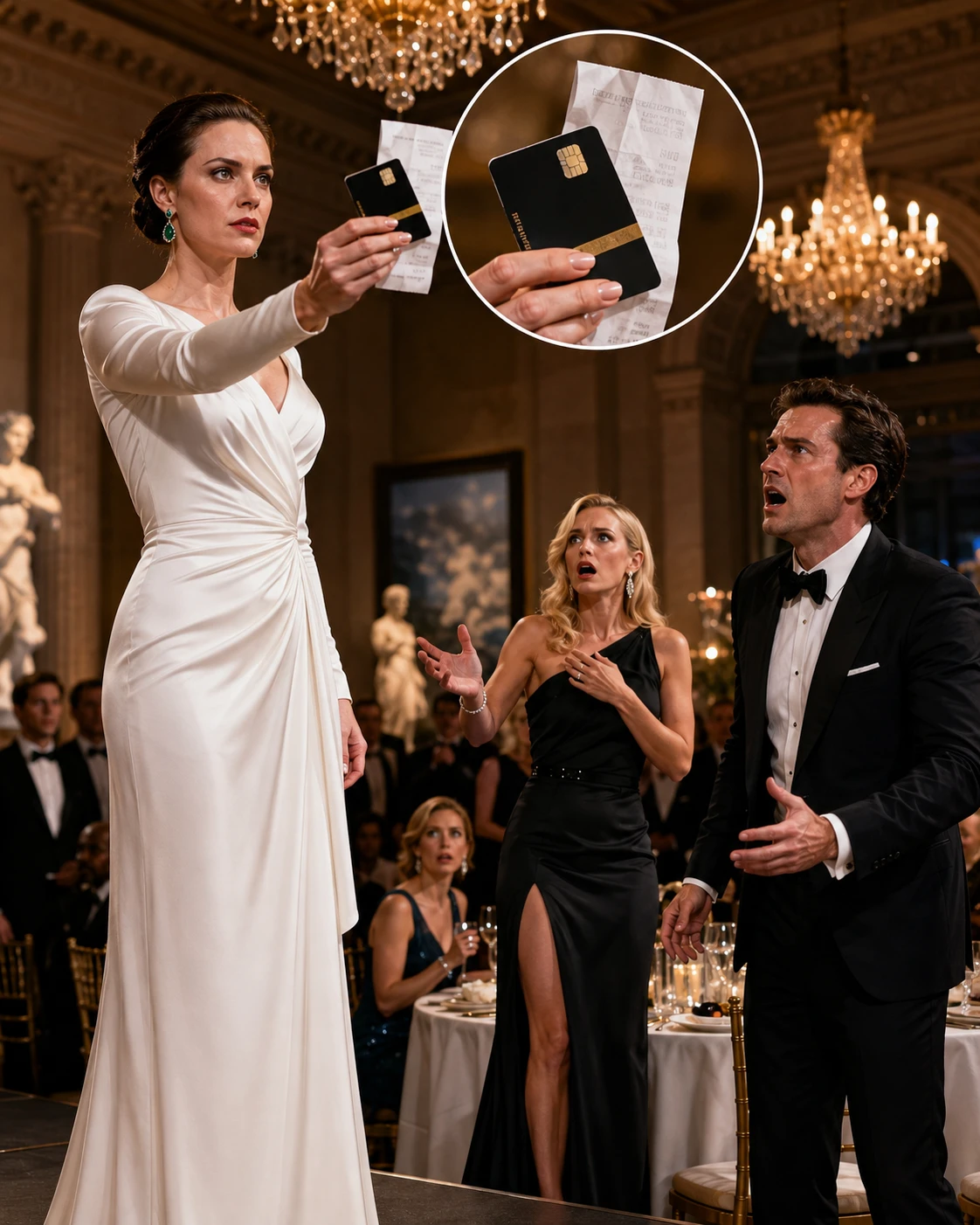
Then I stepped onstage with the receipt.
And when every camera turned toward me, I smiled at the woman in my dress, at the man who thought humiliation was a weapon, and at the city that had mistaken my silence for surrender.
“Tonight’s first exhibit,” I said, “is walking near table six.”
Chapter 1 — The Woman at Table Six
The first rule of luxury is that nothing is ever as clean as it looks.
White roses hide bruised stems.
Diamonds hide blood.
A marriage can look perfect from across a ballroom if the wife knows how to stand still.
For ten years, I stood beautifully.
Grant Caldwell had married me in a cathedral of glass overlooking Lake Michigan, with the Chicago skyline blazing behind us and the newspapers calling us “the new American dynasty.” He was the hungry boy from Oak Park who built Caldwell & Voss from a struggling real estate analytics firm into a billion-dollar luxury development machine. I was Evelyn Pierce, only daughter of Helena Pierce, the hotel heiress who taught me that money was not power unless no one knew exactly how much of it you had.
Grant loved that about me at first.
Or perhaps he loved the doors it opened.
I was twenty-six when I met him at a charity luncheon in Lincoln Park. He had no family name worth whispering, no yacht, no trust fund, no polished ease around antique silver. But he had ambition so sharp it practically hummed. When he spoke, men twice his age leaned in. When he looked at me, I felt chosen by a storm.
“You look bored,” he said the first time we met.
“I am,” I told him.
“Then marry me,” he said.
I laughed because I thought he was joking.
He smiled because he was not.
Back then, Grant made hunger feel romantic. He worked eighteen-hour days and came home with his tie loose, his eyes bright, his dreams too large for whatever room we were in. He took my hand in taxicabs. He wrote notes on hotel stationery. He kissed me in elevators like the city could wait.
The first time he asked me for money, he cried.
Not dramatically. Not enough to embarrass himself. Just one perfect tear sliding down the face that had convinced half of Chicago he was the future.
“Bridge financing,” he said. “Ninety days. I swear I hate asking you.”
I believed him because I wanted to.
My mother did not.
Helena Pierce had three expressions: public warmth, private frost, and courtroom silence. She listened to Grant’s proposal at the head of her dining table, wearing pearls the size of small moons.
When he finished, she said, “No.”
He blinked. “Mrs. Pierce—”
“No is a complete sentence, Mr. Caldwell.”
After he left, furious but smiling, I followed her into the library.
“You humiliated him,” I said.
“I protected you.”
“You don’t know him.”
“I know men who enter rooms empty-handed and leave carrying women’s inheritances.”
I remember folding my arms. “He loves me.”
My mother looked at me for a long time, and in that look was the exhausted mercy of every woman who has seen the knife before the daughter feels the blade.
“Then let him love you without touching the Pierce money.”
But I was young, and love makes arrogance feel like loyalty.
So I helped him.
Not directly. I knew better than that. My mother had at least taught me caution, even when she failed to teach me suspicion. I created Nereid Holdings through a chain of attorneys in Delaware and Nevada. The money entered Caldwell & Voss as a convertible note from a private investment vehicle Grant believed belonged to a quiet East Coast family office.
He never knew it was mine.
That secret saved my life.
For years, our marriage was the kind people photographed for glossy magazines. We hosted donors in our Gold Coast townhouse. We spent summers in Nantucket, winters in Aspen, springs in Palm Beach pretending we liked people we only tolerated. Grant became richer, smoother, less grateful. His suits softened. His voice hardened. He learned to say “my wife” the way men say “my house” or “my car.”
An acquisition.
A thing that reflected well.
I learned too.
I learned which smiles meant debt.
Which wives drank too much before noon.
Which husbands touched waitresses after their third bourbon.
Which nonprofits were laundries for reputations.
Which women were invited to galas and which women were brought to them like declarations of war.
Sloane Mercer appeared in our life on a rainy Tuesday in March.
Grant introduced her in our kitchen.
Not the formal living room. Not the office. The kitchen.
That alone told me she was already dangerous.
“Evelyn, this is Sloane,” he said. “She’s helping us reposition the Caldwell brand for the coastal expansion.”
Sloane smiled with glossy innocence.
She was younger than I was, but not young enough to be harmless. Thirty-two, maybe. Honey-blonde hair parted down the middle. A face built by discipline and dermatology. A white silk blouse tucked into trousers she wanted me to notice were not quite office appropriate.
“It’s such an honor,” she said. “Grant talks about you constantly.”
Women like Sloane always say that.
It is meant to sound admiring.
It means: I know where the furniture is.
I poured her coffee.
She glanced at the black card lying beside my phone on the marble counter. It was not a normal credit card. It was attached to the Pierce Family Foundation’s gala sponsorship account, used for auctions, events, donor gifts, and charitable commitments. Heavy, dark, almost plain.
Sloane’s eyes lingered one second too long.
Grant noticed.
So did I.
That night, I asked him about her.
He loosened his cuff links in the mirror and smiled at my reflection.
“She’s good at what she does.”
“And what exactly is that?”
“Optics.”
I watched him carefully.
“Is that what I am now? An optic?”
His smile thinned. “Don’t start, Evie.”
There are marriages where betrayal arrives like a gunshot.
Mine arrived like a scent.
Sloane’s perfume in his car.
A second wineglass rinsed too quickly at our Hamptons house.
A hotel charge in Santa Monica when Grant claimed to be in Dallas.
Then came the tiny humiliations.
He stopped reaching for my hand at dinners.
He corrected me in front of people.
He began using words like “legacy” and “fresh energy” and “alignment” whenever someone asked why I no longer sat in on Caldwell Foundation meetings.
At home, he became tender only when he wanted something.
A signature.
A smile.
A public appearance.
“You’re imagining things,” he told me one night after I found a gold earring in his garment bag.
“It’s not mine.”
“It belongs to wardrobe.”
“You’re a CEO, Grant. Not a movie.”
His eyes went flat.
“You know what your problem is?” he said. “You were born at the finish line and still think you ran the race.”
I felt that sentence enter me quietly and sit down.
I could have screamed then.
Instead, I learned.
My mother had died two years earlier, leaving behind letters, locked files, and one instruction written in blue ink on the inside of a leather notebook:
Never confront a man while he still controls the story.
So I let Grant keep talking.
I let Sloane keep smiling.
I let the city think I was fading from my own marriage like candle smoke.
And I began collecting proof.
The black satin dress was not the first charge.
It was simply the prettiest.
Before that, Sloane bought shoes in Beverly Hills. A Cartier bracelet in Palm Beach. A suite at the Carlyle billed as “donor hospitality.” Each transaction passed through the same account connected to the Pierce Family Foundation’s Whitmore Museum sponsorship.
Grant approved them through his office.
He was clever enough to hide lust.
Not clever enough to hide arrogance.
By the time the gala invitation arrived, thick cream paper engraved in silver, I already knew Sloane would be there.
I just did not know she would wear my money on her body.
Grant told me two weeks before the event.
We were at breakfast. He sat across from me in a charcoal sweater, reading headlines on his tablet. Rain ran down the windows of our Gold Coast townhouse.
“I need you to be graceful about something,” he said.
That is how cowards announce cruelty.
I set down my teacup. “Graceful?”
“Sloane is attending the Whitmore Gala with the Caldwell team.”
“The Caldwell team,” I repeated.
“She’s leading the rebrand.”
“I’m chairing the foundation’s sponsorship.”
He sighed, as if I were making the weather difficult.
“Evelyn, don’t be territorial. It looks small.”
There it was.
A man can take your bed, your trust, your years, and still accuse you of pettiness for noticing.
“Will she be sitting at our table?”
He paused just long enough.
“No,” he said.
A lie.
I smiled.
“Of course.”
He looked relieved. That insulted me more than the lie.
On the night of the gala, I dressed alone.
Grant had left early, claiming a board reception. His tuxedo had been gone from the closet since noon. So had the cedar shoe trees, the Tom Ford cuff links I had given him on our fifth anniversary, and the version of him that once waited at the foot of the stairs just to see what I wore.
I chose winter-white silk.
Not black.
Never compete with a mistress on her chosen battlefield.
My gown was long-sleeved, liquid, severe. My hair was swept back. Emerald earrings, my mother’s. No necklace. A bare throat can be more threatening than diamonds when a woman has nothing left to beg for.
At 7:46 p.m., my driver pulled up to the Whitmore Museum.
The building glowed against the Chicago cold, all limestone columns and glass, a palace built for tax deductions and whispered affairs. Cameras flashed along the carpet. Women shivered in couture. Men in tuxedos laughed too loudly, already drunk on money and the relief of being admired.
The moment I stepped from the car, the photographers turned.
“Mrs. Caldwell!”
“Evelyn, this way!”
“Where’s Grant tonight?”
I smiled the way my mother taught me.
Soft eyes.
Still chin.
Nothing free.
Inside, the museum had been transformed into a dream of winter wealth. Crystal branches hung from the ceiling. Black candles floated in glass cylinders. White orchids climbed the staircase like expensive ghosts.
And there, near the center of the room, stood my husband.
With her.
Sloane Mercer wore the black satin dress like a confession.
It clung to her body with obscene precision, one shoulder bare, the slit rising high enough to make half the room pretend not to look. Her hair fell in polished waves. Her mouth was painted the color of fresh blood.
Grant’s hand rested at the small of her back.
Not hovering.
Resting.
A possession.
For one suspended second, the room noticed me noticing them.
Then the whispers began.
They moved like weather.
Poor Evelyn.
Did she know?
Of course she knew.
He brought her here?
In public?
Sloane turned.
Her eyes found mine.
She smiled.
It was not nervous. Not apologetic.
It was victorious.
Grant saw me then. His jaw tightened, but he recovered quickly and crossed the room.
“Evie,” he said, leaning in as if to kiss my cheek.
I turned slightly, offering air.
His face hardened.
“You look beautiful.”
“You look busy.”
His hand closed around my elbow. Lightly, but not kindly.
“Not tonight,” he murmured. “Whatever you think you know, not tonight.”
I looked at his fingers on my skin.
“Take your hand off me.”
He did.
Because cameras were watching.
Sloane drifted toward us in my forty-two-thousand-dollar evidence.
“Evelyn,” she said. “That gown is so elegant.”
“Thank you,” I said. “I prefer elegance to costume.”
A flash of irritation crossed her face.
Grant stepped between us with a laugh meant for nearby donors.
“Ladies, please. The night is about the museum.”
“No,” I said softly. “Tonight is about preservation.”
He did not understand.
That was always his weakness.
Men like Grant think silence is emptiness. They do not understand it can be storage.
The dinner bell chimed at eight-thirty.
We entered the main hall beneath a ceiling of chandeliers bright enough to make every lie sparkle. Our table sat near the front. Grant had placed me three seats away from him, between an orthopedic billionaire and a senator’s wife who smelled like gin and gardenias.
Sloane sat at table six.
Directly in my line of sight.
Clever.
Cruel.
Amateur.
During the first course, Grant stood for informal remarks. He thanked the museum, the donors, the board, the city. He thanked “the Caldwell team” for ushering in “a new era of vision, youth, and courage.”
Then he turned toward Sloane.
“I especially want to recognize someone who has challenged us to imagine the future differently,” he said. “Sloane Mercer represents the new era of Caldwell & Voss.”
Applause rose.
Not from everyone.
Enough.
Sloane stood, glowing.
I lifted my water glass and took a sip.
Across the room, near the west arch, Adrian Kane watched me.
Most people noticed Adrian only after they realized everyone important already had. He was tall, composed, with black hair touched by silver at the temples and the kind of face that revealed nothing unless he chose it. A former federal prosecutor, now counsel to three private investment funds and half the families in America who preferred discretion to innocence.
He had been my mother’s attorney.
Now he was mine.
He did not smile.
He simply adjusted his cuff and glanced once toward the stage.
Ready.
At nine o’clock, the auctioneer stepped up beneath the spotlight.
“Ladies and gentlemen, before we begin tonight’s extraordinary auction, we invite the representative of our lead sponsor to offer opening remarks.”
Grant rose.
Of course he did.
The sponsor was the Pierce Family Foundation.
My family.
My mother’s name.
My money.
My grief.
My legacy.
Yet Grant stood as if all of it belonged to him.
That was the moment the last soft thing in me went quiet.
I rose too.
A ripple moved through the room.
Grant turned, confused.
I walked past him without touching his sleeve.
Every step to the stage felt calm enough to frighten me.
The auctioneer blinked. “Mrs. Caldwell?”
I smiled. “Thank you. I’ll be brief.”
Grant’s face drained of color.
At table six, Sloane stopped smiling.
I unfolded the receipt.
END OF PART 1 – PLEASE CLICK “NEXT CHAPTER” BELOW THE COMMENT BOX TO READ THE NEXT PART.”❤️