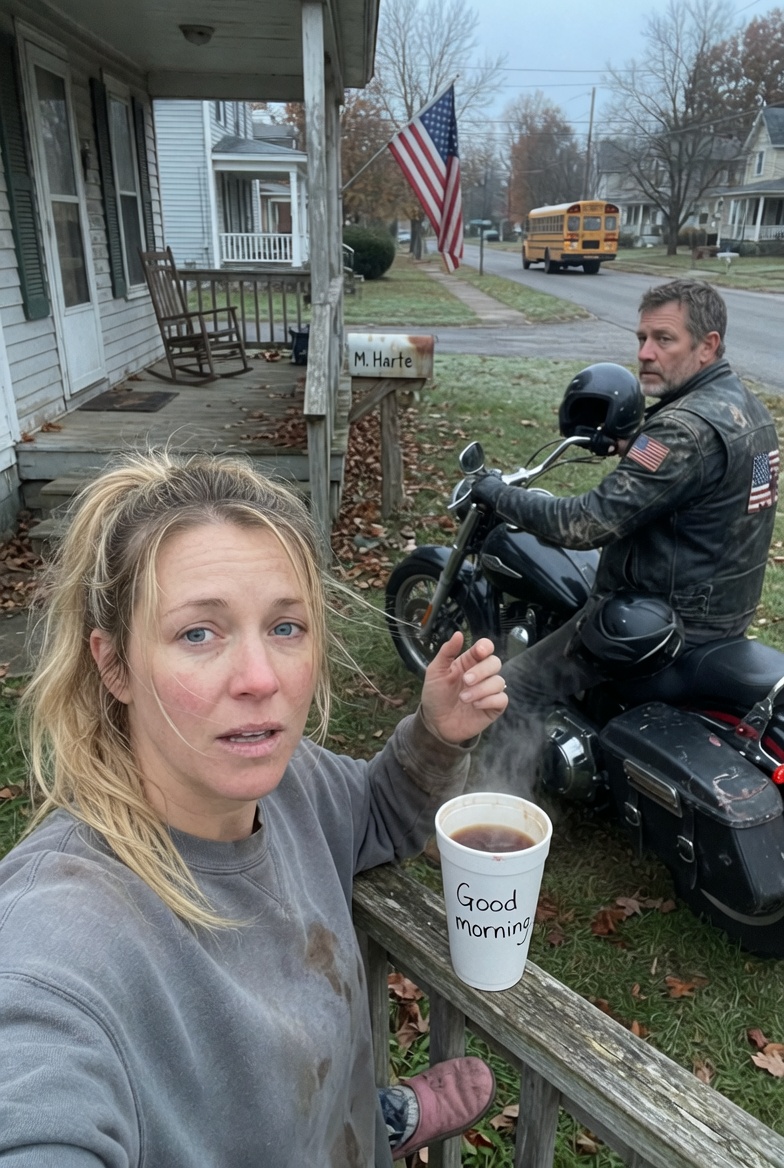
Part 2: I didn’t go back inside right away.
The cold had settled into my slippers, numbing my toes, but I couldn’t move. The cup was still there, balanced on the weathered railing, its steam now a ghost. Good morning. The black marker gleamed faintly, the G tilting upward in a way that felt almost hopeful. I stood there until the chill became a physical ache, and then I walked to my door, closed it softly, and pressed my forehead against the wood.
That was the first morning I admitted something to myself: I was jealous. Not of Margaret — never of her — but of the certainty in Marcus’s grief. He had found a way to keep showing up. I had spent two years shrinking from every memory of my marriage, deleting photos, avoiding songs, packing away the wedding china like it was evidence of a crime. I had burned the rituals. He had turned his into a cathedral.
Emma came home that afternoon with a construction-paper turkey, her fingers stained orange. She chattered about a boy named Leo who ate glue and a teacher who sang the cleanup song off-key. I listened, I laughed, I made mac and cheese, but my mind kept drifting back to the railing. To the lift on the G.
That night, after Emma was asleep, I opened my laptop and searched for Margaret Harte. The obituary was still there — a small notice in the local paper from four years ago. Margaret Eleanor Harte, 67, of Caldwell Street. Survived by a daughter, Allison, who lived out of state. Preceded in death by her husband, Robert. A private service. No mention of Marcus.
I stared at the screen until the words blurred. Who was he to her, officially? A friend from a diner didn’t make the obituary. Yet he had built a monument out of paper cups and habit. I wondered if her daughter knew. I wondered if anyone knew.
The next morning, I was at the window at 6:30. The bike came at 6:47 exactly, the engine a low growl that I felt in my chest. Marcus set the cup down, paused, adjusted it that same two inches to the left, and left. The ritual was unchanged. I didn’t go outside. I just watched.
That became my new routine. For four more days, I watched. On the fifth morning, it rained again — a hard, sideways rain that rattled the gutters. He still came. He wrapped the cup in a plastic bag from his saddlebag, tucked the edges carefully so the marker wouldn’t run, and placed it on the railing. He was soaked through in seconds. I almost ran out with an umbrella, but something stopped me. This wasn’t my ritual. I was a guest here, an outsider peering through glass.
By Saturday, I couldn’t take it anymore. I needed to see the diner.
Lena’s sat on a corner off Mill Street, a squat brick building with a neon sign that buzzed even in daylight. I parked across the street and sat in my car for a full ten minutes, arguing with myself. This was intrusive. This was none of my business. But I kept thinking about the obituary, the missing name, and the way Marcus had said I never told her.
I pushed open the door.
The diner smelled of bacon grease, burnt toast, and something sweet — maybe pancake batter. A bell jingled overhead. The place was half-full, mostly older folks nursing coffee at the counter, a couple in a booth sharing a newspaper. I took a stool at the far end, near the pie case. The waitress behind the counter was a woman in her fifties, with short gray hair and a name tag that read Rita.
— Coffee, hon? she asked, already reaching for a mug.
— Please. Black.
She filled the cup, gave me a quick once-over. New face. She didn’t ask, but her eyebrows lifted slightly.
I wrapped my hands around the warmth. How did I even start this? I rehearsed lines in my head and discarded them all. Finally, I just said it:
— I’m trying to learn about Margaret Harte.
Rita’s hand paused on the coffee pot. The diner noise seemed to hush for a beat, though it didn’t.
— Margaret, she said. Her voice dropped, careful. You a relative?
— No. A neighbor. I live next door to her old house.
Rita nodded slowly. She set the pot down on the burner and leaned her elbows on the counter.
— You’ve seen Marcus then.
It wasn’t a question.
— Every morning, I said.
Rita exhaled through her nose. She glanced down the counter, as if checking for eavesdroppers, then back at me.
— He still writing on the cups?
— “Good morning.” In her handwriting.
Rita’s eyes went glassy for just a second. Then she shook her head, a small sad smile pulling at her mouth.
— He practiced that for months, you know. Came in here with a notepad one day, sat at the corner booth, and copied those two words over and over until his hand cramped. Told me her daughter sent him a photo of an old note. He wouldn’t rest until he got the G right.
I felt my throat tighten. Months. He’d spent months learning to forge her goodbye.
— How long were they friends? I asked.
Rita signaled me to wait. She poured a refill for a man at the other end, rang up a check, then came back and leaned in again.
— Seven years, give or take. Marcus has been coming here since before I started. Quiet guy, tips well, keeps to himself. Margaret started coming after Robert died — her husband. She was so lonely you could see it hanging off her. She’d sit at that table by the window and stare out at the parking lot like she was waiting for someone to walk in and make it all better.
— That’s where they met?
— Not right away. Took months. He was at the counter, she was at the table. Then one morning, the place was packed — some church group — and the only open seat was across from her. He asked if he could sit. She said yes. By the end of the week, they had their own table.
Rita’s eyes went distant.
— They weren’t romantic, she said, like she could read the question on my face. I mean, I don’t think so. It wasn’t like that. It was… rarer. Two people who’d lost their people and found a reason to drink coffee again. They’d share the paper. Argue about the crossword. She’d laugh at the way he put an ice cube in his coffee — he said it cooled it down just enough without watering it too much. He’d roll his eyes when she asked for a third refill. And every single morning, before she left, she’d write “Good morning” on his empty cup with a Sharpie she kept in her purse. She said it was a reminder that the day had started right.
I looked down at my own cup. Black, no sugar. I wondered if that was intentional.
— Did he ever tell her? I asked.
Rita’s expression shifted into something more complicated.
— About how he felt?
— About what she meant to him.
— He tried. Once. Near the end. She was already in the hospital by then, and he went to visit. I don’t know what was said, but he came back to the diner later that day and sat in the corner booth for six hours, just staring at nothing. He never talked about it. But I think… I think he started to tell her and she stopped him.
— Why?
— Margaret was proud. She didn’t want pity. She didn’t want anyone, she said, to feel obligated to love her just because she was dying. I think she was afraid that anything he said would feel like a goodbye, and she wasn’t ready for that.
I pressed my palm flat against the counter. The Formica was cold, bleached by decades of cleanup.
— And after she died?
— He disappeared for three months, Rita said. No calls, no visits. I thought he’d moved away. Then one Tuesday he walked in, ordered his usual, and asked for an extra cup. Black. No sugar. He pulled out a marker — one he must’ve practiced with — and wrote “Good morning” on the side. I didn’t ask. I just handed him a lid.
She wiped her hands on her apron.
— That was four years ago. He hasn’t missed a day since. Not one. I open at five-thirty, and he’s always the first one through the door.
The bell jingled. Two men in work boots came in, laughing about something. Rita straightened and gave me a look that said she’d told me more than she usually told strangers.
— You know where the cup goes after noon? I asked.
Her face flickered with something — not surprise, exactly, but a guarded recognition.
— Why do you want to know?
— Because it disappears. Every day. And I’ve never seen anyone take it.
Rita was quiet for a long moment. Then she picked up the coffee pot and poured into my half-empty mug without me asking.
— You should ask Marcus about that, she said. It’s not my story to tell.
She walked away to greet the newcomers, and I sat there with my refilled cup, the steam curling into my face like a question I wasn’t sure I wanted answered.
I went back the next morning. And the morning after that.
Not to the diner — to the window. But something had shifted. I wasn’t just watching anymore. I was participating in a small way, even if Marcus didn’t know it. I’d stand with my own coffee, lukewarm by the time he arrived, and I’d silently toast the railing as he set the cup down. Good morning. A prayer I didn’t know I was praying.
Emma caught me at it on a Tuesday. She’d woken early with a nightmare — something about a river and a broken bridge — and padded into the kitchen in her footie pajamas. She saw me at the window, saw the bike pulling away.
— Is that the coffee man? she asked, rubbing her eyes.
— Yeah, baby.
She climbed onto the chair next to me and peered through the glass. The cup sat on the railing, steam rising, the morning light hitting the marker just so.
— Why does he do it every day if nobody drinks it?
I opened my mouth, then closed it. How do you explain ritual to a seven-year-old? How do you explain that some things are done not for the outcome but for the doing itself?
— I think, I said slowly, he does it because it makes him feel close to someone he misses.
— Like when I sleep with Daddy’s old sweatshirt?
My heart squeezed. I’d forgotten she’d kept that — an old gray hoodie he’d left behind, buried at the bottom of her closet. I’d never said anything about it, afraid that mentioning it would break whatever comfort she found there.
— Yeah, I said. Kind of like that.
She watched the cup for a moment longer.
— Does he know we watch him?
— I don’t think so.
— Can we wave next time?
I smiled, surprised. — Maybe.
— Okay, she said, and hopped down. I’m going back to bed. Don’t let the coffee man be sad.
She left before I could respond, her small feet shuffling down the hall. Don’t let him be sad. As if that were a thing I could control. As if any of us could.
That Friday, the cup didn’t disappear at noon.
I noticed because I’d started checking. Every day, around lunchtime, I’d glance out the kitchen window, and the railing would be bare. No cup, no lid, no trace. I’d assumed the wind knocked it down, or maybe some animal, but the railing had a lip that would catch most things. And it was always too clean — no spilled coffee, no crushed cup on the ground. Someone was taking it.
But that Friday, I looked out at 12:15, and it was still there. 12:30, still there. 1:00. My chest started to tighten. Something was wrong.
I pulled on my coat and boots and walked over. The cup was half-filled with cold, black coffee, the paper starting to soften at the rim. The marker had smudged slightly from the morning dew. Good morning was still legible, but the G had bled into a little smudge.
I stood on the porch of the empty house and looked around. The street was quiet. No cars, no footsteps. The house itself was still and dark behind the dusty windows. I hadn’t set foot on this porch since I’d moved in.
I’d never really looked closely at the house before. Now, standing inches from the front door, I noticed things I’d missed. A small ceramic pot near the welcome mat, empty except for dead soil. A wind chime, its strings tangled and silent. A faint outline on the paint where a rocking chair had once rested, the wood behind it a shade darker than the rest. And tucked under the corner of the mat, a corner of paper.
I bent down. It was a note, folded into a tight square, damp but dry enough to open. Handwriting — the same deliberate hand I’d seen on the cup. Marcus’s handwriting, but not the copied G. This was looser, more personal.
Margaret —
I still can’t get the G right. You’d laugh at me. You’d tell me to stop trying so hard and just let it be crooked.
I folded the note back carefully, my fingers shaking. He wasn’t just leaving coffee. He was leaving letters.
I looked around again, heart pounding. This wasn’t my house. This wasn’t my note. But the cup was still here, past its usual vanishing hour, and I had a terrible feeling that something had happened to whoever usually took it.
I went back inside, made myself a cup of tea, and sat at the kitchen table. The note burned in my mind. I didn’t know what to do. Call someone? Who? The police? “Hello, officer, I’d like to report a missing coffee cup collector.” I almost laughed, but the sound would have been too hollow.
Around 3:00, a car pulled up to the Harte house. Not a bike — a sedan, older model, beige. A woman stepped out. She was in her late thirties, maybe early forties, wearing a heavy coat and carrying a cardboard box. She walked to the porch, stopped when she saw the cup, and her shoulders dropped.
I was already at the window. I watched her pick up the cup, hold it for a moment, then look around — not furtively, but with a kind of resigned acknowledgment. She saw me in the window. Our eyes met.
I didn’t wave. I just stood there, frozen. She hesitated, then walked toward my house.
I opened the door before she could knock.
— You’re the neighbor, she said. Her voice was tired but not unkind.
— Caroline. I’ve been watching. I’m sorry.
— Don’t be. I know about the window.
I felt a flush rise up my neck. She smiled, a small, sad curve.
— Allison Harte, she said, shifting the box to her hip. Margaret was my mother.
We sat at my kitchen table. I made her tea. She set the box on the floor — it was full of old documents, folders, what looked like property deeds.
— I’m in town to finalize the estate, Allison said. It’s been held up in probate. Long story. But I come by once a month to check on things. Usually I get here earlier. Today I had a meeting with a lawyer that ran long. So the cup was still there.
— You’re the one who takes it, I said.
She nodded.
— Every day. I live three hours away, so I can’t always be here, but I have a neighbor down the street — Pat, you know Pat? — who collects the cups for me when I can’t. She mails them in a padded envelope. I have… I have four years of cups in my basement.
I tried to picture it. Fourteen hundred coffee cups, stacked and stored, each one marked Good morning.
— Why? I asked, my voice barely a whisper.
Allison wrapped her hands around the mug I’d given her. She had her mother’s cheekbones, I thought — sharp, elegant.
— At first, I was angry, she said. When Marcus started showing up at the house, I thought it was morbid. I told him to stop. He didn’t. I considered a restraining order. But then I watched him one morning — I’d stayed over to clean out some things — and I saw him set the cup down. The way he touched the railing. The way he stood there. And I realized he wasn’t doing it for himself. He was doing it for her.
She paused, looking into the tea.
— My mother was not an easy woman, Allison continued. After my dad died, she shut down. She pushed people away. I tried to be there, but I have a job, a family — and she made it so hard. She didn’t want to be a burden, she said. So she isolated herself. When she got sick, she didn’t even tell me until it was almost too late. By the time I flew home, she had weeks. And in those weeks, the only person who could make her laugh was Marcus. He’d come to the hospital with a cup of coffee for her — even though the nurses said she couldn’t have it — and she’d light up. Not in a big way. Just a softening around her eyes.
She took a sip.
— I realized that I’d never been able to give her that. That daily, quiet consistency. I was always the daughter who called twice a week and visited on holidays. Marcus was the one who showed up every single morning. And when she died, I felt this horrible guilt — that I hadn’t been what she needed. But Marcus didn’t stop showing up. He kept doing what he’d always done. And so the cups became… I don’t know. A way for me to honor both of them, I guess. To say, I see you. I see what you’re doing. And I’ll carry it forward.
She looked at me then, her eyes wet but steady.
— I collect them because someday, when the house is finally sold, I’m going to have them all. And I’ll know, for four years and counting, someone loved my mother enough to keep writing her good morning.
I couldn’t speak. I just reached across the table and put my hand on hers.
Allison stayed for another hour. She told me more about Margaret — how she’d been a librarian, how she’d loved jazz, how she’d met Robert at a USO dance and never looked at another man. How after he died, the silence in the house became a physical weight. How she’d started going to Lena’s Diner because the chatter of strangers was the only thing that could drown out the quiet. How Marcus had been the first person who hadn’t tried to fix her. He’d just sat with her, morning after morning, saying nothing that wasn’t true.
— Do you know what he told me once? Allison said. He said, “Your mother taught me that grief doesn’t need to be solved. It needs to be witnessed.” That was his word. Witnessed.
I thought about my divorce. About how many people had offered advice — “You’ll find someone better,” “It’s for the best,” “Time heals.” No one had just sat with me. No one had just said, “I see you hurting, and I’m not going anywhere.” I had been starving for a witness.
Allison left after exchanging numbers with me. She said she’d be back next month, and if I saw Marcus, I should tell him she said hello. I promised I would.
That night, I couldn’t sleep. I lay in bed listening to the wind rattle the shutters of the house next door. The house that wasn’t truly empty — because it was filled with the echo of a ritual, with the memory of a chair, with the phantom scent of coffee.
The next morning, I was at the window at 6:40. The bike came at 6:47. But this time, when Marcus set the cup down and began to turn away, I was already opening my door.
— Marcus, wait.
He stopped. His helmet was already half-on, and he pulled it off slowly.
— Neighbor, he said. Caroline, right?
I hadn’t told him my name that first day. He’d found out anyway.
— I met Allison yesterday, I said.
His expression flickered — something guarded, something hopeful.
— She’s a good woman, he said.
— She told me about the cups. That she collects them.
He looked at the ground, then back at me. The morning light caught the silver in his stubble.
— I know, he said. I figured it out about a year in. Pat told me. At first, I was embarrassed. I thought I’d stop. But then I realized… it didn’t matter who had the cups. What mattered was that I kept showing up.
I stepped closer, my breath fogging in the cold.
— Why do you never miss a day? I asked. What happens if you miss one?
He was quiet for so long I thought he wouldn’t answer. Then he said:
— The morning she died, I wasn’t there. I’d gone to see my brother out of state. I got the call from Rita. She’d passed at 6:47. The exact time I would’ve been sitting across from her at the diner. I wasn’t there. And I’ve spent every morning since trying to be where I should’ve been.
My eyes burned.
— Marcus, that’s not your fault.
— I know, he said. In my head, I know. But grief doesn’t live in the head. It lives in the body. And my body needed to be here. At 6:47. With coffee.
He turned the helmet in his hands.
— The day I started leaving the cups, I told myself I’d do it until I felt like I’d said what I needed to say. But four years later, I still haven’t found the words. Maybe I never will. But I keep showing up because that’s the only language I have left.
I stood there, tears freezing on my cheeks, and I didn’t try to fix him. I didn’t offer platitudes. I just witnessed.
After a moment, he pulled a marker from his jacket pocket. The same marker, I guessed, that had written a thousand Good mornings.
— Do you want to write it today? he asked.
I stared at him.
— The cup, he said. On the other side. It’s blank. She always believed that small things, done with attention, could change a person. Maybe it’s time someone else wrote her a note.
My hand shook as I took the marker. I uncapped it, walked to the railing, and picked up the still-warm cup. On the blank side, I wrote:
Thank you.
Marcus read it, and for the first time since I’d met him, he smiled — a real smile, deep and cracked and full of light.
— That’s a good word, he said.
He put on his helmet and rode away, and I stood there holding the cup, the word I’d written facing the door of the empty house. I set it back on the railing — in the spot, in the light — and I didn’t feel like a trespasser anymore. I felt like a student, learning the slow, holy work of showing up.
The following weeks changed something in me. I didn’t start a new ritual overnight — real transformation doesn’t work like that. But I started noticing the small spaces in my own life where presence had been missing. I started leaving notes in Emma’s lunchbox — not big ones, just a word or two, a heart, a joke. I started calling my sister on Sunday afternoons, even when there was nothing to say. I started letting the memory of my marriage exist without trying to erase it. I was learning, from a biker and a dead woman, that love could be a steady, quiet thing — a cup on a railing, a note under a mat, a morning witnessed.
In March, Allison called me with news. The estate was finally settled. The house would be sold in the spring.
— What happens to the cups? I asked.
— They come with me, she said. All of them. I’m going to build a shelf in my living room, and every morning, I’m going to take one down and read it. I think my mother would like that.
She paused.
— And I talked to Marcus. He’s going to stop leaving them the day before the house closes. He said he’s ready.
I felt a strange pang — grief for a ritual I’d only been part of for a few months.
— What will he do instead? I asked.
— He said he’ll start sitting at the diner again. At her table. With an empty chair across from him, and two cups of coffee — one black, one black with sugar, which is how I think she actually took it. He’s decided it’s time to be in the place where they were happy, rather than the place where he lost her.
That made sense. That felt like a graduation of sorts.
On the last morning, I woke at 6:30 without an alarm. Emma had asked to come with me, and she stood beside me at the window, her small hand in mine. We watched Marcus pull up one final time. He set the cup down, paused, and instead of leaving, he looked directly at my window. He lifted a hand.
We waved back, together.
He placed something else on the railing — an envelope, weighted down with a stone — then got on his bike and rode east, into the sunrise.
We walked over once the engine faded. The cup was there, as always, Good morning on one side. On the other side, in Marcus’s uneven, careful handwriting, was a new phrase:
Be kind to the morning.
The envelope was addressed to me. Inside was a note on lined paper, the same marker, the same deliberate hand.
Caroline —
You asked me once why I never missed a day. I told you about guilt. But the truth is bigger than that. Guilt was the engine, but the fuel was something else. I kept showing up because I believed, somewhere deep, that the world is made of small, repeated acts of attention. That a life is not a story you tell but a series of things you do, every day, without applause. Margaret taught me that. And I think, in your own way, you’re learning it too.
The house is empty now. But the ritual remains inside me. I won’t leave coffee on a railing anymore. I’ll leave it in my own heart, where it’s always belonged.
If you ever want to meet at Lena’s, I’ll be there. Table by the window. Two cups. Maybe three, if Emma wants hot chocolate.
Good morning.
— M.
I folded the note and held it to my chest. Emma tugged my sleeve.
— Mama, why are you crying?
— Happy tears, I said. Very happy tears.
We brought the cup inside. I didn’t know what Allison would want me to do with it, but I set it on my own kitchen windowsill, where I could see it every morning. The marker would fade eventually. The paper would yellow. But the gesture — the choice to be present — that was now stitched into my days.
That Sunday, I took Emma to Lena’s Diner. Marcus was there, at the table by the window, two cups already cooling. He stood when he saw us, pulled out chairs. Rita winked from behind the counter.
Emma ordered hot chocolate with whipped cream. I ordered black coffee. Marcus took his with one ice cube.
— Ridiculous, I said.
— That’s what she said, he replied, and the smile that crossed his face was no longer cracked. It was whole.
We sat in the diner where a friendship had started, and we talked about nothing important — the weather, Emma’s school play, the best way to brew coffee at home. And somewhere between the refills and the laughter, I realized this was the point. Not grand gestures, not dramatic confessions. Just morning. Just showing up. Just two words written on a cup, over and over, until they became a kind of prayer.
Good morning.
I started writing it on my own cup after that. Every day. With a little lift on the G, the way Marcus had taught me. Because somewhere, out there, a biker had proven that the smallest rituals can hold the heaviest love. And I wanted to be part of that witness.
The Harte house sold in April to a young couple with a baby. They painted the shutters blue and put a new rocking chair on the porch — a wooden one, similar to the original. I left them a note in the mailbox, unsigned, that said, “Welcome. This is a house that knows how to hold morning light.”
On the first day they moved in, I stepped outside at 6:47 with a cup of coffee in my hand. I didn’t leave it on their railing — that wasn’t my ritual to claim. But I stood on my own porch, facing east, and I raised the cup toward the sunrise. Good morning. In my own handwriting, on my own cup, for my own heart.
Emma came out a few minutes later, still in pajamas.
— Are you the coffee man now? she asked.
— No, baby. I’m just someone who learned how to say good morning.
She thought about that.
— That’s a good thing to learn, she said.
— The best, I said.
We went inside together, the morning light spilling across our floor, and I didn’t look back at the empty house next door. Because it wasn’t empty. It had never been empty. It had been full of ritual, full of memory, full of a love that refused to end.
And so was I.
In the months that followed, I kept going to Lena’s. Not every morning — life still had packed lunches and work deadlines and a broken garbage disposal — but often enough that Rita knew my order by heart. Marcus and I became something I didn’t have a word for. Friends felt too small; family, too loaded. We were two people who had been taught by the same ghost, and that bound us in a way that didn’t need naming.
Allison would join us when she was in town. She’d bring one of the cups from her basement collection, and we’d pass it around the table like a relic. Some mornings we talked about Margaret — the real Margaret, the librarian who swore like a sailor when she couldn’t find her keys, the woman who once threw a shoe at a raccoon in her attic. Other mornings we just sat in the kind of silence that only comes when you’ve cried together.
Emma loved those mornings. She called Marcus “Mr. Coffee” and drew pictures of his motorcycle that he hung on his fridge. She started writing her own notes — small things, like “have a good day” or “you are nice” — and leaving them on my pillow, or in my purse, or tucked into the pages of my books. I never taught her that. She just absorbed it, the way children absorb the weather of a home.
One morning in late summer, Marcus was quieter than usual. He stirred his coffee in slow circles, the ice cube long melted. Finally, he spoke.
— I had a dream about her last night, he said. It wasn’t the hospital this time. It was the diner. She was laughing at something — I don’t remember what — and she reached across the table and took my hand. She said, “You can stop now. I know.”
He looked at me, his eyes clear.
— I think I finally believe her.
I reached across the table and took his hand, the way Margaret had in the dream. It was rough and warm and real.
— Then it’s time, I said.
He nodded.
That was the last time we talked about the ritual. Not because it wasn’t important, but because it had done its work. The coffee had been drunk, the words had been written, the witness had been offered. What remained was not an ending but a continuation — a love that had moved from the porch railing into the living hearts of everyone it had touched.
When I think about those years now — the divorce, the loneliness, the slow rebuilding — I think about the cup. I think about how a stranger’s grief pulled me out of my own. I think about how the smallest possible act, repeated with attention, can crack open a life. I think about Margaret Harte, who loved strong coffee and quiet mornings, and who left a mark so deep that a man spent four years copying her G. I think about the fact that I almost called the police on the most faithful love I’ve ever seen.
And I think about what I’d write now, if I could leave a note on her railing, just once. It wouldn’t be long. It wouldn’t be complicated. It would be two words, with a lift on the G.
Good morning.
And underneath, in my own handwriting: Thank you for showing up.
Because in the end, that’s the whole story. Not the grand gestures, not the dramatic confessions, but the daily, quiet, stubborn act of being there. For a friend. For a ghost. For yourself. For the morning, every morning, whether anyone is watching or not.
And so the story doesn’t end. It shifts. It becomes a new ritual — not coffee on a railing, but presence in a diner, laughter across a table, notes tucked into lunchboxes, hands held across the booth. It becomes a life lived in the knowledge that small things, done with love, can outlast even death.
That’s what I carry now. That’s what I write on my own cup, every day, looking east. Good morning. Two words. The smallest thing. The biggest thing. The only thing that ever really mattered.