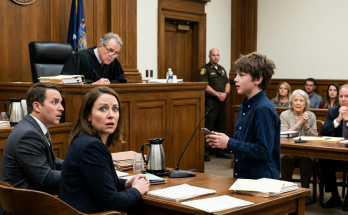

Part 1 – The Call That Changed Everything
The Mojave Desert was supposed to be the place where First Sergeant Marcus Vance completed the final days of his eight-month military assignment. The heat was unbearable, the training schedule was exhausting, and after months away from home, Marcus was counting every remaining hour until he could return to his nine-year-old daughter, Lily. He had spent his entire career learning how to remain calm under pressure, but nothing prepared him for the phone call that arrived at 2:17 in the morning.
The number on his screen belonged to Lily.
At first, Marcus thought it might be a mistake.
Children did not usually call their parents from hospitals in the middle of the night.
Then he heard her voice.
“Dad…”
It was barely a whisper.
“Everything h:3rts.”
The moment Marcus heard those words, every instinct he had developed through years of military service took over. He did not panic, because he knew fear from the person offering help could make a frightened child feel even more alone. Instead, he lowered his voice, told Lily to breathe slowly, and asked her to explain what happened one detail at a time.
She struggled to speak.
But she told him everything.
Her uncles, Rowan and Jaxson Sterling, had arrived at the family estate in Sterling Falls, North Carolina, while they were intoxicated. Lily had accidentally spilled a drink on Rowan’s expensive leather boots, and instead of treating it as a child’s mistake, the two men reacted with horrifying cruelty. They dragged her outside onto the gravel driveway, grabbed a heavy tire iron from their truck, and attacked her while her mother, Miranda, watched from the upstairs window.
“They took turns, Dad.”
Those were the last words Marcus heard before a nurse gently took the phone away because Lily was too exhausted to continue.
For several seconds, Marcus sat completely still.
The desert wind continued blowing around him.
The sounds of the military base continued in the background.
But none of it mattered anymore.
His daughter was in a hospital.
And the people responsible were her own family.
Marcus immediately arranged emergency leave and traveled across the country to Asheville, North Carolina. By the time he reached the pediatric intensive care unit, doctors had already completed their first evaluations. Dr. Jane Archer met him outside Lily’s room and carefully explained the severity of his daughter’s injuries.
Lily had suffered fractures in both arms.
Three broken ribs.
A shattered femur.
And severe injuries to her fingers from trying to protect her face.
The doctor explained that Lily would recover physically, but emotional healing would be a much longer process. Children who experience violence often remember the fear long after their bodies begin to heal, and nobody could promise Marcus when his daughter would finally sleep through the night without waking from nightmares.
Marcus entered the room quietly.
For four days, he barely left Lily’s side.
He held the fingers that were not covered in casts, read to her when she was awake, and stayed nearby whenever she became frightened. He did not ask her to be strong. He did not tell her to forget what happened. He simply reminded her that she was safe now.
But outside the hospital walls was a town that had spent decades protecting the people who hurt her.
Sterling Falls was not an ordinary mountain community. The Sterling family controlled nearly every important part of local life. Charles Sterling, the family patriarch, owned the largest timber mill in the county, controlled Sterling Valley Finance, and had enough influence over local politics that people rarely challenged him.
The sheriff attended Sterling family dinners.
Judges benefited from their financial support.
Inspectors who should have protected workers looked the other way.
For years, the Sterling name had become a shield that protected the powerful while ordinary people suffered in silence.
Marcus already knew this side of the family.
During his short marriage to Miranda, he slowly realized that the Sterlings viewed loyalty differently from everyone else. To them, family was not about love or responsibility. It was about control, reputation, and protecting the name at any cost.
After their divorce, Marcus secured shared custody of Lily.
But the Sterlings treated court orders as suggestions.
They believed their influence was stronger than any document.
Four days after Lily’s hospitalization, Marcus received a call from Evelyn Sterling, the family matriarch. Her tone immediately revealed the confidence of someone who believed she was untouchable.
“I heard you’re back in town, soldier boy.”
She sounded amused.
“My sons are protected.”
“My husband controls this county, the police department, and the courthouse.”
Marcus listened silently.
Evelyn continued.
“Take your daughter when she’s discharged.”
“Be grateful we’re allowing you to leave with her.”
Then her voice became colder.
“Rowan said if you come looking for him, he’ll finish what he started.”
She hung up.
What Evelyn did not know was that Marcus had placed the call on speaker, and his military habits had led him to automatically record the conversation for documentation.
He listened to the recording once.
Then he called Colonel Arthur Mitchell, his former commanding officer.
Marcus did not ask for revenge.
He did not ask for weapons.
He did not ask for permission to confront the Sterlings.
He asked for advice.
After hearing Evelyn’s threat, Colonel Mitchell remained silent for several seconds.
Then he said:
“Assemble your team.”
Marcus expected him to continue.
Instead, the Colonel added:
“But we are not going to war.”
“We are going to audit.”
That night, while the Sterling family celebrated inside their mansion, believing their power was still absolute, another person made a decision that would change everything.
Brooke Sterling, Jaxson’s teenage daughter and Lily’s cousin, secretly sent a video file to a secure number Marcus had created. She had witnessed what happened in the driveway and had finally decided she could no longer protect the family secret.
The footage showed Rowan and Jaxson attacking Lily.
It showed the driveway.
It showed the aftermath.
And it showed Miranda standing at the upstairs window.
Watching.
Then closing the curtains.
For Marcus, the video confirmed the truth he already feared.
Lily had not only been hurt by the people who attacked her.
She had been abandoned by the person who was supposed to protect her.
And this time, the Sterling name would not be enough to hide what they had done.
Part 2 – The Empire Built on Fear Begins to Collapse
After receiving Brooke’s video, Marcus did not immediately confront the Sterlings. He understood something the powerful family had forgotten: anger creates noise, but evidence creates consequences. The Sterlings had spent decades building an empire based on intimidation, connections, and people being too afraid to speak, so Marcus knew the only way to defeat them was to expose every hidden piece of their operation through undeniable proof.
He contacted four people he trusted most.
Not soldiers for a battle.
Investigators for the truth.
Marcus gathered his closest allies at a quiet cabin near Fontana Lake, away from the attention of Sterling Falls. None of them wore military uniforms, but their discipline and focus remained exactly the same as when they served together. They were not there to threaten anyone or take justice into their own hands.
They were there to uncover what the Sterling family had spent years hiding.
Ivan Fletcher handled communications and financial research. He traced company records, property ownership, tax documents, and the complicated network of businesses connected to the Sterling family. Matthew Caldwell analyzed the financial relationships between the Sterlings and local officials, searching for patterns that showed how money had influenced decisions throughout the county.
Thomas Mercer focused on medical and workplace records. His task was to identify injuries, accidents, and reports that had been ignored or altered over the years. Bruno Briggs handled security, not as an aggressor, but as someone responsible for making sure nobody could intimidate witnesses or use violence to silence them.
Within days, the walls of the cabin transformed into a complete map of the Sterling empire.
The more they discovered, the more disturbing the truth became.
Sterling Valley Finance had not become powerful by helping people.
It had grown by exploiting them.
The company targeted workers from the timber mill who were already struggling financially. When someone suffered an injury, lost income, or fell behind on payments, Sterling-owned companies often moved quickly to seize their homes. Families who had lived on the same land for generations suddenly found themselves fighting against contracts they never fully understood.
The pattern was not accidental.
It was a system.
The timber mill created the workers’ problems.
The finance company profited from those problems.
And local officials made sure nobody interfered.
Marcus’s team discovered records showing that workplace injuries had been hidden through manipulated reports. Emergency response logs were changed, accident details disappeared, and families were pressured into silence before they could challenge the Sterling companies.
They also uncovered problems connected to a local medical clinic controlled by the family. A doctor with financial ties to the Sterlings had repeatedly issued questionable prescriptions to workers, while suspicious deaths connected to medication abuse were ignored by officials who benefited from staying loyal.
Every discovery revealed the same truth.
The Sterling family had not built respect.
They had built fear.
Brooke became one of the most important witnesses.
At first, Marcus worried that she would be afraid to cooperate. She was still a teenager, and speaking against her own family meant challenging the people who had controlled her entire life. But when she arrived at the cabin, she carried herself differently than before.
She was no longer just a frightened girl who had witnessed something terrible.
She was someone who had decided silence was no longer acceptable.
Brooke explained where hidden financial records were stored, which vehicles were used for questionable transactions, and which nights influential people regularly visited the Sterling estate. She knew the family routines because she had grown up surrounded by them.
Marcus listened carefully.
Then he told her something important.
“You are not responsible for what they did.”
“You are responsible for what you choose to do now.”
Brooke handed over every piece of information she had.
Marcus’s team never stole documents.
They never broke into offices.
They never used illegal methods.
They simply followed the evidence that already existed.
Every transaction.
Every record.
Every connection.
They organized everything into a legal case that could not be dismissed as revenge.
The first person they contacted was Deputy Iris Barr.
Unlike the rest of the local law enforcement system, Iris had spent years trying to challenge corruption inside the sheriff’s department. She had been pushed aside because she refused to ignore wrongdoing, and she immediately understood the importance of the evidence Marcus presented.
The second was Victoria Caldwell, a family law attorney known for aggressively protecting children and fighting powerful opponents. When she reviewed Lily’s medical records and the evidence involving Miranda, her response was direct.
“Your daughter doesn’t need revenge.”
“She needs protection.”
The final person was Federal Agent Rebecca Lomax.
The financial records, corporate documents, and witness statements were enough to begin a federal investigation into fraud, corruption, and violations connected to the Sterling businesses.
For the first time in decades, the Sterling family faced people they could not intimidate.
The collapse began quietly.
Then all at once.
The Department of Labor arrived at the timber mill for a surprise inspection. Environmental investigators collected samples from the river near the factory after evidence suggested years of illegal dumping. Federal healthcare officials reviewed the clinic’s controlled substance records, and investigators began examining financial transfers that connected businesses, officials, and hidden accounts.
Charles Sterling did not understand what was happening at first.
He was too used to winning.
He spent years believing every problem could be solved with money, influence, or a phone call. When he heard about investigations, he assumed someone would eventually step in and make them disappear.
But nobody did.
Because this time, the people investigating him did not owe him anything.
Meanwhile, Rowan and Jaxson realized their family empire was collapsing. Instead of accepting responsibility, they returned to the same solution they had always used.
Intimidation.
Late one night, they drove toward the cabin near the lake carrying heavy steel pipes. They believed Marcus was vulnerable because he was away from the hospital and surrounded only by a small group of people.
They were wrong.
Marcus had expected desperation.
Bruno was already watching the entrance.
Thomas had documented every movement.
Deputy Iris Barr had been informed.
When Rowan and Jaxson forced their way inside, the confrontation ended almost immediately. They never had the opportunity to hurt anyone. They were restrained safely, and within minutes Deputy Barr arrived and placed them under arrest for unlawful entry and attempted assault.
The entire incident was recorded.
Every action.
Every threat.
Every mistake.
The footage became another piece of evidence proving the Sterlings were willing to use violence when their control disappeared.
Charles reacted by trying to move money between accounts before authorities could freeze them. He believed he was protecting his fortune, but every transfer created another record for investigators to follow.
Every desperate move became another piece of the case.
Three days later, before sunrise, a line of unmarked federal vehicles entered Sterling Falls.
The town watched silently as agents moved toward the Sterling estate.
For decades, people had lowered their voices when speaking about the family.
That morning, they finally began whispering something different.
Maybe the Sterlings were not untouchable after all.
Inside the mansion, Evelyn Sterling heard the pounding at the front door.
She walked toward it expecting another problem she could solve with authority.
Instead, she heard the words no one in her family had ever forced themselves to imagine.
“Federal agents.”
“We have search warrants and arrest warrants.”
For the first time in thirty years, the Sterling family had no phone call powerful enough to save them.

Part 3 – The Daughter Who Survived and the Family That Fell
The morning federal agents entered the Sterling estate became the day an entire town finally saw the truth. For decades, people had whispered about the family behind closed doors, but nobody had been willing to challenge them publicly. The Sterlings had built their reputation on the belief that money could erase mistakes, influence could silence witnesses, and fear could keep everyone obedient.
That belief ended when the evidence became impossible to ignore.
Inside the mansion, Charles Sterling watched investigators move through the rooms where he had hosted politicians, business leaders, and community figures for years. He expected someone to call, someone to intervene, someone powerful enough to make the situation disappear. Instead, every person he contacted either refused to answer or quietly distanced themselves from the family.
For the first time, Charles understood that the protection he depended on was never loyalty.
It was fear.
And fear disappears when people realize they are no longer alone.
The investigation continued for months. Financial records revealed years of fraud, workplace violations, and hidden transactions connected to Sterling-owned companies. Former employees who had remained silent for years finally stepped forward, encouraged by the fact that the family no longer had the power to punish them.
One worker named Daniel Harris provided testimony about the timber mill.
He explained how injuries were ignored, complaints disappeared, and employees were pressured to remain quiet because losing their jobs meant losing everything. He described how the Sterling family used people’s desperation as a tool, knowing that many workers could not afford to challenge them.
Another witness confirmed the same pattern inside Sterling Valley Finance.
Families were offered loans they could barely understand.
Payments were structured to create long-term dependence.
Properties were taken when people inevitably struggled.
The system was designed so that the Sterlings always won.
The case against Charles became one of the largest corruption investigations in the county’s history. The same newspapers that once praised the Sterling family began publishing articles about their hidden operations. The name that once represented power and success became associated with betrayal, exploitation, and abuse of influence.
But for Marcus, none of that mattered as much as what happened in Lily’s hospital room.
When his daughter finally woke after a difficult procedure, Marcus sat beside her bed holding her hand. The bruises had started healing, but the emotional wounds were still visible in the way she reacted to sudden sounds and unfamiliar voices.
She looked at him quietly.
“Dad?”
“I’m still scared.”
Marcus moved closer.
“I know.”
“What happened wasn’t your fault.”
Lily looked down at her hands.
“They said nobody would believe me.”
Those words hurt Marcus more than any injury report ever could.
Because Lily had not only been harmed physically.
She had been taught that her pain did not matter.
Marcus squeezed her hand gently.
“I believe you.”
“I always will.”
That became the foundation of Lily’s recovery.
Not revenge.
Not anger.
Safety.
With Victoria Caldwell representing her interests, Lily received the protection and support she needed. The court recognized the danger created by Miranda’s actions and the Sterling family’s influence. Custody arrangements were reviewed, and Marcus became the parent responsible for providing Lily with a stable environment.
Miranda attempted to explain herself.
She said she had been afraid of her family.
She said she did not know what to do.
She said she regretted not protecting Lily.
But when Marcus heard those words, he remembered the video.
He remembered Lily standing alone.
He remembered Miranda watching from the window.
Fear could explain hesitation.
It could not excuse abandoning your child.
Marcus eventually agreed that Lily could decide what kind of relationship she wanted with her mother in the future. He refused to force forgiveness or hatred onto his daughter. He wanted Lily to understand that healing meant having control over her own choices.
Months later, Lily returned home.
Not to the Sterling estate.
To a smaller house near the mountains where Marcus had created a new beginning for them.
The walls were covered with her drawings.
Her room was filled with books and soft blankets.
There were no family rules about protecting a name.
No expectations about staying silent.
No fear of speaking the truth.
One evening, while they sat outside watching the sunset, Lily asked Marcus a question.
“Are we still a family?”
Marcus looked at her.
The question revealed how much the Sterlings had damaged her understanding of love.
He smiled gently.
“Of course we are.”
She thought for a moment.
“But we’re not like them.”
Marcus shook his head.
“No.”
“We’re different.”
“How?”
He looked at the daughter he almost lost.
“Because families protect each other.”
“Families listen.”
“Families believe each other.”
Lily smiled.
For the first time in a long time, she looked like a child again.
Not a survivor.
Not a witness.
Just a nine-year-old girl.
A year later, Marcus retired from active military service. He still missed the structure and purpose of his old career, but he realized his most important mission had never been overseas.
It had been standing beside Lily.
The experience changed him.
He began working with organizations that helped children affected by family violence and corruption. He shared Lily’s story carefully, protecting her privacy while showing others that powerful people could still be held accountable.
As for Sterling Falls, the town changed too.
The sheriff’s department was rebuilt.
New officials were elected.
Workers who had been ignored for years finally received justice.
The Sterling mansion eventually became a reminder of what happens when people believe they are above consequences.
But Marcus never wanted Lily to remember only the pain.
He wanted her to remember that someone believed her.
That someone came.
That someone fought for her.
Years later, when Lily graduated from high school, she asked Marcus to stand beside her during the ceremony. Before walking onto the stage, she hugged him tightly.
“Thank you for coming back for me.”
Marcus smiled.
“I would always come back.”
Because that was the promise he made the night she called him from the hospital.
Not a promise to destroy the people who hurt her.
A promise to make sure she never felt alone again.
The Sterling family lost everything they built through fear.
But Marcus and Lily gained something far more valuable.
A life built on trust.
A home built on love.
And the knowledge that even the strongest walls eventually fall when the truth finally reaches the light.