WHOLE STORY:
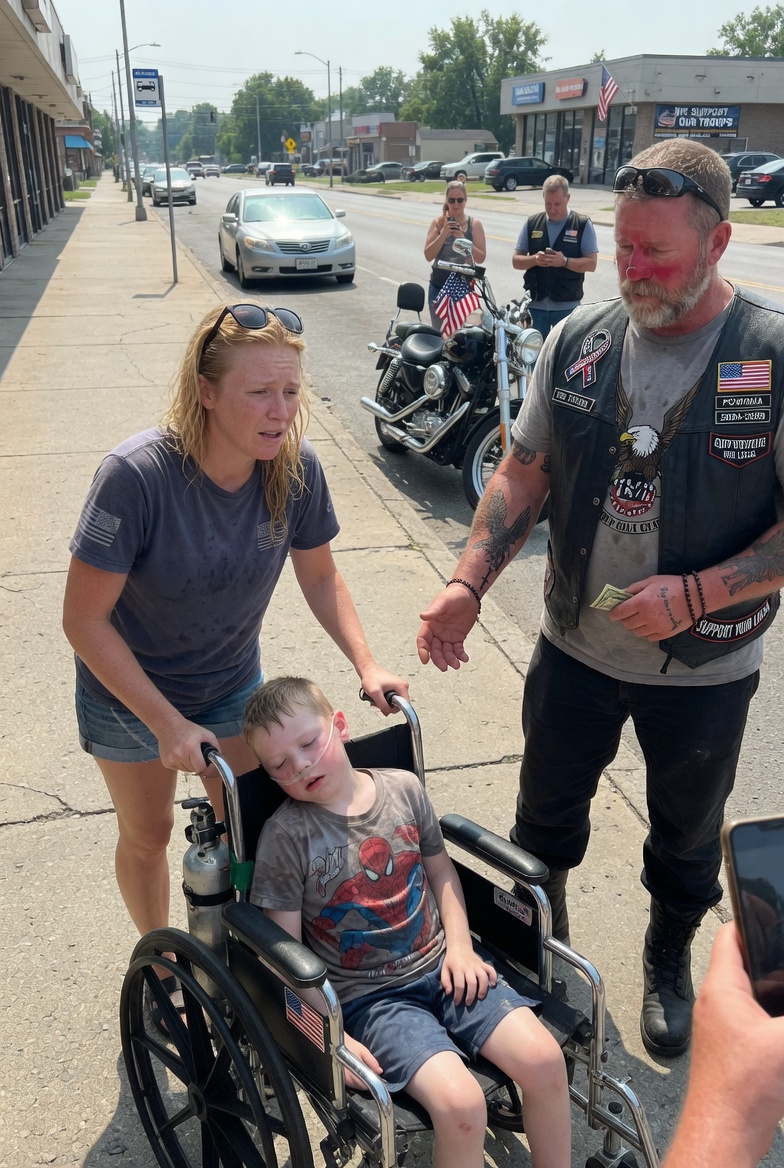
I couldn’t breathe. My fingers dug into the wheelchair handles so hard they ached. I wanted to scream, to run, to do anything—but my legs wouldn’t obey.
His hand moved slowly. I couldn’t see what he was holding. Just the outline of his thick fingers closing around something deep in the dark leather of his vest.
The crowd held its breath.
And so did I.
Then his hand emerged.
It wasn’t a weapon.
It was a triangle of damp blue fabric, folded with care. And a bottle of water, sweating beads of condensation that ran down the plastic and fell onto the blazing hot asphalt.
He didn’t lunge. He didn’t step closer. He looked me right in the eyes—long enough for me to see that his own eyes were heavy, tired, carrying a weight I would only understand later—and then he knelt.
Right there on the street, on the ground that was hot enough to burn skin, he lowered himself to the level of my son.
“I’m not here to scare you,” he said again. “My name is Logan. I have a daughter. I know a mom in trouble when I see one.”
I couldn’t move. My body was locked in flight mode, but there was nowhere to go. The wheelchair was heavy. The heat was crushing. And this man—this giant of a man covered in ink and leather—was kneeling in front of us like he was the one asking for mercy.
My son stirred.
The sound was small. A whimper. A dry, cracked sound that cut through the roar of traffic and the pounding of my own heart.
“Mom…”
Everything inside me broke.
I dropped to my knees beside the wheelchair. I grabbed the water bottle. My hands were shaking so badly I could barely twist the cap. “I’m here, baby. I’m right here.”
I held the bottle to his lips. He drank. Slow, desperate sips. The water ran down his chin, clear and cool, dripping onto his hospital wristband.
Logan didn’t move. He stayed on his knees, watching us with an expression I couldn’t read. Not pity. Not judgment. Something deeper. Something that looked like memory.
“What’s his name?” he asked softly.
“Ethan.”
“Ethan,” he repeated, like he was tasting the word. “That’s a strong name.”
Another horn blared behind him. A car swerved around his abandoned motorcycle, tires squealing. Someone leaned out the window and screamed, “Get out of the road, you idiot!”
Logan didn’t even flinch.
He looked over his shoulder and gave a short, sharp whistle.
The sound cut through the noise like a blade.
Within seconds, a low rumble grew into a thunder. Three more motorcycles rounded the corner. They didn’t speed. They glided, pulling to a stop in a perfect line behind Logan’s bike, blocking the lane completely.
My heart seized.
I pulled Ethan closer to me, wrapping my body around his chair. “Please,” I whispered. “Please don’t.”
Logan held up a hand, palm out. A signal. The engines died, one by one. Silence. Heavy. Suspended.
A tall man with a long gray beard and the kindest eyes I had ever seen dismounted first. He walked straight to his saddlebag, pulled out a collapsible umbrella, and opened it. Without a word, he walked over and held it over Ethan’s head, blocking the blinding sun.
“The heat’s a killer today,” he said. His voice was warm, soft, grandfatherly. “I’m Slim. I used to be a pediatric nurse. Mama, you’re doing a beautiful job.”
I couldn’t speak.
Another rider, young, with a gold cross tattooed on his neck, handed me a cold towel wrapped in a ziplock bag. “Put this on the back of his neck,” he said. “It’ll help bring his temp down.”
The third rider just stood guard, arms crossed, watching the street with the quiet stillness of a man who had seen everything and judged nothing.
I was surrounded.
Not by danger.
By a tribe of men who saw my struggle and responded before I could even ask.
The first tear fell. Then another. I couldn’t stop them. They burned hot tracks down my cheeks.
“I don’t…” My voice cracked. “I don’t have any money to pay you.”
Slim leaned down, his eyes soft. “Ma’am, we’re not here for money.”
“Then why?”
Logan stood up. He looked at the street, at the people staring from windows and cars, at the world that had walked past me all morning. His jaw tightened.
“Because the world is full of people who look away,” he said. “We’re the ones who look back.”
I wiped my face with the back of my hand. Ethan was awake now, his eyes wide, watching the men in leather with the same cautious wonder a rabbit might watch a wolf. But the wolf hadn’t bitten. The wolf had offered water.
“I need to get to the hospital,” I said. “The bus stop is half a mile down. The bus comes every hour. I missed the last one.”
Logan nodded. “We know. We saw you walking. We were on our way to a charity ride, but this is more important.” He looked at Slim, at the young one, at the guard. “We’re walking with you.”
I started to shake my head. “You don’t have to—”
“I know we don’t have to,” he said. “We want to.”
Slim handed me the umbrella. “You hold this over your boy. Logan, you push. Marco, run ahead and see if that gas station has ice.”
The young one—Marco—took off at a jog.
Logan moved behind the wheelchair. His big hands wrapped around the handles, and he began to push. The wheels rolled smooth, easier than they had under my exhausted arms.
I walked beside them, holding the umbrella, feeling a cold towel pressed against the back of my neck that Marco had given me before he left.
We moved together.
A strange, unlikely procession.
The people on the street didn’t know what to make of us. A woman crying. A sick boy in a chair. Four bikers in full leather, walking slow, matching her pace. The phones came out. The whispers started.
But the whispers changed.
“What’s happening?”
“He just stopped his bike…”
“Is he helping her?”
A man sitting on his stoop watched us pass. He was older, weathered, holding a coffee cup. His eyes met Logan’s.
“You need anything, brother?” the man asked.
Logan shook his head. “We’re good.”
The man nodded. “Respect.”
We walked three blocks in a heavy, sacred silence. The only sounds were the hum of traffic, the rhythmic thump of the wheels on the sidewalk cracks, and the soft, labored breathing of my son.
Then Ethan spoke.
“Mister?”
Logan leaned forward so his head was level with the chair. “Yeah, buddy?”
“Are you a superhero?”
I heard Logan’s breath catch. Just a tiny hitch. He cleared his throat.
“No, buddy,” he said, his voice husky. “I’m just a guy who saw a superhero and wanted to walk with her for a while.”
Ethan frowned, confused. “Who’s the superhero?”
Logan looked at me.
I couldn’t hold his gaze. I looked down at the cracked sidewalk, at the shadows stretching long in the late afternoon sun.
We reached the gas station. Marco was waiting outside with a bag of ice and a bottle of electrolyte drink. “They didn’t have the blue, little man, but the orange is pretty good.”
Ethan smiled. A real smile. Small, thin, tired—but real.
It was the first time I had seen it in six weeks.
I leaned against the wall of the gas station and felt my legs give out. I slid down until I was sitting on the hot concrete. The umbrella clattered beside me.
I was done. Empty. A shell.
Slim was there in an instant. He knelt beside me. “Mama, when is the last time you ate?”
I couldn’t remember.
“Marco,” he said quietly, “go get her a sandwich. And a Gatorade. The blue one.”
Marco disappeared inside.
Logan parked the wheelchair in the shade. He sat down on the curb beside me, not too close, leaving space. He didn’t say anything. He just sat there.
The silence gave me permission.
I started talking.
“His name is Ethan. He’s six. He has severe aplastic anemia. His bone marrow stopped working. He needs a transplant. We’ve been on the list for eight months. Eight months of transfusions, infections, hospital stays. His father left six months ago. Said he couldn’t handle it. The car broke down this morning. The bus broke down. I didn’t know what to do. I just kept walking.”
I wiped my face.
“I’m so tired, Logan.”
He nodded. He looked at his hands, at the tattoos winding up his arms, at the wear and tear of a hard life written in every line.
“My little brother’s name was Jake,” he said. “He had leukemia. He was eight. My mother pushed his wheelchair for three years. Every day. To the hospital. Back home. In the rain. In the heat. It didn’t matter. She did it alone.”
His voice dropped.
“I was fifteen. I was a punk. I was running with the wrong crowd, pretending I was tough. I never helped her. I never went with her. I was too busy being angry at the world. One day, Jake had a crisis. She called me. Six times. I didn’t answer. I was at a party.”
He stopped. The air was thick.
“By the time I got home, he was gone. And my mother… she was never the same. She died two years later. The doctors said it was her heart. I knew it was broken.”
He turned and looked at me.
“I’ve been carrying that guilt every single day for twenty years. Helping people is how I carry it. Not to fix it—I can’t fix it. But to point it in a direction that matters. When I saw you on that road today, I saw my mother. I saw a chance to do what I should have done back then.”
He reached into his pocket again. My heart didn’t jump this time. I waited.
He pulled out a transit card. Worn. Bent at the edges. The print was fading.
“This was hers. She used it to get to the hospital every day. After she passed, I found it in her drawer. There was still twenty bucks on it. I’ve been carrying it for years, waiting for the right person.”
He held it out to me.
“I can’t take that, Logan. It’s your mother’s.”
“That’s exactly why you have to take it,” he said. “She’d want someone to use it. Someone who needed a ride.”
I took the card.
It was warm from his pocket.
It felt holy.
Marco came back with a sandwich and a blue Gatorade. I ate. I didn’t realize how hungry I was until the first bite hit my stomach. Ethan finished the electrolyte drink and asked for another. Marco bought him one.
When we started walking again, something had shifted. The fear was gone. The weight was lighter. I wasn’t carrying it alone.
A police car pulled up beside us.
My stomach dropped.
The officer got out, adjusted his belt, looked at the bikers, looked at me, looked at the wheelchair.
“Everything okay here, ma’am?”
I opened my mouth to speak, but Logan stepped forward.
“We’re fine, officer,” he said. “Just helping a neighbor get to the hospital.”
The officer’s eyes narrowed. He recognized Slim.
“Slim?” the officer said. “I didn’t know you were riding with this crew now.”
Slim smiled. “Been riding with them for years, Jerry. Good people.”
The officer looked at me. I nodded, my voice steady for the first time all day. “They helped me. My son is sick. They stopped to help.”
The officer studied Logan. Long and hard. Then he nodded.
“Take care of her,” he said.
“Always do,” Logan replied.
The officer got back in his car and drove away.
We walked the rest of the way in a daze. The sun was starting to dip, casting long shadows. The heat was still there, but it wasn’t cruel anymore. It was just weather.
And then we were there.
The bus stop.
A bench in a sliver of shade.
Slim parked the chair. Marco handed Ethan a toy car he had bought at the gas station. The quiet one—whose name I finally learned was Deck—stood at the edge of the sidewalk, watching the road for the bus.
Logan stood beside me.
“The bus will be here in ten minutes,” he said.
“I know.”
“The card has enough for the ride. And a ride back.”
I looked at the card in my hand. I looked at the men around me. Rough. Tattooed. Scarred. And so gentle it broke my heart.
“I don’t know how to thank you,” I said.
“You just did,” Logan said. “You let us help. That’s the gift.”
The bus arrived.
Logan and Slim helped get the wheelchair onto the lift. Marco strapped it down. Deck handed me a plastic bag with extra water, extra snacks, and a piece of paper.
“That’s my number,” he said. His voice was gravelly, unused. “If you ever need a ride to the hospital. A ride anywhere. Call. I don’t care what time it is.”
I took the paper.
My hands were shaking again.
I climbed onto the bus. The doors hissed closed. The driver looked at me in the mirror. “You okay, miss?”
I looked out the window. Four bikers stood by their motorcycles, watching the bus. Slim raised a hand.
I raised mine.
“Yes,” I said. “I think I am.”
Ethan was asleep before we passed the first light, his hand wrapped around the toy car Marco gave him.
I sat down in the sticky vinyl seat and let the tears fall freely, silently, for the entire ride.
—
That was eighteen months ago.
Ethan found a donor. A nineteen-year-old college student from Ohio who signed up for the registry on a whim. The transplant worked. It took months of recovery, setbacks, and sleepless nights. But he made it.
Today, he runs.
Today, he rides a bicycle. A blue one, with streamers on the handles.
And the Midnight Riders?
They never left.
They came to the hospital. Every week. Logan sat with Ethan during his chemo infusions and let him play with his keys. Slim brought homemade soup. Marco brought comic books. Deck—quiet, silent Deck—fixed our broken minivan in his driveway and handed me the keys without a word.
When Ethan finally came home for good, they threw a block party. A bounce house. A grill. Ice cream. The whole neighborhood came. The same neighborhood that had looked away on that hot sidewalk eighteen months ago now looked at the bikers like family.
Because they are.
Logan is the godfather. Slim is the honorary grandfather. Marco is the big brother Ethan never had. Deck is the quiet uncle who shows up with tacos and leaves before anyone can thank him.
I don’t call them bikers anymore.
I call them family.
The world taught me to be afraid of men like them. The media, the news, the warnings. Loud engines. Dark tattoos. A certain look.
But the world was wrong.
The scariest day of my life turned into the day I found my people.
Not because a man with a leather vest saved me. Because a man with a kind heart stopped his engine, stepped into the heat, and walked beside me until I was no longer alone.
Hope doesn’t always come with a halo.
Sometimes, it comes with a revving engine, a faded leather jacket, and a hand reached out in the middle of the road.
I will never stop telling this story.
Because someone out there needs to hear it.
The world is full of people who look away.
Be the one who looks back.
—
TITLE:
A Mother Pushed Her Son’s Wheelchair Under the Blazing Sun, Exhausted and Alone – Until a Tattooed Biker Killed His Engine and Walked Straight Toward Her. The Crowd Braced for the Worst. Then He Slowly Reached Into His Pocket…
FACEBOOK CAPTION:
The sun was merciless. I felt every degree baking through my shirt as I pushed my son’s wheelchair down the sidewalk. Each step cost me more than the last. His small body was limp in the seat, his lips cracked, his breathing shallow. I couldn’t stop. Not even to wipe the sweat from my eyes. The bus stop was still half a mile away.
People walked past without meeting my gaze. A few glanced our way, then looked down at their phones. I saw the pity—and the judgment. A woman with a child shouldn’t be out in this heat. They didn’t know I had no choice.
Then I heard it. A motorcycle engine revving behind me, then cutting off with a sharp choke. My shoulders tensed. Footsteps hit the pavement—heavy boots, deliberate.
I didn’t turn. I kept pushing.
“Ma’am.”
The voice was low, rough. I froze. A figure stepped into my peripheral vision. Leather vest. Tattoos crawling up his arms. Sunburned skin. A biker.
My heart began to pound. I pulled the wheelchair closer, angling myself between him and my son.
“Please,” I said, my voice cracking. “We’re fine.”
He didn’t stop. Cars behind him honked. Someone shouted. I could feel the weight of eyes from windows, from the street. Everyone was watching.
He stopped a few feet away. Hands visible. Posture open.
“I’m not here to scare you,” he said.
I didn’t believe him. My mind raced through every warning I’d ever heard. Every story about women alone, a child, a stranger who looked like trouble. This was exactly how those stories started.
He pointed down the road. “You’ve got a long walk. No shade out there.”
“I know,” I snapped. “I said we’re fine. Please just go.”
He didn’t move. His eyes lingered on my son—on the way his head lolled, on the rapid rise and fall of his chest. Then the biker’s jaw tightened, and he reached into his pocket.
Time shattered.
I couldn’t breathe. My fingers dug into the wheelchair handles so hard they ached. I wanted to scream, to run, to do anything—but my legs wouldn’t obey.
His hand moved slowly. I couldn’t see what he was holding. Just the outline of his fingers closing around something deep in his vest.
The crowd held its breath.
And so did I.
Be the one who looks back.
I took those words and carved them into my heart. They became the lens through which I saw every stranger, every struggle, every moment of hesitation on the street. But it wasn’t until a year later that I truly understood what they meant—when I found myself on the other side of the road, watching a woman who could have been me.
It was August again. The heat had returned with the same merciless weight, pressing down on the city like a held breath. I was driving Ethan to his follow-up appointment at the children’s hospital, our old minivan humming along with the air conditioner struggling against the blaze. He was in the back seat, singing along to a kids’ song, his cheeks full of color, his fingers tapping the window. Healthy. Alive. A miracle in a booster seat.
I stopped at a red light.
And I saw her.
She was on the sidewalk, maybe thirty yards ahead. A woman, young, with a stroller that looked too heavy for her frame. She was bent over the handles, pushing with her whole body, her hair plastered to her scalp with sweat. Even from the car I could see the redness in her face, the strain in her neck. The stroller tilted every time she hit a crack.
A child inside—maybe two years old—was crying. A thin, exhausted wail that barely carried over the traffic but somehow reached me through the glass.
I looked at the light. It was still red.
I looked back at her.
No one stopped. No one even slowed. The people on the sidewalk passed her the same way they had passed me eighteen months before. Eyes down. Phones out. The heat was an excuse, but it was also a truth—nobody wanted to get involved.
I felt something snap inside me.
Not anger. Recognition. A physical memory of that exact pavement burning through my shoes, the weight of a child I couldn’t save alone, the taste of salt and shame.
I turned the wheel without thinking.
The minivan jerked into the right lane. Horns blared. Ethan gasped. “Mom?”
“I see someone who needs help, baby. We’re going to help.”
I pulled to the curb, threw the car into park, and got out. The heat hit me like a wall. But I didn’t hesitate. I walked straight toward her.
She saw me coming. Her eyes widened. She pulled the stroller closer, her body curling around it like a shell.
“Ma’am?” I said, my voice softer than I intended. “Ma’am, are you okay?”
She shook her head quickly, too quickly. “We’re fine. We’re fine.”
The lie was so familiar it hurt.
“Please,” I said, slowing my steps. I stopped a few feet away, hands visible, posture open. The exact way Logan had stood in front of me. “I’m not here to scare you. My name is Sarah. I saw you from my car and I—I’ve been where you are.”
She stared at me, her breath fast and shallow. The toddler in the stroller was red-faced, tears cutting tracks through dust on his cheeks. A thin blanket was draped over him, but it had slipped, leaving one leg exposed to the sun.
“I don’t have any money,” she said, her voice cracking.
“Neither did I,” I said. “But I had a boy who needed help. And someone stopped for us. Let me stop for you.”
She looked at me. Really looked. At my face, at my car idling at the curb, at the child in the back seat watching through the window.
“I’m trying to get to the clinic,” she whispered. “He has a fever. It’s been three days. I don’t have a car. The bus—I missed the bus. I thought I could walk.”
“How far?”
“Two miles.”
Those two words carried everything. Exhaustion. Desperation. The quiet terror of a mother who has run out of options.
I looked back at my minivan. Ethan was fine. The appointment wasn’t for another hour. I had time.
“I have a car,” I said. “I can drive you.”
Her face crumbled. “I can’t—I don’t have a car seat.”
“Then we’ll figure something out. I have a friend who can help.”
I pulled out my phone. I scrolled to a contact I never thought I’d use this way. I pressed call.
He picked up on the second ring.
“Sarah?” Logan’s voice was rough, but warm. “Everything okay?”
“I’m at the corner of Fifth and Maple,” I said. “I found someone who reminds me of me. Can you come?”
There was a pause. Then a low, quiet chuckle.
“I’ll be there in ten. You need anything else?”
“Maybe a water bottle. And a cold towel.”
“You got it.”
He hung up. I looked at the woman.
“Help is coming,” I said. “What’s your name?”
She hesitated. Then: “Diane. His name is Marcus.”
I smiled. “Nice to meet you, Diane. Do you mind if I hold an umbrella over Marcus while we wait?”
She nodded, tears spilling down her cheeks.
I walked back to my car, grabbed the emergency umbrella I kept in the door, and opened it over the stroller. The shade fell over Marcus immediately. His crying softened to a whimper.
“You’re okay, little man,” I said. “You’re going to be okay.”
Ethan rolled down his window. “Mom, is that a baby?”
“Yeah, baby. He’s sick. We’re helping.”
“Can I give him my juice box?”
I felt my heart swell. “That’s a great idea. Bring it here.”
He unbuckled himself and scampered out, holding out an unopened juice box with a bendy straw. He approached the stroller carefully, the way he approached everything now—with a gentleness that had been born in hospital rooms.
“Here,” he said, holding it out. “It’s apple. It helps when you’re hot.”
Diane looked at me, eyes wet. I nodded.
She took the juice box. “Thank you,” she whispered. “Thank you both.”
We stood there in the shade of the umbrella, the three of us—and Marcus—waiting.
I heard them before I saw them.
The rumble started low, building into a familiar thunder. I didn’t flinch. Diane did. She stepped back, her face tightening.
“It’s okay,” I said. “They’re my family.”
Four motorcycles rounded the corner, gliding to a stop in a neat line behind my minivan. Engines died. Boots hit the pavement.
Logan dismounted first, his leather vest catching the sun. Slim was right behind him, his gray beard longer now, his eyes just as kind. Marco waved from his bike. Deck stayed on his for a moment, watching the street, then swung off and stood at the edge.
Logan walked toward us. He saw Diane’s fear and slowed his pace. He even held his hands out slightly, palms open.
“Ma’am,” he said gently. “I’m Logan. Sarah told me you need a ride.”
Diane’s voice was small. “I don’t have a car seat.”
“Marco?” Logan said.
Marco stepped forward. “Got one in the truck. Slim’s bike has a sidecar, but that’s no good for a little one. I’ll run home and grab my sister’s car seat. Ten minutes, tops.”
“You don’t have to—” Diane started.
“We want to,” Marco said, and he was already on his bike, firing it up. “I’ll be back before you finish that juice box.”
He roared off.
Slim approached the stroller slowly. “Mind if I take a look at little Marcus? I used to be a nurse.”
Diane looked at me. I nodded.
Slim knelt, his big frame folding with impossible grace. He pressed the back of his hand to Marcus’s forehead, then checked his pulse with two fingers.
“Fever’s high, but not dangerous yet. He’s hydrated enough. You did good, Mama. You got him out of the sun. You did exactly right.”
Diane covered her mouth with her hand.
Deck appeared beside me, holding a cold bottle of water. He didn’t say anything. He just handed it to me, nodded at Diane, and stepped back to his post.
Logan stood beside Diane. “When Marco gets back, we’ll get you to the clinic. Slim and I will ride ahead to clear the way if there’s traffic. Deck will follow behind. You’ll be there in fifteen minutes.”
“I don’t know how to thank you,” she said.
Logan smiled. “You just did. You let us help.”
I watched the words land. I saw the shift in her shoulders, the release of tension that only comes when you realize you’re not alone.
I knew that feeling.
Marco returned in eight minutes, a car seat strapped to the back of his bike. He transferred it to my minivan with practiced ease. We got Marcus buckled in, his eyes wide and curious now, the fever breaking into a sweat that Slim said was a good sign.
Diane sat in the back seat next to him. I drove. The bikers surrounded us—two in front, two behind—a rolling convoy of leather and compassion.
When we pulled up to the clinic, a nurse came out to meet us. Logan had called ahead.
Diane got Marcus checked in, his fever already dropping. The doctor said he had an ear infection, but they caught it early. He’d be fine.
Diane stood in the waiting room, holding Marcus on her hip. She looked at me. At Logan. At the rest of them standing by the door, not wanting to crowd, but not leaving.
“Why?” she asked. “Why did you stop for me? You don’t even know me.”
Logan looked at me.
I stepped forward.
“Because someone stopped for me,” I said. “Eighteen months ago, I was pushing my son’s wheelchair in the same heat, and I had nothing left. A man named Logan killed his engine and walked toward me. I was terrified. But he wasn’t there to hurt me. He was there to tell me I wasn’t alone.”
I took her hand.
“They became my family. And now I get to be that for someone else. That’s how it works. You receive it, and you pass it on.”
She started crying. I held her.
Marcus reached out and grabbed a fistful of my hair. I laughed.
Ethan came up and showed Marcus the toy car he still carried—the one Marco had given him at the gas station. “You can hold it for a minute,” he said. “But then I need it back. It’s lucky.”
Marcus took the car. He smiled a toothy, snotty, perfect smile.
Diane held my hand for a long time.
We left when Marcus was settled in a bed, antibiotics running, his mother asleep in the chair beside him. The nurses promised to call if she needed anything.
Outside, Logan put a hand on my shoulder.
“You did good today, Sarah.”
“I learned from the best.”
He shook his head. “You learned from yourself. I just showed up. You’re the one who looked back.”
We stood there for a moment, the sun setting behind us, the heat finally breaking.
I looked at the bikers—Slim stretching his back, Marco texting his sister, Deck leaning against a lamppost, silent and steady. And I thought about how the world sees them. Rough. Dangerous. Outsiders.
But the world doesn’t see what I see.
It doesn’t see the way Logan calls his daughter every night before bed, reading her stories over the phone because he works late.
It doesn’t see Slim volunteering at the children’s hospital twice a week, holding hands with kids who don’t have anyone else.
It doesn’t see Marco coaching a youth baseball team in his spare time, teaching boys how to be strong without being cruel.
It doesn’t see Deck, who never says more than five words, spending weekends fixing cars for single mothers—free of charge, no questions asked.
The world sees their tattoos, their scars, their leather. The world makes assumptions.
But I know the truth.
I know that sometimes, the people who look the scariest are the ones with the softest hearts. They’ve been hardened by life, but they haven’t been broken. They’ve chosen to take their pain and turn it into purpose.
And that choice—that quiet, daily choice—is the most beautiful thing I’ve ever seen.
I drove home that night with Ethan asleep in the back, the toy car clasped in his hands, his lips curved into a calm smile.
I thought about Diane. I thought about Marcus. I thought about the road ahead of them—the fear, the uncertainty, the long nights.
But I also thought about how they’d never have to walk it alone.
Because now they knew.
The world is full of people who look away.
But there are others.
We are the ones who look back.
And we never stop.