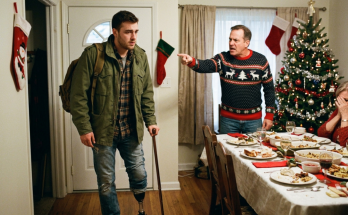

The judge had barely finished saying, “This divorce is final,” when I leaned toward my attorney and whispered, “Book the tickets.”
Ten minutes later, I was fastening my youngest child into an airplane seat, while my two older children sat beside me in stunned silence, still holding the small backpacks I had packed the night before.
Across town, Daniel’s family was gathered in a cheerful maternity clinic, surrounding his mistress and waiting to hear the heartbeat of the baby they had already decided was their future.
They were smiling. Celebrating. Believing they had won.
They had no idea the doctor was about to say something that would shatter everything.
I didn’t cry when the judge signed the divorce papers. By then, all my tears had already been used up. I had cried months earlier in the laundry room, where the dryer’s hum covered the sound. I had cried when I found the first message on Daniel’s phone, a message that looked harmless but carried a closeness that no longer belonged to me.
After that, the tears came everywhere — in the kitchen, in the car, even once in a grocery store parking lot while I gripped the steering wheel until my hands hurt. But not in court. In court, I was steady.
“Mrs. Carter,” the judge asked, “do you agree to the terms as presented?”
“Yes, Your Honor,” I said.
My voice did not shake.
Daniel sat across the room, looking relieved and impatient. He wanted it finished. So did I.
On paper, the agreement looked acceptable. He kept the house, most of the savings, and his business accounts stayed untouched. I took the children and a modest settlement. To anyone watching, it would have looked like I had lost.
His mother sat in the back row, whispering to his sister with a smile she could barely hide. They thought I was leaving with nothing.
Maybe they needed to believe that.
When the hearing ended, Daniel stood quickly and reached for his phone.
“Good,” he muttered. “That’s done.”
I collected my things slowly, making sure I left nothing behind.
“Emily,” he said casually, like we had ended a meeting instead of a marriage, “I’ll have someone coordinate the kids’ schedule with you.”
“I won’t be available,” I said.
He paused. “What do you mean?”
“You’ll need to go through my attorney.”
His face tightened. “There’s no need to make this difficult.”
“I’m not,” I said calmly. “I’m making it clear.”
Outside the courthouse, my lawyer Robert Hayes walked beside me.
“You handled that well,” he said.
“I didn’t do anything.”
“You did exactly what we planned. You stayed calm. You didn’t push.”
Then he lowered his voice. “Are you sure about what comes next?”
“I am.”
“The children?”
“They’ll be fine,” I said, even though my chest tightened. “They need stability. Not all of this.”
The car was already waiting.
The night before, after the children were asleep, I had prepared everything: three small suitcases, passports, documents, and a folder in my carry-on filled with copies of everything Robert and I had built over months.
Lily noticed first.
“Mom,” she asked as we pulled away from the courthouse, “where are we going?”
“We’re taking a trip,” I said.
“A vacation?” Ethan asked.
“Something like that.”
Noah, my youngest, simply held his stuffed bear and stared out the window, trusting me completely.
“Is Dad coming?” Lily asked.
“No,” I said. “Just us.”
At the airport, everything moved quickly: check-in, security, boarding. I had chosen a morning flight on purpose. Less time for questions. Less time for Daniel to realize anything.
Once we were seated, I buckled Noah in and tucked a blanket around him.
“Where are we going?” he asked.
“Somewhere new,” I said.
As the plane lifted into the sky, I looked down at the city I had called home for nearly twenty years. I thought of the house, the kitchen, the life I had built piece by piece.
Then I let it go.
Because across town, Daniel was probably walking into the clinic with Vanessa, his family gathered around them, ready to celebrate what they thought was a fresh beginning.
They didn’t know what had already started.
They didn’t know the agreement Daniel had signed that morning contained a clause he had barely read. They didn’t know the financial disclosures he swore were complete had already been quietly checked.
For the first time in a long time, I was not waiting for life to happen to me.
I had already moved first.
When my phone buzzed after we landed, I ignored it.
The air outside the airport felt softer than the place we had left. The rental house I had arranged was simple, clean, and near a school I had already contacted. It wasn’t fancy. It was enough.
I had been preparing for weeks. Quiet calls before sunrise. Emails from an account Daniel didn’t know existed. Documents copied, organized, and checked again.
When the kids settled in, I stepped onto the small patio and finally looked at my phone.
Five missed calls.
Three from Daniel.
Two from a number I already knew.
I called Robert instead.
“You landed?” he asked.
“We’re here.”
“Then we’ve begun,” he said.
Daniel’s accounts had been temporarily frozen for review. The IRS had opened an inquiry into discrepancies between his reported income and actual transfers. The non-disclosure clause in the divorce agreement had been triggered.
The deal Daniel thought he had secured that morning was no longer safe.
I didn’t feel victory. It was quieter than that.
It felt like balance.
Meanwhile, at the clinic, Daniel stood beside Vanessa while his family watched the ultrasound screen. His mother was already calling the baby her grandchild.
Then the technician’s expression changed.
“I’m going to ask the doctor to come in,” she said.
The doctor entered, studied the screen, and began asking questions about timing. Cycle dates. Possible conception dates. Vanessa answered, but the room grew tense.
Finally, the doctor said the pregnancy timeline did not match what they had described.
Daniel’s voice went low. “How much earlier?”
“Earlier than your relationship would account for,” the doctor said.
The room fell silent.
Vanessa’s face went pale.
Daniel stared at her. “Is there something you need to tell me?”
She said nothing.
And silence, when a question is that direct, becomes its own answer.
Then Daniel’s phone rang.
He stepped into the hallway and answered sharply. It was Robert.
He informed Daniel that the financial disclosures from the divorce were under formal review due to undeclared transfers, offshore accounts, and hidden assets. Several accounts had been frozen, and the asset division was now subject to reassessment.
Daniel returned to the ultrasound room carrying two disasters at once.
The child they were celebrating might not be his.
The divorce settlement he thought he had won was unraveling.
His future had shifted in less than an hour.
Later that evening, Daniel texted me.
What did you do?
I stared at the message for a long moment.
Some questions deserve answers. Others are just the sound of someone realizing they have lost control.
I did not reply.
I put the phone down and returned to the stove. Lily was helping Noah with a worksheet. Ethan was rinsing dishes without being asked.
“Mom,” Lily asked, “are we okay?”
I rested my hand on her shoulder.
“We are,” I said.
And for the first time, I didn’t have to force myself to believe it.
That night, after the kids were asleep, another message came.
You think this is over?
No, I knew it wasn’t over.
Consequences do not arrive all at once. They unfold slowly, exactly like the plans I had put in motion.
By the next morning, Daniel’s world had already begun to shake. Not publicly, but quietly — through lawyers, bankers, business partners, and careful questions that did not sound like questions.
Robert called.
“He’s trying to move funds,” he said. “But the accounts are flagged.”
“And the business?”
“Partners are asking questions. Some are stepping back until things are clearer.”
People are loyal until risk becomes visible.
Later, Vanessa called.
I almost didn’t answer.
“Emily?” she said softly.
“What do you need?”
“I didn’t know,” she said. “About the accounts. About any of it.”
“I didn’t think you did.”
“They’re saying the baby might not be his.”
“I heard.”
“I swear I thought the timing was right. I didn’t plan this.”
Her voice carried uncertainty, not innocence. The kind that appears when the story you told yourself starts falling apart.
“Vanessa,” I said gently, “this isn’t something I can help you with.”
“I know. I just needed to say it to someone who would understand.”
“I hope you figure things out,” I said.
And I meant it.
Not because I owed her kindness, but because painful truth is still better than living inside a lie.
Daniel stopped calling after a few days. Not because he had given up, but because he changed tactics.
A formal request came through Robert. They wanted to revisit the terms privately.
Of course they did.
Privacy gives people room to control the story.
“They’re proposing a meeting,” Robert said.
“What do you recommend?”
“We continue as planned.”
“I agree.”
“You’re not interested in a settlement?”
“I already agreed to one,” I said. “Now we’re correcting the parts that were false.”
The following weeks moved steadily. Lawyers met. Assets were reassessed. The truth replaced the version Daniel had presented.
I did not demand more than was fair.
But I would not accept less than what was right.
One afternoon, Lily asked me in the park, “Mom, are you happy?”
I thought about the quiet mornings, the absence of tension, the way I no longer had to predict someone else’s mood.
“Yes,” I said. “I am.”
The call came on a quiet Tuesday.
Daniel’s name lit up my phone while I was rinsing a cup at the sink.
I almost let it ring.
Then I answered.
“Emily,” he said.
His voice was different. Tired. Not sharp. Not controlling.
“I didn’t expect you to pick up.”
“I almost didn’t.”
He said he wanted to talk — not about the case, not about lawyers. Just talk.
“That was never something we were good at,” I said.
“I know,” he replied.
He admitted he had thought I was being difficult when I told him I was making things clear. He thought he had everything handled: the finances, the house, the future. But now nothing was settled.
“And Vanessa?” I asked.
“She’s gone,” he said. “She moved out two days ago.”
Then he said, “I’m not asking you to come back. I know that isn’t possible.”
“What are you asking for?”
“A chance to do better. For the kids.”
That mattered.
“They deserve stability,” he said. “Even if it isn’t us.”
“They do.”
“I haven’t been that,” he admitted.
I took a slow breath. In the past, this was where I would have softened and taken responsibility for making everything easier.
Not anymore.
“Daniel,” I said, “this isn’t about trying. It’s about showing up consistently. Not only when things fall apart.”
“I understand.”
“There will be boundaries. Clear ones. Communication goes through the structure already set. No surprises. No side agreements.”
“Okay.”
Then he said, “Emily, I’m sorry.”
The words were quiet. Not polished. Not dramatic.
Just there.
There was a time when those words would have meant everything.
Now they meant something else.
He was beginning to see.
“I hear you,” I said.
It was not forgiveness.
But it was acknowledgment.
After the call, I stood by the window for a while. The house was still. Lily was explaining something patiently to Noah. Ethan’s footsteps moved down the hallway.
Life continued.
That evening, Lily asked, “Was that Dad?”
“Yes.”
“Is he okay?”
“He’s figuring things out.”
“Are we going to see him?”
“Yes,” I said. “In time. In a way that works for all of us.”
That was enough.
One Sunday morning, I finally understood what everything had been for.
Sunlight came softly through the kitchen window. Coffee was made. Noah sat at the table coloring carefully. Ethan was outside shooting hoops. Lily was reading because she wanted to, not because she needed to escape anything.
No tension.
No waiting.
No fear that something would go wrong.
Just life.
If I could tell someone in my old position one thing, it would be this:
Pay attention to what is real.
Not what is promised.
Not what people assume.
Not what looks perfect from the outside.
What is real.
Because in the end, that is the only thing strong enough to hold.
I did not walk away with everything.
But I walked away with what mattered.
And that was enough.
I didn’t go home after court.
There was nothing left for me there except memories that had already turned against me.
Instead, I went straight to a pre-booked airport transfer, my children asleep in the back seat, clutching their stuffed toys like anchors to a life I was ripping them away from.
My phone vibrated once.
Then twice.
Then nonstop.
I didn’t answer.
Not until I saw the first message from my ex.
“You really did this? You think you can just leave?”
I almost laughed.
I didn’t leave.
I escaped.
Because what he still didn’t understand was simple:
By the time the ink dried on that divorce paper, I had already moved everything important out of his reach.
Not just me.
Not just the kids.
Everything.
At the airport, I finally stopped.
One final notification lit up my screen.
It was from his mother.
A photo.
His entire family sitting in a private clinic room—smiling, champagne glasses raised—celebrating the ultrasound of the baby they believed would secure their legacy.
The caption read:
“Finally, a real heir for our family.”
I stared at it for a long moment.
Then I whispered one sentence my children would never forget:
“Good. Let them celebrate.”
Because the collapse had already started.
They just hadn’t heard the first crack yet.
And that crack?
It wasn’t emotional.
It was financial.
At exactly 3:14 p.m., the company audit triggered.
A frozen account alert hit every executive dashboard.
And buried in the legal notice was a name my ex never expected to see again.
Mine.
The first call came while the ultrasound machine was still humming.
My ex didn’t answer it.
He was too busy smiling at the screen, holding the mistress’s hand like nothing in the world could touch him.
The second call came five seconds later.
Then a third.
By the fourth, the doctor frowned.
“Sir… your phone is vibrating nonstop.”
He finally looked down.
Unknown numbers. Bank alerts. Legal notices.
And then one message that made his smile disappear completely:
“ALL COMPANY ACCOUNTS FROZEN. FRAUD INVESTIGATION ACTIVE. DO NOT ATTEMPT TRANSFERS.”
The room didn’t feel the same after that.
The champagne glasses lowered slowly.
His mother’s smile faltered.
“What does that mean?” the mistress asked softly, still half-lying on the examination bed.
But my ex wasn’t listening anymore.
He was already standing up.
Already leaving.
Outside the clinic, the air felt different too—colder, heavier.
His driver was gone.
So was the second car.
Instead, waiting at the curb was a man in a dark suit holding a folder.
“You’re Mr. ___?” the man asked calmly.
“Yes,” my ex snapped. “What is this nonsense about frozen accounts?”
The man opened the folder.
“It’s not nonsense. It’s enforcement.”
And then he said the words that finally shattered his certainty:
“Your wife authorized a full financial audit six months ago.”
He blinked.
“…My ex-wife?”
The man nodded.
And slid a document forward.
A signature.
Mine.
At that exact moment, thousands of miles away in the airport lounge, I finally turned my phone off airplane mode.
My children were eating snacks, completely unaware that their father’s empire was already breaking apart in real time.
I didn’t feel anger.
Not anymore.
Just distance.
Because revenge isn’t loud.
It’s administrative.
And the final notice I had signed?
It had just reached him.
The first thing my ex tried to do was call me again.
Then again.
Then he switched to messages—short, broken, desperate.
“What did you do?”
“Answer me.”
“This is illegal. You can’t just destroy me.”
But the irony was almost funny.
For years, he had signed papers without reading them.
For years, he had called it “trust.”
Now those same signatures were being used as proof.
At the airport, I finally saw the one message that mattered.
Not from him.
From his lawyer.
“Stop all transfers. Don’t leave the country. We may be able to negotiate if you respond immediately.”
I didn’t reply.
Instead, I looked at my children sleeping in the waiting chairs, legs tangled together, completely safe for the first time in years.
That was my only negotiation.
Back at the clinic, chaos had already replaced celebration.
The ultrasound room was empty now.
The mistress was gone.
Not discharged—just gone.
No one had seen her leave.
Only her phone remained on the bed, still lighting up with unknown notifications.
One of them caught his mother’s eye.
A bank alert.
Then another.
Account after account.
All tied to names no one in that family had questioned before.
Except mine.
And that’s when it clicked.
Not all at once.
Slowly.
Painfully.
My ex turned to the doctor.
“Where is she?”
The doctor frowned. “She said she was going to use the restroom and never came back.”
Silence.
Then his phone rang again.
This time, it was an investigator.
A real one.
Not a warning.
An instruction.
“Mr. ___, we need you to remain where you are. The woman you were with is under multiple financial fraud investigations. You are now a person of interest.”
His mother dropped her glass.
It shattered before it hit the floor.
At the airport, boarding was announced.
I stood up.
My children held my hands.
And for the first time, I looked at the gate not like an escape—
but like arrival.
Because I wasn’t running anymore.
I had already won the only thing that mattered.
Time.
Freedom.
And distance from everything they were only just starting to lose.
The boarding gate doors slid open with a soft mechanical chime.
That sound should’ve meant relief.
Instead, it felt like a countdown finishing.
Because that’s when I saw him.
My ex wasn’t supposed to be there.
He wasn’t even supposed to know which terminal I was in.
But there he was—standing near the security line, hair disheveled, tie loose, eyes scanning every direction like a man chasing something already slipping through his fingers.
And then he saw me.
Everything in him stopped.
“Don’t move,” he said, voice cracking as he pushed through the crowd.
People turned. Some stepped aside. Others stared.
But I didn’t.
I just tightened my grip on my children’s hands.
He reached the barrier and stopped, breathing hard.
“You set me up,” he said. “All of it… the audit, the accounts, the investigation—”
I looked at him calmly.
“You did that yourself,” I said.
That made him flinch more than anything else.
Behind him, his phone rang again.
He didn’t check it this time.
He already knew what it would say.
But I knew.
Because I had seen the final piece minutes earlier.
The company board had voted.
Emergency removal.
Complete asset lock.
And the last line of the notice had been simple:
“Former CEO removed effective immediately.”
His voice dropped.
“Just tell me what you want.”
That was the first honest thing he’d said in years.
I studied him for a long moment.
Then I glanced at the children.
They were watching quietly.
Not afraid.
Just waiting.
“I already got what I wanted,” I said.
He frowned. “What is that supposed to mean?”
I stepped closer—not enough for him to reach, just enough for him to hear.
Then I said it clearly:
“Proof that you would always choose your world over ours.”
Silence hit him harder than any accusation.
Because he couldn’t deny it.
Not anymore.
The final boarding call echoed through the terminal.
My son tugged my hand. “Mom?”
I smiled gently.
“Let’s go.”
We walked forward.
Past him.
Past everything.
And as the distance widened, I didn’t look back.
Not because I was afraid of what I’d see—
but because for the first time, there was nothing behind me worth returning to.