The day I brought Grandpa home from the hospital, he leaned toward me in the wheelchair, close enough that only I could hear, and whispered, “Want to test their hearts with me?”
The cold little smile that followed told me that someone was about to lose a great deal more than an inheritance.
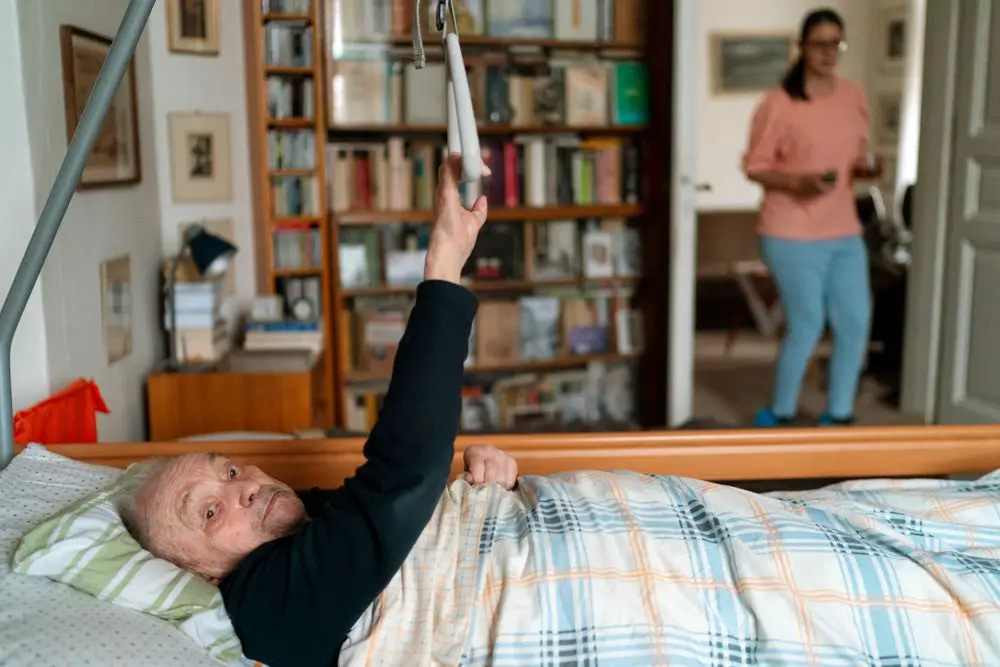
He had supposedly been at death’s door. For twelve days the doctors had spoken to me in the careful, softened voices they reserve for families they expect to be planning a funeral soon. But the moment the hospital’s automatic doors slid shut behind us and the winter air hit his face, something changed in him. His eyes, which had looked so filmed and distant in that narrow white bed, sharpened into the gaze I remembered from my childhood, the one that used to make grown men in expensive suits sit up straighter around a conference table.
I helped him settle into the passenger seat of my car, tucking the blanket over his knees the way I had every day for nearly two weeks. At eighty-two, Arthur Vale still owned Vale Industrial outright, along with three apartment buildings and enough scattered property to keep my family talking about him the way other people talk about a winning lottery ticket they are waiting to cash. He was not, to them, a man. He was an amount, and the only real question in their minds was when that amount would finally come due.
Not one of them had visited during those twelve days. I want that on the record, plainly, before any of the rest of it. Not one. I slept beside him every single night in a vinyl recliner that left a permanent ache in my lower back, waking every time a monitor changed its tone, holding his hand through the worst of the nights when his breathing frightened even the nurses. My father called exactly once during that stretch, and it was not to ask whether his own father was frightened or in pain. It was to demand the access code to Grandpa’s safe-deposit box, and when I told him I didn’t have it, he hung up on me without saying goodbye. My brother Mason sent an arrangement of flowers so expensive it embarrassed the nurses, then forgot to sign the card, then spent the rest of that same afternoon calling Grandpa’s secretary to request a copy of the current shareholder agreement. And my mother, all the while, posted bright, filtered photographs of a beach vacation, cocktails and sunsets and her own smiling face, on the very days the cardiologist was pulling me into hallways to warn me that Grandpa’s heart might simply stop.
They thought I was the harmless one. The quiet, divorced granddaughter with no ambition, the one who had wasted her education and her prospects, the one who was only useful for sitting at bedsides because she had nothing better to do. That was the version of me they had agreed upon years ago, and it had never once occurred to them to update it.
They had forgotten I was a forensic accountant.
Once we reached his house and I had him settled into the worn leather chair by the fireplace that had been his favorite for as long as I could remember, he looked at me, then at the phone in my hand, and gave a small nod. We had discussed this in the hospital, in whispers, on the good nights. I dialed my father and switched on the speaker, and set the phone on the side table between us.
“Dad,” I said, and I let my voice break and tremble, let it climb into the register of a woman who has been crying. “Grandpa died last night.”
There was a silence on the line. And then my father exhaled, and it was not the exhale of grief. It was the long, loosening breath of a man setting down something heavy he had been waiting a long time to put down.
“So the old man finally died,” he said.
My stomach tightened, even though I had told myself, over and over in the days leading up to this, to expect nothing better. Somewhere behind him, muffled but unmistakable, I heard my mother’s voice. Ask about the will, she said. Ask him about the will.
Before my father could answer her, the phone changed hands, and my brother’s voice came through, oily with satisfaction. “He left everything to me,” Mason said. “The company, the houses, all of it. You get nothing, Claire. You wasted years playing nurse because you thought he’d reward you for it. That was always your problem. You confused being useful with being important.”
And my mother laughed. I heard her laugh, clear and bright, the same laugh from the beach photographs. “You were always too sentimental,” she said. “That’s exactly why you’ll never amount to anything.”
Beside me, Grandpa raised one finger, slow and unsteady, and I lifted the phone and brought it close to his mouth.
“Excellent,” he said, and his voice was no longer the thin, wavering thing they believed they were mourning. It came out clear and level and terrible. “Now I know exactly whose names to erase from my will. And whose secrets to expose.”
The line went completely, perfectly silent.
Then my father exploded. “What the hell is this?” Mason stammered something, a strangled “Grandpa?” that cracked in the middle of the word. And in the background, I heard something made of glass fall and shatter near my mother.
Grandpa looked at me and said, simply, “End the call.” I did. Within seconds the phone began to vibrate its way across the side table. Dad. Mom. Mason. Dad again. Mom again. He watched it buzz and dance across the wood without the slightest change in his expression, and he did not answer a single one.
“You were right,” he said softly, when the phone finally went still. “I kept hoping you were wrong. Right up until just now, I kept hoping.”
I opened my laptop.
For six months I had been quietly examining Vale Industrial’s financial records, ever since Grandpa, still sharp then, had mentioned to me over dinner that certain vendor payments had begun to bother him without his being able to say quite why. It had begun as a favor, a daughter’s daughter humoring an old man’s worry. It had not stayed that way for long. My family believed I was his quiet, divorced granddaughter, the one without a career worth mentioning. They had genuinely forgotten what I did for a living, or perhaps they had never really registered it, because a forensic accountant did not fit the story they preferred to tell about me. And so they had no idea that I had already followed more than two million dollars as it wound its way through a series of shell companies, and that nearly every thread I pulled led back, eventually, to my father and my brother.
By noon the next day, my parents’ black SUV came speeding up Grandpa’s long gravel driveway. Mason arrived close behind them in his sports car, braking hard enough to spray gravel across the flower beds, as though the property were already his to abuse. My father walked in without knocking, the way he always had.
“This joke ends now,” he announced to the room.
Grandpa sat by the fireplace beneath a gray blanket, and to anyone who did not know him he looked frail, diminished, an old man near the end. I knew better. My mother rushed toward him first, arranging her face into a theatrical grief that had arrived far too late to be believed. “Arthur, we were devastated,” she said. “Claire manipulated all of us. She’s not well, she’s never been well since the divorce.”
Grandpa raised one hand and stopped her. “You laughed,” he said.
“I was in shock, Arthur. People say strange things when they’re in shock.”
“Mason told your husband I had left him everything.”
Mason shoved his hands into his pockets. “You told Dad I’d eventually run the company.”
“I said you might one day earn a position,” Grandpa replied, and there was no heat in it at all, which somehow made it worse. “Instead, you stole one.”
For less than a second, something flickered across my brother’s face, a crack in the confident mask. I saw it. So did Grandpa, and I watched him note it and file it away with the calm of a man who had spent sixty years reading the faces of people trying to lie to him.
My father turned on me. “What have you been telling him?”
“Very little,” I said. “The bank records speak clearly enough on their own.”
The room went still. My mother recovered first, as she always did. “Records can be misunderstood,” she said. “You of all people should know how easily numbers can be twisted.”
“Not these,” I said, and I turned my laptop around to face them.
On the screen was a financial diagram, clean and merciless, connecting Vale Industrial to three false vendors. Northcrest Logistics. Blue Harbor Consulting. M&R Procurement. Mason’s initials appeared on one of the accounts. My father’s home address was attached to another. And on the third, in ink I recognized instantly, was my mother’s signature.
My father’s voice dropped low, the register he used when he wanted to sound reasonable and dangerous at once. “You went through private company files.”
“I was authorized by the chairman,” I said, and Grandpa lifted a signed engagement letter from the arm of his chair and held it up without a word.
Mason laughed, too loud and too fast. “Even if money moved around, it was legitimate consulting work. Vendors get paid. That’s how business functions, Claire, not that you’d know.”
“Then you won’t mind explaining,” I said, “why Northcrest billed the company for steel deliveries on three separate dates when the warehouse was closed and empty.”
His smile disappeared entirely.
I clicked to the next file. Photographs filled the screen. Empty loading bays on the days steel had supposedly arrived. Fabricated invoices laid beside genuine ones so the differences in formatting stood out. The same purchase orders submitted two and three times over. And the wire transfers, following the money out of the company and into an offshore account like water running downhill. I did not linger on the drama of it. What I made sure they saw, what mattered more to me than any of their excuses, was the human ledger underneath the financial one. Every stolen dollar had a shadow. Delayed wages for the men on the floor. Repairs to aging equipment that kept getting postponed. A lapse in the insurance coverage for people who had trusted the Vale name with their livelihoods because my grandfather had spent a lifetime earning that trust. That was the part that mattered. That was the part they had never once thought about.
My mother stepped back from the table as if the laptop had grown warm. My father pointed a finger at me. “You think a spreadsheet makes you powerful?”
“No,” I said. “Evidence does.”
The doorbell rang.
Grandpa’s attorney, Miriam Cole, came in with two people behind her, an independent auditor and a retired federal investigator who now worked in corporate compliance. My father’s anger curdled into something closer to fear the moment he understood who they were. Miriam set a sealed folder on the table between all of us. “Arthur has executed a new will,” she said, “a new trust, and an emergency shareholder resolution.” Mason reached for the folder, and the investigator simply stepped between him and the table. “Touch it,” he said, without raising his voice at all, “and today gets a great deal worse for you.”
Grandpa’s voice, when it came, stayed quiet. “Daniel,” he said to my father, “you are removed as chief executive, effective immediately. Mason, you are terminated. Elaine, your access to every family trust account is frozen pending review.” My mother stared at him, openmouthed. “You can’t do this to your own family,” she said. And Grandpa’s eyes, which had been so gentle with me for twelve nights in that hospital, went hard as flint. “You stopped being family,” he said, “the moment you treated my illness like the opening bell at an auction.”
My father leaned over the old man’s chair, close and looming. “You need me. The board will never accept Claire. They don’t know her. They won’t follow a woman who’s been out of the game babysitting you.” Grandpa turned, slowly, and looked at me, and that was the moment I gave them the one piece of the board they had never thought to check. “I don’t need the board to accept me,” I said. “They elected me interim chief financial officer this morning.” Mason went pale. The board had already read my report in full. The vote had been unanimous.
The final confrontation came three days later, in the glass-walled boardroom at the top of Vale Industrial. My parents arrived with an attorney. Mason walked in still wearing the confidence of a man who believed, deep down, that enough money could rewrite any inconvenient fact. Grandpa came in beside me, leaning on a cane but upright, and everyone in the room stood as he entered. Everyone except my father.
“This is a family matter,” their lawyer announced, before anyone had even sat down.
Miriam set a small recorder on the table. “No,” she said. “It is a criminal matter with a family attached to it.” And she pressed play. So the old man finally died. He left everything to me. You get nothing. And then my mother’s laughter, filling that quiet, expensive room, bouncing off the glass. Mason stared down at the polished surface of the table as if he might be able to sink through it. Grandpa’s face showed nothing at all.
The auditor presented the findings plainly. Over the course of four years, my father and my brother had diverted just over two point four million dollars through false invoices, inflated contracts, and unauthorized bonuses paid to themselves. My mother had helped conceal the transfers by signing trust paperwork and by feeding misleading explanations to the outside accountants whenever they came too close. My father struck the table with his fist hard enough to rattle the water glasses. “I built this company!”
Grandpa’s cane came down against the floor, one sharp crack. “You inherited a title,” he said. “I built it.”
My father stood. “You would destroy your own son over money?”
“No,” Grandpa said. “You destroyed yourself over money. I am only the one who stopped pretending not to notice.”
I placed three documents on the table in front of my father, one after another. The first was a civil complaint seeking full repayment and the seizure of every asset purchased with stolen funds. The second was the board resolution formally removing him. The third was a referral package, and I told him, because I wanted him to hear it from me, that it had already been delivered to both state and federal investigators.
Mason lurched to his feet. “You reported us? Your own family?”
“I documented you,” I said. “Your actions reported themselves. I just wrote them down.”
My mother began to cry then, and for the first time in the whole ordeal I believed the tears were real, though they had nothing to do with remorse. She reached her hand toward Grandpa. “Arthur, please. Think about what this will do to us. Think about the family name.” He looked at her outstretched hand until, slowly, she drew it back. “I did think about it,” he said. “I thought about it a great deal. I thought about it while Claire was feeding me by hand and changing my dressings and sleeping folded up in a chair that was too small for her, and every one of you was calculating how quickly I might die and what you’d each be owed when I did.”
Two investigators came into the room. Their attorney closed his eyes. Mason turned toward the door and found security already standing in front of it.
The consequences came quickly and precisely, the way things do when the paperwork has been prepared with care. My father and my brother were charged with conspiracy, fraud, embezzlement, and tax violations. Both took plea agreements once the offshore records surfaced and made any defense impossible. My father received six years. Mason received four. Their cars and vacation homes and investment accounts were seized toward restitution, handed back, dollar by dollar, to the company and the people they had stolen from. My mother avoided prison by cooperating fully with the investigators, but she lost her access to every family trust, and within the year she was living in a rented apartment across town. Once the charges became public, the country club friends she had cultivated for thirty years stopped returning her calls, all at once, the way such friends always do.
Grandpa transferred controlling ownership of Vale Industrial into a trust held by its employees, the men and women on the floor whose wages had been quietly bled to pay for my brother’s sports car, and he appointed me permanent chief financial officer. His revised will established scholarships in two categories that mattered to him, one for family caregivers and one for victims of elder financial exploitation, because he understood now, in a way he had not before, how the two so often lived in the same house. He left me his home. Not because I asked for it, and I want that understood too. Because, as he wrote in his own careful hand, I had protected the person who lived inside it when no one else would.
Two years later, Grandpa sat in the front row while I cut the ribbon on the Arthur Vale Care Foundation. Afterward, when the crowd had thinned, the two of us stood together beneath the old oak tree that had shaded the front of his house since long before I was born.
“Do you regret it?” I asked him. “Testing them, I mean.”
He was quiet for a moment, looking up into the branches. “I regret that we had to,” he said finally. “I would have given anything for the test to come out differently. But I’m grateful, every single day, that you answered the phone.”
My own phone buzzed against my hip just then, another collect call from a correctional facility, my father’s number, the one I had long since stopped picking up. I silenced it without looking, and I slipped my arm through Grandpa’s, and the two of us turned and walked slowly back toward the house together, in no particular hurry, with all the time in the world.