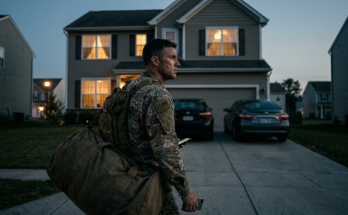
The photograph showed me in profile beside our SUV.
One hand rested beneath my stomach. The other lifted a small rolling suitcase into the back.
There was nothing dramatic about the image.
No secret departure.
No fleeing family.
Just a pregnant woman putting a hospital bag into her car.
Yet Lorraine’s attorney had received it with a caption describing “preparations to leave the jurisdiction.”
I studied the angle.
The photograph had been taken from the same side of the street where Lorraine’s SUV had sat the night she arrived with the contractor.
Mark enlarged the image.
“You can see our mailbox.”
“Yes.”
“And this tree.”
He pointed.
“That means whoever took it was near the Petersons’ driveway.”
The Petersons lived two houses down.
Mrs. Peterson had a doorbell camera.
We called.
Twenty minutes later she sent us footage.
At 8:06 that morning, a gray sedan stopped across the street.
A man stepped out.
He wore a baseball cap and carried a camera with a long lens.
He stood near the sidewalk for almost seven minutes.
Then he photographed me loading the suitcase.
He photographed Mark leaving for coffee.
He photographed Amber arriving with Zoe.
At 8:14, he returned to the sedan.
Mrs. Peterson’s camera captured part of the license plate.
Ray ran it through appropriate channels.
The vehicle belonged to a private-investigation company.
Mark stared at him.
“She hired an investigator?”
“Looks that way.”
I felt strangely calm.
The mystery had become too organized to frighten me in the same way.
Every new discovery showed planning.
But planning left records.
Invoices.
Names.
Vehicles.
Dates.
People who could be questioned.
Lorraine had spent years operating inside family spaces where everything depended on memory and emotion.
Now she had moved into systems that documented her.
That was proving to be her weakness.
Evelyn obtained the petition that afternoon.
Lorraine claimed I had exhibited “escalating behavioral instability,” had “threatened to remove both children from the support network,” and had “refused reasonable family assistance.”
She also claimed Mark privately supported intervention but was “subject to coercive control.”
Mark read that sentence three times.
“She’s saying Jennifer controls me?”
“Yes.”
“She controls me.”
Evelyn looked at him.
“Then prove your own choices.”
The hearing was scheduled for the next morning.
Temporary.
Preliminary.
Not a final custody proceeding.
Evelyn warned us not to treat it as a trial.
“The judge wants to know whether an immediate emergency exists.”
“There doesn’t,” I said.
“Then we show that.”
“What about the protective order?”
“We show that too.”
The courthouse smelled of old paper and floor polish.
I had never felt more visibly pregnant.
Every person who looked at my stomach seemed connected to the dispute even when I knew they were not.
Mark sat beside me.
Across the aisle, Lorraine wore a navy dress and pearl earrings.
She did not look at us.
Patricia Lang sat beside her.
She was perhaps sixty, with silver hair cut sharply at the jaw and the expression of someone who disliked surprises.
I wondered how many Lorraine had given her.
Judge Miriam Ellis entered at nine fourteen.
The room rose.
The hearing began.
Patricia spoke first.
She described Lorraine as a concerned grandmother who believed a child and unborn baby faced “potential instability” due to my deteriorating emotional state.
Potential.
A useful word when facts were scarce.
She referenced family observations.
She referenced Mark’s recordings.
She referenced the hospital bag.
Then she said, “Mrs. Hale has reason to believe Mrs. Carter may leave the state before delivery.”
Judge Ellis looked toward me.
“What reason?”
Patricia handed over the photograph.
The judge examined it.
“This shows a suitcase.”
“Yes, Your Honor.”
“People use suitcases.”
Patricia’s expression tightened slightly.
“This was consistent with statements Mrs. Hale reports hearing.”
“What statements?”
“That Mrs. Carter said no one would know when or where the baby was born.”
My pulse quickened.
I had said something similar.
To Amber.
Three days earlier.
After discovering Lorraine had contacted my clinic, I said I wished no one knew where I was giving birth.
It had been frustration.
Not a plan.
“How did Mrs. Hale hear that?” the judge asked.
Patricia looked at Lorraine.
Lorraine whispered something.
Then Patricia said, “Through a family member.”
Amber sat behind us.
I felt her stiffen.
Evelyn rose.
“Your Honor, may I clarify? Ms. Hale is currently subject to a protective order prohibiting indirect contact. We would like the identity of the alleged family source.”
Judge Ellis nodded.
Patricia consulted Lorraine again.
Then she looked annoyed.
“The source was Mrs. Hale’s daughter, Amber Hale.”
Amber made a sound behind me.
“No.”
The judge looked up.
Evelyn said, “Amber Hale is present.”
Patricia turned.
For the first time, uncertainty crossed her face.
Judge Ellis asked Amber to come forward.
She was sworn in.
“Did you tell your mother Jennifer intended to leave the state before delivery?”
“No.”
“Did Jennifer tell you she planned to do that?”
“No.”
“Did Jennifer say she wished people did not know where she was delivering?”
Amber looked toward me.
“Yes.”
Lorraine’s face changed.
Amber continued.
“She said it after learning Mom had been calling her clinic. She meant she wanted privacy. She never said she was leaving.”
Judge Ellis looked at Patricia.
The first crack had opened.
Evelyn widened it.
She introduced the clinic incident report.
Denise’s written statement described Lorraine striking Zoe.
She introduced photographs of the mark.
She introduced hospital records showing repeated attempts to obtain delivery information.
Then the audio.
Lorraine’s own voice filled the courtroom.
“Yes, this is Susan Carter.”
Patricia turned toward her client.
The reaction was small.
But unmistakable.
She had not heard the recording before.
Lorraine whispered urgently.
Patricia raised one hand without looking at her.
The audio continued.
“He can’t speak freely right now.”
Mark’s jaw tightened.
When it ended, Judge Ellis leaned back.
“Mrs. Hale, were you identifying yourself as Susan Carter?”
Patricia stood.
“I would advise my client not to answer until I understand the circumstances.”
The judge nodded.
“That is her right.”
Evelyn then introduced Mark’s text rejecting Lorraine’s suggestion that she take the baby.
Mom, to be absolutely clear, I am not asking you to take our baby.
The judge read it.
Then looked at Lorraine’s petition, which claimed the opposite.
Patricia requested a short recess.
It was granted.
The moment we entered the hallway, Patricia led Lorraine into a conference room.
We could hear nothing through the closed door.
But twelve minutes later, Patricia emerged alone.
She approached Evelyn.
“My client did not provide me the hospital recording.”
Evelyn nodded.
“I assumed that.”
“She represented that Mark Carter had requested contingency planning.”
“He explicitly rejected it.”
“I see that.”
Patricia looked genuinely angry.
Not at us.
At Lorraine.
Then she said, “She also represented that the clinic incident involved Jennifer becoming aggressive toward the child.”
Evelyn handed her Denise’s statement.
Patricia read it.
Her lips pressed into a thin line.
“I need five minutes.”
When the hearing resumed, Patricia announced that she was withdrawing the request for immediate intervention pending verification of information supplied by her client.
Lorraine’s head snapped toward her.
“You cannot do that.”
The courtroom went silent.
Patricia whispered something.
Lorraine ignored her.
“I hired you.”
Judge Ellis looked over her glasses.
“Mrs. Hale.”
“She is abandoning this because they intimidated her.”
“Mrs. Hale, your attorney is permitted to make legal decisions concerning filings.”
“They are lying.”
Judge Ellis’s expression remained neutral.
“That may be addressed through evidence.”
“I have evidence.”
Lorraine opened her handbag.
Patricia tried to stop her.
Too late.
Lorraine pulled out a stack of papers.
“These are Jennifer’s medical records.”
Every person at our table went still.
I stared at the pages.
My name.
My date of birth.
Dr. Patel’s clinic.
Laboratory results.
Not appointment reminders.
Actual medical records.
My stomach dropped.
Judge Ellis saw my reaction.
“Counsel?”
Evelyn stood.
“My client did not provide those to Mrs. Hale.”
Patricia turned toward Lorraine.
“Where did you get them?”
Lorraine held the papers against her chest.
“I was given them.”
“By whom?”
“That doesn’t matter.”
The judge’s voice hardened.
“It may matter considerably.”
Lorraine looked around the courtroom and seemed to realize the papers she believed would prove my instability had created a different problem.
“How did you obtain them?” Judge Ellis asked.
Lorraine’s face reddened.
“I had access.”
“To what?”
No answer.
Patricia closed her eyes.
Evelyn requested that the documents be preserved and that the court note our objection to any unauthorized medical disclosure.
Judge Ellis agreed.
Then she denied Lorraine’s emergency request.
Not postponed.
Denied.
She also ordered that no petition concerning custody or guardianship be filed on the basis of the same allegations without disclosure of the contradictory evidence presented that day.
Lorraine stared straight ahead.
The hearing was over.
But the medical records changed everything.
Outside the courthouse, Ray met us near the steps.
Evelyn had called him during the recess.
He took a copy of the first page and asked me whether I recognized the format.
“Yes.”
It was from Dr. Patel’s electronic system.
“These aren’t screenshots from my patient portal.”
“How do you know?”
“The layout.”
Dr. Patel confirmed it within an hour.
The records had been printed from an internal clinic account.
Not mine.
Not Lorraine’s.
An employee account.
I felt sick.
Someone inside the clinic had given her my medical information.
The practice launched an internal investigation.
By evening they had narrowed the access log.
My chart had been opened repeatedly by someone who had no clinical reason to view it.
A scheduling coordinator.
Her name was Melissa Dane.
I did not recognize it.
Mark did.
His face changed when Dr. Patel said the name.
I turned toward him.
“You know her?”
He stared at the floor.
“Sort of.”
“How?”
“She used to be friends with Mom.”
My skin went cold.
“How close?”
“They worked together years ago.”
“Where?”
“At St. Agnes.”
Lorraine had been a hospital billing supervisor before she retired.
I had forgotten.
Mark had not.
“Did your mother know Melissa worked at Dr. Patel’s clinic?”
“I don’t know.”
Amber did.
When we called her, she answered immediately.
“Yes.”
One word.
Enough.
“How?”
“Mom mentioned Melissa got a new job there last year.”
No one spoke.
Amber continued.
“I didn’t think anything of it.”
Neither had anyone else.
That was Lorraine’s advantage.
She built serious things from ordinary relationships nobody questioned.
Dr. Patel called again shortly before ten.
Melissa Dane had been suspended pending investigation.
The access logs went back four months.
My records had been opened eleven times.
Some days corresponded exactly with entries in Lorraine’s blue folder.
The day I received nausea medication.
The day I complained of poor sleep.
The day a nurse documented that I was tearful because of back pain.
Normal pregnancy notes.
Converted into a private dossier.
Then Dr. Patel said, “Jennifer, there’s one access that concerns me more than the others.”
“What?”
“Melissa opened your emergency contact information.”
My stomach tightened.
“When?”
“Two days before Lorraine rented the house near the hospital.”
Mark swore softly.
Dr. Patel continued.
“She also opened your insurance information and scanned identification documents.”
“Why?”
“We’re still determining that.”
The answer arrived from Ray fifteen minutes later.
Melissa had been interviewed.
She admitted printing records for Lorraine.
She claimed Lorraine told her I had authorized it.
Nobody believed that explanation would survive long.
Then Melissa revealed something else.
Lorraine had asked for copies of my driver’s license and insurance card.
“Did she get them?” I asked.
Ray was silent.
“Ray?”
“Yes.”
I gripped the phone.
“What would she need my identification for?”
“I don’t want to speculate.”
But someone else did not need to speculate.
Evelyn.
When I told her, she became very still.
“Jennifer, check your credit.”
I did.
At first nothing looked unusual.
Then I opened the inquiries section.
A credit check had been performed six weeks earlier.
The applicant name was mine.
The address was not.
It was the rental house near the hospital.
The creditor was a private home-care agency.
Mark leaned over my shoulder.
“What the hell?”
I called.
The agency confirmed that “Jennifer Carter” had submitted a preliminary application for post-hospital psychiatric home supervision.
The application was incomplete.
But it included my date of birth.
Insurance.
Driver’s license.
And an emergency contact.
Lorraine Hale.
The agency representative emailed me the intake form.
I opened it.
Under reason for anticipated care, someone had typed:
High risk for postpartum psychiatric decompensation with potential danger to newborn.
At the bottom was a digital signature.
My name.
Jennifer Carter.
Forged.
Click here to continue reading: PART 11: The Forged Care Application Turned Lorraine’s Scheme Into Fraud, and Melissa Finally Explained What She Had Been Promised in Return
My Mother-in-Law Slapped My Daughter and Planned to Take My Baby—But She Didn’t Know the House Was Mine
Part 10 of 15