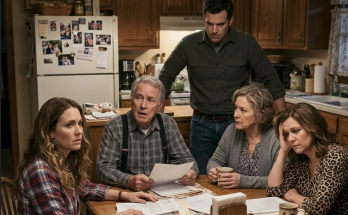
By spring, the first thing people noticed when they entered our kitchen was nothing.
That was exactly how I wanted it.
There were no dramatic renovations. No expensive stone Lorraine had chosen without asking. No designer fixtures. The cabinets were painted a warm white because Mark and I liked it, and one door beneath the sink still closed slightly crooked because neither of us had bothered fixing the hinge.
The house looked lived in.
Not curated.
Not controlled.
Ours.
The legal disputes ended gradually rather than all at once. The fraudulent medical power of attorney remained permanently invalid. The home-care application became part of the investigators’ file. The clinic documented Melissa’s unauthorized access and notified the appropriate authorities. Cheryl admitted she had notarized my absent signature in violation of her duties.
Lorraine’s lawyers stopped filing anything related to guardianship.
There was nothing left to support it.
My actual medical record showed a normal pregnancy followed by a normal postpartum recovery.
Dr. Cole had never evaluated me.
Dr. Patel documented no psychiatric incapacity.
Mark had repeatedly rejected Lorraine’s supposed contingency plan in writing.
The hospital had Lorraine’s impersonation call.
Kelsey had her instructions.
Denise had witnessed the slap.
The story Lorraine tried to build had eventually collapsed beneath the weight of its own contradictions.
The house issue took several months to clean completely.
Each filing had to be addressed.
Each unauthorized claim had to be challenged.
The contractor confirmed Lorraine had presented herself as having authority she did not possess.
Daniel Mercer supplied the documents showing what Mark had actually signed and what those papers did not permit.
The trust records established ownership.
Nothing transferred the home to Lorraine.
Nothing entitled her to live there.
Nothing gave her the right to decide who should occupy it after I delivered.
The threat that once terrified me—by Friday, the house won’t be yours—became something almost pathetic in retrospect.
She had mistaken paperwork for power.
More accurately, she had mistaken Mark’s habit of yielding to her for authority over everyone else.
Those were not the same thing.
Mark changed slowly.
I distrusted fast transformations by then.
He did not become a different husband because of one speech in a parking lot or one blocked phone number.
Trust returned in ordinary decisions.
He read documents before signing them.
He asked before making family commitments.
He stopped volunteering explanations for my choices to relatives.
When someone said, “Your mom always meant well,” he no longer answered automatically.
Sometimes he said, “Intent isn’t the only thing that matters.”
Sometimes he changed the subject.
Sometimes he said nothing.
Silence, when chosen instead of forced, could be a boundary too.
We started marriage counseling.
Not because Lorraine had ordered it.
Not because someone thought I was unstable.
Because Mark and I had thirteen years of habits to untangle.
There were sessions when I was angry enough to leave with a headache.
There were sessions when Mark admitted things I wished he had understood earlier.
There were also sessions when I admitted that once the crisis ended, part of me kept waiting for him to betray a boundary again.
He did not tell me to get over it.
He said, “That makes sense.”
Then he kept showing me something different.
Amber remained in our lives.
Marriage suited her.
So did distance from Lorraine.
She called less often with apologies and more often with ordinary things: recipes, complaints about her husband leaving socks beside the bed, photographs of a ridiculous lamp she wanted me to help her choose.
Normality returned in pieces.
I had not realized how precious boring conversation could be.
Zoe needed more time.
For weeks she asked whether Grandma knew where we were going whenever we left the house.
At bedtime she sometimes wanted the hallway light left on.
We never forced her to discuss Lorraine.
A child therapist helped us answer questions simply.
Grandma made unsafe choices.
Grandma is not allowed to come here.
Adults are making sure you are safe.
None of it was Zoe’s responsibility.
That last part mattered most.
Gradually she stopped asking whether Lorraine was outside.
She remembered being four the way children remember storms—certain images sharp, the timeline blurred.
The fish tank.
The cold pack.
A blue dress at Amber’s wedding.
She remembered that someone hit her.
She remembered that afterward, Mommy said no.
I could live with that memory.
I would rather have prevented it.
But if she had to carry anything from that day, I wanted it to be the part where the adults finally protected her.
Lillian grew quickly.
By three months she had perfected a disapproving stare that made Mark laugh every time he saw it.
By four months she slept just long enough at night to trick us into thinking the difficult part was over.
By five months she discovered Zoe’s hair.
Zoe considered this a personal betrayal.
Their relationship settled into the strange intensity of sisters who adored each other while constantly competing for the same blanket.
Sometimes I watched them and thought about the rental house.
The prepared nursery.
The packed suitcase.
The car seat in Lorraine’s vehicle.
A different future had been arranged for them by someone who believed preparation created entitlement.
It had not.
Love did not mean deciding where another person belonged.
Protection did not mean removing choice.
Family did not mean ownership.
Lorraine sent two more letters that year.
Both went through Evelyn.
Neither contained a direct apology to Zoe.
In one, Lorraine wrote that she hoped “time would allow everyone to recognize mistakes on all sides.”
I recognized the sentence for what it was.
An invitation to dilute responsibility until nobody could identify what happened.
We declined.
The second letter was shorter.
She said she missed Mark.
He read that one.
His face changed.
There was grief in it.
I did not resent him for grieving.
Lorraine was still his mother.
She had raised him after his father left.
She had attended school plays.
She had cared for him when he was sick.
She had also manipulated him, deceived him and used his loyalty to threaten his wife and children.
Human beings did not become simple because boundaries became necessary.
“Do you want to answer?” I asked.
He thought for a long time.
“Not yet.”
I nodded.
Months earlier I might have needed a stronger answer.
By then, I trusted the difference between compassion and surrender.
He never answered that letter.
The protective order remained.
Sunday dinners changed completely.
Sometimes Amber and her husband came.
Sometimes Ray stopped by with his family.
Sometimes we ordered pizza and ate from paper plates because neither of us wanted to cook.
And sometimes nobody came.
Those were my favorite Sundays.
One evening Zoe tipped an entire glass of apple juice across the table.
The liquid ran under Mark’s plate, across a folded napkin and onto the floor.
She froze.
For one instant her face wore the expression I remembered from the clinic waiting room.
Waiting for anger.
Waiting for punishment.
Waiting for someone larger to decide the mistake meant something about who she was.
Mark looked at the mess.
Then at Zoe.
“Well,” he said, “the floor was thirsty.”
She stared at him.
Then laughed.
I laughed too.
We cleaned it together.
No lecture.
No humiliation.
No discussion about discipline.
Just a towel.
A sticky table.
A four-year-old who had spilled juice.
That ordinary moment felt like victory.
The ultrasound photograph stayed in Lillian’s room.
Eventually I replaced the frame with a small wooden one that matched the bookshelf.
I never erased Lorraine’s handwriting from the back.
Baby Rose, coming home to Grandma.
Those words were part of what happened.
Erasing them would not change that.
But they no longer controlled what the photograph meant.
On the front was my daughter before any of us had seen her face.
That belonged to me.
To Mark.
Someday, if Lillian ever wanted it, to her.
Nobody else got to write the ending.
One afternoon Zoe found me dusting the shelf.
She pointed at the picture.
“Was that Lillian when she was in your tummy?”
“Yes.”
“She looks like a bean.”
“She was a very expensive bean.”
Zoe laughed.
Then she grew serious.
“Was Grandma going to call her Rose?”
I set the cloth down.
“Yes.”
“Why?”
“Because Grandma wanted that name.”
“But you didn’t.”
“No.”
Zoe considered the problem.
Then she shrugged with the brutal clarity of children.
“She wasn’t the mom.”
“No.”
“She didn’t get to pick.”
“Exactly.”
That was enough for her.
I wished adults learned that lesson as easily.
On Lillian’s first birthday, Amber brought a cake with too much frosting.
Zoe insisted on putting twelve candles on it because one looked “sad.”
Mark removed eleven before we set the cake near the baby.
Lillian crushed icing between both hands and smeared it across her cheeks.
Everyone laughed.
For one brief second, while I watched my daughters together, I remembered Lorraine’s carefully labeled nursery order.
Baby Rose.
Grandma’s house.
Her certainty had been extraordinary.
So was how wrong she had been.
The property was still mine.
Completely.
The locks were ours.
The codes were ours.
The visitor list was ours.
The decisions inside those walls belonged to the people living there.
That did not make us perfect.
Mark and I still argued.
Zoe still negotiated bedtime as if she had legal counsel.
Lillian still cried when anyone put her down during certain weeks.
Laundry accumulated.
Bills arrived.
Sometimes the kitchen remained messy until morning.
There was freedom in imperfection.
Lorraine’s system had depended on convincing us that any struggle proved we needed her control.
We finally understood that struggling and failing were not the same thing.
Families could be tired without being unsafe.
Parents could disagree without being incapable.
Mothers could cry without surrendering motherhood.
Children could misbehave without being struck.
And help was only help when the person receiving it was allowed to say no.
People occasionally asked whether I forgave Lorraine.
The question always seemed to assume forgiveness was a door.
Say the right word and someone deserved to walk through it again.
I stopped thinking that way.
I no longer woke angry at her.
I no longer rehearsed conversations in the shower.
I no longer checked the street every time a dark SUV passed.
Her name could be mentioned without my pulse changing.
Maybe some people would call that forgiveness.
Maybe not.
I did not need a label.
What I knew was simpler.
I could let go of carrying her every day without giving her access to my children.
Those were separate choices.
Mark eventually said something similar.
“Missing Mom doesn’t mean I have to hand her the key.”
We were sitting on the back steps while Zoe chased fireflies and Lillian sat between my knees trying to eat a leaf.
“No,” I said. “It doesn’t.”
He looked toward the house.
“I should’ve learned that years ago.”
“Probably.”
He laughed.
That was another change.
He no longer needed me to make his regret comfortable.
The last legal letter arrived almost fourteen months after the night Lorraine stood on my porch with a contractor.
Evelyn emailed first.
Everything related to the property had been resolved.
The unauthorized claims were gone.
No pending guardianship matter existed.
No medical authorization naming Lorraine remained valid.
The last pieces had finally been removed from every official system where she had tried to place herself.
I printed one page.
Not because I needed proof that the house belonged to me.
I already had that.
I printed it because I wanted to mark the ending.
Then I carried it upstairs and placed it in the same safe where my grandmother’s estate documents had been waiting the night Lorraine threatened to take everything.
My grandmother’s photograph was still beside the safe.
I touched the frame.
For years I had thought the greatest thing she left me was the money that bought the house.
It was not.
It was the insistence that some things should be made clear in writing.
Ownership.
Responsibility.
Choice.
That evening we ate dinner late.
Lillian threw peas.
Zoe complained that peas were already unpleasant before being thrown at her.
Mark attempted to enforce a no-projectile-food rule while laughing too hard to sound authoritative.
I watched them from across the table.
The house was quiet in the way homes become quiet when no one inside is afraid of the next knock.
Sunday dinner came and went without Lorraine.
No criticism.
No rearranged cupboards.
No reminders of what someone had sacrificed for us.
No one measuring my mood.
No one turning Mark’s complaints into evidence.
No one whispering plans to Zoe.
Just our family.
Imperfect.
Noisy.
Safe.
After dinner, I carried Lillian upstairs.
Zoe followed.
She stood beside the crib while I lowered her sister onto the mattress.
Lillian rolled onto her back and grabbed at the air.
Zoe leaned over the rail.
“She’s home,” she said.
The words stopped me.
She had said almost the same thing the first day we brought Lillian back from the hospital.
Back then there had still been fear underneath them.
Now there was none.
“Yes,” I said.
Zoe looked at me.
“Nobody can take her?”
I touched her shoulder.
“No one gets to decide she belongs somewhere else.”
Zoe nodded, satisfied.
Then she ran downstairs because Mark had promised popcorn.
I stayed beside the crib another minute.
Above it hung my grandmother’s photograph.
Beside it was the ultrasound image Lorraine had once tried to claim with a name and a destination.
Baby Rose.
Coming home to Grandma.
Lorraine had been wrong about the name.
Wrong about the house.
Wrong about Mark.
Wrong about me.
Most of all, she had been wrong about what made a family.
Control had never been protection.
Fear had never been respect.
And peace purchased by surrendering every boundary had never really been peace.
Lillian stirred.
I placed my hand lightly against her back.
From downstairs came Zoe’s laughter, then Mark telling her she had taken half the popcorn before the movie started.
I turned off the nursery lamp and left the door open a few inches.
Our house was not perfect.
Neither was our marriage.
Neither was the family we were still learning how to become.
But the choices inside it were ours.
The mistakes were ours.
The repair was ours.
The children were not possessions to be won.
They were people to be protected until they could make choices of their own.
I went downstairs.
Mark handed me a bowl of popcorn.
Zoe moved over to make space beside her.
On the baby monitor, Lillian slept peacefully in the room Lorraine once believed she could claim.
Outside, the porch was empty.
Inside, nobody was waiting for permission to breathe.
And for the first time in thirteen years, that was enough.
The End
Read more original stories on Feel Every Story.
My Mother-in-Law Slapped My Daughter and Planned to Take My Baby—But She Didn’t Know the House Was Mine
Part 15 of 15