PART 1 – The Look I Couldn’t Ignore
It started with what seemed like a completely normal problem.
My ten-year-old daughter, Sophie Carter, had been complaining about a toothache for nearly a week. Nothing alarming. Just one of those everyday parenting situations you schedule, handle, and forget about.
I booked an appointment with our family dentist and expected to be home before lunch.
Then my husband insisted on coming.
That should have been my first warning.
Michael never attended appointments.
Parent-teacher meetings.
School events.
Doctor visits.
There was always a reason he couldn’t make it.
Yet that morning, before I even asked, he grabbed his car keys.
“I’ll come with you,” he said.
At the time, I thought he was simply being supportive.
Now I know better.
The dental clinic sat inside a quiet medical plaza just outside town. The waiting room smelled of antiseptic and peppermint. Sophie sat beside me flipping through an old magazine while Michael paced back and forth near the reception desk.
Something about Sophie felt different.
She wasn’t acting like a child with a sore tooth.
She looked scared.
When the hygienist called her name, Sophie immediately stood up.
Before I could move, Michael was already following behind her.
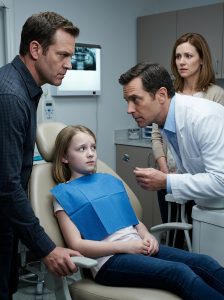
Inside the examination room, Dr. Nathan Bennett greeted us with a warm smile.
“Well, Sophie, let’s figure out what’s causing all this trouble.”
She climbed into the chair and pointed toward the left side of her mouth.
Then she looked at Michael.
Just for a second.
Most people would have missed it.
I didn’t.
And neither did the dentist.
It wasn’t the look of a child seeking reassurance.
It was the look of someone checking whether it was safe to speak.
Dr. Bennett’s expression remained professional, but something changed behind his eyes.
Something alert.
Something concerned.
As he continued examining her teeth, Michael remained unusually close to the chair.
Watching every movement.
Listening to every word.
Studying every reaction.
I tried to lighten the mood.
“You know, she’s not having surgery,” I joked.
Michael forced a laugh.
“I just want to make sure she’s okay.”
The answer sounded practiced.
Like he’d rehearsed it.
Several minutes later, Dr. Bennett paused while examining one of Sophie’s back teeth.
“There seems to be some unusual sensitivity here,” he said.
Then he stopped.
Long enough to make the room uncomfortable.
“I’d like to take some X-rays.”
The hygienist guided Sophie to another room.
For the first time, only the three adults remained behind.
The atmosphere shifted immediately.
“Is something wrong?” Michael asked.
Dr. Bennett slowly removed his gloves.
“That depends.”
Michael frowned.
“Depends on what?”
The dentist met his eyes directly.
“On how the injury occurred.”
A chill ran through me.
Michael laughed awkwardly.
“It’s a toothache, Doctor, not a criminal case.”
But Dr. Bennett didn’t smile.
“We’ll know more once we see the images.”
Moments later, Sophie returned.
She looked pale.
Nervous.
Almost as if she knew something none of us did.
And for the first time that day, I realized this appointment might have nothing to do with a toothache at all.
Something was very wrong.
And before we left that office, a secret message would change everything I thought I knew about my family.
PART 2 – The Note In My Pocket
Dr. Bennett clipped the X-rays onto the light screen.
For a moment, nobody spoke.
The black-and-white image glowed in the dim room, all roots and shadows and bone. I didn’t understand what I was looking at, but I understood the way the doctor’s jaw tightened.
Michael understood it too.
He stepped closer.
“What is it?” he asked.
Dr. Bennett didn’t answer him immediately. Instead, he looked at Sophie.
“Sophie,” he said gently, “did you fall recently?”
Her small hands gripped the arms of the chair.
Michael answered before she could.
“She’s clumsy,” he said. “Always has been. Kids fall.”
The doctor’s eyes flicked to him.
“I asked Sophie.”
The silence that followed was so sharp I could almost hear it cut through the room.
Sophie swallowed. Her lips trembled. “I… hit my face.”
“Where?”
“At home.”
Michael laughed again, but this time the sound came out thin and ugly.
“She bumped into the kitchen counter. I told her to slow down.”
I turned to him. “You never told me that.”
“It wasn’t a big deal,” he snapped.
Sophie flinched.
That single movement destroyed something inside me.
Not because it was dramatic. Not because she cried. She didn’t. She simply pulled her shoulders up, as if her body had learned long ago how to make itself smaller around him.
My daughter was afraid of my husband.
And somehow, until that room, I had not allowed myself to see it.
Dr. Bennett cleared his throat. “Mrs. Carter, I’d like to speak with you privately for a moment.”
Michael’s head turned slowly.
“No,” he said.
The word was quiet.
Too quiet.
The hygienist froze near the counter.
Dr. Bennett kept his voice calm. “It’s standard procedure when we see certain types of injury in a minor.”
“Certain types?” Michael repeated. “Are you accusing me of something?”
“No one has accused anyone.”
“Then say what you mean.”
“Michael,” I whispered, “please.”
He looked at me then, and for one terrifying second, I saw the man Sophie had been seeing when I wasn’t in the room.
Not the charming husband who brought flowers after arguments.
Not the man who cried when he promised he’d change.
Not the stepfather who smiled in Christmas photos with one hand resting possessively on Sophie’s shoulder.
I saw control.
Cold, practiced, patient control.
Dr. Bennett stepped slightly between Michael and the chair.
“We’re going to finish Sophie’s exam,” he said. “Then I’ll provide instructions.”
Michael smiled.
But it was not a smile.
“Of course.”
The rest of the appointment passed like a dream with broken edges.
Dr. Bennett spoke about inflammation and a cracked molar. He explained that Sophie would need treatment, possibly a temporary crown. His tone was steady. Professional. Almost too normal.
But his eyes kept moving.
To Sophie.
To Michael.
To the closed door.
To me.
At one point, while Michael bent to answer a phone call, Dr. Bennett leaned close to Sophie and asked her something too softly for me to hear. Sophie didn’t speak.
She only blinked.
Once.
Dr. Bennett’s face changed.
Just slightly.
But I saw it.
When the appointment ended, Michael stood before anyone else.
“We’ll schedule whatever she needs later,” he said. “Come on.”
Dr. Bennett handed me a folded treatment estimate. His fingers brushed mine.
Then, so quickly I almost missed it, his other hand slipped something into the pocket of my coat.
A small square of paper.
My breath caught.
He looked at me, and his expression was no longer professional.
It was urgent.
“Mrs. Carter,” he said, “please stop by the front desk before you leave. I need your signature on one form.”
Michael frowned. “She can sign next time.”
“It has to be today.”
The two men stared at each other.
Finally, Michael gave a short laugh. “Fine.”
At the reception counter, my hands were shaking so badly I could barely hold the pen. Michael stood close enough that his sleeve brushed mine. Sophie stood beside me, silent as stone.
The receptionist slid the form toward me.
I signed my name.
Then I felt the paper in my pocket like it was burning through fabric.
Outside, the parking lot shimmered under pale winter sunlight. Michael unlocked the car.
“Get in,” he said.
I reached for Sophie’s hand.
And for the first time in years, my daughter squeezed mine so hard it hurt.
That was when I knew.
Whatever was in my pocket, I had to read it before we went home.
“I forgot my phone in the bathroom,” I said.
Michael looked at me sharply.
“You had it in your hand.”
“No, I didn’t.”
His eyes narrowed.
For half a second, I thought he might grab me right there in the parking lot.
Then Sophie spoke.
“I have to pee.”
Her voice was tiny.
Michael stared at her.
Dr. Bennett had appeared by the glass clinic door, pretending to read something on a clipboard.
Michael saw him.
His expression smoothed.
“Fine,” he said. “Two minutes.”
Inside the restroom, I locked the door and pulled the note from my pocket.
It contained only seven words.
DO NOT GO HOME. POLICE ARE WAITING. TRUST SOPHIE.
My knees almost gave out.
Sophie stood by the sink, watching me with huge, wet eyes.
I whispered, “Baby… what happened?”
She didn’t answer at first.
Then she reached into the pocket of her pink jacket and pulled out something small wrapped in tissue.
A tooth.
Not the cracked tooth from the X-ray.
A different one.
A baby tooth, yellowed with age.
“I saved it,” she whispered. “Because he said if I told you, he would make sure nobody believed me.”
The room tilted.
“Who said that?”
Sophie’s mouth trembled.
“Michael.”
My blood turned cold.
She grabbed my sleeve. “Mommy, he didn’t just hurt me.”
I crouched in front of her. “What do you mean?”
Her face crumpled.
“He took pictures of papers in your office. The ones from Grandma’s lawyer. He said when I turn eleven, everything becomes mine, but if you’re gone, he can control it.”
I stopped breathing.
My mother had died eight months earlier and left Sophie a trust I barely understood. Michael had been strangely interested in the documents. Too interested.
But Sophie wasn’t finished.
“He said accidents happen to moms who ask questions.”
A sound came out of me, raw and broken.
Then someone knocked gently.
“Mrs. Carter?” Dr. Bennett’s voice came through the door. “It’s safe. Officers are in the building.”
I opened the door with Sophie behind me.
Two police officers stood in the hallway.
And through the clinic windows, I saw Michael in the parking lot, staring straight at us.
He knew.
For one suspended second, nobody moved.
Then Michael ran.
PART 3 – The Man Who Had Planned Everything
He didn’t run like an innocent man.
He ran like someone whose life had just cracked open.
Michael sprinted between parked cars, shoved past a nurse getting out of her sedan, and reached his black truck before the first officer made it through the clinic door.
“Stay here!” Dr. Bennett shouted.
But I couldn’t.
Not completely.
I moved to the window with Sophie clinging to my side.
Michael yanked the truck door open.
Then he stopped.
Because two patrol cars turned into the lot from opposite entrances, blocking him in.
His face changed.
I will never forget it.
The anger vanished first.
Then the arrogance.
Then the mask.
What remained was fear.
Real fear.
An officer raised his hand. “Michael Carter, step away from the vehicle.”
Michael looked toward the clinic window.
At me.
At Sophie.
His mouth moved.
I couldn’t hear the words, but I understood them.
You’ll regret this.
Sophie hid behind me.
That was the last time she ever hid from him.
The arrest should have felt like an ending.
It wasn’t.
It was the beginning of the truth.
At the police station, Sophie sat wrapped in a gray blanket while a detective named Laura Reeves spoke to her with a kindness that made me want to collapse. Dr. Bennett had followed every mandatory step. He had noticed bruising inside Sophie’s cheek, a fracture pattern inconsistent with a fall, and something else I still struggle to say without shaking.
Sophie had been leaving clues.
Tiny ones.
A tooth hidden in a jacket.
A flinch at the dentist’s question.
One blink when Dr. Bennett whispered, “Are you afraid to go home?”
One blink meant yes.
That was enough.
But the police had already been watching Michael.
That was the part I never saw coming.
Detective Reeves placed a folder on the table in front of me.
“Mrs. Carter,” she said carefully, “your husband has been under investigation for financial exploitation, identity fraud, and suspected involvement in two unsolved insurance-related deaths.”
My ears rang.
“Deaths?”
She opened the folder.
The first photograph was of a woman I had never met.
Young. Smiling. Blonde.
“This is Anna Whitcomb,” the detective said. “Michael’s first wife.”
I stared at the picture.
“First wife?”
“He told you he had never been married before?”
I nodded numbly.
Detective Reeves’s face tightened. “Anna died in a house fire nine years ago. Michael received a settlement.”
She turned another page.
A second woman.
Older. Elegant. Warm eyes.
“This is Patricia Lane. His former fiancée. She died after falling down a staircase four years ago. Her daughter had a trust fund.”
The room went silent.
My stomach twisted.
“Sophie,” I whispered.
Detective Reeves nodded. “We believe Michael married you because of your daughter’s inheritance.”
I covered my mouth.
Every memory rearranged itself.
Michael helping with my mother’s estate.
Michael encouraging me to increase my life insurance.
Michael insisting Sophie was “too sensitive.”
Michael telling me I was paranoid when I thought drawers had been moved in my office.
Michael volunteering to drive Sophie to school on mornings when she returned too quiet.
The monster had not appeared suddenly. He had been living in my house, wearing my husband’s face.
“Why didn’t you arrest him sooner?” I asked, my voice cracking.
“We didn’t have enough,” Detective Reeves said. “But your dentist called us after reviewing the X-ray. He also recognized Michael.”
I blinked. “Recognized him?”
She hesitated.
Then the door opened.
Dr. Bennett stepped inside.
He looked older than he had that morning.
Tired.
Haunted.
“I’m sorry,” he said.
I stood. “You knew him?”
Dr. Bennett looked at Sophie through the glass window of the interview room. She was drinking hot chocolate from a paper cup, her little hands wrapped around it for warmth.
“My sister was Anna Whitcomb,” he said.
The world stopped.
Michael’s first wife.
The woman in the photograph.
Dr. Bennett’s voice shook, but he kept going.
“I couldn’t prove what he did to her. Nobody believed me. He was charming. Calm. Devastated at the funeral.” His eyes filled with pain. “When I saw him walk into my clinic with your daughter, I thought I was looking at a ghost.”
I sat down hard.
“That’s why you watched him.”
“Yes,” he said. “But then I saw Sophie watching him too.”
Across the hall, Sophie looked up.
Her eyes met mine.
For years, I had thought protecting my daughter meant keeping peace.
Not upsetting Michael.
Not starting fights.
Not reading too much into things.
But peace built around fear is not peace.
It is a cage.
That night, police searched our house.
They found copies of my signature.
Insurance forms I had never signed.
A burner phone hidden behind a loose panel in the garage.
And in Michael’s locked desk, they found a printed schedule for the next morning.
My schedule.
Sophie’s school drop-off.
A note about the bridge on County Road 12.
The detective didn’t say what it meant.
She didn’t have to.
By midnight, Michael was in a holding cell, and Sophie was asleep in my arms on a narrow couch at the station. Her face looked younger in sleep. Softer. For the first time in months, she wasn’t grinding her teeth.
Dr. Bennett stopped by before leaving.
He placed a small plastic dental case in my hand.
Inside was Sophie’s baby tooth.
“She wanted you to keep it,” he said.
I looked down at that tiny tooth and began to cry.
Not because it was frightening.
Because it had saved us.
A child who believed no one would listen had still found a way to speak.
Weeks later, Michael’s entire life unraveled in court.
His real name was not Michael Carter.
It was Michael Voss.
He had changed it twice.
The evidence from our house reopened Anna Whitcomb’s case and Patricia Lane’s case. Other women came forward. Other children spoke. The man who had built his life on silence was finally buried beneath the voices he had tried to erase.
But the final shock came three months later.
A letter arrived from my mother’s attorney.
I had assumed Sophie’s inheritance was the reason Michael targeted us.
I was wrong.
The trust was real, but there was another document my mother had sealed before she died.
A handwritten statement.
In it, she wrote that she had distrusted Michael from the beginning. She had hired a private investigator after catching him photographing family documents at Thanksgiving. The investigator had discovered the name Anna Whitcomb, but before my mother could confront me, she became ill.
So she changed the trust.
Michael could never touch it.
Not through marriage.
Not through custody.
Not even through my death.
Then came the line that made me drop the letter.
If anything happens to Claire, full guardianship and control of Sophie’s trust shall transfer to Dr. Nathan Bennett.
My mother had found Anna’s brother.
She had known.
She had quietly built a lifeboat before the storm reached us.
That was the twist Michael never imagined.
He had walked into that dental clinic believing he was controlling the appointment.
Instead, he had walked Sophie straight to the one man my mother had chosen to protect her.
A year later, Sophie and I moved into a small yellow house near the lake. She started laughing again. Not all at once. Healing never happens like that. It came in pieces.
A joke at breakfast.
A song hummed in the shower.
A night without nightmares.
A visit to Dr. Bennett’s clinic where she sat in the chair, opened her mouth, and gave him a brave little thumbs-up.
After the appointment, he handed her a sticker.
She smiled and said, “I’m not scared anymore.”
Dr. Bennett looked at me.
Neither of us spoke.
Some truths are too heavy for words.
Outside, Sophie slipped her hand into mine.
“Mom,” she said, “did Grandma save us?”
I looked up at the bright sky.
Then at my daughter.
Then at the clinic door behind us, where the man who had lost his sister had helped me save mine.
“Yes,” I whispered. “Grandma saved us.”
Sophie thought about that.
Then she squeezed my hand.
“And my tooth helped.”
I laughed through tears.
“Yes, baby,” I said. “Your tooth helped too.”
And for the first time since that terrible morning, the world did not feel like something waiting to break.
It felt like something beginning again.
Because sometimes the smallest voice in the room is the one telling the truth.
And sometimes salvation arrives folded into a note, slipped quietly into a mother’s pocket, by someone brave enough to notice what everyone else ignored.
knew about my family.