PART 3
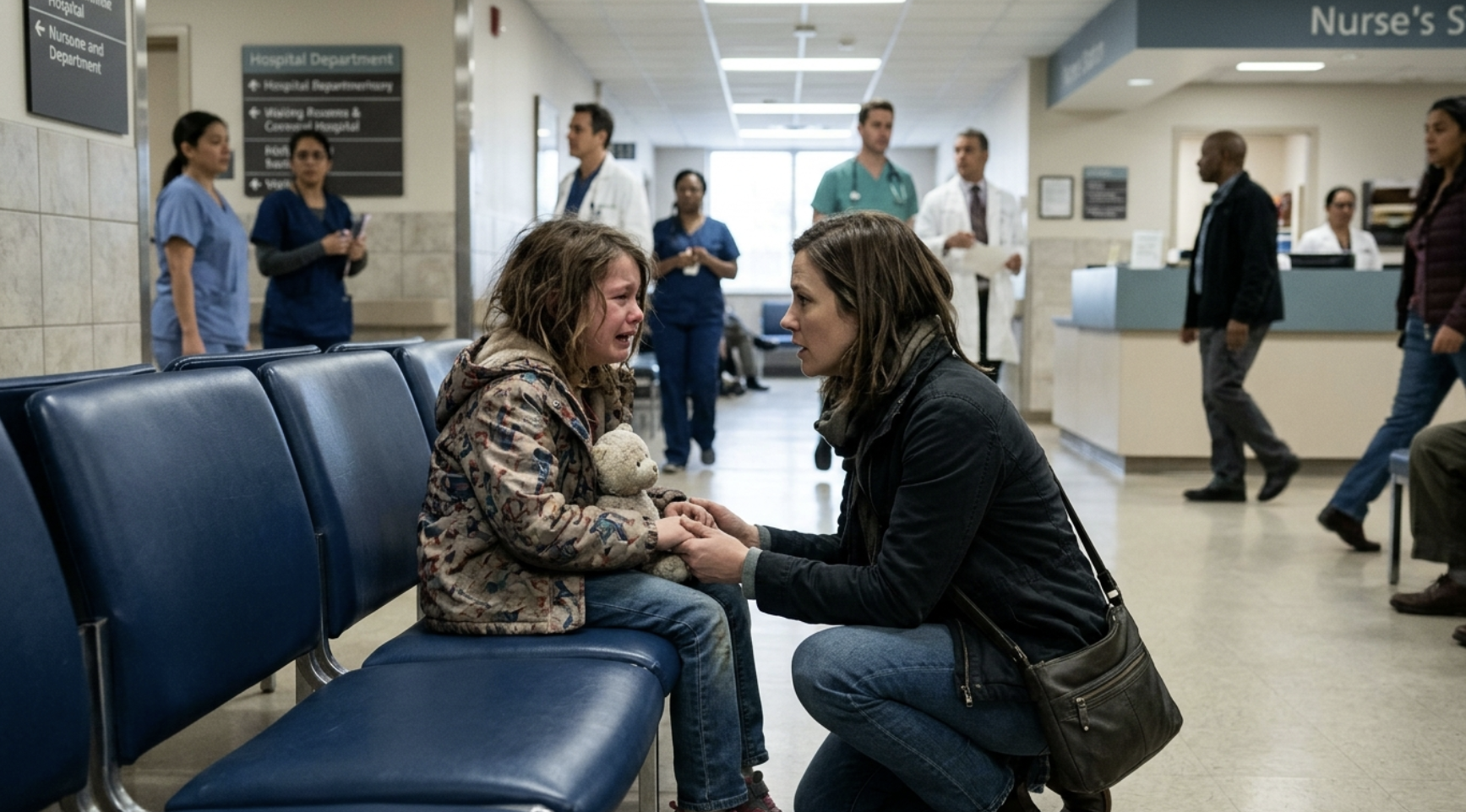
I looked toward Lucy’s bed.
She lay beneath a white hospital blanket, her small chest rising and falling with the help of oxygen. Captain Floppy rested beside her hand. Even through the fever, she kept her fingers wrapped around one of the rabbit’s worn paws.
A nurse adjusted the monitor while the attending physician reviewed her initial results.
“Her oxygen level is improving,” he told me quietly. “But she’s got a significant respiratory infection, and she’s severely dehydrated. We’re admitting her for observation and treatment. We’ll know more when the remaining tests come back.”
“Is she going to be okay?”
“We’re treating her, Marianne. That’s what matters right now.”
I nodded, but my eyes returned to the phone.
“Doctor, we need to notify the appropriate child-protection team. And someone needs to contact her father through his command. He’s deployed.”
The physician’s expression changed.
“Have you found out what happened to the aunt?”
“Not yet. But the messages suggest she knew Lucy was alone.”
“Preserve the messages. Document exactly what you found. Don’t confront anyone yourself. We’ll make sure the proper people handle it.”
I knew he was right.
Still, a part of me wanted to pick up that phone, call Aunt Bernie, and ask her how she had managed to sleep at night while an eight-year-old girl sat alone in a dark house, counting crackers and wondering whether she would die before anyone came home.
Instead, I took a breath and returned to Lucy’s bedside.
She opened her eyes when I sat down.
“Miss Marianne?”
“I’m here, sweetheart.”
“Did you read my messages?”
I hesitated.
“Yes. I did.”
Her face crumpled.
“Am I in trouble?”
The question hit me harder than I expected.
“No, Lucy. Absolutely not.”
“But Aunt Bernie said I would be.”
“Your aunt isn’t here right now, and you haven’t done anything wrong.”
Lucy stared at me for several seconds, as if she were trying to determine whether I was telling the truth.
Then she whispered, “She said if I told people, they’d take me away from Daddy.”
I pulled my chair closer.
“Nobody is going to blame you for being sick or needing help. Do you understand?”
She shook her head.
I didn’t push her.
Instead, I reached for a tissue and gently wiped a tear from her cheek.
“Listen to me, Lucy. You did something very brave today. You found your way to a hospital because you knew you needed help. That was the right thing to do.”
She looked down at Captain Floppy.
“I didn’t want to bother anybody.”
I swallowed the lump in my throat.
“Sweetheart, you could never be a bother for needing help.”
For the first time since I had met her, Lucy began to cry without trying to hide it.
Not loudly. Not dramatically.
She cried the way children cry when they have spent too long believing they must be brave because nobody else will be.
I stayed beside her until her breathing settled.
And while she slept, I made a decision.
Whatever happened next, this little girl would not have to fight to be heard again.
Not while I had anything to do with it.
The Secret Behind Aunt Bernie’s Messages
By late afternoon, Lucy’s fever had begun to come down.
She had received fluids, medication, and oxygen. Her breathing was still labored, but the medical team was cautiously encouraged by her progress.
I checked on her between my duties, bringing her water when she was allowed to drink and making sure someone was always nearby.
At one point, she woke from a restless nap and asked whether I could close the curtains.
“Is the light bothering you?”
“No.”
“Are you cold?”
She shook her head.
“Then what’s wrong, sweetheart?”
Lucy glanced toward the doorway.
“I don’t want Aunt Bernie to see me.”
I sat down again.
“Your aunt isn’t here.”
“But she might come.”
“Are you afraid of her?”
Lucy pulled the blanket up to her chin.
For several seconds, she said nothing.
Then she nodded.
I didn’t ask her to explain immediately. Children who have been frightened by adults often need time before they can put what happened into words.
I simply told her that the hospital staff would follow the appropriate safety procedures if her aunt arrived.
After a while, Lucy spoke.
“Aunt Bernie wasn’t always mean.”
I listened.
“She used to bring me candy when Daddy was home. She smiled at Mom, too. But after Mom died, she started saying everything was expensive.”
“Everything?”
“Food. Electricity. The house. Even the soap.”
Her voice was so quiet that I had to lean closer.
“She said Daddy was far away, and I needed to stop acting like a baby. She said I was lucky she let me stay in my own house.”
I felt my stomach tighten.
“Your own house?”
Lucy nodded.
“Daddy said it was our house. He bought it when Mom was still alive. But Aunt Bernie said she was the one taking care of everything now.”
I kept my expression calm.
“Did she live with you?”
“No. She came sometimes. Then she stopped coming every day.”
“When did you last see her?”
Lucy looked at the ceiling, thinking.
“Maybe two weeks ago. She brought a bag of groceries, took some papers from Daddy’s desk, and said she had important things to do.”
“What happened after that?”
“Mrs. Pruitt came to check on me. She lived next door. She made breakfast and helped me with homework.”
Lucy paused.
“Then Mrs. Pruitt got sick.”
I remembered what Lucy had told me earlier about the ambulance.
“Do you know where she went?”
“She said she was going to the hospital. She told me not to worry because Aunt Bernie would come that evening.”
“But she didn’t.”
Lucy shook her head.
“At first, I thought maybe she forgot. Then I called her. She didn’t answer. I sent messages. She read them, but she didn’t come.”
Her fingers tightened around Captain Floppy.
“After that, I tried to be good so Aunt Bernie wouldn’t get angry.”
I felt a familiar ache behind my ribs.
“What do you mean by good?”
“I didn’t turn on the television. I didn’t use too much water. I ate only a little, so the food would last.”
She stopped and glanced at me.
“Was that good?”
I had to look away for a moment.
When I looked back, I made sure she could see my face.
“No, sweetheart. You shouldn’t have had to do any of those things to earn someone’s care. You’re eight years old. You’re supposed to have food, a safe place to sleep, and an adult who makes sure you’re okay.”
Lucy seemed to consider that.
Then she asked the question that would stay with me for years.
“Then why did Aunt Bernie say I was expensive?”
I didn’t have an answer that an eight-year-old could understand.
Not one that would make the world feel fair again.
So I told her the truth.
“Sometimes adults make choices that hurt other people. Those choices are not the children’s fault.”
She looked at me for a long time.
Then she whispered, “That’s what Mommy used to say.”
I reached for her hand.
And for a moment, I thought about my own daughter, Ellie.
She had been eight when I lost her.
Eight years old.
The same age as Lucy.
I had spent years convincing myself that the only way to survive my grief was to keep a professional distance from the children who came through the hospital doors.
I could treat them. I could comfort them. I could do my job.
But I had stopped allowing myself to imagine their lives beyond the hospital bed.
Lucy had broken through that wall in a single afternoon.
She hadn’t done anything extraordinary.
She had simply asked someone to help her.
And I had realized how much it mattered that somebody answered.
A Call to the Commanding Officer
At 4:37 p.m., the hospital social worker arrived.
Her name was Denise Walker, and she had worked with military families for more than a decade. She listened carefully as I explained Lucy’s condition, the circumstances in which she had arrived, and the messages on the phone.
She didn’t interrupt.
When I finished, she asked, “Has anyone reached Chief Brennan?”
“Not yet. We know his deployment limits his availability.”
“Then we’ll work through the appropriate military channels. We also need to make a formal report and determine who can safely care for Lucy.”
“What about the aunt?”
“We won’t assume the entire story based on one message, but we certainly won’t ignore it. The messages need to be preserved, and the relevant authorities will investigate.”
I nodded.
That was what Lucy needed: not another adult making promises they couldn’t keep, but a coordinated effort to protect her.
Denise stepped into the hallway to make several calls.
About twenty minutes later, she returned.
“We’ve reached a contact through Chief Brennan’s command,” she said. “They’ve been informed that his daughter is hospitalized and that we need to speak with him as soon as communication can be arranged.”
“Does he know she’s been alone?”
“Not yet. We want to make sure we can speak to him directly rather than pass on incomplete information.”
I understood.
Still, I couldn’t stop wondering what would happen when Owen Brennan learned the truth.
Would he blame himself?
Would he believe Lucy?
Would he wonder how he could have been so far away without realizing what was happening at home?
I had seen military parents struggle with guilt before. They served because they believed their work protected their families and their country. Yet the very nature of deployment sometimes forced them to entrust the people they loved to others.
That trust could be a source of strength.
Or it could be abused.
As Denise worked, I returned to Lucy.
She was awake, watching a children’s program on the television without really following it.
“Lucy, the social worker is helping us contact your dad.”
Her eyes widened.
“Really?”
“Yes.”
“Can he come home?”
I sat on the edge of the chair.
“I don’t know how quickly he’ll be able to travel, sweetheart. But we’re trying to reach him.”
She swallowed.
“Will he be angry?”
“At you? No.”
“What if he thinks I was bad?”
I felt my chest tighten.
“Why would he think that?”
“Because Aunt Bernie said I was supposed to be quiet. She said Daddy had important work, and if I made him worry, I would ruin everything.”
I leaned forward.
“Lucy, your dad’s job is important. But you are important, too. If he knew you were sick and alone, he would want someone to help you.”
She didn’t answer.
Instead, she looked toward the window, where the afternoon sun was beginning to fade.
“My dad always says he can find me anywhere.”
I smiled gently.
“That sounds like something a good dad would say.”
“He said it when Mommy was alive. He used to hide behind the curtains and pretend he couldn’t find me, and then I’d yell until he came out.”
For the first time, a small smile appeared on her face.
“He was really bad at hiding.”
I laughed softly.
“Some adults are.”
Lucy giggled, but the sound faded quickly.
Then she said, “I hope he can find me now.”
I reached for her hand.
“We’re going to help him.”
And I meant it.
The Woman Who Finally Answered the Phone
At 5:12 p.m., Denise received a return call from someone who identified herself as Bernadette Pruitt.
The name confused us at first.
Lucy had mentioned Mrs. Pruitt, the elderly neighbor who had been caring for her before she was taken to the hospital.
But the caller explained that her full name was Bernadette Pruitt. Lucy called her Mrs. Pruitt, while her relatives sometimes called her Bernie.
Denise put the call on speaker only after confirming the caller’s identity and following the hospital’s procedures.
“Mrs. Pruitt, we’re calling regarding Lucy Brennan. We understand you’ve been helping care for her.”
“Oh, thank goodness,” the woman replied, her voice trembling. “Is she alive?”
The question made me straighten in my chair.
“Yes,” Denise said. “She’s receiving treatment.”
There was a long silence.
Then Mrs. Pruitt began to cry.
“I knew something was wrong. I knew it.”
“Can you tell us what happened?”
“I was taken to the hospital ten days ago. I had a bad infection, and they wouldn’t let me go home. I called Lucy’s aunt and begged her to check on the child. She told me she would.”
Mrs. Pruitt took a shaky breath.
“At first, she said Lucy was fine. Then she stopped answering my calls. I thought perhaps she was busy. I thought perhaps she had arranged for someone else to help.”
“Did you know Lucy was alone?”
“No. Never. I would have called the police myself if I had known.”
Her voice broke.
“That poor little girl. She must have been so frightened.”
I closed my eyes briefly.
There were two different adults in Lucy’s story.
One had been unable to continue caring for her because of a medical emergency.
The other had apparently accepted responsibility and then failed to provide the care Lucy needed.
The distinction mattered.
Mrs. Pruitt was not simply a name from the past. She was a witness to what had happened before Lucy’s aunt took over.
“Mrs. Pruitt,” Denise continued, “we may need to speak with you further as part of the investigation. Are you able to provide the contact information you have for Lucy’s father?”
“Of course. I have his number and the information he gave me before deployment. I also have a note he left with my daughter, just in case anything happened to me.”
“What does the note say?”
“That Lucy should be brought to the attention of his command if he couldn’t be reached, and that I was authorized to contact the family support office if there was an emergency.”
I looked at Denise.
That was important.
Owen Brennan had not simply left his daughter with no plan at all. He had arranged for someone he trusted to help, and he had left instructions for emergencies.
But somewhere along the way, those arrangements had failed.
“Can you tell us anything about the aunt?” Denise asked.
Mrs. Pruitt hesitated.
“I don’t want to say something unfair about anyone. But I never trusted her with Lucy for very long.”
“Why not?”
“Because she was always asking about the house.”
The room became very still.
“What house?” Denise asked.
“The house Lucy lives in. Owen bought it with his wife. It’s a small place, but it’s paid for. His wife worked hard for years, and he used his military benefits and savings to make sure they had a home.”
Mrs. Pruitt lowered her voice.
“After Lucy’s mother died, the aunt started talking about selling it.”
I felt the hairs rise on my arms.
“Did Lucy’s father agree to that?”
“Not that I know of. Owen told me he wanted Lucy to have the house when she grew up. He wanted her to have something stable, something that belonged to her family.”
Denise asked several more questions, recording the information for the appropriate authorities.
Then Mrs. Pruitt said something that changed the direction of the conversation.
“There’s something else. A few days before I was hospitalized, I heard Lucy’s aunt arguing with someone on the phone outside the house. She said she couldn’t keep waiting for the money.”
“What money?” Denise asked.
“I don’t know. I didn’t want to interfere. But she said, ‘The child is the problem. As long as she’s there, I can’t finish this.’”
My mouth went dry.
Mrs. Pruitt continued.
“I should have paid more attention. I should have done something sooner.”
“Please don’t blame yourself for being hospitalized,” Denise told her. “We need to understand what happened, and your information may help us protect Lucy now.”
When the call ended, neither of us spoke for several seconds.
The story was no longer only about a sick child left alone.
There might be another motive behind the neglect.
Perhaps the aunt had been careless, selfish, or overwhelmed.
Perhaps there was something more deliberate happening.
We didn’t know yet.
But we knew that every message, every call, and every document might matter.
And we knew that Lucy’s father needed to hear from us.
The Message Lucy Was Afraid to Show Me
That evening, Lucy woke again as I was checking her oxygen level.
She seemed more alert, though her cheeks were still flushed.
“Miss Marianne?”
“Yes, sweetheart?”
“Did Mrs. Pruitt call?”
I smiled.
“She did. She’s worried about you, and she wants you to get better.”
“Is she mad at me?”
“No. She’s very glad you’re receiving care.”
Lucy thought about that for a moment.
Then she reached beneath her pillow and pulled out a folded piece of paper.
“I was going to give this to Daddy.”
I accepted it carefully.
“What is it?”
“A note I wrote when Aunt Bernie was here.”
“May I read it?”
Lucy nodded.
The paper was creased and damp around the edges. The handwriting was uneven, with some letters written backward and several words crossed out.
It said:
Dear Daddy,
I am trying to be good. I don’t know when Aunt Bernie is coming back. I am sorry I ate the last crackers. I was very hungry.
I don’t want you to worry when you are working.
I miss Mommy.
Please come home when you can.
Love, Lucy.
I read it twice.
Then I folded it carefully and placed it on the bedside table.
Lucy watched my face.
“Is it a bad letter?”
“No, sweetheart.”
“Then why are you crying?”
I hadn’t realized tears were running down my cheeks.
I wiped them away quickly.
“Because it’s a very important letter.”
She looked confused.
“But I didn’t write anything special.”
I sat beside her.
“Sometimes the most important things are the things we need to hear but forget to say. Your dad needs to know that you miss him. He needs to know that you’ve been frightened. And he needs the chance to help you.”
Lucy pressed Captain Floppy against her chest.
“But I don’t want him to stop being a sailor because of me.”
I stared at her.
“Why would you think that?”
“Because Aunt Bernie said he would lose everything if he had to come home. She said his commander would be angry, and people would say he wasn’t doing his job.”
I took a slow breath.
“Lucy, your dad is responsible for his work, but the adults around him are responsible for making sure you’re safe. You didn’t cause this. You haven’t ruined anything.”
She looked at the note again.
“Can you keep it for me?”
“Of course.”
“Until Daddy comes?”
I nodded.
“I’ll keep it safe.”
I slipped the note into a clean envelope and wrote Lucy’s name on the front.
Then I placed it inside my work bag, intending to return it to her when her father could be there to receive it.
I had no idea how much that little piece of paper would matter in the days ahead.
A Voice From Far Out at Sea
At 7:46 p.m., the hospital received confirmation that Chief Petty Officer Owen Brennan had been reached through his command.
Because of his operational circumstances, the call had taken time to arrange. When the connection finally came through, Denise asked me to join her.
We stood in a quiet consultation room with the door closed.
A voice came through the speaker.
“This is Chief Brennan.”
He sounded tired, alert, and immediately concerned.
“This is Denise Walker from Harbor Naval Medical Center. Chief, your daughter Lucy is here with us. She’s receiving treatment for a serious respiratory infection.”
There was a sharp silence.
Then his voice changed.
“What do you mean, she’s there? Is she hurt?”
“She’s stable at the moment, but she needs continued medical care.”
“Who brought her?”
“She arrived alone.”
For several seconds, the only sound was faint static.
Then Owen spoke again, more quietly.
“Alone?”
“Yes, Chief. She told us she traveled to the hospital herself.”
I heard him draw a breath that sounded almost painful.
“Where is she now?”
“She’s in the pediatric unit. She’s safe and being treated.”
“Please. Please let me talk to her.”
Denise looked at me.
We had to consider Lucy’s condition and the arrangements for the call, but there was no reason to delay longer than necessary.
“I’ll bring her the phone,” I said.
When I entered Lucy’s room, she was sitting up, holding Captain Floppy in both hands.
“Lucy, sweetheart, there’s someone who wants to talk to you.”
She looked at me hopefully.
“Mrs. Pruitt?”
I shook my head.
“It’s your dad.”
For a moment, Lucy didn’t move.
Then her eyes widened.
“Daddy?”
I nodded.
She reached for the phone with trembling hands.
“Hello?”
The silence on the other end lasted barely a second.
Then I heard a man’s voice break.
“Lucy-bug?”
Lucy gasped.
“Daddy!”
“Oh, sweetheart. Oh, my God. Are you there? Can you hear me?”
“I’m here.”
“Are you hurt?”
She glanced at me.
“I’m sick.”
“I know, baby. They told me. I’m so sorry. I’m so sorry I wasn’t there.”
Lucy began to cry.
“Daddy, I tried to be good.”
There was a sound from the phone that I will never forget. It was the sound of a grown man trying desperately to keep himself together and failing.
“Listen to me, Lucy. You don’t have to be good to deserve help. You don’t have to be quiet. You don’t have to hide when you’re scared. Do you hear me?”
She nodded, even though he couldn’t see her.
“I was scared, Daddy.”
“I know.”
“I didn’t know if you could find me.”
“I’m going to find you, sweetheart. I’m going to do everything I can to get home as soon as I’m allowed. But right now, I need you to listen to the doctors and nurses. They’re going to take care of you until I can get there.”
Lucy wiped her face with her sleeve.
“Are you mad?”
“No.”
“Even though I went on the buses?”
“No, baby.”
“Even though I didn’t have my ID card?”
“No.”
“Even though I bothered the hospital?”
“No, Lucy!”
His voice cracked.
“You could never bother me by needing help. Never. Do you understand?”
She pressed the phone against her ear.
“I miss you.”
“I miss you more than you know.”
“Can you come home?”
“I am working on it. I promise I will do everything I can.”
He paused.
Then he asked, “Where’s Aunt Bernie? Why didn’t she bring you to the hospital?”
Lucy went completely still.
Her fingers tightened around the phone.
I watched her expression change from relief to fear.
“Daddy?”
“I’m here, sweetheart.”
“Please don’t be angry with me.”
“I’m not angry with you. Tell me what happened.”
Lucy looked at me.
I nodded gently.
“You can tell him the truth, Lucy. You’re safe here.”
She swallowed.
“Aunt Bernie said you knew I was okay.”
The line went silent.
“She told me you were okay,” Owen finally said. “She told me Mrs. Pruitt’s daughter was helping you.”
“But Mrs. Pruitt was gone.”
“I know, baby. I know.”
“She said not to tell anyone.”
I heard him take another breath.
“What else did she say?”
Lucy hesitated.
Then she whispered, “She said you would lose your job if I made trouble.”
The silence that followed seemed to stretch forever.
When Owen finally spoke, his voice was different.
Not louder.
Not angrier.
Just painfully controlled.
“Lucy, listen to me very carefully. You did nothing wrong. I need you to remember that for the rest of your life.”
She nodded.
“I love you, baby. I love you more than anything.”
“I love you too, Daddy.”
“Can I speak to the nurse for a moment?”
Lucy handed me the phone.
I stepped into the hallway, leaving the door open enough that I could still see her.
“Owen Brennan,” I said. “My name is Marianne Hargrove. I’m one of the nurses caring for Lucy.”
“Thank you for helping her.”
His voice was unsteady.
“I don’t know how to thank you.”
“You don’t need to thank me. She’s our patient, and she’s receiving the care she needs.”
“How bad is it?”
I explained her condition as accurately as I could, without making promises about how quickly she would recover.
He listened to every word.
Then he asked, “Can I speak to her again?”
“Of course.”
Before I handed the phone back, he said something I knew I would remember.
“Miss Hargrove, I trusted my family to look after my little girl. I thought I had done everything right.”
I paused.
“You arranged for someone to care for her, Owen. We need to find out why those arrangements failed. Right now, your daughter needs you to stay connected to her and let the people here help.”
He exhaled shakily.
“Please tell her I’m coming.”
“I will.”
When I returned the phone to Lucy, she was crying again, but this time she was smiling.
“Daddy says he’s coming home.”
I tucked her blanket around her shoulders.
“Then we’ll help you get stronger while you wait.”
She nodded and placed Captain Floppy beside her pillow.
For the first time since I had met her, she closed her eyes without asking whether anyone would be there when she woke up.
I sat beside her for another ten minutes.
Then I went back to work.
But I couldn’t shake the feeling that the hardest part of Lucy’s story had not yet begun.
Because somewhere in Norfolk, there was a woman who had been entrusted with an eight-year-old child’s safety.
And she was about to discover that Lucy was no longer alone.
The Call That Changed Everything
At 9:18 p.m., Denise came to find me.
“Marianne, we have an update.”
I followed her into the consultation room.
The appropriate authorities had been notified. The hospital was preserving the relevant records, and arrangements were underway to ensure Lucy would not be released into the care of an unverified adult.
Owen’s command was working through the procedures necessary to determine whether and when he could return home. Nobody could promise an immediate departure, but his family-support contacts had been informed.
Then Denise showed me another piece of information.
A local officer had attempted to contact Aunt Bernie using the number provided by Lucy’s father.
The first call went unanswered.
The second went directly to voicemail.
The third was answered.
According to the officer’s report, the woman on the other end of the line initially claimed that Lucy was staying with a neighbor.
When told that Lucy was hospitalized and had arrived alone, the woman reportedly became defensive.
She insisted that she had arranged for someone to check on the child.
But when asked to identify that person, she could not provide a clear answer.
Then she ended the call.
The officer had documented the conversation and would follow up.
I read the report twice.
“She still hasn’t asked how Lucy is doing,” I said.
Denise’s expression was grave.
“We don’t know what she may have said or done outside that conversation. The investigation needs to establish the facts. But we have enough concern to make sure Lucy is protected.”
I nodded.
Then Denise added, “There’s another issue. The officer was told that the aunt may have access to documents concerning the house.”
I thought of Mrs. Pruitt’s account.
The house.
The money.
The child who was supposedly in the way.
“What kind of documents?”
“We don’t know yet. We’re not going to speculate. But the authorities will examine whether there was any financial motive connected to the neglect.”
I felt a chill.
I had seen families fight over money before. I had watched relatives argue in hospital corridors about bank accounts, property, and inheritances while a patient lay unconscious behind a closed door.
But Lucy was eight.
Whatever the adults were arguing about, she should never have been caught in the middle.
I looked through the window toward her room.
She was asleep, one hand resting on Captain Floppy.
I wondered what she would remember about this day when she was grown.
Would she remember the fever, the buses, the frightening trip to the hospital?
Would she remember the reception desk where nobody answered her?
Or would she remember the moment someone finally knelt beside her and said she wasn’t a bother?
I hoped it would be the last one.
But as I returned to my duties, my phone vibrated.
It was a message from Denise.
The officer has just received additional information about the house. We need to discuss it in the morning.
I stared at the screen.
Then another message appeared.
It may explain why Lucy’s aunt was so determined to keep her quiet.
I looked toward the pediatric unit.
Lucy had finally fallen into a peaceful sleep.
Her father knew where she was.
Her treatment was underway.
For the first time in ten days, the little girl had adults around her who understood that she needed protection.
But the truth about what had happened in that house was still waiting to come out.
And when it did, I had a feeling it would change everything Owen Brennan thought he knew about the people he had trusted.
PART 4
At 6:15 the next morning, I arrived at Harbor Naval Medical Center earlier than my shift required.
I told myself it was because Lucy’s condition needed close attention.
That was partly true.
But the other part was simpler: I couldn’t stop thinking about the little girl who had sat alone at our reception desk, asking whether somebody would tell her father if she died.
I had heard those words in my sleep.
If I die here, will somebody tell my dad?
Every time I closed my eyes, I saw her holding Captain Floppy, trying to apologize for being sick.
I entered the pediatric unit carrying a small paper bag. Inside were a clean pair of pajamas, a coloring book, and a new stuffed rabbit I’d picked up at a pharmacy on my way to work.
I wasn’t sure whether Lucy would want it. Captain Floppy was clearly important to her.
When I reached her room, I found her awake and sitting against the pillows. Her oxygen support had been reduced, and her breathing looked easier than it had the day before.
She was drawing something on a sheet of paper.
“Good morning, sweetheart.”
She looked up.
“Miss Marianne!”
Her smile made the difficult night worthwhile.
“How are you feeling?”
“My chest doesn’t hurt as much.”
“That’s good news. Have you had breakfast?”
She nodded toward the tray.
“I ate the eggs.”
“All of them?”
“Almost.”
“That’s a good start.”
I placed the bag on her bedside table.
“I brought you something, but you don’t have to use it if you don’t want to.”
Lucy opened the bag carefully.
When she saw the coloring book, her face brightened. Then she lifted the new rabbit.
For a moment, she simply stared at it.
“Is this for me?”
“If you’d like it.”
She touched its soft ears.
“What’s his name?”
“I thought you might want to choose.”
She considered the question seriously.
“Captain Floppy needs a friend.”
“That sounds reasonable.”
She held both rabbits together.
“I’ll call this one Scout.”
“Scout it is.”
Then she looked at me with an expression that made my heart ache.
“Miss Marianne, will you still come to see me today?”
I pulled the chair beside her bed.
“Yes. I’ll be here.”
“Even if I get better?”
I smiled.
“Even if you get better.”
She seemed satisfied with that answer and returned to her drawing.
I glanced at the paper.
It showed a small house with a red roof, a tall man wearing a uniform, a little girl, and two rabbits.
Above the house, she had written in large, uneven letters:
HOME IS WHERE SOMEONE COMES BACK.
I turned away for a moment, pretending to examine the monitor.
I didn’t want Lucy to think she’d done anything wrong by making me cry.
But I knew I would remember that sentence for the rest of my life.
And before the morning was over, I would learn just how much that little house meant to her.
The Documents Hidden in the House
At 8:30 a.m., Denise Walker invited me into her office.
She had received an update from the authorities investigating Lucy’s situation.
“Marianne, I want to make sure you understand that we still have questions to answer,” she began. “We need to distinguish what we know from what we’re investigating.”
I nodded.
“What do we know?”
“Lucy was left without adequate adult supervision. Her medical condition required urgent evaluation. Her messages to her aunt appear to show that the aunt knew she was alone and was not responding with appropriate assistance. Those messages have been preserved for review.”
“And the house?”
Denise opened a folder.
“Mrs. Pruitt has provided additional information. She says Lucy’s father had repeatedly expressed his intention to keep the house for Lucy’s future.”
She showed me a summary of the information collected so far.
Owen Brennan had purchased the house with his late wife, Emily, several years before her death. It wasn’t a mansion. It was a modest three-bedroom property in a quiet Norfolk neighborhood, with a narrow driveway, a small garden, and a porch where Emily used to grow flowers.
After Emily died, Owen had asked his sister-in-law, Bernadette, to help coordinate practical matters while he was deployed.
He trusted her because she was Emily’s older sister.
He believed she would protect Lucy’s interests.
But investigators had discovered that Bernadette had recently made inquiries about selling the property.
“Did she have the legal authority to sell it?” I asked.
“That’s one of the questions being examined. She may have had access to some documents, but access doesn’t automatically give someone the right to sell a property. The ownership records and any authorization will need to be reviewed.”
I looked at the folder.
“Was Lucy’s father aware of any of this?”
“According to his initial statement, no.”
Denise paused.
“There may also be a financial issue involving money intended for Lucy’s care. We don’t yet have a complete accounting.”
I felt my hands tighten.
“Are you saying she took the money?”
“I’m saying that investigators are examining whether money was provided for Lucy and how it was used. We shouldn’t make a conclusion before the records are reviewed.”
I understood.
But I remembered Lucy’s words.
I ate only a little, so the food would last.
Whatever the documents eventually revealed, a child had been hungry while the adults around her failed to ensure she was safe.
That fact was enough to make me angry.
Denise closed the folder.
“The important thing is that Lucy remains protected while the investigation proceeds. Her father is working with his command, and the appropriate child-welfare professionals are arranging a safe care plan.”
“What happens if Owen can’t return immediately?”
“Lucy won’t be sent back into an unsafe situation. We’ll work with the relevant agencies to identify appropriate temporary care.”
I nodded.
Then Denise looked at me.
“Marianne, I need to ask you something. Did Lucy tell you anything else about her aunt?”
I thought for a moment.
“She said the aunt warned her not to tell anyone she was alone. She also said the aunt told her that her father would lose his job if Lucy caused trouble.”
Denise wrote it down.
“Thank you. We’ll make sure that information is included in the record.”
As I stood to leave, she added, “One more thing. Owen has asked to speak with you when the next communication window becomes available.”
“Of course.”
“He wants to understand exactly what happened when Lucy arrived.”
I looked at the door.
“I’ll tell him what I witnessed.”
And I would.
I would tell him that his daughter had been sick and frightened.
I would tell him that she had crossed the city by herself because she believed a hospital would help a Navy family’s child.
And I would tell him that when she finally arrived, she had been left waiting while adults argued about paperwork.
Not because she didn’t deserve care.
But because the people responsible for helping her had forgotten what care was supposed to mean.
The Aunt Returns
At 10:42 a.m., the pediatric unit received a call from hospital security.
A woman had arrived asking to see Lucy Brennan.
She identified herself as Bernadette Pruitt.
Security had been instructed to notify the appropriate staff because of the ongoing concerns surrounding Lucy’s safety.
I wasn’t the person responsible for deciding whether Bernadette could visit. That decision belonged to the hospital’s established procedures and the professionals handling Lucy’s protection.
But I was asked to remain nearby in case Lucy became distressed.
I stood outside her room while Denise and another staff member spoke with Bernadette in a private consultation area.
Through the open doorway, I could see Lucy coloring at her bedside.
She was drawing a blue ocean.
“What’s that?” I asked.
“Daddy’s ship.”
“That’s a very big ship.”
“It has to be. Daddy says the ocean is enormous.”
She added a yellow sun in the corner.
Then she looked up.
“Miss Marianne, is Aunt Bernie here?”
I hesitated.
“Yes. She’s at the hospital.”
Lucy immediately stopped drawing.
Her crayon slipped from her hand.
“Does she know where I am?”
“Yes, sweetheart.”
She pulled Captain Floppy into her lap.
“Can she take me home?”
“No one is going to send you somewhere without making sure it’s safe.”
Lucy stared at the door.
“She’ll be angry.”
I sat beside her.
“You don’t have to speak to her if you feel frightened. The people responsible for your safety will decide what happens next.”
Lucy nodded, but her eyes filled with tears.
“I don’t want to be bad again.”
I took her hand.
“Lucy, you are not bad. You are not in trouble. You have nothing to apologize for.”
She leaned against me, holding both rabbits.
A few minutes later, Denise came out of the consultation area.
Her face was serious.
“Bernadette is requesting to see Lucy. We’re not agreeing to any visit at this point. We need to consult with the people overseeing her safety plan.”
“What did she say?”
“She claims she came to take Lucy home because the situation has been misunderstood. She says she has been overwhelmed and that she intended to arrange care.”
“Did she explain the messages?”
“She says she was trying to prevent Lucy from worrying her father.”
I looked at Lucy’s drawing.
The little ship had a bright yellow flag.
“Did she ask about Lucy’s medical condition?”
Denise paused.
“She asked whether Lucy would be discharged soon.”
I felt something cold settle inside me.
Not because that question was necessarily proof of wrongdoing.
But because, after everything Lucy had endured, the first priority should have been the child’s well-being.
Denise continued.
“She has also been asked to provide information about the arrangements she made for Lucy. We’ll leave the investigation to the appropriate authorities.”
Then she returned to the consultation room.
I remained with Lucy.
She watched the doorway for a long time.
Finally, she whispered, “Will Daddy believe me?”
I turned toward her.
“Yes, sweetheart. Your father has already told us that he wants to hear what happened and make sure you’re safe.”
“But Aunt Bernie is his family, too.”
“That makes this difficult for him. But he can love someone and still need to understand whether that person has hurt you.”
Lucy looked down at Captain Floppy.
“Can you love someone and not let them come to your house?”
I thought about the question.
“Yes,” I said gently. “Sometimes keeping someone safe means setting boundaries with people who haven’t treated them properly.”
She considered that for several seconds.
Then she returned to her drawing.
She added a little person standing on the ship’s deck.
“Daddy,” she explained.
And beside the house, she drew another figure.
A nurse with brown hair.
I didn’t tell her that the picture had made me cry.
I simply stayed beside her until she was ready to color again.
A Father’s Promise
That afternoon, Owen’s command arranged another call.
This time, the connection was clearer.
When Lucy heard her father’s voice, she sat up so quickly that I had to remind her to take it slowly.
“Easy, sweetheart. We don’t want you getting dizzy.”
“Daddy!”
“Hello, my brave girl.”
“I’m not brave.”
“Who told you that?”
“Nobody.”
“Well, I think you’re brave. But you don’t have to be brave every minute. You can be scared. You can cry. You can tell people when something is wrong.”
Lucy held the phone with both hands.
“Can I tell you something?”
“Anything.”
“I was hungry.”
The words came out so softly that I nearly missed them.
Owen went quiet.
Lucy continued.
“I tried to save the crackers, but there weren’t enough. I drank water from the bathroom. Sometimes I slept with my coat on because the house was cold.”
I looked away.
Her father didn’t speak for several seconds.
Then I heard him take a shaky breath.
“Oh, Lucy.”
“I didn’t want to bother you.”
“You could never bother me.”
“But Aunt Bernie said—”
“I know what she said, sweetheart. And we’ll talk about that. But I need you to understand something first.”
His voice grew steadier.
“Your mother and I didn’t bring you into this world so you could spend your life worrying about whether you’re a burden. We had you because we loved you. We love you because you’re you. Not because you’re quiet. Not because you never ask for anything. Not because you make life easy for us.”
Lucy began to cry.
Owen continued.
“If you’re hungry, you tell someone. If you’re sick, you ask for help. If you’re frightened, you say so. And if someone tells you that you have to keep a dangerous secret, you can tell another trusted adult. You hear me?”
“Yes, Daddy.”
“I should have made sure you had more than one person to call. I should have checked more carefully. I thought I had everything arranged, but I didn’t understand what was happening.”
His voice broke again.
“That’s something I need to fix. It isn’t something you need to fix.”
Lucy pressed her cheek against the phone.
“I miss Mommy.”
“So do I, baby.”
“Do you think she’d be mad?”
“Mad about what?”
“That I couldn’t take care of myself.”
Owen’s answer came immediately.
“No. Never. Your mother would be proud that you kept looking for help. But she’d be heartbroken that you ever thought you had to take care of yourself like that.”
Lucy cried harder.
I reached for a tissue, but she shook her head and continued listening.
Owen spoke about Emily, telling Lucy how her mother used to leave notes in his lunch bag and how she once drove across town in a thunderstorm because he had forgotten his favorite jacket.
He told Lucy that Emily had been the sort of person who would stop to help a stranger carry groceries.
“Your mother believed that caring for people wasn’t a weakness,” he said. “It was one of the bravest things a person could do.”
Lucy smiled through her tears.
“She used to give people flowers.”
“She did.”
“Even when they were grumpy.”
“Especially when they were grumpy.”
Lucy giggled.
Then Owen became serious again.
“I’m working on coming home, sweetheart. I can’t promise you an exact date until my command confirms it. But I’m going to do everything I can, and until then, the people at the hospital are helping us make sure you’re safe.”
“Promise?”
“I promise I’ll keep working on it. And I promise I’m not going to stop loving you for one second.”
Lucy nodded.
“Okay.”
After the call ended, she leaned back against her pillows.
“Daddy says Mommy would be proud of me.”
I smiled.
“I think he knows you very well.”
She looked at me.
“Do you think Mommy can see me?”
I took a slow breath.
“I can’t tell you what happens after someone dies, sweetheart. Different people believe different things. But I know that the love your mother gave you is still part of your life. You remember her. You carry the things she taught you. And you can keep loving her while you grow up.”
Lucy seemed to think about that.
Then she touched the little drawing beside her bed.
“I want to be kind like her.”
I squeezed her hand.
“You can be.”
And for the first time, I saw something in Lucy’s expression that hadn’t been there when she arrived.
Not just relief.
Hope.
The Truth About the Money
Three days later, Lucy’s condition had improved enough for her medical team to begin discussing discharge planning.
She still needed rest and follow-up care, but she was eating better, breathing more comfortably, and asking for extra coloring pages.
She had also developed a habit of checking whether every new person who entered her room knew that Captain Floppy was the original captain and Scout was his assistant.
The doctors considered this a positive sign.
I considered it a sign that Lucy was beginning to feel like a child again.
Meanwhile, the investigation continued.
The authorities had reviewed the available messages and were gathering records concerning Lucy’s care, the property, and any money intended for her needs.
The details emerged gradually.
Owen had transferred funds to cover Lucy’s living expenses during his deployment. He had also arranged for money to be available for emergencies and for expenses related to the house.
The records suggested that the money had not been used entirely as intended.
Investigators were examining transactions, statements, and communications to determine what had happened. No final conclusions had yet been reached, but there were serious questions about expenses Bernadette had claimed were connected to Lucy’s care.
There was also the matter of the house.
A real-estate agent confirmed that Bernadette had contacted the office about the possibility of selling the property.
The agent had been told that she was helping manage matters for an absent relative.
But when the agent requested documentation establishing her authority to proceed, the necessary paperwork had not been completed.
The sale had not gone through.
That discovery brought some relief.
Lucy would not return to find her home sold without her father’s knowledge.
But it also raised a difficult question.
Why had Bernadette been so interested in the property?
When questioned, she said she had been under financial pressure and had hoped to resolve several family matters. She denied deliberately endangering Lucy and insisted that she had expected the child to be looked after.
The authorities continued investigating those statements.
They would determine what the evidence supported.
I didn’t need to know every financial detail to understand one thing.
Whatever Bernadette’s intentions had been, Lucy had been left without the care she needed.
And that was the most important fact.
On the fourth day, Denise received a call from Owen’s designated family-support contact.
His return arrangements had been approved, subject to the final operational and travel requirements. He was expected to reach Norfolk within the next day.
When Denise told Lucy, the little girl stared at her in disbelief.
“Daddy’s coming home?”
“That’s what we’re being told, sweetheart.”
“Tomorrow?”
“Possibly tomorrow, depending on the final arrangements.”
Lucy looked at me.
“Should I make him a picture?”
I smiled.
“I think he’d love one.”
She immediately reached for her crayons.
For the next hour, she worked carefully on a drawing of a house with a red roof, a blue ocean, and a ship returning to shore.
At the bottom, she wrote:
WELCOME HOME, DADDY. I SAVED YOU A HUG.
She asked me to help her spell welcome.
Then she asked me to check the spelling again.
And again.
She wanted everything to be perfect.
I watched her concentrate, her tongue peeking out slightly as she wrote.
I thought about the little girl who had once counted bus stops with a pebble in her hand because she was afraid she would forget the way to the hospital.
Now she was counting the hours until her father came home.
I hoped the world would be kinder to her from that point forward.
But there was still one conversation waiting to happen.
A conversation between a father who had trusted the wrong person and a little girl who had been afraid to tell him the truth.
The Reunion at the Hospital Door
Owen Brennan arrived shortly after noon the following day.
I was standing at the nurses’ station when I saw him walk into the pediatric unit.
He wore his uniform and carried a small duffel bag over one shoulder. He looked exhausted, with dark circles beneath his eyes and several days’ worth of worry etched across his face.
But he didn’t stop to speak to anyone.
He looked toward Lucy’s room.
“She’s in there,” I told him quietly.
He nodded, unable to speak.
I walked with him to the doorway.
Lucy was sitting in bed, arranging her two rabbits beside her coloring book.
She heard the footsteps and looked up.
For one second, she simply stared.
Then the coloring book slipped from her hands.
“Daddy?”
Owen stopped.
“Hi, baby.”
Lucy scrambled toward the edge of the bed.
I moved closer to make sure she didn’t pull on her monitoring equipment, but Owen was already kneeling beside her.
She threw her arms around his neck.
He held her as if the whole world had narrowed to the small child in his arms.
“Oh, Lucy. My Lucy.”
She buried her face against his shoulder.
“Daddy, you’re home.”
“I’m home, sweetheart.”
“You found me.”
He closed his eyes.
“Yes, baby. I found you.”
For a long time, neither of them said anything.
Lucy cried against his uniform. Owen held her, one hand gently resting against the back of her head.
He didn’t ask why she hadn’t called sooner.
He didn’t ask why she hadn’t tried harder.
He didn’t ask why she had gone to the hospital alone.
He simply held her.
When Lucy finally leaned back, she touched his face.
“You look tired.”
A broken laugh escaped him.
“I am a little tired.”
“Did you sleep on the ship?”
“Some.”
“Did you eat?”
He looked at her for a moment, then smiled sadly.
“I did.”
“Good. You have to eat when you’re working.”
He pressed his forehead against hers.
“You’re right. I do.”
Lucy suddenly remembered something.
She reached for the folded drawing beside her pillow.
“I made this for you.”
Owen accepted it with trembling hands.
He read the words at the bottom.
WELCOME HOME, DADDY. I SAVED YOU A HUG.
Then he looked at the drawing itself.
A house.
A ship.
A little girl.
Two rabbits.
He began to cry.
Lucy looked alarmed.
“Is it bad?”
“No, sweetheart. It’s beautiful.”
“Really?”
“It’s the most beautiful thing anyone has ever given me.”
He folded the paper carefully and tucked it into his uniform pocket.
Then he looked at me.
“Miss Hargrove?”
“Yes?”
“Thank you.”
His voice was quiet, but the gratitude in it was unmistakable.
I shook my head.
“You don’t owe me anything. Your daughter needed help, and we helped her.”
“But you listened.”
I didn’t answer immediately.
Owen glanced at Lucy, who was now explaining to him why Scout had been promoted to assistant captain.
Then he looked back at me.
“She told me what happened when she came here. She told me she sat at the reception desk and asked whether anyone would tell me if she died.”
I felt the old ache return.
“She was very sick, Owen.”
“I know.”
He swallowed.
“She told me nobody answered her.”
I glanced toward the reception area.
“I wish someone had.”
He nodded slowly.
“Me too.”
There was no anger in his voice directed at me.
Only grief.
And the knowledge that a system intended to help people had failed his daughter at the very moment she needed it most.
“I want to understand how that happened,” he said. “I want to make sure it doesn’t happen to another child.”
I looked at him.
“Then let’s start by making sure Lucy gets everything she needs.”
He nodded.
“Yes. That’s first.”
And for the rest of the afternoon, that was exactly what he did.
He listened to the doctors.
He spoke with the social worker.
He learned about the follow-up appointments and the support available to military families.
He asked questions without trying to rush anyone.
Most importantly, he stayed beside Lucy.
When she fell asleep, he sat in the chair next to her bed and held her hand.
Every few minutes, he looked at her face as if he still couldn’t believe she was there.
I understood that feeling more than I wished I did.
There are moments when life gives you back something you were terrified of losing.
And for a while, all you can do is sit quietly and be grateful.
A Sister’s Betrayal
The next morning, Owen met with the professionals handling the investigation and Lucy’s safety plan.
He was calm, but it was clear that he had spent much of the night thinking about what his daughter had told him.
When I saw him later, he was standing near Lucy’s room with a folder in his hand.
“Marianne, do you have a moment?”
“Of course.”
We walked to a quiet area.
“I’ve been reviewing the arrangements I made before deployment,” he said. “I want to understand where they broke down.”
I listened as he explained.
Before leaving, Owen had prepared written instructions listing the people authorized to help Lucy and the contacts to use if an emergency arose. He had also made financial arrangements for food, utilities, and medical needs.
He believed that between Bernadette and Mrs. Pruitt, his daughter would have reliable support.
He had not anticipated that Mrs. Pruitt would be hospitalized or that Bernadette would fail to provide the care she had promised.
“I kept thinking that I should have called more often,” he said. “But we had communication windows, and sometimes the connection failed. When I did get through, Bernadette said Lucy was fine.”
“Did Lucy speak to you directly?”
“Twice. Both times, Bernadette was nearby. Lucy said she was okay.”
He rubbed his forehead.
“I thought she sounded quiet because she missed me. I didn’t know she was afraid to speak.”
I wanted to tell him that he couldn’t have known everything happening hundreds or thousands of miles away.
But I also knew he needed to work through the guilt in his own way.
Finally, he said, “Bernadette is Emily’s sister. We were never especially close, but after Emily died, I thought family was family.”
“What are you going to do now?”
He looked toward Lucy’s room.
“Whatever is necessary to protect my daughter.”
He didn’t say he hated Bernadette.
He didn’t threaten revenge.
He didn’t talk about ruining her life.
He spoke about protecting Lucy.
That was the difference between anger and responsibility.
Later that day, Bernadette’s attorney contacted the relevant authorities about arranging a formal interview. The investigation would continue, and Owen was advised not to make private agreements concerning the property or money while the facts were being established.
He agreed.
He would not let grief or anger push him into a decision that might make matters harder for Lucy.
When Bernadette eventually met with the authorities, she continued to deny that she had intended for Lucy to be harmed. She said she had been struggling with financial difficulties and had believed the child could manage for a short time.
But the messages remained.
So did the evidence that Lucy had repeatedly asked for help.
And so did the fact that Bernadette had not ensured another responsible adult was caring for the child.
The investigation did not depend on whether Bernadette admitted every mistake.
It depended on the evidence.
As the days passed, the authorities continued examining the financial records and the circumstances surrounding the proposed property sale. The results would determine whether further legal action was warranted.
Owen made one thing clear through the proper channels.
Bernadette would not be responsible for Lucy’s care while the concerns remained unresolved.
He would also review the legal arrangements concerning his home, his finances, and his daughter’s future.
He had trusted family once.
He would not confuse family ties with proof that someone was safe to trust again.
That evening, he sat beside Lucy and helped her color a picture.
She was drawing a garden.
“That’s where Mommy’s flowers used to be,” she explained.
Owen smiled sadly.
“She loved those flowers.”
“I want to plant some when we go home.”
“Then we’ll plant some.”
“Can I choose the colors?”
“Every single one.”
Lucy looked at him.
“And can we leave the porch light on?”
Owen’s hand stopped moving.
“Of course, sweetheart.”
“Even when nobody is coming?”
He put down the crayon.
“Especially then.”
Lucy leaned against him.
And Owen held her close.
The Day Lucy Went Home
Six days after she had arrived at the hospital, Lucy was finally cleared to leave.
Her fever had resolved, her breathing had improved, and she was eating regularly. The medical team provided instructions for medication, follow-up appointments, and warning signs that would require immediate medical attention.
Her discharge plan had been coordinated with the appropriate child-welfare professionals.
Owen would be responsible for her care, and the necessary support arrangements would be in place while he adjusted to life at home after deployment.
Before Lucy left, she asked if she could say goodbye to everyone who had helped her.
The request took nearly an hour.
She thanked the nurses.
She thanked the orderly who had brought her to the emergency department.
She thanked the respiratory therapist who had helped her breathe more comfortably.
She even thanked the woman who had brought her breakfast every morning.
When she reached me, she wrapped both arms around my waist.
“Thank you for coming to get me.”
I knelt beside her.
“You don’t have to thank me for that, sweetheart.”
“But I want to.”
She looked at me with serious eyes.
“Everyone was busy, and you came.”
I swallowed.
“I’m glad I heard you.”
She touched Captain Floppy’s worn ear.
“Daddy says I should always ask for help when I need it.”
“He is right.”
“And he says I should tell him when something is wrong.”
“He’s right about that, too.”
Lucy thought for a moment.
Then she asked, “What if I get scared again?”
I gently tucked a strand of hair behind her ear.
“Then you tell someone you trust. You tell your dad. You tell your teacher. You tell a nurse or another safe adult. You keep telling people until someone helps you.”
She nodded.
“Okay.”
Then she hugged me again.
Owen waited by the door with her small backpack over his shoulder.
He had brought a coat for Lucy and a larger bag for her belongings. Captain Floppy and Scout were tucked safely inside Lucy’s arms.
Before they left, he turned toward me.
“I don’t know how to explain what your kindness has meant to us.”
“You don’t need to explain it.”
“I do, actually.”
He glanced at Lucy.
“When she was at her most frightened, you treated her like she mattered. You didn’t make her prove she deserved help.”
I felt my throat tighten.
“She always mattered, Owen.”
He nodded.
“Yes. She did.”
Then he held out his hand.
I shook it.
He looked at me for another moment.
“Take care of yourself, Marianne.”
“You, too.”
Lucy waved as they walked toward the exit.
“Goodbye, Miss Marianne!”
“Goodbye, Lucy!”
She stopped just before the doors.
Then she ran back, threw her arms around me one last time, and whispered in my ear.
“I’m not afraid of the hospital anymore.”
I hugged her gently.
“That’s good, sweetheart.”
She stepped back and smiled.
Then she returned to her father.
I watched them leave together.
Owen held the door open for her, and Lucy stepped into the sunlight with both rabbits tucked beneath her arm.
For the first time in ten days, she wasn’t walking toward help alone.
She was going home with someone who had promised to protect her.
And this time, that promise would be supported by a real plan.
THE FINAL PART: The Little Girl Who Learned She Was Never a Burden
An 8-Year-Old Girl Cried, “If I Die Here, Will Somebody Tell My Dad?” Everyone Ignored Her—Until One Nurse Read the Terrifying Message From Her Aunt
Part 1 of 2