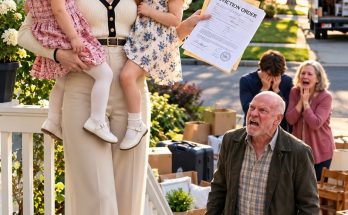
The sun was beginning to set when Cullen joined me at the porch railing.
Most of the guests were still inside.
I could hear laughter through the open blue door.
Someone was clearing plates.
Someone else had begun telling a story about Nile.
I stood quietly, watching the water.
The birthday gathering had been everything I wanted.
There had been no grand display.
No pressure.
No expectation that I would hand over something valuable.
Just people I cared about sharing an afternoon in my home.
I was seventy-two.
And I felt more at peace than I had in years.
Cullen stood beside me for a while.
Then he turned.
"Mom?"
I looked at him.
"Yes?"
He hesitated.
"Do you ever wish you hadn't changed the locks?"
I looked toward the door.
For a moment, I remembered the day I had turned that new key.
The suitcases were on the covered porch.
Blythe was crying.
Miles and Laurelai had left.
And Cullen had looked at me as though I had chosen a building over my own child.
I remembered how badly I wanted to open my arms.
How close I had come to offering him a compromise.
How frightened I had been that saying no would destroy our relationship.
Then I thought about everything that had happened afterward.
The phone calls.
The uncomfortable truths.
The meeting with Margaret.
The returned photograph.
The community center.
The fund.
Cullen and Blythe buying their own home.
And the wooden box sitting inside my house.
I looked at my son.
"No."
He nodded slowly.
He didn't appear surprised.
I watched his face.
Then I asked him the same question.
"Do you wish I hadn't?"
He looked toward the ocean.
For a moment, he was quiet.
Then he shook his head.
"No."
I waited.
He took a breath.
"I wish I'd never given you a reason to do it."
My eyes filled.
I hadn't expected him to say that.
There was no excuse in his voice.
No attempt to make me responsible for his embarrassment.
He wasn't asking me to apologize.
He was accepting what he had done.
I reached for his arm.
He stood closer.
For a while, we said nothing.
I could hear the waves moving against the shore.
The sound was familiar.
It had been part of my life with Nile.
It had carried through the years after his death.
It had been there on the afternoon I stood outside defending my home.
And it was there now.
The same ocean.
The same house.
But I was different.
I thought about the woman I had been at seventy-one.
She had loved her son so much that she was frightened of disappointing him.
She had believed saying no might make her cruel.
She had spent years trying to solve his problems before he had to face them himself.
That woman was still part of me.
I didn't want to pretend otherwise.
I still worried about Cullen.
I still wanted him to be happy.
I still felt protective when I heard that work was difficult or that he and Blythe were struggling with something.
But I no longer believed his happiness depended on my surrendering my own.
That was the difference.
I looked toward the open door.
Inside, the house glowed with warm light.
Friends were talking.
Someone laughed loudly.
I recognized Patricia's voice.
Then another guest began telling a story about Nile.
I heard his name.
For a moment, my heart tightened.
But it was a gentle feeling.
Not the sharp grief I had carried for so long.
Nile had loved that house.
He had spent years making it comfortable.
He had repaired the porch after the hurricane.
He had painted the blue front door.
And he had written me a letter when he knew he wouldn't be there forever.
I thought about that letter.
The cream-colored envelope.
The words that had helped me find the courage to protect myself.
I had once believed it was simply a reminder of my husband's love.
Now I understood it was something more.
He had known me.
He had known how difficult it was for me to refuse Cullen.
He had worried that I might keep giving until there was nothing left of my own life.
He hadn't wanted that.
He wanted me to remain Evelyn.
Not only Cullen's mother.
Not only Nile's widow.
A person with choices.
A person whose feelings mattered.
I looked at my son.
He was watching the water.
His expression was peaceful.
I thought about the man who had stood on the lawn demanding my house.
He had been frightened of looking unsuccessful.
He had wanted approval from people who valued expensive things.
He had allowed that fear to become more important than honesty.
He had lied about my health.
He had told people I was too sick to attend his wedding because admitting I wasn't invited would have made him look bad.
He had assumed my estate planning papers meant something they didn't.
Then he had turned that assumption into a promise.
He had allowed Blythe and her parents to believe the house would be theirs.
And when the truth threatened to become public, he had relied on my reluctance to embarrass everyone.
I remembered all of it.
I didn't have to forget those things to forgive him.
That was something I had learned.
Forgiveness didn't require pretending the injury had never happened.
It didn't require returning the spare key.
It didn't require changing my estate plan.
It didn't require allowing anyone to make decisions in my name again.
It simply meant I no longer wanted anger to control every part of our relationship.
Cullen had earned back some of my trust.
Not by asking for it.
By behaving differently.
He had stopped making promises about my property.
He had listened when I explained my boundaries.
He had volunteered at the community center.
He had helped people whose problems reminded him of the pain he had caused.
He had admitted the lie about my wedding absence.
And he had begun taking responsibility for his own life.
I was proud of that.
But I didn't pretend I had created the change for him.
I hadn't.
I could tell him the truth.
I could refuse to reward dishonesty.
I could give him the opportunity to make better choices.
But the choices themselves belonged to Cullen.
That had been difficult for me to accept.
For years, I had believed being a good mother meant finding a way to make everything right.
If he struggled financially, I worried.
If he was unhappy, I tried to help.
If he made a mistake, I looked for a way to soften the consequences.
I had done those things because I loved him.
But sometimes my help had prevented him from understanding what his decisions cost.
He had come to believe that my resources were available whenever he needed them.
My money.
My time.
My home.
My willingness to forgive.
And I had been afraid that setting limits would make him feel unloved.
Now I knew better.
Love without respect could become something painful.
Generosity without boundaries could turn into expectation.
And keeping quiet to avoid an argument wasn't always the same as keeping peace.
I had learned those lessons late.
But not too late.
Cullen moved slightly closer.
I slipped my arm through his.
We stood together.
I remembered the dinner at his new house.
The small wooden table.
The narrow kitchen.
The backyard where Blythe hoped to grow vegetables.
The porch step that needed repairing.
He had been so pleased to show me everything.
Not because the house was impressive.
Because it was theirs.
They had bought it with money they had saved.
They had accepted a mortgage they could afford.
They had chosen something that suited their actual lives.
Not the image they wanted strangers to admire.
That made me happier than seeing him receive an expensive property ever could have.
I had once imagined leaving the beach house to Cullen as the greatest gift I could offer.
Now I understood that giving him the property before he was ready would have taught him something terrible.
That he could avoid responsibility.
That other people's work existed for his convenience.
That affection meant he could demand whatever he wanted.
I didn't want that for him.
I wanted him to have a good life.
A life built on his own choices.
A life where he and Blythe treated each other honestly.
A life where success wasn't measured only by what they owned.
Their modest house showed me they were beginning to understand.
I was grateful.
Inside, someone called Cullen's name.
He turned toward the door.
Then he looked back at me.
"Are you coming in?"
"In a minute."
He nodded.
He didn't insist.
He didn't ask why I wanted to remain outside.
He simply smiled and went back to the gathering.
I watched him enter.
The blue door stayed open.
For a moment, I stood alone at the railing.
I thought about the first months after Nile died.
I had returned to the beach house because it was the place where I still felt close to him.
I had walked through the rooms touching furniture we had chosen together.
I had looked at the repairs he had completed.
I had stood outside the blue door wondering how I was supposed to continue living without him.
For a long time, I had treated the house as a place to preserve the past.
I had been afraid to change anything.
I had been afraid of losing the memories.
Then Cullen tried to claim it.
And I discovered how much of my own future I had been willing to surrender.
The conflict forced me to look at the house differently.
It wasn't only a memory of Nile.
It was still my home.
A place where I could make new memories.
Where I could invite friends.
Where I could sit in a comfortable chair and read.
Where I could help organize work for the independence fund.
Where I could celebrate another birthday without apologizing for being alive and happy.
That realization changed me.
I began repairing things because I wanted them repaired.
I planted flowers because I liked looking at them.
I joined a book club.
I walked along the shore.
I invited people to visit.
I stopped arranging every decision around the question of what Cullen might eventually inherit.
Margaret had my properly executed estate documents.
My wishes were recorded.
There was no need for anyone else to know every detail.
I hadn't promised Cullen the house.
I hadn't promised to exclude him from my estate either.
I had simply decided that my property would be handled according to my wishes, at the appropriate time.
That was enough.
The Nile Bennett Independence Fund had become another important part of my life.
I thought about the people we had helped.
The widow who needed independent advice before signing a financial agreement.
The resident who needed temporary assistance after a family dispute.
Walter, who had been afraid to refuse his daughter's requests for money.
I didn't know how every one of their stories would end.
Some family situations were complicated.
Some people needed more help than we could provide.
The fund couldn't solve everything.
But it could give people information.
Support.
A chance to make decisions without feeling entirely alone.
I was proud of that work.
It honored Nile in a way I thought he would appreciate.
Not by displaying wealth.
Not by creating a grand monument.
By helping people remain independent.
I smiled as I thought about him.
He would have been uncomfortable with all the attention.
He would have insisted that the volunteers deserved the credit.
Then he would have asked whether someone needed help repairing a shelf.
That was Nile.
Practical.
Patient.
Kind.
I missed him every day.
But I no longer believed missing him meant I had to stop living.
The laughter inside grew louder.
Someone had reached the funny part of a story.
I recognized it.
Nile had once tried to finish a repair before rain arrived.
He had insisted the weather would hold.
It hadn't.
He came inside soaked.
I had laughed until I cried.
For years, I couldn't hear that story without becoming sad.
Now I found myself laughing on the porch.
Alone.
The memory made me happy.
I looked toward the water again.
The sun was lower.
The sky had begun to change color.
I had lived in that house long enough to recognize the evening light.
It was beautiful.
I wondered how many sunsets I had missed because I was inside worrying about someone else's problems.
Too many.
I couldn't change that.
But I could enjoy the ones still ahead.
I went back inside.
The living room was full of people.
Patricia was sitting near the fireplace.
Margaret stood beside a small group of volunteers.
Blythe was helping clear plates.
Cullen was laughing with a guest near the dining table.
I stopped for a moment and watched them.
It was an ordinary scene.
People talking.
Dishes being carried.
Someone asking where the extra napkins were.
I felt a quiet happiness.
This was what I had wanted.
Not an expensive celebration.
Not a house full of people impressed by my possessions.
Just warmth.
Company.
And the freedom to choose who entered my home.
I went to the dining table.
The wooden box was still there.
I opened it again.
The two keys rested inside.
The brass tag caught the light.
Evelyn's Home. Evelyn's Choice.
I touched the engraving.
Then I lifted the keys.
For a moment, I remembered the new locks.
The afternoon I had stood outside with Cullen and Blythe.
The way my hands shook when I finally closed the door.
I had feared that locking my son out would mean losing him.
Instead, the boundary had forced us to confront the truth.
He had learned that I was not something he owned.
I had learned that loving him didn't require surrendering myself.
And slowly, we had found our way back to each other.
I closed the box.
I slipped the keys into my pocket.
Then I returned to the gathering.
Cullen saw me.
He smiled.
I smiled back.
There was no argument waiting behind his expression.
No request.
No expectation that I would give him something more.
He was simply happy to see me.
I thought about how much I had wanted that.
For years, I had been afraid that my son's love depended on my willingness to help him.
Now I understood that a relationship built on constant sacrifice wasn't the kind of relationship I wanted.
I wanted honesty.
Respect.
The freedom to disagree.
And the knowledge that saying no wouldn't end our connection.
Cullen had begun giving me those things.
Not perfectly.
He was still human.
So was I.
We would make mistakes.
We would misunderstand each other.
There would be difficult conversations.
But I no longer feared every disagreement.
I knew we could survive one.
I knew we could speak honestly.
And I knew I didn't have to surrender my home to prove I loved him.
Later, when the guests began leaving, I walked several of them to the front door.
They thanked me for inviting them.
I thanked them for coming.
Patricia hugged me.
Margaret wished me a happy birthday again.
The volunteers said they would see me at the center.
One by one, the house became quieter.
Cullen and Blythe stayed to help.
They carried dishes into the kitchen.
They put away chairs.
They collected the remaining food.
I watched them work together.
There was nothing dramatic about it.
And that was exactly why I appreciated it.
Nobody was trying to impress anyone.
They were helping because help was needed.
When the last things were put away, Cullen came into the living room.
He looked tired.
But happy.
"Did you have a good birthday?"
I smiled.
"A wonderful one."
He nodded.
"I'm glad."
Blythe came to stand beside him.
She hugged me.
Then Cullen did too.
We said goodnight.
I walked them to the door.
They stepped outside.
I watched them go toward their car.
For a moment, I remembered the day they had stood beside their suitcases, uncertain where they would stay.
That memory felt distant now.
Not forgotten.
Just part of a longer story.
A story that hadn't ended with anger.
Cullen opened the car door for Blythe.
Then he looked back.
"Love you, Mom."
I smiled.
"Love you too."
They drove away.
I stood on the porch until their car disappeared.
Then I turned toward the house.
The blue front door was open.
Warm light spilled across the porch.
Inside, everything was where it belonged.
The photographs.
The furniture.
The flowers.
The memories.
I stepped inside.
I closed the door.
Then I locked it.
The key turned easily.
I didn't feel guilty.
I didn't feel lonely.
I felt safe.
I walked into the living room and stopped before Nile's photograph.
His familiar smile looked back at me.
I touched the frame.
"Our boy is doing better."
I stood there for a moment.
Then I smiled.
"So am I."
I had spent much of my life believing that being a good mother meant giving everything I could.
I had thought sacrifice was proof of love.
I had mistaken silence for harmony.
And I had believed that protecting my relationship with Cullen meant never allowing him to feel disappointed.
I was wrong.
I could love my son without allowing him to control my decisions.
I could forgive him without pretending he had done nothing wrong.
I could welcome him into my home without giving him ownership of it.
And I could be seventy-two years old, living alone in a beautiful house, with a full life that belonged entirely to me.
That was something I hadn't expected to learn so late.
But I was grateful I had learned it.
I went to my comfortable chair.
I sat down.
The room was quiet.
Outside, the ocean continued moving toward the shore.
I thought about Nile rebuilding the porch.
About the blue paint on the front door.
About the long summers when we had worked side by side.
I thought about Cullen as a little boy.
Then as a man who had made serious mistakes.
Then as the son who had stood beside me at my birthday gathering and admitted that he regretted giving me a reason to change the locks.
I loved all those versions of him.
But I didn't have to excuse everything he had done.
That was the difference between love and surrender.
I looked toward the dining table.
The wooden box was there.
The keys were safely in my pocket.
I thought about the house's financial value.
Almost two million dollars.
To some people, that number would always be the most important thing about it.
To me, it was where I had shared a life with Nile.
Where I had grieved his death.
Where I had made mistakes as a mother.
Where I had finally learned to set boundaries.
And where I had welcomed my son back without handing him control of my future.
I couldn't imagine a more valuable place.
But its value didn't make it anyone else's.
It remained mine.
Not because I had won an argument.
Not because Cullen had lost.
Because it had always been mine to decide what to do with.
I turned off the lamp.
Then I went upstairs.
Before entering my bedroom, I looked back down the hallway.
The house was quiet.
The rooms were familiar.
And I felt something I hadn't felt in years.
I wasn't waiting for someone else to decide what my life should become.
I was living it.
The next morning, I would open the blue door.
I would step onto the porch.
I would listen to the ocean.
There would be flowers to water.
Friends to visit.
Work to do through the fund.
Books to read.
And conversations with my son that no longer needed to begin with fear.
I had kept the beach house.
I had kept my independence.
And slowly, I had rebuilt my relationship with Cullen.
Not because I gave him what he demanded.
Because I finally stopped being afraid to tell him the truth.
At seventy-two, I understood something Nile had tried to teach me long before he died.
A home could be built with patience, work, and love.
But the life lived inside it had to remain your own.
I had spent years forgetting that.
Now I remembered.
And the keys were exactly where they belonged.
With me.
Source: psndaily.xyz
The End
Read more original stories on dramausa.
I Wasn’t Welcome at My Own Son’s Wedding, but Somehow Everyone Expected Me to Give Him the Keys to My Home
Part 15 of 15