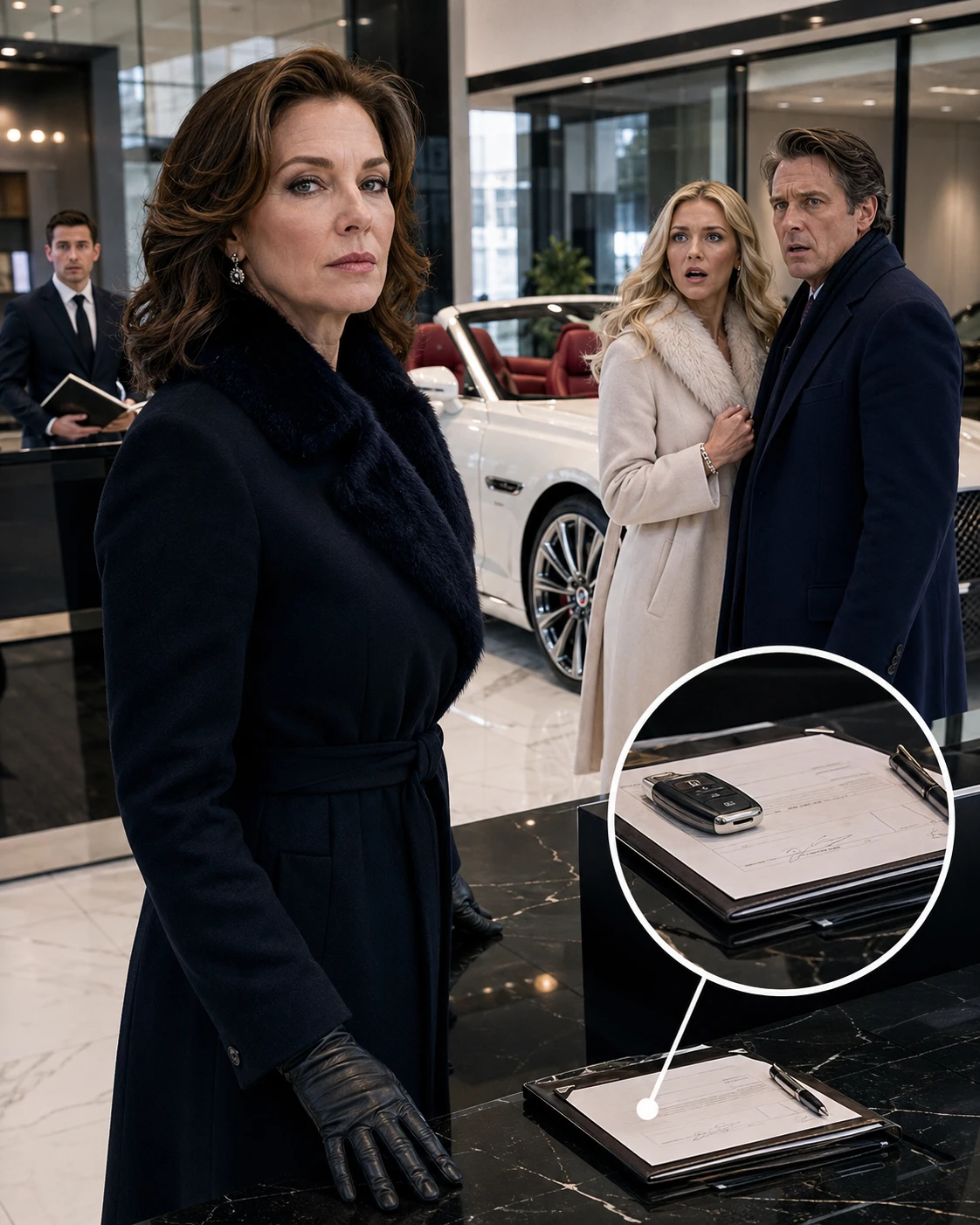
His mistress called me “the old model” at a luxury car dealership in Winnetka, Illinois.
Not behind my back. Not in a text. Not in one of those private, ugly little corners where weak people usually hide their cruelty.
She said it in front of the salesman, the receptionist, two finance assistants, a man shopping for a Range Rover, and my husband.
Evan Pierce, my husband of eighteen years, laughed.
He laughed like she was charming. Like the insult was clever. Like I was some outdated appliance he had finally found the courage to replace.
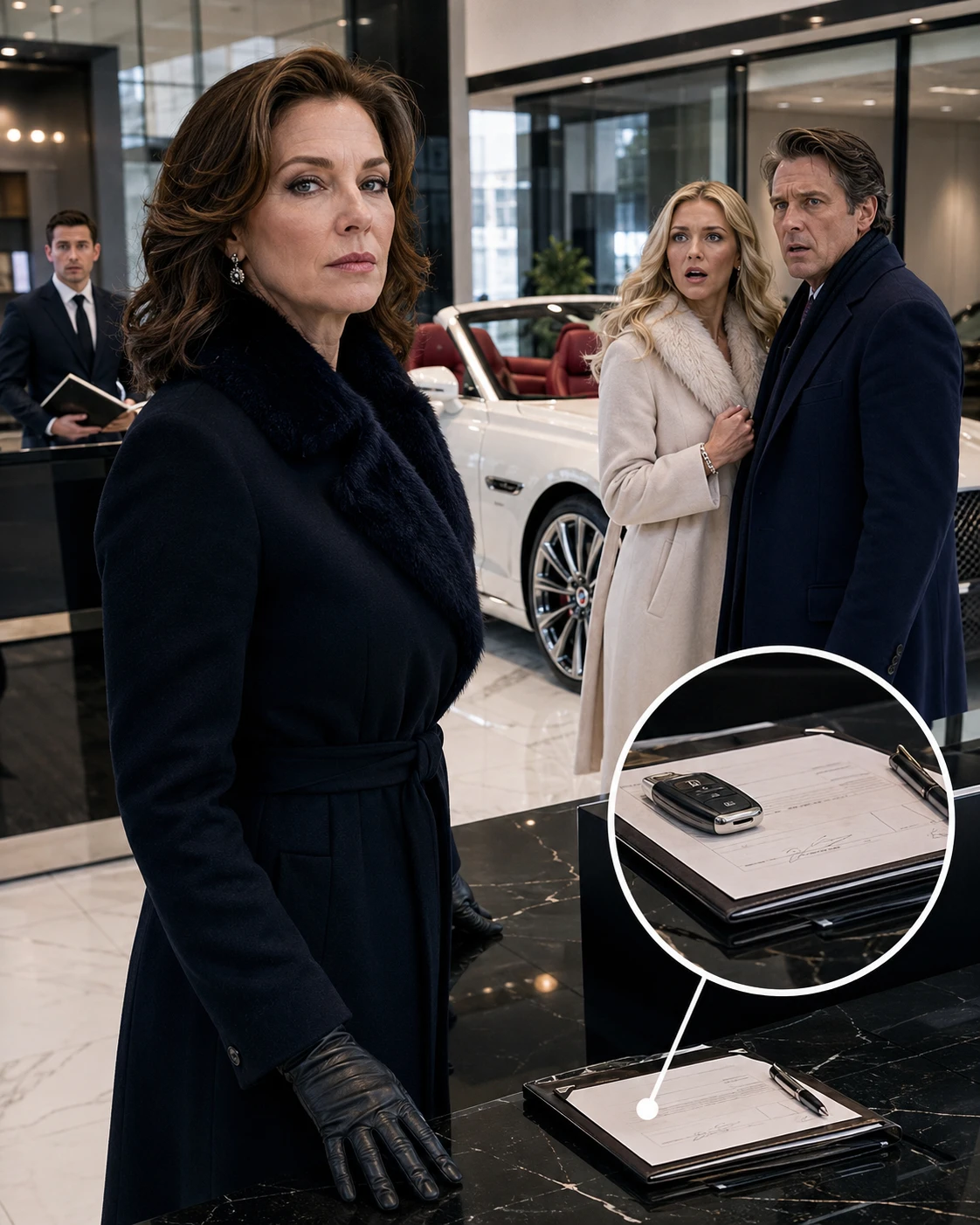
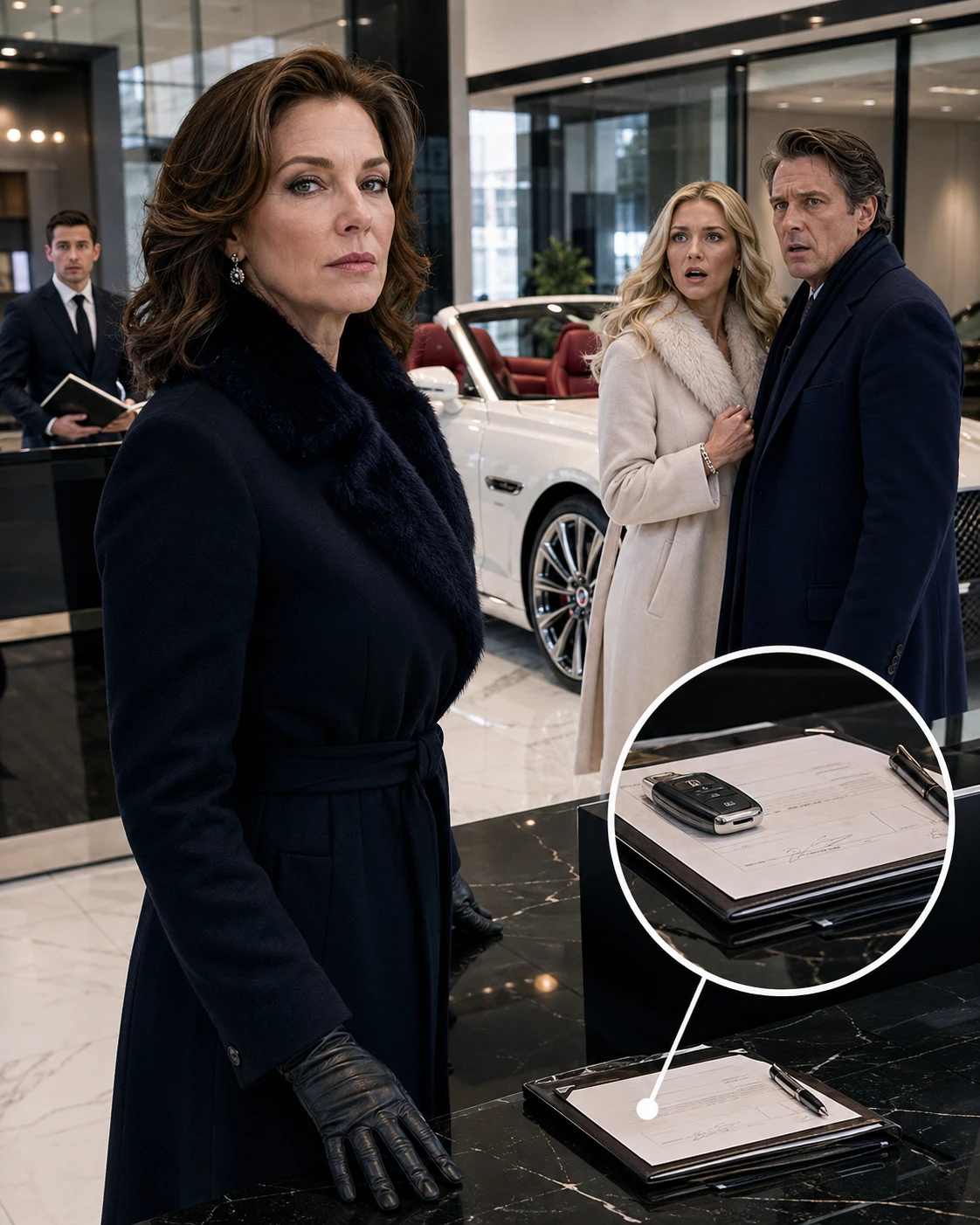
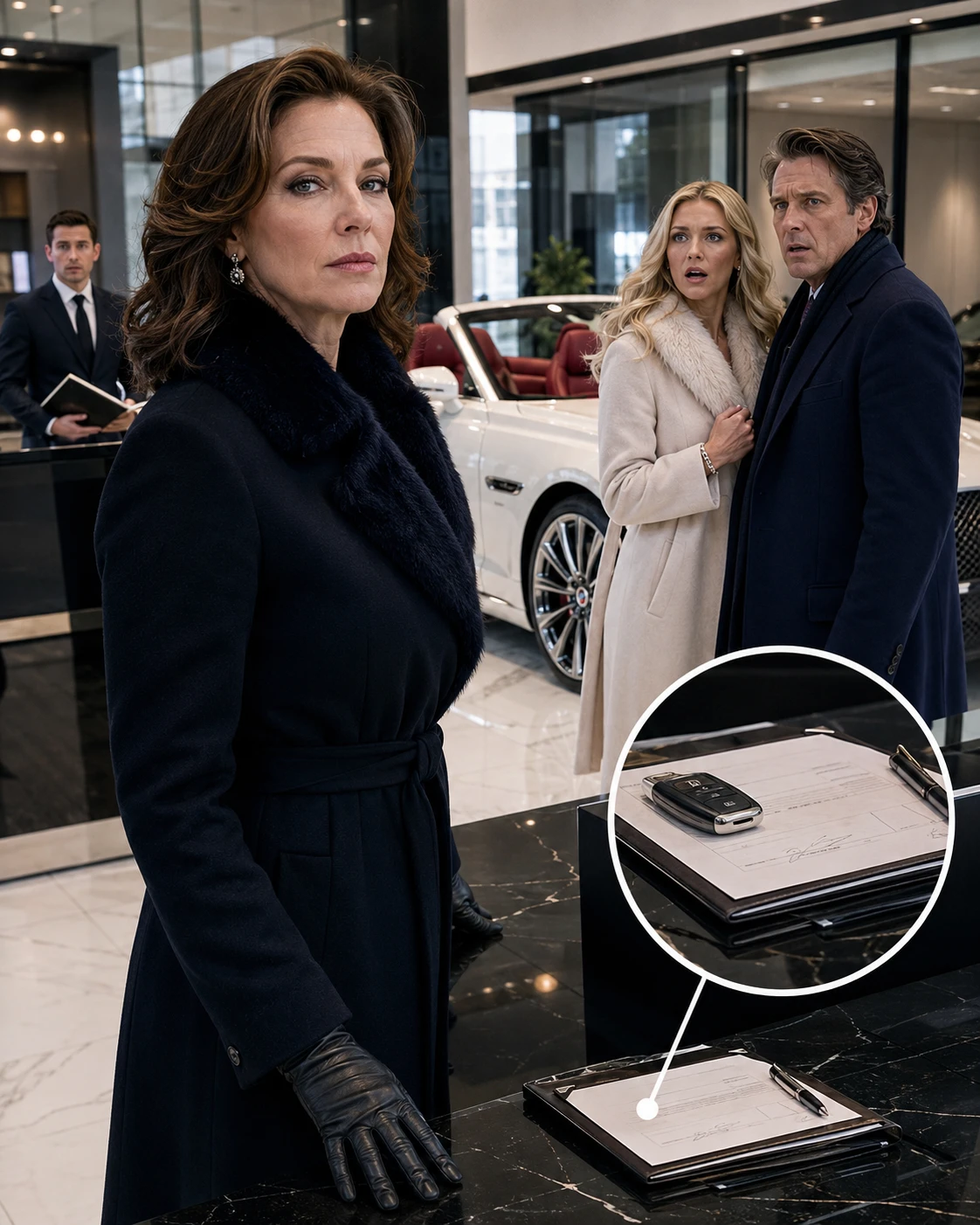
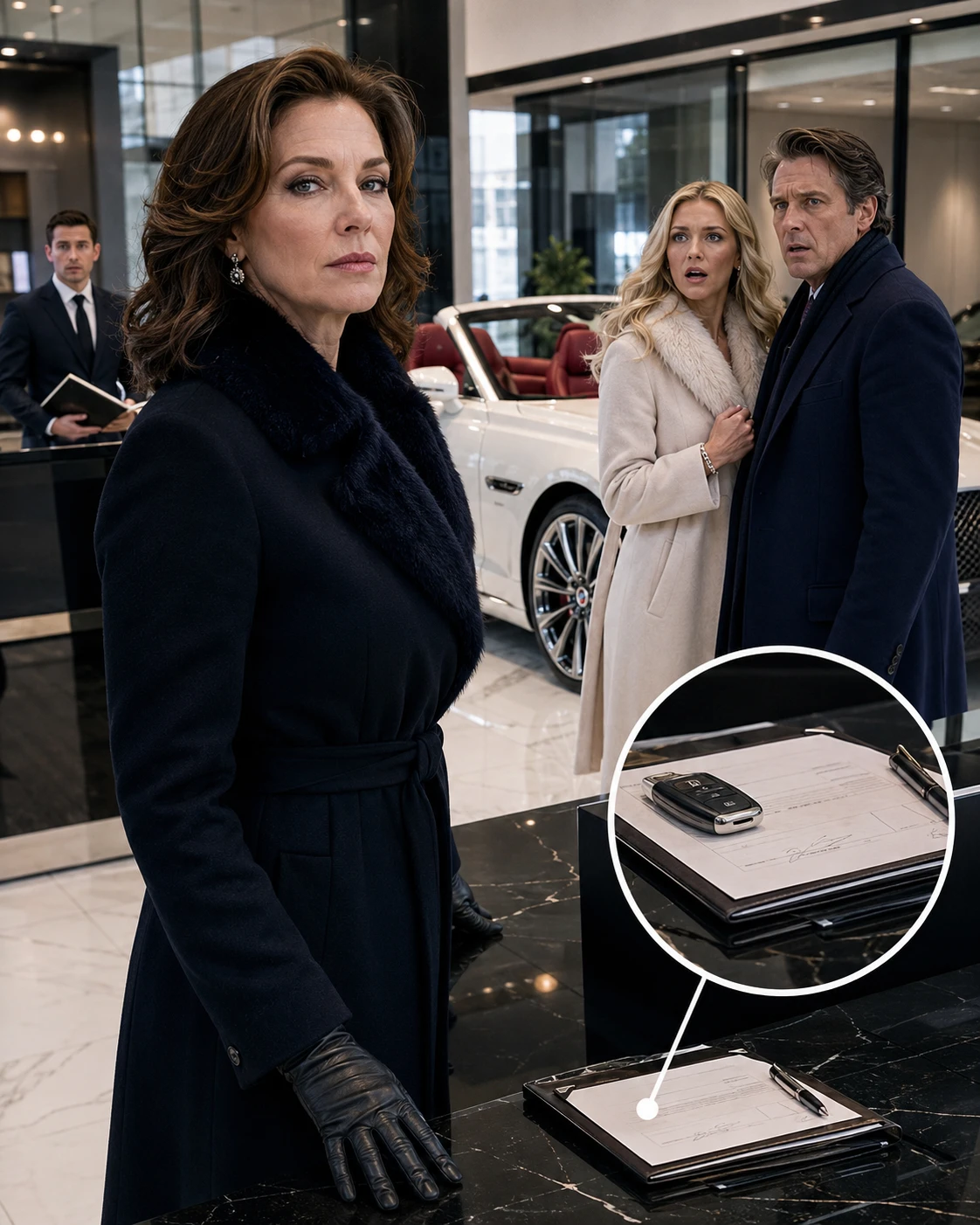
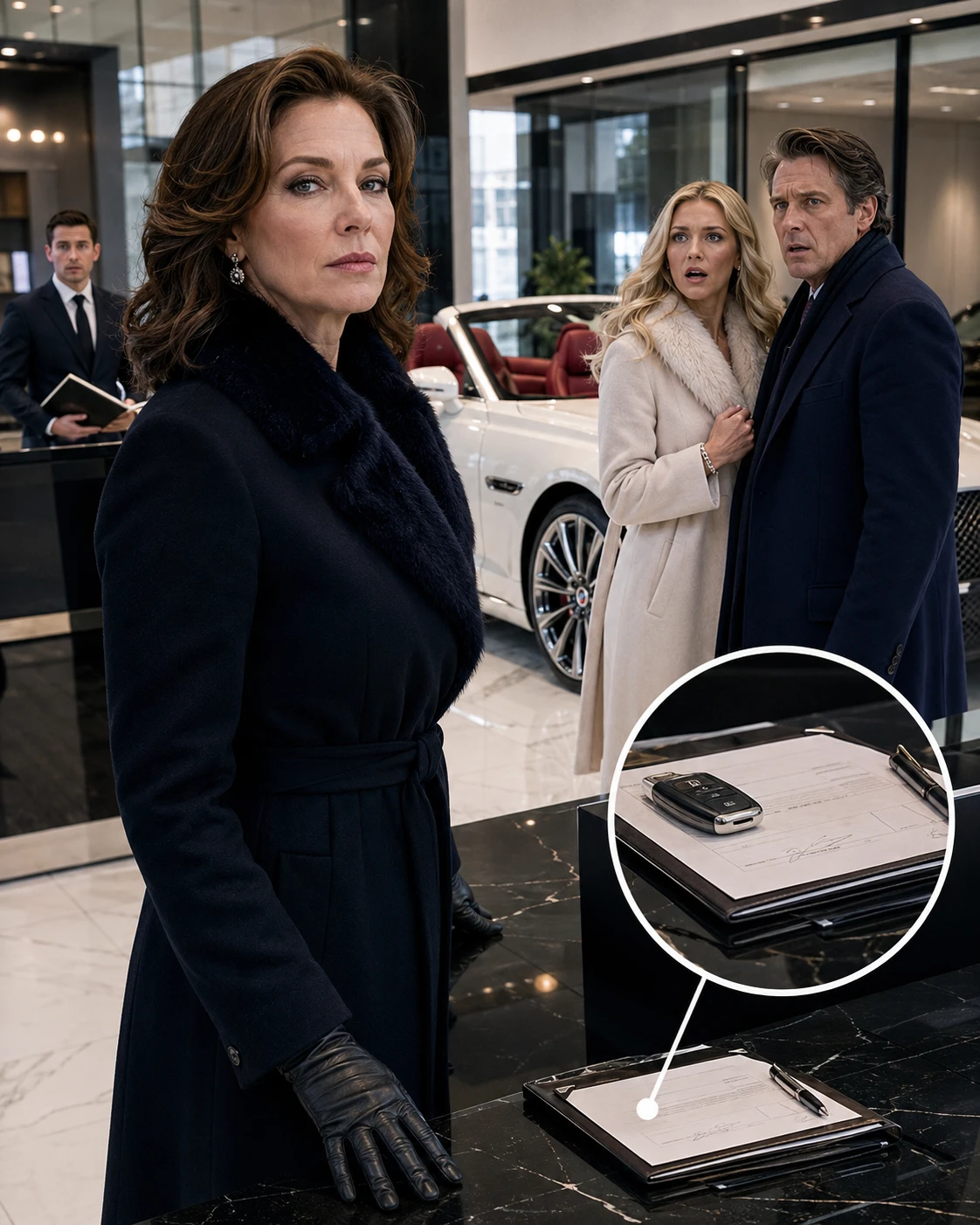
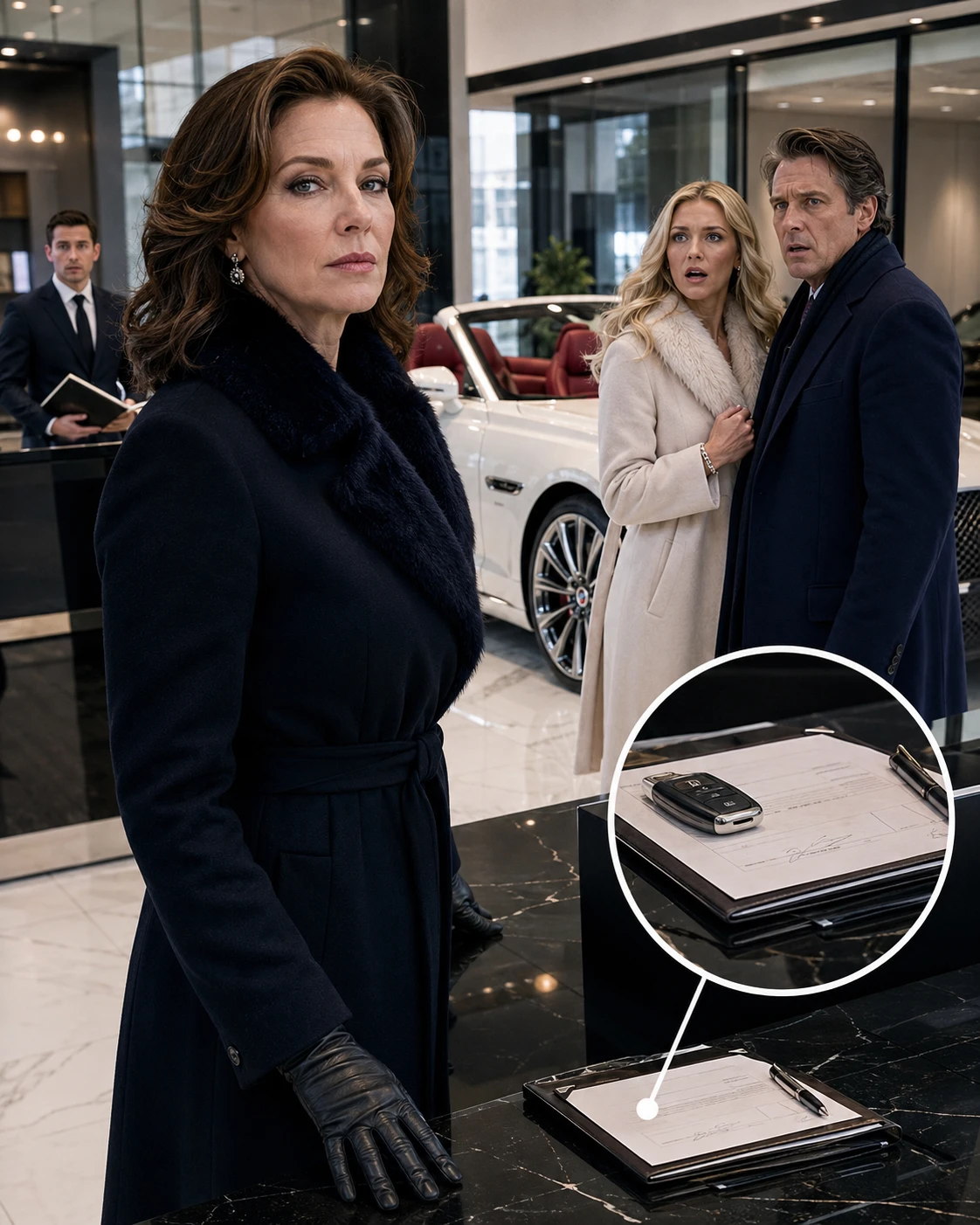
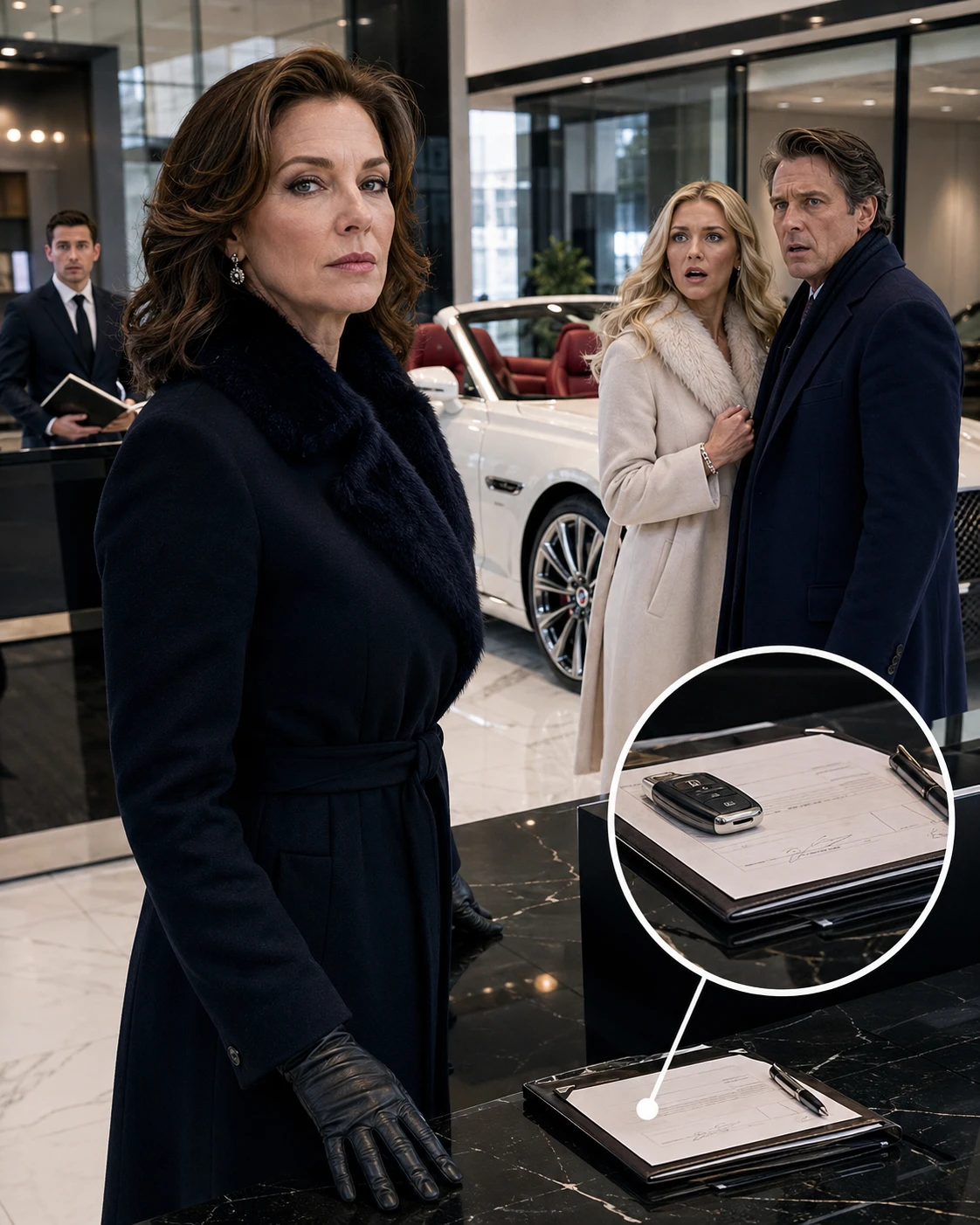
The mistress, Sloane Hart, stood beside a pearl-white convertible with red leather seats, one hand resting on the hood as if she had already been photographed in it by the paparazzi she imagined were waiting outside. She was twenty-nine, glossy, and expensive in the way rented things often look expensive. Her blonde hair fell in perfect waves. Her diamond tennis bracelet flashed every time she moved. I recognized the bracelet because Evan had bought it with our joint card three months earlier and told me it was a “corporate appreciation gift” for a client.
“She’s not mad,” Sloane said, smiling at me. “She’s just adjusting. It’s hard when the new model comes out.”
The salesman’s face froze.
Evan’s smile twitched. Not with shame. With warning.
“Mara,” he said softly, using the voice he saved for charity galas and restaurant managers. “Don’t make a scene.”
I looked at him. Then at her. Then at the convertible.
For a moment, I saw the whole shape of my marriage the way you see a house after the lights go out: not the furniture, not the art, not the polished surfaces, but the exits.
I turned to the salesman.
“Whose name,” I asked, “will be on the title?”
The young man swallowed. His name tag read DANIEL. He looked at Evan, then at the folder in his hand.
“Mrs. Pierce,” he said carefully, “the preapproval came through under Whitaker & Rowe Design Group. The authorized purchaser is listed as Mara Whitaker Pierce.”
Sloane’s smile faded.
Evan stopped laughing.
And I understood everything.
My husband had used my business credit to preapprove the purchase of his mistress’s convertible, thinking I would not notice until after the car was delivered, the keys were in her hand, and humiliation had already become paperwork.
I smiled for the first time that afternoon.
“Daniel,” I said, “please cancel the sale.”
CHAPTER 1: THE SHOWROOM OF SMALL MEN
Luxury has a sound.
It is not champagne popping or diamonds clinking against crystal. It is silence. Thick carpet swallowing footsteps. A receptionist’s whisper. A door closing so softly it feels like a secret being locked away.
Monroe Imports had all of it. White marble floors. Black leather chairs. A wall of glass facing Lake Michigan’s pale winter light. There were cars inside that cost more than some houses in Ohio, arranged like sculptures for people who had forgotten hunger was real.
I had come there because Evan asked me to meet him.
He said he wanted to talk.
That should have been my first warning. Men like Evan did not “talk” unless a performance required an audience.
He had spent the last six months becoming a stranger in designer suits. He worked late, traveled often, and had suddenly developed opinions about fragrance, Pilates, and rooftop lounges in Fulton Market. He slept with his phone under his pillow. He bought new shirts and old excuses. He kissed me on the cheek like he was greeting a cousin.
Still, I came.
Not because I was naïve.
Because I was collecting pieces.
A woman knows before she knows. She feels the shift in a room, the extra second before a husband answers, the careful placement of a phone face down, the way guilt makes people generous in public and cruel in private. I had felt Evan leaving me long before he admitted there was somewhere else he wanted to arrive.
But I had not expected a showroom.
And I had not expected her.
Sloane Hart was leaning against the convertible when I walked in, wearing a cream cashmere coat I had seen on Evan’s AmEx statement. She looked at me with the bright, polished pity of a woman who had mistaken proximity to a married man for victory.
Evan stood beside her in his navy overcoat, handsome in the way that photographs well and ages poorly. At fifty-one, he still had the jawline that charmed donors and judges and bored wives at private clubs. He had built his entire life on appearing more successful than he was.
“Mara,” he said, as if he had not staged this. “You came.”
“You asked me to.”
Sloane tilted her head. “You didn’t tell me she was so elegant.”
It sounded like a compliment until she smiled.
Evan cleared his throat. “Sloane is helping with the Lakeshore project.”
Of course she was. Every mistress in America was “helping with a project.”
“The Lakeshore project,” I repeated.
Sloane’s smile widened. “Branding. Lifestyle positioning. Evan says I understand the new market.”
“The new market,” I said.
She touched the convertible again. “And apparently the new model.”
Then came the line.
The old model.
The laugh.
My husband’s laugh.
It did not break my heart. That surprised me. I had thought, after eighteen years, betrayal would feel like fire. Instead, it felt like a glass being set down very carefully.
Final.
Clean.
Cold.
The salesman, Daniel, shifted beside the finance desk, holding a folder with my company’s logo visible through the clear plastic cover.
Whitaker & Rowe Design Group.
My company.
My father’s name, my mother’s discipline, my own twenty-four years of work. I had built it from a two-room studio above a bakery in Evanston into one of the most respected boutique design firms in the Midwest. Hotels. Private residences. Restoration projects. Corporate interiors. We had survived recessions, supply-chain disasters, impossible clients, and one contractor who tried to hide a flooded basement behind imported wallpaper.
Evan had never cared about the company unless he needed it to impress someone.
Or, apparently, to buy his girlfriend a car.
When Daniel said the preapproval had come through under my business credit, the air changed.
Sloane blinked, then looked at Evan.
“Evan?” she said.
He recovered quickly. Men like him always do. Their lives are built on the confidence that someone else will absorb the damage.
“It’s a formality,” he said. “Mara and I share financial structures.”
“No,” I said. “We do not.”
His eyes hardened. “This is not the place.”
“It became the place when you invited your mistress to insult me beside a car you tried to purchase with my company’s credit.”
Sloane’s lips parted. Around us, the showroom went very still.
Evan stepped closer. His voice dropped.
“Be careful.”
There it was.
Not apology. Not regret.
Threat.
I looked at him, and for the first time in months, maybe years, I saw him without the filter of memory. Not the young architect who proposed to me on a rainy street in Boston. Not the man who held my hand through my mother’s funeral. Not the husband who danced with me barefoot in our kitchen while pasta boiled over.
I saw a man who had mistaken my grace for weakness.
“Daniel,” I said, never taking my eyes off Evan, “cancel the sale.”
Daniel nodded too fast. “Yes, Mrs. Pierce.”
Sloane laughed once, sharp and nervous. “You can’t just do that.”
I turned to her. “I can.”
“It’s already approved.”
“By me?”
She looked at Evan again.
He said nothing.
I reached into my handbag, took out my phone, and called my company’s CFO.
“Malcolm,” I said when he answered, “freeze all purchasing authority connected to Evan Pierce, Pierce Urban Development, and any pending luxury vehicle transaction initiated in the last seventy-two hours.”
Evan’s face went pale.
Malcolm did not ask questions. That was why I paid him very well.
“Done,” he said. “And Mara?”
“Yes?”
“We flagged this application this morning. I was waiting for your confirmation.”
I looked at the convertible. At Sloane’s hand still resting on it.
“Consider it confirmed.”
I ended the call.
Sloane pulled her hand away from the car as if it had burned her.
Evan whispered, “You’re embarrassing yourself.”
“No,” I said. “I’m taking attendance.”
Then I walked out of Monroe Imports with every eye in the showroom following me.
I did not cry in the parking lot.
I did not scream behind the wheel.
I sat in my black Mercedes, adjusted my gloves, and waited for my breathing to become even.
Then I drove to my lawyer.
CHAPTER 2: THE WOMAN WHO KEPT RECEIPTS
Claire Beaumont’s office was on the thirty-second floor of a glass tower in downtown Chicago, where winter made the city look carved from steel.
Claire had represented me for twelve years. She was sixty, silver-haired, and devastating in a charcoal suit. She had the rare gift of listening without softening. When I finished telling her what happened at the dealership, she did not gasp. She did not say, “I’m so sorry.” She simply opened a yellow legal pad and wrote one word.
Fraud.
Then she underlined it.
“Did he sign anything?” she asked.
“I believe so.”
“Under your name?”
“Possibly under company authorization.”
Her pen paused. “Good.”
I almost laughed. “Good?”
“Good for us. Bad for him.”
Claire pressed a button on her desk phone. “Nina, bring in the Pierce file. Also call Malcolm Rowe and request every financial authorization connected to Evan Pierce or his development company for the past three years.”
She looked back at me. “Do you want to divorce him?”
The question landed with less weight than I expected.
“Yes.”
“Do you want it quiet?”
I thought of Sloane’s smile. Evan’s laugh. Daniel’s trembling hand around the folder. The way everyone in that showroom had waited to see whether I would collapse.
“No,” I said. “I want it clean.”
Claire’s smile was almost invisible. “Clean can be louder than messy.”
For eighteen years, I had been the elegant wife.
The one who remembered names at fundraisers. The one who wrote thank-you notes. The one who stood beside Evan at ribbon cuttings for buildings he could barely finance without my connections. I softened him for donors, translated him for bankers, excused him for friends.
When he lost his temper, I called it stress.
When he overspent, I called it ambition.
When he flirted, I called it charm.
Women are trained to rename knives until they forget what bleeding is.
Claire did not let me rename anything.
For the next two weeks, we moved quietly.
Not secretly. Quietly.
There is a difference.
Secrets hide because they are afraid.
Quiet gathers power.
Malcolm discovered the first thread within forty-eight hours. Evan had used a dormant vendor authorization connected to one of my hospitality projects to request a business credit increase. The request had been routed through an outdated email account belonging to my former operations manager, a woman who had retired eighteen months earlier and was now living in Scottsdale.
The signature was mine.
It was also fake.
The second thread led to Pierce Urban Development. Evan’s company had been bleeding money for nearly a year. Two condominium projects delayed. One investor lawsuit pending. A downtown land purchase financed with bridge loans at interest rates that made Malcolm remove his glasses and whisper, “Idiot.”
The third thread led to Sloane.
Not just the car.
Rent.
Jewelry.
A “consulting fee” of $18,000 per month routed through a shell marketing agency registered in Delaware.
Hotel suites in Miami, Aspen, and Palm Springs.
A private chef in Napa.
Two first-class tickets to Paris during the exact week Evan told me he was in Dallas negotiating a municipal contract.
My marriage had not ended in an affair.
It had ended in accounting.
Every betrayal has a number attached if you know where to look.
Claire filed emergency motions to restrict Evan’s access to marital and corporate assets. She sent preservation letters to the dealership, the banks, the credit agencies, and Sloane’s marketing company. She subpoenaed dealership footage from the day of the showroom humiliation.
Daniel, the salesman, called my office three days later.
His voice shook.
“Mrs. Pierce, I don’t want to get involved.”
“You already are,” I said gently.
He was quiet.
“I have a mother,” he said. “My father did something like this to her. Not with a car. With a restaurant. He put debt in her name.”
I closed my eyes.
“I’m sorry.”
“I saved a copy of the application,” he said. “Before my manager told me not to. I don’t know if that helps.”
“It helps.”
“And there’s audio from the showroom security system.”
My fingers tightened around the phone.
“Audio?”
“Yes, ma’am. The cameras record sound in the finance area. Your husband knew. He asked about it when he came back.”
“When did he come back?”
“The next morning.”
Of course he did.
“What did he want?”
Daniel exhaled. “He wanted us to delete the footage.”
That was the moment my anger changed shape.
Before then, there had been pain in it. Old pain. Wife pain. The kind that remembers anniversaries, vacations, a man sleeping beside you with his hand on your hip.
After that, it became something sharper.
Evidence.
I thanked Daniel and sent his information to Claire.
By Friday, we had the application, the forged authorization, the security footage, the audio of Sloane calling me “the old model,” Evan laughing, me asking whose name would be on the title, and Daniel confirming my company’s credit had been used.
By Monday, we had Evan on camera returning to ask for the deletion.
By Wednesday, we had the emails.
He had written to the dealership finance manager: “My wife is emotional and may try to interfere. Proceed as planned. She will sign off after delivery.”
I read that sentence three times.
Not because it surprised me.
Because it clarified him.
My wife is emotional.
How many women have been buried beneath that phrase? How many bank accounts drained, careers sabotaged, reputations ruined, children manipulated, houses stolen, inheritances emptied, all because a man found it convenient to call the truth emotional?
I printed the email and placed it in a blue folder.
On the tab, I wrote:
AFTER DELIVERY.
Then I went home.
Evan was in the kitchen, drinking my father’s bourbon.
He looked tired. Not remorseful. Tired. There is a particular exhaustion that comes from realizing the person you underestimated owns the map.
“We need to talk,” he said.
“No, we don’t.”
“Mara.”
I removed my gloves slowly. The house around us was beautiful in the curated, quiet way of old money trying not to look new. Lake Forest stone exterior. A kitchen of white oak and marble. Art we bought together. Silver-framed photographs of vacations where I now wondered who he had texted between courses.
“I made a mistake,” he said.
“A mistake is using salt instead of sugar.”
He flinched.
“I got caught up,” he said. “Sloane doesn’t mean anything.”
I looked at him for a long moment.
“Then you humiliated me publicly for someone meaningless.”
His jaw tightened.
“You canceled a transaction in front of everyone like I was some criminal.”
“You forged my signature.”
“That’s not what happened.”
I almost admired the speed of the lie.
“It is exactly what happened.”
He set down the bourbon glass. “You think you’re untouchable because of your company.”
“No,” I said. “I’m protected because of my paperwork.”
His eyes narrowed.
“There’s a difference,” I added.
He came closer, lowering his voice. “You built that company while married to me. Don’t forget that.”
I smiled.
It was the first warning I gave him.
“You should have read the trust documents, Evan.”
CHAPTER 3: THE TRUST HE NEVER BOTHERED TO READ
Before my father died, he told me something I did not understand until years later.
“Never confuse love with access.”
At the time, I thought he meant emotional access. Secrets. Vulnerability. The tender places we allow another person to touch.
He meant bank accounts.
My father, Arthur Whitaker, had been a quiet man with expensive caution. He loved Evan at first. Everyone did. Evan was handsome, energetic, full of plans. He spoke about architecture like it was salvation. He made my father laugh.
But my father had built his life in commercial real estate. He knew the difference between vision and appetite.
Six months before my wedding, he asked Evan to meet with our family attorney and review the prenuptial agreement.
Evan signed it after skimming the first four pages.
He should have read page seventeen.
Whitaker & Rowe Design Group was not marital property.
Neither were its subsidiaries.
Neither was the intellectual property.
Neither were the receivables.
Neither was the quiet little holding company my father created when I was twenty-eight, back when I thought “holding company” sounded like something men in golf sweaters used to hide taxes.
Whitaker Reserve Holdings owned several things Evan had never cared enough to ask about.
A warehouse in West Loop.
Two commercial storefronts in Evanston.
A minority interest in a boutique hotel group.
And, as of three years earlier, a forty-one percent stake in Monroe Imports.
I did not know Evan was planning to take Sloane there.
But fate, unlike husbands, sometimes has a sense of humor.
My stake in the dealership was not public-facing. It had been part of a distressed asset acquisition Claire helped structure when Monroe Imports nearly collapsed after a messy ownership dispute. I did not manage it. I did not sit in the showroom. I did not approve sales.
But I received quarterly reports.
And I had voting rights.
When I told Evan he should have read the trust documents, I watched his confidence falter.
“What are you talking about?” he asked.
I walked past him to the cabinet where my father’s bourbon used to sit unopened for guests. Evan had opened it the week after the dealership incident. Even that felt like theft.
I took the bottle and poured it down the sink.
His mouth fell open. “That was a four-thousand-dollar bottle.”
“It belonged to my father.”
“So you’re destroying things now?”
“No,” I said. “I’m reclaiming them.”
The next morning, Claire filed for divorce.
By noon, Evan’s attorney responded aggressively, which is what weak positions often do before they become quiet. They demanded temporary spousal support. They claimed Evan had contributed “strategic guidance” to my company. They alleged I had “weaponized corporate resources” to embarrass him.
Claire read the filing aloud in her office and laughed once.
It was not a warm laugh.
“Strategic guidance,” she said. “Is that what we call forgery now?”
Then came Sloane’s mistake.
She posted a video.
It was twelve seconds long, filmed inside a glossy condo downtown. She wore sunglasses indoors and held a champagne flute. The caption read:
When his ex thinks she can cancel your future, but he already upgraded.
She did not name me.
She did not need to.
The comments did what comments do. Women found the story. Someone had been in the dealership that day. Someone had recorded a few seconds after her “old model” line. Someone recognized Evan from a charity gala photo. Someone found Sloane’s consulting company. Someone found me.
By evening, my assistant showed me the post.
“Do you want us to report it?” she asked.
I watched Sloane smile into the camera like a girl dancing on a frozen lake.
“No,” I said. “Let it breathe.”
Claire called an hour later.
“She’s helping us,” she said.
“I know.”
“Don’t respond.”
“I won’t.”
Silence is unbearable to people who need applause.
Sloane posted again.
This time, she implied I was jealous, controlling, and “financially abusive.” She said successful men deserve women who understand their dreams. She said some wives become “institutions,” and institutions eventually get replaced.
She should never have used the word financial.
By then, Claire had the full paper trail.
Evan had diverted nearly $612,000 through false vendor invoices, inflated consulting agreements, and unauthorized credit instruments connected to my business reputation. Some funds had gone to Sloane. Some had gone to cover debt service for Pierce Urban Development. Some had vanished into a Nevada account we had not yet fully traced.
Malcolm’s summary was clinical.
Claire’s response was not.
“We can settle,” she said, “or we can bury him.”
I looked out her office window at Chicago below, the river black and shining between towers.
“I don’t want revenge for sport,” I said.
“I know.”
“I want every door he used to hurt me closed.”
Claire nodded. “That is revenge. The adult kind.”
The court hearing was scheduled for a Thursday morning in Cook County.
Evan arrived with a new haircut, a darker suit, and the face of a man who had practiced looking wounded in the mirror. Sloane came with him. That surprised even Claire.
“She’s either arrogant,” Claire murmured, “or poorly advised.”
“Both can be true.”
Sloane wore ivory. A mistake. Courtrooms punish bridal energy.
I wore navy.
No jewelry except my wedding ring, which I had not removed yet. Not because I wanted it. Because I wanted Evan to see it when I handed it back.
The hearing began with Evan’s attorney arguing that I had overreacted to a “personal marital conflict” and unfairly frozen access to funds needed for his business obligations.
Claire stood slowly.
She did not raise her voice. She did not perform outrage. She simply distributed documents.
The judge read.
The courtroom quieted.
There is a special beauty in watching a lie meet a document.
Claire introduced the credit application. The forged signature. The email instructing the dealership to proceed despite my interference. The dealership footage. The audio transcript. The attempted deletion request. The vendor invoices. The consulting payments. The shell company records.
Evan sat very still.
Sloane’s face changed one shade at a time.
Then Claire played the audio.
Sloane’s voice filled the courtroom.
“She’s not mad. She’s just adjusting. It’s hard when the new model comes out.”
Then Evan’s laugh.
I watched the judge’s expression.
Not disgust.
Worse.
Recognition.
Every woman in that room recognized something in that laugh.
Even some of the men did.
Evan’s attorney objected on relevance.
Claire looked almost pleased.
“Your Honor, the recording establishes context for the fraudulent vehicle purchase, the respondent’s knowledge of unauthorized use, and the subsequent attempt to conceal evidence.”
The judge allowed it.
Then came Daniel.
He testified in a clean shirt and nervous hands. He told the truth. He said Evan confirmed the purchase was meant for Sloane. He said Evan used my company’s preapproval. He said Evan came back the next day and asked for the footage to be erased.
When Daniel stepped down, he looked at me once.
I nodded.
It was enough.
By the end of the hearing, the judge granted temporary restraints on Evan’s access to marital accounts, referred the suspected forgery and financial misconduct for further review, ordered preservation of all business records, and prohibited Evan from contacting certain employees at my company or Monroe Imports.
Sloane left the courtroom before Evan did.
Not with him.
Before him.
That was the first time I saw him realize she loved the lifestyle, not the man.
CHAPTER 4: THE PARTY WHERE NOTHING EXPLODED
The final act did not happen in court.
It happened at a gala.
Because men like Evan do not fear judges as much as they fear rooms full of people who used to admire them.
The Whitaker Foundation Winter Benefit had been on the calendar for eleven months. It raised money for housing support programs across Chicago and the North Shore. My mother started it after volunteering at a women’s shelter in Rogers Park. My father funded it quietly until the day he died.
For years, Evan had treated the benefit like his own coronation.
He shook hands. He promised donations with other people’s money. He stood under the chandeliers and let photographers capture him beside me, as if generosity were something that happened through proximity.
This year, I considered canceling my appearance.
Then I thought of Sloane calling me an institution.
Institutions survive weather.
So I went.
The ballroom at the Peninsula was gold-lit and fragrant with white roses. Women wore silk and diamonds. Men wore tuxedos and guilt. Snow moved softly beyond the tall windows, turning Michigan Avenue into a winter postcard.
I arrived alone.
That mattered.
People noticed.
They noticed the absence of Evan’s hand on my back. They noticed the absence of my wedding ring. They noticed the quietness around me, the way conversation bent and paused as I moved through the room.
No one asked directly.
Powerful people rarely ask direct questions. They already know the answers. They just want to see how much you know they know.
Claire stood near the bar with Malcolm. Both looked like they had come prepared for either champagne or war.
“You look terrifying,” Malcolm said.
“Thank you.”
“I meant that as a compliment.”
“I accepted it as one.”
The program began at eight. I took the stage beneath a wash of warm light. For a moment, I saw every face turned upward. Donors. Board members. Reporters. Old friends. False friends. Women who had heard rumors and men who hoped rumors stayed abstract.
Evan entered late.
Of course he did.
He came through the ballroom doors with Sloane on his arm.
The room noticed that too.
Sloane wore scarlet. She had mistaken visibility for control.
I paused just long enough for everyone to turn.
Evan smiled at me from the back of the room.
It was the old smile. The charming one. The one that used to make me forgive delays, debts, and disappearing acts.
I looked at him and continued.
“My mother believed housing was not simply shelter,” I said into the microphone. “She believed it was dignity made visible. A door that locks. A table where children can do homework. A place where a woman can sleep without fear.”
The room softened.
I let it.
“For years, this foundation has supported people rebuilding their lives after losing the ground beneath them. Tonight, I understand that mission more personally than I ever expected.”
A ripple moved through the ballroom.
I did not look at Evan.
“I have learned recently that some losses arrive wearing familiar faces. Some betrayals do not enter through broken windows. They enter with keys. They sit at your table. They learn your passwords. They borrow your name.”
The silence deepened.
Evan’s smile disappeared.
I continued, calm as snowfall.
“But I have also learned that dignity is not what remains after humiliation. Dignity is what you choose before anyone apologizes. It is the hand that signs the injunction. The voice that tells the truth. The woman who does not beg to be chosen because she remembers she owns the door.”
Claire lowered her eyes to hide a smile.
I did not name Evan.
I did not name Sloane.
That was the elegance of it.
Everyone did.
Then I announced the foundation’s new initiative: legal and financial support for women escaping economic abuse. Emergency counsel. Forensic accounting grants. Credit repair. Safe housing partnerships.
The first pledge was mine.
Two million dollars.
The second came from Whitaker Reserve Holdings.
Three million.
The third came from Monroe Imports.
The ballroom murmured.
Evan’s head snapped up.
There it was.
The final twist beginning to open.
I looked toward the back of the room for the first time.
“Many of you know Monroe Imports as one of the North Shore’s premier luxury dealerships,” I said. “What you may not know is that Whitaker Reserve Holdings has been a significant silent investor for several years. As of this afternoon, following a scheduled buyout and restructuring, Whitaker Reserve is now the majority owner.”
Sloane stared at me.
Evan stared harder.
“The company’s first act under new control,” I said, “will be to donate one percent of annual profits to transportation assistance for women rebuilding credit after financial coercion.”
Applause began slowly.
Then grew.
Then filled the room.
I waited.
A good ending needs silence after applause.
When it came, I added, “The second act was completed at four-thirty this afternoon. Monroe Imports has terminated all pending transactions connected to unauthorized credit applications and has referred related documentation to counsel.”
Evan moved then.
Just one step.
But everyone saw it.
His face had gone gray.
Sloane pulled her arm from his.
It was small.
It was devastating.
Photographers caught it.
The internet would do the rest.
After the program, I stepped down from the stage and walked through a room that parted for me not with pity, but with respect.
Evan intercepted me near the corridor leading to the elevators.
“Mara,” he said.
I kept walking.
He followed. “You didn’t have to do that.”
I stopped beneath a crystal wall sconce.
“Do what?”
“Humiliate me.”
For one second, I almost smiled.
It was always humiliation when it happened to him. When it happened to me, it was a joke.
“You brought her to my foundation gala,” I said.
His mouth tightened. “You made me look like a criminal.”
“No, Evan. I made you visible.”
Sloane appeared behind him, no longer glowing. Scarlet dress, white face, phone clutched in her hand.
“You own the dealership?” she asked.
I looked at her.
“Yes.”
Her voice sharpened. “You let me stand there?”
“You chose where to stand.”
Evan turned on her. “Sloane, not now.”
She stared at him as if seeing the clearance sticker beneath the luxury packaging.
“You told me the car was handled.”
“It was.”
“No,” I said. “It wasn’t.”
Her eyes flashed. “You think this makes you better than me?”
“No.”
“Then what?”
I considered her for a moment.
She was cruel. Yes.
But she was also young enough to believe being chosen by a dishonest man meant she had won something. Evan had lied to her too. Not in the same way. Not with the same consequence. But enough.
“It makes me finished,” I said.
Then I removed the envelope from my clutch and handed it to Evan.
He looked at it without touching it.
“What is that?”
“My ring.”
His eyes dropped to my left hand.
The absence registered slowly.
“And a copy of the amended complaint,” I said. “Claire thought you’d prefer not to be served in the ballroom.”
His hand trembled when he took the envelope.
Sloane laughed once, but there was no joy in it.
“This is insane,” she said. “All over a car?”
I turned to her.
“No, Sloane. The car was just the showroom.”
CHAPTER 5: THE KEYS THAT NEVER ARRIVED
The weeks after the gala were loud in the way modern life is loud.
A clip of my speech circulated online. Then the dealership audio leaked through someone who was not me and not Claire, though Claire raised one eyebrow when I asked and said, “The world is full of mysterious civic-minded citizens.”
The internet gave the scandal a name.
The Old Model Divorce.
I hated it for twelve minutes.
Then donations to the foundation tripled.
Women wrote to me from Texas, Oregon, Georgia, Michigan, and small towns I had never heard of. They told me about husbands who opened credit cards in their names. Boyfriends who destroyed their credit scores. Fiancés who convinced them to co-sign loans. Exes who took cars, houses, businesses, and then called them crazy for noticing.
I read as many messages as I could.
Some nights, I cried.
Not for Evan.
For all the women who had been trained to feel embarrassed about being robbed.
Evan’s world shrank quickly.
Investors withdrew from Pierce Urban Development. The city paused a contract review. His attorney stopped using aggressive language and started using phrases like “mutually beneficial resolution.” Sloane’s consulting company dissolved after the Delaware registration appeared in discovery. Her social media shifted from luxury lifestyle to “healing journey” within ten days.
I wished her healing.
Far away from me.
The divorce did not become a dramatic courtroom war because documents are boring and lethal. Evan settled after Claire’s team traced the Nevada account to a last desperate attempt to shield project funds. He agreed to repay the diverted money, relinquish any claim to Whitaker & Rowe, vacate our Lake Forest home, and cooperate with ongoing financial investigations.
He kept some things.
A condo in River North.
His watches.
His reputation, in whatever reduced form a reputation can exist after the internet has turned your mistress’s convertible into a cautionary tale.
I kept my company.
My home.
My name.
My peace.
That last one took longer.
People think revenge heals you because it looks powerful from the outside. It does not. Revenge can clear the room. It can close the door. It can make consequences arrive wearing perfect tailoring.
But healing is quieter.
Healing is waking up and not checking where someone is.
Healing is eating toast at your kitchen island without the ghost of a lie sitting across from you.
Healing is changing the sheets, the locks, the passwords, and eventually the story you tell yourself about how long you should have known.
In March, I returned to Monroe Imports.
Not for spectacle.
For business.
The showroom looked the same: marble floors, black chairs, cars gleaming under clean light. But it felt different now. Maybe because I did.
Daniel had been promoted to client relations manager after testifying. He met me near the entrance, smiling with the shy pride of a young man who had done the right thing and survived it.
“Mrs. Pierce,” he said, then corrected himself. “Ms. Whitaker.”
I smiled. “Mara is fine.”
He looked relieved.
We walked past the place where the pearl-white convertible had once been displayed. The floor was empty now, waiting for something new.
“Whatever happened to that car?” I asked.
Daniel’s smile flickered.
“It was reassigned to another dealership. Then sent to auction.”
“Good.”
“There was one thing,” he said. “The second key fob was never programmed because the sale was canceled before delivery.”
I laughed softly.
A real laugh this time.
Not cruel. Not wounded.
Just free.
Later that afternoon, I drove south along Sheridan Road with the lake flashing silver between bare trees. Chicago rose in the distance, bright and hard and beautiful. My phone stayed quiet in the passenger seat. No apologies. No threats. No unknown numbers. No Sloane. No Evan.
At a red light, I caught sight of myself in the rearview mirror.
Forty-six years old.
No longer a wife.
Not old.
Not new.
Original.
There was a time when I thought being loved meant being kept. Then I thought being betrayed meant being discarded. Now I understood both were wrong.
A woman is not a model of anything.
Not a car.
Not a season.
Not an upgrade cycle for a man terrified of his own aging.
She is the owner of her life, even if someone else has been driving it badly for years.
That evening, I hosted dinner at the Lake Forest house.
Not a gala. Not a performance.
Just twelve women around my table: Claire, Malcolm’s wife Elise, my assistant Nina, Daniel’s mother, two foundation directors, three old friends who had never liked Evan but were too polite to say so, and two women from the new financial freedom program who had just secured safe housing.
We ate roast chicken, winter salad, warm bread, and chocolate cake. We drank wine from bottles Evan had been saving for men he wanted to impress. We laughed loudly enough to make the house feel startled.
At some point, Daniel’s mother raised her glass.
“To women who keep receipts,” she said.
We toasted.
After dinner, when everyone had gone and the candles had burned low, I stood alone in the kitchen. Snow began to fall outside, soft against the dark windows. For the first time in months, the silence did not feel like waiting.
It felt like mine.
I opened the drawer where Evan used to throw his keys.
Empty.
Perfect.
CONCLUSION: WHAT I KEPT
People still ask me whether I regret how publicly everything ended.
The answer is no.
I regret the years I mistook endurance for love. I regret every dinner where I smiled through disrespect because I thought dignity meant not reacting. I regret how many women watched me from the outside and thought I had a perfect marriage, when what I really had was beautiful lighting and a man who knew where the cameras were.
But I do not regret the dealership.
I do not regret asking whose name would be on the title.
I do not regret canceling the sale.
Because that moment taught me something I now tell every woman who comes through the foundation doors:
Check the paperwork.
Know your credit.
Read the documents.
Keep copies.
Trust the feeling that makes your stomach go cold.
And never let anyone convince you that calm is the same as weakness.
Evan wanted me embarrassed.
Sloane wanted me replaced.
Instead, they gave me a microphone, a courtroom, a paper trail, and the perfect ending.
She wanted a new model. I canceled the keys.
Caption: The mistress insulted the wife. The wife owned the credit.