## PART ONE — TWENTY-TWO MINUTES OF MARRIAGE
**I had been Preston Cross’s wife for exactly twenty-two minutes when he chose another woman’s life over mine.**
People later told me the fire moved like a living creature. They said it climbed the velvet curtains, raced along the polished beams, and swallowed the western wing of the estate before anyone understood what was happening. What I remember most clearly, however, was not the heat or the smoke.
It was the sound of my husband’s boots turning away from me.
Our wedding had taken place at Briarwood Estate, an old mansion outside Denver with white stone walls and windows that caught the late-afternoon sun. Preston and I had chosen it because it seemed timeless. White roses covered the terrace, candles glowed inside glass lanterns, and a string quartet played beneath cottonwood trees that had already begun to turn gold.
At thirty-nine, I had stopped expecting a fairy-tale wedding. Life had cured me of that kind of innocence. My mother had died when I was young, my father had passed away six months earlier, and most of my adult years had been spent caring for others while quietly postponing myself.
Then Preston came into my life.
He was forty-three, broad-shouldered, calm under pressure, and respected throughout Denver County as one of its finest fire captains. He spoke gently to frightened children, remembered the names of elderly people he had rescued, and had once sat beside an injured dog for two hours until a veterinarian arrived.
He made safety sound like a promise.
“You don’t have to carry everything alone anymore,” he told me the night he proposed.
I believed him.
After the ceremony, we slipped away from the reception for a private moment. Preston kissed my forehead, apologized for being called aside by one of his firefighters, and promised to return before our first dance. I went upstairs to the bridal suite to replace my cathedral veil with a shorter one that would not trip me on the dance floor.
That was when the alarms began.
The first shriek was so sudden that I dropped a pearl hairpin.
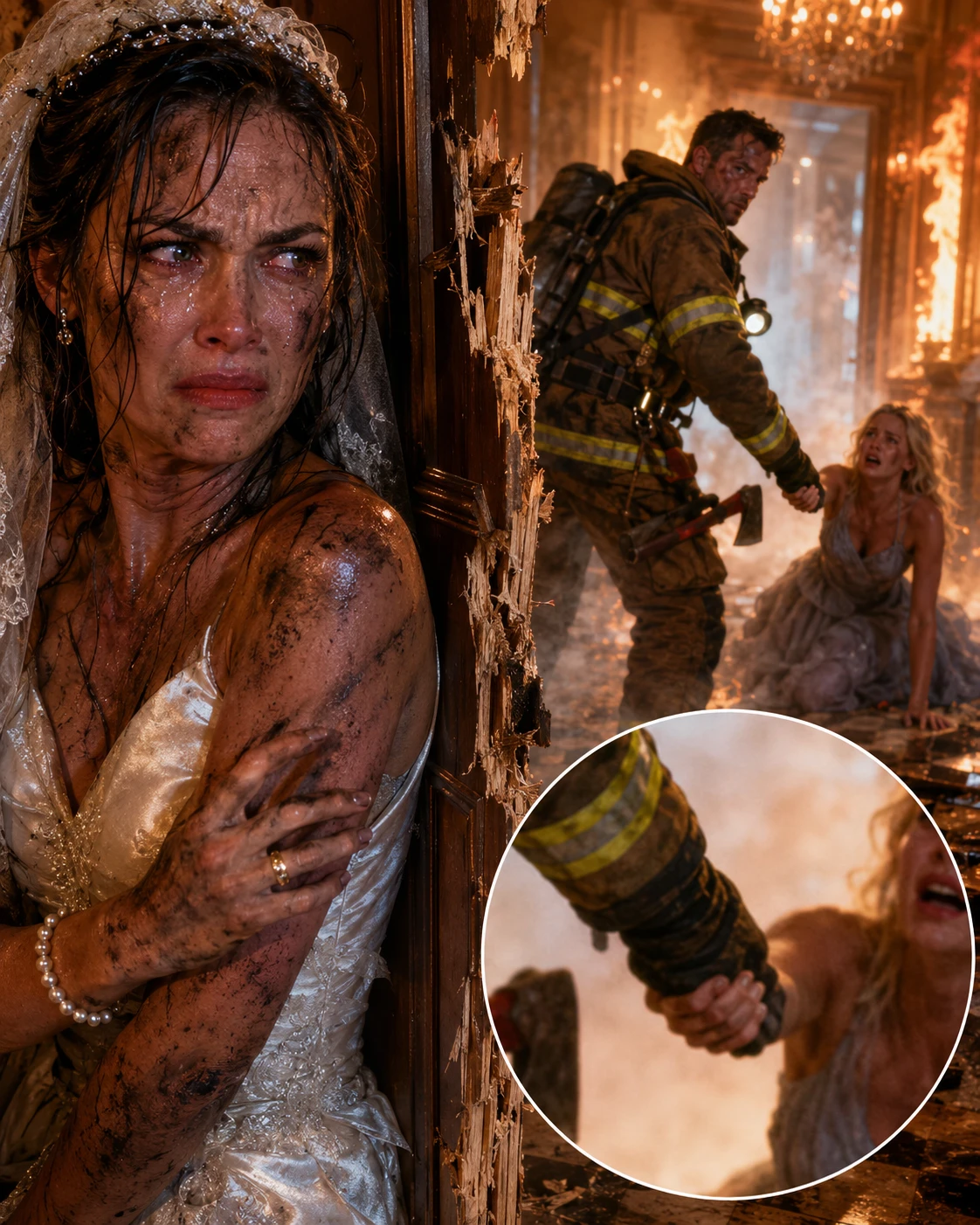
For one confused second, I stood perfectly still, staring at my reflection. The woman in the mirror wore a silk gown, a new gold ring, and an expression that had not yet understood fear.
Then orange light flashed beneath the door.
Smoke began curling into the room.
I grabbed the handle and pulled.
It did not move.
“Hello?” I shouted.
I twisted the handle again and put my shoulder against the door. Something solid had fallen or been wedged against it from the other side. The wood shuddered beneath my weight but refused to open.
Within seconds, the air changed. It became thick and bitter, carrying the smell of scorched fabric, burning paint, and something chemical that made my eyes water.
I pounded on the door.
“Somebody help me!”
The alarms drowned my voice.
I grabbed a chair and struck the door near the lock. Once. Twice. The chair splintered before the door did.
Then I heard footsteps in the hallway.
Heavy, controlled, unmistakable.
“Preston!” I screamed. “I’m in here!”
A flashlight beam cut through the smoke beneath the door. The sight of it filled me with such relief that my knees nearly gave way.
“Tara!” Preston shouted. “Step away from the door!”
I stumbled backward, pressing part of my veil over my mouth.
He was there.
My husband was there, and Preston had spent his entire life entering burning buildings when everyone else was running out. He had promised that as long as he was alive, nothing would happen to me.
I heard metal strike wood.
Once.
Twice.
Then a woman’s voice floated through the smoke.
“Preston…”
The blows stopped.
“Preston, I can’t breathe.”
My heart tightened before I even recognized her.
Khloe Mercer.
She had been Preston’s closest friend since childhood. She was beautiful in a fragile way that made people want to protect her—soft blond hair, pale blue eyes, and a voice that always seemed to tremble at exactly the right moment.
She also had an astonishing ability to need Preston whenever I needed him most.
During our first anniversary dinner, she called because someone had tried to break into her garage. On the night Preston planned to propose, she had a panic attack and kept him at her apartment until after midnight. When my father died, Preston missed the memorial service because Khloe had driven into a ditch during a snowstorm.
I had tried to be patient.
Preston and Khloe had survived difficult childhoods together. Her mother had died in a warehouse fire, and Preston’s father, a firefighter, had been killed trying to save her. Preston carried a deep, permanent sense of responsibility toward Khloe.
“She’s family,” he would say.
I never asked why family always seemed to come before me.
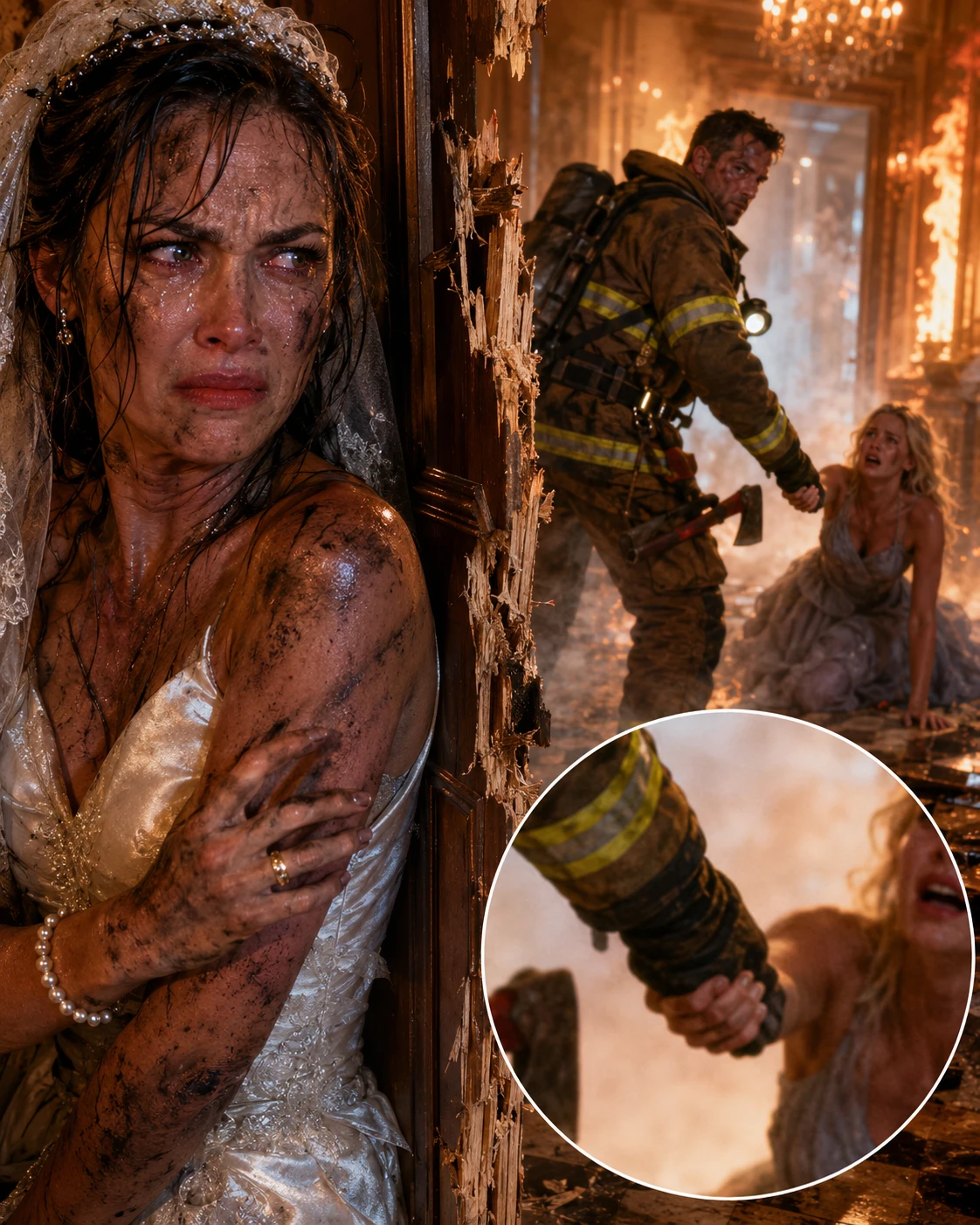
Now, through the narrow space beneath the door, I watched Preston’s boots turn toward her voice.
A younger firefighter shouted from somewhere nearby.
“Captain! Your bride is still in that room!”
There was a pause.
It lasted perhaps one second.
It divided my entire life into before and after.
“Get Khloe out first,” Preston ordered. “She has asthma.”
I stopped pounding.
The flames had begun creeping along the edge of the carpet, but for that terrible moment, I barely felt the heat.
Khloe coughed again.
Preston called to me through the smoke.
“Tara, listen to me. Stay low. Cover your mouth. You know first aid.”
I waited for him to say he was breaking down the door.
Instead, he said, **“I’ll be right back.”**
Then he left.
I heard him lifting Khloe. I heard the younger firefighter protest. I heard Preston order him to clear the hallway before the ceiling came down.
Their footsteps receded.
My husband had not failed to hear me.
He had not been unable to find me.
**He had looked at two lives and decided hers should be saved first.**
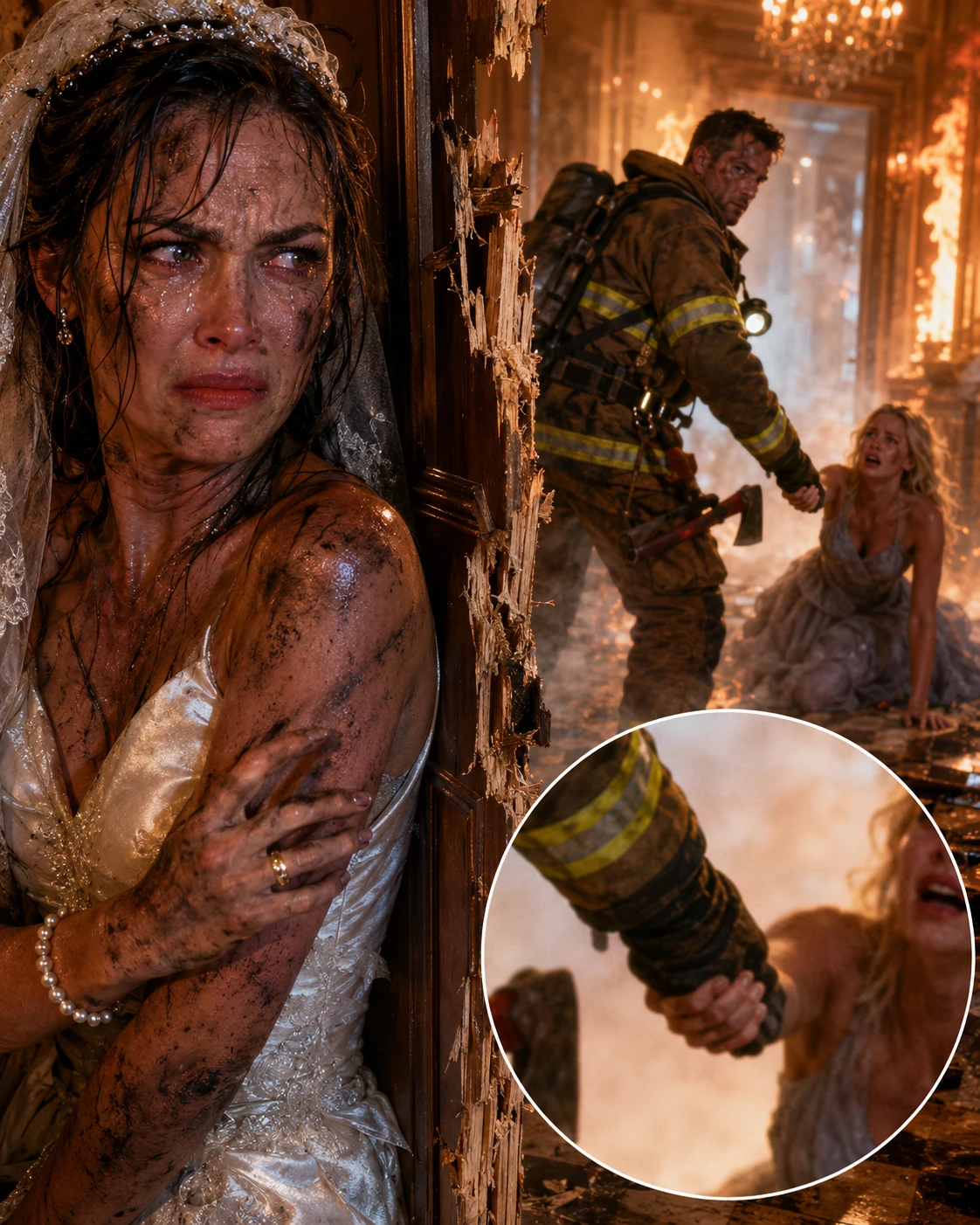
The hem of my wedding gown caught fire.
I slapped at it with my bare hands. The silk blackened and curled beneath my palms. Heat climbed my legs while smoke filled my lungs, each breath sharper and smaller than the one before it.
I crawled toward the window, but the antique latch had been painted shut. I struck it with the broken chair until the glass cracked but did not break.
My strength began draining from me.
Images passed through my mind with cruel clarity.
My father walking me through his garden when I was seven.
My mother’s pearls resting inside a velvet box.
Preston kneeling beside me with a ring.
Khloe calling.
Preston leaving.
I thought of every moment I had accepted second place because I was afraid that demanding more would make me difficult to love. Every interrupted dinner. Every abandoned plan. Every apology that had ended with me comforting him.
The smoke pressed me toward the floor.
I placed one burned hand against the door and whispered, “You promised.”
No one answered.
For one terrible moment, **I stopped fighting.**
Then the door exploded inward.
A firefighter burst through the smoke. He was younger than Preston, perhaps thirty, with soot streaked across his mask and a silver nameplate that read REED.
He dropped to his knees beside me.
“I’ve got you!”
I tried to speak, but only a broken sound came out.
He pulled off one glove, pressed two fingers against my throat, and shouted into his radio.
“Victim alive! Female, severe smoke inhalation and burns. I need the west corridor cleared now!”
The ceiling groaned.
He lifted me into his arms.
As he carried me into the hallway, a beam crashed behind us. Sparks scattered across the floor like fireflies. The young firefighter shielded my face against his chest and ran.
His heart hammered beneath his protective coat.
“Stay with me,” he said. “My name is Wyatt. You stay with me, Tara.”
I never understood, at the time, how he knew my name.
Near the entrance, the smoke thinned enough for me to see the open doors and the evening sky beyond them. Guests stood on the lawn in formal clothes, crying and filming the flames with their phones.
Preston was just outside.
His fire captain’s jacket had been wrapped around Khloe’s shoulders. She stood on her own, though she leaned toward him as he held both her arms.
Then something around her wrist caught the emergency lights.
Pearls.
My backup bracelet.
It had belonged to my mother, and I had placed it on the dressing table that morning in case the clasp on my primary bracelet broke. An hour before the ceremony, I discovered it was missing.
I had assumed one of the bridesmaids moved it.
But there it was on Khloe’s wrist.
As Wyatt carried me past, Preston looked up.
Our eyes met.
Recognition struck his face so violently that his mouth opened.
“Tara?”
For one breathless second, I expected him to release Khloe and run to me.
**His hands never left her shoulders.**
The world tilted.
Wyatt carried me to an ambulance. Paramedics cut through my wedding gown, fitted an oxygen mask over my face, and tried to keep me awake.
A woman bent over me.
“What is your name?”
“Tara,” I tried to say.
My voice did not exist.
“What did she say?”
“I can’t hear her.”
“Pressure is falling.”
“Possible airway collapse.”
The doors slammed shut.
Through the rear window, I saw Preston running toward the ambulance at last. Khloe stood behind him, wrapped in his coat, one hand covering my pearls.
Then the ambulance pulled away.
My lungs seized halfway to the hospital.
The paramedics shouted numbers. Someone pressed hard against my chest. The monitor beside me released one long, piercing tone.
I remember Wyatt’s face appearing above me. He had removed his mask, revealing dark hair, gray eyes, and an expression of desperate concentration.
“Do not let her die,” he said.
Someone pushed him away.
The darkness that followed was not peaceful.
It was filled with doors that would not open and footsteps walking away.
Three days later, I woke behind a sheet of reinforced glass.
Every part of me hurt. My throat felt lined with broken glass, my left arm was bandaged from wrist to shoulder, and clear tubes ran beneath my hospital gown.
A silver-haired nurse sat beside the bed.
When she saw my eyes open, she stood quickly.
“Do not try to speak,” she said. “Your airway was badly damaged.”
I tried anyway.
Only air escaped.
“You are at St. Catherine’s Medical Center. My name is Evelyn Carter. You survived.”
I closed my eyes.
Survived.
The word did not feel like victory.
Evelyn moistened my lips with a sponge.
“There is something you need to understand,” she said. “There has been a serious problem with your identity.”
I looked at her.
Before she could explain, voices sounded beyond the glass.
Evelyn turned.
In the hallway stood Preston.
He wore the same dark suit he had worn to my father’s funeral, though now it was wrinkled, and his face appeared several years older. He carried white flowers.
Khloe stood a few steps behind him.
She was not wearing my bracelet.
A hospital administrator approached Preston with a document. They spoke too softly for me to hear, but I saw the administrator point toward a covered body on a gurney farther down the corridor.
Preston stared at the paper.
The flowers slipped from his hand.
His knees struck the floor.
Evelyn quietly lowered the blind over my glass wall, but not before I saw the heading printed across the document.
**CERTIFICATE OF DEATH: TARA ELIZABETH HALE CROSS.**
My husband believed I had died in the fire.
The hospital had declared me dead.
And somewhere beyond that glass, another woman was lying beneath a sheet with my name attached to her body.
—
## PART TWO — THE ADVANTAGE OF BEING DEAD
For the next several hours, Evelyn refused to answer questions.
She said my blood pressure was unstable. She said the swelling in my throat made speech dangerous. She said there would be time for explanations after the doctors confirmed that my lungs had begun healing.
I did not want time.
I wanted the truth.
The following morning, Evelyn gave me a pad of paper and a black marker. My fingers trembled so badly that the first question looked like a child had written it.
**WHY DOES PRESTON THINK I’M DEAD?**
Evelyn read the words and sat slowly in the chair beside me.
“Because according to the hospital system, you are.”
I wrote again.
**WHO IS THE BODY?**
“A woman found near the estate’s service corridor. She had severe burns and no identification. She died before reaching the hospital.”
**WHY MY NAME?**
Evelyn glanced toward the door before answering.
“Your medical chart and hers were switched during admission. Your blood samples, photographs, and personal information were attached to her record. Her death was recorded under your name.”
I stared at her.
Accidents happened in hospitals. Charts were mislabeled. People made mistakes during disasters.
But this did not sound like one mistake.
It sounded like a sequence.
Evelyn seemed to read the thought on my face.
“I have worked in emergency medicine for thirty-eight years,” she said. “I have seen confusion. I have seen incompetence. This was neither.”
She explained that two ambulances had arrived within minutes of each other. I was unconscious and unidentified because my dress had been cut away and my belongings had been lost. The other woman had been wearing a hospital identification band by the time Evelyn first saw her.
The band bore my name.
“Who attached it?” I wrote.
“We don’t know.”
**CAMERAS?**
“Offline for maintenance.”
I almost laughed, but my chest hurt too much.
Evelyn lowered her voice.
“Someone accessed the hospital database at 8:43 that evening. Your admission file was moved to a restricted category under the name Anna Reed. Thirty-one minutes later, Tara Cross was pronounced dead.”
Reed.
I wrote the name.
Evelyn nodded.
“Yes. The firefighter who carried you out is Wyatt Reed.”
A pulse of alarm moved through me.
**DID HE CHANGE IT?**
“I don’t know. He was in the emergency department that night. He refused to leave until the doctors stabilized you.”
That could have meant he was protecting me.
It could also have meant he was watching.
Evelyn continued.
“At midnight, a man wearing a fire department uniform came to the nurses’ station. He asked whether the bride from Briarwood had survived. He did not give a name.”
“Preston?” I whispered painfully.
“No. I know Captain Cross. It was not him.”
The door opened.
Wyatt entered carrying two paper cups of coffee.
Without the helmet and soot, he looked younger than I remembered. He had a narrow scar near his left eyebrow and the quiet posture of someone accustomed to observing a room before entering it.
When he saw me awake, relief softened his expression.
“You made it.”
Evelyn accepted one cup but did not drink.
“Tara has questions.”
“I expected she would.”
He pulled a chair closer to the bed.
I wrote slowly.
**YOU KNEW MY NAME.**
Wyatt read the sentence.
“There was a wedding portrait near the staircase. Your names were printed underneath it.”
A reasonable answer.
Too reasonable, perhaps.
I wrote another.
**WHY ANNA REED?**
His eyebrows lifted.
“I don’t know.”
Evelyn watched him.
“Her restricted chart was created under your surname.”
Wyatt’s expression changed, but only slightly.
“I gave the emergency department my name because I rode in with her. Somebody may have used it when she came in unidentified.”
“Somebody with administrative access,” Evelyn said.
He looked toward the hallway.
“Has anyone told Preston she survived?”
“No,” Evelyn replied.
Wyatt turned to me.
“Keep it that way.”
The directness of the statement startled me.
Evelyn frowned. “That is her husband.”
“It is also her husband’s department that controlled the scene. Someone blocked that bridal suite door from the outside.”
My skin went cold.
Evelyn asked, “You are certain?”
“I went back after the fire was contained. The obstruction was not collapsed furniture. A steel serving cart had been pushed sideways and secured beneath the handle with a banquet table brace.”
He looked at me.
**“You were locked in deliberately.”**
The room seemed to narrow around us.
I remembered the handle refusing to turn. The chair splintering in my hands. Preston’s boots turning away.
“Who?” I forced out.
Wyatt shook his head.
“I don’t know. But someone wanted everyone to believe you died inside that room, and now the hospital has given them exactly what they wanted.”
Evelyn stood.
“We should notify the police.”
“Which police?” Wyatt asked. “The county fire chief was at the estate. Two sheriff’s deputies helped identify the body. The hospital administrator signed the emergency correction himself.”
“You are suggesting a conspiracy.”
“I’m suggesting we do not announce that she survived until we know who tried to kill her.”
I looked from Wyatt to Evelyn.
The sensible part of me wanted Preston.
I wanted his familiar voice, his steady hands, his explanation. I wanted him to enter the room, see that I was alive, and become the man I had believed I married.
Then I remembered his hands on Khloe’s shoulders.
I remembered my pearls around her wrist.
Evelyn returned the pad to me.
**DECIDE FOR YOURSELF**, she said.
I wrote for a long time.
**LET THEM THINK I’M DEAD.**
Wyatt did not smile, but something in his eyes settled.
“Then we find out who benefits from your death.”
The answer should have been no one.
My father’s estate had already been distributed. I owned a modest house, a small independent bookstore in Denver, and a collection of antique books that mattered more emotionally than financially.
Preston and I had signed a prenuptial agreement. We had discussed everything with painful maturity. If I died, he would receive the house, but not my father’s remaining trust.
Khloe would receive nothing.
Unless the fire was not about money.
Perhaps it was about the bracelet.
I wrote the word.
**PEARLS. KHLOE TOOK THEM.**
Wyatt leaned forward.
“Are they valuable?”
“No,” I whispered. “Mother’s.”
Evelyn brought water.
I took a careful sip, then wrote that the bracelet had disappeared before the ceremony and appeared on Khloe’s wrist during the fire.
Wyatt asked, “Did it have any unusual markings?”
“Gold clasp. Initials.”
“What initials?”
I closed my eyes, picturing the tiny engraving.
**S.H.**
Samuel Hale.
My father.
Wyatt’s gaze sharpened.
“Your father gave it to you?”
“He said it was my mother’s.”
“Did Khloe know that?”
“She knew everything about Preston. I don’t know what she knew about me.”
For six days, I remained behind the glass while the world mourned me.
News stations played footage of Briarwood Estate burning against the night sky. Preston appeared in photographs carrying Khloe through the smoke. Headlines called him heroic.
**FIRE CAPTAIN SAVES ASTHMATIC WOMAN FROM WEDDING INFERNO.**
**GROOM LOSES BRIDE HOURS AFTER CEREMONY.**
The story was irresistible.
A decorated firefighter had saved one life but lost the woman he loved. The town filled the steps of Preston’s station with flowers. Strangers donated money. People posted photographs of our wedding and wrote about tragic love.
No one mentioned that I had still been alive when he carried Khloe outside.
No one knew he had heard me begging.
On the seventh day, Evelyn wheeled me into a small observation room where a television showed the memorial service.
My photograph stood at the front of St. Matthew’s Church beside an empty white coffin.
Preston approached the lectern.
He looked exhausted.
“I have spent my life believing I understood fire,” he began. “I believed training could defeat panic and experience could overcome fear.”
His voice broke.
“But the worst fire of my life lasted only a few minutes, and I will spend the rest of my days inside it.”
The church was silent.
“I made a decision that night. I told myself it was a professional decision. One victim was visible, unable to breathe, and the other was behind a blocked door with another firefighter approaching.”
Wyatt, standing behind my wheelchair, shifted slightly.
Preston continued.
“But Tara was not a victim on an incident report. She was my wife.”
His hands gripped the lectern.
**“She called my name, and I left her.”**
A murmur moved through the church.
Khloe sat in the front row, pale and rigid.
Preston looked down at the empty coffin.
“I do not ask forgiveness. I have no right.”
Tears ran down my face before I could stop them.
I had wanted him to admit it.
Hearing him do so did not heal anything.
After the service, the camera followed people outside. Khloe tried to approach Preston, but he stepped away from her.
They argued beneath the church portico.
The microphone was too far away to capture their words, but Preston pointed toward her bare wrist.
Khloe reached into her purse and produced something small.
A flash of white.
My bracelet.
Preston took it from her.
Wyatt leaned closer to the screen.
“Pause it.”
Evelyn froze the image.
Preston held the pearls in one hand. With the other, he appeared to press the clasp.
The gold fastener opened.
Something dark and rectangular fell into his palm.
It was no larger than a fingernail.
Wyatt’s voice was very quiet.
“That is not a jewelry clasp.”
Evelyn enlarged the image.
A tiny memory card rested between Preston’s fingers.
My father had hidden something inside my mother’s bracelet.
Khloe knew it was there.
And Preston had known enough to look.
**My husband had been keeping secrets long before he left me in the fire.**
—
## PART THREE — WHAT THE PEARLS REMEMBERED
I left St. Catherine’s Medical Center under another woman’s name.
Evelyn arranged for me to recover at her sister’s empty cottage near Evergreen, where pine trees crowded around a narrow lake and the nearest neighbor lived half a mile away. My burns were hidden beneath long sleeves and compression bandages. A scarf concealed the healing skin along my neck.
Wyatt drove me there after midnight.
Neither of us spoke much.
Denver’s lights faded behind us, replaced by black mountains and scattered stars. I watched my reflection in the passenger window and barely recognized myself.
Before the fire, I had been a woman preparing to begin a marriage.
Now I was legally dead, hiding under an assumed name, investigating my husband and my oldest family memories.
At the cottage, Wyatt carried my bag inside.
“You should rest.”
“I have rested for eleven days.”
“You almost died.”
“I did die, according to the State of Colorado.”
He looked at me for a moment.
“That can be useful.”
The words unsettled me.
“How?”
“People speak freely around the dead.”
The next morning, Preston returned to our house.
Wyatt had placed a camera across the street, and we watched through a secure feed on a laptop. Preston entered alone and remained inside for three hours.
When he emerged, he carried a metal document box that had belonged to my father.
He drove west.
We followed at a distance.
Preston stopped at my father’s old mountain house, a property the estate had not yet sold. Khloe’s car was already outside.
Wyatt wanted me to remain hidden.
I refused.
The house stood among aspens, its porch silvered by years of snow. My father had brought me there every summer when I was a child. After my mother died, it became the only place where I could remember her without seeing grief on his face.
I entered through the back door.
Voices came from the study.
“You took it from her on her wedding day,” Preston said.
“I was trying to protect her.”
“You wore it while the building burned.”
“I put it on because I had no pockets!”
“You should have told me.”
“I tried. Every time I mentioned Samuel, you defended him because he was Tara’s father.”
Preston’s voice hardened.
“Samuel paid for my education after Dad died.”
“And perhaps you should have wondered why.”
I stepped into the doorway.
“Perhaps both of you should have told me the truth.”
Khloe screamed.
Preston turned so quickly that he knocked a lamp from the desk.
For several seconds, no one moved.
I had imagined this reunion many times. In some versions, Preston ran to me. In others, I slapped him. Sometimes I wept. Sometimes he did.
The reality was quieter.
He stared at my burned hands, the scarf around my throat, and the faint red scars reaching toward my jaw.
“Tara?”
His voice collapsed around my name.
Khloe pressed both hands over her mouth.
Preston took one step toward me.
I moved back.
He stopped.
“You’re alive.”
“Yes.”
He looked as though the room had shifted beneath him.
“They told me—I saw the body. I signed—”
“You signed my death certificate.”
“I thought it was you.”
“You looked at her face?”
His silence answered.
The body had been too badly burned.
Identification had depended on medical records, dental scans, and the authority of people no one thought to question.
Preston’s eyes filled.
“I saw you outside the estate. Wyatt was carrying you. I tried to reach the ambulance.”
“You did not try until after you were certain Khloe was safe.”
His face tightened.
“Tara, I need you to understand what I saw.”
“I saw it too.”
“She was on the floor. Her lips were blue. She could not breathe.”
“I was locked inside a burning room.”
“Reed was behind me.”
“He was not behind you when you made your decision.”
Preston lowered his head.
“No.”
The honesty hurt more than an excuse would have.
“No,” he repeated. “He was coming from the west stairs. I believed he could reach you while I moved Khloe. I made the calculation in seconds.”
“You calculated your wife.”
“I know.”
“You heard me calling.”
“I hear you every night.”
The room became painfully still.
Khloe began to cry.
I turned toward her.
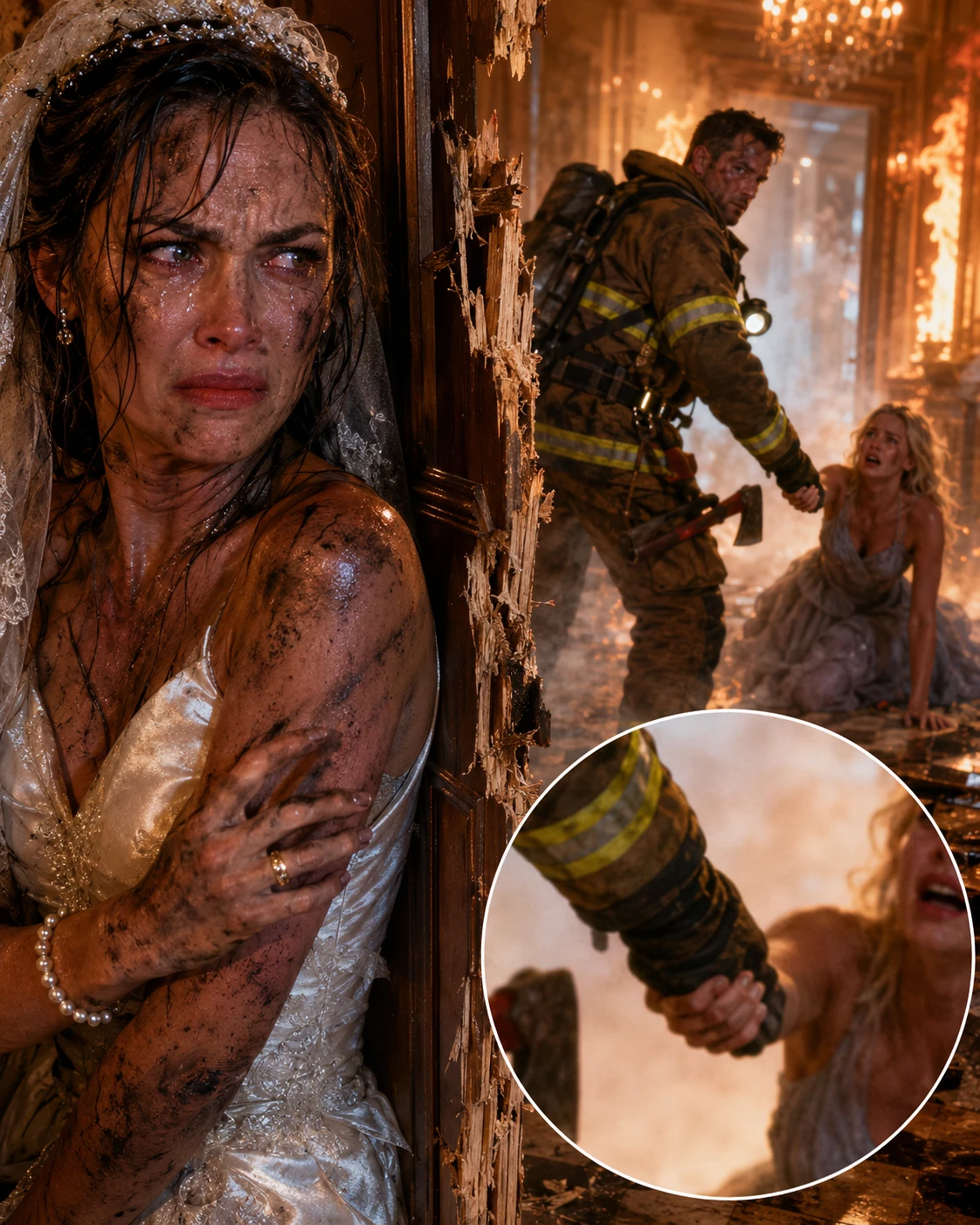
“Take off the bracelet.”
She looked at the pearls around her wrist.
“I’m sorry.”
“You were wearing my mother’s bracelet while my dress was burning.”
“I did not steal it because I wanted it.”
“Then why?”
Khloe removed the bracelet carefully and placed it on the desk.
“My mother was named Diane Mercer,” she said. “She worked as a bookkeeper for one of your father’s companies. Thirty-four years ago, she died in a fire at a warehouse in Aurora.”
“I know.”
“What you don’t know is that the fire was ruled accidental before the investigation was complete. Preston’s father died inside the same building. He had radioed that he found financial records and a locked office. Three minutes later, the roof collapsed.”
Preston opened my father’s document box.
Inside were yellowed newspaper articles, insurance reports, photographs, and copies of fire investigations.
Khloe continued.
“Six months ago, a woman contacted me. She said my mother had discovered something before she died. A network of companies had been buying failing properties, increasing their insurance coverage, and then collecting after fires.”
I looked at Preston.
“You knew?”
“Not at first.”
“But before the wedding?”
“Yes.”
The word cut cleanly.
Khloe opened the bracelet clasp and removed the tiny memory card.
“The woman told me Samuel kept evidence in something that had belonged to your mother. I did not believe her until I saw your bracelet at the rehearsal dinner.”
“So you searched my bridal suite.”
“Yes.”
“Why not ask me?”
“Because Samuel was your father, and every time anyone questioned him, you defended him.”
“My father was dead.”
“We did not know who else was involved.”
I thought of my father sitting beside my hospital bed when I had pneumonia at twelve. My father teaching me to drive. My father growing thinner during his final year, though doctors could not explain why.
He had been stern, private, and generous.
He had also been a commercial developer with dozens of companies I never understood.
“What is on the card?”
Preston inserted it into a laptop.
A password box appeared.
Khloe said, “We have tried everything.”
I looked at the bracelet.
My mother’s name was Laura.
My father used to call her his first light.
I typed FIRSTLIGHT.
The file opened.
Rows of property addresses filled the screen. Each was followed by an insurance policy number, a date, and a payment amount.
Seven properties had burned over a span of nineteen years.
The warehouse where Diane Mercer and Daniel Cross died was the first.
Briarwood Estate was the last.
Beside each address were initials.
S.H.
C.R.
A.V.
Preston pointed.
“S.H. is Samuel Hale.”
“C.R. could be Chief Conrad Rourke,” Khloe said. “He was a fire investigator before becoming chief.”
I recognized the final initials.
“Adrian Vale.”
Dr. Adrian Vale was the administrator who had signed my death record.
A second folder contained scanned letters.
The earliest were written by my father.
Conrad,
The west property is ready. Vale has confirmed the morgue intake can be adjusted. No remains must be identified until the claim is accepted.
I stopped reading.
My father’s words looked ordinary on the screen. His familiar sharp handwriting made them worse.
“He arranged deaths?” I whispered.
Preston said nothing.
Another letter referred to “replacement identities,” “unclaimed bodies,” and “accelerated certificates.”
The fires had not only been insurance fraud.
They had been used to erase people.
A final document had been created three weeks before my father’s death.
It was an unfinished confession.
My name is Samuel Hale, and for thirty-four years I have lived with the consequences of the Aurora warehouse fire. What began as fraud became murder when Diane Mercer discovered the accounts. Conrad Rourke sealed the west stairwell. Adrian Vale changed the dead. Daniel Cross entered the building because I told him workers were trapped inside.
Khloe made a broken sound.
Preston’s face emptied.
I kept reading.
I did not order their deaths, but I created the machinery that made them possible. My silence afterward made me no less guilty.
The document ended abruptly.
Below it was one sentence.
**THE BOY SURVIVED. FIND HIM BEFORE CONRAD DOES.**
“What boy?” I asked.
Khloe shook her head.
“My mother had no son.”
Preston examined the file information.
“This was modified the night Samuel died.”
My father’s death had been ruled a single-car accident. He had driven through a guardrail on a mountain road after midnight. No witnesses. No mechanical failure.
I had accepted it because grief makes explanations feel like mercy.
Wyatt entered the study.
Preston moved immediately between us.
“What is he doing here?”
“He saved my life,” I said.
Preston’s jaw tightened. “He also allowed the department to believe you were dead.”
“He did not create the death certificate.”
“You don’t know that.”
Wyatt closed the door behind him.
“And you do not know who locked her room.”
Preston stepped closer.
“Identify yourself.”
“Firefighter Wyatt Reed, Station Seventeen.”
“I checked the dispatch report. Station Seventeen was never assigned to Briarwood.”
Silence fell.
Wyatt looked at me.
“I was off duty. I heard the call while driving nearby.”
“In full equipment?” Preston asked.
“I keep gear in my truck.”
“Your radio was already on the tactical channel.”
“I know how to use a scanner.”
Preston’s suspicion filled the room.
I remembered Wyatt telling the paramedics not to let me die. I remembered him beside my hospital bed.
Yet I also remembered the chart labeled Anna Reed.
“Why were you at Briarwood?” I asked.
Wyatt held my gaze.
“I had received an anonymous message that morning. It said there would be a fire at the Hale wedding.”
Khloe gripped the desk.
“You never told us that.”
“I told the county dispatcher. She said there was no credible threat.”
“Show me the message,” Preston demanded.
Wyatt handed me his phone.
The message contained one line.
**THE PEARLS REMEMBER WHAT THE FIRE BURIED.**
My father had written something similar in a birthday card years earlier.
Pearls remember what people forget.
I had thought it was sentimental.
Now it felt like a warning.
Wyatt said, “Someone wanted me there.”
“Why you?” I asked.
“I have been trying to answer that since I carried you out.”
Preston did not believe him.
Neither did I.
But before we could ask another question, a bullet shattered the study window.
Wyatt threw me to the floor.
A second bullet tore through the wall.
Preston dragged Khloe behind the desk.
Outside, an engine roared to life.
Wyatt ran toward the porch, but the vehicle disappeared between the trees before he reached the road.
He returned holding a brass rifle casing.
Preston stared at it.
“That is county-issue ammunition.”
Wyatt closed his fingers around the casing.
“Someone knows Tara is alive.”
My death had protected me for eleven days.
Now that protection was gone.
And whoever had locked me inside the bridal suite had just tried to finish the job.
—
## PART FOUR — THE MEN WHO FED THE FIRE
The bullet changed everything.
Until then, some part of me had believed the truth could be uncovered carefully, one document at a time. The shattered window corrected that illusion.
We were no longer investigating history.
History was hunting us.
Preston wanted to take me directly to the state police. Wyatt argued that Conrad Rourke had spent thirty years building relationships throughout local law enforcement. Khloe wanted to publish every file online.
I surprised all of them.
“We need proof that cannot be dismissed as my father’s fabrication.”
Preston looked at me. “Tara, someone just fired at you.”
“Then we know we are close.”
“That is not a reason to continue.”
“It is exactly the reason.”
He stared at the woman I had become since the fire.
Perhaps he had expected the old Tara—the one who softened every disagreement, apologized before expressing anger, and made herself smaller so other people would remain comfortable.
That woman had died behind the bridal suite door.
The woman standing before him had climbed out of her own death certificate.
Wyatt knew a retired insurance investigator named Mason Greer who had worked several of the properties on my father’s list. Greer lived alone in a farmhouse near Fort Collins and refused to speak over the telephone.
We drove there the next afternoon.
Greer was seventy-one, thin as fence wire, with nicotine-stained fingers and a face that seemed permanently skeptical. He listened without interrupting while I explained the files.
When I finished, he looked at the scars on my hands.
“Samuel’s daughter.”
“Yes.”
“You have his eyes.”
“I hope that is all I have.”
Greer studied me for a long moment.
“Your father was not always the man described in those letters.”
“That does not excuse him.”
“No. It makes him more dangerous to understand.”
He led us into a back room filled with filing cabinets. From the bottom drawer, he removed a folder marked PHOENIX.
“The first fires were clean,” he said. “Vacant buildings. Inflated policies. No injuries. Samuel chose properties already scheduled for demolition.”
Khloe’s voice tightened.
“And then my mother found the accounts.”
Greer nodded.
“Diane Mercer was a good bookkeeper. Better than Samuel realized. She discovered payments to Rourke and Vale.”
“Why Vale?” I asked.
“To provide death certificates when the fires required them.”
Preston frowned. “Required deaths?”
“Some people wanted to disappear. Debtors. Witnesses. Men running from families. Samuel’s network could place an unidentified body in a burned building and declare someone else dead.”
The room felt colder.
“Like me,” I said.
“Exactly like you.”
Greer placed a photograph on the table.
It showed my father standing outside the Aurora warehouse with Conrad Rourke, Adrian Vale, Diane Mercer, and a young firefighter I recognized as Preston’s father.
A small blond girl stood beside Diane.
Khloe touched the image.
“That’s me.”
Behind Diane, partly hidden by her coat, was a baby carriage.
Khloe stared at it.
“My mother told everyone the baby died at birth.”
Greer looked toward Wyatt.
The color had drained from his face.
“You,” Greer said quietly. “I knew I had seen those eyes before.”
Wyatt stepped back.
Preston’s hand moved toward the weapon beneath his jacket.
Greer continued.
“Diane had a son. Samuel’s son.”
Khloe’s mouth opened.
“No.”
“Samuel was married to Laura at the time. Diane threatened to expose both the affair and the Phoenix accounts. The warehouse burned two weeks later.”
Everyone looked at Wyatt.
He appeared less shocked than he should have been.
I felt the room tilt beneath me.
“Who are you?” I asked.
Wyatt did not answer.
A car door slammed outside.
Greer moved toward the window.
The first shot struck him through the chest.
Khloe screamed.
Preston pulled her down. Wyatt overturned the table as bullets tore through the wall.
I crawled toward Greer.
Blood spread across his shirt.
He caught my sleeve.
“The boy,” he gasped. “Samuel tried to find…”
His eyes moved toward Wyatt.
Then his hand fell.
Smoke seeped beneath the back door.
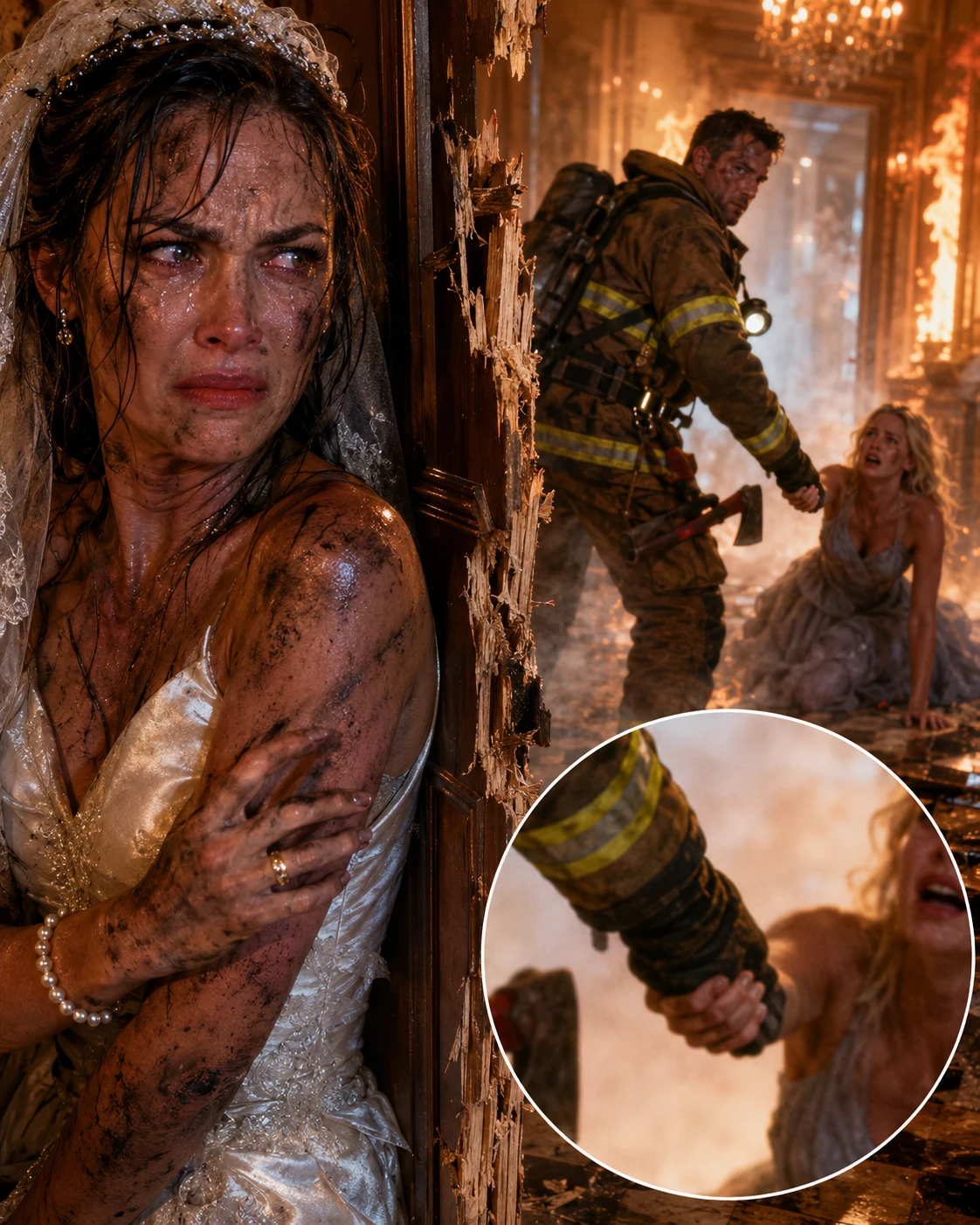
“They set the house on fire,” Preston said.
The front windows shattered.
Wyatt kicked open a cellar door and ordered us downstairs. Flames climbed the curtains as we descended into darkness.
A narrow storm tunnel led beneath the farmhouse to an equipment shed. We emerged among tractors while the main house burned behind us.
A black county vehicle sped away across the fields.
Preston raised his phone and photographed the license plate.
Wyatt stood staring at the fire.
Khloe approached him.
“Was she your mother?”
He said nothing.
“Was Diane your mother?”
“Yes.”
The word sounded dragged from a grave.
Khloe struck him across the face.
“You knew.”
“I suspected.”
“I am your sister.”
“Half-sister.”
“And you said nothing?”
“I did not know whether you were involved.”
“Involved in our mother’s murder?”
“I did not know who I could trust.”
Khloe laughed bitterly.
“That is rich coming from a man who appeared at a wedding before the fire department was called.”
Wyatt’s expression hardened.
“I spent my childhood in foster homes because Samuel Hale wanted his mistake buried. I learned my mother’s name when I was nineteen. I learned about the warehouse when I was twenty-four. Since then, I have followed every person connected to it.”
“Including Tara?” Preston asked.
“Yes.”
My stomach tightened.
“How long?”
“Two years.”
“You knew who I was before the wedding.”
“Yes.”
“And you told me you saw my name on a portrait.”
“I could not explain the truth while you were dying.”
“You have had weeks.”
He looked at me.
“I saved your life.”
The sentence should have reassured me.
Instead, it sounded like a debt he expected me to repay.
Preston stepped between us.
“Did you send the message to yourself?”
“No.”
“Did you alter her hospital chart?”
“No.”
“Did you lock the bridal suite?”
Wyatt’s jaw tightened.
“No.”
Preston turned to me.
“We cannot trust him.”
Wyatt replied, “You left her to burn.”
The words landed with brutal precision.
Preston did not defend himself.
Neither did I.
That evening, the state police confirmed that the vehicle photographed outside Greer’s farmhouse had been assigned to Chief Conrad Rourke. By morning, the vehicle had been reported stolen.
Rourke publicly denied knowing Mason Greer.
Dr. Adrian Vale announced he was taking emergency medical leave.
Both men were preparing to disappear.
We needed to force them into the open.
The unfinished confession on my father’s memory card referred repeatedly to the Aurora warehouse. Although the original building had burned, a newer storage facility stood on the same foundation. Rourke owned it through a shell company.
Khloe suggested sending him a message.
**SAMUEL KEPT THE ORIGINAL LEDGER. MIDNIGHT. AURORA. COME ALONE OR IT GOES TO THE STATE.**
Preston opposed the plan.
“It is a trap.”
“Yes,” I said. “Ours.”
“No. Theirs. We do not know how many people are involved.”
“We know Rourke and Vale are running.”
“And Wyatt?”
Wyatt stood across the room, silent.
I had begun noticing details I previously ignored.
He knew exactly how the hospital records had been changed.
He had arrived at Briarwood before his station was dispatched.
He had known Mason Greer.
He had followed me for two years.
Yet each suspicion collided with one undeniable fact.
When Preston walked away, Wyatt had come through the door.
That night, Preston found me alone on the cottage porch.
Snow had begun falling lightly over the lake.
He placed my wedding ring on the railing between us. The hospital had returned it with my belongings.
“I thought you might want this.”
I looked at the gold band.
“I do not know what I want.”
“I do.”
He waited until I met his eyes.
“I want you alive, even if that means you never forgive me.”
His face held no expectation.
“For years,” he continued, “I told myself Khloe needed me because of what our families survived. Every emergency felt connected to my father. Saving her became a way to believe I could save him.”
“And what was I?”
“The person who made me believe I had a future.”
“That sounds beautiful, Preston. It also means you kept sacrificing the future to repair the past.”
He closed his eyes.
“Yes.”
“Did you love her?”
“Not the way I loved you.”
“That was not my question.”
He understood.
“I loved being needed by her. I loved being the person who arrived. With you, I was afraid of failing because you saw me as more than a rescuer.”
“You did fail.”
“Yes.”
The snow collected in his hair.
“I saw you through the smoke,” he said. “Wyatt was carrying you, and I knew immediately that every justification I had made was a lie. I had not chosen based on training. I chose the person whose need felt familiar.”
I picked up the ring.
For a moment, I remembered his hands trembling as he placed it on my finger.
Then I put it in his palm.
“I forgive the man who made a terrible decision in a burning hallway.”
Hope flickered across his face.
“But I cannot remain married to a man who spent years teaching me that I came second.”
The hope disappeared.
He closed his hand around the ring.
“I understand.”
For the first time since the fire, **I believed him.**
At eleven thirty the following night, we entered the Aurora warehouse.
Preston had arranged for state investigators to monitor from two miles away, but the building’s steel construction disrupted the signal. Evelyn had copies of every file and instructions to release them if I did not contact her by one in the morning.
Khloe carried her inhaler.
Preston carried a fire axe.
Wyatt carried a gun.
I carried the bracelet.
At midnight, a side door opened.
Conrad Rourke entered first.
He was sixty-eight, thick-necked, silver-haired, and still powerful. Adrian Vale followed, sweating despite the cold.
Rourke saw me and stopped.
“You were supposed to be dead.”
Vale whispered, “I told you the chart was wrong.”
Rourke turned on him.
“You signed it.”
“Because he made me!”
“Who?” I asked.
Vale looked toward the darkness behind us.
“The one who brought you in.”
I slowly turned.
Wyatt stood near the main doors.
His gun was pointed at Preston.
Rourke laughed.
“There he is,” he said. “Diane’s little boy.”
Khloe moved toward Wyatt.
“Tell me he is lying.”
Wyatt’s eyes met mine.
The warmth I had seen in them was gone.
**“I am sorry, Tara,” he said. “But he isn’t.”**
—
## PART FIVE — THE FIREFIGHTER WHO NEEDED THE FLAMES
For a moment, nobody moved.
The warehouse creaked around us as wind pressed against its metal walls. Snow tapped faintly on the roof. Somewhere in the darkness, water dripped with slow, measured patience.
Preston lowered the axe.
“Wyatt.”
“That is not my name.”
Khloe’s face had gone white.
“What is it?”
He looked at her.
“Evan Mercer.”
The name changed him.
Wyatt Reed had been the young firefighter who broke through a burning door. Evan Mercer stood straighter, colder, as though he had spent years waiting to step out from behind the borrowed identity.
“My mother named me Evan,” he said. “Samuel’s lawyer changed it after the fire. I was moved through three foster homes before I turned five.”
Khloe shook her head.
“No. Mother believed you died.”
“Our mother was told I died. Then she discovered I had been hidden.”
Rourke sneered.
“Samuel panicked. His wife had learned about the affair. Diane had learned about Phoenix. He thought moving the child would solve both problems.”
“And when it didn’t,” Evan said, “you burned the warehouse.”
Rourke shrugged.
“Samuel built the machine. I merely kept it running.”
Khloe took another step toward Evan.
“Why did you never come to me?”
“Because you had Preston.”
The bitterness in his voice sounded almost childish.
“You grew up surrounded by people who remembered our mother. I grew up with strangers who told me I should be grateful for a bed.”
“I was six years old.”
“And Tara grew up in Samuel’s house.”
His gaze shifted to me.
“She received the gardens, the schools, the birthday parties, and the father who erased me.”
“My childhood was not your crime,” I said.
“No. It was your inheritance.”
Preston subtly moved closer to Khloe.
Evan noticed.
“Do not.”
He aimed the gun at Preston’s chest.
“Drop the axe.”
Preston obeyed.
Dr. Vale raised both hands.
“I did what you asked. I changed the records. I signed the certificate. You promised I could leave.”
Evan smiled without warmth.
“You changed hundreds of records for Samuel. Do not pretend Tara’s was the first.”
My pulse hammered.
“You declared me dead.”
“I needed the world to stop looking at you,” Evan replied.
“Why save me at all?”
The question seemed to please him.
“Because death would have been too easy.”
His answer entered me more deeply than the cold.
He walked closer.
“I spent years studying Samuel. I learned everything about his businesses, his charities, his beloved daughter, and the brave fire captain she planned to marry.”
“You followed me for two years.”
“I needed to know what kind of person he had raised.”
“And what did you decide?”
“That you were kind.”
The word sounded almost accusing.
“That made it worse. Monsters are simple. Innocent children who inherit the lives purchased by dead mothers are much more complicated.”
Khloe began to cry.
“Evan, I am your sister.”
“You are the sister who spent thirty years calling Preston whenever she was frightened.”
“I thought you were dead.”
“And tonight you will be.”
Preston lunged.
Evan fired into the floor beside him.
The shot echoed through the warehouse.
“Next time, Captain, I will not miss.”
Rourke moved toward a side exit.
Evan turned the weapon on him.
“You stay.”
Rourke stopped.
Vale’s breathing became rapid.
I looked around the warehouse more carefully.
Several red fuel cans stood along the walls.
A black cable ran from a timer toward stacked wooden pallets.
The entire building had been prepared to burn.
“You arranged the wedding fire,” I said.
Evan looked at me.
“Yes.”
Khloe made a strangled sound.
“You sent me the messages about the bracelet.”
“Yes.”
“You wanted me to steal it.”
“I needed the memory card removed before the room burned.”
“You knew I would call Preston.”
“I knew you always called Preston.”
The cruelty of his plan became clear.
He had not simply set a fire.
He had designed an emotional machine in which each of us would behave exactly as expected.
Khloe would take the bracelet.
She would panic.
Preston would choose her.
I would be left behind.
Evan would arrive as the hero.
“You blocked my door,” I said.
“Yes.”
My scarred hands began trembling.
“The serving cart.”
“I secured it before the ceremony.”
“You listened to me scream.”
His expression flickered.
“I was in the west corridor.”
“You waited.”
“I had to wait until Preston made his choice.”
Preston’s face twisted with horror.
“You used her to punish me.”
“I used your weakness to reveal you.”
“You nearly killed her.”
“I knew exactly how long the room would remain survivable.”
“You could not know that.”
“No,” Evan admitted. “I could not.”
For the first time, uncertainty crossed his face.
“I entered twelve seconds later than I intended. The ceiling fell early.”
“Twelve seconds,” I whispered.
“I still brought you out.”
“You set the fire and then expected gratitude for saving me.”
“I gave you the truth.”
“No. You gave me burns.”
He flinched.
It was slight, but I saw it.
Evan wanted to be understood. Beneath the planning, the identities, and the weapon was a boy who had built his entire life around the belief that pain became justice when carefully arranged.
That need made him dangerous.
It also made him predictable.
“What happened to my father?” I asked.
Rourke laughed.
“Ask your firefighter.”
Evan’s jaw tightened.
“I confronted Samuel six months ago. I showed him what I knew.”
“He died that night.”
“He tried to leave.”
“You forced his car off the road.”
“He chose the cliff.”
“Did he?”
Evan did not answer.
Rourke said, “The old man begged for time. Said he had written a confession. Said he was changing his will.”
“Be quiet,” Evan ordered.
Rourke smiled.
“He had been searching for you, boy.”
“Liar.”
“He hired Greer to find you.”
Evan’s hand tightened around the gun.
“You killed Greer.”
“Because you told me where he was.”
Khloe stared at Evan.
“You gave Rourke the address?”
“I needed him frightened. Frightened men confess.”
“He murdered an innocent man.”
“No one connected to Phoenix was innocent.”
“Mason was trying to expose it.”
“He waited thirty-four years.”
Evan pointed toward Rourke and Vale.
“Tonight, the architects die. Preston dies for choosing Khloe. Khloe dies because our mother died trying to protect her. Tara dies as Samuel’s final heir.”
“And you?” I asked.
“I walk away as Wyatt Reed, the firefighter who tried to save everyone.”
The elegance of the plan was horrifying.
Rourke and Vale would be blamed for another Phoenix fire. Preston, Khloe, and I would become victims. Evan would survive as the heroic firefighter who had already rescued the dead bride once.
He would control the entire story.
Just as my father and Rourke had controlled so many stories before him.
“You made one mistake,” I said.
Evan’s eyes narrowed.
“What mistake?”
“You believed I trusted you.”
Something changed in his face.
I reached slowly into my coat.
He raised the gun.
“Hands where I can see them.”
I removed a small silver device and held it between two fingers.
It was not a weapon.
It was a transmitter.
“The signal does not leave the building,” Evan said.
“It does not need to.”
His eyes dropped toward the device.
“It records locally,” I continued. “Every word you said is stored in three places.”
“You are bluffing.”
“Am I?”
I had begun suspecting him at Mason Greer’s house.
Not because Greer recognized him.
Because when Greer was shot, Evan moved before the glass shattered.
He had known where the bullet would come from.
Later, I discovered that his fire department identification had been issued only eight months earlier. Wyatt Reed had no childhood records, no school photographs, and no Social Security history before age twenty-eight.
Evelyn found one more detail.
The hospital camera system had not truly been offline.
The recordings had been rerouted to a private server registered under the name E. Mercer.
I had told no one—not Preston, not Khloe, and certainly not Evan.
The transmitter in my hand was connected to a recorder sewn inside my compression sleeve. A second recorder was hidden in Khloe’s inhaler case. A third had been placed beneath the warehouse floor two hours earlier by state investigators.
Evan’s attention moved to Khloe.
She held up her inhaler.
Her tears were real.
So was the tiny green light blinking beneath her thumb.
Preston moved.
Evan fired.
The bullet struck Preston high in the shoulder and spun him backward.
Khloe screamed and dropped beside him.
Rourke rushed toward Evan.
A second shot struck Rourke in the leg.
Vale ran for the side door.
The timer beside the fuel cans reached zero.
Flames rose along the eastern wall.
The fire moved faster than any natural flame should have moved. It rolled across the treated pallets, climbed the support columns, and spread through channels Evan had prepared in advance.
He had built another bridal suite.
Another locked room.
Another choice.
Smoke thickened beneath the roof.
Evan backed toward the main doors.
They did not open.
For the first time, surprise broke through his control.
“What did you do?” he shouted.
“I locked them,” Rourke said from the floor.
Even wounded, the old fire chief smiled.
“You were never leaving me inside.”
Evan fired at the lock.
The bullet ricocheted.
Preston pressed one hand against his bleeding shoulder and pointed toward the rear of the warehouse.
“Service tunnel. West wall.”
Rourke laughed again.
“Sealed it years ago.”
Heat gathered around us.
Khloe struggled to breathe.
Preston took her inhaler, shook it, and placed it in her hand.
“Slow breath. Look at me.”
Then he looked toward me.
“Tara, there is a manual suppression valve in the basement. Old warehouses were required to have one.”
“You are injured.”
“I can still move.”
A burning beam crashed between us and Evan.
Vale disappeared into the smoke.
Rourke crawled toward the wall.
Evan stood alone near the center of the warehouse, staring at the flames he had created.
I understood then that he had never expected to face them.
He had spent his life studying fire as a weapon, a language, and a form of judgment.
But fire had no loyalty.
Preston led us toward a metal staircase. We descended into a basement filled with pipes and rusted valves.
Smoke followed.
Khloe coughed violently.
Preston leaned against the wall, blood running between his fingers.
“There,” he said.
A red wheel protruded from a pipe.
I tried to turn it.
It would not move.
Preston placed his uninjured hand over mine.
Together, we pulled.
The wheel groaned.
Nothing happened.
Khloe joined us.
All three of us forced the valve.
It turned.
For one second, the warehouse remained filled with flame.
Then overhead pipes burst open.
Water crashed through the ceiling.
Steam exploded around us.
The fire weakened, but portions of the roof had already begun collapsing.
We climbed toward the loading bay, where a section of wall had buckled from the heat. Preston used the axe to widen an opening.
Khloe crawled through first.
I followed.
Outside, sirens approached through the snow.
Preston remained inside.
“Preston!”
“Evan is still there.”
I grabbed his coat.
“He tried to kill us.”
“I know.”
“You cannot save everyone.”
His eyes met mine.
The sentence passed between us with the weight of our entire marriage.
“I know that now,” he said.
He stepped outside.
A crash sounded from within the warehouse.
Through the smoke, I saw Evan beneath a fallen beam.
He was alive.
Flames crawled toward him.
He looked at me through the opening.
“Tara!”
The way he said my name was different now.
Not like a firefighter.
Not like an avenger.
Like a frightened boy.
Preston caught my arm.
“The roof is going.”
I could leave Evan.
No one would blame me.
He had blocked my door, burned my body, stolen my life, and turned my husband’s worst weakness into a public execution of our marriage.
The fire offered me an ending simple enough to understand.
Then I remembered my hand sliding down the bridal suite door.
I remembered believing no one would return.
**I would not become the person who listened to someone beg and walked away.**
I took Preston’s axe.
“Tara, no.”
“I am not saving him because he deserves it.”
I crawled back through the opening.
Water and burning debris fell around me. Evan struggled beneath the beam, one leg trapped.
“You came back,” he gasped.
“Do not make me regret it.”
I struck the weakened wood three times. Preston crawled in beside me despite his wound.
Together, we lifted enough for Evan to pull free.
The roof groaned.
We dragged him toward the opening.
A section of ceiling collapsed behind us as we fell into the snow.
State police surrounded the building.
Officers took Evan into custody.
He did not resist.
As they led him away, he looked back at me.
“Why?”
I understood the question.
Why save the man who had made me suffer?
Why refuse the justice he would have accepted?
“Because you do not get to decide what the fire makes of me,” I said.
His face crumpled.
That was the first moment I saw Evan Mercer cry.
The investigations lasted fourteen months.
Conrad Rourke survived and received multiple life sentences for murder, attempted murder, arson, insurance fraud, and conspiracy. Adrian Vale testified in exchange for a reduced sentence, though reduced still meant he would die in prison.
The Phoenix network was exposed.
Twenty-three people who had been declared dead under false identities were traced. Some had paid to disappear. Others had never known their names had been used. Families who had mourned empty graves finally learned the truth.
My father’s companies were dissolved.
His remaining fortune was placed into a restitution fund for the families affected by the fires.
The public removed Samuel Hale’s name from schools, hospital wings, and charitable foundations. The bronze plaque at my former college disappeared one rainy morning.
I did not object.
Love did not require me to protect my father from the truth.
Preston resigned from the fire department before the disciplinary board reached a decision. He was not charged, but he refused to let the town continue calling him a hero.
He began training emergency crews on decision-making under emotional pressure.
We annulled our marriage.
The process took twenty minutes.
Longer than we had been husband and wife before the fire began.
On the courthouse steps, Preston returned my mother’s bracelet.
“I had the clasp repaired.”
I took it.
“Thank you.”
He looked older than he had at our wedding, but perhaps so did I.
“I will always be sorry.”
“I know.”
“And I will always love you.”
“I know that too.”
He waited.
There was no dramatic reconciliation. Some wounds can be forgiven without becoming doors back into the same room.
I kissed his cheek.
Then I walked away.
Khloe and I did not become sisters in any simple, sentimental sense. She had stolen from me, used Preston’s guilt, and allowed her fear to dominate our lives.
But she had also lost a mother, a brother, and the truth about her childhood.
We began with letters.
Months later, we had coffee.
Trust returned slowly, not as innocence but as a decision made with open eyes.
Two years after the fire, I reopened my bookstore under a new name.
FIRST LIGHT.
The front room held novels, comfortable chairs, and photographs of people whose identities had been stolen by Phoenix. The upstairs offered free legal assistance to families correcting false death records.
On the wall behind the counter hung my framed death certificate.
People often thought it was a joke.
It was not.
On the second anniversary of the fire, Evelyn arrived carrying a sealed envelope.
“This was found among Adrian Vale’s private records,” she said. “It was addressed to you.”
The handwriting belonged to my father.
Inside was a letter dated four days before his death.
Tara,
By the time you read this, you may know what I did. There is no explanation that can make it smaller.
I spent my life pretending guilt was the same as repentance. It is not. Guilt looks backward. Repentance gives up what it stole.
I have changed my will. Nothing will pass directly to you or to Evan. Everything will go to the people harmed by Phoenix.
I stopped breathing for a moment.
My father had known Evan was alive.
I continued reading.
Conrad told Evan that I abandoned him willingly. That is not true. I searched for him for twenty-seven years. Every investigator I hired was threatened or bought. When I finally found him, he had already found you.
He believes you received the life meant for him. What he does not know is that I was never your biological father.
The room fell silent around me.
I read the sentence again.
Evelyn pulled out a chair.
My hands trembled as I unfolded the second page.
Your mother, Laura, could not have children. During the Aurora fire, Diane placed a baby girl in Daniel Cross’s arms before returning for the financial records. Daniel carried the child outside and went back for Diane.
He never returned.
The baby was you.
The words blurred.
Diane Mercer was not only Khloe and Evan’s mother.
**She was mine.**
Samuel had adopted me after arranging the fire that killed my biological mother. He had raised me not as his daughter by blood, but as a living monument to his guilt.
Preston’s father had saved me from the warehouse thirty-four years before Preston left me in another fire.
And Evan, the man who had locked me inside the bridal suite, was not my father’s abandoned son standing against his favored daughter.
**He was my brother.**
I sat in the bookstore until evening, surrounded by the quiet breathing of books.
Then I drove to the state penitentiary.
Evan entered the visiting room in gray prison clothes. His hair had begun turning silver near his temples. The scars from the warehouse crossed one side of his neck.
He sat behind the glass.
“You look well,” he said.
I placed my father’s letter against the partition.
“You should read this.”
He scanned the first page without expression.
Then he reached the second.
His lips parted.
He read it twice.
“No.”
“The DNA test confirmed it.”
He shook his head.
“No.”
“Diane was my mother.”
His eyes lifted to mine.
For years, he had believed I represented everything stolen from him.
Now he saw our mother’s eyes in my face.
“You were the baby,” he whispered.
“Yes.”
“Samuel took you.”
“He raised me.”
“I tried to kill my own sister.”
“You tried to kill many people.”
He lowered his head.
“I thought you were his.”
“I was. In every way that shaped my childhood.”
“But you were hers.”
“So were you.”
His shoulders began to shake.
I did not forgive him that day.
Forgiveness is not a key that opens every locked door. Sometimes it is only the decision to stop carrying hatred from room to room.
I placed my hand against the glass.
After a long time, Evan lifted his hand to meet mine from the other side.
Between us stood a wall neither of us could cross.
But for the first time, it was not made of fire.
Years later, people continued asking what I regretted most.
Marrying Preston?
Trusting Wyatt?
Defending my father?
Ignoring the signs?
The answer was none of those things.
I regretted every year I had believed love had to be earned by accepting less than I needed. I regretted confusing patience with silence and loyalty with self-erasure.
The fire took my wedding dress, my marriage, my unscarred skin, and the father I thought I knew.
It also gave me something I had never possessed before.
A life that belonged completely to me.
On quiet mornings, I still touch the pearl bracelet around my wrist. Its clasp no longer holds secrets. The memory card sits in an evidence vault, and the pearls have been restrung with stronger thread.
Sometimes Preston visits the bookstore. Sometimes Khloe joins him. We sit beneath the photograph of Diane Mercer and speak honestly about the dead, the living, and the terrible distance between intention and choice.
We are not the family any of us expected.
But we no longer build our lives around lies.
And whenever someone asks why I keep my death certificate displayed where every customer can see it, I tell them the truth.
**Because Tara Elizabeth Hale Cross died in that fire.**
She was the woman who waited behind locked doors.
She was the woman who mistook being chosen eventually for being chosen completely.
She was the woman who believed rescue could only come from someone else.
The woman who walked out of the flames carried a different name in the hospital records, scars across her body, and no idea what waited beyond the glass.
But she was alive.
And this time, **she chose herself first.**
“`