**PART ONE
THE DAY HE THREW ME AWAY**
The first time my husband looked at me as though I were a stranger, **a hundred cameras were there to preserve it**.
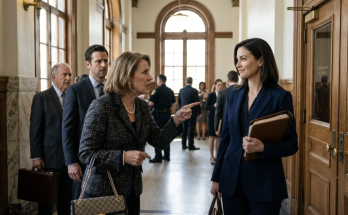
Reid Ashford stood on the steps of the county courthouse in Minneapolis with his arm wrapped around one of the most beautiful women in America. Photographers shouted his name, reporters pushed microphones toward him, and flashes burst against the gray afternoon like silent explosions. Beside him, Marissa Blake leaned against his shoulder with the effortless confidence of a woman accustomed to being watched.
I stood less than ten feet away, holding the folder that officially ended our six-year marriage.
The ink on the divorce papers was barely dry.
My wedding ring was still on my finger.
Reid’s had already disappeared.
Marissa was famous enough that even people who knew nothing about fashion recognized her face. She appeared on perfume advertisements, luxury billboards, and magazine covers displayed beside supermarket cash registers. That afternoon, she wore a cream-colored coat that probably cost more than my first car, and she had turned the courthouse steps into a runway for their public debut.
Reid looked proud.
Not nervous. Not ashamed. Not conflicted.
**Triumphant.**
As though leaving me had been the easiest and most intelligent decision he had ever made.
I had seen that expression on his face before—when Ashford Genomics secured its first federal contract, when the company reached a valuation of ten billion dollars, and when a financial magazine called him “the architect of modern preventive medicine.”
But I had never expected to see it on the day our marriage died.
“Mr. Ashford!” a reporter called. “How long have you and Ms. Blake been together?”
Another shouted, “Were you seeing each other before the separation?”
Reid did not answer directly. He merely smiled and tightened his arm around Marissa.
That smile told them everything they wanted to know.
I felt something cold and sharp move through my chest. For six years, I had known the private version of Reid—the man who slept with one foot outside the blankets, who hated thunderstorms but pretended not to, who called his father every Sunday even when they had nothing to say. I knew how he took his coffee, which shoulder ached when he was under pressure, and how his voice softened whenever we talked about the children we hoped to have.
Now he was presenting himself to the world as though I had been nothing more than an unfortunate chapter between his rise to power and the glamorous life he deserved.
Marissa looked directly at me.
Her smile was polished, controlled, and utterly empty.
“Some women are only part of the warm-up,” she said softly.
She made certain I heard her above the clicking cameras.
For one terrible second, rage burned through my grief.
I wanted to ask her whether she knew that Reid still kept the faded ticket from our first baseball game in the back of his desk drawer. I wanted to tell her that the mansion she had probably already visited had been renovated from plans I had drawn at our kitchen table. I wanted to explain that I had sat beside Reid through his father’s final illness, through corporate investigations, sleepless nights, and every moment when the empire he inherited had nearly collapsed beneath him.
More than anything, I wanted to turn to Reid and remind him of the night he had held me in the nursery we never used.
“We’ll fill this room someday,” he had whispered.
I had believed him.
Instead, I swallowed every word.
I would not give them the pleasure of watching me beg.
Reid adjusted the sleeve of his perfectly tailored charcoal suit and glanced at me with something that looked almost like pity.
That expression hurt more than Marissa’s insult.
“Claire,” he said, shaking his head. “Don’t make this dramatic.”
The reporters fell quiet enough to listen.
“You were good to me,” he continued. “But Marissa is the life I’m choosing now.”
**You were good to me.**
As though I had been an employee receiving a satisfactory final review.
As though love were a service I had performed adequately until someone more attractive applied for the position.
The sounds around me began to disappear. The traffic, the reporters, the cameras, the distant courthouse doors opening and closing—all of it faded until I could hear only the pounding of my own heart.
Inside my handbag, beneath a package of tissues and the keys to a house that no longer felt like mine, lay a white envelope from a private medical clinic.
I had opened it that morning.
I had read the result four times.
**Pregnant.**
After three years of failed treatments, two surgeries, and countless nights of quiet disappointment, I was carrying the child Reid and I had once prayed for.
Six weeks.
The doctor had warned me that it was early. She had also warned me that stress could be dangerous.
I had walked into the courthouse intending to tell him after the papers were signed. I had imagined that, no matter what had happened between us, the news might awaken something decent in him.
Then I saw Marissa.
Then I heard him call her the life he was choosing.
Slowly, I removed my wedding ring.
My fingers were cold, but they did not tremble.
I placed the ring on top of the divorce papers and handed the folder to Reid’s attorney.
There were a thousand things I could have said. I could have told Reid that our child already existed, a heartbeat beginning somewhere beneath my own. I could have demanded an explanation or asked whether six years of marriage had truly meant so little.
Instead, I looked directly into his eyes.
“I hope you understand what you just gave away.”
For the briefest moment, uncertainty flickered across his face.
Then Marissa slipped her hand into his and guided him toward the cameras.
They walked away together while reporters shouted questions about their future. Reid did not look back.
I remained on the courthouse steps until they disappeared into a black car.
Only then did I allow myself to breathe.
My attorney, Helen Vargas, approached from behind me. She was sixty-two, silver-haired, and possessed the steady gaze of a woman who had watched people destroy their lives over pride.
“Are you all right?” she asked.
“No.”
It was the first honest word I had spoken all day.
Helen glanced toward the departing car.
“Do you need me to take you home?”
I pressed my palm against my abdomen, although there was nothing yet to feel.
“I need to go somewhere first.”
Twenty minutes later, I sat in the office of Dr. Evelyn Shaw, an independent obstetrician whose clinic had no connection to Ashford Genomics or any of its hospitals.
Dr. Shaw studied my face before looking at the screen beside her.
“The pregnancy is progressing normally,” she said. “Given your history, I would like to monitor you closely.”
“My history,” I repeated.
According to the specialists at Ashford Reproductive Medicine, I had less than a two-percent chance of conceiving naturally. Reid had attended every early appointment, holding my hand while doctors explained that my ovaries had stopped functioning properly.
Eventually he stopped attending.
Eventually he stopped asking.
“Could the previous diagnosis have been wrong?” I asked.
Dr. Shaw hesitated.
“Medicine is not perfect. But the records you brought are unusual.”
“In what way?”
“Your hormone levels from three years ago do not match the pathology described in the reports.”
I stared at her.
“What does that mean?”
“It means I would like to repeat everything independently.”
She turned the monitor so I could see the tiny flicker on the ultrasound.
There it was.
A fragile pulse of light.
My child.
My hand rose to my mouth as tears filled my eyes.
The marriage was over. The future I had imagined was gone. The man I loved had celebrated losing me in front of the world.
Yet inside me, something continued.
Something innocent.
Something that had survived the ruin.
Dr. Shaw lowered her voice.
“Claire, does your former husband know?”
I thought of Reid’s arm around Marissa. I heard his voice again.
Marissa is the life I’m choosing now.
“No,” I said.
“Will you tell him?”
I watched the tiny heartbeat on the screen.
“Not yet.”
That evening, I returned to the lake house my father had left me outside Stillwater. It was small compared with the Ashford estate, but it had wide wooden floors, a stone fireplace, and windows that looked across the frozen water.
I had not lived there since my father died.
Dr. Thomas Monroe had been a quiet, brilliant man who believed all problems could be solved with patience and careful observation. He had worked in medical research when I was a child, although he rarely discussed the details.
He died in a car accident when I was seventeen.
Reid’s father, Harrison Ashford, had paid for my college education through a charitable scholarship. Years later, Harrison introduced me to Reid at a museum fundraiser.
At the time, I believed it was coincidence.
Standing alone in my father’s old house, I began to wonder how much of my life had been decided by people who had never bothered to tell me the truth.
On the kitchen table sat an overnight package delivered by courier.
The return address belonged to Ashford Genomics.
Inside was a confidentiality agreement.
The letter reminded me that, during my marriage, I had attended private corporate meetings and had access to sensitive information. In exchange for an additional financial settlement, I was expected to sign a permanent nondisclosure agreement.
At the bottom was Reid’s signature.
He had not even waited twenty-four hours.
I read the letter twice, then carried it to the fireplace.
I watched the corner catch, curl, and darken.
By the time the signature disappeared into ash, I had made my first decision as a divorced woman.
**Reid had chosen his future.**
Now I would protect mine.
And I would not sign away another word.
—
**PART TWO
THE CHILD THEY SAID COULD NEVER EXIST**
Pregnancy changed the shape of time.
The first weeks moved with unbearable slowness. Every morning began with fear, and every night ended with my hand resting over the life inside me. I waited for bad news because disappointment had trained me to distrust hope.
But the child remained.
At ten weeks, I heard the heartbeat clearly.
At fourteen weeks, Dr. Shaw told me the genetic screening was normal.
At twenty weeks, the ultrasound technician smiled and said, “You have a son.”
A son.
I drove home through spring rain, repeating the words until they felt real.
For years, Reid and I had spoken about names. He liked old family names—Harrison, Charles, Edward. I preferred names without the weight of inheritance.
In the end, I chose Henry.
My father’s middle name.
The second name required no thought at all.
**Henry Thomas Monroe.**
I gave him my name because I did not know whether Reid deserved to give him anything.
Meanwhile, Reid and Marissa became impossible to avoid.
Their faces appeared everywhere. They attended premieres, charity galas, and fashion events. Photographs showed them boarding private planes and leaving restaurants with their hands intertwined. Commentators called them a “power couple,” as though beauty and money were proof of happiness.
Three months after the divorce, Reid announced that Marissa would become the global ambassador for VitaSure, Ashford Genomics’ most profitable medical product.
VitaSure was a prenatal genetic screening platform marketed to hospitals across the country. It promised expectant parents earlier, more accurate information about inherited conditions.
I knew the product better than most members of Reid’s board.
During the first years of our marriage, I had worked quietly behind the scenes, reviewing patient communication and identifying inconsistencies in clinical reports. My graduate degree was in health administration, and I had once believed that helping Reid improve the company was part of building our life together.
The public never knew.
To investors, I was merely the founder’s pleasant wife.
Reid often thanked me in private.
He never credited me in public.
In May, I received a call from a man named Peter Lang, a former quality-control director at Ashford Genomics.
“I’m sorry to contact you,” he said. “But I heard you refused the nondisclosure agreement.”
“How did you hear that?”
“People inside the company are nervous.”
I stood at the window overlooking the lake.
“What do they have to be nervous about?”
There was a long pause.
“Your medical records.”
My fingers tightened around the phone.
“What about them?”
“They were modified.”
The room seemed to tilt.
Peter asked to meet at a diner halfway between Minneapolis and Stillwater. He arrived wearing an old brown coat and looked repeatedly toward the parking lot before sitting across from me.
He placed a flash drive on the table.
“I worked on an internal audit two years ago,” he said. “We found unusual access to patient databases, especially records involving employees, board members, and their families.”
“My fertility records?”
“Yours and Reid’s.”
I stared at him.
“What do Reid’s records say?”
Peter rubbed his hands together.
“I never saw the complete file. But I saw access logs. Test results were replaced, then locked under executive authorization.”
“Whose authorization?”
“The account belonged to Julian Cross.”
Julian was Ashford Genomics’ chief operating officer. He had worked beside Reid’s father for more than twenty years and had remained with the company after Harrison’s death.
He was also Reid’s mother’s closest adviser.
“What was changed?” I asked.
“I don’t know. I tried to investigate, and I was dismissed three days later.”
“Why come to me now?”
“Because VitaSure records were altered too. Thousands of them.”
The waitress approached, and Peter fell silent until she moved away.
He leaned closer.
“The company has been suppressing false-negative reports. Families were told their children were healthy when the data showed serious conditions. Other families received false warnings and made irreversible medical decisions.”
The baby moved inside me—a soft flutter beneath my ribs.
“What does this have to do with me?”
“I think your records were a test.”
“A test for what?”
“To prove that the system could change a patient’s reproductive history without triggering an audit.”
The thought was so monstrous that I rejected it immediately.
“No. Reid would never allow that.”
Peter looked at me with weary compassion.
“Did Reid know everything happening in his company?”
I wanted to defend him.
Despite the divorce, despite the courthouse, some old instinct rose automatically. I had spent years protecting Reid from criticism, explaining his absences, excusing his temper, and telling myself that pressure could make a good man appear cruel.
Then I remembered the confidentiality agreement sent on the day he left me.
“I don’t know,” I admitted.
Peter pushed the flash drive toward me.
“Find out before they discover what you’re carrying.”
My eyes snapped to his.
“How do you know?”
“I saw you enter Dr. Shaw’s clinic.”
Fear moved through me.
“Were you following me?”
“No. Someone else was.”
I left the diner through the kitchen and drove home using three different routes.
Helen arranged for a security system to be installed at the lake house. She also hired a forensic medical consultant to examine the records Dr. Shaw had questioned.
The consultant’s conclusion arrived two weeks later.
**My infertility diagnosis was unsupported by the original laboratory data.**
Several hormone values had been digitally altered. A physician’s electronic signature had been copied from another file. The pathology report describing premature ovarian failure had been created eleven hours after the appointment at which the doctor claimed to have reviewed it with me.
For three years, Reid and I had believed I could not give him a child.
That belief had entered every corner of our marriage.
At first, Reid had been gentle.
“We are enough,” he told me.
But as his mother began speaking more frequently about the Ashford legacy, his patience changed. He stayed later at the office. He traveled more often. He stopped touching me with tenderness and began treating my sadness like an accusation.
The month before he met Marissa, we argued in the unused nursery.
“I cannot keep grieving a child who was never here,” he said.
“I’m not asking you to.”
“You look at me as though I failed you.”
“I look at you as though I miss you.”
He had turned away.
At the time, I thought infertility had destroyed our marriage.
Now I understood that **someone had planted a lie and allowed it to grow between us**.
I considered contacting Reid.
Then a photograph appeared online showing him and Marissa in Paris. He was kissing her beneath the lights of the Eiffel Tower while reporters speculated that an engagement was imminent.
I closed the article.
Whatever had been done to us, Reid had still chosen how to treat me.
Manipulation might explain his distance.
It did not excuse his cruelty.
In August, Marissa announced her engagement through an elaborate magazine feature. She wore an enormous diamond and posed inside the Ashford mansion—the home I had renovated, the home where my clothes had once hung in the upstairs closet.
The article described the wedding as the most anticipated society event of the year.
It also quoted Reid.
“With Marissa, I finally understand what it means to live without regret.”
I read the sentence in Dr. Shaw’s waiting room.
Then my water broke.
Henry arrived four weeks early after fourteen hours of labor.
The delivery room was bright, crowded, and filled with urgent voices. For several terrifying minutes after he was born, I heard no cry.
“What’s wrong?” I demanded. “Why isn’t he crying?”
A nurse moved between me and the medical team.
“Give them a moment.”
I tried to sit up, but pain pulled me back.
Then the sound came.
Thin, furious, and perfect.
My son announced himself to the world with a cry strong enough to shatter every fear I had carried for nine months.
Dr. Shaw placed him against my chest.
He was warm and astonishingly small, with dark hair pressed against his head and one tiny fist curled beneath his chin.
“Hello, Henry,” I whispered.
His eyes opened briefly.
They were gray.
Reid’s eyes.
I wept then—not because I wanted my husband back, but because grief and love had become impossible to separate. Henry was evidence of everything Reid and I had once hoped for and everything we had lost.
Helen stood beside the bed.
“Have you decided what to do?” she asked.
On the table lay the independent paternity report she had arranged through a court-certified laboratory.
The result was conclusive.
**Probability of paternity: 99.9997 percent.**
Reid Ashford was Henry’s father.
That same morning, every major entertainment program was covering Reid and Marissa’s engagement announcement. Their wedding would take place in six weeks at the Ashford estate.
I looked at my son.
“He deserves to know where he came from,” I said.
“Does that mean you’re telling Reid?”
“Yes.”
Helen studied my face.
“Are you certain?”
“I’m not asking Reid to return. I’m not asking for money. But I will not allow my son’s existence to remain a secret someone else can use against him.”
We prepared an envelope.
Inside, I placed a photograph of Henry sleeping against my shoulder, the certified paternity report, and a copy of his birth certificate.
**Henry Thomas Monroe.**
I added no emotional letter.
Only one handwritten sentence.
**Before you accuse me of anything, have your own medical records tested.**
The envelope was delivered to Reid’s private office at Ashford Tower.
At nine seventeen that morning, my phone began to ring.
Reid called seven times.
I did not answer.
At nine thirty-two, Helen received notice that Reid’s attorneys were demanding an emergency meeting.
At ten fifteen, security cameras recorded a black sedan racing up the road toward the lake house.
I was standing beside Henry’s crib when the pounding began.
“Claire!”
Reid’s voice shook the front door.
“Open this door!”
Henry stirred.
I lifted him carefully into my arms and walked downstairs.
For the first time since the courthouse, I prepared to face the man who had thrown me away.
This time, however, I was not alone.
—
**PART THREE
THE ENVELOPE THAT BROKE THE EMPIRE**
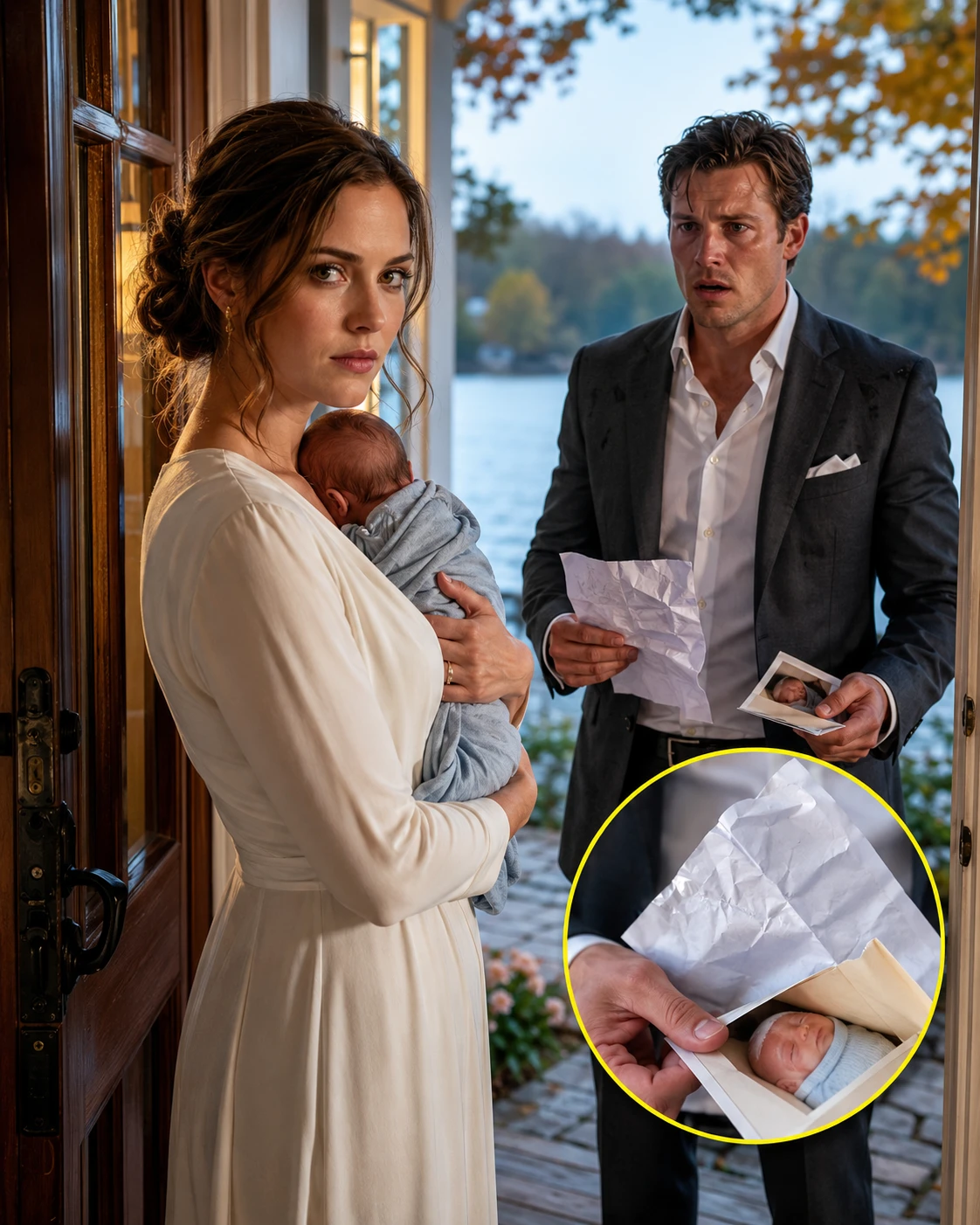
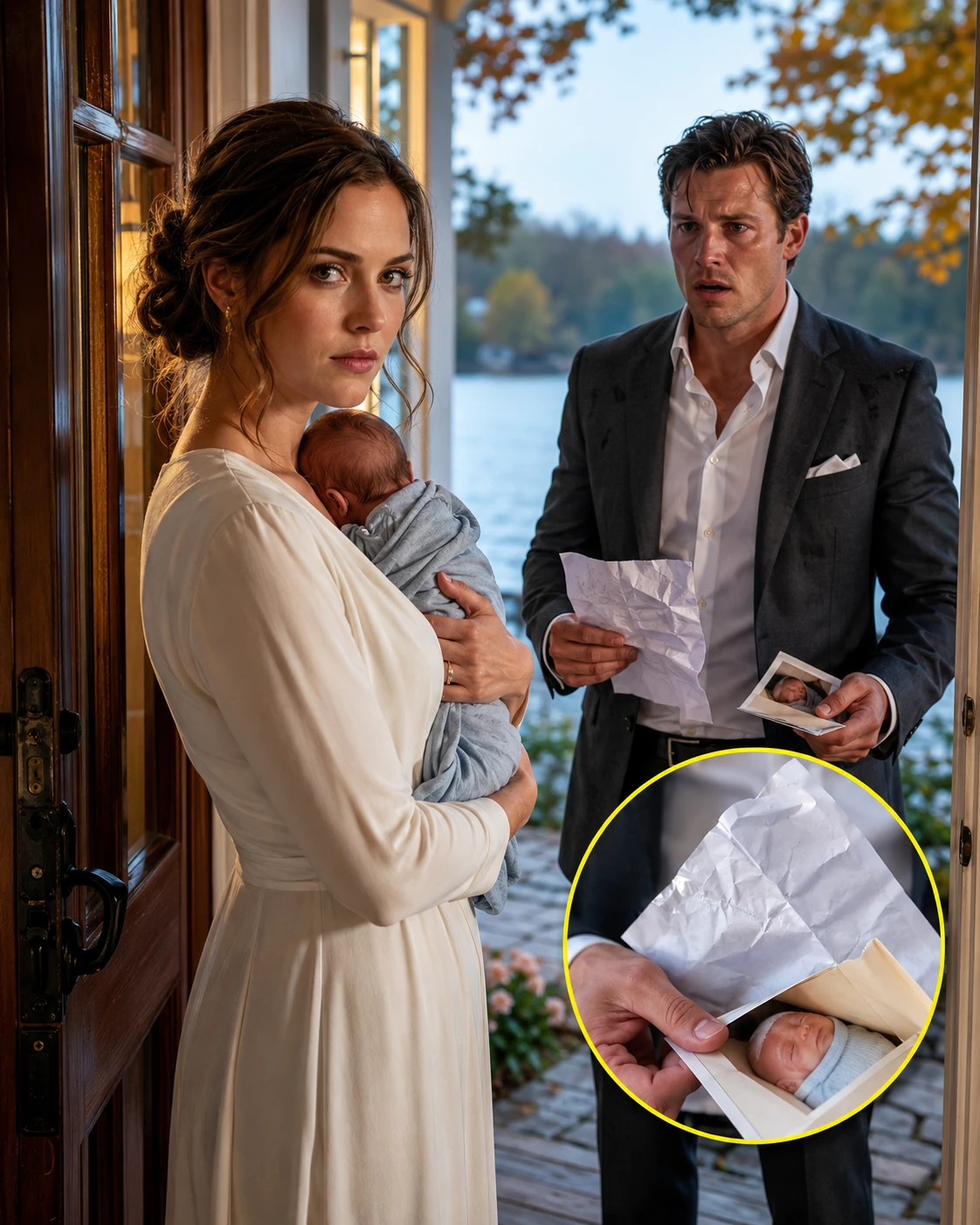
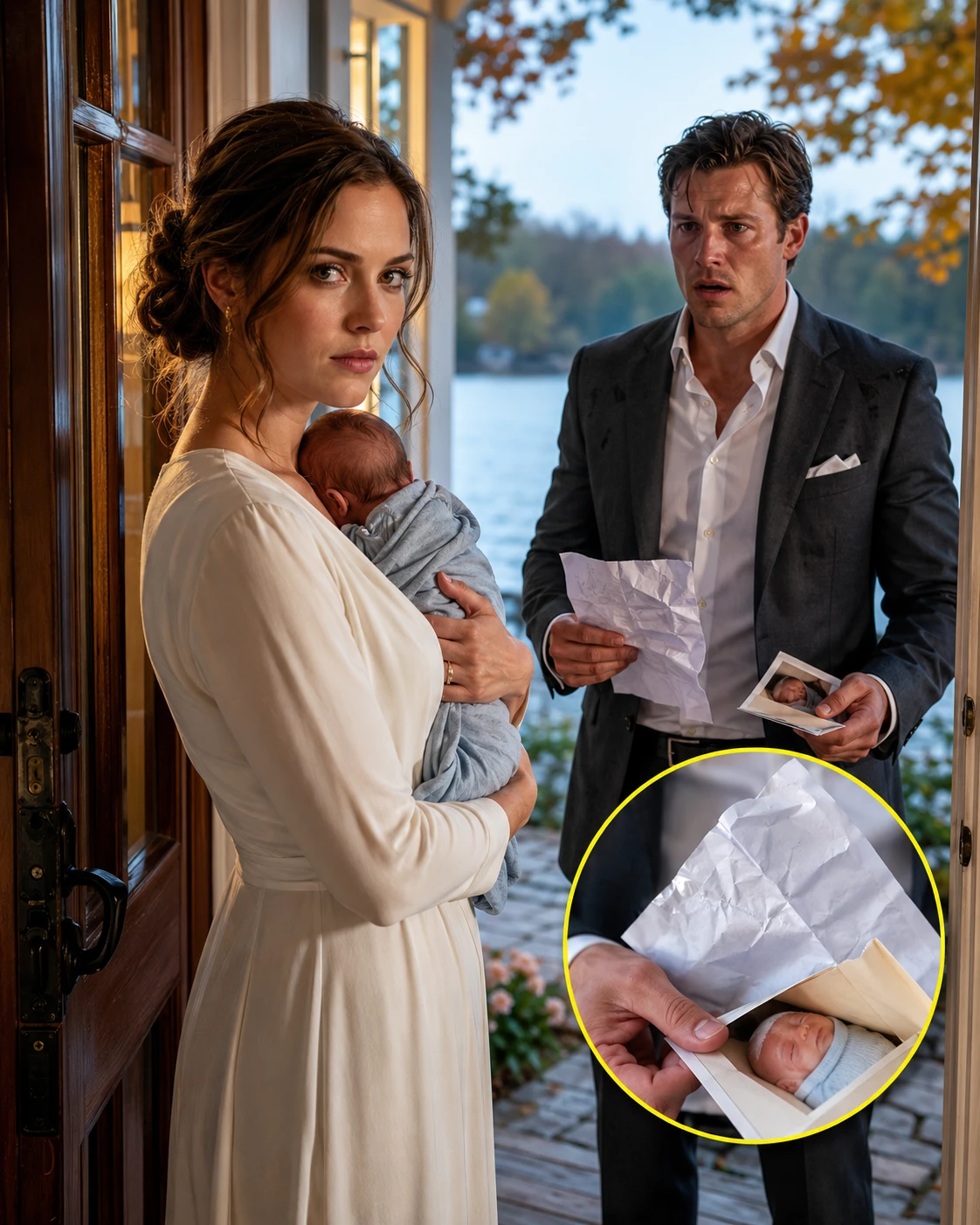
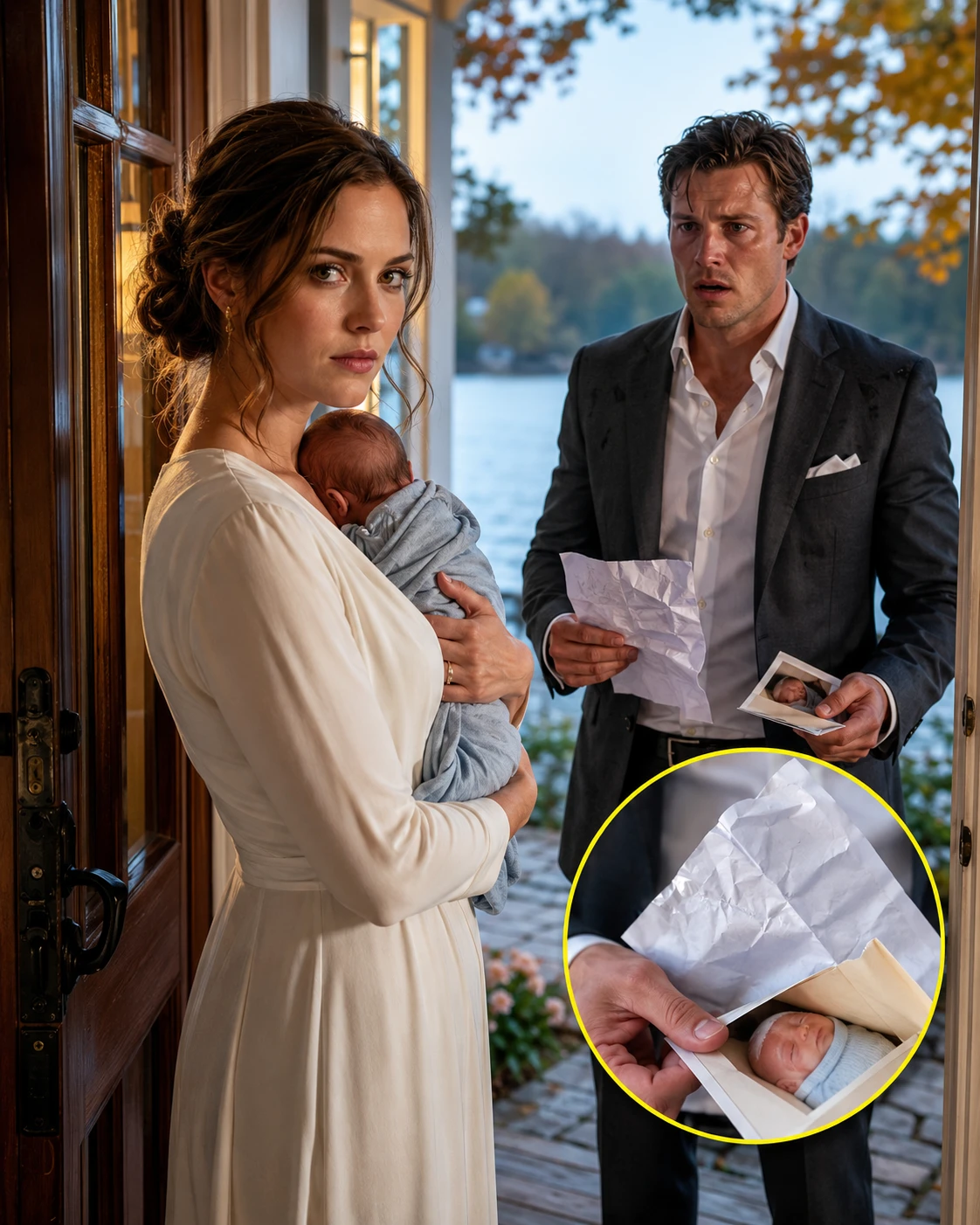
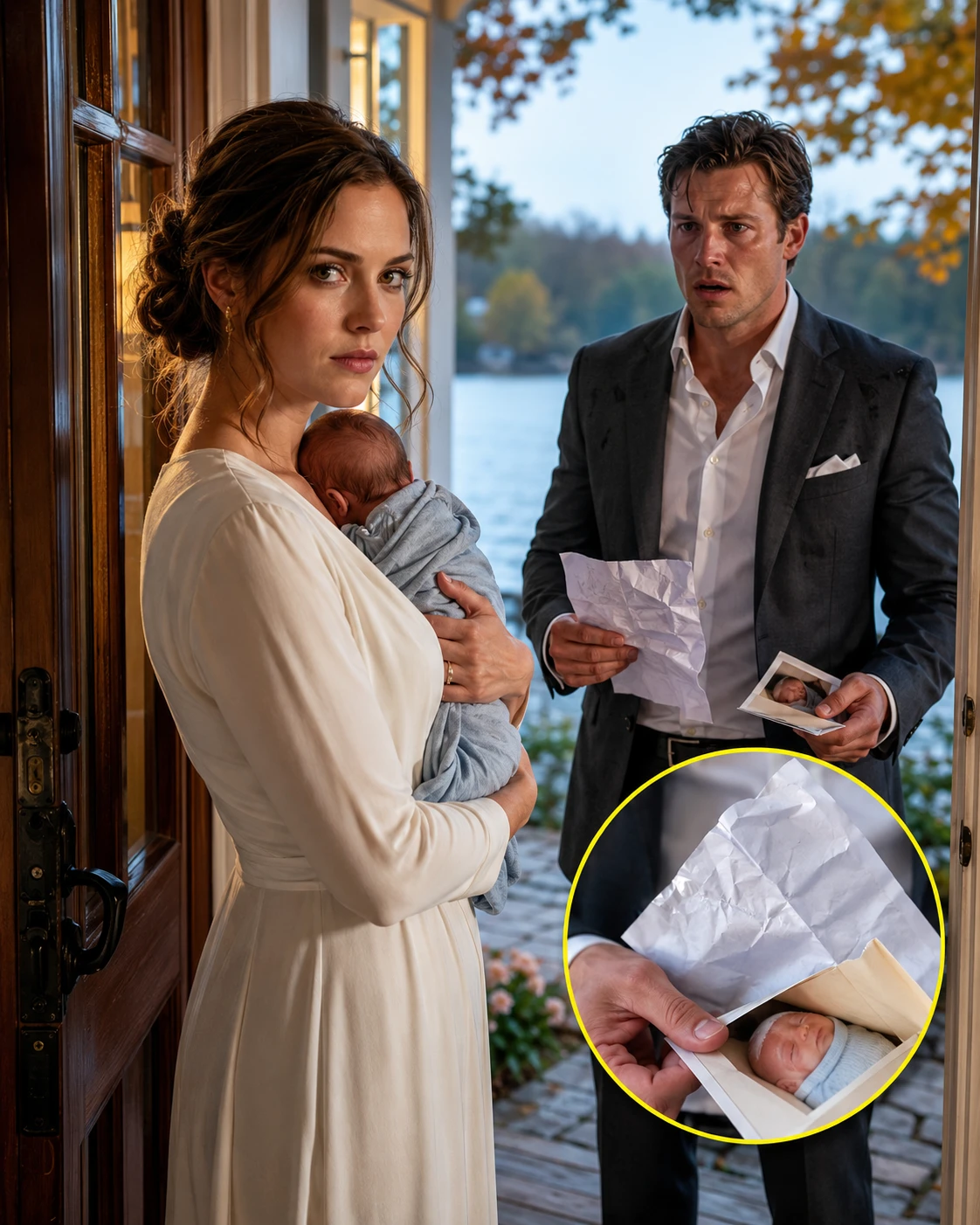
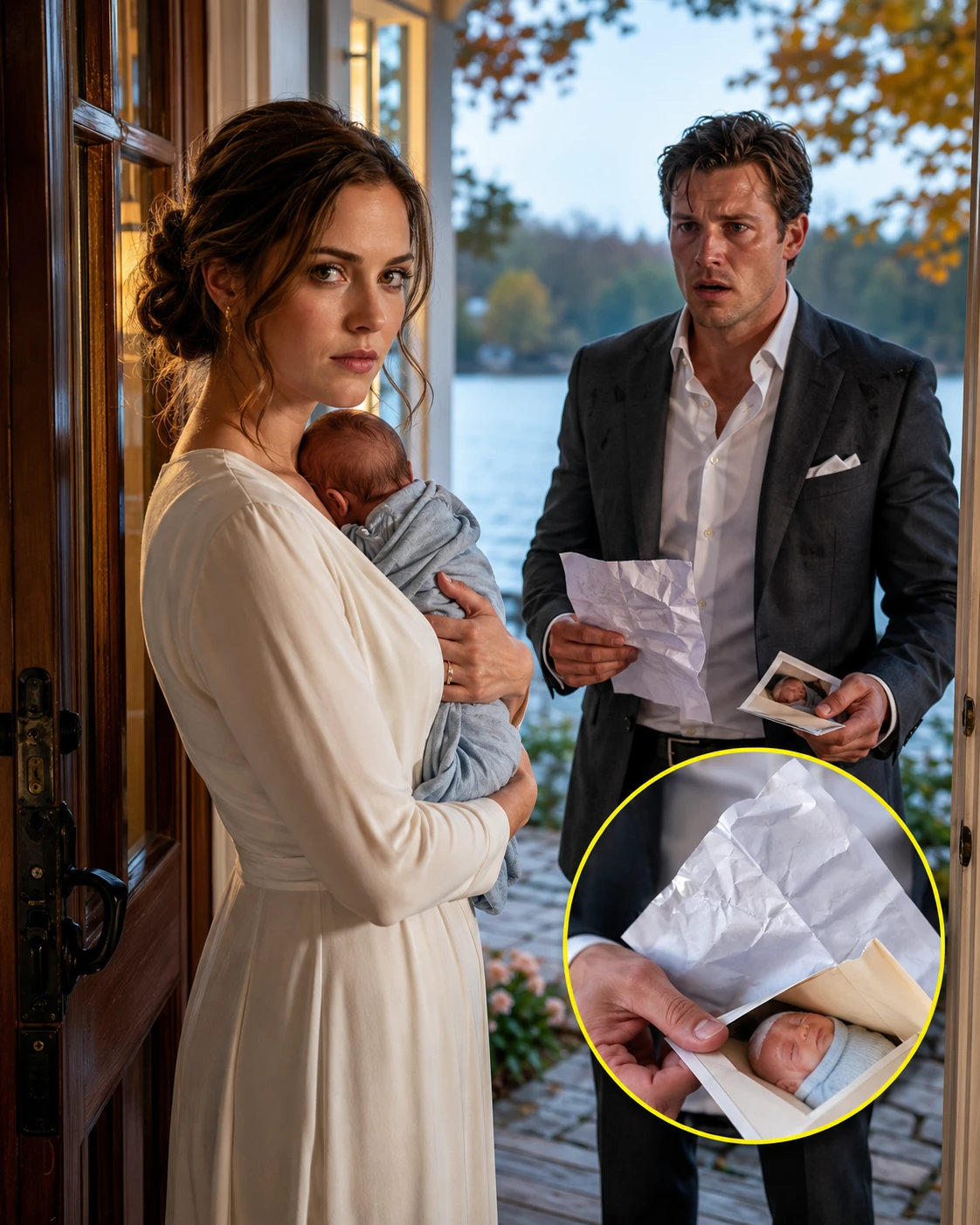
Reid stood on my porch without a coat, despite the September wind blowing off the lake.
His face had lost all color.
In one hand, he held the photograph of Henry. In the other, he clutched the paternity report so tightly that the paper had folded beneath his fingers.
When I opened the door, his anger vanished.
His eyes moved past me.
Henry was sleeping against my chest, his cheek pressed over my heart.
Reid stared at him as though the world had stopped.
“That’s him?” he whispered.
“That is my son.”
His gaze rose sharply.
“Our son.”
The words sounded strange in his mouth.
I stepped outside and pulled the door nearly closed behind me.
“You cannot arrive unannounced and shout outside his room.”
“Why didn’t you tell me?”
“I intended to tell you at the courthouse.”
Pain moved across his face.
“You knew that day?”
“I had received the result that morning.”
“And you said nothing?”
“You told me Marissa was the life you were choosing.”
Reid looked toward the lake.
For several seconds, he seemed unable to speak.
“You should have told me anyway.”
“Perhaps. But do not stand here and pretend my silence was the first betrayal between us.”
He closed his eyes briefly.
“I need another test.”
“I expected you would.”
“I’m not calling you a liar.”
“You came to my home holding a certified report as though it were evidence from a crime scene.”
His jaw tightened.
“I was told I could never father a child.”
The wind seemed to disappear.
“What?”
Reid looked at Henry again.
“Two years ago, I had tests done privately. The results showed complete infertility.”
“Where?”
“At Ashford Reproductive Medicine.”
A cold understanding moved through me.
“When were you going to tell me?”
“I wasn’t.”
“Why?”
“Because you had already been diagnosed. I thought telling you would only add another wound.”
I laughed once, although nothing was funny.
“So we were both told we were incapable of having children.”
“Yes.”
“And yet Henry exists.”
Reid looked down at the report.
“That is why I need to know how.”
“You think I cheated.”
“I don’t know what to think.”
The old Claire—the woman who had spent years softening every difficult truth for him—might have invited him inside and tried to ease his confusion.
That woman no longer existed.
“Your infertility report was probably altered,” I said.
His head lifted.
“My records were altered too.”
I told him about the forensic review, Peter Lang, the false laboratory values, and Julian Cross’s executive authorization.
Reid listened without interrupting.
With every sentence, his expression changed from disbelief to fear.
“Julian would have no reason to alter our medical files.”
“Then find the reason.”
“You are accusing the chief operating officer of a public company of falsifying medical records.”
“I am telling you that someone used his credentials to falsify mine.”
“Why?”
“That is the question you should have asked before accusing me with your eyes.”
Henry made a small sound and moved against my shoulder.
Reid’s entire body softened.
“May I hold him?”
“No.”
The answer seemed to strike him physically.
“Claire—”
“You do not get to walk out of a courthouse with another woman, disappear for nine months, and then enter my home as though fatherhood is a door you can open whenever it suits you.”
“I didn’t know.”
“You made certain you would not know.”
“I was cruel to you.”
“Yes.”
He looked at me directly.
For the first time since the divorce, there was no confidence in his face, no polished public expression, and no trace of the billionaire accustomed to controlling every room he entered.
“I am sorry,” he said.
The apology was too small for the damage, but it was the first honest thing he had given me in a long time.
“I will arrange another paternity test,” I told him. “You may choose the laboratory. Helen will supervise everything.”
“And after that?”
“After that, you will investigate the records.”
“I want to see my son.”
“You will prove that allowing you into his life will not place him in danger.”
“Danger from whom?”
I held his gaze.
“Your family. Your company. Perhaps from you. I do not know yet.”
Reid recoiled.
“I would never harm him.”
“You once promised you would never harm me.”
He had no answer.
The second paternity test confirmed the first.
The third, requested by Reid’s attorneys, confirmed it again.
Henry was unquestionably his biological child.
More disturbing was the independent analysis of Reid’s fertility records.
The laboratory values showed that his original results had been normal.
The diagnosis of complete infertility was fraudulent.
Two weeks after Reid first came to the lake house, he called an emergency meeting of Ashford Genomics’ executive committee.
I attended by video with Helen beside me.
Reid sat at the head of the conference table. Marissa was not present, but his mother, Vivienne Ashford, occupied the chair to his right.
At seventy, Vivienne remained an imposing woman. Her silver hair was always perfectly arranged, and her voice carried the calm authority of someone who had never been required to repeat herself.
Julian Cross sat across from her.
He was broad-shouldered, white-haired, and expressionless.
Reid placed copies of the altered records on the table.
“I want to know who authorized these changes.”
Julian examined the documents.
“These appear to be fabricated.”
“They came from our database.”
“Then someone has attempted to create the impression that my account was involved.”
Vivienne turned toward the screen.
“Claire, I understand congratulations are appropriate.”
Her tone made the words sound like an accusation.
“Thank you.”
“It is unfortunate that you chose to conceal the pregnancy.”
“It is unfortunate that my medical records were falsified.”
Vivienne smiled faintly.
“You have always possessed a gift for drama.”
Reid’s hand struck the table.
“Enough.”
Everyone went silent.
It was the first time I had ever seen him speak to his mother that way.
He looked at Julian.
“I am ordering an external audit of the medical division.”
Julian leaned back.
“That would be extremely damaging. Even the appearance of an investigation could affect investor confidence.”
“Then we should hope there is nothing to find.”
Vivienne folded her hands.
“Reid, perhaps we should discuss the family consequences before making impulsive decisions.”
“What family consequences?”
She looked at me again.
For the first time, I saw something beneath her composure.
Fear.
“Our attorneys have located a provision in Harrison’s estate documents,” she said.
Reid frowned.
“What provision?”
Julian slid a folder across the table.
Reid opened it.
As he read, the muscles in his face tightened.
“What does it say?” I asked.
Helen leaned toward the screen.
Reid did not answer immediately.
Finally, he looked directly at me.
“My father established a continuity trust before his death.”
“I know there was a trust.”
“Not this one.”
Vivienne spoke carefully.
“The provision was designed to protect the company during a generational transfer.”
“From what?” I asked.
“Instability.”
Helen’s expression sharpened.
“Read the operative clause.”
Reid looked down.
“Upon the birth of my first biological child, if the child is born within a lawful marriage or within three hundred days of its dissolution, temporary voting authority over the Ashford Family Trust transfers to an independent maternal trustee.”
The room went completely still.
I stared at him.
“Who is the maternal trustee?”
Reid’s eyes remained fixed on mine.
“The child’s mother.”
Helen sat back slowly.
“What percentage of the company does the trust control?”
No one answered.
“Reid?”
“Forty-two percent of the voting shares.”
My breath caught.
Vivienne’s voice became colder.
“The arrangement was never intended for this situation.”
“You mean it was never intended for me,” I said.
“You and Reid are divorced.”
“Henry was born within three hundred days.”
“The provision can be challenged.”
Helen smiled without warmth.
“You are welcome to try.”
Julian rose from his chair.
“This is absurd. Mrs. Monroe has no experience governing a biotechnology corporation.”
“I spent six years correcting the mistakes your executives ignored,” I said.
“You reviewed charity reports and patient brochures.”
“I identified the reporting discrepancy that saved VitaSure’s federal approval.”
Reid looked at Julian.
“That is true.”
Julian’s eyes hardened.
Reid continued reading.
“There is another requirement. Upon transfer, the trustee must commission an independent audit of all family-controlled medical operations.”
Helen and I exchanged a glance.
Suddenly the altered fertility records made sense.
The child they had said could never exist had triggered an audit they desperately wanted to prevent.
Vivienne stood.
“This meeting is over.”
“No,” Reid said. “It has finally begun.”
The external audit started the following Monday.
As Henry’s mother, I became temporary voting trustee of the family’s controlling block. I could not sell the shares or take profits for myself, but I possessed the authority to suspend officers, preserve records, and appoint investigators.
The first order I signed prevented the deletion of any patient file.
The second suspended Julian Cross’s access to Ashford databases.
The third appointed a former federal prosecutor to lead the investigation.
Reid signed each order beside me.
We sat across from each other in a secure conference room at Ashford Tower, close enough for me to see the exhaustion beneath his eyes.
Outside the windows, Minneapolis stretched beneath us.
“This company was supposed to help people,” Reid said.
“Perhaps parts of it did.”
“My father built it from nothing.”
I thought of my own father.
“Did he?”
Reid looked at me.
Before he could respond, the door opened.
Marissa entered without permission.
She wore large sunglasses and a dark blue coat. For once, no photographers followed her.
Reid stood.
“You should not be here.”
“I know about the audit,” she said.
“How?”
“Your mother called me.”
Reid’s expression hardened.
Marissa removed her sunglasses.
She had been crying.
“I need to speak to Claire.”
“I have nothing to say to you,” I replied.
“You will after you see this.”
She placed a second flash drive on the table.
“What is it?” Reid asked.
Marissa looked at him, and whatever affection had once existed between them was nowhere in her face.
“Proof that our relationship was never an accident.”
Then she turned to me.
“And proof that **your divorce was arranged before Reid ever met me**.”
—
**PART FOUR
THE LIES BENEATH THE ASHFORD NAME**
Marissa sat across from us with both hands wrapped around a glass of water.
Without the professional makeup and practiced smile, she looked younger than she did in photographs. She also looked frightened.
“Julian Cross approached my management team eleven months before the divorce,” she began. “Ashford Genomics wanted a celebrity ambassador.”
“That is common,” Reid said.
“The campaign was only part of the offer.”
She looked at him.
“They wanted me to meet you.”
Reid’s face became unreadable.
“Who is ‘they’?”
“Julian and your mother.”
“That is ridiculous.”
Marissa pushed the flash drive toward him.
“There are emails, payment schedules, travel arrangements, and private reports about your marriage.”
A terrible silence filled the room.
I asked the question Reid could not.
“What kind of reports?”
“Arguments. Medical appointments. Time spent apart. Information about what Reid was unhappy about.”
My stomach turned.
“You studied us.”
“At first, I thought it was ordinary publicity research. Then Julian began telling me what to say to Reid. What subjects to bring up. Which events to attend.”
Reid rose from his chair and walked to the window.
“Did you ever care about me?”
Marissa looked down.
“In the beginning, it was an arrangement. Later, I cared more than I intended.”
“That is not an answer.”
“Yes,” she said. “I cared. But not enough to tell you the truth.”
He turned.
“And the courthouse?”
Her eyes moved to me.
“Julian wanted photographs that made reconciliation impossible.”
“Your comment about the warm-up?” I asked.
Shame crossed her face.
“He gave me several lines. I chose that one.”
“You chose to humiliate me.”
“Yes.”
She did not defend herself, and somehow that made my anger sharper.
“Why are you helping us now?”
Marissa opened her handbag and removed a photograph of a young woman with the same high cheekbones and bright eyes.
“My sister, Lily.”
The picture showed her standing beside a hospital bed.
“She was pregnant three years ago,” Marissa said. “VitaSure reported that her baby had no significant genetic abnormalities. He was born with a metabolic condition that should have been identified immediately.”
Reid slowly returned to the table.
“What happened?”
“He lived eleven days.”
Marissa’s voice broke.
“After Lily demanded answers, the hospital claimed there had been a sample error. She became depressed. A year later, she took her own life.”
“I’m sorry,” I said.
“I believed it was a tragic mistake until I found her case number on Julian’s computer.”
“How did you access his computer?”
“He asked me to retrieve presentation files during a campaign meeting. I saw a folder labeled ‘exception management.’ Lily’s record was inside.”
Marissa looked at Reid.
“The company knew the test had failed. They changed the internal result to protect VitaSure’s accuracy numbers.”
Reid closed his eyes.
Marissa continued.
“When I confronted Julian, he reminded me that I had accepted money and participated in breaking up your marriage. He said no one would believe me.”
“He underestimated you,” I said.
“No. He understood me perfectly. I was ambitious, vain, and willing to hurt a stranger because powerful people made me feel chosen.”
She met my eyes.
“I cannot undo what I did to you. But I can help expose what they did to thousands of families.”
The audit uncovered the first major fraud within forty-eight hours.
For seven years, Ashford Genomics had maintained two sets of VitaSure performance records. The public database showed accuracy rates above ninety-nine percent. The internal database documented thousands of inconclusive, altered, or falsely reported results.
When failures threatened regulatory approval, patients’ records were modified.
The investigation also revealed a smaller, more secret program known as Heritage Management.
It involved medical files belonging to senior executives and members of the Ashford family.
My fertility records were there.
So were Reid’s.
Both had been altered under Julian’s credentials.
But the authorization chain led higher.
To Vivienne Ashford.
When confronted, she denied everything.
“My account was compromised,” she said during a meeting with investigators. “Julian managed medical operations. Any misconduct belongs to him.”
Julian responded through his attorney by accusing Vivienne of directing the entire program.
The alliance that had controlled Ashford Genomics for decades began to fracture.
One rainy evening, Reid arrived at the lake house carrying a small wooden box.
By then, he had been allowed three supervised visits with Henry.
The first time Reid held him, his hands trembled.
Henry opened his gray eyes and stared up at him with solemn curiosity.
Reid began to cry without making a sound.
I watched from across the room, feeling no triumph.
There are moments when seeing another person’s pain does not heal your own. It simply adds another sorrow to the world.
That evening, Reid placed the wooden box on my kitchen table.
“I found this in my father’s private vault.”
Inside were photographs, notebooks, and bundles of letters tied with string.
The first photograph showed Harrison Ashford as a young man standing outside a university laboratory.
Beside him was my father.
Thomas Monroe.
They were smiling, their arms resting across each other’s shoulders.
On the back, someone had written:
**Thomas and Harrison. The beginning.**
“My father told me he founded Ashford Genomics alone,” Reid said.
“My father told me he was a research assistant.”
We opened the notebooks.
Most were written in my father’s precise handwriting. They contained formulas, patient models, and early versions of the genetic-risk algorithm that eventually became the foundation of VitaSure.
At the bottom of several pages appeared a name.
**Monroe Predictive Index.**
The technology that built the Ashford fortune had not been created by Harrison Ashford.
It had been created by my father.
A letter dated four months before Thomas Monroe’s death described a dispute.
Harrison,
I will not approve clinical use until the error rates are disclosed. Julian believes the failures can be removed from the model. They cannot. A family making a medical decision deserves the truth, including the limits of our knowledge.
If you proceed without correcting the data, I will report the project.
Thomas
Another letter, written by Harrison but never mailed, contained only three sentences.
Thomas,
You are right about the data. Vivienne and Julian have already approached investors using the inflated results.
I am afraid the company may now be beyond my control.
Reid lowered the paper.
“My father knew.”
“Yes.”
“He built the company on stolen research and fraudulent results.”
“Or he allowed others to build it.”
“That distinction will not matter to the families who were harmed.”
For the first time, I heard no defensiveness in him.
Only shame.
Beneath the letters lay a sealed envelope bearing my name.
My hands shook as I opened it.
Inside was a key and a note from Harrison.
Claire,
If you are reading this, the trust has transferred and Thomas’s grandchild has opened the final provision.
The company’s true history is stored where our work began.
Forgive me if you can.
Harrison
“Thomas’s grandchild,” Reid repeated.
“Henry.”
The key belonged to a safety-deposit box at a bank near the university where our fathers had worked.
The next morning, Helen, Reid, and I entered the vault together.
The box contained original patent applications, laboratory records, stock certificates, and a video recording dated three weeks before Harrison’s death.
We watched it in a private conference room.
Harrison appeared thinner than I remembered. Illness had hollowed his face, but his voice remained steady.
“Claire,” he began, “the history you were taught is a lie.”
On the screen, he explained that he and Thomas had met as graduate researchers. Thomas developed the predictive model; Harrison secured funding and built the business structure around it.
They planned to become equal partners.
Then Harrison married Vivienne.
Vivienne and Julian pushed the technology toward commercialization before the data was ready. Thomas threatened to report them and dissolve the company.
Two days later, his car went off an icy road.
I stopped the recording.
“My father’s death was an accident.”
Reid said nothing.
Helen placed her hand over mine.
I forced myself to continue.
Harrison’s voice returned.
“I cannot prove that Vivienne or Julian caused the crash. I can prove that Julian’s security team followed Thomas that night. I can also prove that Vivienne ordered the surveillance records destroyed.”
The room blurred through my tears.
After Thomas died, Harrison patented the research under the Ashford name. He justified it by telling himself he was protecting their work.
In reality, he had protected his fortune.
Years later, guilt led him to create a scholarship for me. He followed my education from a distance and eventually arranged my invitation to the museum fundraiser where I met Reid.
I turned to Reid.
“Our meeting was arranged?”
He looked devastated.
“I didn’t know.”
On the screen, Harrison continued.
“I believed that if Claire became part of the Ashford family, Thomas’s legacy would remain with his blood. It was cowardice disguised as kindness.”
My entire marriage shifted beneath me.
The scholarship.
The fundraiser.
My introduction to Reid.
The house, the company, the family I had entered.
All of it had begun with Harrison’s attempt to keep the daughter of the man he betrayed close enough to control.
Then Harrison said something none of us expected.
“Over time, I saw that Claire possessed the judgment neither I nor Reid had shown. She questioned the VitaSure reports. She protected patients when executives preferred silence. I realized that returning Thomas’s legacy to her was not charity. It was justice.”
The video ended.
Helen examined the stock certificates.
Her expression changed.
“These are not ordinary certificates.”
“What are they?” I asked.
“Founders’ shares.”
“How many?”
She counted slowly, then looked at me.
“Fifty-one percent of the original company.”
Reid stood motionless.
“That is impossible. The family trust controls forty-two percent.”
Helen shook her head.
“The family trust controls forty-two percent of the publicly disclosed voting shares. These certificates appear to be held through a dormant entity.”
She read the name.
“Monroe Stewardship Trust.”
My knees weakened.
“I have never heard of it.”
“Harrison transferred the founders’ shares eleven years ago,” Helen said. “Before your marriage.”
Reid stared at the papers.
“Who is the beneficiary?”
Helen turned the final page toward me.
**Claire Elizabeth Monroe.**
The company the world believed belonged to Reid had legally belonged to me for years.
Harrison had hidden the shares because revealing them while Vivienne and Julian controlled the board would have placed me in danger. The birth of Thomas Monroe’s first grandchild activated the trust’s disclosure clause.
Henry had not merely transferred temporary voting authority.
**His birth had revealed that the Ashford empire was built on my father’s stolen work—and that its controlling interest had already been returned to me.**
Reid sat down heavily.
At the courthouse, he had believed he was discarding a wife who no longer fit his future.
In reality, he had walked away from the woman who owned the foundation beneath his billion-dollar throne.
Helen broke the silence.
“We need to act immediately. If Vivienne learns these certificates exist, she will attempt to invalidate or destroy them.”
A security alarm sounded in the corridor.
Then the lights went out.
In the darkness, Reid’s hand closed around my arm.
From outside the locked conference room came the unmistakable sound of metal striking metal.
Someone was trying to enter the vault.
—
**PART FIVE
WHAT HE HAD REALLY GIVEN AWAY**
The emergency lights flickered on.
Helen moved toward the wall phone while Reid pushed a heavy table against the door. The pounding from the corridor stopped as suddenly as it had begun.
For several seconds, no one moved.
Then smoke began to drift beneath the door.
“They are trying to force us out,” Reid said.
The bank’s fire alarm erupted.
A recorded voice instructed everyone to evacuate.
Helen gathered the certificates while I took the video drive and my father’s notebooks. Reid wrapped the documents inside his coat.
“We stay together,” he said.
The hallway outside was hazy but not yet filled with flames. At the far end, a man in a maintenance uniform disappeared through a stairwell door.
Security guards rushed toward us.
The fire was later traced to a storage room containing electrical equipment. Investigators found evidence of deliberate ignition, but the man in the maintenance uniform was never identified.
We did not need to identify him.
Only four people knew we had entered that vault.
One of them was Julian Cross.
By sunset, certified copies of the documents had been delivered to federal investigators, the Securities and Exchange Commission, and three separate law firms.
Vivienne called Reid shortly before midnight.
He placed the phone on speaker.
“You have made a catastrophic mistake,” she said.
“No, Mother. I inherited one.”
“You are allowing a bitter former wife to dismantle your father’s life’s work.”
“Her father’s work.”
Silence.
Then Vivienne spoke more quietly.
“You have no idea what you are doing.”
“I know Thomas Monroe was followed the night he died.”
“You should be careful with accusations.”
“I know Claire’s medical records were altered.”
“I had no involvement.”
“I know you arranged my relationship with Marissa.”
This time, Vivienne did not deny it.
“You were wasting your life in a dead marriage.”
“My marriage was not dead until you poisoned it.”
“You were unhappy.”
“I was weak,” Reid said. “There is a difference.”
I looked at him.
It was the first time he had accepted responsibility without placing part of it on me.
Vivienne’s voice hardened.
“If Claire activates those shares, the company will collapse. Thousands of employees will lose their jobs. Research programs will disappear. Patients will suffer.”
Reid looked at my father’s notebooks on the table.
“Patients have already suffered.”
“You are prepared to destroy your own name?”
“No,” he said. “I am prepared to learn whether there was ever anything honorable behind it.”
He ended the call.
The following morning, Ashford Genomics issued a public notice announcing an emergency shareholder meeting.
The annual company gala, scheduled for that weekend at the Ashford estate, was canceled.
The wedding was canceled too.
Tabloids claimed Marissa had fled after discovering Reid’s secret child. Financial networks reported that the company was facing an internal governance dispute. None of them yet knew the true scale of the investigation.
Vivienne and Julian attempted to remove me through an emergency board vote.
They argued that the Monroe Stewardship Trust was fraudulent, that Harrison had been mentally incompetent, and that I had manipulated him before his death.
Then Marissa released the recordings of Julian arranging her relationship with Reid.
The recordings included something even more damaging.
Julian’s voice could be heard discussing the need to keep Reid childless until Vivienne’s preferred trust revisions were approved.
“If Claire conceives, Harrison’s clause becomes active,” he said. “The medical files must remain consistent.”
Another recording captured Vivienne’s reply.
“Then make certain both of them believe conception is impossible.”
The audio spread across every major network within an hour.
Ashford stock fell thirty-eight percent before trading was suspended.
Federal agents entered Ashford Tower that afternoon.
Julian was arrested while attempting to leave through a private garage with encrypted drives and two passports. Vivienne was escorted from her home the following morning.
She maintained her composure until reporters began asking about Thomas Monroe.
Then, for the first time, the great Vivienne Ashford lowered her head.
The emergency shareholder meeting took place one week later in a crowded auditorium.
Investors, employees, reporters, and attorneys filled every seat.
I stood behind the curtain holding my father’s original notebook.
Henry was safe at the lake house with Dr. Shaw and a security team.
Reid waited beside me.
He wore a dark suit, but he no longer looked like the man from the courthouse photographs. The confidence remained, though it had changed. It was quieter now, stripped of vanity.
“What happens after today?” he asked.
“The company survives if it deserves to.”
“And if it doesn’t?”
“Then we build something better from what remains.”
He nodded.
“I have submitted my resignation.”
I looked at him.
“You do not have to resign before the shareholders vote.”
“Yes, I do.”
“Why?”
“Because whether I knew about the fraud or not, I benefited from it. I ignored warnings because believing the company was good was easier than proving it.”
“That will cost you everything.”
He gave a tired smile.
“I once thought everything meant a company, a house, a name, and the woman standing beside me in photographs.”
His gaze dropped.
“I was wrong.”
The auditorium quieted as we entered.
Reid spoke first.
He did not blame his mother.
He did not blame Julian.
He did not blame his father, Marissa, the board, or the pressures of leadership.
“My name gave me authority I had not earned,” he said. “When questions arose, I accepted convenient answers. When my wife challenged those answers, I treated her judgment as disloyalty. When our marriage became difficult, I chose admiration over honesty.”
He paused.
“**Ignorance is not innocence when a person has the power to seek the truth and chooses not to.**”
Then he announced his resignation.
A murmur moved through the room.
I stepped forward.
I told them about Thomas Monroe.
I showed the original research and Harrison’s recorded confession. I explained the falsified VitaSure results, the altered fertility files, and the continuity trust.
Finally, Helen submitted the founders’ certificates.
The legal counsel confirmed what no one in the room had expected.
Through the Monroe Stewardship Trust, **I controlled fifty-one percent of Ashford Genomics**.
The empire had changed hands before most of its executives knew the rightful owner existed.
A reporter called from the audience.
“Mrs. Monroe, will you rename the company?”
“Yes.”
“Will you remain chief executive?”
“No.”
The room stirred.
Another reporter stood.
“Are you selling your shares?”
“No.”
“What do you intend to do with them?”
I looked toward the employees seated in the rear rows. Some had spent their entire careers believing they were helping families. Others had raised concerns and been silenced. Many feared they would lose their jobs because of crimes committed by executives they had never met.
“My father believed medical information belonged first to the patient,” I said. “He believed uncertainty should be disclosed, not erased for profit.”
I placed my hand on his notebook.
“I am transferring forty percent of my voting interest into an independent patient-and-employee trust. Profits from VitaSure will fund restitution, long-term care, and independent genetic counseling for every family harmed by false results.”
The auditorium fell completely silent.
“The remaining shares will support a nonprofit research institute operating under open-data requirements. No member of the Ashford or Monroe family will be permitted to control clinical reporting.”
The reporter frowned.
“You are giving away control of a multibillion-dollar company?”
“I am returning control to the people who paid the price for it.”
That was the final surprise Harrison Ashford had never anticipated.
He had believed justice meant returning my father’s empire to me.
My father’s last private letter, discovered behind the lining of the safety-deposit box, had taught me otherwise.
Claire,
If our work ever becomes valuable, remember that value is not ownership. A discovery that affects human life carries an obligation greater than any patent.
Do not build a throne from another family’s fear.
Build a table where the truth can be shared.
I read the letter aloud.
By the time I finished, people throughout the auditorium were standing.
Not for me.
For Thomas Monroe.
For the families whose grief had been hidden inside altered databases.
For the employees who had refused to delete records.
For every person who had been told that wealth, beauty, and influence mattered more than truth.
The vote passed with overwhelming support.
Ashford Genomics was renamed the Monroe Center for Ethical Medicine.
The Ashford estate was sold to fund the first restitution payments. VitaSure was removed from hospitals until its data could be independently validated. Several executives were indicted, and congressional hearings began before the end of the year.
Vivienne accepted a plea agreement after prosecutors produced evidence that she had ordered surveillance of my father. Julian was convicted of fraud, obstruction, medical-data tampering, and conspiracy.
The investigation into my father’s crash remained unresolved until Marissa found one final recording hidden among Julian’s files.
In it, Julian spoke to a former security contractor the night before the accident.
“Do not hurt Monroe,” he said. “Frighten him. Make him understand what happens if he speaks.”
The contractor answered, “And if he refuses?”
A pause followed.
Then Vivienne’s voice entered the conversation.
“Thomas has always mistaken conscience for courage. By tomorrow, he will understand the difference.”
Prosecutors could never prove they intended to kill him.
But they proved the surveillance vehicle forced his car off the road.
After thirty-eight years, my father’s death was no longer recorded as an accident.
He had died because he refused to hide the truth.
Marissa testified at every trial.
Her career in fashion ended almost immediately. Sponsors abandoned her, and strangers condemned her for participating in the destruction of my marriage.
She accepted the consequences publicly.
Privately, she began working with families harmed by genetic-testing errors.
One afternoon, nearly a year after the courthouse confrontation, she came to the lake house.
Henry was learning to stand by holding the edge of the sofa.
Marissa remained near the door.
“He looks like Reid,” she said.
“He has Reid’s eyes.”
“And your expression.”
“What expression?”
“The one that suggests everyone else should think carefully before speaking.”
I almost smiled.
She became serious.
“I came to apologize without asking you to forgive me.”
“You already apologized.”
“I explained. That is not always the same thing.”
She looked toward Henry.
“What I said at the courthouse was cruel. I wanted to make myself feel powerful by making you feel small.”
“You succeeded for several minutes.”
“I know.”
“But you also gave investigators the evidence they needed.”
“That does not erase what I did.”
“No.”
We stood in silence.
Then I said, “Atonement is not erasure. It is choosing what you do after you can no longer deny who you were.”
Tears filled her eyes.
“Is that what you told Reid?”
“No. Reid requires shorter sentences.”
This time, we both smiled.
Reid did not ask me to take him back.
Perhaps he understood that some injuries change the shape of love permanently. Regret can make a person wiser, but it cannot always make him welcome in the home he destroyed.
He moved into a modest apartment in Minneapolis and worked as an unpaid adviser to the restitution program. He attended counseling. He testified against his mother and spent months meeting families harmed by VitaSure.
At first, his visits with Henry remained supervised.
Then they became weekly afternoons at the lake house.
Reid learned to warm bottles, change diapers, and walk the floor during teething fits. He stopped bringing expensive toys after Henry showed more interest in the cardboard boxes.
One evening, when Henry was nearly eighteen months old, Reid sat beside him on the porch steps.
Henry reached for his hand.
Reid looked at me across the yard.
The grief in his face was no longer demanding. It did not ask me to relieve it.
“Was there ever a moment,” he said, “when you considered telling me at the courthouse?”
“Yes.”
“If you had told me, would everything have been different?”
I thought carefully.
“You might have left Marissa.”
“I would have.”
“You might have returned home.”
“Yes.”
“But you would have returned because of a child, not because you understood what you had done to me.”
He lowered his eyes.
“That is true.”
“The truth would still have been buried. Your mother and Julian would still have controlled the company. Families would still have been harmed.”
“So losing you exposed all of it.”
“No. Your choices exposed you. Henry exposed them.”
Reid watched our son attempt to place a leaf inside his pocket.
“I loved you,” he said quietly.
“I know.”
“I think part of me still does.”
“I know that too.”
“Is there any future for us?”
I looked at the man I had once expected to grow old beside.
He was not the same man who had stood on the courthouse steps. Humiliation, fatherhood, and truth had stripped away much of his arrogance.
But change did not require me to return.
“For us as husband and wife, no.”
Pain crossed his face, but he accepted the answer.
“For you and Henry,” I continued, “there can be a future if you keep earning it.”
Reid looked toward our son.
“That is more than I deserve.”
“Perhaps. But this is not about what you deserve. It is about what kind of father he deserves.”
The sun lowered over the lake, turning the water gold.
Henry stumbled across the grass and fell against Reid’s knees. Reid lifted him carefully, and our son laughed.
The sound carried through the evening air.
Years earlier, Reid and I had stood in an empty nursery imagining the laughter of children who might never exist.
Now the laughter was real.
It did not fill the grand Ashford mansion.
It filled my father’s small lake house.
It belonged neither to an empire nor to a family name.
It belonged to a child who had entered the world carrying no responsibility for the sins that came before him.
On the courthouse steps, Reid had believed he was choosing a perfect future. He thought he had traded an ordinary wife for beauty, excitement, and freedom.
He had not understood that he was walking away from his son.
He had not known he was abandoning the woman who possessed the legal power to take apart his empire.
He had not realized that the fortune beneath his feet had been built from another man’s stolen work.
But the greatest thing Reid gave away was not the company.
It was the certainty that love would remain available after he had treated it as disposable.
I did not destroy him.
I did not need revenge.
**I simply stopped protecting him from the consequences of the truth.**
And when the truth finally returned nine months later, it arrived not as a threat, a lawsuit, or an act of vengeance.
It arrived inside a white envelope.
It wore my father’s name.
And it had Reid’s gray eyes.
“`