
PART 3
“There is no mistake.”
Silence settled over the room again.
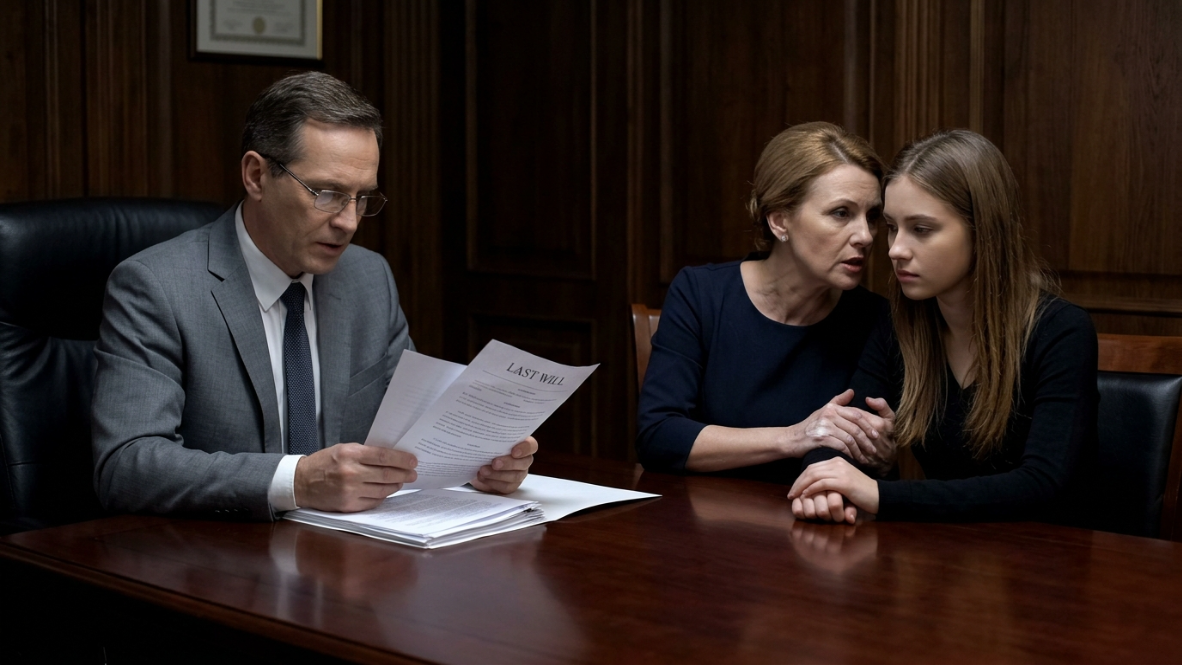
Then Mr. Caldwell began reading.
“If this amendment is being read, then I know my time has come. To whoever sits in this room, I ask only one thing. Listen until the end before making judgments. Truth deserves patience.”
I felt a lump rise in my throat.
That sounded exactly like Nana.
She never rushed anyone.
Not even when they deserved it.
Mr. Caldwell continued.
“To my daughter Margaret…”
My mother straightened.
“…I leave the home, the visible bank accounts, my furniture, and the personal property already described in my previous will.”
Mother exhaled slowly.
“There,” she muttered, almost smugly. “Exactly.”
Mr. Caldwell raised one finger.
“I’m not finished.”
Mother’s smile disappeared.
He continued reading.
“These gifts remain only if every statement made to me concerning my granddaughter Sarah during my final illness was truthful.”
Nobody breathed.
My father looked sharply toward my mother.
Mr. Caldwell continued.
“Should any evidence show that Sarah was intentionally prevented from visiting me through deception, manipulation, or false representations made in my name, every gift listed above shall immediately be revoked.”
The room exploded.
“What?” my mother shouted.
“That’s ridiculous!”
My father stepped forward.
“Revoked?”
Mr. Caldwell nodded once.
“The amendment contains what is legally known as a conditional inheritance.”
Mother slammed her hand on the coffee table.
“She couldn’t do that!”
“She did.”
“I was her daughter!”
“And this was her estate.”
Mother looked ready to scream.
Instead she laughed.
A hard, brittle laugh.
“So what? How would anyone prove something like that?”
Mr. Caldwell looked at me.
Then he slowly reached into his briefcase.
“I was wondering when someone would ask.”
He placed a thick manila envelope onto the table.
“I was instructed to deliver this only after reading the amendment.”
My heart started pounding.
The envelope looked old.
Its corners were worn.
Across the front, in Nana’s neat handwriting, were seven words.
Open only if Margaret challenges the amendment.
Mother stared at it.
“No…”
Her voice cracked.
“No, Mother…”
Mr. Caldwell opened the envelope.
Inside were several smaller envelopes.
Photographs.
Medical documents.
A flash drive.
And a handwritten letter.
My father’s confidence began slipping away.
“What exactly is all this?”
Mr. Caldwell answered quietly.
“Evidence.”
He picked up the handwritten letter first.
“The letter is addressed to me.”
He unfolded it.
“I’ll read exactly what Mrs. Whitaker wrote.”
He began.
“Dear Thomas,
If you are reading this, then my daughter has probably behaved exactly as I feared she would.
Sarah will likely be frightened.
Please tell her she has nothing to fear anymore.”
Tears blurred my vision.
I hadn’t heard anyone call me “my Sarah” since Nana became sick.
Mr. Caldwell continued.
“Several nurses have privately informed me that Sarah has been turned away from my room more than once.”
Mother immediately interrupted.
“They’re lying!”
Mr. Caldwell ignored her.
“I have also learned that my daughter informed hospital staff I no longer wished to see Sarah.”
My father slowly turned toward Mother.
“You said your mother asked for that.”
Mother didn’t answer.
“That statement was false.”
The words echoed through the room.
False.
Mother’s breathing became uneven.
Mr. Caldwell reached for another document.
“This,” he said, “is a sworn statement signed by three members of the nursing staff.”
He passed copies across the table.
I recognized one name immediately.
Nurse Olivia Bennett.
She had smiled at me every morning in the hospital cafeteria.
She had once whispered,
“Don’t give up.”
Back then, I hadn’t understood why.
Now I did.
The statement described everything.
How my mother repeatedly instructed staff not to allow me inside.
How she claimed I upset Nana.
How she insisted Nana became confused whenever I visited.
Then came the sentence that made my father’s eyes widen.
“Patient repeatedly requested to see granddaughter Sarah Whitaker.”
Father looked up.
“You told me your mother didn’t recognize Sarah anymore.”
Mother swallowed.
“I…”
“You told me she couldn’t remember anyone.”
“I was trying to—”
“Trying to what?”
She looked away.
Mr. Caldwell calmly reached for another item.
“The flash drive.”
Father frowned.
“What’s on it?”
Mr. Caldwell looked almost reluctant.
“Security footage.”
My mother’s head snapped upward.
“No.”
“Recorded by St. Catherine’s Medical Center.”
“You can’t have that.”
“I can.”
He placed the flash drive on the table.
“The hospital preserved the footage after receiving Mrs. Whitaker’s written complaint.”
Complaint?
My heart skipped.
Nana had filed a complaint?
Even while dying?
Mr. Caldwell answered the question before I asked it.
“Three days before her death, Mrs. Whitaker dictated a formal statement.”
He held up another document.
“She specifically stated she believed Sarah was being deliberately isolated from her.”
My mother whispered something under her breath.
I couldn’t hear it.
My father could.
“What did you say?”
“I said she was confused.”
“You forged her wishes.”
“I protected her.”
“You lied.”
“I did what had to be done!”
The words burst out before she could stop them.
The room froze.
Even she realized what she’d admitted.
Mr. Caldwell quietly placed the documents back into neat piles.
“I’m afraid we’re only halfway through.”
Mother stared at him in disbelief.
“Halfway?”
“There is considerably more.”
He lifted another sealed envelope.
This one had my name on it.
Sarah.
Only Sarah.
My hands trembled as he handed it to me.
“It was your grandmother’s instruction that only you open this.”
I carefully broke the seal.
Inside was a handwritten letter.
Several folded pages.
The paper smelled faintly of lavender.
The same scent that filled Nana’s linen closet.
I unfolded the first page.
Her handwriting was unmistakable.
Steady.
Graceful.
Familiar.
The tears came before I read the first sentence.
My dearest Sarah,
If you are holding this letter, then you listened to me.
You found the blue velvet box.
I smiled through my tears.
Yes, Nana.
I found it.
There is something I never told anyone except Thomas Caldwell.
Not your parents.
Not your father.
Not even the church ladies who think they know every secret in this county.
Despite everything, I laughed softly.
That sounded exactly like her.
Then my smile disappeared.
The greatest treasure I own was never this house.
It was never my savings.
It was never my jewelry.
It was the truth.
I turned the page.
My breath caught.
Folded inside was another document.
An original property deed.
Not to the little blue cottage.
To somewhere else.
Somewhere I had never heard of.
Attached was a small yellow sticky note in Nana’s handwriting.
Sarah… this is where our real story begins.
For several seconds, I could only stare at the document in my hands.
The paper was older than I was.
Its edges had yellowed with time, and the ink carried the faint smell of old files and cedar drawers. Across the top, embossed in faded gold, were the words:
Warren County, New Jersey – Property Deed
It listed nearly sixty acres.
Sixty.
Not six.
Not half an acre.
Sixty acres.
My mother lunged forward.
“Give me that.”
I instinctively pulled it back.
“It isn’t yours.”
“It belonged to my mother!”
“It belongs to whoever she left it to,” Mr. Caldwell said evenly.
Mother ignored him.
She reached again, but my father caught her wrist.
“Margaret.”
“Let go of me.”
“Not until you calm down.”
“I am calm.”
“No,” he said quietly. “You’re terrified.”
For the first time in their forty-year marriage, I watched my father truly look at his wife—not with trust or habit, but with suspicion.
I looked back at Nana’s letter.
Her handwriting remained steady despite the illness that must have made every word difficult.
Sarah,
If you’re reading this, then Thomas has already shown everyone the amendment. That means your mother finally understands that secrets never stay buried forever.
But she still doesn’t know the biggest one.
I swallowed.
Forty-three years ago, your grandfather and I purchased another property. We never told anyone except our attorney and our accountant.
We bought it before your mother was married.
We kept it because I feared one day greed would become stronger than love inside this family.
A chill ran through me.
She had planned for this…
Decades ago.
Mr. Caldwell smiled sadly.
“Your grandmother was one of the most thoughtful women I’ve ever represented.”
My mother laughed bitterly.
“Thoughtful? She hid property from her own daughter.”
“No,” he corrected gently.
“She protected it.”
Nana’s letter continued.
That land was never intended to make anyone rich.
It was intended to protect someone who needed a second chance.
I prayed every year that I would never have to give it to you.
I hoped your parents would prove me wrong.
I looked across the room.
Neither of them could meet my eyes.
They didn’t.
The room fell silent again.
Then Mr. Caldwell cleared his throat.
“There is one more legal document connected to that property.”
Mother groaned.
“Oh, for heaven’s sake…”
He ignored her.
“The deed was transferred into a family trust twenty-two years ago.”
Father frowned.
“What’s that mean?”
“It means the land was never part of the estate you believed you were inheriting.”
“What?”
“It was legally separated decades ago.”
Mother shook her head violently.
“No…”
“The blue cottage was your mother’s residence.”
“The farmland was not.”
“So who owns it?”
Mr. Caldwell looked directly at me.
“The trust’s sole beneficiary becomes Sarah Whitaker immediately upon Eleanor Whitaker’s death.”
My mother actually staggered backward.
“No.”
She whispered it.
Then louder.
“No!”
She pointed at me with a shaking finger.
“She manipulated my mother.”
“I wasn’t even allowed to see her.”
“You poisoned her against me!”
Mr. Caldwell slowly opened another folder.
“I wondered if you’d make that accusation.”
Mother froze.
Another folder?
How many had Nana prepared?
Inside were photographs.
Hundreds of them.
He spread them across the coffee table.
Photos of Nana.
Photos of me.
Birthday parties.
School concerts.
Pumpkin patches.
Christmas mornings.
Hospital visits from years before.
Every picture had dates written neatly on the back.
My grandmother had documented our relationship for nearly twenty-five years.
“I’ve never seen these,” Mother whispered.
“No,” Mr. Caldwell replied.
“Because your mother asked me to keep them.”
He picked up one photo.
I was six years old.
Covered in flour.
Standing beside Nana while we baked pies.
On the back she had written:
“Sarah laughed for thirty-two straight minutes today. Happiness like this deserves remembering.”
Another.
Age ten.
Fishing.
“She caught the smallest fish and acted like she’d won the Olympics.”
Another.
Age sixteen.
Prom dress.
“She thinks she’s nervous. She has no idea how beautiful kindness looks on her.”
I couldn’t stop crying.
Every moment I’d forgotten…
She had remembered.
Then Mr. Caldwell unfolded the final page of Nana’s letter.
His expression changed.
“This part,” he said softly, “Mrs. Whitaker specifically requested be read aloud.”
He looked at me.
“She wanted everyone to hear it.”
He began reading.
My daughter,
If you’re hearing these words, I imagine you’re angry.
You have every right to be.
But not for the reasons you think.
Mother folded her arms tightly.
I failed you.
That made everyone stop.
Mother blinked.
I raised you to believe appearances mattered more than character.
I corrected your manners.
Your clothes.
Your grades.
Your friends.
I forgot to teach compassion.
Mother’s lip trembled.
That failure belongs to me.
A tear rolled down Mother’s cheek before she quickly wiped it away.
But your choices belong to you.
Nobody moved.
Every time Sarah cried because she thought she wasn’t good enough…
I knew exactly where she had learned that feeling.
Mother closed her eyes.
Every birthday you missed.
Every recital.
Every broken promise.
Every cruel word…
I noticed.
Father slowly sat down.
His face had gone pale.
He hadn’t known.
Not all of it.
Mr. Caldwell continued.
Sarah never asked me for money.
She never asked for gifts.
She only asked for time.
I remembered.
Every Saturday.
Banana bread.
Card games.
Old movies.
Garden work.
Time.
That’s all I had ever wanted.
The next paragraph shattered the room.
Margaret…
Do you remember Sarah’s eighth birthday?
Mother’s eyes flew open.
Of course she remembered.
I did too.
Or at least…
I remembered crying.
I’d waited by the front window wearing a yellow dress Nana had sewn for me.
Mom had promised we’d all go to the zoo.
Instead…
She and Dad left for a charity dinner.
Without me.
They told the babysitter to order pizza.
I cried myself to sleep.
The next morning Nana arrived with balloons.
She never mentioned my parents.
She simply said,
“Looks like today’s a better birthday than yesterday.”
We spent the day feeding ducks instead.
To me…
That became my birthday.
Mr. Caldwell read Nana’s words.
You told Sarah work was more important.
Later you told everyone she had enjoyed her birthday.
Mother buried her face in her hands.
Do you remember when Sarah won first place in the science fair?
Another memory surfaced.
I had searched the audience for my parents.
Two empty seats.
Nana had clapped loud enough for ten people.
Do you remember telling Sarah she embarrassed you by crying?
Mother began sobbing.
“I…”
Her voice broke.
“I didn’t…”
But she had.
I remembered every word.
Father stared at her.
“You told me those events were canceled.”
She couldn’t answer.
“You said Sarah never wanted us there.”
Silence.
Heavy.
Unavoidable.
Finally Father whispered,
“My God…”
He looked at me.
Then back at Mother.
“How much of our daughter’s childhood did I never actually see?”
Mother collapsed into the sofa.
Not dramatically.
Not theatrically.
Just…
Collapsed.
Like someone who had spent years holding up a wall that finally gave way.
Mr. Caldwell carefully folded Nana’s letter.
“I have one last instruction.”
No one spoke.
He looked directly at me.
“Eleanor asked that you and I visit the second property tomorrow morning.”
“Why?”
He smiled.
“Because there’s something there that isn’t listed in any will.”
Mother looked up.
“What now?”
Mr. Caldwell’s smile grew almost wistful.
“Your mother called it…”
He reached into the folder and produced an old brass key attached to a faded blue ribbon.
“…the Promise House.”
He placed the key gently into my hand.
“It has been locked for twenty-one years.”
I stared at the weathered key, my heart racing.
“What is inside?”
Mr. Caldwell looked out the rain-speckled window before answering.
“I’ve been your grandmother’s attorney for thirty-eight years.”
He paused.
“And even I was never allowed inside.”
The room fell into stunned silence as every pair of eyes fixed on the small brass key resting in my trembling palm—the key to a place that had been waiting, untouched, for more than two decades.
PART 4
I barely slept that night.
The brass key sat on my bedside table, catching the moonlight every time I opened my eyes.
Every few hours I reached over just to make sure it was still there.
It felt impossible that something so small could carry the weight of my grandmother’s final promise.
By six-thirty the next morning, I was already dressed.
The sky was pale gray, and the rain had stopped, leaving the roads wet and shining beneath the autumn sun.
At exactly seven o’clock, Mr. Caldwell pulled into my apartment parking lot in his silver sedan.
He stepped out carrying a leather briefcase.
“You ready?” he asked.
I looked at the key in my hand.
“I think so.”
He smiled gently.
“Your grandmother always said courage wasn’t the absence of fear.”
“What did she say it was?”
“Walking anyway.”
I smiled.
“That sounds like Nana.”
“It does.”
We drove nearly an hour northwest through winding country roads.
The towns grew smaller.
Traffic disappeared.
The neat suburban neighborhoods slowly gave way to forests, old farms, and rolling hills painted orange and gold by October leaves.
Mr. Caldwell finally turned onto a gravel road so narrow that tree branches brushed against both sides of the car.
The road ended at an old iron gate.
Across the arch, faded but still readable, were two words:
Whitaker Farm
I stared.
“Nana owned all this?”
“For forty-three years.”
“I’ve never heard of it.”
“Very few people have.”
He unlocked the gate with another key.
The hinges groaned as though they hadn’t moved in years.
Beyond the entrance stretched a long dirt lane lined with enormous maple trees.
Their leaves drifted lazily onto the hood of the car.
At the end of the lane stood an old white farmhouse.
Not abandoned.
Not broken.
Simply…
Waiting.
The porch wrapped around the entire front.
Blue shutters framed every window.
A weather vane turned slowly above the barn.
Even from the driveway, I noticed something unusual.
The grass wasn’t overgrown.
The flower beds were neat.
Someone had been taking care of this place.
“You said nobody came here.”
“I said nobody entered the house.”
He pointed toward the barn.
“A groundskeeper maintained the property.”
“For twenty-one years?”
“He followed very specific instructions.”
An older man emerged from the barn carrying a rake.
He looked to be in his seventies, with weathered hands and a denim jacket patched at both elbows.
The moment he saw me, his eyes filled with tears.
“Well…”
He removed his cap.
“There you are.”
I looked at him in confusion.
“I’m sorry… have we met?”
He smiled.
“Not yet.”
He walked toward us slowly.
“My name’s Henry Collins.”
He held out his hand.
“I’ve been waiting twenty-one years to meet you.”
I blinked.
“Waiting for me?”
He nodded.
“Your grandmother hired me in 2005.”
“To take care of this place?”
“And to wait.”
“For what?”
He smiled.
“For the day a young woman named Sarah arrived carrying a brass key.”
A chill ran through me.
“Nana told you that?”
“Word for word.”
Henry reached into his jacket pocket and pulled out a folded envelope.
“My instructions were simple.”
He handed it to me.
“If Sarah comes alone… give her this.”
I unfolded it carefully.
The familiar handwriting nearly brought fresh tears.
Good morning, Sunshine.
That was what Nana always called me.
Even when I was twenty-five.
Even when I insisted I was too old for nicknames.
If Henry is handing you this letter, then you’ve found your way home.
Home.
Not property.
Not inheritance.
Home.
Henry quietly walked back toward the barn.
“I’ll give you two some privacy.”
I continued reading.
You must have a thousand questions.
I know.
Be patient.
Every room inside this house has an answer.
My heart pounded.
Before you open the front door…
Turn around.
Confused, I lowered the letter and slowly turned.
Behind me stretched the entire valley.
Golden trees.
Open fields.
A small creek winding through the property.
Sunlight breaking through the clouds.
It was breathtaking.
Then I noticed something I had missed.
Near the edge of the hill stood a single wooden bench.
Simple.
Handmade.
Facing the sunrise.
Henry noticed me looking.
“She sat there every Sunday morning.”
“For years?”
He nodded.
“She always brought two cups of coffee.”
I frowned.
“But she came alone.”
Henry smiled softly.
“Not according to her.”
“What do you mean?”
“She always said…”
His voice caught.
“…’One day Sarah will sit beside me. Until then, I’ll save her seat.’”
I covered my mouth.
She had been saving a place for me.
For years.
Mr. Caldwell quietly looked away, giving me a moment.
When I finally composed myself, I walked toward the farmhouse.
The brass key slid smoothly into the old front door.
Click.
The lock opened effortlessly.
Almost as though it had been expecting me.
I pushed the door inward.
The smell hit me first.
Cinnamon.
Old books.
Fresh cedar.
Lavender.
Nana.
It smelled exactly like her.
Sunlight poured through lace curtains.
Dust floated lazily through the air.
Everything looked…
Lived in.
The furniture wasn’t covered.
The clocks still hung on the walls.
Family quilts rested neatly over rocking chairs.
On the dining table sat four place settings.
As though dinner might begin at any moment.
I whispered,
“She kept it ready…”
Henry answered from the doorway.
“She told me never to let it feel abandoned.”
Then I noticed something that made me stop.
Photographs.
Hundreds of them.
Every wall.
Every hallway.
Every shelf.
Pictures of me.
As a baby.
As a child.
As a teenager.
College graduation.
Every birthday.
Every Christmas.
Even photographs I never knew existed.
There were almost none of my parents.
Only me.
And Nana.
I turned to Mr. Caldwell.
“How?”
He smiled sadly.
“Every year, she’d ask friends, teachers, neighbors… anyone who had a picture of you.”
“She collected them?”
“She called this…”
He looked around the room.
“…her Sarah House.”
Tears blurred my vision again.
On the fireplace mantel sat a framed note.
In Nana’s handwriting.
Love leaves evidence.
Three words.
Simple.
Yet they explained the entire house.
Every picture.
Every quilt.
Every memory.
Then Henry cleared his throat.
“There’s one room.”
“What room?”
“The one she never let anyone enter.”
He pointed toward the end of the hallway.
A white door.
Different from all the others.
On it hung a small blue ribbon.
And beneath the ribbon…
A handwritten sign.
For Sarah.
Only Sarah.
My heart began racing as I slowly walked toward it.
I reached for the doorknob.
Behind me, Mr. Caldwell spoke softly.
“Whatever is in that room…”
He paused.
“…your grandmother believed it would change your life.”
I wrapped my trembling fingers around the handle.
Took a slow breath.
And gently pushed the door open…
PART 5
The door opened without a sound.
Sunlight spilled through a large bay window, illuminating a room unlike anything I had imagined.
It wasn’t a vault.
It wasn’t a secret office.
It wasn’t filled with gold or priceless antiques.
It was…
A nursery.
My breath caught.
The walls were painted a soft robin’s-egg blue. White curtains fluttered gently in the breeze from a cracked window. A wooden rocking chair sat beside a small crib, and shelves held children’s books that I instantly recognized.
“The Velveteen Rabbit.”
“Charlotte’s Web.”
“Goodnight Moon.”
Every book Nana had once read to me.
I stepped inside as though afraid the room might disappear if I moved too quickly.
On the crib lay a folded quilt.
I knew it immediately.
I had chosen those fabrics when I was twelve.
“Nana,” I whispered.
“You finished it.”
Henry nodded from the doorway.
“She stitched the last square the week before she went into the hospital.”
I ran my fingers across the quilt.
Every square contained a tiny embroidered date.
Birthdays.
Graduations.
The day I learned to ride a bicycle.
The day I got my driver’s license.
Even the day I graduated from college.
She had sewn my life into a blanket.
Beside the rocking chair stood a cedar chest.
On top rested one final envelope.
This one simply read:
Open when you’re ready to know everything.
I sat in the rocking chair.
The wood creaked softly.
Exactly the way Nana’s chair had at the blue cottage.
I opened the letter.
My dearest Sarah,
If you’ve reached this room, then you’ve already discovered something important.
My greatest inheritance was never money.
It was love.
Love is the only thing that grows larger the more you give it away.
I smiled through my tears.
That sounded exactly like her.
There is something you deserve to know.
This house was never built for me.
I frowned.
It was built for you.
My hands froze.
The year you were born, I dreamed of a place where you would always know you were wanted.
Somewhere no harsh words could follow you.
Somewhere no one could tell you that you weren’t enough.
Somewhere that would always feel like home.
Tears rolled freely now.
She had built this place…
For me.
The next page answered questions I hadn’t even known to ask.
Every month, I set aside money.
Every year, I bought another acre.
Every birthday, I planted another tree.
I looked out the window.
The long row of maple trees lining the driveway…
There were twenty-six of them.
One for every birthday I’d celebrated.
Henry smiled.
“She planted every one herself.”
The final pages revealed another surprise.
Inside the cedar chest weren’t valuables.
There were journals.
Twenty-six journals.
One for every year of my life.
Each labeled with my age.
Age One.
Age Two.
Age Three.
All the way to Twenty-Six.
I opened the first.
Inside, Nana had written about the day I was born.
Today I met my granddaughter.
She wrapped her tiny fingers around mine.
I made her a promise.
As long as I breathe, she will never wonder whether someone loves her.
I cried harder than I had at the funeral.
I spent hours reading.
Every journal contained memories.
The birthdays my parents forgot.
The achievements they never attended.
The heartbreaks Nana somehow sensed without my telling her.
When I was fourteen, she wrote:
Sarah smiled today, but her eyes didn’t.
Children learn to hide sadness far too early.
When I was nineteen:
She apologized three times today for asking for help.
Someone taught this beautiful girl that she is a burden.
I pray one day she unlearns that lie.
When I graduated college:
She walked across that stage looking for her parents.
She never noticed that I stood and clapped before anyone else.
I hope someday she remembers.
I did remember.
Now.
Near the bottom of the cedar chest was one last legal folder.
Mr. Caldwell examined it before handing it to me.
“It wasn’t meant for the will.”
Inside was the trust agreement.
Along with a handwritten note.
One last surprise.
Attached was a statement from the trust’s investment account.
Over forty-three years, Nana had quietly invested part of every paycheck, every dividend, every tax refund, and every profit from selling crops grown on the farm.
She hadn’t lived extravagantly.
She had saved patiently.
The balance at the bottom of the page made me stare in disbelief.
$4,873,216.84
I looked up.
“This…”
Mr. Caldwell smiled.
“She was an excellent investor.”
Henry chuckled.
“And a terrible spender.”
We all laughed through our tears.
Three days later, my parents called.
Again.
And again.
I didn’t answer.
Finally, I agreed to meet them at a quiet coffee shop.
They arrived looking older than they had a week earlier.
Especially my father.
He sat down slowly.
“I owe you an apology.”
He looked directly into my eyes.
“I failed you.”
For a long moment, neither of us spoke.
Then he continued.
“I believed what I wanted to believe.”
“I thought providing money was enough.”
“I didn’t notice what was happening in my own house.”
His voice cracked.
“I’m so sorry.”
I believed he meant it.
Then my mother spoke.
Not defensively.
Not angrily.
Just…
Broken.
“I spent my whole life trying to look perfect.”
She wiped away tears.
“I cared more about what neighbors thought than what my daughter felt.”
She looked at me.
“I don’t expect forgiveness.”
“I only wanted you to know…”
She couldn’t finish.
“I know.”
She nodded.
Silence settled between us.
Finally I reached across the table.
Not because everything was suddenly healed.
It wasn’t.
Some wounds take years.
Some never disappear completely.
But healing has to begin somewhere.
I took her hand.
“I’m willing to see whether we can build something honest.”
She cried harder than before.
Over the following year, things changed slowly.
My father entered counseling.
My mother volunteered at a family support center after admitting how badly appearances had consumed her life.
She never tried to erase what she’d done.
Instead, she accepted responsibility.
She apologized—not once, but many times.
Sometimes healing is dramatic.
Ours wasn’t.
It was quiet.
One honest conversation at a time.
As for the farm…
I kept it.
But not as a private estate.
Remembering Nana’s words—that the greatest inheritance was love—I transformed it into The Eleanor Whitaker Home, a nonprofit retreat for grandparents raising grandchildren, young adults aging out of foster care, and families rebuilding after hardship.
The farmhouse became a place where no child was ever told they were “too much.”
The nursery remained exactly as Nana left it.
Visitors often asked why.
I always smiled.
“Because hope deserves a room of its own.”
Henry became the caretaker.
He refused to retire.
“This place finally has the family she dreamed of,” he said.
“I’d be a fool to leave now.”
On the first anniversary of Nana’s passing, we gathered on the hill overlooking the valley.
Henry.
Mr. Caldwell.
My father.
My mother.
And me.
Each of us carried a cup of coffee.
Just as Nana always had.
We sat on the old wooden bench and watched the sunrise.
No one spoke for several minutes.
Then I noticed there was still one empty space.
The place Nana had always saved for me.
I smiled.
“I think she’d like this.”
Mr. Caldwell looked toward the glowing horizon.
“I don’t think she’d change a thing.”
Before leaving that morning, I walked alone to the row of maple trees.
There were twenty-six.
One for every birthday.
I picked up a small shovel from the barn and dug one more hole at the end of the line.
Henry watched from a distance.
“What are you planting?” he called.
I smiled.
“Birthday number twenty-seven.”
He handed me a young maple sapling.
Together we placed it into the earth.
As I covered the roots with soil, a gentle breeze rustled through the older trees, their golden leaves dancing in the morning light.
For just a moment, I caught the familiar scent of lavender and cinnamon on the wind.
I looked toward the farmhouse.
Toward the blue sky.
Toward the bench where two cups of coffee had once waited.
Then I whispered the words I wished I had said one last time.
“Thank you, Nana.”
The wind stirred the leaves again.
And somehow…
It felt like she had answered.