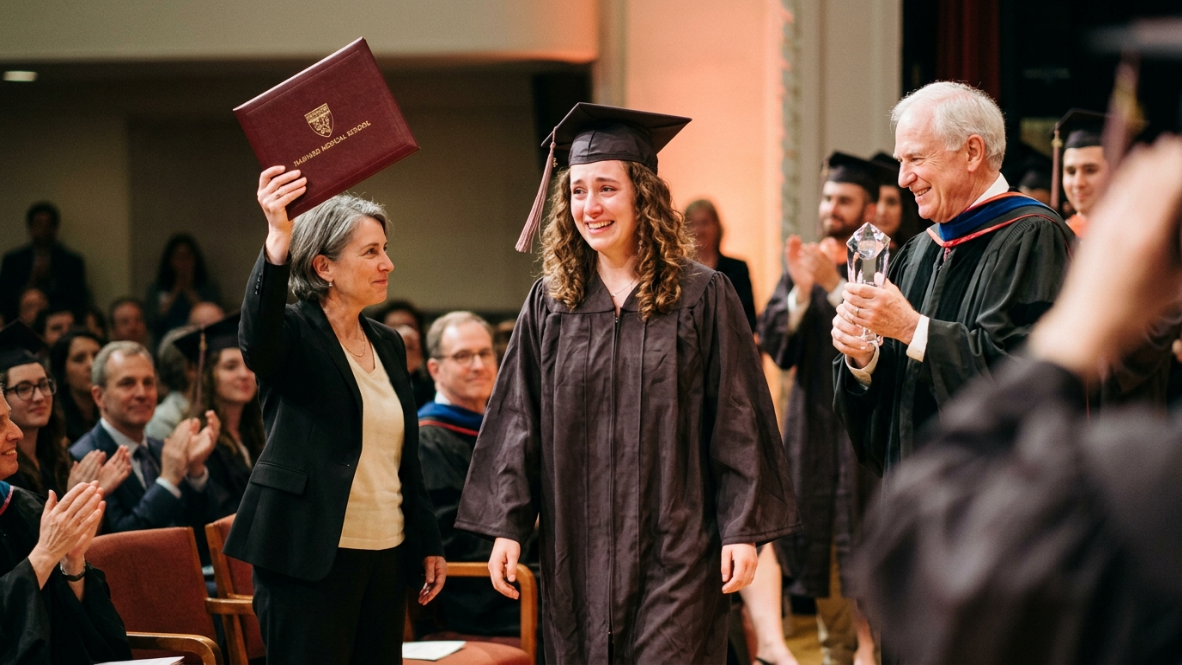
PART 3
Another voice yelled, “Congratulations!”
For a moment I couldn’t hear anything except the pounding of my own heartbeat.
Because this wasn’t just acceptance.
The combined program admitted only a tiny number of students each year.
Years of research.
Medical school.
A fully funded physician-scientist track.
The opportunity to spend a lifetime searching for treatments instead of simply treating diseases after they appeared.
It was everything I had dreamed about since I was fourteen years old.
Everything I had worked toward while serving coffee before sunrise.
Everything I had protected from the people sitting in Row Seven.
Dr. Porter continued.
“Sarah will also receive the President’s Biomedical Innovation Fellowship.”
Another wave of applause.
The dean smiled proudly.
Professor Liang actually wiped away a tear.
Then Dr. Porter said the words that changed the expression on every face in my family.
“The fellowship includes full tuition, research funding, housing assistance, international conference sponsorship, and a living stipend exceeding one hundred thousand dollars over the course of her training.”
Silence.
Not from the audience.
From my family.
My father’s jaw actually trembled.
Marcus stared at me as though someone had switched our lives while he wasn’t looking.
Emma slowly lowered her phone.
My mother whispered something that looked like—
“One hundred…”
She couldn’t even finish the sentence.
Dr. Porter wasn’t finished.
“Sarah was selected after competing against applicants from around the world.”
Another burst of applause.
“Her published research has already attracted attention from multiple institutions.”
The audience applauded again.
I looked at my parents.
They weren’t clapping.
They were calculating.
I knew those expressions.
I’d seen them every Christmas when bonuses came up.
Every tax season.
Every time Marcus needed another loan.
They weren’t hearing my achievement.
They were hearing numbers.
Money.
Prestige.
Status.
Things they understood.
Dr. Porter gently squeezed my shoulder.
“I’ve had the privilege of interviewing hundreds of applicants,” she said.
“Sarah was one of the most determined young scientists I’ve ever met.”
She turned toward the audience.
“During her interview, I asked her how she maintained such outstanding academic performance while working nearly full-time.”
She smiled at me.
“I expected to hear about scholarships.”
The audience chuckled softly.
“Instead, she told me she opened a coffee shop every morning at four-thirty.”
Several people gasped.
“Then attended classes.”
“Worked in a research laboratory.”
“Returned to the coffee shop for evening shifts.”
“And repeated the process six days a week.”
The applause this time wasn’t loud.
It was different.
Warmer.
Respectful.
Dr. Porter looked at me again.
“She never complained.”
“She simply said she had no other choice.”
Professor Liang finally stood.
“I’d like to add something.”
Dean Morrison nodded.
Professor Liang walked slowly to the microphone.
“I have supervised research for twenty-three years.”
“I’ve worked with students whose parents donated buildings.”
“I’ve mentored students who never had to think about rent.”
He paused.
“Sarah often slept in the laboratory.”
The audience became completely still.
“Not because she wanted to.”
“Because taking the last bus home meant losing three hours she needed to finish experiments.”
He looked directly toward Row Seven.
“I once found her studying at two in the morning.”
“I asked why she hadn’t gone home.”
“She told me her apartment’s electricity had been temporarily disconnected because she had chosen to pay tuition first.”
A woman somewhere in the audience quietly covered her mouth.
I had never told him not to mention that.
I had simply hoped nobody would.
Professor Liang continued.
“Later I learned she had been surviving on instant noodles and free crackers from the student center.”
Another silence.
This one heavier.
My father slowly looked at me.
Not proudly.
Confused.
As though he had never considered that my life had continued after I walked out of their house.
Professor Liang wasn’t done.
“The department created an emergency research assistant position.”
“We told Sarah it was because she deserved it.”
He smiled.
“The truth is…”
“We were worried she wasn’t eating enough.”
A nervous laugh rippled through the auditorium.
Professor Liang shook his head.
“She thanked us.”
“Then used her first paycheck to buy additional laboratory supplies.”
The laughter grew louder.
He smiled.
“She actually apologized for spending department money on herself.”
People laughed again.
Even I laughed.
Because it sounded ridiculous now.
At the time it had simply felt normal.
Then Professor Liang’s expression became serious.
“I asked Sarah once why she never spoke about her family.”
Every muscle in my body tightened.
“I’ll never forget her answer.”
He looked at me with unmistakable kindness.
“She said…”
“‘My family already decided who I was years ago.’”
Silence.
“‘I’m waiting until my work gets a vote.’”
Nobody moved.
Nobody spoke.
The words hung in the air like they belonged to someone much older than twenty-two.
Professor Liang stepped away from the microphone.
“I believe her work has voted.”
The audience stood.
Every single person.
A standing ovation.
The sound rolled through the auditorium like thunder.
Except Row Seven.
My family remained seated.
Not because they wanted to.
Because they looked incapable of standing.
The ceremony finished nearly forty minutes later.
Students hugged professors.
Parents cried.
Flowers filled the aisles.
I was halfway through thanking classmates when I heard my mother’s voice.
“Sarah.”
I turned.
She was smiling.
Not warmly.
Carefully.
The smile people wear before asking for something.
“Oh, sweetheart…”
Sweetheart.
Interesting.
She hadn’t called me that since I was twelve.
My father appeared beside her.
Marcus followed.
Emma drifted behind them, looking uncomfortable.
Dad laughed awkwardly.
“Well…”
“I guess you surprised us.”
I nodded politely.
“I suppose I did.”
He reached for the crystal award.
“Let me hold this while we take some family pictures.”
I stepped back before his fingers touched it.
“I’m okay.”
His hand froze.
“You don’t trust me?”
I met his eyes.
“I’ve learned to carry my own accomplishments.”
For a second he looked offended.
Then he laughed as if I had made a joke.
“Come on.”
“Don’t be dramatic.”
Marcus finally spoke.
“So…”
He rubbed the back of his neck.
“Harvard.”
“That’s… impressive.”
It sounded painful for him to say.
“Congratulations.”
“Thank you.”
An awkward silence settled between us.
Then my mother asked the question I had expected from the moment Dr. Porter mentioned the fellowship.
“So…”
She smiled too brightly.
“How much exactly is the stipend?”
There it was.
Not—
How are you feeling?
Are you excited?
We’re proud of you.
Just…
How much?
I answered honestly.
“It varies.”
“But enough to live comfortably.”
Dad’s eyes lit up.
“That’s wonderful.”
He clapped me on the shoulder as though we had always been close.
“We always knew you’d do well.”
I blinked.
Always?
Was this the same man who had leaned toward my mother less than two hours earlier?
The same man who whispered—
“We’re finally done wasting money on this failure.”
I looked directly at him.
“No.”
His smile faltered.
“You didn’t.”
He frowned.
“What?”
“You didn’t always know.”
“You said something before the ceremony.”
His face emptied.
My mother immediately interrupted.
“Oh, honey, everyone says things they don’t mean.”
“I meant every word.”
The sentence landed like ice.
Marcus shifted uncomfortably.
Dad cleared his throat.
“You misunderstood.”
“I didn’t.”
“I heard you.”
“You called me a failure.”
His face reddened.
“I was frustrated.”
“You graduated.”
“That’s what matters.”
“No.”
I shook my head gently.
“What matters…”
“…is that you only changed your mind after strangers told you I was valuable.”
None of them answered.
Because none of them could.
Just then another voice interrupted.
“Sarah!”
I turned.
An older man in a dark gray suit was walking toward us.
Silver hair.
Kind eyes.
Expensive watch.
Professor Liang waved him over.
“There you are.”
The professor smiled.
“I’d like you to meet someone.”
The gentleman extended his hand.
“Daniel Whitmore.”
“I’ve been looking forward to finally meeting you.”
I shook his hand.
“It’s nice to meet you.”
My father stepped slightly closer, sensing importance.
Mr. Whitmore noticed.
Then looked back at me.
“I read your paper three times.”
I smiled.
“I’m honored.”
“No.”
He laughed softly.
“The honor is mine.”
He reached into his jacket and handed me a business card.
“My foundation funds early-stage biomedical research.”
I recognized the name immediately.
The Whitmore Foundation.
One of the largest private medical research organizations in the country.
My pulse skipped.
“We’re opening a new neuroscience institute next year.”
He smiled.
“And after reading your work…”
“…I’d like to discuss building one of our first research teams around you.”
I forgot how to breathe.
Around…
me?
My father’s face went completely white.
Marcus stared at the business card as though it were made of gold.
Mr. Whitmore continued calmly.
“We can discuss details after you’ve settled in Boston.”
“But I’d like you to know…”
He smiled warmly.
“…this is only the beginning.”
And standing just a few feet away, my family finally realized something they had never imagined.
The daughter they had spent years overlooking…
…had just become the person everyone else was trying to find.
For a long moment, no one spoke.
Daniel Whitmore’s words lingered in the air long after he and Professor Liang walked toward another group of faculty members.
I looked down at the business card still resting in my hand.
Simple.
Elegant.
Heavy cardstock.
Just a name.
A phone number.
A promise of a future I had never dared picture.
Behind me, I heard my father clear his throat.
“So…” he said, forcing a laugh that fooled no one. “Looks like you’ve become quite popular.”
I slipped the card into the inside pocket of my gown.
“I’m fortunate to have good mentors.”
Dad nodded too quickly.
“Exactly.”
He looked around as though searching for witnesses.
“We always taught you the value of hard work.”
I looked at him.
Really looked at him.
He wasn’t lying because he believed it.
He was rewriting history because he couldn’t bear to remember it honestly.
“You taught me something,” I said quietly.
His smile returned.
“I knew you’d—”
“You taught me what it feels like to work as if nobody is coming to help.”
His smile disappeared.
People continued filling the lobby.
Graduates posed with parents.
Faculty congratulated students.
Children ran between clusters of balloons.
The entire building buzzed with celebration.
My family stood around me in uncomfortable silence, as though none of them knew who should speak next.
It was Emma who finally broke it.
“I… didn’t know.”
Her voice was almost too quiet to hear.
I turned toward my younger sister.
She was twenty.
Still in college.
Still living at home.
Still trying to earn affection by never disagreeing with our parents.
“I didn’t know you worked that much,” she whispered.
I smiled sadly.
“You never asked.”
Emma looked down at her shoes.
“I guess…”
She swallowed.
“I guess I never did.”
She looked as though she wanted to say more.
Instead, she stepped back.
Marcus, however, moved forward.
He folded his arms across his expensive tailored jacket.
“So Harvard wants you.”
“Yes.”
“And this foundation guy wants you.”
“It sounds that way.”
He laughed once.
A short, bitter sound.
“Funny.”
I waited.
“When I got into Harvard Law, Mom and Dad threw a party.”
“I remember.”
“They invited two hundred people.”
“I remember.”
“They rented the ballroom at the country club.”
“I remember.”
He looked around the crowded lobby.
“You get all this.”
I frowned.
“Marcus…”
“No.”
He shook his head.
“I’ve been trying to figure something out.”
His voice became quieter.
“When did you become smarter than me?”
The question surprised even him.
I could see it.
He hadn’t meant to say it out loud.
I answered honestly.
“I never wanted to be smarter than you.”
He blinked.
“I only wanted someone to notice I existed.”
Something inside Marcus shifted.
For years I had blamed him for everything.
The favoritism.
The comparisons.
The impossible standards.
But standing there, I suddenly realized something.
Marcus hadn’t created the competition.
He had simply been born into the role our parents assigned him.
The golden child.
He had benefited from it.
Absolutely.
But he had also grown addicted to it.
Without being the favorite…
Who was he?
“Sarah!”
A familiar voice called from across the lobby.
I turned.
My manager from Maple Bean Café hurried toward me carrying a bouquet of white lilies.
Linda Foster.
Fifty-nine years old.
Sharp tongue.
Soft heart.
The woman who had hired me four years earlier after I accidentally spilled coffee on a customer during my trial shift.
She hugged me before I could react.
“You did it!”
She was crying.
Actually crying.
“I knew you would.”
I laughed through my own tears.
“Linda…”
“You didn’t tell me Harvard accepted you!”
“I signed confidentiality paperwork.”
She smacked my shoulder lightly.
“You could’ve whispered!”
She handed me the flowers.
“I’m so proud of you.”
Three simple words.
I’m so proud of you.
I had imagined hearing those words from my parents for years.
Instead…
I heard them from the woman who used to sneak extra muffins into my backpack after closing because she knew I skipped dinner.
Dad smiled awkwardly.
“And you are…?”
Linda turned.
Her expression changed instantly.
Professional.
Polite.
“I’m Linda Foster.”
She extended a hand.
“I own Maple Bean Café.”
Dad shook it.
“Oh.”
“The coffee shop.”
Linda nodded.
“The one your daughter practically kept running.”
Dad chuckled.
“She always liked staying busy.”
Linda stared at him.
“No.”
She said it so calmly the word felt heavier.
“She stayed busy because she needed rent.”
Dad’s smile faded.
Linda continued.
“She worked opening shifts.”
“Closing shifts.”
“Covered holidays.”
“Took double shifts during finals.”
She looked him directly in the eyes.
“One Christmas Eve she worked fourteen hours.”
Dad frowned.
“I don’t remember that.”
Linda’s expression didn’t change.
“She told me you said she wasn’t welcome unless she brought gifts for everyone.”
Silence.
Complete silence.
Even Emma looked shocked.
Mom immediately stepped forward.
“That’s not what happened.”
Linda crossed her arms.
“It isn’t?”
Mom hesitated.
Linda continued.
“Sarah sat in my office and cried because she couldn’t afford presents.”
“I told her family wouldn’t care.”
Linda looked at my parents.
“I’ve regretted saying that ever since.”
Nobody answered.
Because nobody could.
An hour later, the lobby had nearly emptied.
Graduates drifted toward restaurants and parties.
I was gathering my things when Dad cleared his throat.
“So…”
He rubbed his hands together.
“Since we’re all here…”
He smiled.
“Why don’t we celebrate?”
I blinked.
“You already have dinner reservations.”
Mom laughed nervously.
“Oh, we’ll cancel those.”
“For me?”
“Of course.”
I tilted my head.
“Interesting.”
“What?”
“You didn’t invite me this morning.”
Mom looked embarrassed.
“Well…”
“We assumed…”
“You assumed I wasn’t worth celebrating.”
She looked away.
“No.”
“You just graduated.”
“I graduated today.”
“I’ve been working toward Harvard for four years.”
Silence.
Dad tried another approach.
“People make mistakes.”
“I agree.”
He smiled hopefully.
“So let’s move forward.”
I nodded.
“I already have.”
His face fell.
“What does that mean?”
“It means I have plans.”
“What plans?”
“I have dinner.”
“With who?”
I smiled.
“The people who were proud of me before they knew my name would be worth something.”
At that exact moment, Professor Liang appeared again.
Alongside him were Dr. Porter…
Linda…
Three of my lab partners…
And half a dozen professors from the biology department.
Professor Liang grinned.
“Our reservation is in twenty minutes.”
“You ready?”
I smiled.
“I am.”
As I started walking toward them, Dad called after me.
“Sarah.”
I stopped but didn’t turn around.
“I…”
His voice cracked.
“I’m proud of you.”
The words should have healed something.
Instead…
They arrived years too late.
Without looking back, I answered quietly.
“I hope someday you’re proud of the daughter you actually had.”
Then I walked away.
Dinner lasted nearly four hours.
For the first time in my life, I sat at a table where nobody interrupted when I spoke.
Nobody rolled their eyes at science.
Nobody changed the subject whenever my accomplishments came up.
Instead…
People asked questions.
Real questions.
“What inspired your research?”
“What do you hope to discover?”
“What disease would you most like to help cure?”
I talked until my voice became hoarse.
I laughed until my cheeks hurt.
When dessert arrived, Professor Liang stood and tapped his glass.
“I’d like to make a toast.”
Everyone quieted.
“I’ve taught thousands of students.”
He looked at me.
“Only a handful have changed how I think about resilience.”
He raised his glass.
“To Sarah.”
“May the world never mistake quiet strength for weakness again.”
Everyone lifted their glasses.
I blinked rapidly, trying not to cry.
Across the table, Dr. Porter smiled knowingly.
“You realize your life is about to become very busy.”
I laughed.
“I’ve been busy for years.”
She laughed too.
“Fair point.”
Then her expression became serious.
“One more thing.”
She reached into her briefcase.
“I wasn’t planning to give you this until next week.”
She slid a sealed envelope across the table.
The Harvard crest gleamed in gold.
“What is it?”
“Open it.”
I carefully broke the seal.
Inside was another letter.
Not an acceptance.
Something else.
As I read the first paragraph, my hands began to shake.
Professor Liang smiled.
“Well?”
I looked up in complete disbelief.
“I…”
I couldn’t finish.
Dr. Porter leaned back in her chair.
“It seems Boston has decided they don’t want to wait for you to become famous.”
Everyone leaned closer.
I looked down at the letter one more time.
Then whispered,
“They’ve named an entire research laboratory after the project I proposed…”
The table erupted.
But hidden in the second page of the letter…
…was a name I hadn’t expected to see.
A donor whose identity had been kept confidential for six months.
Someone who had quietly invested millions into my research before ever meeting me.
And when I finally read the signature at the bottom…
My heart stopped.
PART 4
My fingers tightened around the letter until the paper trembled.
The room around me faded.
Professor Liang was saying something.
Dr. Porter leaned forward.
Someone laughed at the other end of the table.
But I heard none of it.
My eyes remained fixed on the signature.
Edward Whitmore.
I looked up at Daniel Whitmore, who was sitting across from me with the calm expression of someone who had been expecting this moment.
“You…” I whispered.
He smiled apologetically.
“I suppose introductions were a little incomplete.”
Professor Liang chuckled.
“I told him you’d figure it out eventually.”
I looked back at the signature.
Edward Whitmore.
Founder of the Whitmore Foundation.
One of the most respected biomedical philanthropists in the country.
The man whose donations had built children’s hospitals, funded cancer institutes, and created scholarships for thousands of students.
The same man who had personally funded the research proposal I had submitted months earlier under a blind review process.
I swallowed hard.
“You knew it was mine?”
He nodded.
“Not at first.”
“The proposals were anonymous.”
“So…”
He folded his hands together.
“I chose yours because it was the strongest.”
Dr. Porter smiled.
“Three reviewers ranked it first.”
Daniel nodded.
“When your identity was finally revealed…”
He looked at me carefully.
“…I requested every paper you had ever written.”
I blinked.
“You read all of them?”
“Twice.”
My face flushed.
“They weren’t perfect.”
“No.”
He smiled.
“They were honest.”
The waiter quietly refilled everyone’s water glasses before slipping away.
Daniel continued.
“Most young researchers write to impress.”
“You wrote to solve a problem.”
He paused.
“That difference matters.”
I looked down.
For years, I had assumed my work wasn’t enough.
There was always another smarter student.
Another better-funded lab.
Another university with better equipment.
Another researcher with famous parents or prestigious connections.
I had convinced myself I survived only because I worked harder.
But sitting across from one of the most influential figures in medical research, I realized something.
People had noticed.
Long before today.